Nicolaie Constantinescu, kosson@gmail.com
National Open Access Desk, Romania
Information Architect, kosson.ro
European Research through OpenAIRE
and Zenodo
www.kosson.ro
A Innovation Union
Realising the European Research
Area
2
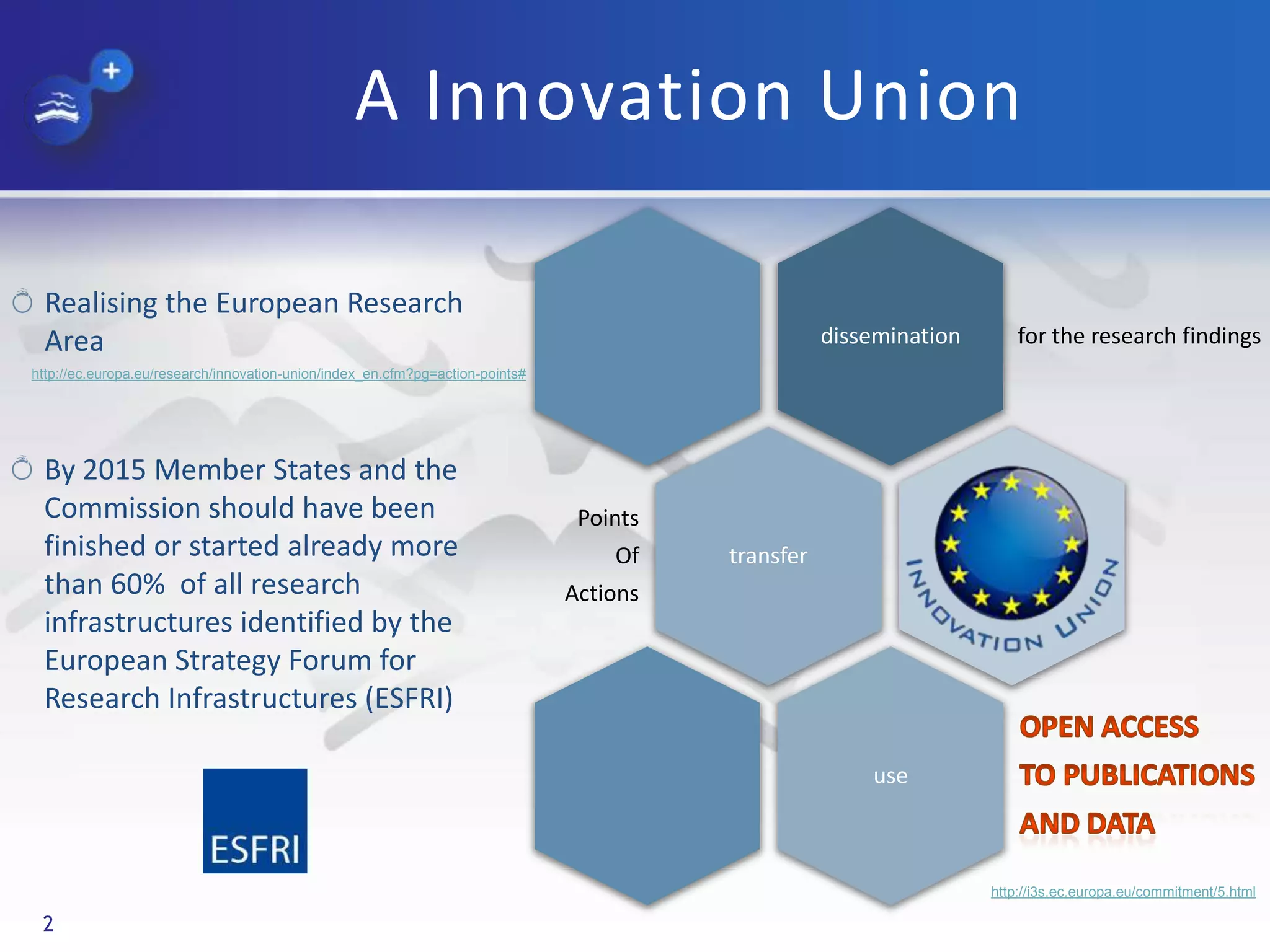
dissemination for the research findings
transfer
Points
Of
Actions
use
http://ec.europa.eu/research/innovation-union/index_en.cfm?pg=action-points#
http://i3s.ec.europa.eu/commitment/5.html
By 2015 Member States and the
Commission should have been
finished or started already more
than 60% of all research
infrastructures identified by the
European Strategy Forum for
Research Infrastructures (ESFRI)
an increasingly important forum to advise
ministries and funding agencies
What are research infrastructures?
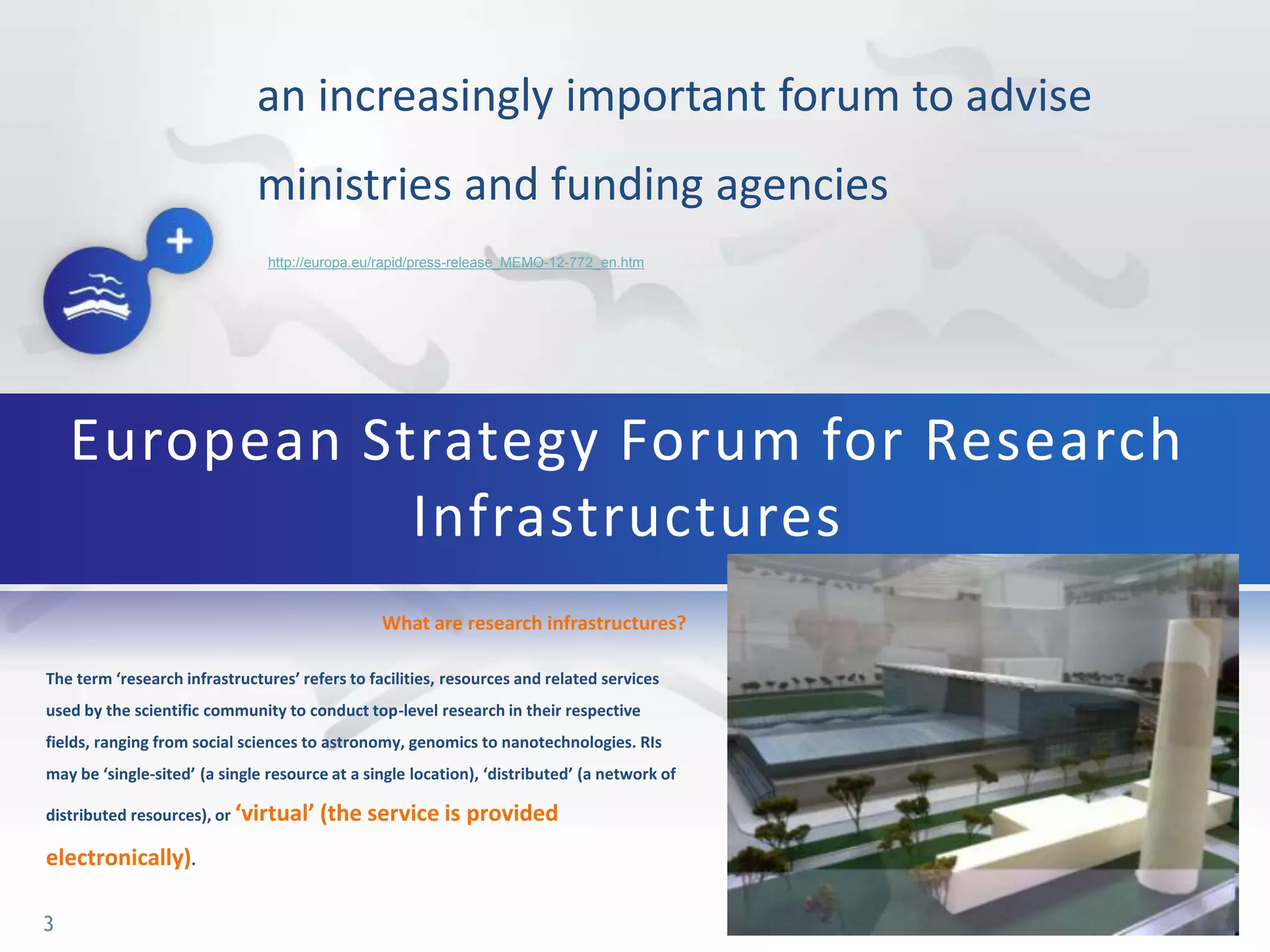
The term ‘research infrastructures’ refers to facilities, resources and related services
used by the scientific community to conduct top-level research in their respective
fields, ranging from social sciences to astronomy, genomics to nanotechnologies. RIs
may be ‘single-sited’ (a single resource at a single location), ‘distributed’ (a network of
distributed resources), or ‘virtual’ (the service is provided
electronically).
European Strategy Forum for Research
Infrastructures
3
http://europa.eu/rapid/press-release_MEMO-12-772_en.htm
Horizon 2020
http://ec.europa.eu/research/horizon2020/index_en.cfm
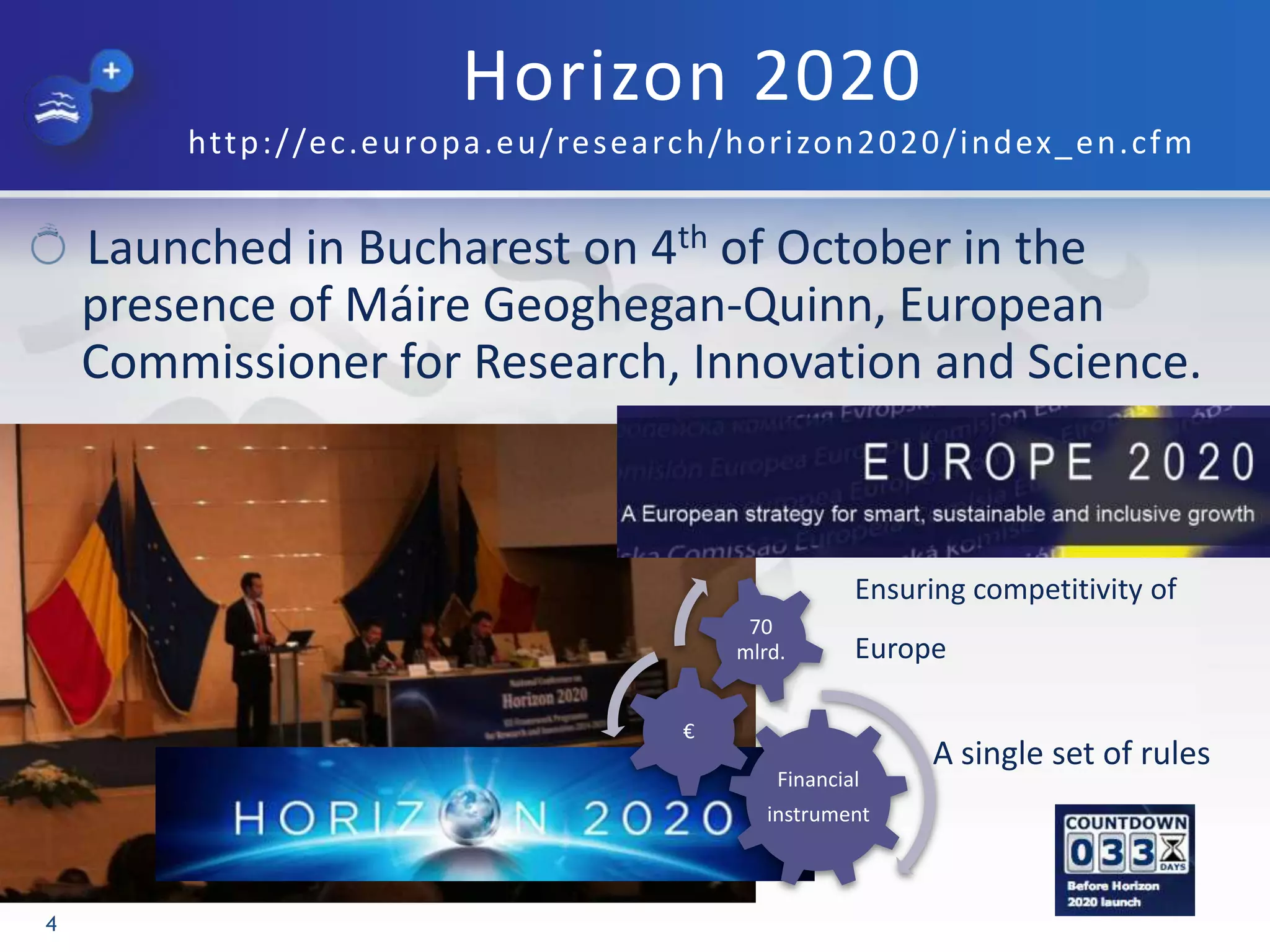
Launched in Bucharest on 4th of October in the
presence of Máire Geoghegan-Quinn, European
Commissioner for Research, Innovation and Science.
4
Financial
instrument
€
70
mlrd.
Ensuring competitivity of
Europe
A single set of rules
Open Access – What is it?
within the context of EU-funded projects, refers
to the practice of providing on-line access to
scientific information that is free of charge to the
end-user and is reusable. In the context of
research and innovation, scientific information
can refer to (i) peer-reviewed scientific research
articles (published in scholarly journals) or (ii)
research data (data underlying publications,
curated data and/or raw data).
Universitatea de Vest, Timișoara, 20145
http://www.iprhelpdesk.eu/node/1960
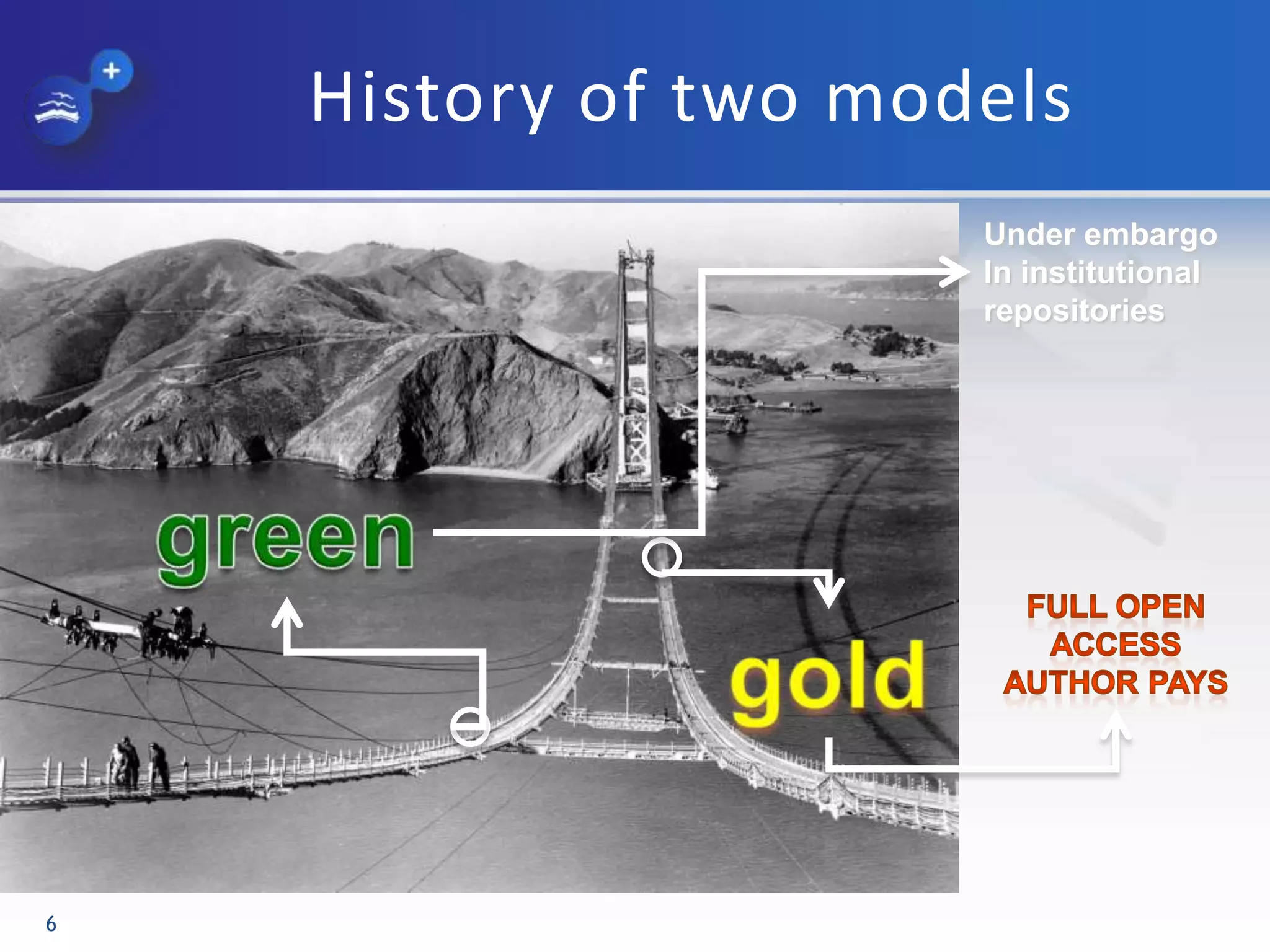
History of two models
6
Under embargo
In institutional
repositories
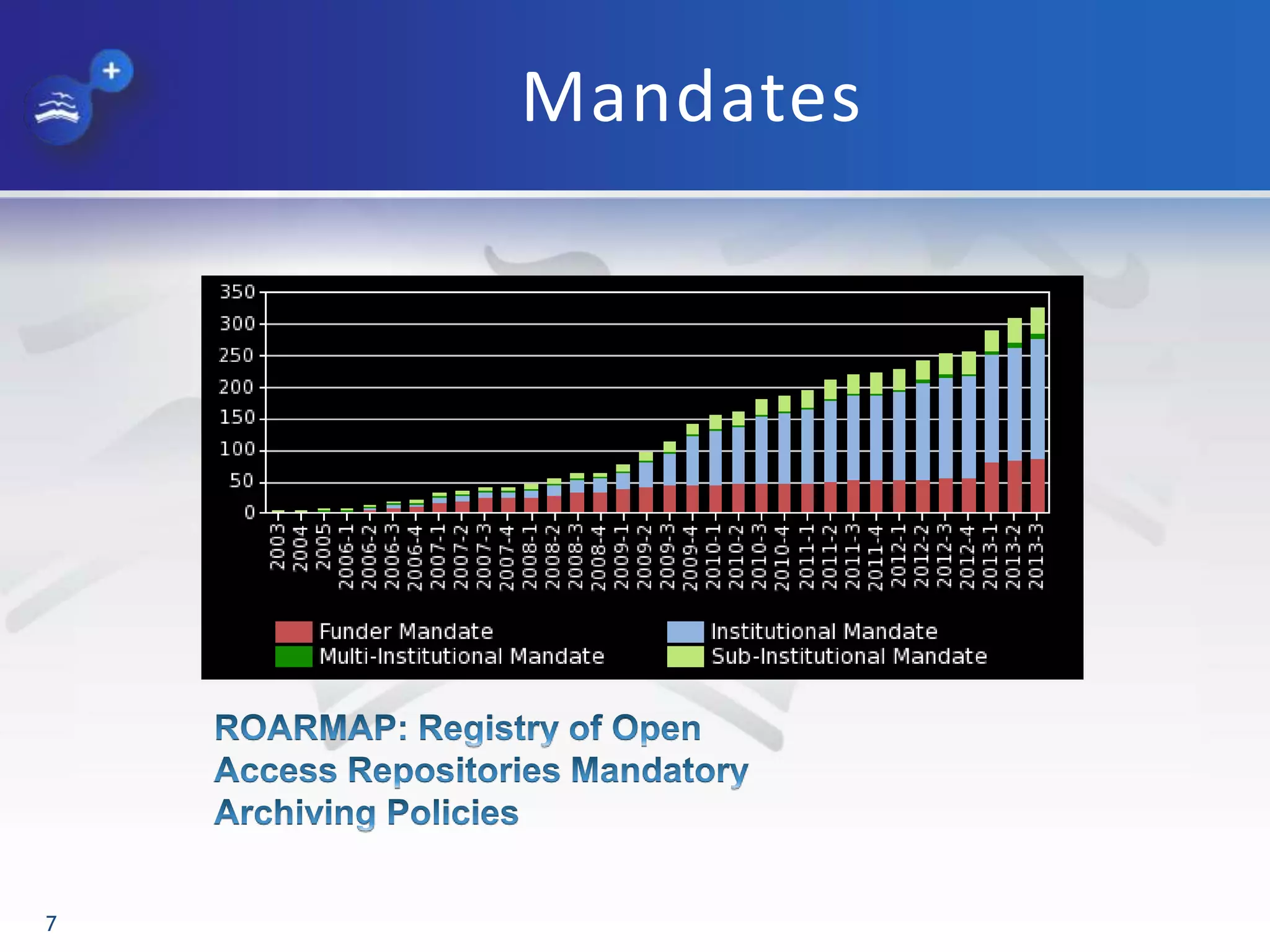
Mandates
7
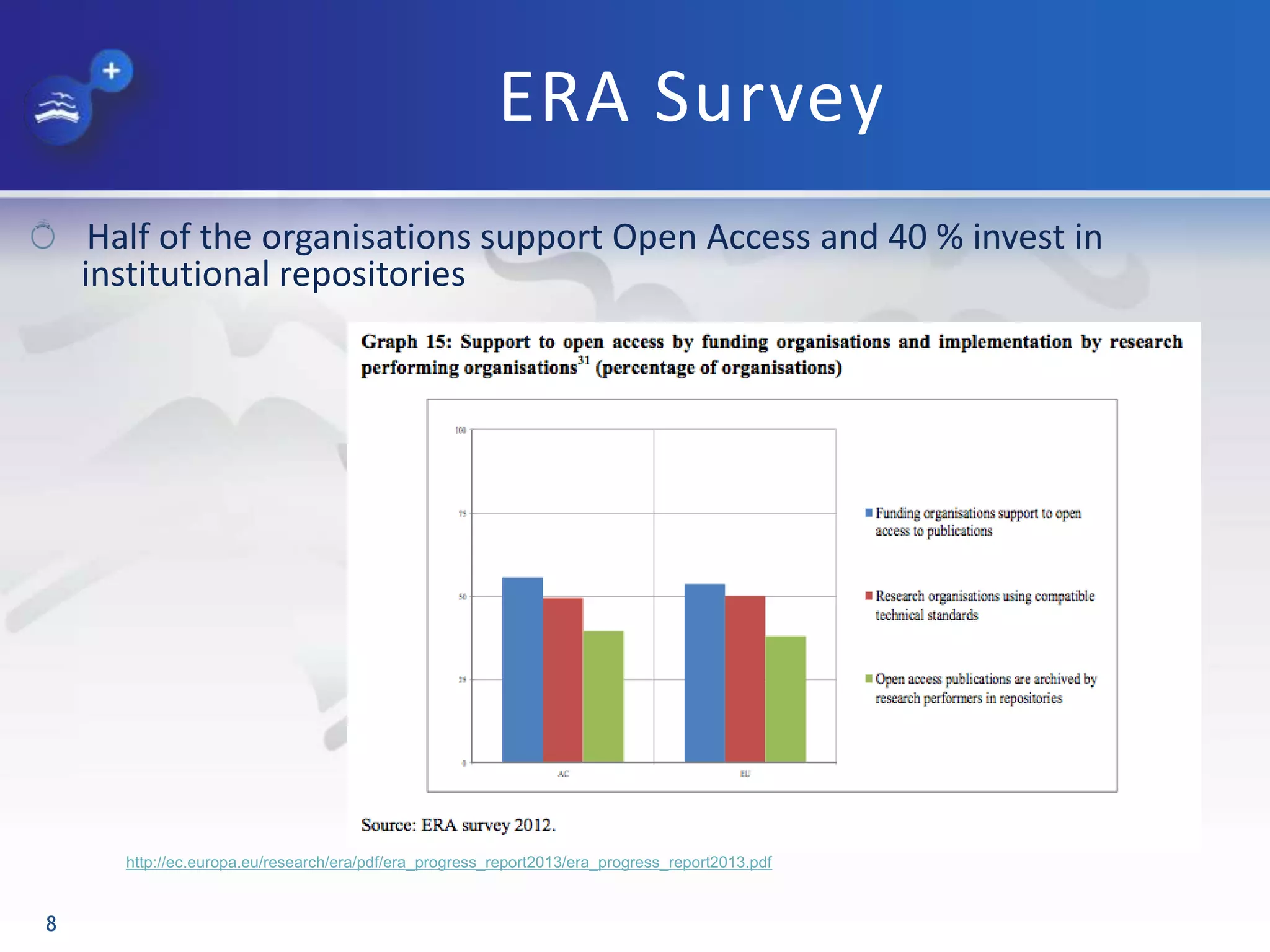
ERA Survey
Half of the organisations support Open Access and 40 % invest in
institutional repositories
8
http://ec.europa.eu/research/era/pdf/era_progress_report2013/era_progress_report2013.pdf
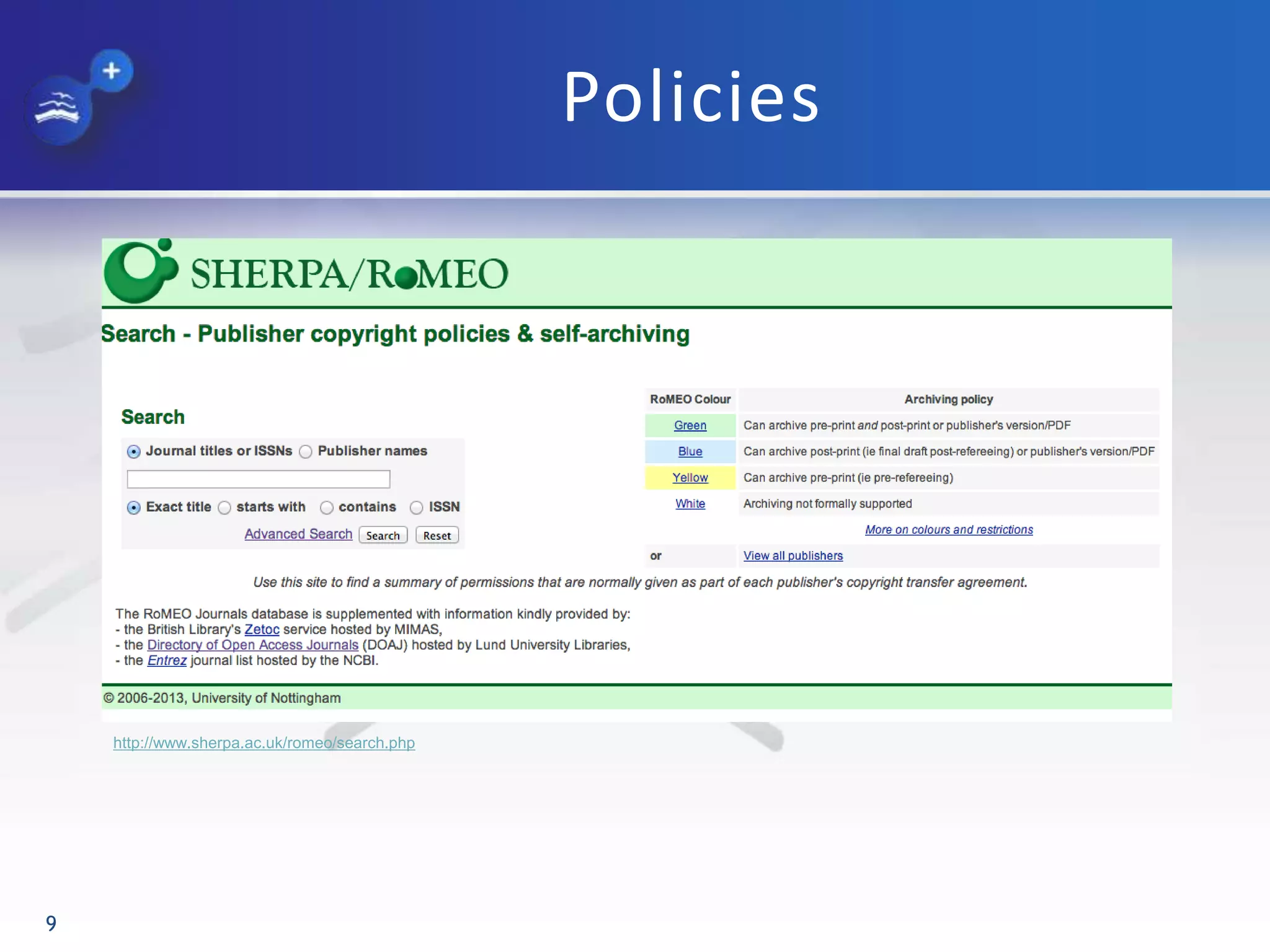
Policies
9
http://www.sherpa.ac.uk/romeo/search.php
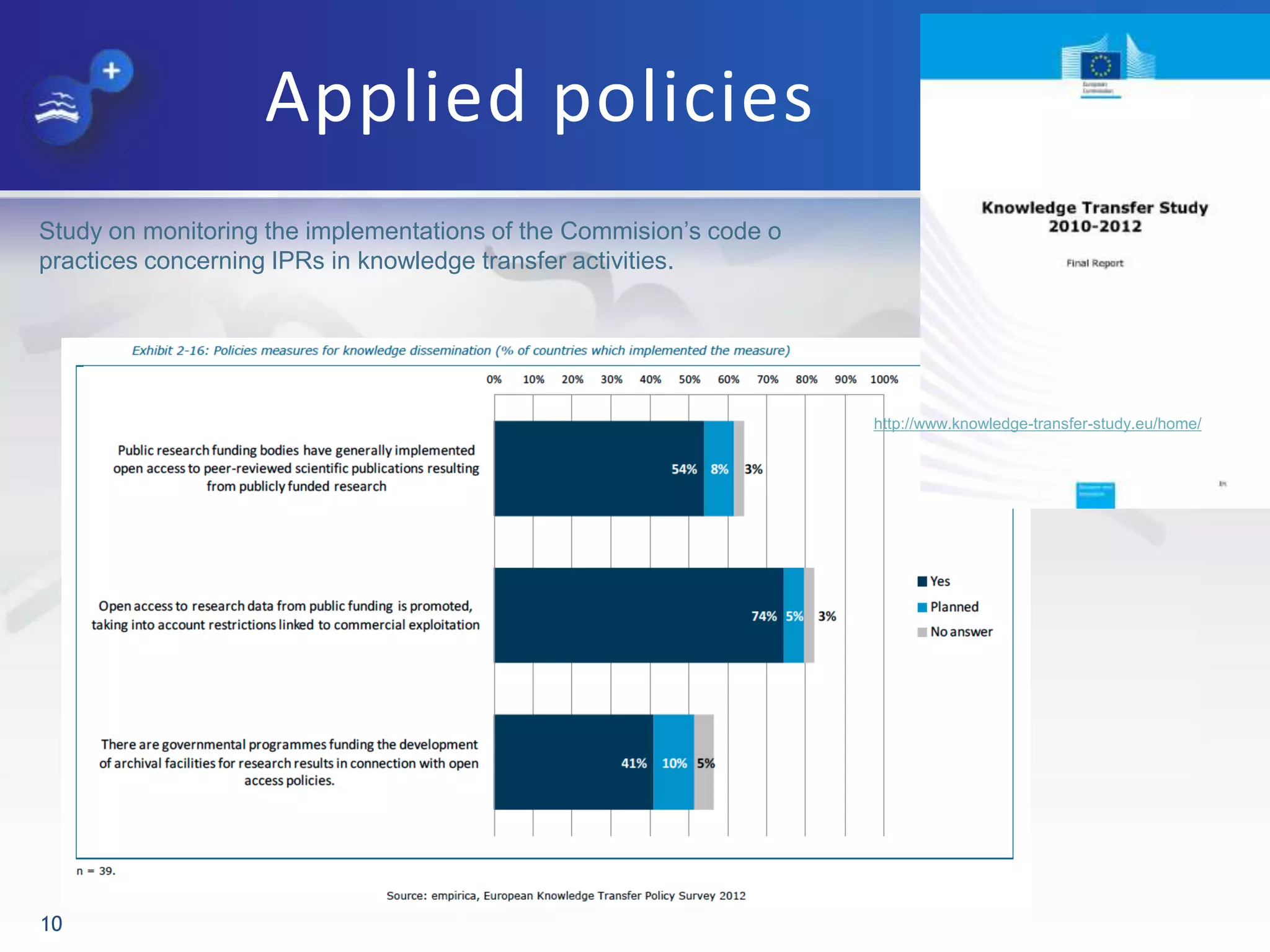
Applied policies
10
http://www.knowledge-transfer-study.eu/home/
Study on monitoring the implementations of the Commision‟s code o
practices concerning IPRs in knowledge transfer activities.
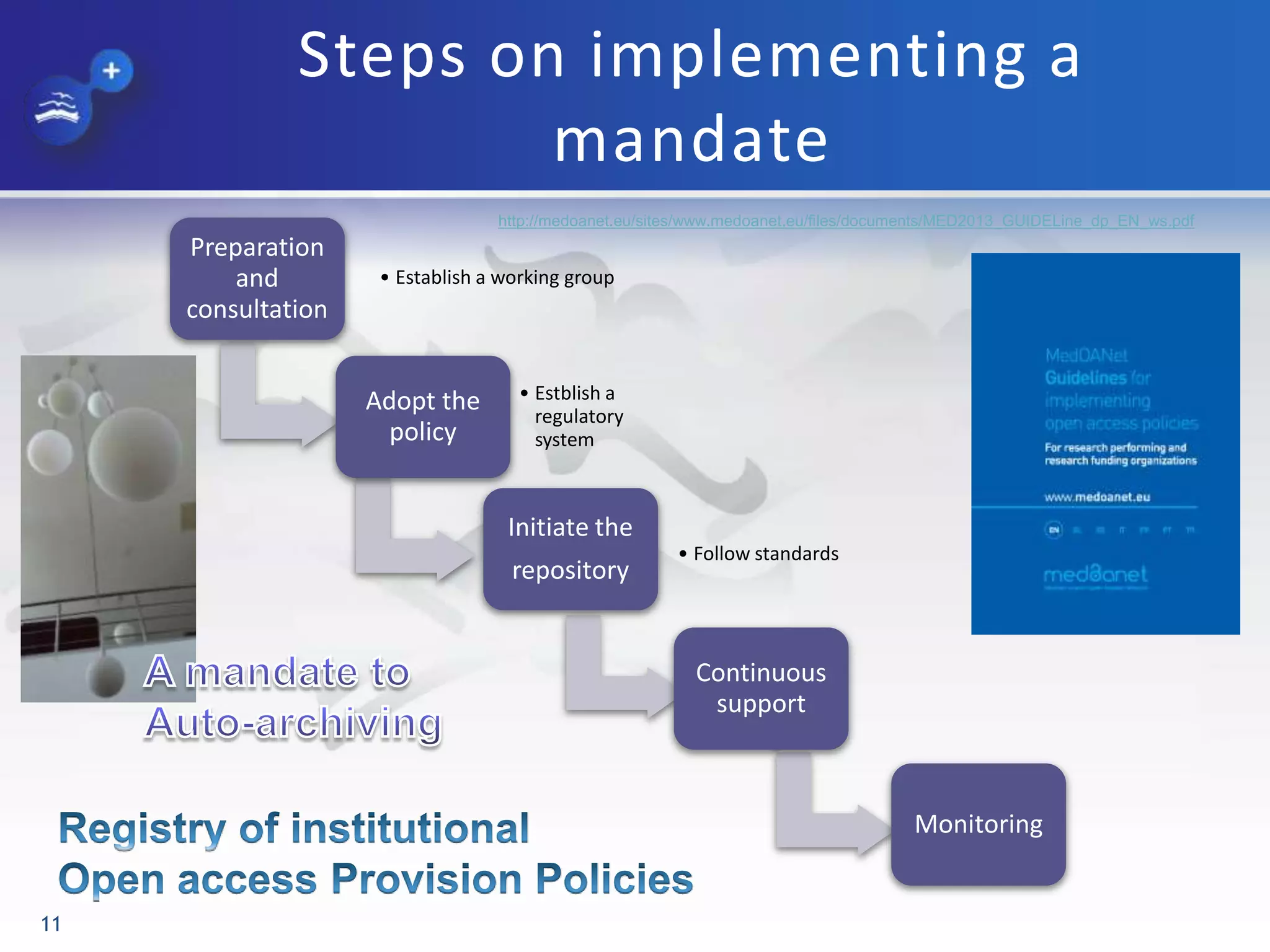
Steps on implementing a
mandate
Preparation
and
consultation
• Establish a working group
Adopt the
policy
• Estblish a
regulatory
system
Initiate the
repository
• Follow standards
Continuous
support
Monitoring
11
http://medoanet.eu/sites/www.medoanet.eu/files/documents/MED2013_GUIDELine_dp_EN_ws.pdf
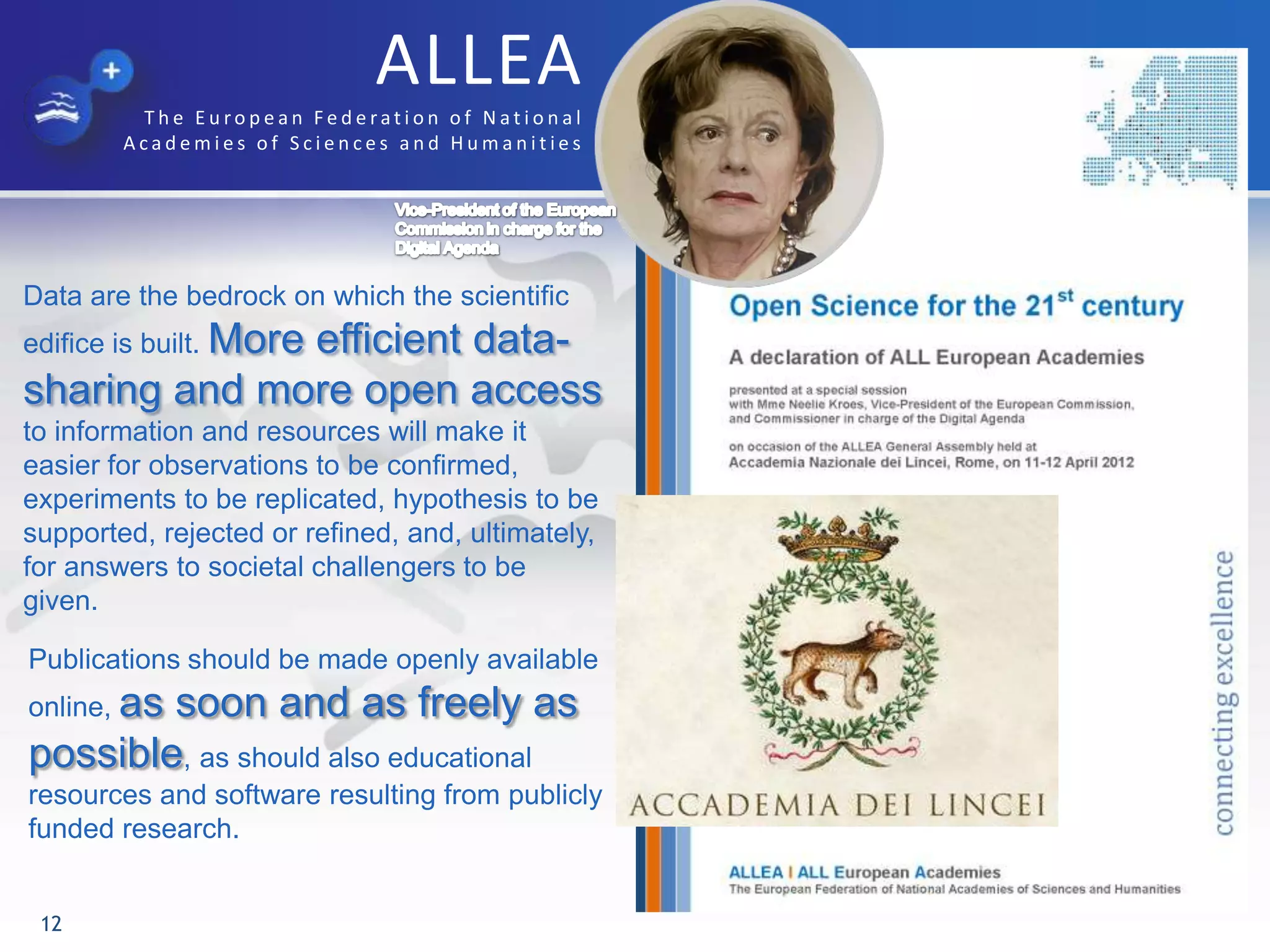
ALLEA
T h e E u ro p e a n F e d e rat i o n o f N a t i o n a l
A c a d e m i e s o f S c i e n c e s a n d H u m a n i t i e s
12
Data are the bedrock on which the scientific
edifice is built. More efficient data-
sharing and more open access
to information and resources will make it
easier for observations to be confirmed,
experiments to be replicated, hypothesis to be
supported, rejected or refined, and, ultimately,
for answers to societal challengers to be
given.
Publications should be made openly available
online, as soon and as freely as
possible, as should also educational
resources and software resulting from publicly
funded research.
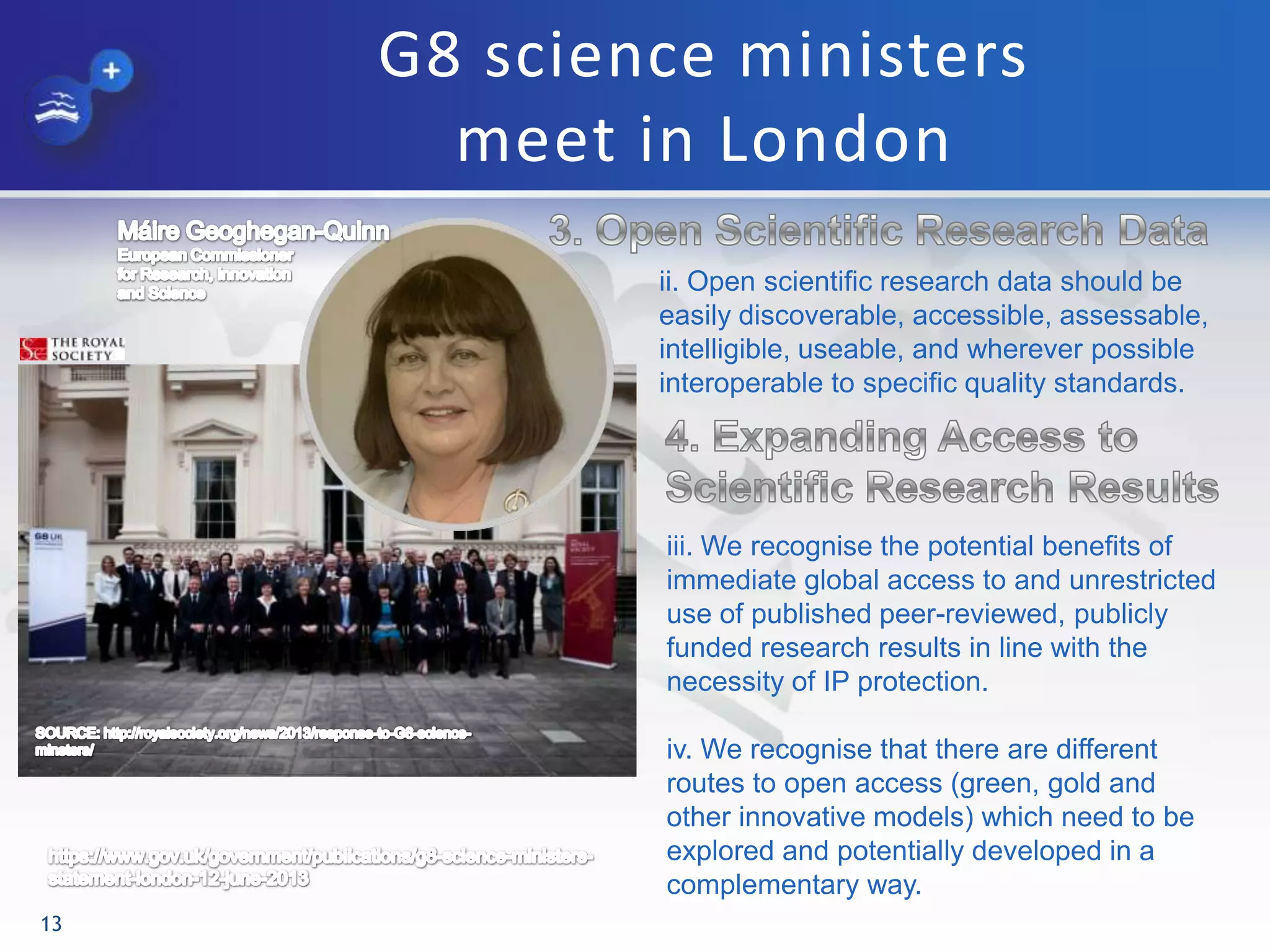
G8 science ministers
meet in London
13
ii. Open scientific research data should be
easily discoverable, accessible, assessable,
intelligible, useable, and wherever possible
interoperable to specific quality standards.
iii. We recognise the potential benefits of
immediate global access to and unrestricted
use of published peer-reviewed, publicly
funded research results in line with the
necessity of IP protection.
iv. We recognise that there are different
routes to open access (green, gold and
other innovative models) which need to be
explored and potentially developed in a
complementary way.
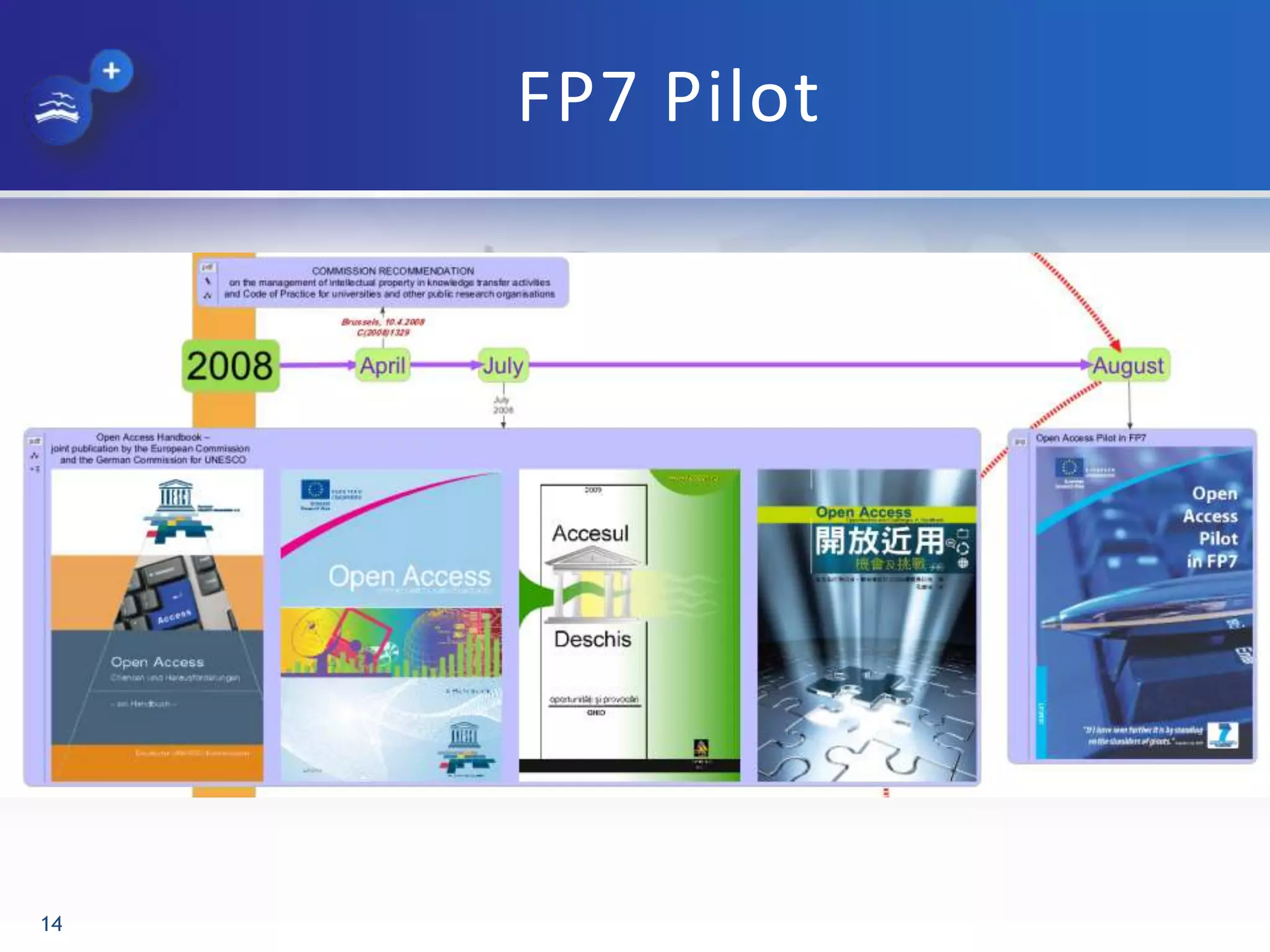
FP7 Pilot
14
What that meant
authors are to obtain the necessary permission from the
participant owning the foreground (even if this participant
is the employer of the author) before submitting a paper
for publication.
Decisions taken with regards to publication should be
"carefully" checked against GA and inform the publisher of
the obligations abiding GA.
And this is the case of Special Clause No. 39 in the GA.
Universitatea de Vest, Timișoara, 201415
Guide to Intellectual Property Rules for FP7 projects
http://ec.europa.eu/research/participants/data/ref/fp7/89593/ipr_en.pdf
Special Clause 39 in GA
The pilot, which will run until the
end of FP7, covers approximately
20 % of the FP7 research budget.
Under the Open Access pilot, FP7 grant recipients in seven areas (energy, environment,
health, information and communication technologies [only cognitive systems, interaction,
and robotics], research infrastructures [only e-infrastructures], science in society, and
socioeconomic sciences and humanities) are expected to:
• deposit peer-reviewed research articles or final manuscripts
resulting from their FP7 projects into an online repository;
• make their best effort to ensure open access to these articles within
either 6 months (health, energy, environment, information and
communication technologies, research infrastructures) or 12 months
(science in society, socioeconomic sciences and humanities) after
publication.
16
6 months embargo
(CS39)
12 months
In addition to the pilot, FP7 rules of participation also
allow all projects to have open access fees eligible for
reimbursement during the time of the grant agreement
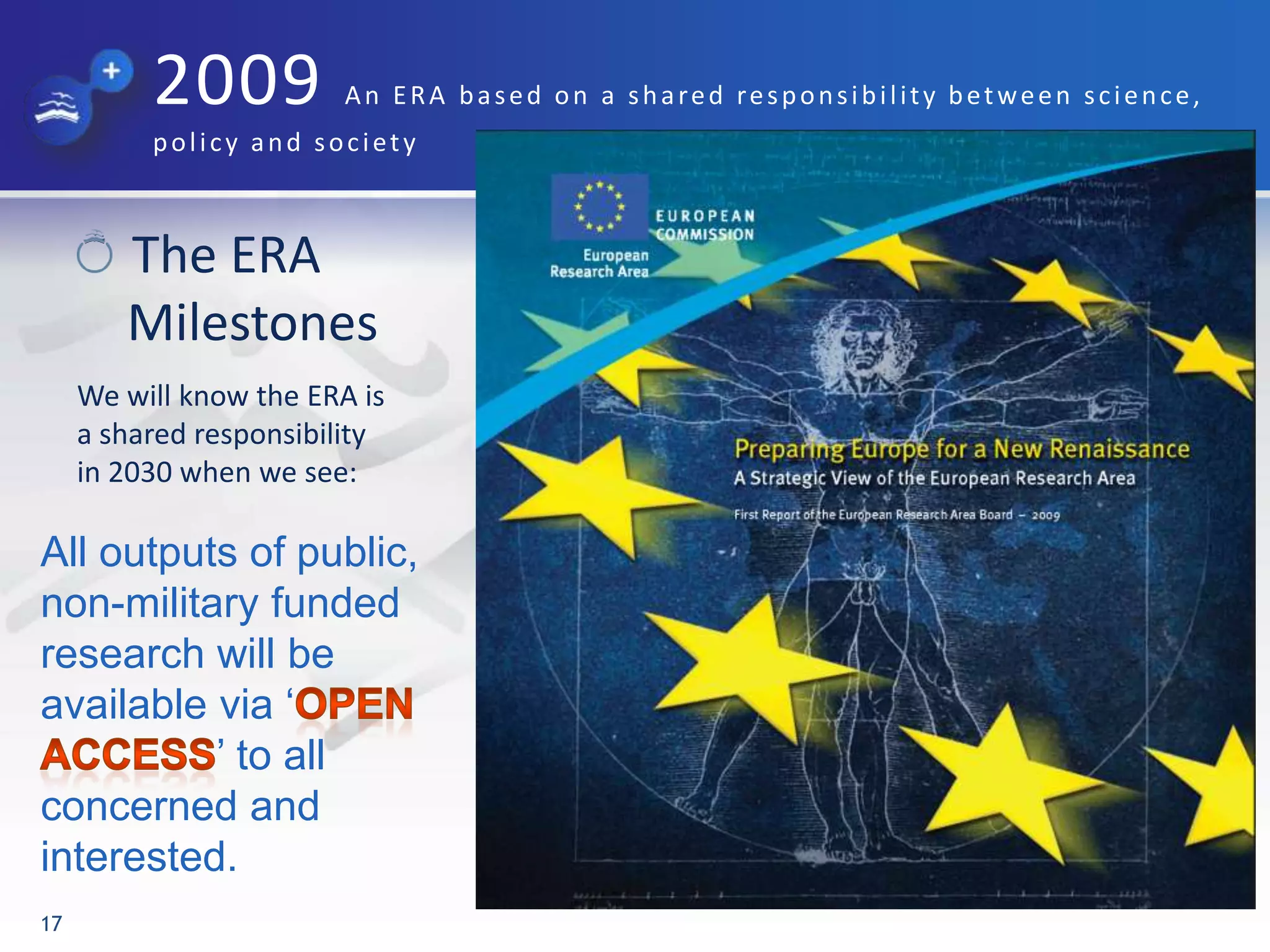
2009 An ERA based on a shared responsibility between science,
policy and society
The ERA
Milestones
We will know the ERA is
a shared responsibility
in 2030 when we see:
17
All outputs of public,
non-military funded
research will be
available via „
‟ to all
concerned and
interested.
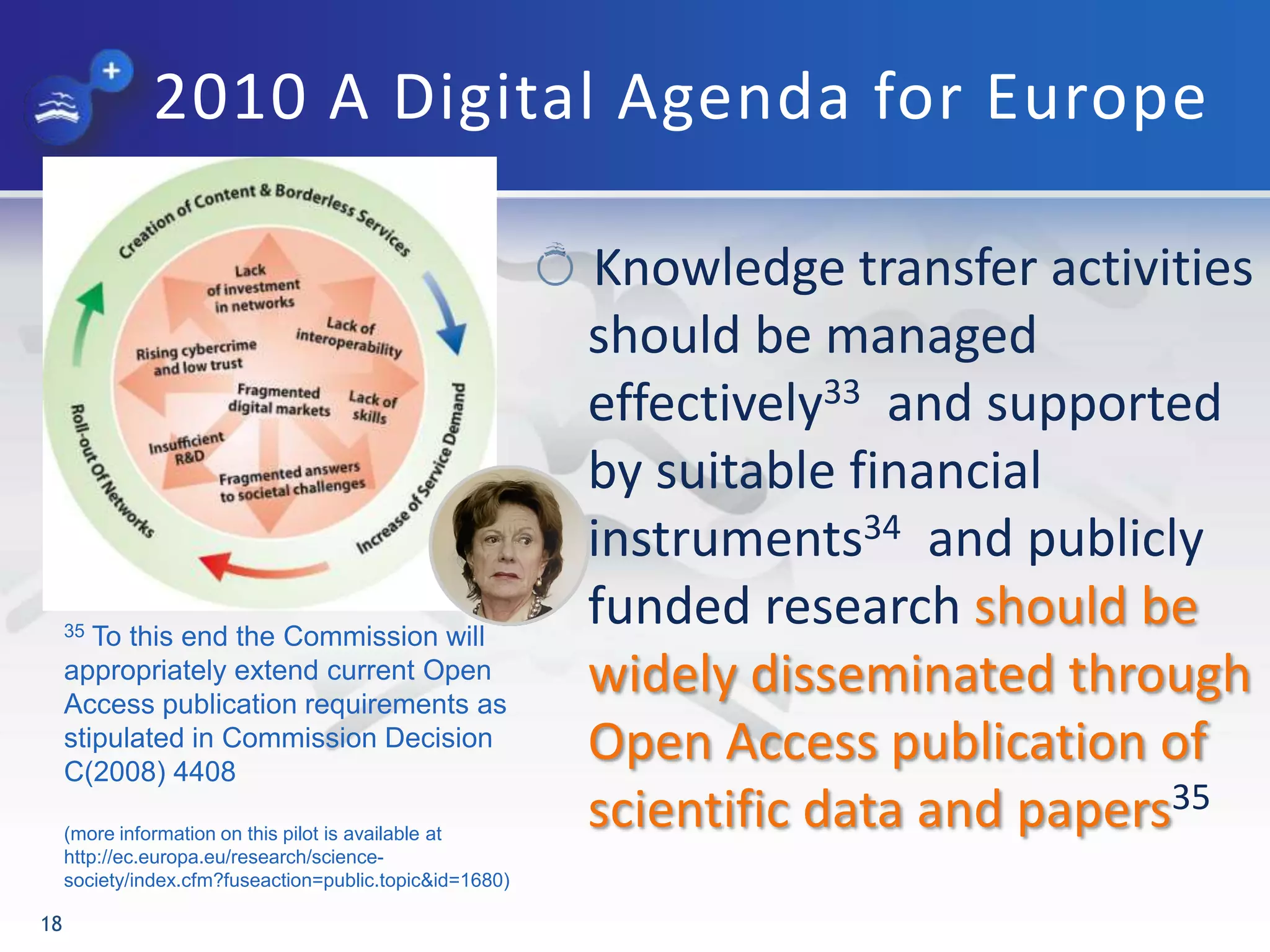
2010 A Digital Agenda for Europe
Knowledge transfer activities
should be managed
effectively33 and supported
by suitable financial
instruments34 and publicly
funded research should be
widely disseminated through
Open Access publication of
scientific data and papers35
18
35 To this end the Commission will
appropriately extend current Open
Access publication requirements as
stipulated in Commission Decision
C(2008) 4408
(more information on this pilot is available at
http://ec.europa.eu/research/science-
society/index.cfm?fuseaction=public.topic&id=1680)
2011 Open data: An engine for innovation, growth
and transparent governance COM(2011) 882 final
19
5.2. Soft law for open research information
Because of the specificities of research data, the Commission will set out in detail and in
separate documents its strategy for scientific and research data and associated infrastructures.
It intends to adopt in 2012 a Communication and Recommendation on the accessibility and
preservation of scientific information. It will work with Member States to step up their activities to
provide open access to scientific information on the basis of a concrete set of measures.
In parallel, the Commission will detail how it will deal with the results of research funded by the
European Union.
Open data strategy, key measures
Open data for science
• Communication and Recommendation to the Member States on scientific information, early
2012;
• Expansion of the open access pilot for scientific publications to the whole of Horizon 2020 +
pilot with open access to research data
2012 results
In May 2011, the Commission
identified the 811 projects
designated at the time and sent a
questionnaire to all project
20
• less than 50% did not know the possibility
• 8 projects out of 194 answers reported they
used it
• For 72% of respondents, reimbursement of
Gold OA is restricted by the fact that most
publishing activities occur after the project
end
• Almost 70% of respondents think it is better
to use self-archiving to satisfy the OA
requirement in FP7
Future consolidation is based on:
Conclusions
The dissemination of research results in FP7,
including self-archiving and costs related to open
access, is often .
However, it requires specific measures and sustained
investment. Despite its , the
implementation of open access remains a challenge.
Open access also raises and
, linked in particular to how researchers
exercise their copyright. Further difficulties are the
of researchers and of concrete
support for them to practice open access.
21
Bruxelles, 17.7.2012 C(2012)
4890 final
22
Concerning
access and
preservation
of scientific
information
“[…] publicly funded research should be
widely disseminated through Open
Access publication of scientific data
and papers”
to make open access to publications the
general principle for projects funded
by the EU research Framework
Programmes
Innovation
Union
(COM(2010)546
, 06.10.2010),
http://eur-
lex.europa.eu/LexUri
Serv/LexUriServ.do?
uri=CELEX:52010D
C0546:EN:NOT
A Digital Agenda for Europe
(COM(2010)245, 19.05.2010),
http://eur-
lex.europa.eu/LexUriServ/LexUriServ.do?uri=
CELEX:52010DC0245(01):EN:NOT
COMMISSION RECOMMENDATION of
17.7.2012 on access to and preservation of
scientific information
Policies on open access to scientific research
results should apply to all research that receives
public funds.
23
Open access to scientific
research data enhances data
quality, reduces the need for
duplication of research, speeds
up scientific progress and helps
to combat scientific fraud.
Then Horizon 2020 came
The rules on IPRs in Horizon 2020 are based on the FP7 rules, with some
further improvements and clarifications. There are however a few
differences, such as:
Open access is now a general requirement(specific approaches defined
in GAs).
In parallel, the Open Research Data Pilot has been launched with the aim
to improve and maximise access to and re-use of research data
generated by certain specific projects.
The new GA model gives access rights to project results for the European
Union, and in the field of security research also for Member States.
Definition of background has been slightly changed.
Universitatea de Vest, Timișoara, 201424
The overall aim of Horizon 2020 is to achieve
a well-functioning European Research Area!
In the recitals it is mention clearly that Horizon
2020 is about "application of a coherent set of
rules“, inherently "rules governing the
exploitation and dissemination of results" (Art.33)
Article 41 says clearly in its first paragraph that
"the results shall be owned by the participant
generating them".
Universitatea de Vest, Timișoara, 201425
An important key: GA
The grant agreement
– may lay down time-limits;
– sets terms and conditions for open access dissemination;
– conditions the eligible costs relating to open access to scientific
publications;
– is not stipulating conditions concerning open access to publications
seeking to cover publication costs after the competition of an
action;
– terms and conditions under which open access to such results shall
be provided [...] taking into consideration the legitimate interests of
the participants and any constraints pertaining to data protection
rules, security rules or intellectual property rights (the work
programme or work plan shall indicate if the dissemination of
research data through open access is required).
Universitatea de Vest, Timișoara, 201426
EC response: OpenAIRE+
Creating a robust, participatory
service for the cross-linking of
peer-reviewed scientific
publications and associated
datasets is the principal goal of
OpenAIREplus
27
Meaning?!
The project will establish an e-
Infrastructure to harvest, enrich and
store the metadata of Open Access
scientific datasets. Innovative
underlying technical structures will be
deployed to support the management
of and inter-linking between associated
scientific data.
28
How it is working?
Access to and deposit of linked publications via
the OpenAIRE portal are supported by a Help
Desk, and OpenAIRE's collaborative networking
structure will be extended to promote the
concept of open enhanced publications among
user communities.
Liaison offices in each of the project's 31
European countries work to support the needs of
researchers in Europe.
29
A pan-European information
structure
30
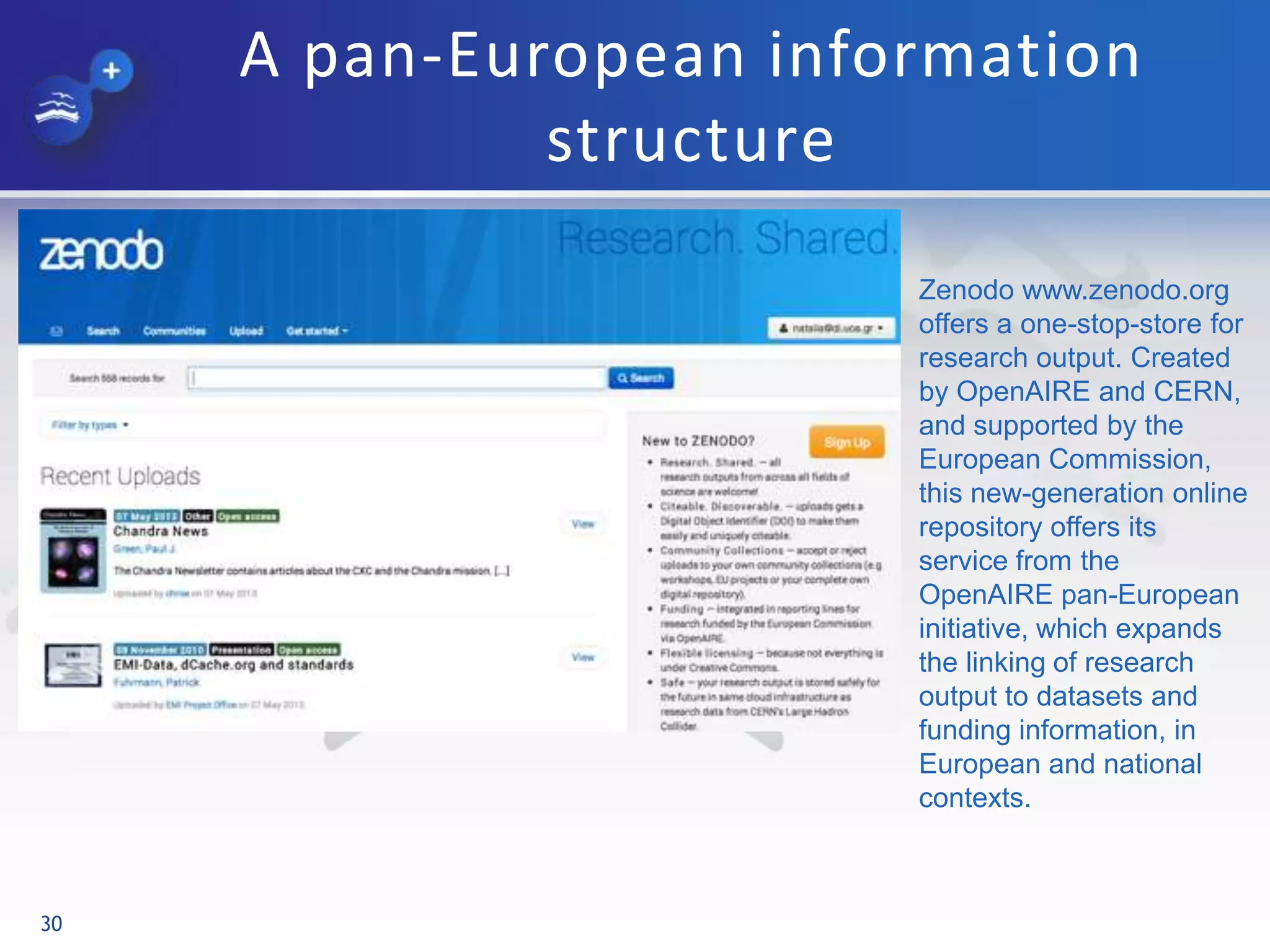
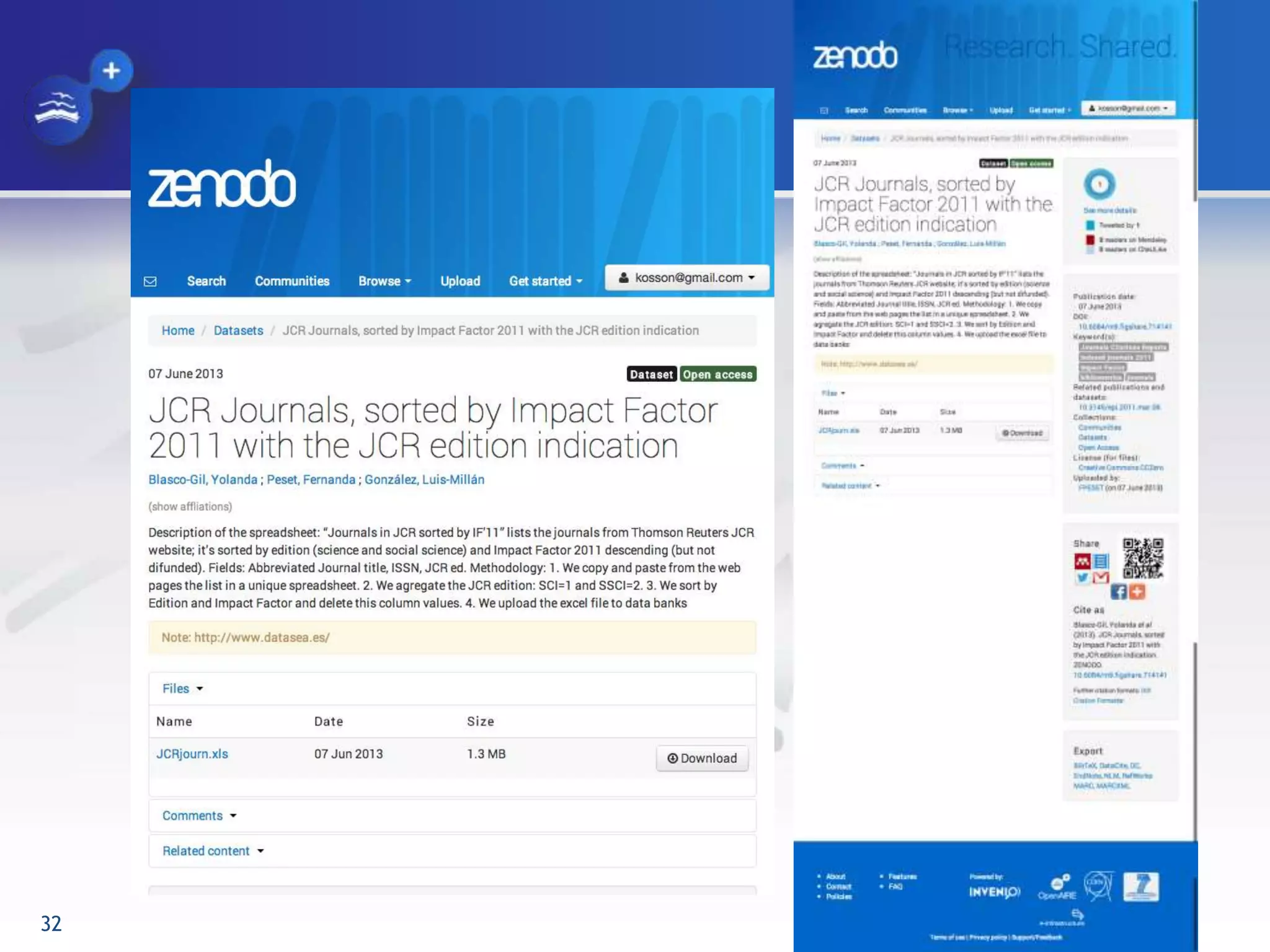
Zenodo www.zenodo.org
offers a one-stop-store for
research output. Created
by OpenAIRE and CERN,
and supported by the
European Commission,
this new-generation online
repository offers its
service from the
OpenAIRE pan-European
initiative, which expands
the linking of research
output to datasets and
funding information, in
European and national
contexts.
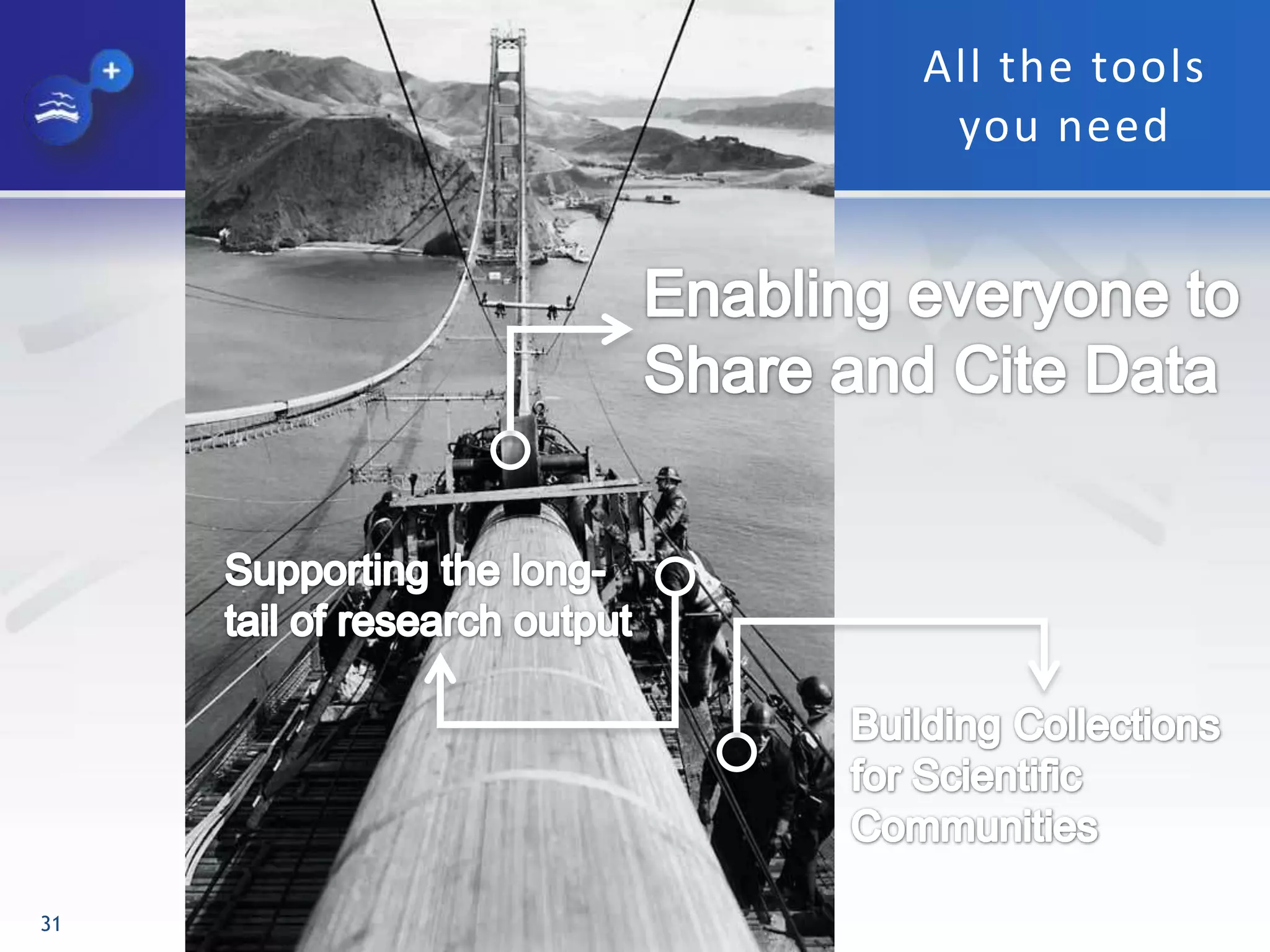
All the tools
you need
31
32
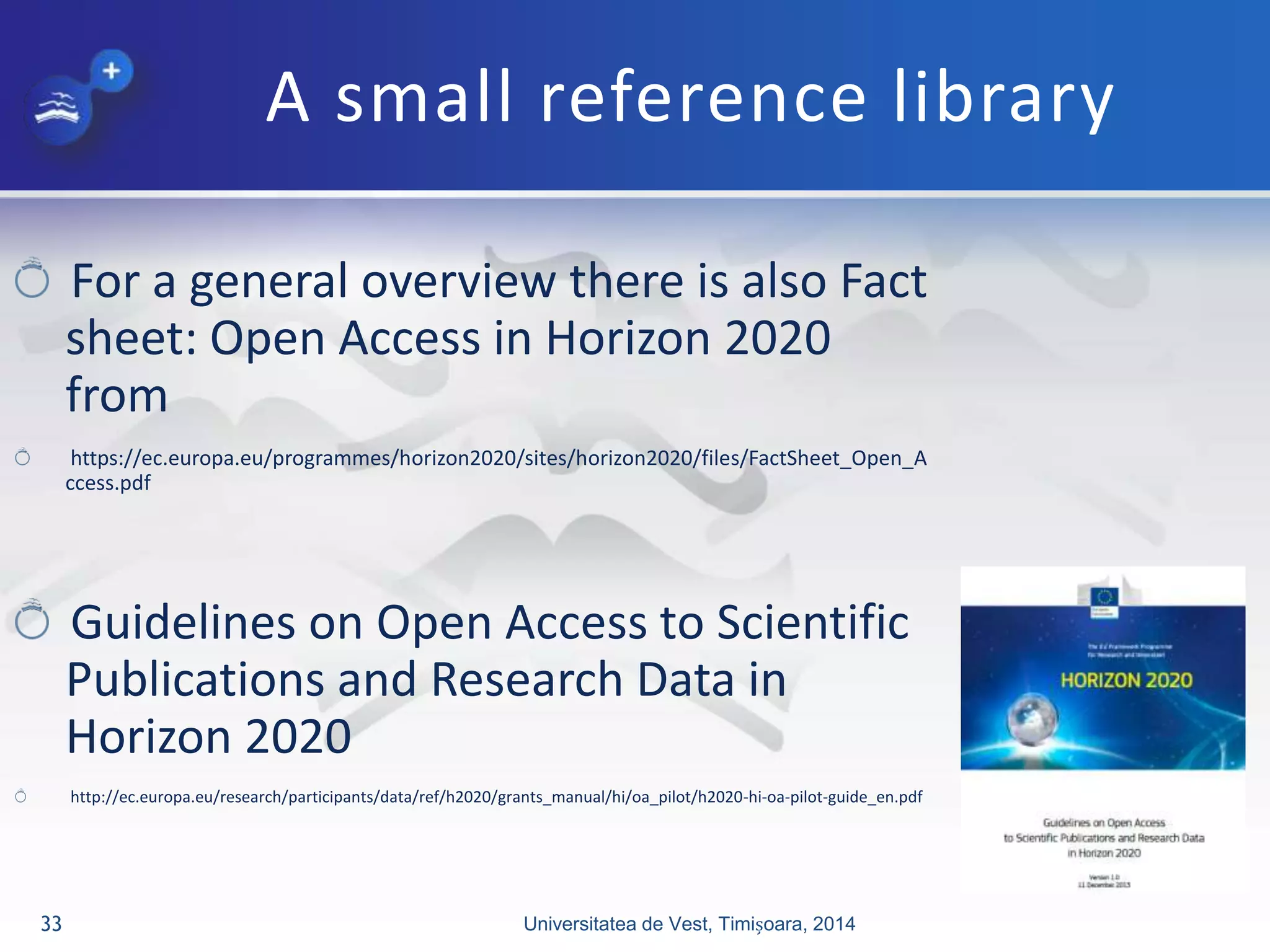
A small reference library
For a general overview there is also Fact
sheet: Open Access in Horizon 2020
from
https://ec.europa.eu/programmes/horizon2020/sites/horizon2020/files/FactSheet_Open_A
ccess.pdf
Guidelines on Open Access to Scientific
Publications and Research Data in
Horizon 2020
http://ec.europa.eu/research/participants/data/ref/h2020/grants_manual/hi/oa_pilot/h2020-hi-oa-pilot-guide_en.pdf
Universitatea de Vest, Timișoara, 201433
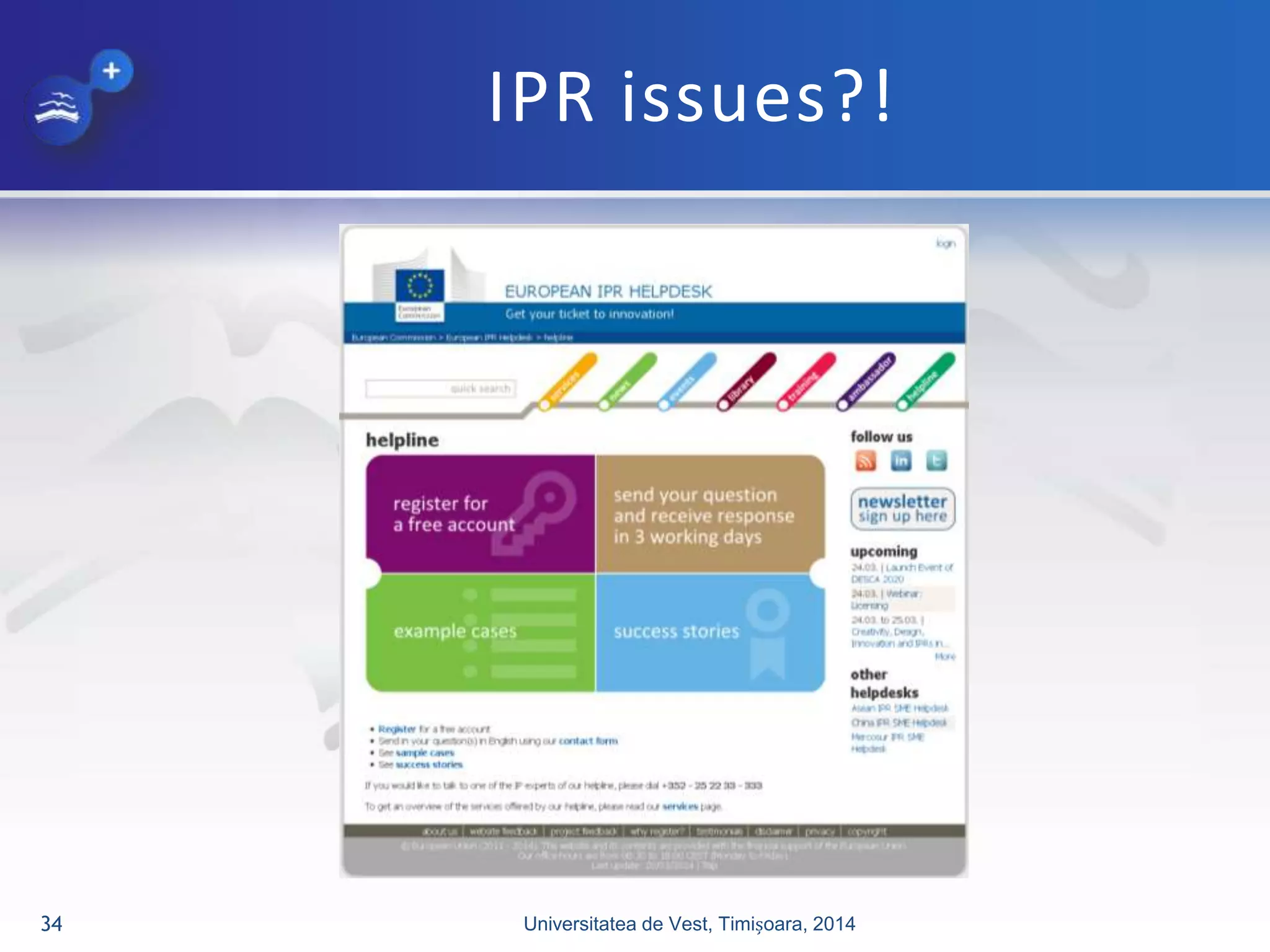
IPR issues?!
Universitatea de Vest, Timișoara, 201434
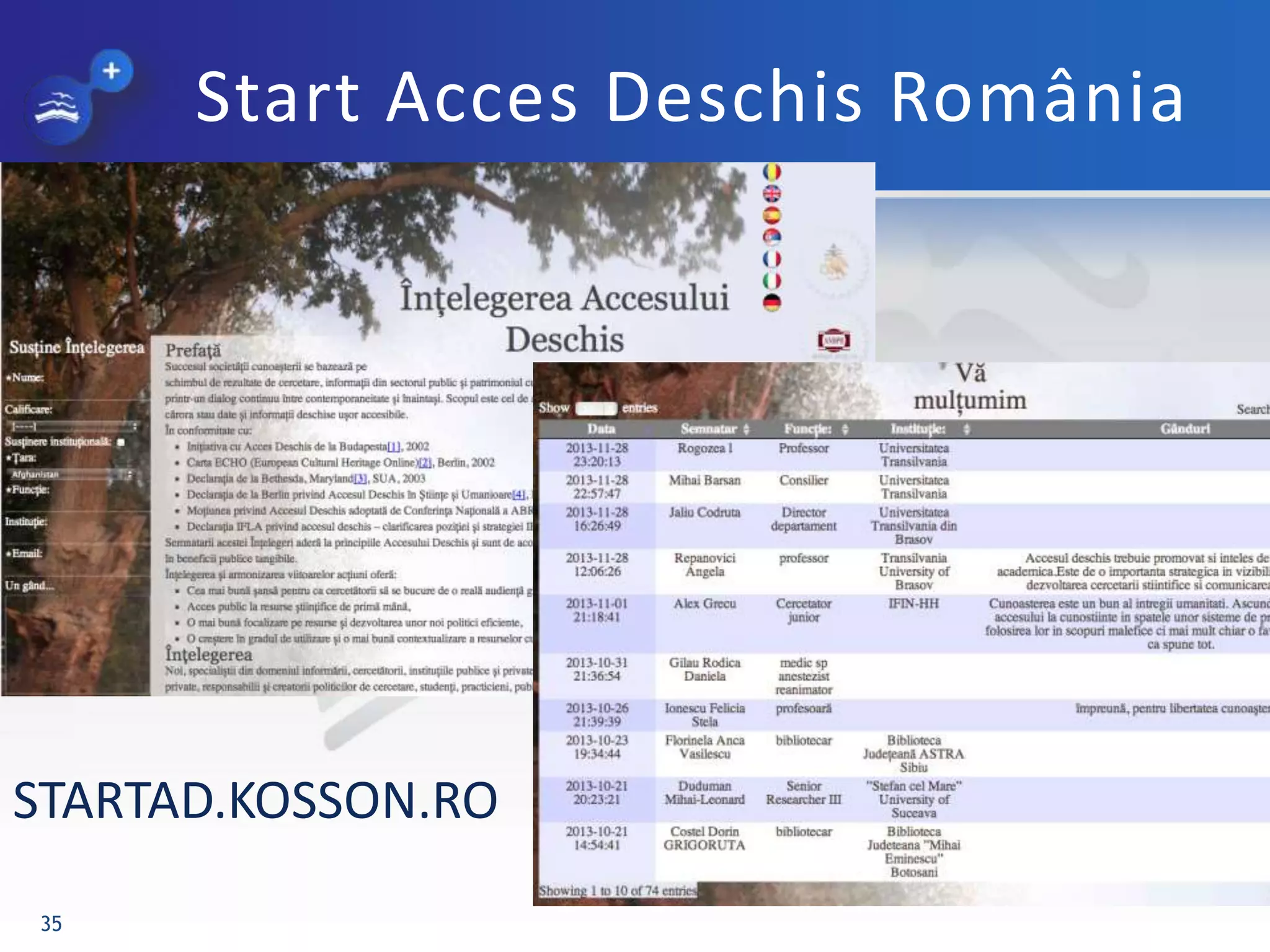
Start Acces Deschis România
STARTAD.KOSSON.RO
35
Thank you!
36
www.acces-deschis.ro

Open Access to research through OpenAIRE+ and Zenodo

  • 1.
    Nicolaie Constantinescu, kosson@gmail.com NationalOpen Access Desk, Romania Information Architect, kosson.ro European Research through OpenAIRE and Zenodo www.kosson.ro
  • 2.
    A Innovation Union Realisingthe European Research Area 2 dissemination for the research findings transfer Points Of Actions use http://ec.europa.eu/research/innovation-union/index_en.cfm?pg=action-points# http://i3s.ec.europa.eu/commitment/5.html By 2015 Member States and the Commission should have been finished or started already more than 60% of all research infrastructures identified by the European Strategy Forum for Research Infrastructures (ESFRI)
  • 3.
    an increasingly importantforum to advise ministries and funding agencies What are research infrastructures? The term ‘research infrastructures’ refers to facilities, resources and related services used by the scientific community to conduct top-level research in their respective fields, ranging from social sciences to astronomy, genomics to nanotechnologies. RIs may be ‘single-sited’ (a single resource at a single location), ‘distributed’ (a network of distributed resources), or ‘virtual’ (the service is provided electronically). European Strategy Forum for Research Infrastructures 3 http://europa.eu/rapid/press-release_MEMO-12-772_en.htm
  • 4.
    Horizon 2020 http://ec.europa.eu/research/horizon2020/index_en.cfm Launched inBucharest on 4th of October in the presence of Máire Geoghegan-Quinn, European Commissioner for Research, Innovation and Science. 4 Financial instrument € 70 mlrd. Ensuring competitivity of Europe A single set of rules
  • 5.
    Open Access –What is it? within the context of EU-funded projects, refers to the practice of providing on-line access to scientific information that is free of charge to the end-user and is reusable. In the context of research and innovation, scientific information can refer to (i) peer-reviewed scientific research articles (published in scholarly journals) or (ii) research data (data underlying publications, curated data and/or raw data). Universitatea de Vest, Timișoara, 20145 http://www.iprhelpdesk.eu/node/1960
  • 6.
    History of twomodels 6 Under embargo In institutional repositories
  • 7.
  • 8.
    ERA Survey Half ofthe organisations support Open Access and 40 % invest in institutional repositories 8 http://ec.europa.eu/research/era/pdf/era_progress_report2013/era_progress_report2013.pdf
  • 9.
  • 10.
    Applied policies 10 http://www.knowledge-transfer-study.eu/home/ Study onmonitoring the implementations of the Commision‟s code o practices concerning IPRs in knowledge transfer activities.
  • 11.
    Steps on implementinga mandate Preparation and consultation • Establish a working group Adopt the policy • Estblish a regulatory system Initiate the repository • Follow standards Continuous support Monitoring 11 http://medoanet.eu/sites/www.medoanet.eu/files/documents/MED2013_GUIDELine_dp_EN_ws.pdf
  • 12.
    ALLEA T h eE u ro p e a n F e d e rat i o n o f N a t i o n a l A c a d e m i e s o f S c i e n c e s a n d H u m a n i t i e s 12 Data are the bedrock on which the scientific edifice is built. More efficient data- sharing and more open access to information and resources will make it easier for observations to be confirmed, experiments to be replicated, hypothesis to be supported, rejected or refined, and, ultimately, for answers to societal challengers to be given. Publications should be made openly available online, as soon and as freely as possible, as should also educational resources and software resulting from publicly funded research.
  • 13.
    G8 science ministers meetin London 13 ii. Open scientific research data should be easily discoverable, accessible, assessable, intelligible, useable, and wherever possible interoperable to specific quality standards. iii. We recognise the potential benefits of immediate global access to and unrestricted use of published peer-reviewed, publicly funded research results in line with the necessity of IP protection. iv. We recognise that there are different routes to open access (green, gold and other innovative models) which need to be explored and potentially developed in a complementary way.
  • 14.
  • 15.
    What that meant authorsare to obtain the necessary permission from the participant owning the foreground (even if this participant is the employer of the author) before submitting a paper for publication. Decisions taken with regards to publication should be "carefully" checked against GA and inform the publisher of the obligations abiding GA. And this is the case of Special Clause No. 39 in the GA. Universitatea de Vest, Timișoara, 201415 Guide to Intellectual Property Rules for FP7 projects http://ec.europa.eu/research/participants/data/ref/fp7/89593/ipr_en.pdf
  • 16.
    Special Clause 39in GA The pilot, which will run until the end of FP7, covers approximately 20 % of the FP7 research budget. Under the Open Access pilot, FP7 grant recipients in seven areas (energy, environment, health, information and communication technologies [only cognitive systems, interaction, and robotics], research infrastructures [only e-infrastructures], science in society, and socioeconomic sciences and humanities) are expected to: • deposit peer-reviewed research articles or final manuscripts resulting from their FP7 projects into an online repository; • make their best effort to ensure open access to these articles within either 6 months (health, energy, environment, information and communication technologies, research infrastructures) or 12 months (science in society, socioeconomic sciences and humanities) after publication. 16 6 months embargo (CS39) 12 months In addition to the pilot, FP7 rules of participation also allow all projects to have open access fees eligible for reimbursement during the time of the grant agreement
  • 17.
    2009 An ERAbased on a shared responsibility between science, policy and society The ERA Milestones We will know the ERA is a shared responsibility in 2030 when we see: 17 All outputs of public, non-military funded research will be available via „ ‟ to all concerned and interested.
  • 18.
    2010 A DigitalAgenda for Europe Knowledge transfer activities should be managed effectively33 and supported by suitable financial instruments34 and publicly funded research should be widely disseminated through Open Access publication of scientific data and papers35 18 35 To this end the Commission will appropriately extend current Open Access publication requirements as stipulated in Commission Decision C(2008) 4408 (more information on this pilot is available at http://ec.europa.eu/research/science- society/index.cfm?fuseaction=public.topic&id=1680)
  • 19.
    2011 Open data:An engine for innovation, growth and transparent governance COM(2011) 882 final 19 5.2. Soft law for open research information Because of the specificities of research data, the Commission will set out in detail and in separate documents its strategy for scientific and research data and associated infrastructures. It intends to adopt in 2012 a Communication and Recommendation on the accessibility and preservation of scientific information. It will work with Member States to step up their activities to provide open access to scientific information on the basis of a concrete set of measures. In parallel, the Commission will detail how it will deal with the results of research funded by the European Union. Open data strategy, key measures Open data for science • Communication and Recommendation to the Member States on scientific information, early 2012; • Expansion of the open access pilot for scientific publications to the whole of Horizon 2020 + pilot with open access to research data
  • 20.
    2012 results In May2011, the Commission identified the 811 projects designated at the time and sent a questionnaire to all project 20 • less than 50% did not know the possibility • 8 projects out of 194 answers reported they used it • For 72% of respondents, reimbursement of Gold OA is restricted by the fact that most publishing activities occur after the project end • Almost 70% of respondents think it is better to use self-archiving to satisfy the OA requirement in FP7
  • 21.
    Future consolidation isbased on: Conclusions The dissemination of research results in FP7, including self-archiving and costs related to open access, is often . However, it requires specific measures and sustained investment. Despite its , the implementation of open access remains a challenge. Open access also raises and , linked in particular to how researchers exercise their copyright. Further difficulties are the of researchers and of concrete support for them to practice open access. 21
  • 22.
    Bruxelles, 17.7.2012 C(2012) 4890final 22 Concerning access and preservation of scientific information “[…] publicly funded research should be widely disseminated through Open Access publication of scientific data and papers” to make open access to publications the general principle for projects funded by the EU research Framework Programmes Innovation Union (COM(2010)546 , 06.10.2010), http://eur- lex.europa.eu/LexUri Serv/LexUriServ.do? uri=CELEX:52010D C0546:EN:NOT A Digital Agenda for Europe (COM(2010)245, 19.05.2010), http://eur- lex.europa.eu/LexUriServ/LexUriServ.do?uri= CELEX:52010DC0245(01):EN:NOT
  • 23.
    COMMISSION RECOMMENDATION of 17.7.2012on access to and preservation of scientific information Policies on open access to scientific research results should apply to all research that receives public funds. 23 Open access to scientific research data enhances data quality, reduces the need for duplication of research, speeds up scientific progress and helps to combat scientific fraud.
  • 24.
    Then Horizon 2020came The rules on IPRs in Horizon 2020 are based on the FP7 rules, with some further improvements and clarifications. There are however a few differences, such as: Open access is now a general requirement(specific approaches defined in GAs). In parallel, the Open Research Data Pilot has been launched with the aim to improve and maximise access to and re-use of research data generated by certain specific projects. The new GA model gives access rights to project results for the European Union, and in the field of security research also for Member States. Definition of background has been slightly changed. Universitatea de Vest, Timișoara, 201424
  • 25.
    The overall aimof Horizon 2020 is to achieve a well-functioning European Research Area! In the recitals it is mention clearly that Horizon 2020 is about "application of a coherent set of rules“, inherently "rules governing the exploitation and dissemination of results" (Art.33) Article 41 says clearly in its first paragraph that "the results shall be owned by the participant generating them". Universitatea de Vest, Timișoara, 201425
  • 26.
    An important key:GA The grant agreement – may lay down time-limits; – sets terms and conditions for open access dissemination; – conditions the eligible costs relating to open access to scientific publications; – is not stipulating conditions concerning open access to publications seeking to cover publication costs after the competition of an action; – terms and conditions under which open access to such results shall be provided [...] taking into consideration the legitimate interests of the participants and any constraints pertaining to data protection rules, security rules or intellectual property rights (the work programme or work plan shall indicate if the dissemination of research data through open access is required). Universitatea de Vest, Timișoara, 201426
  • 27.
    EC response: OpenAIRE+ Creatinga robust, participatory service for the cross-linking of peer-reviewed scientific publications and associated datasets is the principal goal of OpenAIREplus 27
  • 28.
    Meaning?! The project willestablish an e- Infrastructure to harvest, enrich and store the metadata of Open Access scientific datasets. Innovative underlying technical structures will be deployed to support the management of and inter-linking between associated scientific data. 28
  • 29.
    How it isworking? Access to and deposit of linked publications via the OpenAIRE portal are supported by a Help Desk, and OpenAIRE's collaborative networking structure will be extended to promote the concept of open enhanced publications among user communities. Liaison offices in each of the project's 31 European countries work to support the needs of researchers in Europe. 29
  • 30.
    A pan-European information structure 30 Zenodowww.zenodo.org offers a one-stop-store for research output. Created by OpenAIRE and CERN, and supported by the European Commission, this new-generation online repository offers its service from the OpenAIRE pan-European initiative, which expands the linking of research output to datasets and funding information, in European and national contexts.
  • 31.
  • 32.
  • 33.
    A small referencelibrary For a general overview there is also Fact sheet: Open Access in Horizon 2020 from https://ec.europa.eu/programmes/horizon2020/sites/horizon2020/files/FactSheet_Open_A ccess.pdf Guidelines on Open Access to Scientific Publications and Research Data in Horizon 2020 http://ec.europa.eu/research/participants/data/ref/h2020/grants_manual/hi/oa_pilot/h2020-hi-oa-pilot-guide_en.pdf Universitatea de Vest, Timișoara, 201433
  • 34.
    IPR issues?! Universitatea deVest, Timișoara, 201434
  • 35.
    Start Acces DeschisRomânia STARTAD.KOSSON.RO 35
  • 36.

Editor's Notes

  • #4 ELI - Extreme Light Infrastructure - was the first ESFRI project funded by regional structural funds. ELI has been granted €416 million for the construction of two facilities to be built in the Czech Republic and Romania. A third ELI facility is to be located in Hungary, which will also benefit from structural funds.Infrastructurile de Cercetare sunt capacități, resurse sau servicii care au o natură unică și care au fost identificate de comunitățile de cercetare europene pentru a conduce activități de prin rang în toate sectoarele.Această definiție a Infrastructurilor de Cercetare, fiind incluse resursele umane asociate, acoperă zona echipamentelor sau al seturilor de instrumente în completarea resurselor care găzduiesc cunoașterea precum colecțiile, arhivele și băncile de date. Infrastructurile de Cercetare pot avea „un singur sit”, pot fi „distribuite” sau „virtuale” (serviciul fiind oferit electronic). Adesea necesităsisteme de informare structurată în ce privește managementul de date, facilitarea schimbului de informați și comunicațiile. Acestea includ infrastructuri bazare pe tehnologie precum Grid-urile, software-ul și middleware-ul. În toate cazurile luate în considerare pentru parcurs, aceste infrastructuri trebuie să aplice politici de „Acces Deschis” privind cercetarea de bază, i.e. să fie deschise tuturor cercetătorilor interesați în baza liberei competiții și a selecției propunerilor evaluate numai în spiritul excelenței științifice prin evaluare colegială internațională.Extras din Raportul de Strategie privind Infrastructurile de Cercetare: Parcurs 2010
  • #5 Orizont 2020 este un instrument financiar pentru Strategia Europa 2020.