Grid Economics for the Data Center Rex Wang VP Product Marketing, Oracle
The following is intended to outline our general product direction.  It is intended for information purposes only, and may not be incorporated into any contract.  It is not a commitment to deliver any material, code, or functionality, and should not be relied upon in making purchasing decisions. The development, release, and timing of any features or functionality described for Oracle’s products remains at the sole discretion of Oracle.
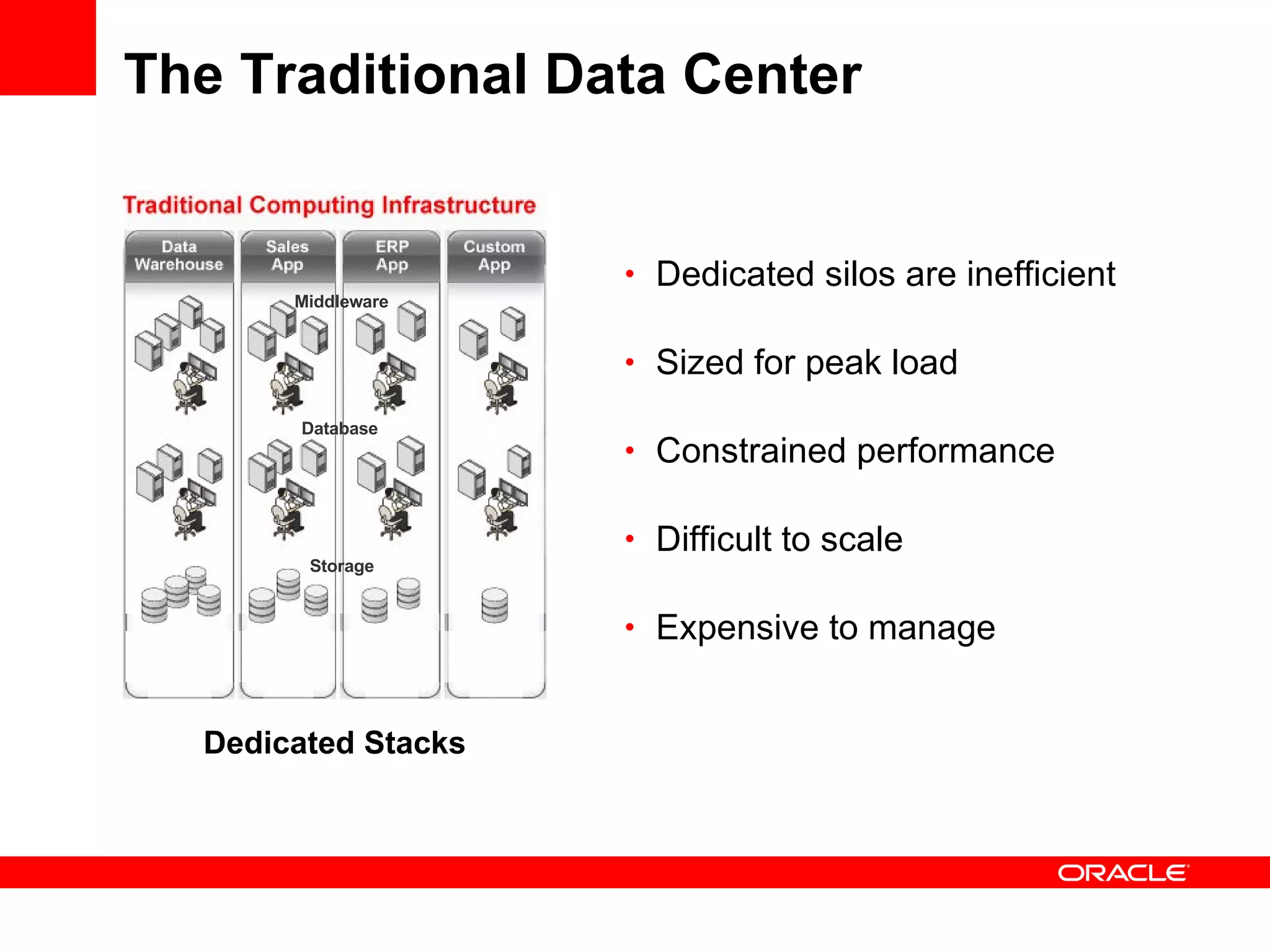
The Traditional Data Center  Dedicated silos are inefficient Sized for peak load Constrained performance Difficult to scale Expensive to manage Dedicated Stacks Middleware Database Storage
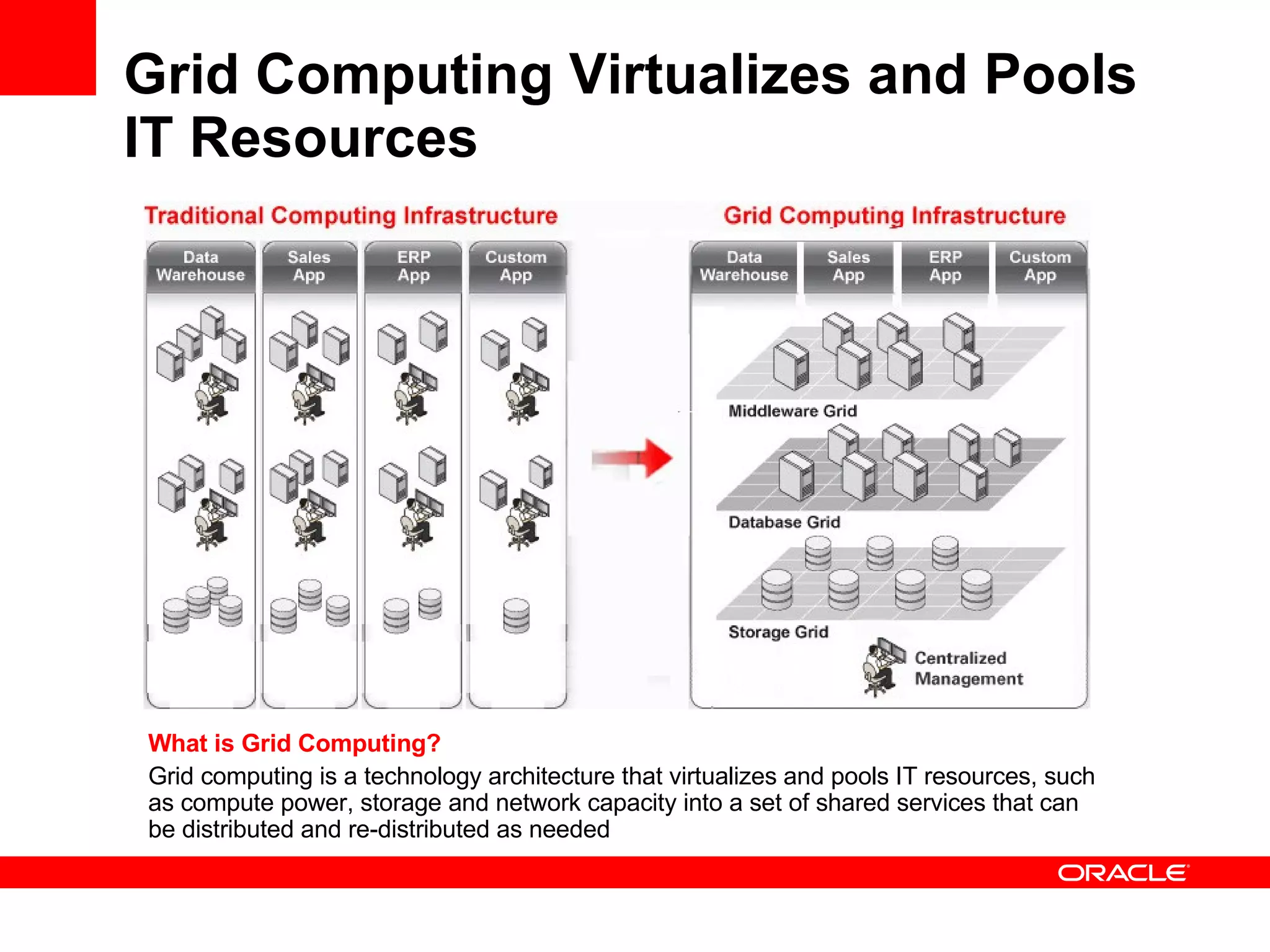
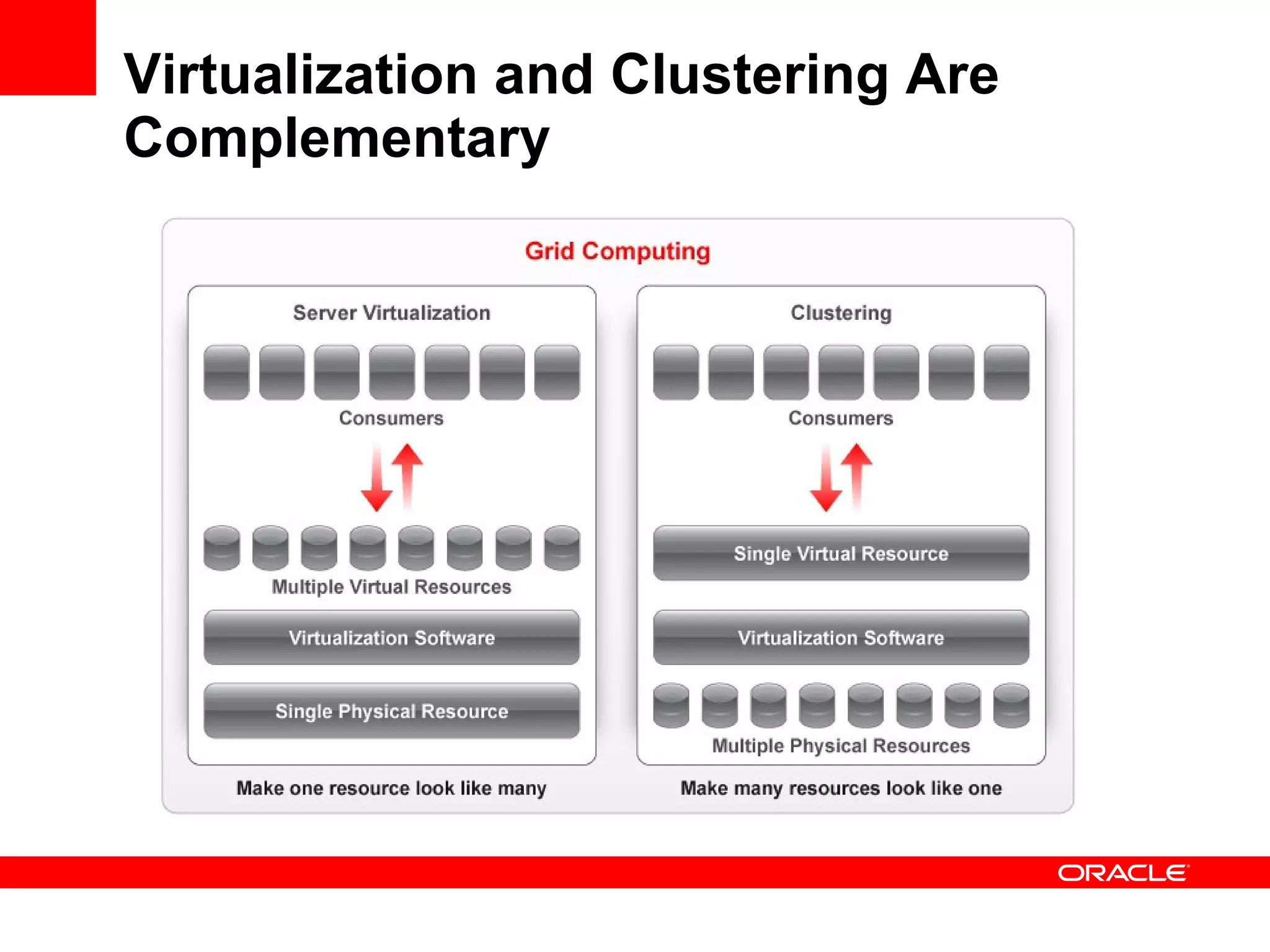
Grid Computing Virtualizes and Pools IT Resources What is Grid Computing? Grid computing is a technology architecture that virtualizes and pools IT resources, such as compute power, storage and network capacity into a set of shared services that can be distributed and re-distributed as needed
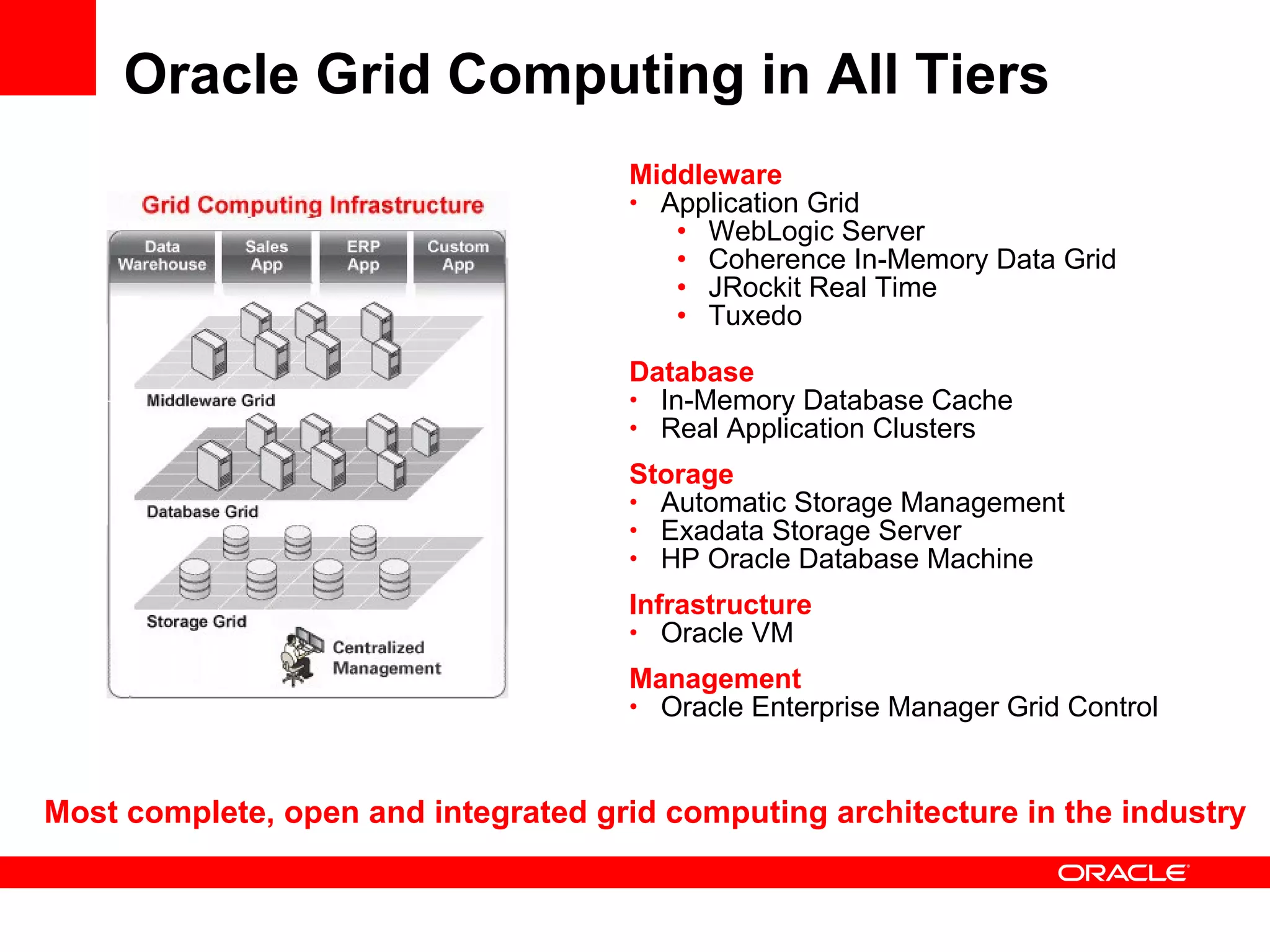
Oracle Grid Computing in All Tiers Middleware Application Grid WebLogic Server Coherence In-Memory Data Grid JRockit Real Time Tuxedo Database In-Memory Database Cache Real Application Clusters Storage Automatic Storage Management Exadata Storage Server HP Oracle Database Machine Infrastructure Oracle VM Management Oracle Enterprise Manager Grid Control Most complete, open and integrated grid computing architecture in the industry
Virtualization and Clustering Are Complementary
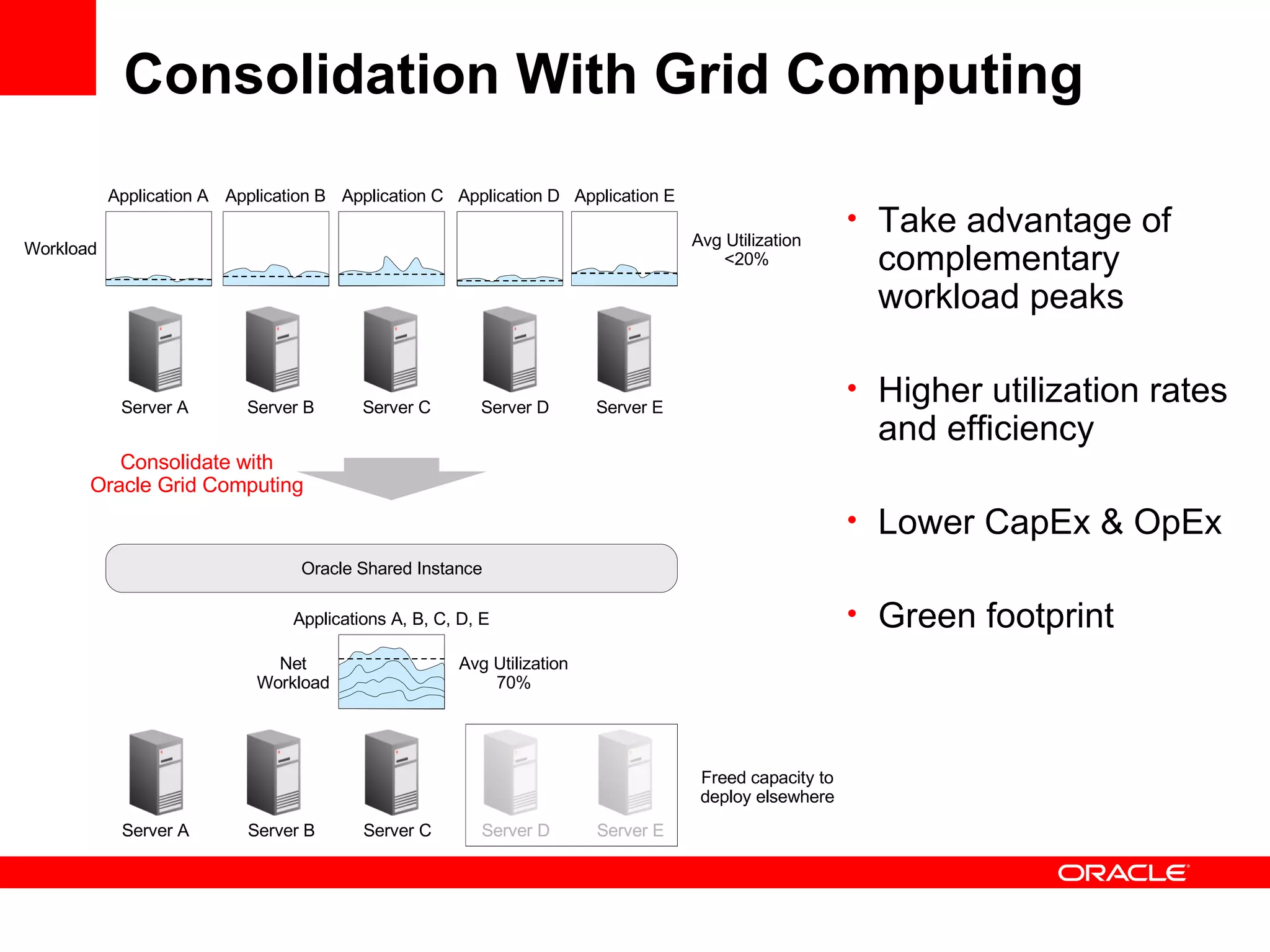
Consolidation With Grid Computing Server A Server B Server C Server D Application A Application B Application C Application D Workload Avg Utilization <20% Applications A, B, C, D, E Net Workload Avg Utilization 70% Freed capacity to deploy elsewhere Consolidate with Oracle Grid Computing Take advantage of complementary workload peaks Higher utilization rates and efficiency Lower CapEx & OpEx Green footprint Oracle Shared Instance Server E Application E Server A Server B Server C Server D Server E
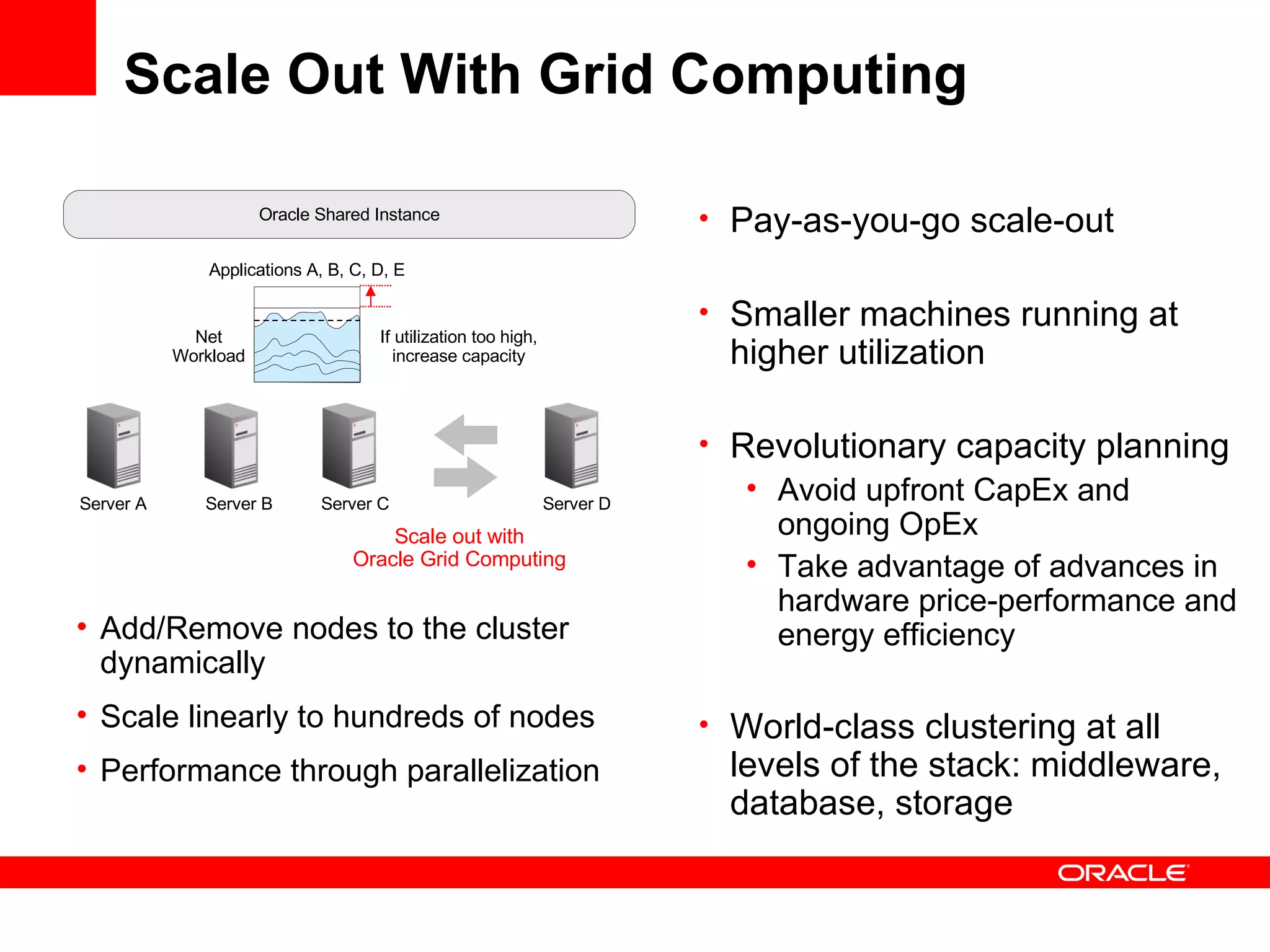
Scale Out With Grid Computing Applications A, B, C, D, E Net Workload If utilization too high, increase capacity Pay-as-you-go scale-out Smaller machines running at higher utilization Revolutionary capacity planning Avoid upfront CapEx and ongoing OpEx Take advantage of advances in hardware price-performance and energy efficiency World-class clustering at all levels of the stack: middleware, database, storage Oracle Shared Instance Server A Server B Server C Server D Add/Remove nodes to the cluster dynamically Scale linearly to hundreds of nodes Performance through parallelization Scale out with Oracle Grid Computing
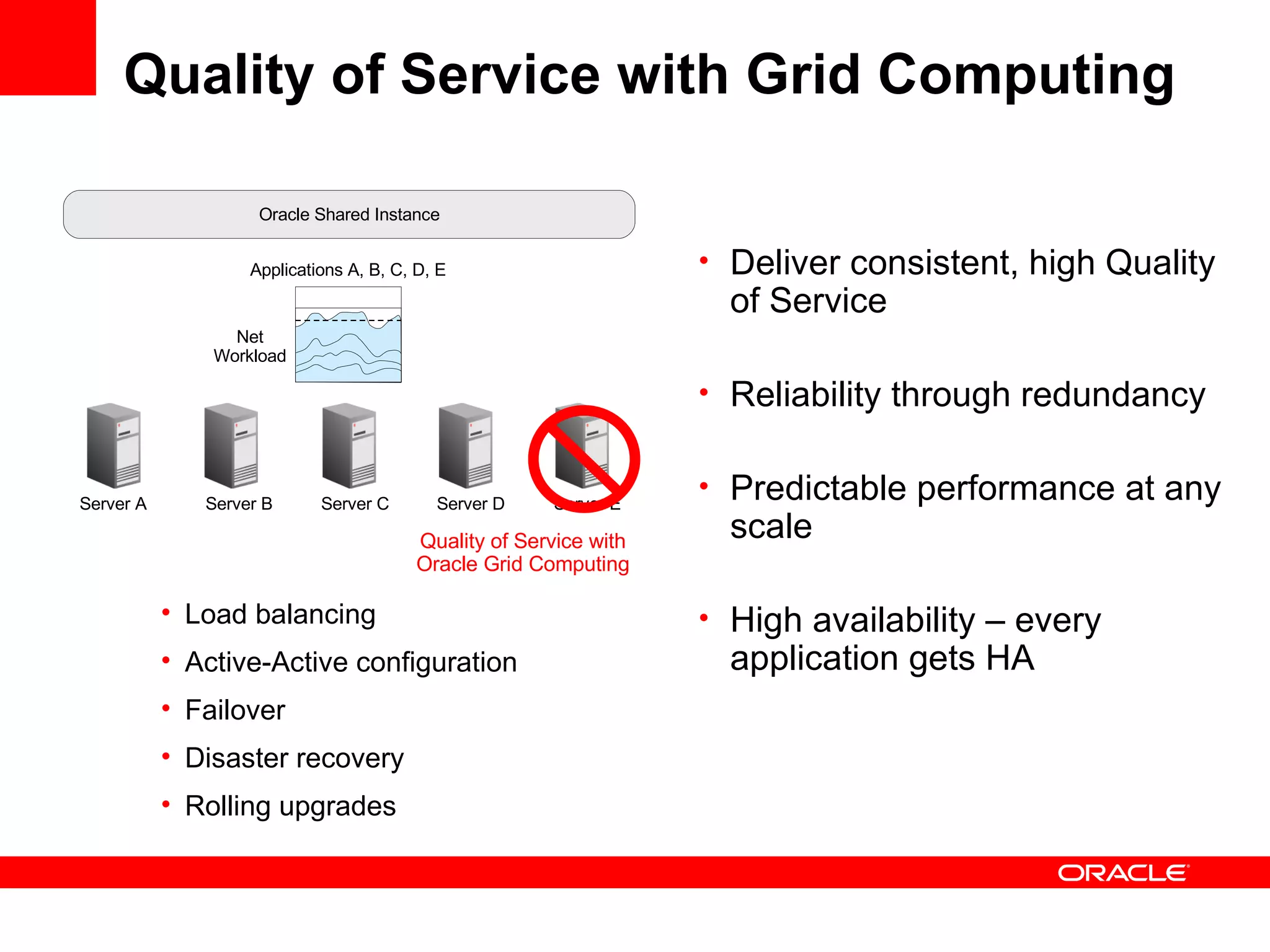
Quality of Service with Grid Computing Applications A, B, C, D, E Net Workload Deliver consistent, high Quality of Service Reliability through redundancy Predictable performance at any scale High availability – every application gets HA Oracle Shared Instance Server A Server B Server C Server D Load balancing Active-Active configuration Failover Disaster recovery Rolling upgrades Quality of Service with Oracle Grid Computing Server E
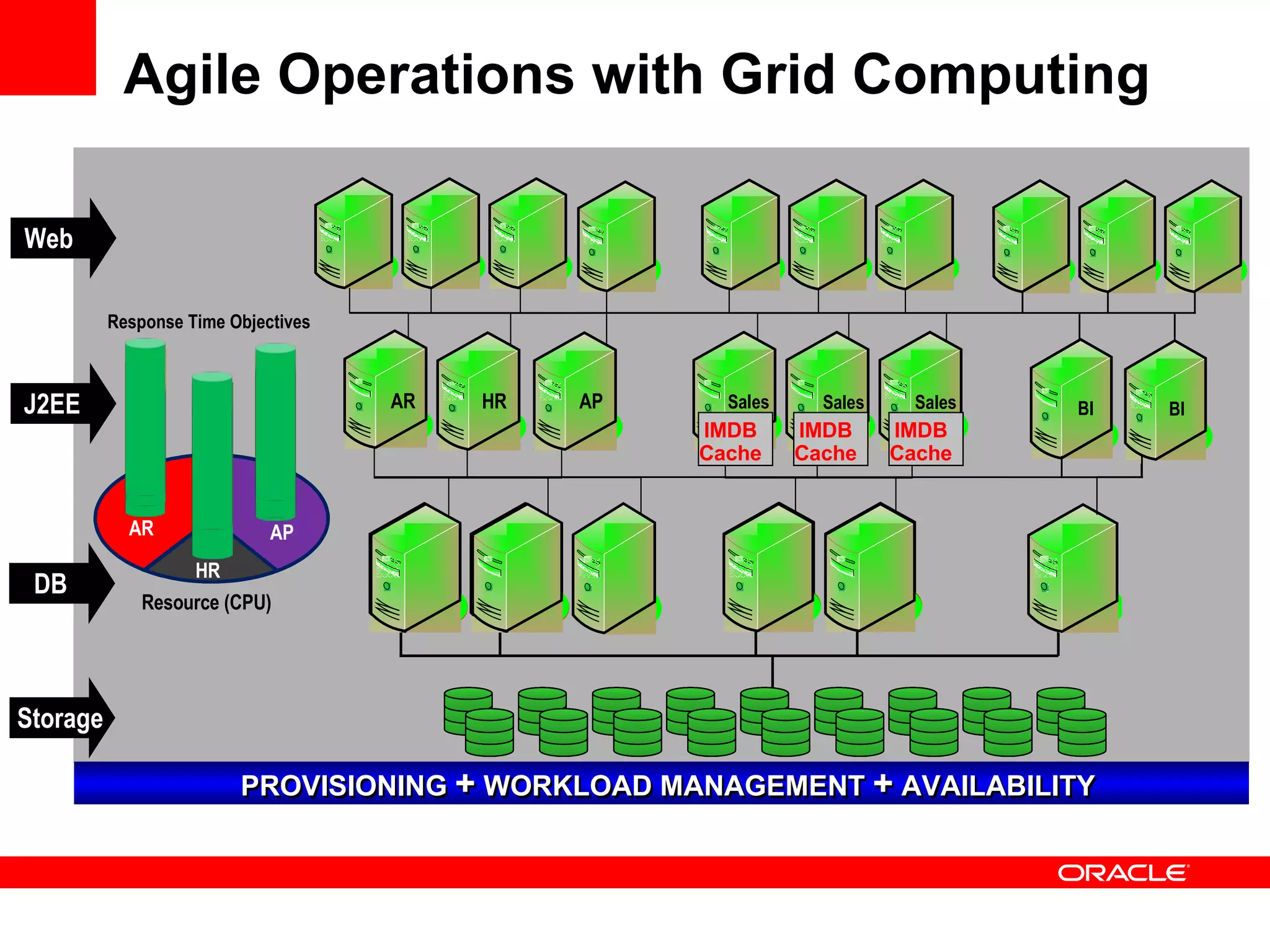
Agile Operations with Grid Computing AR AP HR AR HR AP Resource (CPU) Web J2EE DB PROVISIONING  +  WORKLOAD MANAGEMENT  +  AVAILABILITY Storage AP AR HR Sales Sales Sales BI BI PROVISIONING  +  WORKLOAD MANAGEMENT  +  AVAILABILITY Response Time Objectives IMDB Cache IMDB Cache IMDB Cache
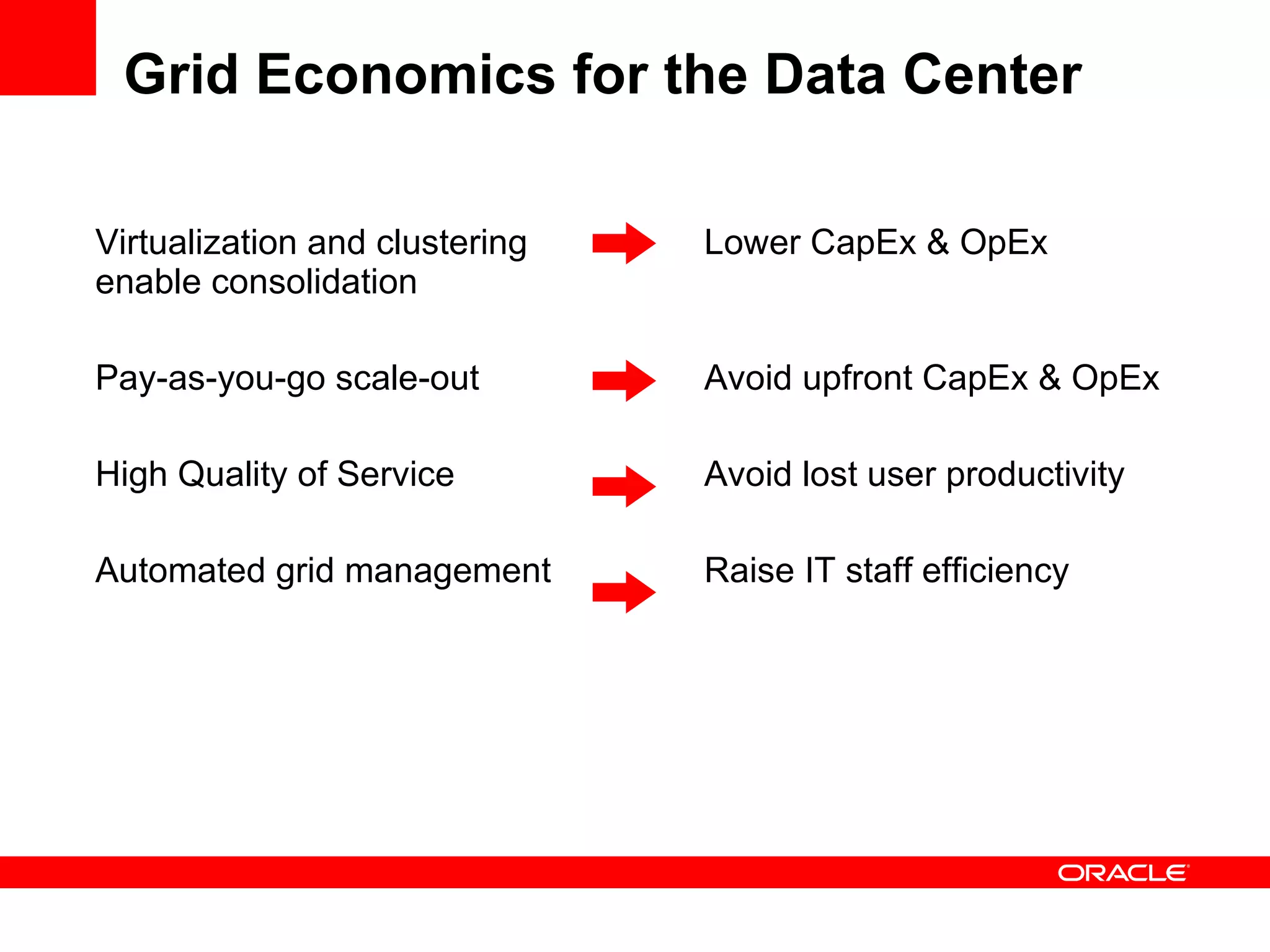
Grid Economics for the Data Center Virtualization and clustering enable consolidation Pay-as-you-go scale-out High Quality of Service Automated grid management Lower CapEx & OpEx Avoid upfront CapEx & OpEx Avoid lost user productivity Raise IT staff efficiency
 

Grid Economics for the Data Center

  • 1.
    Grid Economics forthe Data Center Rex Wang VP Product Marketing, Oracle
  • 2.
    The following isintended to outline our general product direction. It is intended for information purposes only, and may not be incorporated into any contract. It is not a commitment to deliver any material, code, or functionality, and should not be relied upon in making purchasing decisions. The development, release, and timing of any features or functionality described for Oracle’s products remains at the sole discretion of Oracle.
  • 3.
    The Traditional DataCenter Dedicated silos are inefficient Sized for peak load Constrained performance Difficult to scale Expensive to manage Dedicated Stacks Middleware Database Storage
  • 4.
    Grid Computing Virtualizesand Pools IT Resources What is Grid Computing? Grid computing is a technology architecture that virtualizes and pools IT resources, such as compute power, storage and network capacity into a set of shared services that can be distributed and re-distributed as needed
  • 5.
    Oracle Grid Computingin All Tiers Middleware Application Grid WebLogic Server Coherence In-Memory Data Grid JRockit Real Time Tuxedo Database In-Memory Database Cache Real Application Clusters Storage Automatic Storage Management Exadata Storage Server HP Oracle Database Machine Infrastructure Oracle VM Management Oracle Enterprise Manager Grid Control Most complete, open and integrated grid computing architecture in the industry
  • 6.
  • 7.
    Consolidation With GridComputing Server A Server B Server C Server D Application A Application B Application C Application D Workload Avg Utilization <20% Applications A, B, C, D, E Net Workload Avg Utilization 70% Freed capacity to deploy elsewhere Consolidate with Oracle Grid Computing Take advantage of complementary workload peaks Higher utilization rates and efficiency Lower CapEx & OpEx Green footprint Oracle Shared Instance Server E Application E Server A Server B Server C Server D Server E
  • 8.
    Scale Out WithGrid Computing Applications A, B, C, D, E Net Workload If utilization too high, increase capacity Pay-as-you-go scale-out Smaller machines running at higher utilization Revolutionary capacity planning Avoid upfront CapEx and ongoing OpEx Take advantage of advances in hardware price-performance and energy efficiency World-class clustering at all levels of the stack: middleware, database, storage Oracle Shared Instance Server A Server B Server C Server D Add/Remove nodes to the cluster dynamically Scale linearly to hundreds of nodes Performance through parallelization Scale out with Oracle Grid Computing
  • 9.
    Quality of Servicewith Grid Computing Applications A, B, C, D, E Net Workload Deliver consistent, high Quality of Service Reliability through redundancy Predictable performance at any scale High availability – every application gets HA Oracle Shared Instance Server A Server B Server C Server D Load balancing Active-Active configuration Failover Disaster recovery Rolling upgrades Quality of Service with Oracle Grid Computing Server E
  • 10.
    Agile Operations withGrid Computing AR AP HR AR HR AP Resource (CPU) Web J2EE DB PROVISIONING + WORKLOAD MANAGEMENT + AVAILABILITY Storage AP AR HR Sales Sales Sales BI BI PROVISIONING + WORKLOAD MANAGEMENT + AVAILABILITY Response Time Objectives IMDB Cache IMDB Cache IMDB Cache
  • 11.
    Grid Economics forthe Data Center Virtualization and clustering enable consolidation Pay-as-you-go scale-out High Quality of Service Automated grid management Lower CapEx & OpEx Avoid upfront CapEx & OpEx Avoid lost user productivity Raise IT staff efficiency
  • 12.

Editor's Notes

  • #2 Welcome to this session about Grid Economics for the Data Center. Today I’m going to be talking about how Oracle’s technology strategy, and particularly it’s Grid technologies, can help transform an Enterprise data center. I’ll be using examples of real customer implementations in this presentation to illustrate what can be achieved today in terms of resulting technical and business benefits.