What works and what doesn’t work
        in research dissemination


Terese Bird, Learning Technologist & SCORE Research Fellow
                   University of Leicester
 University of South Africa, Pretoria, 13 June 2012
What will we talk about?
1. Collaborate and disseminate as you go
    ‘Closed’ doesn’t work
    Funder requirements
    Examples of sharing data along the way
    Examples of academics – ‘blogging plus’
    Tools
2. Open Research
     Open research issues - affordability, inequality
   Research Impact is greater when we open it up
   Metrics from Leicester LRA
   Metrics from outside Leicester
3. How to start
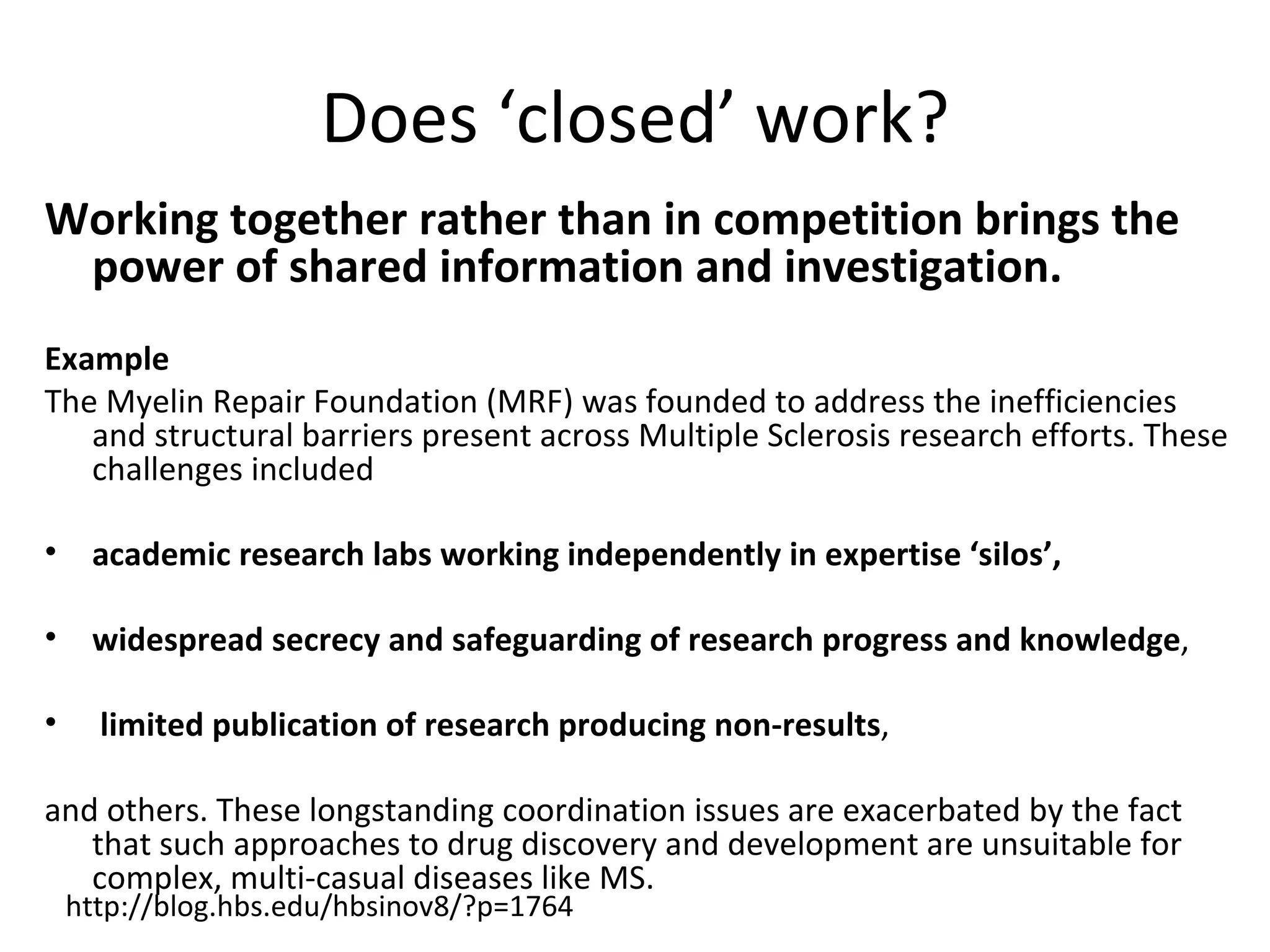
1.Collaborate & disseminate as you go


                 Cann, A., Dimitriou, K., and Hooley, T. (2011), p15
Does ‘closed’ work?
Working together rather than in competition brings the
 power of shared information and investigation.
Example
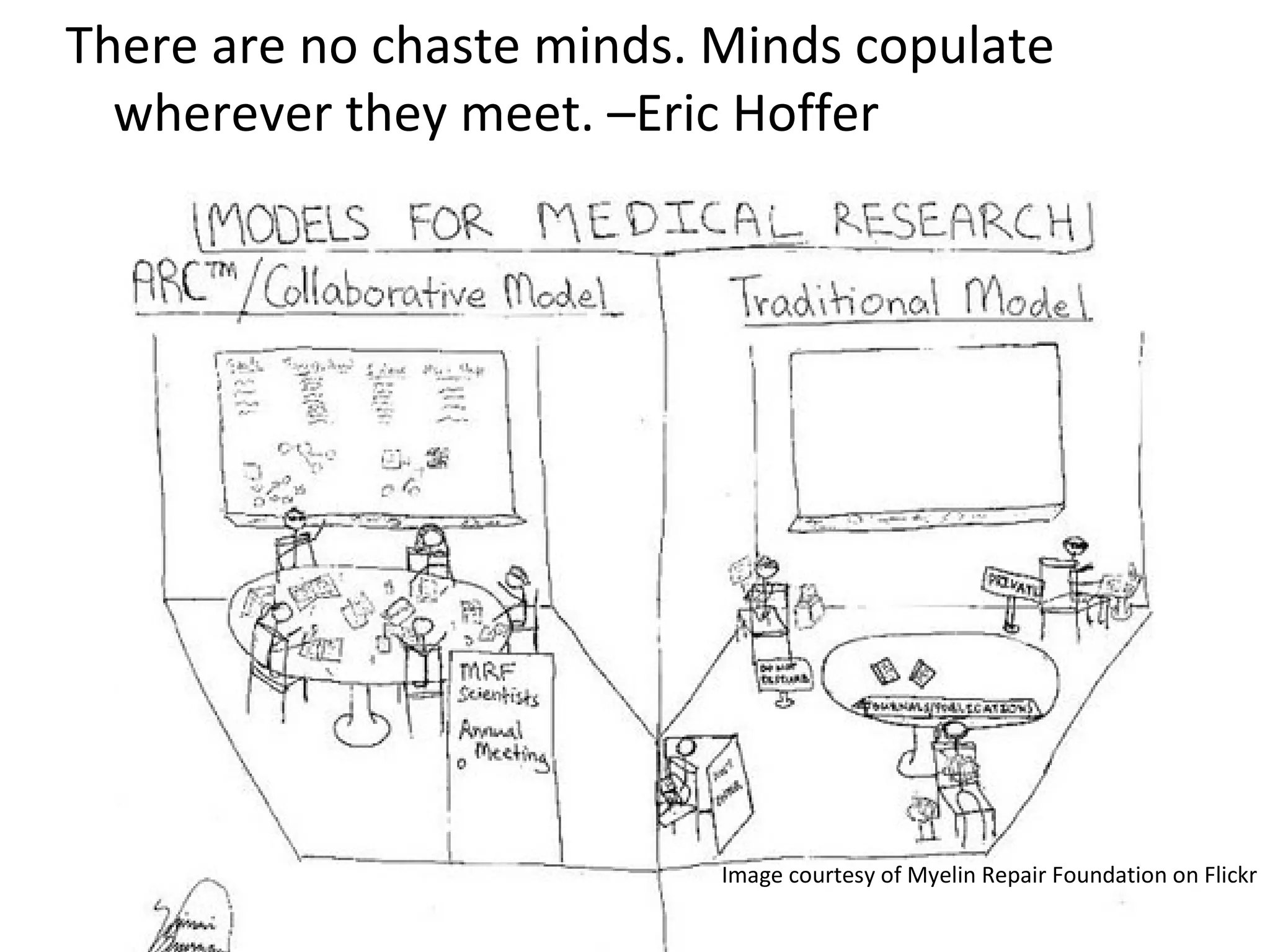
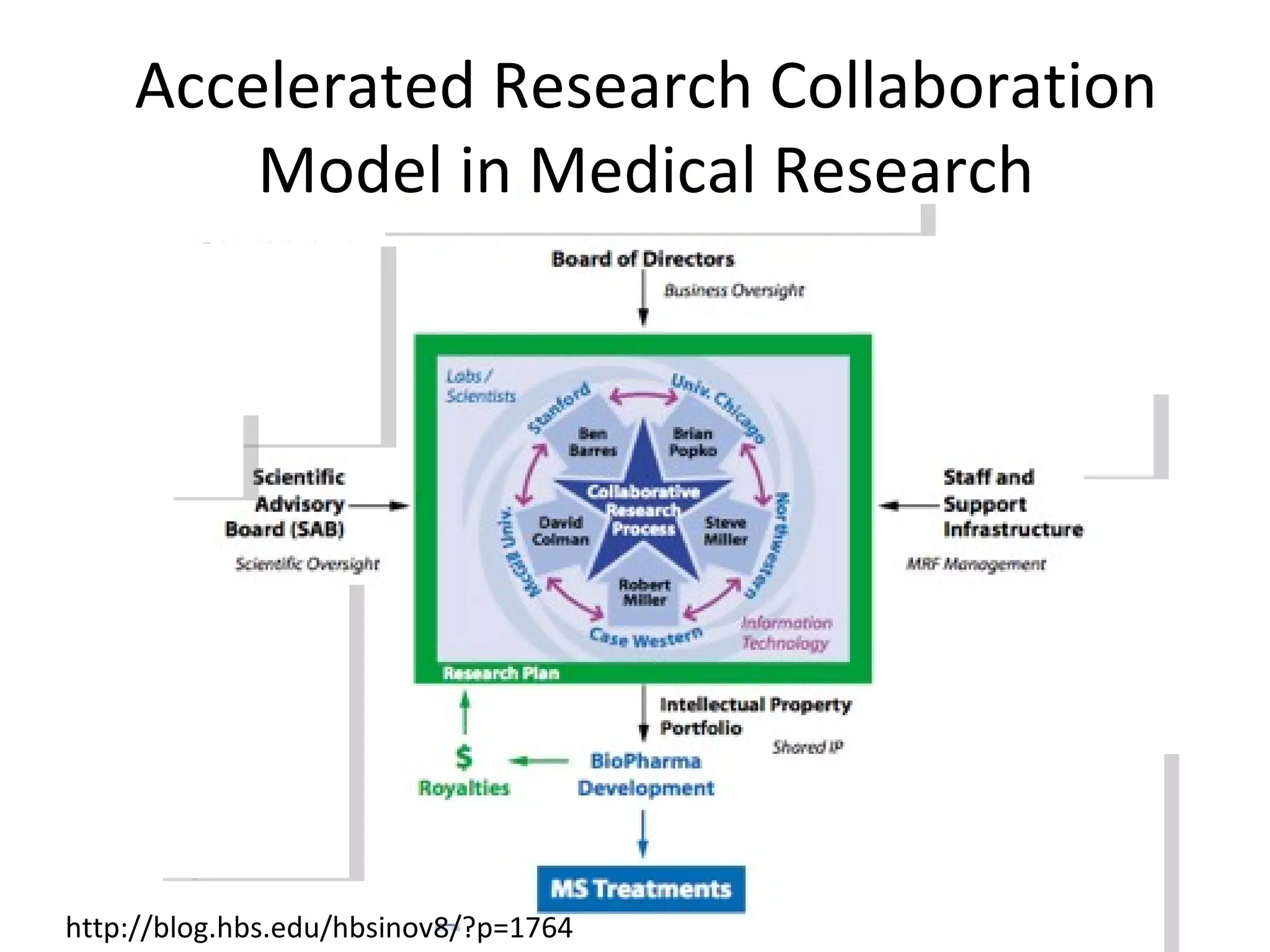
The Myelin Repair Foundation (MRF) was founded to address the inefficiencies
   and structural barriers present across Multiple Sclerosis research efforts. These
   challenges included

•    academic research labs working independently in expertise ‘silos’,

•    widespread secrecy and safeguarding of research progress and knowledge,

•     limited publication of research producing non-results,

and others. These longstanding coordination issues are exacerbated by the fact
   that such approaches to drug discovery and development are unsuitable for
   complex, multi-casual diseases like MS.
    http://blog.hbs.edu/hbsinov8/?p=1764
There are no chaste minds. Minds copulate
  wherever they meet. –Eric Hoffer


                           Image courtesy of Myelin Repair Foundation on Flickr
Funder Requirements
JISC now requires ‘disseminate as you go’ and
   ‘disseminate from day one’

“Dissemination informs the community about
  what you have developed and the benefits of
  using it” - JISC
How does one collaborate and
        disseminate as you go?
• Share findings as you go
• Project website
• Academic blog
  – Open research notebook
  – journaling what happens in practice
  – Recording encountered risks, different from the
    original project timelines
  – Air new ideas, see reaction, discuss
• Invite to your site (Twitter, Google+, Facebook)
• Share presentations on Slideshare
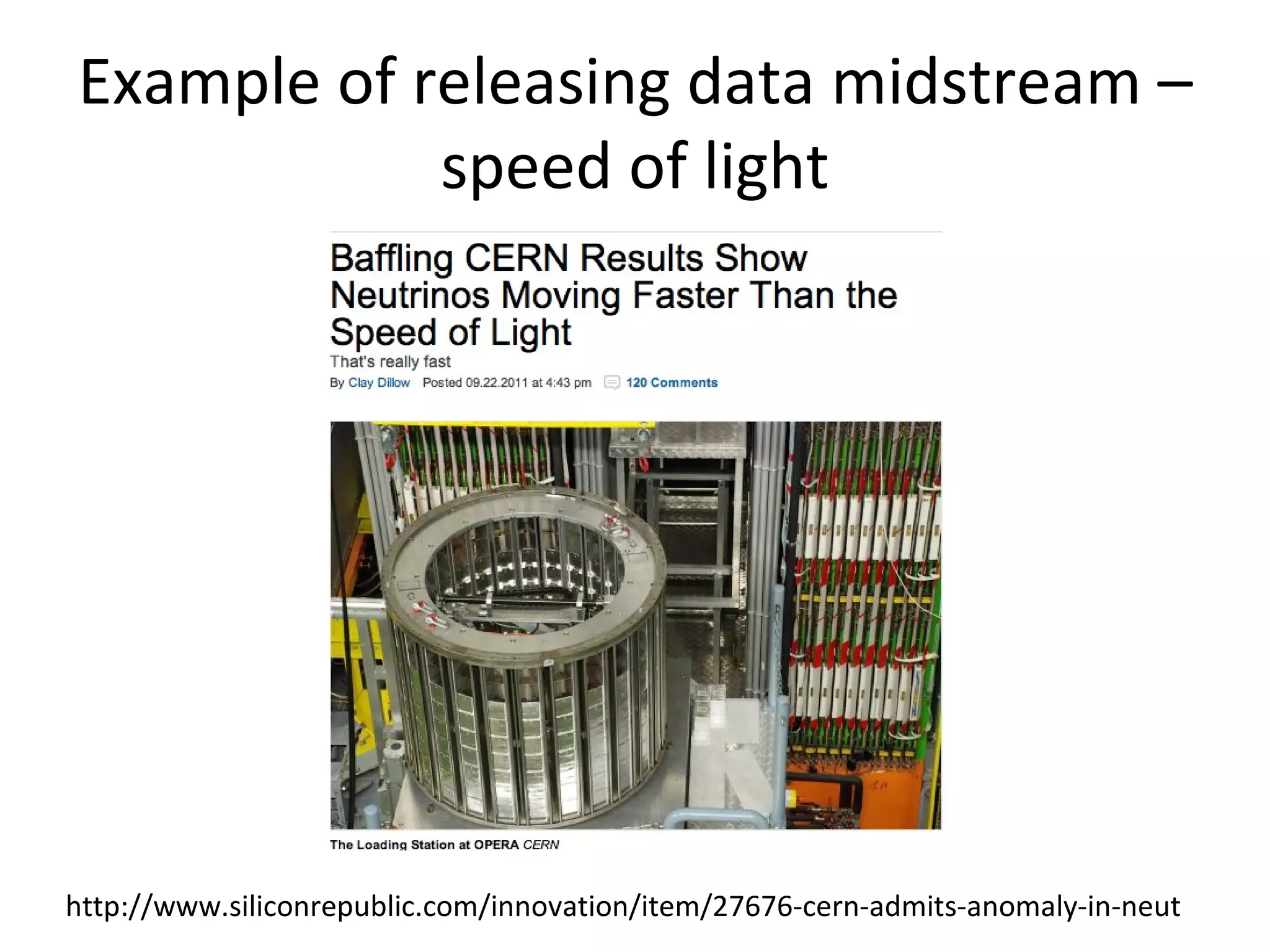
Example of releasing data midstream –
            speed of light


http://www.siliconrepublic.com/innovation/item/27676-cern-admits-anomaly-in-neut
Accelerated Research Collaboration
        Model in Medical Research


http://blog.hbs.edu/hbsinov8/?p=1764
Risks???
Risks
• Stealing ‘but I might have stolen them to start with’. We
  don’t always attribute.
• Sharing simply not allowed- industrial funder.
• Someone may misinterpret your idea, misuse your idea.
  Even safety issues.
• Social Sci – incorrectly attribute causality
• Ethical – exposing data you shouldn’t expose
• Steal your thunder just before you show your stuff
• Is the user interested in half-baked stuff?
• Only brownie points for journal articles, not blogs
• We don’t want to see blogs as references, not peer-
  reviewed
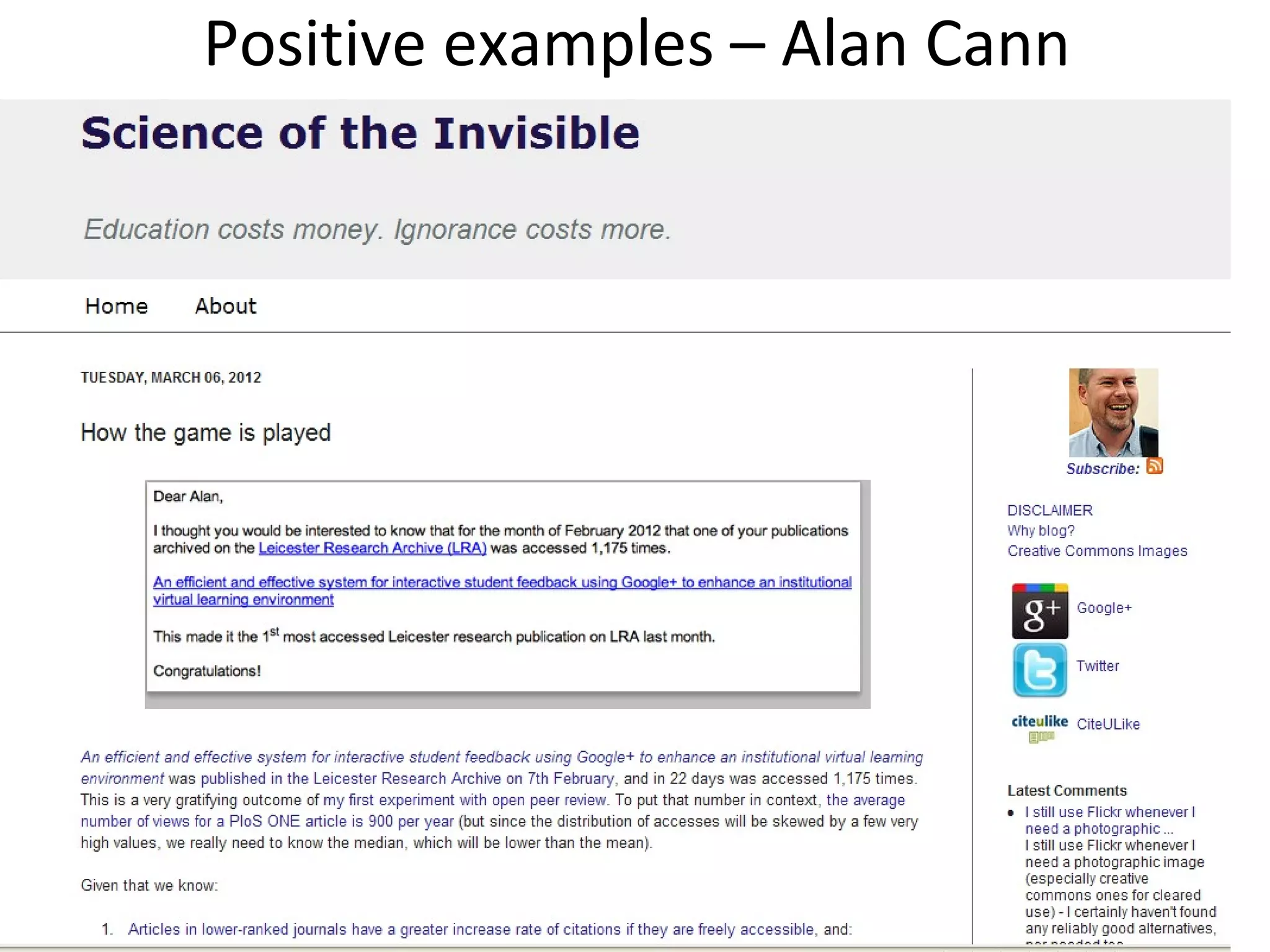
Positive examples – Alan Cann
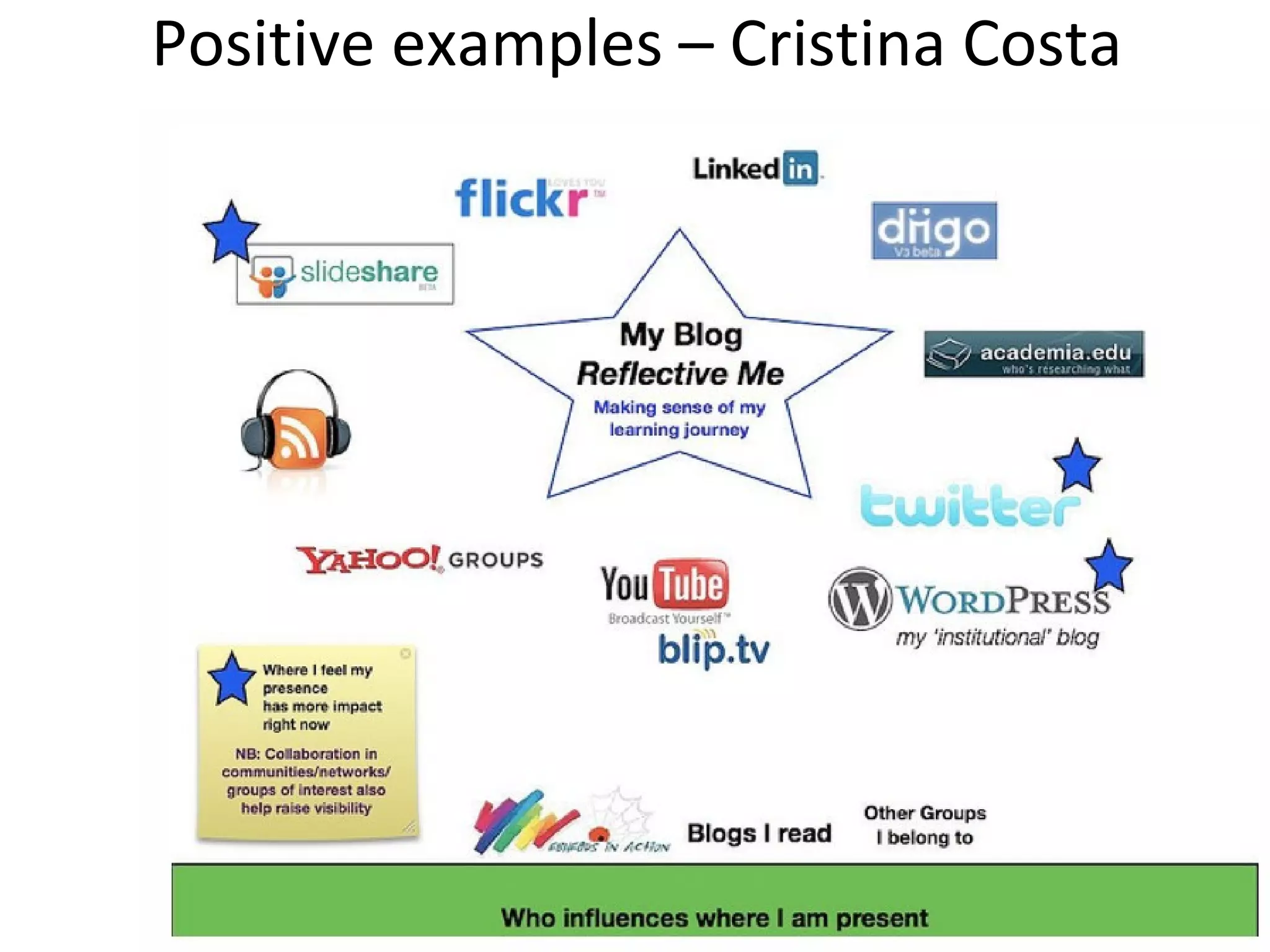
Positive examples – Cristina Costa
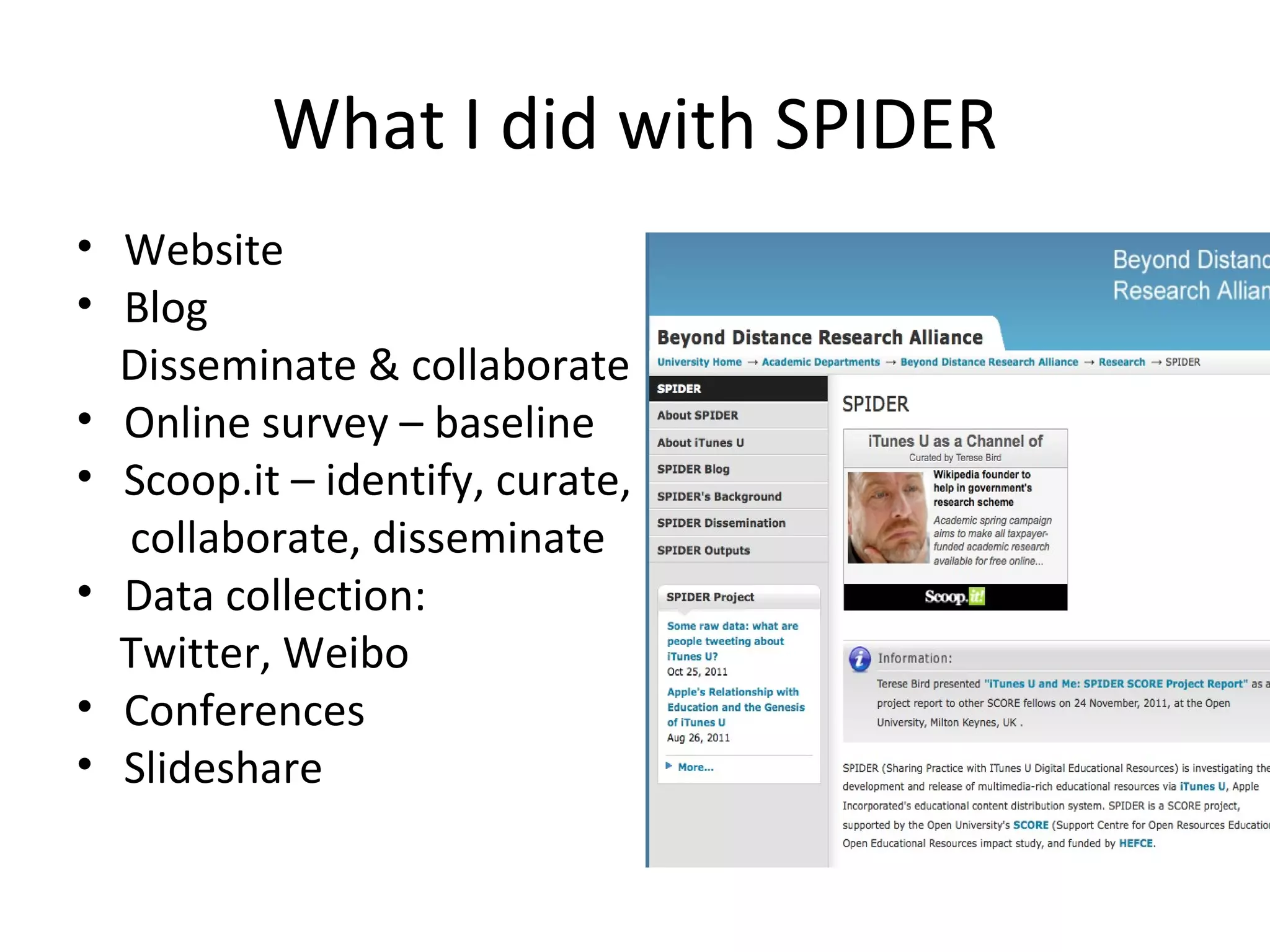
What I did with SPIDER
• Website
• Blog
  Disseminate & collaborate
• Online survey – baseline
• Scoop.it – identify, curate,
  collaborate, disseminate
• Data collection:
  Twitter, Weibo
• Conferences
• Slideshare
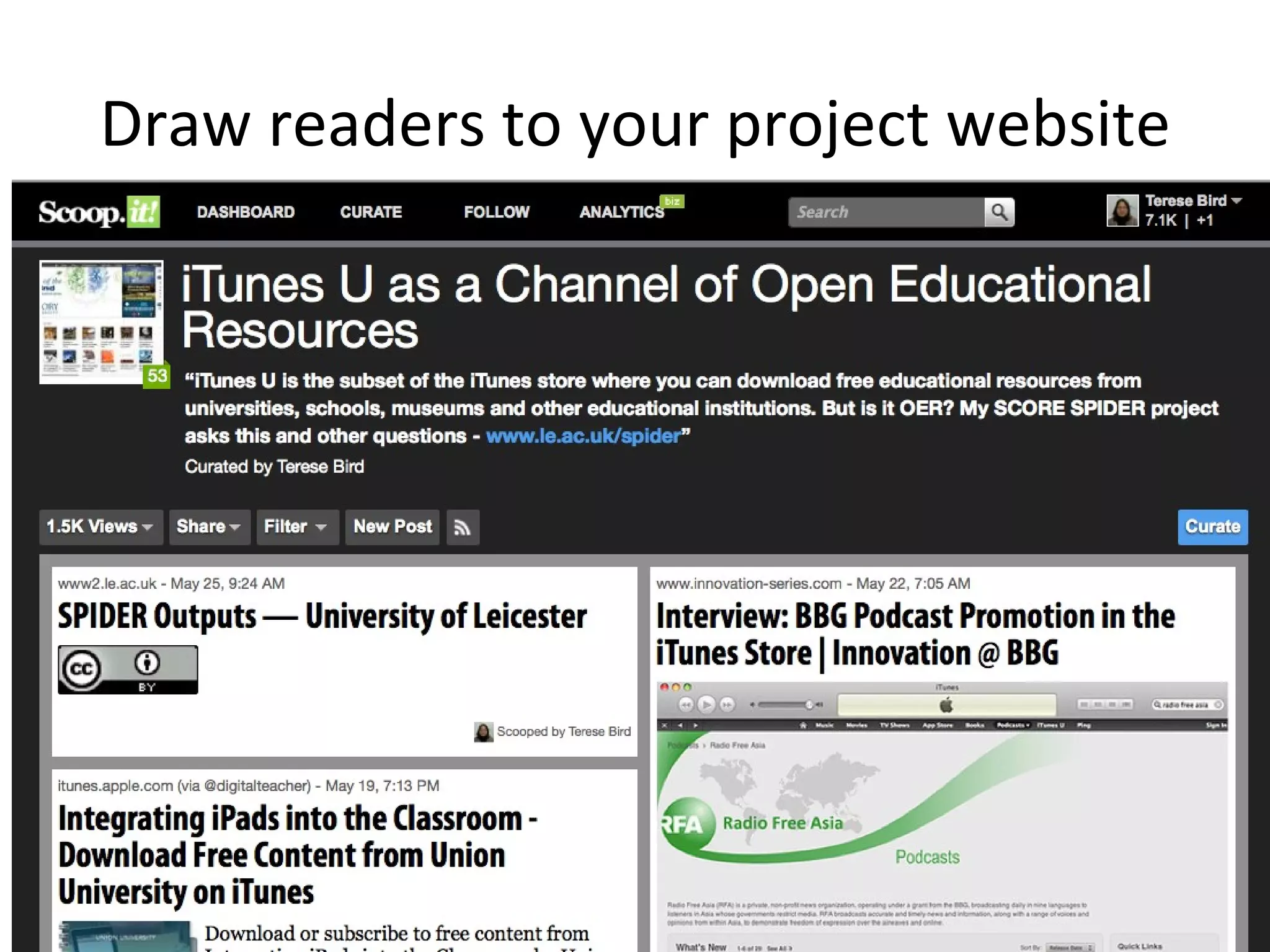
Draw readers to your project website
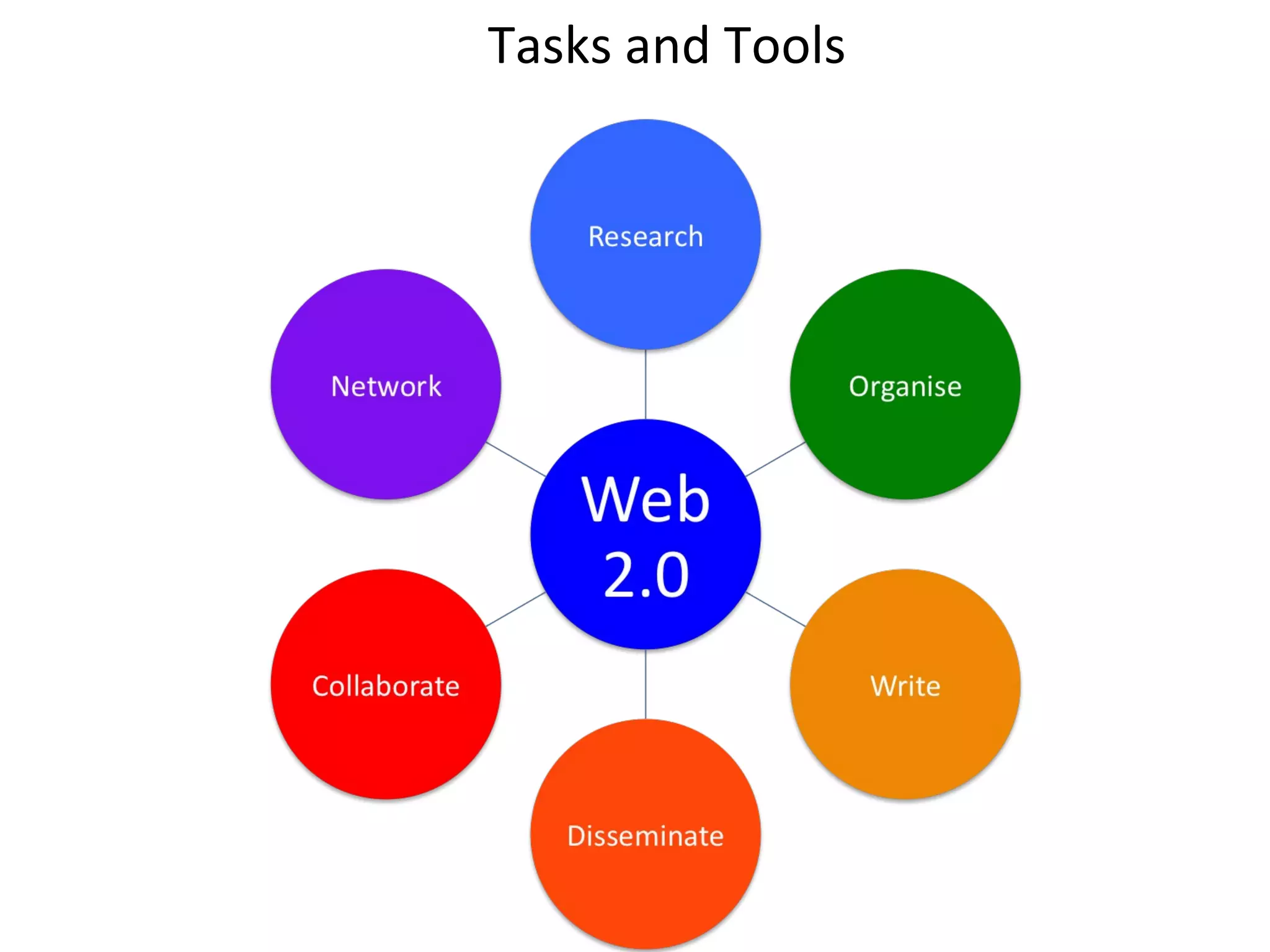
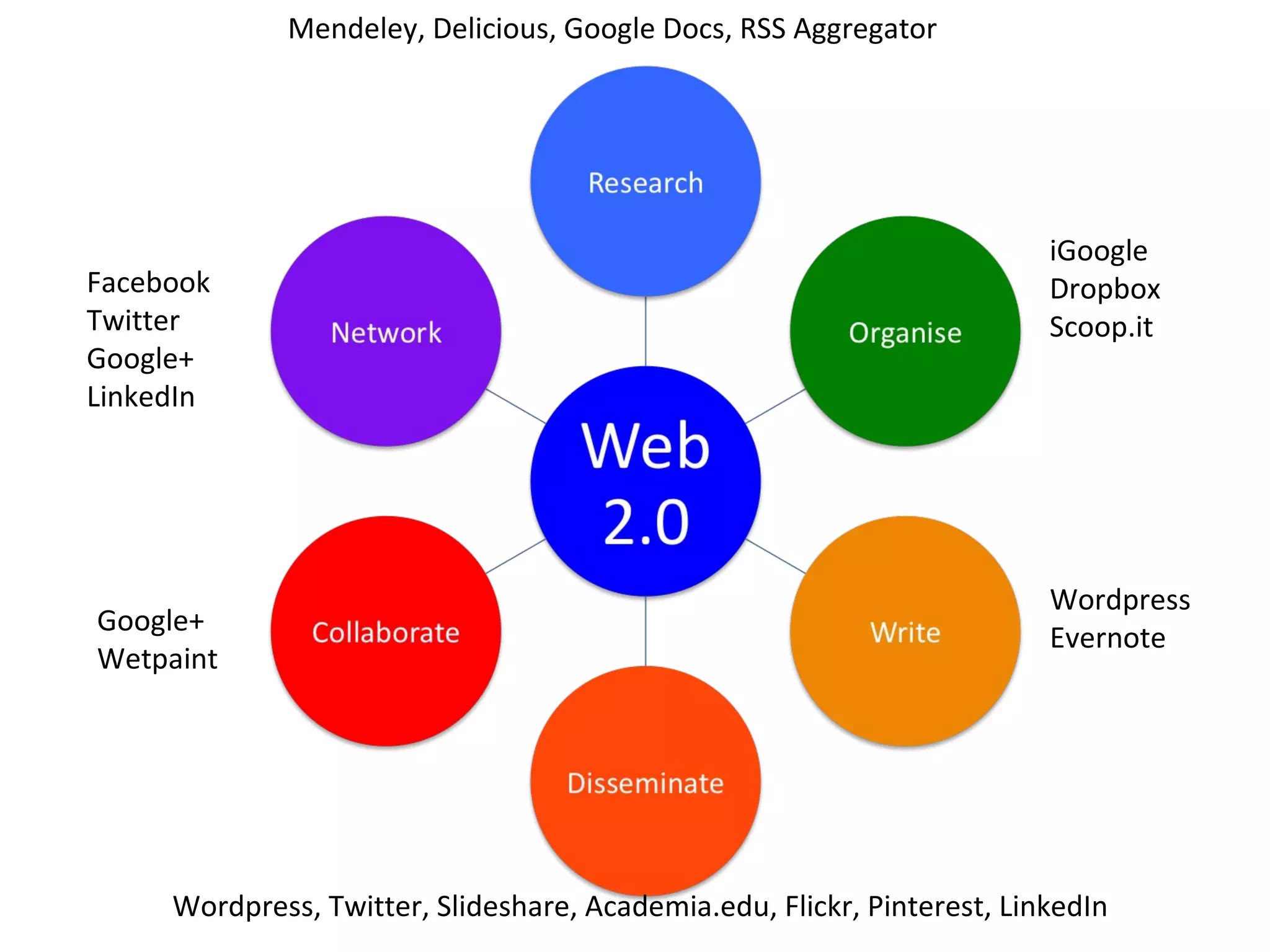
Tasks and Tools
Mendeley, Delicious, Google Docs, RSS Aggregator


                                                                         iGoogle
Facebook                                                                 Dropbox
Twitter                                                                  Scoop.it
Google+
LinkedIn


                                                                         Wordpress
Google+
                                                                         Evernote
Wetpaint


     Wordpress, Twitter, Slideshare, Academia.edu, Flickr, Pinterest, LinkedIn
2. Open Research
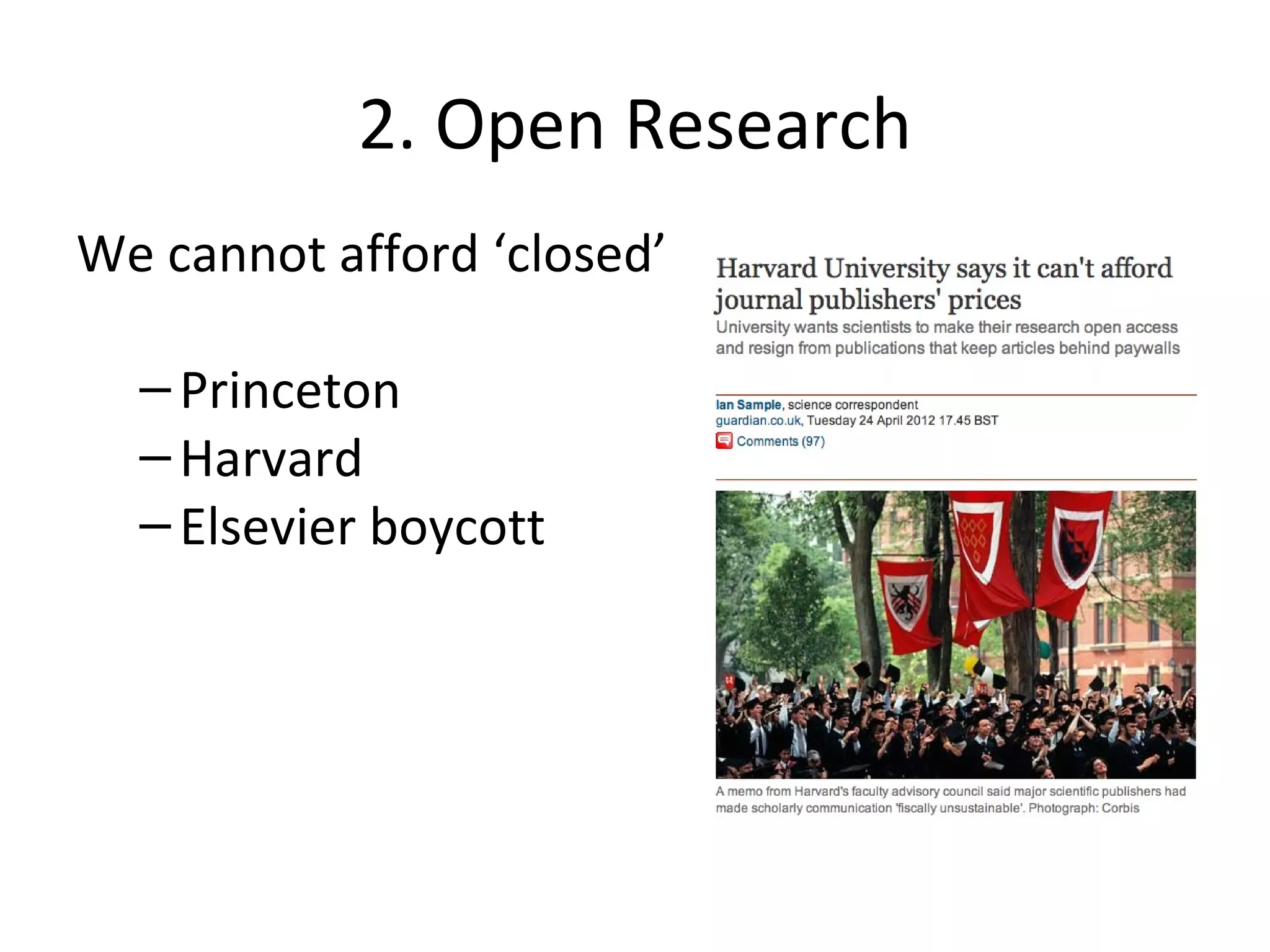
We cannot afford ‘closed’

  – Princeton
  – Harvard
  – Elsevier boycott
UK Open Access Implementation
            Group Reports
The UK public sector already saves ÂŁ28.6 million by using open
  access.
 Both the public sector and the voluntary sector would see
  further direct and indirect benefits from increased access
  to UK higher education research publications. Already,
  more Voluntary and Community Sector (VCS) organisations
  use open access than pay for subscriptions
The UK public sector spends ÂŁ135 million a year, made up of
  subscriptions and time spent trying to find articles,
  accessing the journal papers it needs to perform
  effectively. Each extra 5% of journal papers accessed via
  open access on the web would save the public purse ÂŁ1.7
  million, even if no subscription fees were to be saved.

<http://ie-repository.jisc.ac.uk/575/
Leicester Research Archive Example
• Traditional printed PhD thesis is read a total of
  4 times over the life of the academic (avg)
• Leicester Research Archive: most theses are
  downloaded 10-40x monthly (avg)
• Top 10 LRA accesses in 2011 were PhD theses:
  – 1772 accesses for the number 1
   – 1584 accesses for the number 3
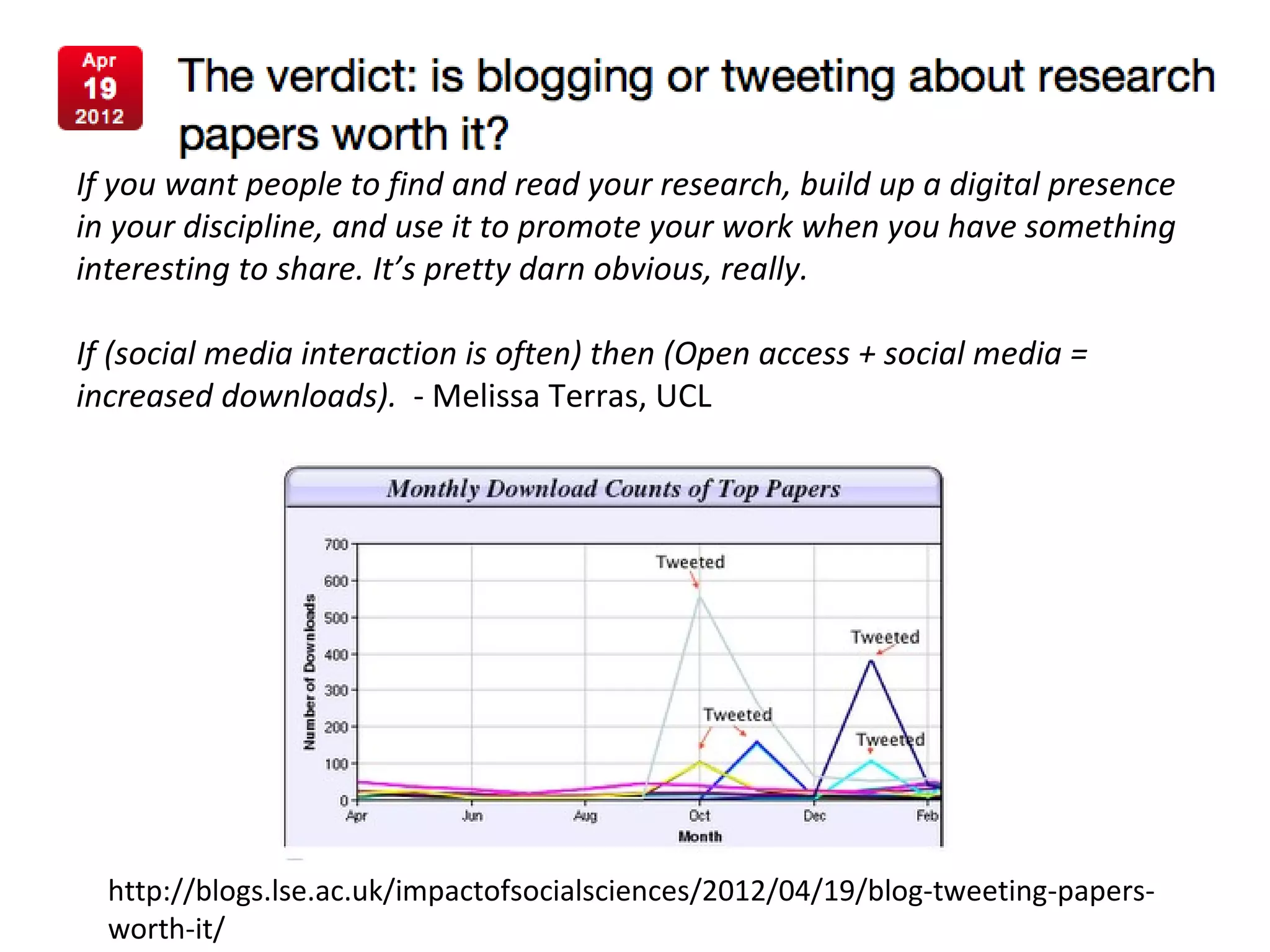
If you want people to find and read your research, build up a digital presence
in your discipline, and use it to promote your work when you have something
interesting to share. It’s pretty darn obvious, really.

If (social media interaction is often) then (Open access + social media =
increased downloads). - Melissa Terras, UCL


  http://blogs.lse.ac.uk/impactofsocialsciences/2012/04/19/blog-tweeting-papers-
  worth-it/
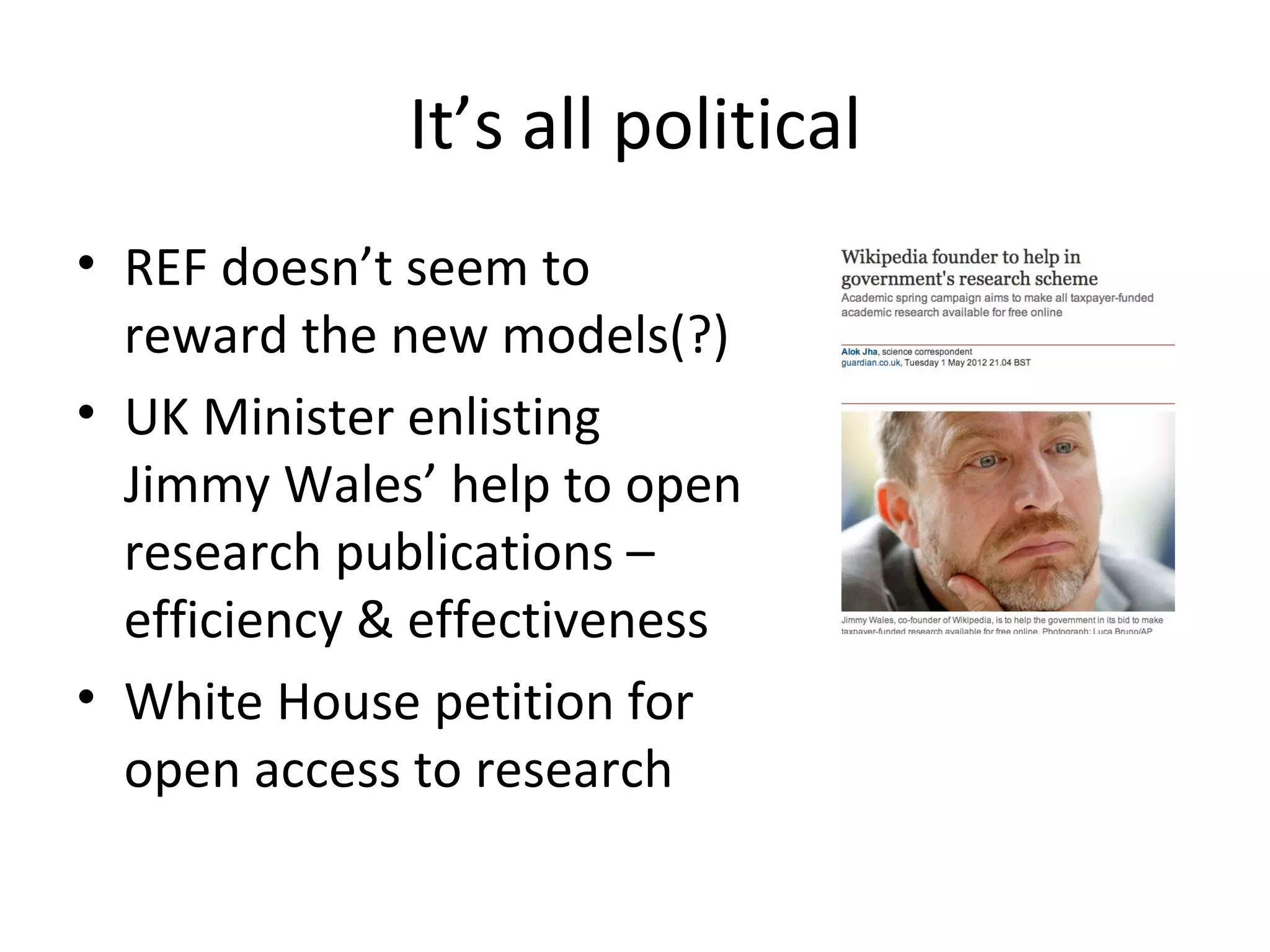
It’s all political
• REF doesn’t seem to
  reward the new models(?)
• UK Minister enlisting
  Jimmy Wales’ help to open
  research publications –
  efficiency & effectiveness
• White House petition for
  open access to research
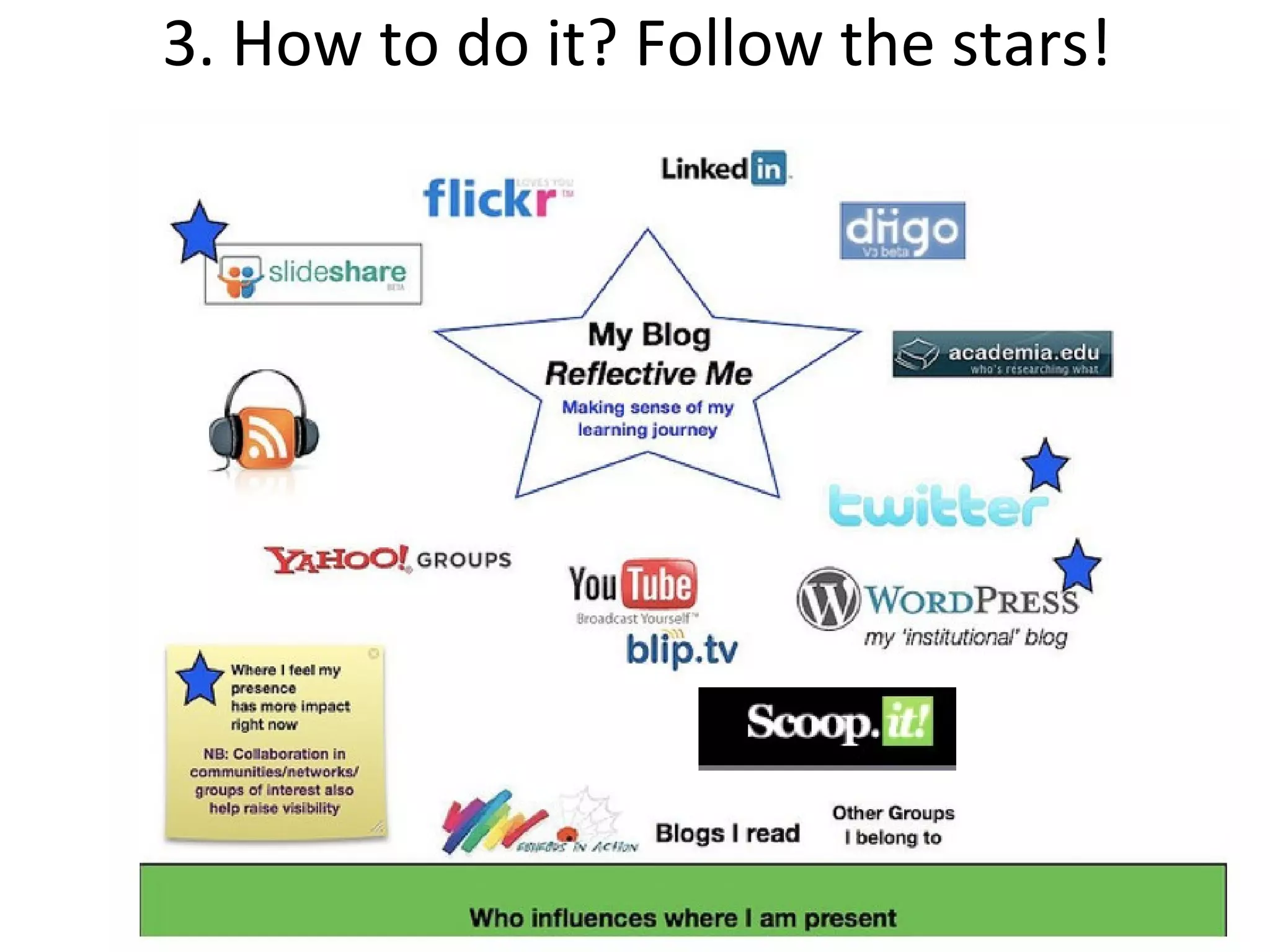
3. How to do it? Follow the stars!
It’s in your hands!
                        Thank you!


Cann, A., Dimitriou, K., Hooley, T. (2011) Social media: a guide for
researchers. 15.

What works and doesn't work in research dissemination

  • 1.
    What works andwhat doesn’t work in research dissemination Terese Bird, Learning Technologist & SCORE Research Fellow University of Leicester University of South Africa, Pretoria, 13 June 2012
  • 2.
    What will wetalk about? 1. Collaborate and disseminate as you go ‘Closed’ doesn’t work Funder requirements Examples of sharing data along the way Examples of academics – ‘blogging plus’ Tools 2. Open Research Open research issues - affordability, inequality Research Impact is greater when we open it up Metrics from Leicester LRA Metrics from outside Leicester 3. How to start
  • 3.
    1.Collaborate & disseminateas you go Cann, A., Dimitriou, K., and Hooley, T. (2011), p15
  • 4.
    Does ‘closed’ work? Workingtogether rather than in competition brings the power of shared information and investigation. Example The Myelin Repair Foundation (MRF) was founded to address the inefficiencies and structural barriers present across Multiple Sclerosis research efforts. These challenges included • academic research labs working independently in expertise ‘silos’, • widespread secrecy and safeguarding of research progress and knowledge, • limited publication of research producing non-results, and others. These longstanding coordination issues are exacerbated by the fact that such approaches to drug discovery and development are unsuitable for complex, multi-casual diseases like MS. http://blog.hbs.edu/hbsinov8/?p=1764
  • 5.
    There are nochaste minds. Minds copulate wherever they meet. –Eric Hoffer Image courtesy of Myelin Repair Foundation on Flickr
  • 6.
    Funder Requirements JISC nowrequires ‘disseminate as you go’ and ‘disseminate from day one’ “Dissemination informs the community about what you have developed and the benefits of using it” - JISC
  • 7.
    How does onecollaborate and disseminate as you go? • Share findings as you go • Project website • Academic blog – Open research notebook – journaling what happens in practice – Recording encountered risks, different from the original project timelines – Air new ideas, see reaction, discuss • Invite to your site (Twitter, Google+, Facebook) • Share presentations on Slideshare
  • 8.
    Example of releasingdata midstream – speed of light http://www.siliconrepublic.com/innovation/item/27676-cern-admits-anomaly-in-neut
  • 10.
    Accelerated Research Collaboration Model in Medical Research http://blog.hbs.edu/hbsinov8/?p=1764
  • 11.
  • 12.
    Risks • Stealing ‘butI might have stolen them to start with’. We don’t always attribute. • Sharing simply not allowed- industrial funder. • Someone may misinterpret your idea, misuse your idea. Even safety issues. • Social Sci – incorrectly attribute causality • Ethical – exposing data you shouldn’t expose • Steal your thunder just before you show your stuff • Is the user interested in half-baked stuff? • Only brownie points for journal articles, not blogs • We don’t want to see blogs as references, not peer- reviewed
  • 13.
  • 16.
  • 17.
    What I didwith SPIDER • Website • Blog Disseminate & collaborate • Online survey – baseline • Scoop.it – identify, curate, collaborate, disseminate • Data collection: Twitter, Weibo • Conferences • Slideshare
  • 18.
    Draw readers toyour project website
  • 19.
  • 20.
    Mendeley, Delicious, GoogleDocs, RSS Aggregator iGoogle Facebook Dropbox Twitter Scoop.it Google+ LinkedIn Wordpress Google+ Evernote Wetpaint Wordpress, Twitter, Slideshare, Academia.edu, Flickr, Pinterest, LinkedIn
  • 21.
    2. Open Research Wecannot afford ‘closed’ – Princeton – Harvard – Elsevier boycott
  • 22.
    UK Open AccessImplementation Group Reports The UK public sector already saves ÂŁ28.6 million by using open access. Both the public sector and the voluntary sector would see further direct and indirect benefits from increased access to UK higher education research publications. Already, more Voluntary and Community Sector (VCS) organisations use open access than pay for subscriptions The UK public sector spends ÂŁ135 million a year, made up of subscriptions and time spent trying to find articles, accessing the journal papers it needs to perform effectively. Each extra 5% of journal papers accessed via open access on the web would save the public purse ÂŁ1.7 million, even if no subscription fees were to be saved. <http://ie-repository.jisc.ac.uk/575/
  • 23.
    Leicester Research ArchiveExample • Traditional printed PhD thesis is read a total of 4 times over the life of the academic (avg) • Leicester Research Archive: most theses are downloaded 10-40x monthly (avg) • Top 10 LRA accesses in 2011 were PhD theses: – 1772 accesses for the number 1 – 1584 accesses for the number 3
  • 24.
    If you wantpeople to find and read your research, build up a digital presence in your discipline, and use it to promote your work when you have something interesting to share. It’s pretty darn obvious, really. If (social media interaction is often) then (Open access + social media = increased downloads). - Melissa Terras, UCL http://blogs.lse.ac.uk/impactofsocialsciences/2012/04/19/blog-tweeting-papers- worth-it/
  • 25.
    It’s all political •REF doesn’t seem to reward the new models(?) • UK Minister enlisting Jimmy Wales’ help to open research publications – efficiency & effectiveness • White House petition for open access to research
  • 26.
    3. How todo it? Follow the stars!
  • 27.
    It’s in yourhands! Thank you! Cann, A., Dimitriou, K., Hooley, T. (2011) Social media: a guide for researchers. 15.

Editor's Notes

  • #4 Not like the old days of research, hold it all close, then just present at the end, write an article for a closed journal This is not the same way scientists are trained which is test first until it’s beyond dispute, then speak up (Martin Weller)
  • #9 CERN Research Director Sergio Bertolucci. &amp;quot;The story captured the public imagination, and has given people the opportunity to see the scientific method in action - an unexpected result was put up for scrutiny, thoroughly investigated and resolved in part thanks to collaboration between normally competing experiments. That&apos;s how science moves forward,&amp;quot; he added. Carmel Doyle |
  • #11 The Myelin Repair Foundation (MRF) was founded to address the inefficiencies and structural barriers present across Multiple Sclerosis research efforts. These challenges included academic research labs working independently in expertise ‘silos’, widespread secrecy and safeguarding of research progress and knowledge, a research emphasis towards uncovering novel findings versus making incremental progress on preexisting findings towards their applicability, limited publication of research producing non-results, publication delays due to intellectual property concerns, and others. These longstanding coordination issues are exacerbated by the fact that such approaches to drug discovery and development are unsuitable for complex, multi-casual diseases like MS. In response, the MRF established the Accelerated Research Collaboration (ARC) approach, which brought together several top labs with complementary skills suited to tackle the multi-disciplinary nature of MS, fostered the coordination between these labs and helped focus their efforts toward meaningful milestones, while providing useful oversight and resources. Although still early in its quest to accelerate MS research, the MRF’s ARC has shown quite positive results, and seems to have addressed the many structural barriers that were likely impeding the progress of research. Which leads us to consider — besides drug discovery, where else might such an approach be able to unlock huge value?
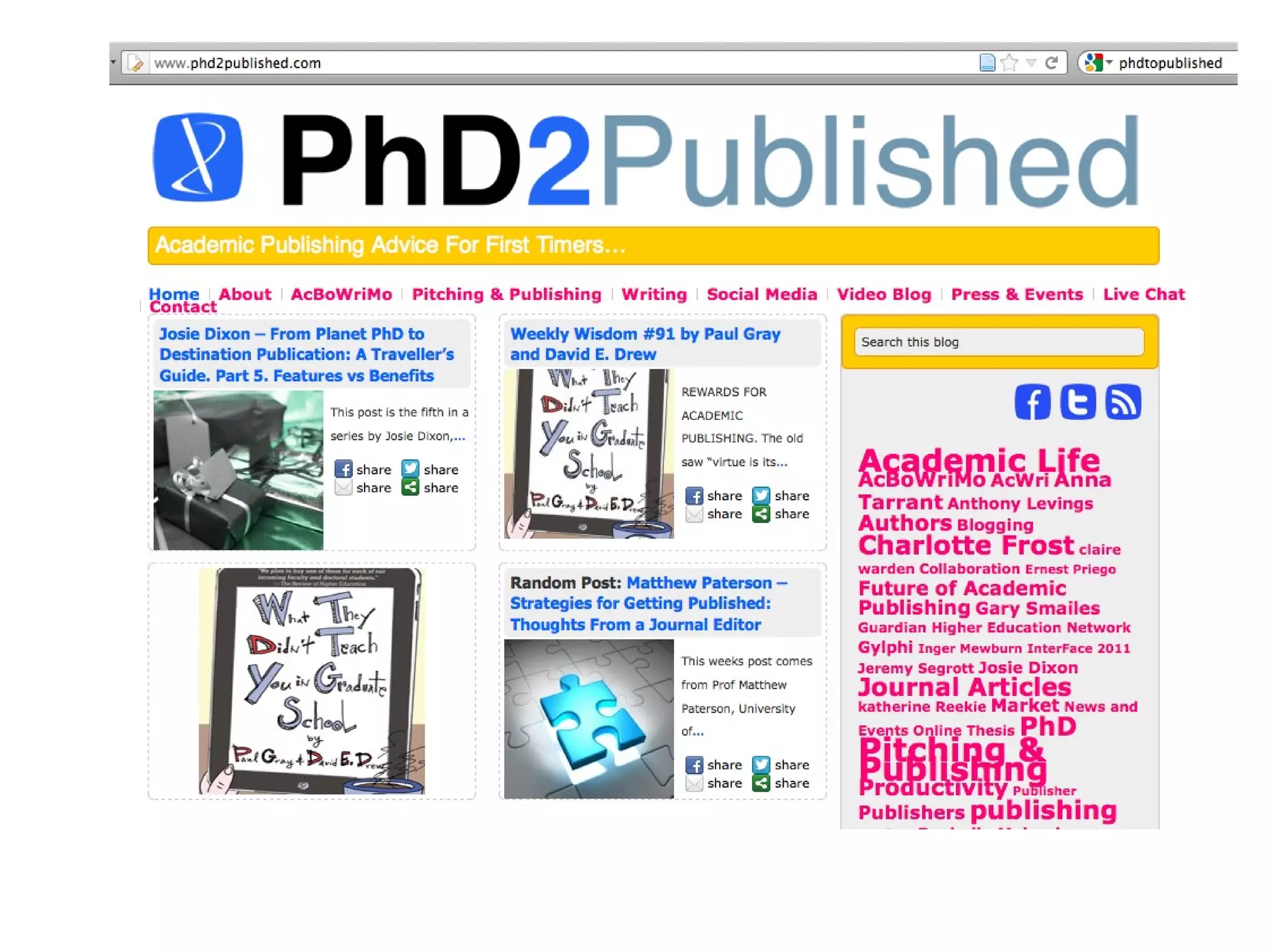
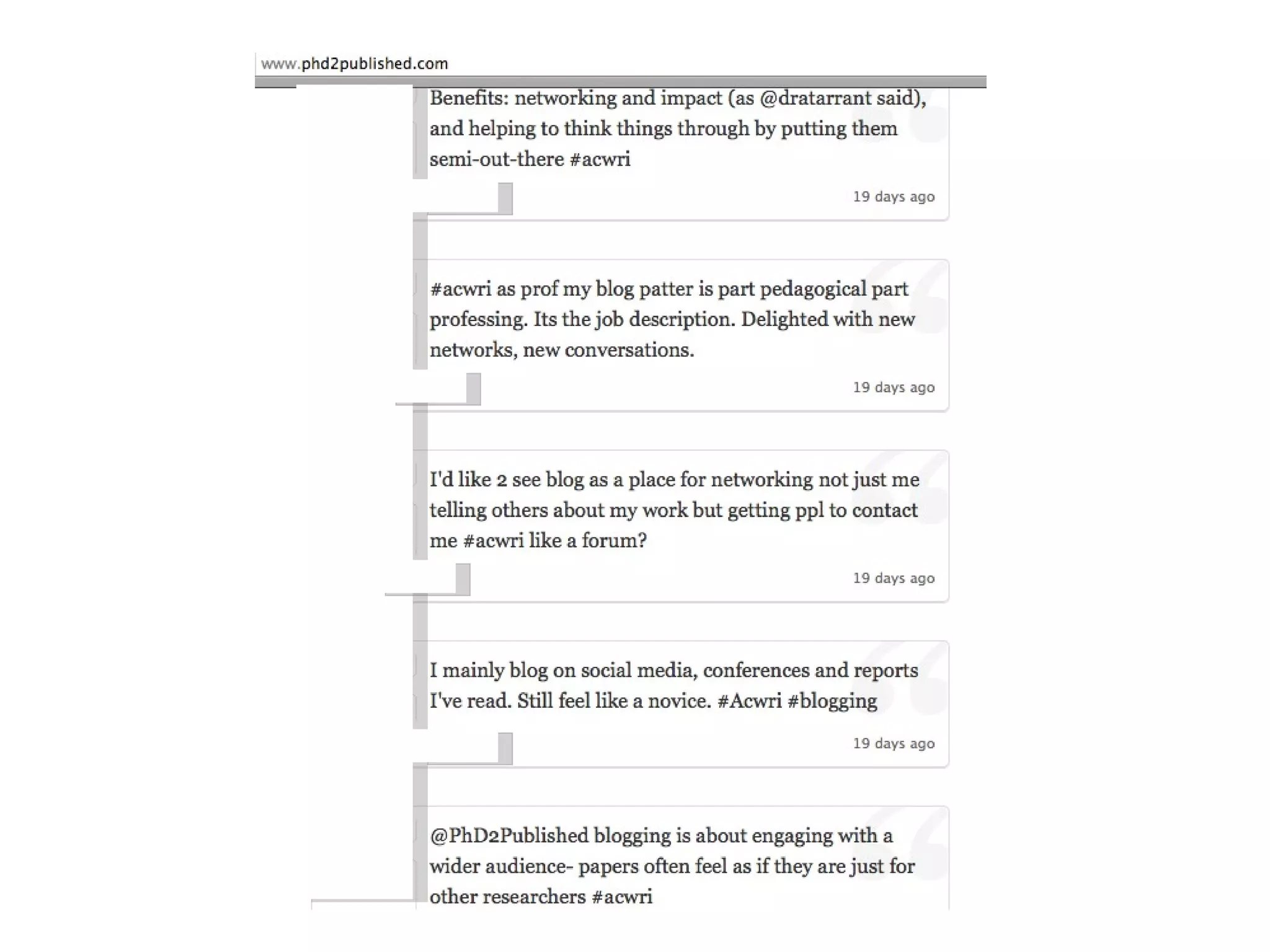
  • #12 I cannot find evidence of ‘idea stealing’ Can be time-consuming ‘ Immodest’ Recent discussion on Twitter of why academics blog http://tinyurl.com/cyv7qub – plaste in a picture of this PhD2Published
  • #14 Get Alan’s other article
  • #17 Winner of Learning Technologist of the Year from Association for Learning Techologies 2010
  • #27 Add scoop.it