Extracting Semantic User Networks
               From
Informal Communication Exchanges

    A.L Gentile V.Lanfranchi S.Mazumdar F.Ciravegna

                      OAK Group
            Department of Computer Science
                 University of Sheffield
Introduction

• Exploit Organisational Knowledge that is often buried

• Generate Semantic Profiles


• Application
   Organisational Knowledge Management Context
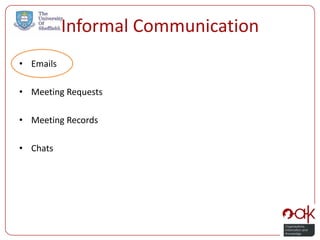
Informal Communication
• Emails

• Meeting Requests

• Meeting Records

• Chats
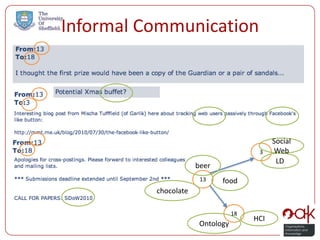
Informal Communication


                                             Social
                                        3    Web
                                              LD
                      beer
                       13    food
          chocolate

                                  18
                                       HCI
                       Ontology
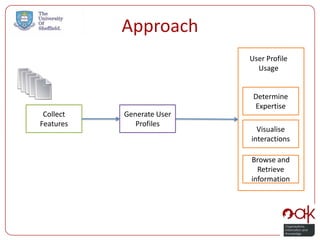
Approach
                           User Profile
                             Usage


                            Determine
                            Expertise
 Collect   Generate User
Features      Profiles
                             Visualise
                           interactions

                           Browse and
                             Retrieve
                           information
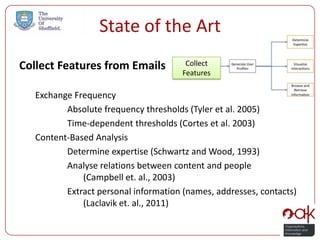
State of the Art
Collect Features from Emails            Collect
                                       Features

   Exchange Frequency
          Absolute frequency thresholds (Tyler et al. 2005)
          Time-dependent thresholds (Cortes et al. 2003)
   Content-Based Analysis
          Determine expertise (Schwartz and Wood, 1993)
          Analyse relations between content and people
              (Campbell et. al., 2003)
          Extract personal information (names, addresses, contacts)
              (Laclavik et. al., 2011)
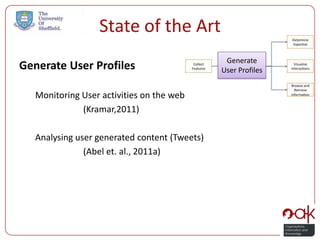
State of the Art
                                                Generate
Generate User Profiles                         User Profiles


   Monitoring User activities on the web
              (Kramar,2011)

   Analysing user generated content (Tweets)
               (Abel et. al., 2011a)
State of the Art
                                                    Generate
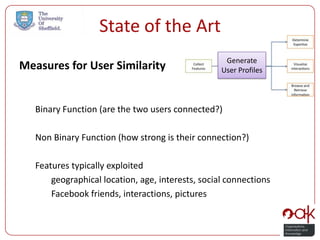
Measures for User Similarity                       User Profiles


   Binary Function (are the two users connected?)

   Non Binary Function (how strong is their connection?)

   Features typically exploited
       geographical location, age, interests, social connections
       Facebook friends, interactions, pictures
State of the Art
                                                             User
User Profile Usage                                          Profile
                                                            Usage


   Information Retrieval – Customised search results
              (Daoud et. al., 2010)

   Recommender Systems - Effective customised suggestions
            (Abel et. al., 2011b)
Research Question


Does increasing the level of semantics in user
   profiles outperform current methods?

           Task: Inferring similarity among users
      Assessment: Correlation with human judgement
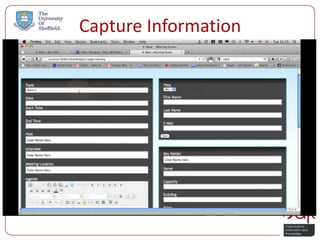
Capture Information
Experiment Settings
Corpus

Internal mailing list of the OAK group in the Computer Science
Department of the University of Sheffield

    1001 emails
    Users in mailing list : 40
    Active users (sending emails to list) : 25
    Users participating in the evaluation: 15
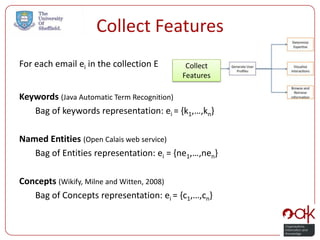
Collect Features
For each email ei in the collection E     Collect
                                         Features

Keywords (Java Automatic Term Recognition)
   Bag of keywords representation: ei = {k1,…,kn}

Named Entities (Open Calais web service)
   Bag of Entities representation: ei = {ne1,…,nen}

Concepts (Wikify, Milne and Witten, 2008)
   Bag of Concepts representation: ei = {c1,…,cn}
Generate User Profiles
                                                       Generate
                                                      User Profiles


Amount of knowledge shared among individuals
(Keywords, Entities, Concepts)

Similarity strength on a [0,1] range

                                       Sample sets for P1, P2:
                                       Keywords, Named entities or
                                       Concepts
Evaluation
• Participants were asked their perceived similarity with colleagues

    – Professional and social point of view
    – Topics of interest

• Similarity on a scale of 1 to 10
    1 – Not similar at all
    10 – Very similar
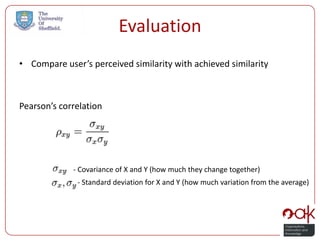
Evaluation
• Compare user’s perceived similarity with achieved similarity


Pearson’s correlation


             - Covariance of X and Y (how much they change together)
              - Standard deviation for X and Y (how much variation from the average)
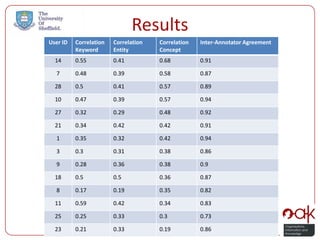
Results
User ID   Correlation   Correlation   Correlation   Inter-Annotator Agreement
          Keyword       Entity        Concept
  14      0.55          0.41          0.68          0.91

  7       0.48          0.39          0.58          0.87

  28      0.5           0.41          0.57          0.89

  10      0.47          0.39          0.57          0.94

  27      0.32          0.29          0.48          0.92

  21      0.34          0.42          0.42          0.91

  1       0.35          0.32          0.42          0.94

  3       0.3           0.31          0.38          0.86

  9       0.28          0.36          0.38          0.9

  18      0.5           0.5           0.36          0.87

  8       0.17          0.19          0.35          0.82

  11      0.59          0.42          0.34          0.83

  25      0.25          0.33          0.3           0.73

  23      0.21          0.33          0.19          0.86
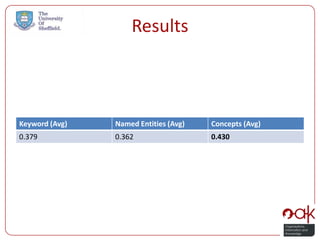
Results


Keyword (Avg)   Named Entities (Avg)   Concepts (Avg)
0.379           0.362                  0.430
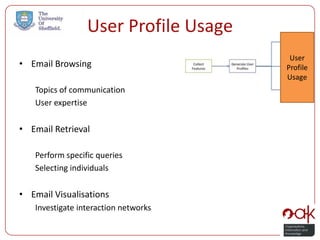
User Profile Usage
                                       User
• Email Browsing                      Profile
                                      Usage
   Topics of communication
   User expertise

• Email Retrieval

   Perform specific queries
   Selecting individuals

• Email Visualisations
   Investigate interaction networks
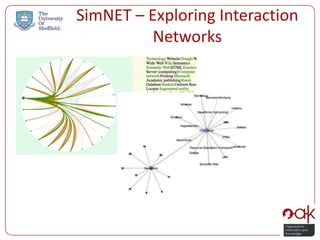
SimNET – Exploring Interaction
          Networks
SimNET
Conclusions
• Dynamically model user expertise from informal communication
  exchanges

• Generate semantic user profiles from textual content, generated by
  users

• Making use of buried knowledge within an organisation
Future Directions
• Long term trials of the system in an organisation with ‘knowledge
  workers’

• Explore new visualisations to facilitate real time visualisation of
  dynamic networks and profiles

• Connect user profiles to Linked Open Data
    – Investigate how profiles can be further enriched using Linked Data
Reference
•   Abel, F., Gao, Q., Houben, G.-J. and Tao, K. (2011a). Semantic Enrichment of Twitter Posts for User Profile Construction on the Social
    Web. In ESWC (2), (Antoniou, G., Grobelnik, M., Simperl, E. P. B., Parsia, B., Plexousakis, D., Leenheer, P. D. and Pan, J. Z., eds), vol.
    6644, of Lecture Notes in Computer Science pp. 375–389, Springer.
•   Abel, F., Gao, Q., Houben, G.-J. and Tao, K. (2011b). Analyzing User Modeling on Twitter for Personalized News Recommendations. In
    User Modeling, Adaption and Personalization, (Konstan, J., Conejo, R., Marzo, J. and Oliver, N., eds), vol. 6787, of Lecture Notes in
    Computer Science pp. 1–12. Springer.
•   Adamic, L. and Adar, E. (2005). How to search a social network. Social Networks 27, 187–203.
•   Campbell, C. S., Maglio, P. P., Cozzi, A. and Dom, B. (2003). Expertise identification using email communications. In Proceedings of the
    twelfth international conference on Information and knowledge management CIKM ’03 pp. 528–531, ACM, New York, NY, USA.
•   Cortes, C., Pregibon, D. and Volinsky, C. (2003). Computational methods for dynamic graphs. Journal Of Computational And Graphical
    Statistics 12, 950–970.
•   Daoud, M., Tamine, L. and Boughanem, M. (2010). A Personalized Graph-Based Document Ranking Model Using a Semantic User
    Profile. In User Modeling, Adaptation, and Personalization, (De Bra, P., Kobsa, A. and Chin, D., eds), vol. 6075, of Lecture Notes in
    Computer Science chapter 17, pp. 171–182. Springer.
•   De Choudhury, M., Mason, W. A., Hofman, J. M. and Watts, D. J. (2010). Inferring relevant social networks from interpersonal
    communication. In Proceedings of the 19th international conference on World wide web WWW ’10 pp. 301–310, ACM, New York, NY,
    USA.
•   Eckmann, J., Moses, E. and Sergi, D. (2004). Entropy of dialogues creates coherent structures in e-mail traffic. Proceedings of the
    National Academy of Sciences of the United States of America 101, 14333–14337.
•   Keila, P. S. and Skillicorn, D. B. (2005). Structure in the Enron Email Dataset. Computational & Mathematical Organization Theory 11,
    183–199.
•   Kossinets, G. and Watts, D. J. (2006). Empirical Analysis of an Evolving Social Network. Science 311, 88–90.
•   Kramar, T. (2011). Towards Contextual Search: Social Networks, Short Contexts and Multiple Personas. In User Modeling, Adaption and
    Personalization, (Konstan, J., Conejo, R., Marzo, J. and Oliver, N., eds), vol. 6787, of Lecture Notes in Computer Science pp. 434–437.
    Springer.
•   Laclavik, M., Dlugolinsky, S., Seleng, M., Kvassay, M., Gatial, E., Balogh, Z. and Hluchy, L. (2011). Email analysis and Information
    Extraction for Enterprise benefit. Computing and Informatics, Special Issue on Business Collaboration Support for micro, small, and
    medium-sized Enterprises 30, 57–87.
•   McCallum, A., Wang, X. and Corrada-Emmanuel, A. (2007). Topic and Role Discovery in Social Networks with Experiments on Enron and
    Academic Email. Journal of Artificial Intelligence Research 30, 249–272. Milne, D. and Witten, I. H. (2008)
Reference
•   Milne, D. and Witten, I. H. (2008). Learning to link with wikipedia. In Proceeding of the 17th ACM conference on Information
    and knowledge management CIKM ’08 pp. 509–518, ACM, New York, NY, USA.
•   Schwartz, M. F. and Wood, D. C. M. (1993). Discovering shared interests using graph analysis. Communications of the ACM
    36, 78–89.
•   Tyler, J., Wilkinson, D. and Huberman, B. (2005). E-Mail as Spectroscopy: Automated Discovery of Community Structure
    within Organizations. The Information Society 21, 143–153.
•   Zhou, Y., Fleischmann, K. R. and Wallace, W. A. (2010). Automatic Text Analysis of Values in the Enron Email Dataset:
    Clustering a Social Network Using the Value Patterns of Actors. In HICSS 2010: Proc., 43rd Annual Hawaii International
    Conference on System Sciences pp. 1–10,.
Acknowledgements
A.L Gentile and V. Lanfranchi are funded by SILOET (Strategic Investment in Low
Carbon Engine Technology), a TSB-funded project. S. Mazumdar is funded by Samulet
(Strategic Affordable Manufacturing in the UK through Leading Environmental
Technologies), a project partially supported by TSB and from the Engineering and
Physical Sciences Research Council

Extracting Semantic

  • 1.
    Extracting Semantic UserNetworks From Informal Communication Exchanges A.L Gentile V.Lanfranchi S.Mazumdar F.Ciravegna OAK Group Department of Computer Science University of Sheffield
  • 2.
    Introduction • Exploit OrganisationalKnowledge that is often buried • Generate Semantic Profiles • Application Organisational Knowledge Management Context
  • 3.
    Informal Communication • Emails •Meeting Requests • Meeting Records • Chats
  • 4.
    Informal Communication Social 3 Web LD beer 13 food chocolate 18 HCI Ontology
  • 5.
    Approach User Profile Usage Determine Expertise Collect Generate User Features Profiles Visualise interactions Browse and Retrieve information
  • 6.
    State of theArt Collect Features from Emails Collect Features Exchange Frequency Absolute frequency thresholds (Tyler et al. 2005) Time-dependent thresholds (Cortes et al. 2003) Content-Based Analysis Determine expertise (Schwartz and Wood, 1993) Analyse relations between content and people (Campbell et. al., 2003) Extract personal information (names, addresses, contacts) (Laclavik et. al., 2011)
  • 7.
    State of theArt Generate Generate User Profiles User Profiles Monitoring User activities on the web (Kramar,2011) Analysing user generated content (Tweets) (Abel et. al., 2011a)
  • 8.
    State of theArt Generate Measures for User Similarity User Profiles Binary Function (are the two users connected?) Non Binary Function (how strong is their connection?) Features typically exploited geographical location, age, interests, social connections Facebook friends, interactions, pictures
  • 9.
    State of theArt User User Profile Usage Profile Usage Information Retrieval – Customised search results (Daoud et. al., 2010) Recommender Systems - Effective customised suggestions (Abel et. al., 2011b)
  • 10.
    Research Question Does increasingthe level of semantics in user profiles outperform current methods? Task: Inferring similarity among users Assessment: Correlation with human judgement
  • 11.
  • 12.
    Experiment Settings Corpus Internal mailinglist of the OAK group in the Computer Science Department of the University of Sheffield 1001 emails Users in mailing list : 40 Active users (sending emails to list) : 25 Users participating in the evaluation: 15
  • 13.
    Collect Features For eachemail ei in the collection E Collect Features Keywords (Java Automatic Term Recognition) Bag of keywords representation: ei = {k1,…,kn} Named Entities (Open Calais web service) Bag of Entities representation: ei = {ne1,…,nen} Concepts (Wikify, Milne and Witten, 2008) Bag of Concepts representation: ei = {c1,…,cn}
  • 14.
    Generate User Profiles Generate User Profiles Amount of knowledge shared among individuals (Keywords, Entities, Concepts) Similarity strength on a [0,1] range Sample sets for P1, P2: Keywords, Named entities or Concepts
  • 15.
    Evaluation • Participants wereasked their perceived similarity with colleagues – Professional and social point of view – Topics of interest • Similarity on a scale of 1 to 10 1 – Not similar at all 10 – Very similar
  • 16.
    Evaluation • Compare user’sperceived similarity with achieved similarity Pearson’s correlation - Covariance of X and Y (how much they change together) - Standard deviation for X and Y (how much variation from the average)
  • 17.
    Results User ID Correlation Correlation Correlation Inter-Annotator Agreement Keyword Entity Concept 14 0.55 0.41 0.68 0.91 7 0.48 0.39 0.58 0.87 28 0.5 0.41 0.57 0.89 10 0.47 0.39 0.57 0.94 27 0.32 0.29 0.48 0.92 21 0.34 0.42 0.42 0.91 1 0.35 0.32 0.42 0.94 3 0.3 0.31 0.38 0.86 9 0.28 0.36 0.38 0.9 18 0.5 0.5 0.36 0.87 8 0.17 0.19 0.35 0.82 11 0.59 0.42 0.34 0.83 25 0.25 0.33 0.3 0.73 23 0.21 0.33 0.19 0.86
  • 18.
    Results Keyword (Avg) Named Entities (Avg) Concepts (Avg) 0.379 0.362 0.430
  • 19.
    User Profile Usage User • Email Browsing Profile Usage Topics of communication User expertise • Email Retrieval Perform specific queries Selecting individuals • Email Visualisations Investigate interaction networks
  • 20.
    SimNET – ExploringInteraction Networks
  • 21.
  • 22.
    Conclusions • Dynamically modeluser expertise from informal communication exchanges • Generate semantic user profiles from textual content, generated by users • Making use of buried knowledge within an organisation
  • 23.
    Future Directions • Longterm trials of the system in an organisation with ‘knowledge workers’ • Explore new visualisations to facilitate real time visualisation of dynamic networks and profiles • Connect user profiles to Linked Open Data – Investigate how profiles can be further enriched using Linked Data
  • 24.
    Reference • Abel, F., Gao, Q., Houben, G.-J. and Tao, K. (2011a). Semantic Enrichment of Twitter Posts for User Profile Construction on the Social Web. In ESWC (2), (Antoniou, G., Grobelnik, M., Simperl, E. P. B., Parsia, B., Plexousakis, D., Leenheer, P. D. and Pan, J. Z., eds), vol. 6644, of Lecture Notes in Computer Science pp. 375–389, Springer. • Abel, F., Gao, Q., Houben, G.-J. and Tao, K. (2011b). Analyzing User Modeling on Twitter for Personalized News Recommendations. In User Modeling, Adaption and Personalization, (Konstan, J., Conejo, R., Marzo, J. and Oliver, N., eds), vol. 6787, of Lecture Notes in Computer Science pp. 1–12. Springer. • Adamic, L. and Adar, E. (2005). How to search a social network. Social Networks 27, 187–203. • Campbell, C. S., Maglio, P. P., Cozzi, A. and Dom, B. (2003). Expertise identification using email communications. In Proceedings of the twelfth international conference on Information and knowledge management CIKM ’03 pp. 528–531, ACM, New York, NY, USA. • Cortes, C., Pregibon, D. and Volinsky, C. (2003). Computational methods for dynamic graphs. Journal Of Computational And Graphical Statistics 12, 950–970. • Daoud, M., Tamine, L. and Boughanem, M. (2010). A Personalized Graph-Based Document Ranking Model Using a Semantic User Profile. In User Modeling, Adaptation, and Personalization, (De Bra, P., Kobsa, A. and Chin, D., eds), vol. 6075, of Lecture Notes in Computer Science chapter 17, pp. 171–182. Springer. • De Choudhury, M., Mason, W. A., Hofman, J. M. and Watts, D. J. (2010). Inferring relevant social networks from interpersonal communication. In Proceedings of the 19th international conference on World wide web WWW ’10 pp. 301–310, ACM, New York, NY, USA. • Eckmann, J., Moses, E. and Sergi, D. (2004). Entropy of dialogues creates coherent structures in e-mail traffic. Proceedings of the National Academy of Sciences of the United States of America 101, 14333–14337. • Keila, P. S. and Skillicorn, D. B. (2005). Structure in the Enron Email Dataset. Computational & Mathematical Organization Theory 11, 183–199. • Kossinets, G. and Watts, D. J. (2006). Empirical Analysis of an Evolving Social Network. Science 311, 88–90. • Kramar, T. (2011). Towards Contextual Search: Social Networks, Short Contexts and Multiple Personas. In User Modeling, Adaption and Personalization, (Konstan, J., Conejo, R., Marzo, J. and Oliver, N., eds), vol. 6787, of Lecture Notes in Computer Science pp. 434–437. Springer. • Laclavik, M., Dlugolinsky, S., Seleng, M., Kvassay, M., Gatial, E., Balogh, Z. and Hluchy, L. (2011). Email analysis and Information Extraction for Enterprise benefit. Computing and Informatics, Special Issue on Business Collaboration Support for micro, small, and medium-sized Enterprises 30, 57–87. • McCallum, A., Wang, X. and Corrada-Emmanuel, A. (2007). Topic and Role Discovery in Social Networks with Experiments on Enron and Academic Email. Journal of Artificial Intelligence Research 30, 249–272. Milne, D. and Witten, I. H. (2008)
  • 25.
    Reference • Milne, D. and Witten, I. H. (2008). Learning to link with wikipedia. In Proceeding of the 17th ACM conference on Information and knowledge management CIKM ’08 pp. 509–518, ACM, New York, NY, USA. • Schwartz, M. F. and Wood, D. C. M. (1993). Discovering shared interests using graph analysis. Communications of the ACM 36, 78–89. • Tyler, J., Wilkinson, D. and Huberman, B. (2005). E-Mail as Spectroscopy: Automated Discovery of Community Structure within Organizations. The Information Society 21, 143–153. • Zhou, Y., Fleischmann, K. R. and Wallace, W. A. (2010). Automatic Text Analysis of Values in the Enron Email Dataset: Clustering a Social Network Using the Value Patterns of Actors. In HICSS 2010: Proc., 43rd Annual Hawaii International Conference on System Sciences pp. 1–10,.
  • 26.
    Acknowledgements A.L Gentile andV. Lanfranchi are funded by SILOET (Strategic Investment in Low Carbon Engine Technology), a TSB-funded project. S. Mazumdar is funded by Samulet (Strategic Affordable Manufacturing in the UK through Leading Environmental Technologies), a project partially supported by TSB and from the Engineering and Physical Sciences Research Council