Social Reporting

A workshop
e-Strategy marketing & training event, University of Pretoria
5 September 2012


Elmi Bester
Manager: CSIR Knowledge Commons
Agenda

• What is Social Reporting?
• Case study : 11th Southern African Online Information Meeting,
    June 2012 - #SAOIM
•   Why Social Reporting as a focus
•   Social Reporting in practice
•   Case study 2
•   Convening social reporting
•   Crafting our social reporting plans
What is Social Reporting? (1)

• Social reporting is an emerging role, a set of skills, and a
   philosophy around how to mix journalism, facilitation and social
   media to help people develop conversations and stories for
   collaboration.
                                             David Wilcox & Bev Trayner

• Social reporting is where a group of participants at an event
   interactively and jointly contribute to some form of reporting, in
   text, photos, images or video.

• It allows to share in real time photos, videos, PowerPoint
   presentations, summaries, comments.
What is Social Reporting? (2)


• Adds to the "official" documentation a rich mix of stories and
    conversations

• The “social report” is made accessible, usually online, as soon as
    possible, sometimes as a half-product. This allows others to join
    in, to extend, to adjust or remix

• Has a human voice and a philosophy of inclusion and
    empowerment

• Interactive and collaborative

• Anyone, and/or a dedicated team

What is Social Reporting, Nancy White
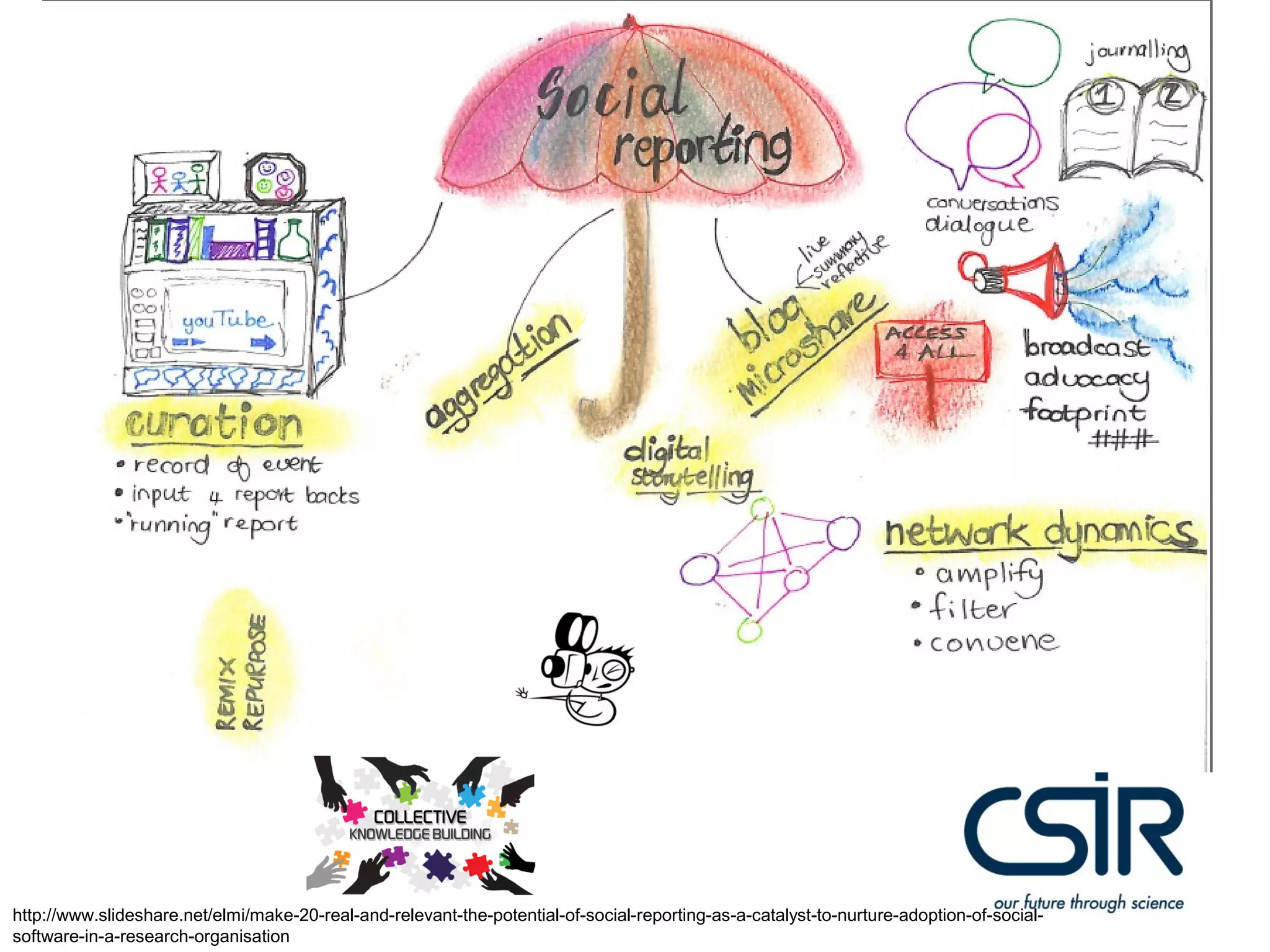
Social Reporting as an umbrella practice


http://www.slideshare.net/elmi/make-20-real-and-relevant-the-potential-of-social-reporting-as-a-catalyst-to-nurture-adoption-of-social-
software-in-a-research-organisation
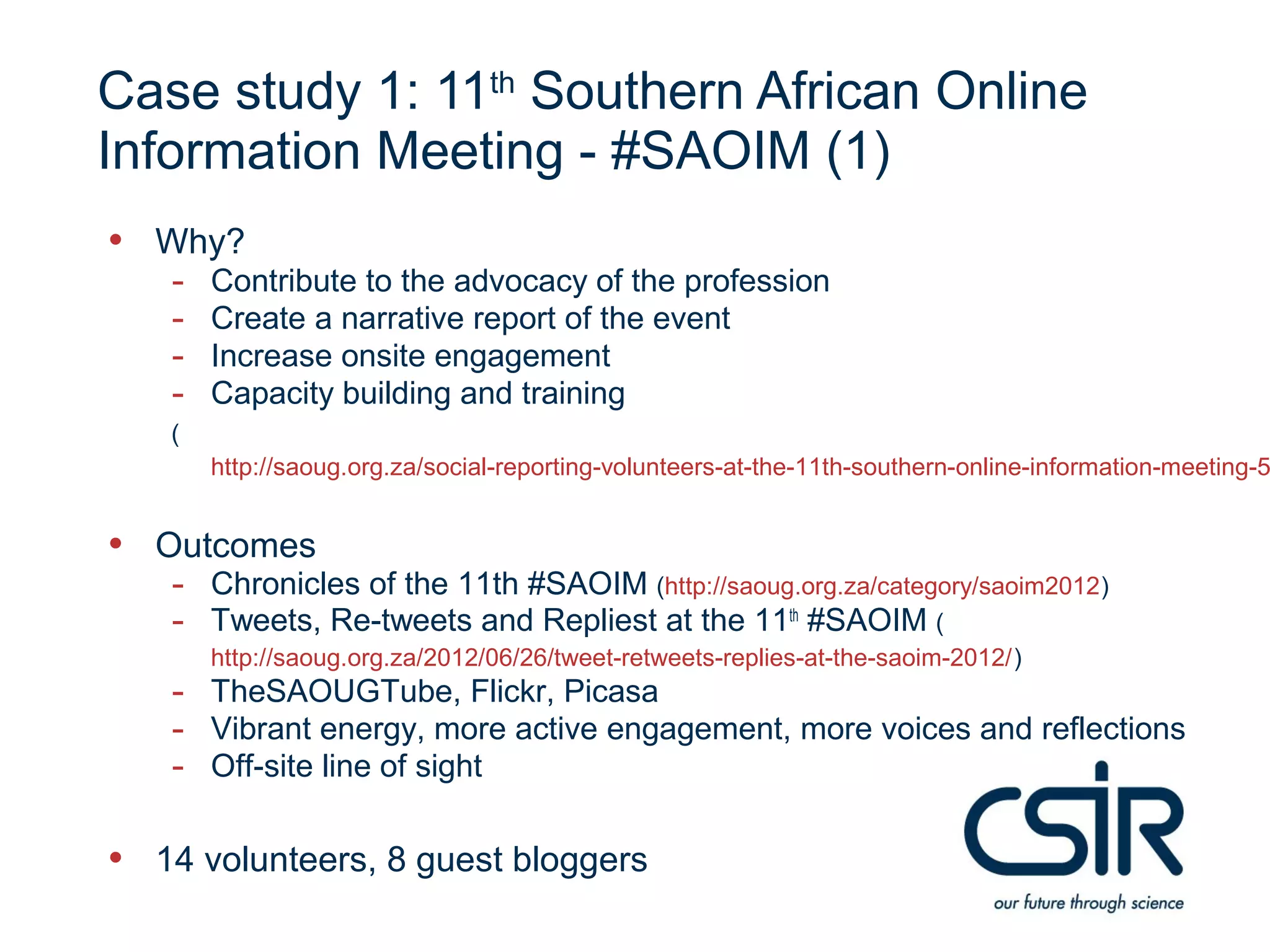
Case study 1: 11th Southern African Online
Information Meeting - #SAOIM (1)
• Why?
   -   Contribute to the advocacy of the profession
   -   Create a narrative report of the event
   -   Increase onsite engagement
   -   Capacity building and training
   (
       http://saoug.org.za/social-reporting-volunteers-at-the-11th-southern-online-information-meeting-5


• Outcomes
   - Chronicles of the 11th #SAOIM (http://saoug.org.za/category/saoim2012)
   - Tweets, Re-tweets and Repliest at the 11th #SAOIM (
       http://saoug.org.za/2012/06/26/tweet-retweets-replies-at-the-saoim-2012/)
   - TheSAOUGTube, Flickr, Picasa
   - Vibrant energy, more active engagement, more voices and reflections
   - Off-site line of sight

• 14 volunteers, 8 guest bloggers
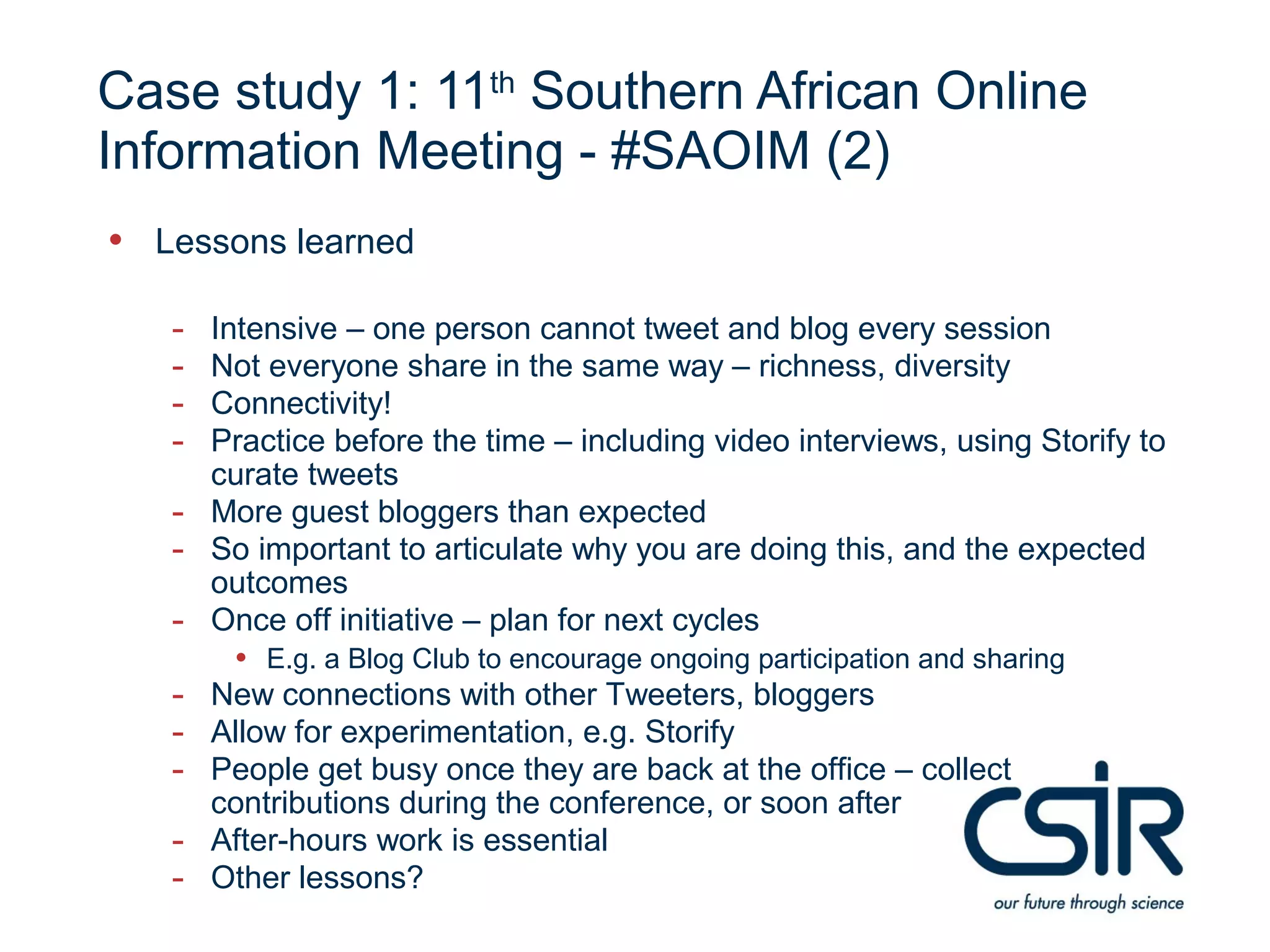
Case study 1: 11th Southern African Online
Information Meeting - #SAOIM (2)
• Lessons learned
   -   Intensive – one person cannot tweet and blog every session
   -   Not everyone share in the same way – richness, diversity
   -   Connectivity!
   -   Practice before the time – including video interviews, using Storify to
       curate tweets
   -   More guest bloggers than expected
   -   So important to articulate why you are doing this, and the expected
       outcomes
   -   Once off initiative – plan for next cycles
        • E.g. a Blog Club to encourage ongoing participation and sharing
   - New connections with other Tweeters, bloggers
   - Allow for experimentation, e.g. Storify
   - People get busy once they are back at the office – collect
       contributions during the conference, or soon after
   -   After-hours work is essential
   -   Other lessons?
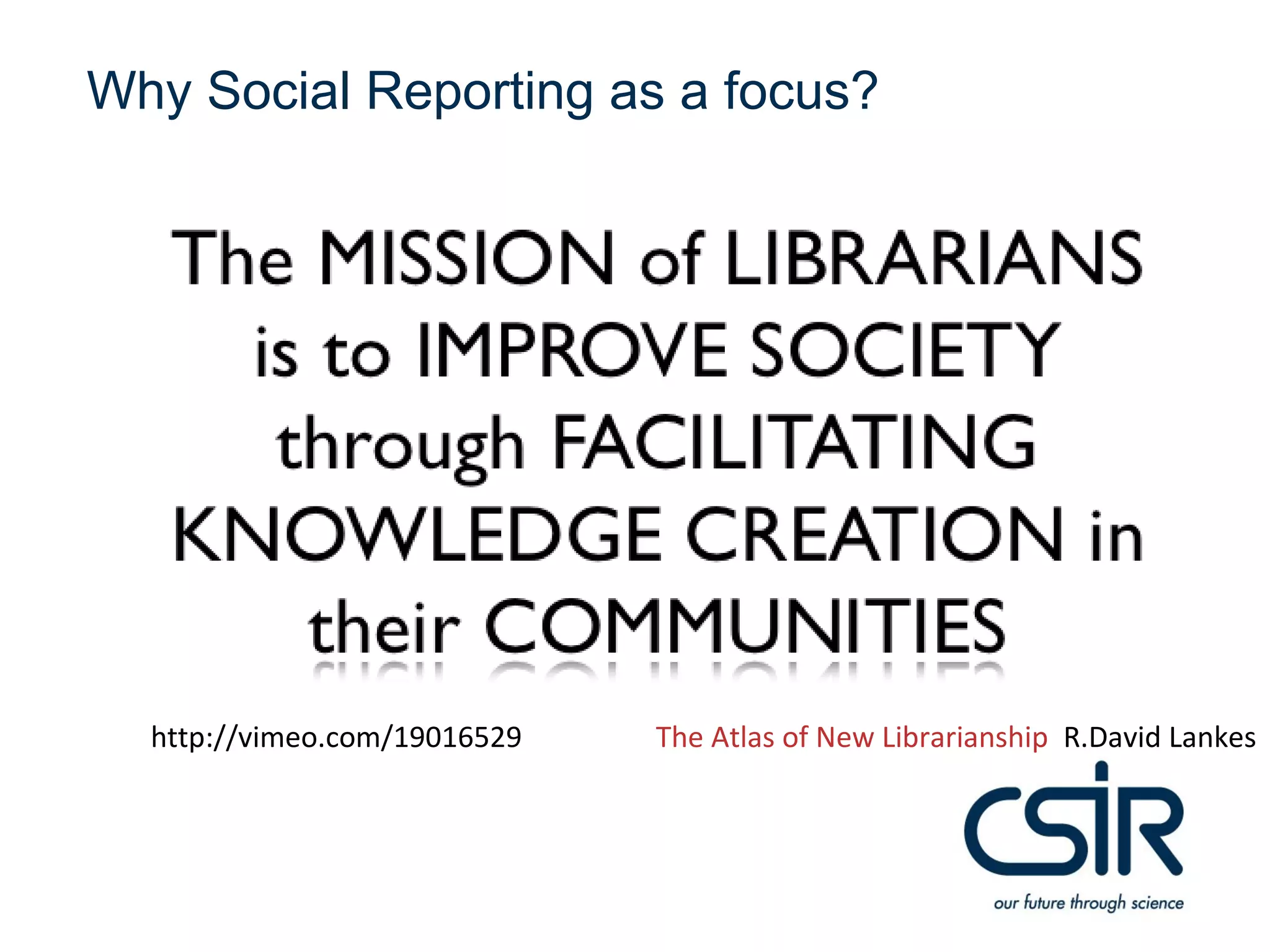
Why Social Reporting as a focus?


  http://vimeo.com/19016529   The Atlas of New Librarianship R.David Lankes
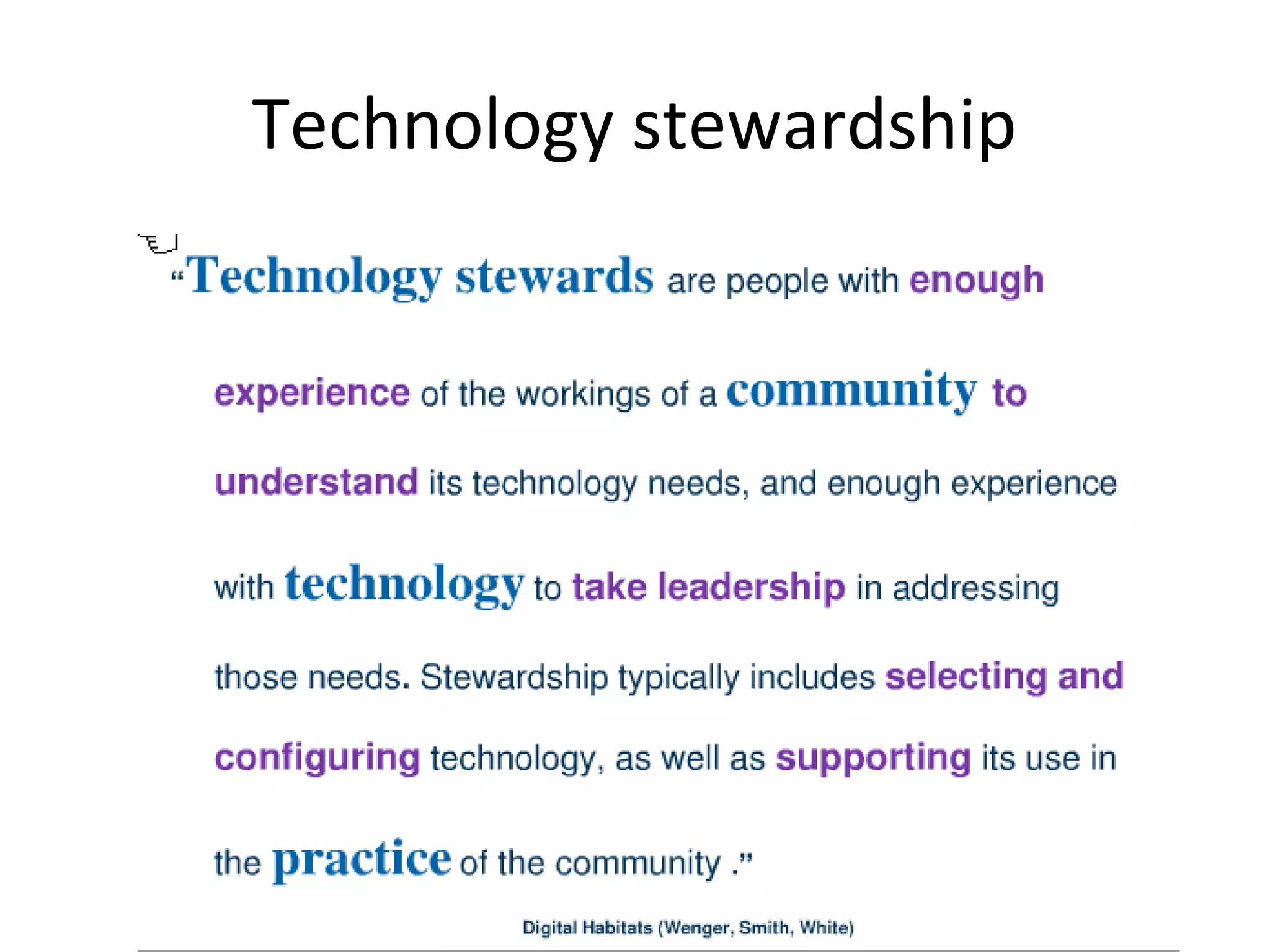
Technology stewardship
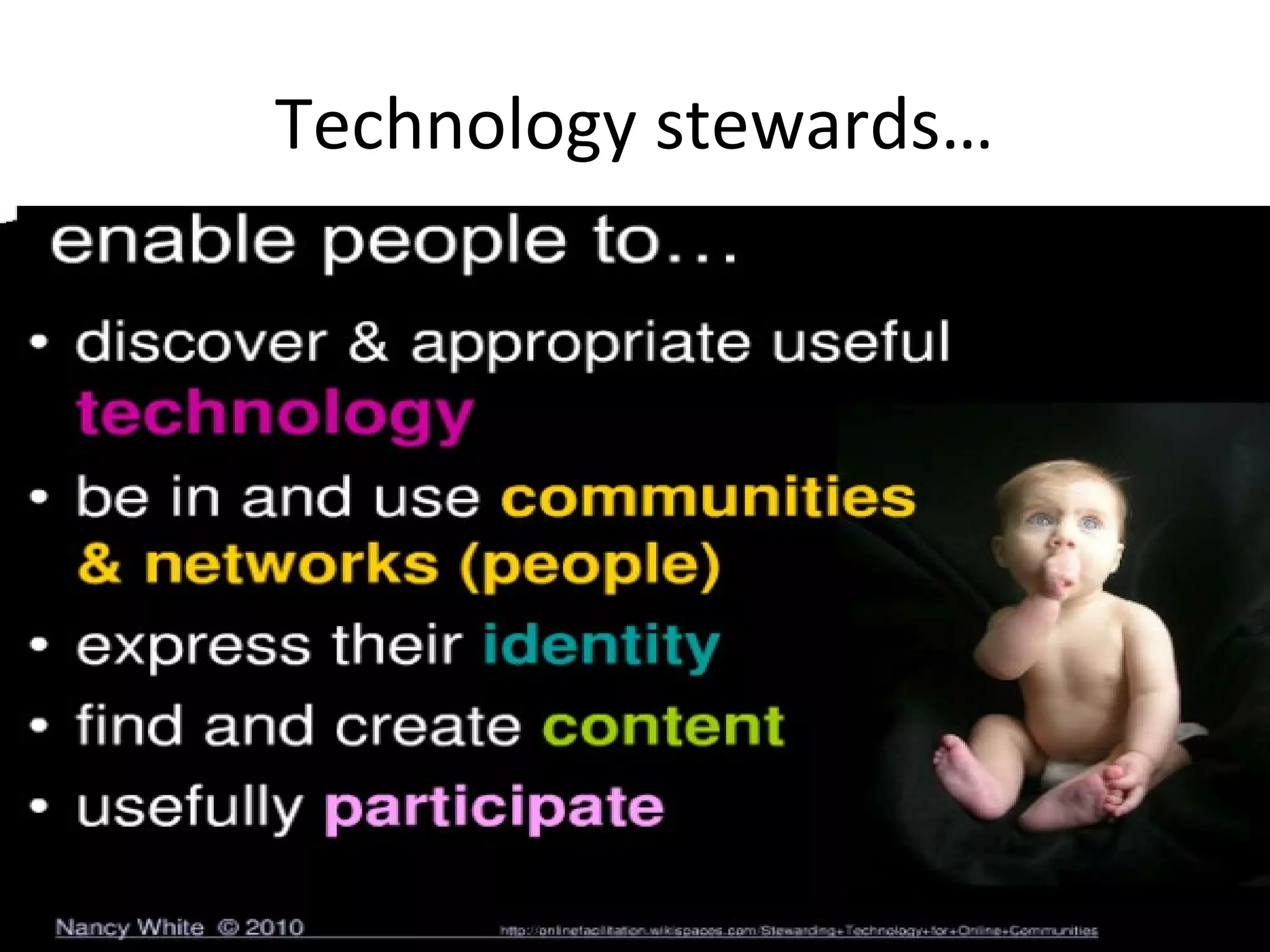
Technology stewards…
Case study 2: Transition network
• 12 bloggers to tell their initiative's story from the front-line, on
      line, over a three month period (text & video)
        - capture the story of a people navigating their way through
          Transition and creating a new community culture
        - to show and record what is really happening in Transition
          towns
        - the blog began to act as a record - the work of other groups,
          a feedback mechanism, as continuity and as a friendly and
          intelligent way to celebrate and disseminate Transition.
•     A community blog. “It’s not just a Me record, it’s a We record.”
•     Allowing diversity - the ability to listen to twelve different voices,
      not just one's own
•     Collaborative and empathic, created by people within the
      experience rather than by commentators from the outside
•     Maintain momentum
•     "Learning, community building, building & extending
      conversations, documenting and weaving voices… "
                                                                             (Josien Kapma)
http://www.transitionnetwork.org/stories/charlotte-du-cann/2011-09/welcome-social-reporting-project
More case studies

• See http://thinkingknowledge.wikispaces.com
• You are welcome to contribute case studies and other material,
   such as
    - http://sabcmedialib.blogspot.com/
    - Variant: Stackathon
         http://cpsquare.org/wiki/Ning_Stackathon_project / http://bit.ly/TgjcYm
    -   http://www.km4dev.org/profiles/blogs/social-reporting-from-events


• Also referred to as “narrating your work”, ‘working out loud”
   - Read more about it: http://elsua.net
Another example
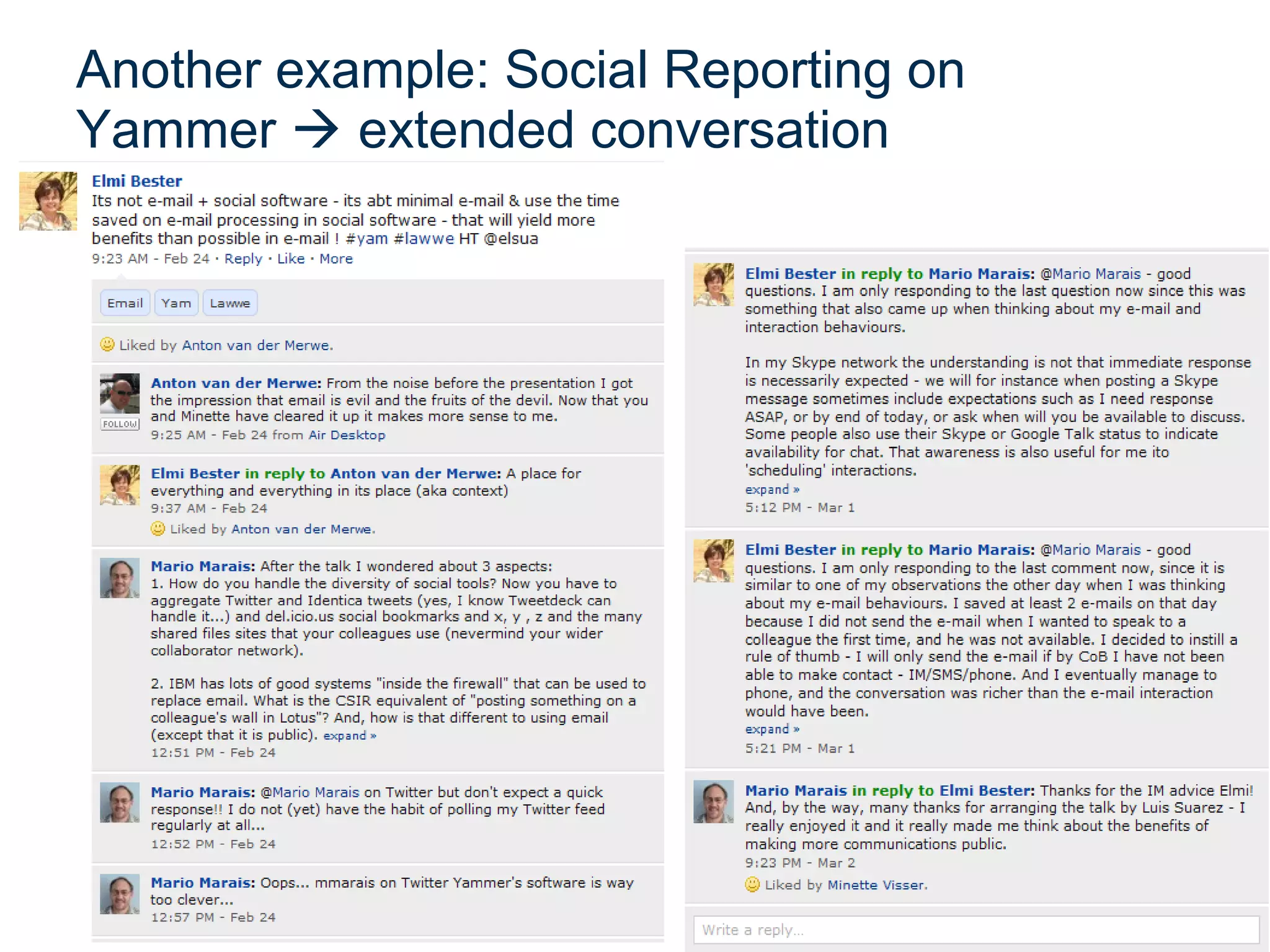
Another example: Social Reporting on
            Extended conversations
Yammer  extended conversation
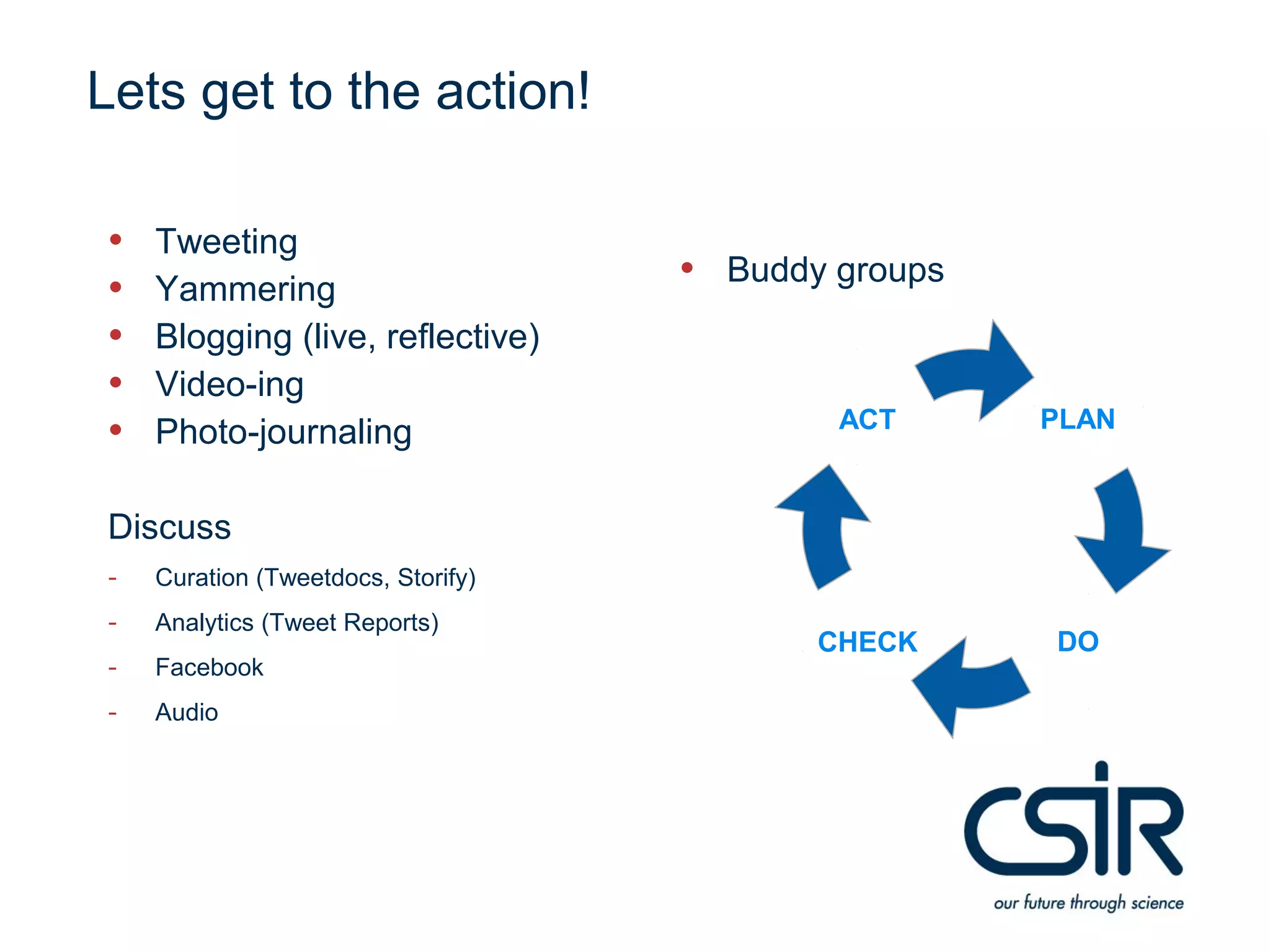
Lets get to the action!

•   Tweeting
•   Yammering
                                    • Buddy groups
•   Blogging (live, reflective)
•   Video-ing
                                            ACT      PLAN
•   Photo-journaling

Discuss
-   Curation (Tweetdocs, Storify)
-   Analytics (Tweet Reports)
                                           CHECK     DO
-   Facebook
-   Audio
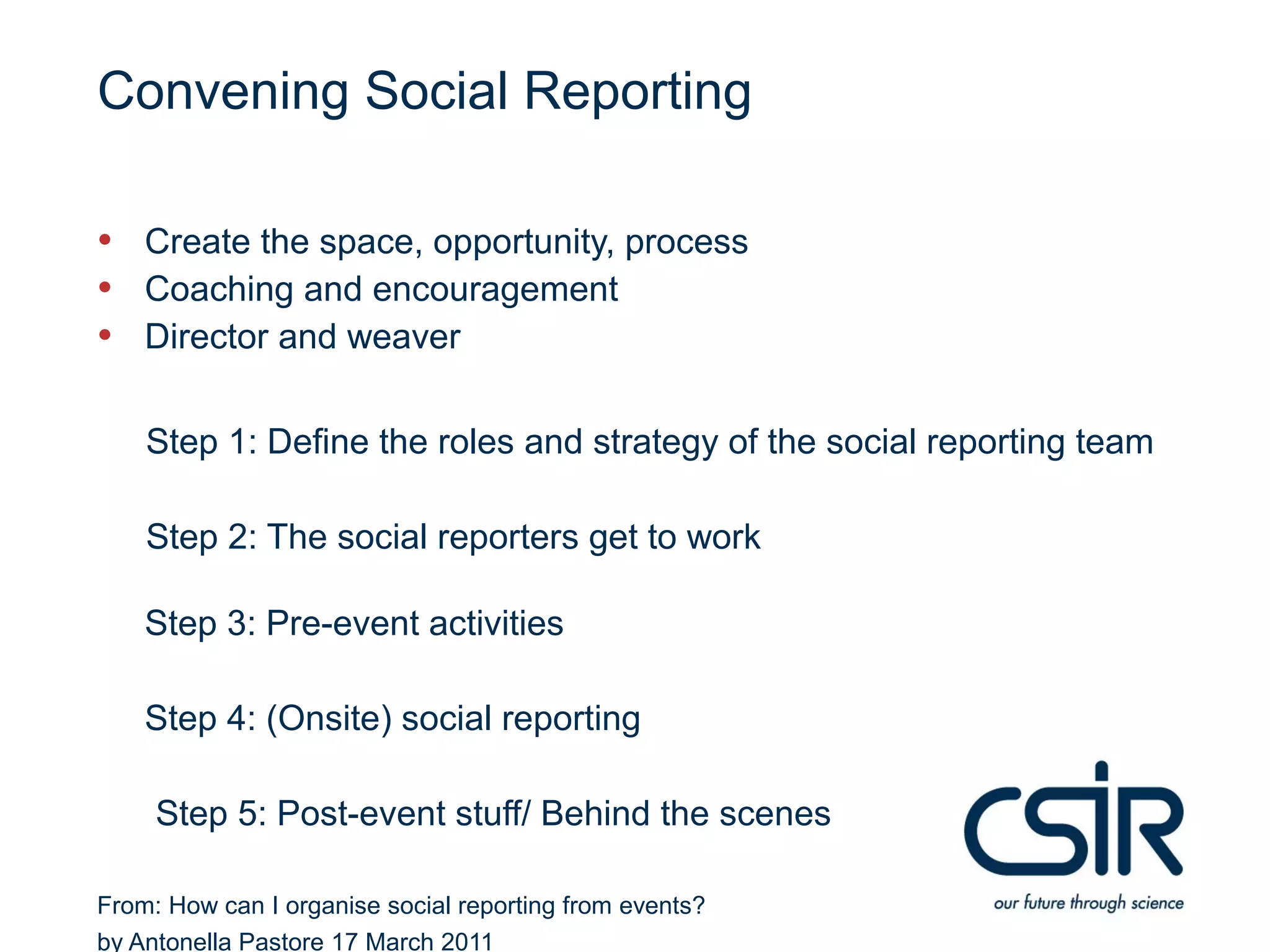
Convening Social Reporting

• Create the space, opportunity, process
• Coaching and encouragement
• Director and weaver

    Step 1: Define the roles and strategy of the social reporting team

    Step 2: The social reporters get to work

    Step 3: Pre-event activities

    Step 4: (Onsite) social reporting

     Step 5: Post-event stuff/ Behind the scenes

From: How can I organise social reporting from events?
by Antonella Pastore 17 March 2011
Crafting our social reporting plans…

                   Convene in work groups

   Identify potential assignments – remember it must be ‘we’

                            “Why”

                    Process and platforms


                How will you enact your plan?

                  What is your commitment?
Some theory slides…

• http://www.slideshare.net/elmi/make-20-real-
  and-relevant-the-potential-of-social-reporting-
  as-a-catalyst-to-nurture-adoption-of-social-
  software-in-a-research-organisation
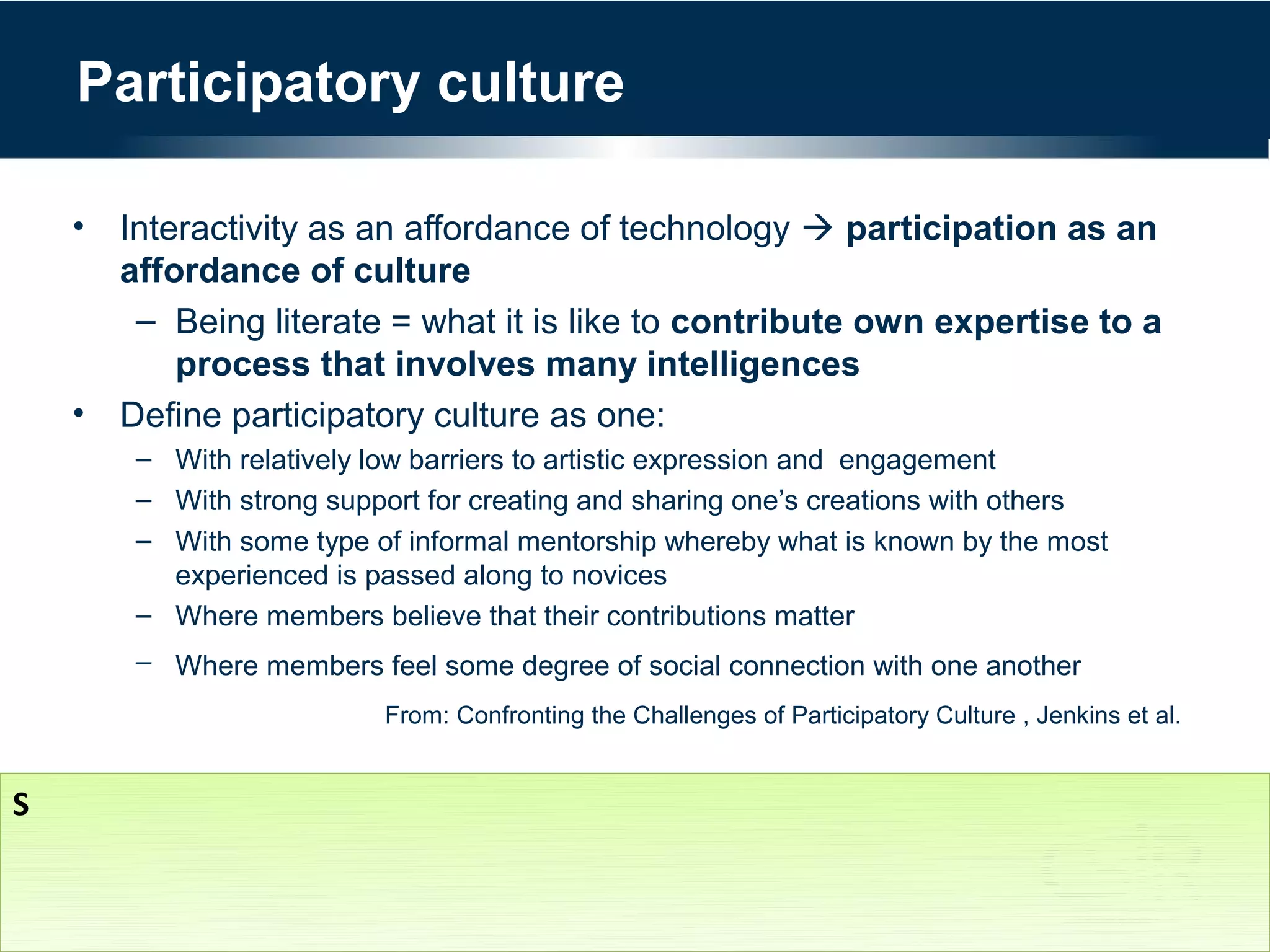
Participatory culture

    • Interactivity as an affordance of technology  participation as an
      affordance of culture
       – Being literate = what it is like to contribute own expertise to a
          process that involves many intelligences
    • Define participatory culture as one:
        – With relatively low barriers to artistic expression and engagement
        – With strong support for creating and sharing one’s creations with others
        – With some type of informal mentorship whereby what is known by the most
          experienced is passed along to novices
        – Where members believe that their contributions matter
        – Where members feel some degree of social connection with one another
                          From: Confronting the Challenges of Participatory Culture , Jenkins et al.


S
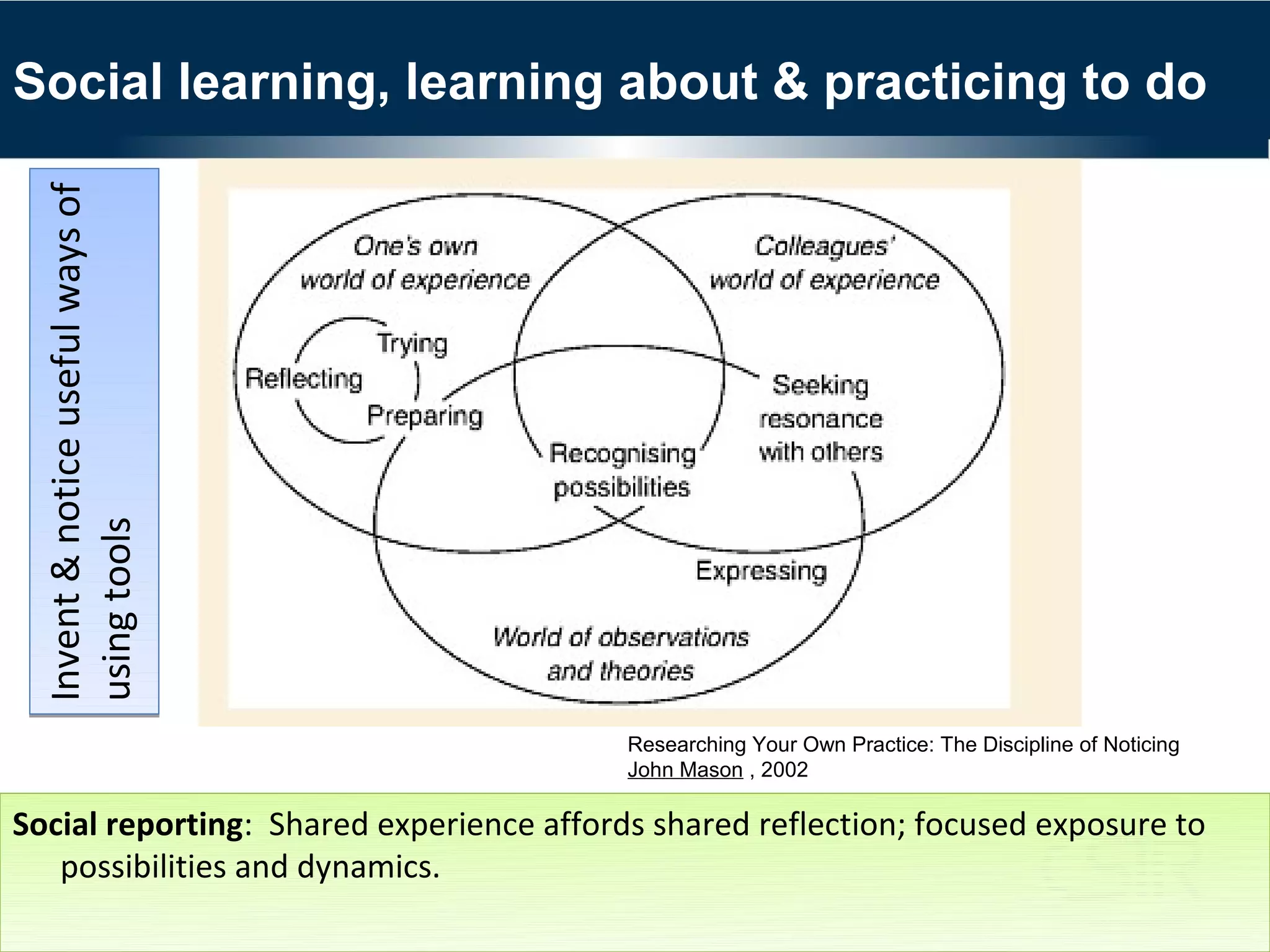
Social learning, learning about & practicing to do
 Invent & notice useful ways of
 using tools


                                          Researching Your Own Practice: The Discipline of Noticing
                                          John Mason , 2002

Social reporting: Shared experience affords shared reflection; focused exposure to
   possibilities and dynamics.

Social Reporting workshop - e-Strategy marketing and training event, University of Pretoria

  • 1.
    Social Reporting A workshop e-Strategymarketing & training event, University of Pretoria 5 September 2012 Elmi Bester Manager: CSIR Knowledge Commons
  • 2.
    Agenda • What isSocial Reporting? • Case study : 11th Southern African Online Information Meeting, June 2012 - #SAOIM • Why Social Reporting as a focus • Social Reporting in practice • Case study 2 • Convening social reporting • Crafting our social reporting plans
  • 3.
    What is SocialReporting? (1) • Social reporting is an emerging role, a set of skills, and a philosophy around how to mix journalism, facilitation and social media to help people develop conversations and stories for collaboration. David Wilcox & Bev Trayner • Social reporting is where a group of participants at an event interactively and jointly contribute to some form of reporting, in text, photos, images or video. • It allows to share in real time photos, videos, PowerPoint presentations, summaries, comments.
  • 4.
    What is SocialReporting? (2) • Adds to the "official" documentation a rich mix of stories and conversations • The “social report” is made accessible, usually online, as soon as possible, sometimes as a half-product. This allows others to join in, to extend, to adjust or remix • Has a human voice and a philosophy of inclusion and empowerment • Interactive and collaborative • Anyone, and/or a dedicated team What is Social Reporting, Nancy White
  • 5.
    Social Reporting asan umbrella practice http://www.slideshare.net/elmi/make-20-real-and-relevant-the-potential-of-social-reporting-as-a-catalyst-to-nurture-adoption-of-social- software-in-a-research-organisation
  • 6.
    Case study 1:11th Southern African Online Information Meeting - #SAOIM (1) • Why? - Contribute to the advocacy of the profession - Create a narrative report of the event - Increase onsite engagement - Capacity building and training ( http://saoug.org.za/social-reporting-volunteers-at-the-11th-southern-online-information-meeting-5 • Outcomes - Chronicles of the 11th #SAOIM (http://saoug.org.za/category/saoim2012) - Tweets, Re-tweets and Repliest at the 11th #SAOIM ( http://saoug.org.za/2012/06/26/tweet-retweets-replies-at-the-saoim-2012/) - TheSAOUGTube, Flickr, Picasa - Vibrant energy, more active engagement, more voices and reflections - Off-site line of sight • 14 volunteers, 8 guest bloggers
  • 7.
    Case study 1:11th Southern African Online Information Meeting - #SAOIM (2) • Lessons learned - Intensive – one person cannot tweet and blog every session - Not everyone share in the same way – richness, diversity - Connectivity! - Practice before the time – including video interviews, using Storify to curate tweets - More guest bloggers than expected - So important to articulate why you are doing this, and the expected outcomes - Once off initiative – plan for next cycles • E.g. a Blog Club to encourage ongoing participation and sharing - New connections with other Tweeters, bloggers - Allow for experimentation, e.g. Storify - People get busy once they are back at the office – collect contributions during the conference, or soon after - After-hours work is essential - Other lessons?
  • 8.
    Why Social Reportingas a focus? http://vimeo.com/19016529 The Atlas of New Librarianship R.David Lankes
  • 9.
  • 10.
  • 11.
    Case study 2:Transition network • 12 bloggers to tell their initiative's story from the front-line, on line, over a three month period (text & video) - capture the story of a people navigating their way through Transition and creating a new community culture - to show and record what is really happening in Transition towns - the blog began to act as a record - the work of other groups, a feedback mechanism, as continuity and as a friendly and intelligent way to celebrate and disseminate Transition. • A community blog. “It’s not just a Me record, it’s a We record.” • Allowing diversity - the ability to listen to twelve different voices, not just one's own • Collaborative and empathic, created by people within the experience rather than by commentators from the outside • Maintain momentum • "Learning, community building, building & extending conversations, documenting and weaving voices… " (Josien Kapma) http://www.transitionnetwork.org/stories/charlotte-du-cann/2011-09/welcome-social-reporting-project
  • 12.
    More case studies •See http://thinkingknowledge.wikispaces.com • You are welcome to contribute case studies and other material, such as - http://sabcmedialib.blogspot.com/ - Variant: Stackathon http://cpsquare.org/wiki/Ning_Stackathon_project / http://bit.ly/TgjcYm - http://www.km4dev.org/profiles/blogs/social-reporting-from-events • Also referred to as “narrating your work”, ‘working out loud” - Read more about it: http://elsua.net
  • 13.
  • 14.
    Another example: SocialReporting on Extended conversations Yammer  extended conversation
  • 15.
    Lets get tothe action! • Tweeting • Yammering • Buddy groups • Blogging (live, reflective) • Video-ing ACT PLAN • Photo-journaling Discuss - Curation (Tweetdocs, Storify) - Analytics (Tweet Reports) CHECK DO - Facebook - Audio
  • 16.
    Convening Social Reporting •Create the space, opportunity, process • Coaching and encouragement • Director and weaver Step 1: Define the roles and strategy of the social reporting team Step 2: The social reporters get to work Step 3: Pre-event activities Step 4: (Onsite) social reporting Step 5: Post-event stuff/ Behind the scenes From: How can I organise social reporting from events? by Antonella Pastore 17 March 2011
  • 17.
    Crafting our socialreporting plans… Convene in work groups Identify potential assignments – remember it must be ‘we’ “Why” Process and platforms How will you enact your plan? What is your commitment?
  • 18.
    Some theory slides… •http://www.slideshare.net/elmi/make-20-real- and-relevant-the-potential-of-social-reporting- as-a-catalyst-to-nurture-adoption-of-social- software-in-a-research-organisation
  • 19.
    Participatory culture • Interactivity as an affordance of technology  participation as an affordance of culture – Being literate = what it is like to contribute own expertise to a process that involves many intelligences • Define participatory culture as one: – With relatively low barriers to artistic expression and engagement – With strong support for creating and sharing one’s creations with others – With some type of informal mentorship whereby what is known by the most experienced is passed along to novices – Where members believe that their contributions matter – Where members feel some degree of social connection with one another From: Confronting the Challenges of Participatory Culture , Jenkins et al. S
  • 20.
    Social learning, learningabout & practicing to do Invent & notice useful ways of using tools Researching Your Own Practice: The Discipline of Noticing John Mason , 2002 Social reporting: Shared experience affords shared reflection; focused exposure to possibilities and dynamics.

Editor's Notes

  • #4 Add a rich multi-modal layer of participation during an event Informal narrative of event – include more voices and diversity Bring in non-attendees into the conversation; reach out Place ownership of tools in the hands of community and network members. They are allowed to use them in ways that make sense for them and for their purpose Deeper change than just e-ink
  • #5 Social reporting from events various from traditional "post event" reporting in two ways - Interactive . It happens both during and after the event to allow people who cannot be at the F2F to have at the minimum a "line of sight" to the event and possible even a way to interact with people at the event by commenting on material produced from the event. Collaborative. It is not done by one person, but by a team that can either be a dedicated reporting team, or if you event participants have some social media experience, ANYONE can contribute by uploading and tagging photos, taking notes and blogging them from sessions, or participating in a pod cast." (From What is Social Reporting by Nancy White)
  • #6 Non-linearity Collective and distributed knowledge systems
  • #7 Social reporting from events various from traditional "post event" reporting in two ways - Interactive . It happens both during and after the event to allow people who cannot be at the F2F to have at the minimum a "line of sight" to the event and possible even a way to interact with people at the event by commenting on material produced from the event. Collaborative. It is not done by one person, but by a team that can either be a dedicated reporting team, or if you event participants have some social media experience, ANYONE can contribute by uploading and tagging photos, taking notes and blogging them from sessions, or participating in a pod cast." (From What is Social Reporting by Nancy White)
  • #8 Social reporting from events various from traditional "post event" reporting in two ways - Interactive . It happens both during and after the event to allow people who cannot be at the F2F to have at the minimum a "line of sight" to the event and possible even a way to interact with people at the event by commenting on material produced from the event. Collaborative. It is not done by one person, but by a team that can either be a dedicated reporting team, or if you event participants have some social media experience, ANYONE can contribute by uploading and tagging photos, taking notes and blogging them from sessions, or participating in a pod cast." (From What is Social Reporting by Nancy White)
  • #9 Social media as technology affording new ways and opportunities for knowledge creation. Practices are more powerful to engage ‘second wavers’ in the adoption cycle, vs the ‘first wave’ pioneers who explore the new media, experiment and frame new practices (such as social reporting) Convergence of skills – librarianship, journalism, community building & network weaving, literacy See also: Make 2.0 real and relevant: the potential of social reporting as a catalyst to nurture adoption of social software in a research organisation. Elmi Bester. 4 th African Conference for Digital Scholarship and Curation, 17 May 2011, Pretoria, South Africa. Available on Slideshare.
  • #12 E.g. research project journaling, field visits etc.
  • #13 (Beth Kanter)
  • #16 Platforms: knowledgeconversations.posterous.com Yammer network: Knowledge Conversations Youtube – use your Google login Flickr
  • #17 (Beth Kanter)
  • #20 Lens that looks at how culture absorbs and responds to the explosion of new media technologies with new affordances of openness and collectiveness, new flows of information and knowledge, and new ways of connecting and relating In a participatory culture been literate is further about discovering what it is like to contribute own expertise to a process that involves many intelligences . A key dynamic is that the community itself provides strong incentives for creative expression and active participation.