Open access
repositories
Iryna Kuchma
Open Access Programme manager
Presented at “New Trends for Science Dissemination”,
ICTP – Trieste, Italy, 26 September 2011


www.eifl.net                             Attribution 3.0 Unported
EIFL Programmes
EIFL-Licensing: Expanding access to commercial e-
resources
EIFL Open Access: Removing barriers to
knowledge sharing
EIFL-IP: Copyright & Libraries: Promoting fair &
balanced copyright laws
EIFL-FOSS: Improving ICT infrastructure in libraries
EIFL-PLIP: Public Library Innovation Programme
Open access (OA) is free,
    immediate, online
 access to the results of
 research, coupled with
  the right to use those
    results in new and
     innovative ways
OA to publications
    open data
 open education
  open science
      FOSS
open innovations
“Restrictive access policies
drastically reduces readership
of electronic research journal
articles.”
Professor Frank Youngman, DVC, University of
                                 Botswana
“OA provides an environment
within which literature and
scholarly research articles are
made freely accessible online
without license restrictions
and without charging users
subscription or access fees.”
“OA is a vital means of
dissemination of information
which is crucial for national
development and in achieving
MDGs, given the crucial role that
information plays in achieving
social, economic, cultural and
political development.”
OA for researchers

increased visibility
usage
& impact for their work
OA for research
institutions
publicises institutes’ research strengths
providing maximum return on investment
complete record of the research output in
easily accessible form
new tools to manage institution's impact
OA for publishers

increased readership & citations
visibility & impact
the best possible dissemination
service for research
OA for libraries

partnerships with scientists & research
managers to set up OA repositories, to curate
research data & to develop OA policies
partnerships with scholarly publishers to publish
OA journals & books
partnerships with educators to produce OERs
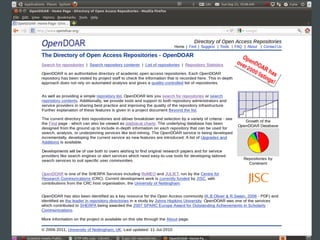
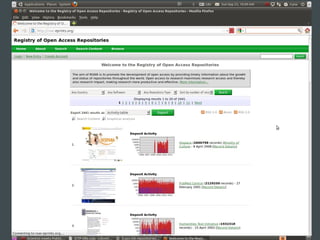
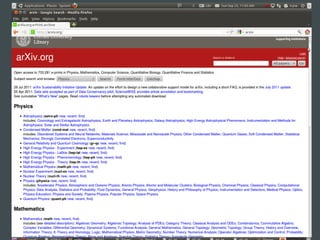
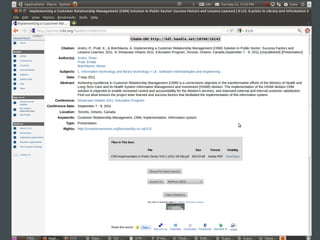
OA repositories

Contain research outputs
Institutional or thematic
Interoperable (OAI-PMH)
Common metadata protocol allows web
applications (text & data mining)
Snapshot of publication
outputs by discipline
OA repositories (2)

The need to evaluate researchers and
departments
As a response to requests from faculty
 (“Open Repository Development in Developing and
    Transition countries” conducted by EIFL and the
                     University of Kansas Libraries)
OA repositories (3)

Publicize an institute’s research
strengths, providing maximum return on
research investment
Provide an administrative tool for
institutions
OA repositories (4)

Increase impact & usage of institute's
research, providing new contacts &
research partnerships for authors
Provide usage statistics showing global
interest & value of institutional research
OA repositories (5)

FOSS to set up, free technical support
Low installation & maintenance costs,
quick to set up & gain benefits
Institutions can mandate OA, speeding
development
to enhance
greater visibility
& application of
research
outputs through
global networks
of OA digital
repositories         http://coar-repositories.org/
“Access to relevant and timely information is
critical to support the University’s mission of
teaching, learning, research and the managerial
functions of the University. Access to
information is also an essential condition for the
economic and social development of the
country. Open access will enhance access to
local content and this goal can only be achieved
through collaborative efforts.”
      Professor Kamau Ngamau, Dean Faculty of
                           Agriculture, JKUAT
One of the key pillars of the University of
Botswana new strategic plan “Strategy for
excellence” is “Research Intensification”. OA will
help the University of Botswana, Government, and
research institutions to achieve this pillar by
ensuring online accessibility to public funded
research output that can be freely shared by
everyone, enhance research quality, and improve
visibility of the institution and the nation globally.


    Prof. Frank Youngman, DVC, U of Botswana
The SOAP survey
11 EIFL partner countries: Bulgaria, China,
Egypt, Nigeria, Poland, Russia, Serbia,
Slovenia, South Africa, Thailand and Ukraine
About 86% of researchers are convinced that
OA publishing is beneficial to their research
field directly improving the way scientific
community work and providing the benefits
outside the scientific community – public
good benefits
The SOAP survey
(2)
Publicly funded
research should
be made available   S tr o n g ly a g r e e
                    A g re e


to be read and
                    N e ith e r a g r e e n o r d is a g r e e
                    D is a g r e e
                    S tr o n g ly d is a g r e e


used without
access barriers
(n=3875)
The SOAP survey
(3)
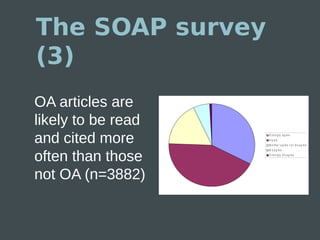
OA articles are
likely to be read
and cited more      S t ro n g ly a g re e
                    A g re e
                    N e i t h e r a g r e e n o r d is a g r e e


often than those
                    D is a g re e
                    S t r o n g l y d is a g r e e


not OA (n=3882)
The SOAP survey
(4)
OA publishing is
more cost-
effective than
subscription-
                      S t r o n g ly a g r e e
                      A g re e
                      N e it h e r a g r e e n o r d is a g r e e


based publishing
                      D is a g r e e
                      S t r o n g ly d is a g r e e


and so will benefit
public investment
in research
(n=3871)
The SOAP survey
(5)
Researchers
should retain the
rights to their      S t ro n g ly a g re e
                     A g re e


published work
                     N e it h e r a g r e e n o r d is a g re e
                     D is a g re e
                     S t ro n g ly d is a g re e


and allow it to be
used by others
(n=3872)
How OA benefits your
  work and career
Distribution and usage
Immediate access to your research output for
everyone upon official publication
More visibility & usage
Immediate impact of your work
Intensification of research through fast
dissemination and use of research;
Possibly a citation advantage as well
How OA benefits your
  work and career

Plus:
Monitoring of your research output
Preservation of your research output by your
library
Keep your rights instead of signing them
away
What can you do?
Submit your research articles to OA journals,
when there are appropriate OA journals in
your field
Deposit your preprints/postprints in an OA
repository
Deposit your data files in an OA repository
along with the publications built on them.
What can you do? (2)

Volunteer to serve on your university’s
committee to evaluate faculty for promotion
and tenure. Make sure the committee is
using criteria that, at the very least, do not
penalize faculty for publishing in peer-
reviewed OA journals. At best, adjust the
criteria to give faculty an incentive to provide
OA to their peer-reviewed research articles
either through OA journals or OA repositories
What can you do? (3)

Work with your professional societies to
make sure they understand OA.
Write opinion pieces (articles, journal
editorials, newspapers op-eds, letters to the
editor, discussion forum postings) advancing
the cause of OA.
Educate the next generation of scientists and
scholars about OA.
“Michael Faraday’s advice to his junior colleague to:
“Work. Finish. Publish.” needs to be revised. It
shouldn’t be enough to publish a paper anymore. If
we want open science to flourish, we should raise our
expectations to: “Work. Finish. Publish. Release.”
That is, your research shouldn’t be considered
complete until the data and meta-data is put up on the
web for other people to use, until the code is
documented and released, and until the comments
start coming in to your blog post announcing the
paper. If our general expectations of what it means to
complete a project are raised to this level, the
scientific community will start doing these activities as
a matter of course.”
  (What, exactly, is Open Science? by Dan Gezelter:
           http://www.openscience.org/blog/?p=269)
Thank you! Questions?

Open access repositories

  • 1.
    Open access repositories Iryna Kuchma OpenAccess Programme manager Presented at “New Trends for Science Dissemination”, ICTP – Trieste, Italy, 26 September 2011 www.eifl.net Attribution 3.0 Unported
  • 4.
    EIFL Programmes EIFL-Licensing: Expandingaccess to commercial e- resources EIFL Open Access: Removing barriers to knowledge sharing EIFL-IP: Copyright & Libraries: Promoting fair & balanced copyright laws EIFL-FOSS: Improving ICT infrastructure in libraries EIFL-PLIP: Public Library Innovation Programme
  • 5.
    Open access (OA)is free, immediate, online access to the results of research, coupled with the right to use those results in new and innovative ways
  • 6.
    OA to publications open data open education open science FOSS open innovations
  • 7.
    “Restrictive access policies drasticallyreduces readership of electronic research journal articles.” Professor Frank Youngman, DVC, University of Botswana
  • 8.
    “OA provides anenvironment within which literature and scholarly research articles are made freely accessible online without license restrictions and without charging users subscription or access fees.”
  • 9.
    “OA is avital means of dissemination of information which is crucial for national development and in achieving MDGs, given the crucial role that information plays in achieving social, economic, cultural and political development.”
  • 10.
    OA for researchers increasedvisibility usage & impact for their work
  • 11.
    OA for research institutions publicisesinstitutes’ research strengths providing maximum return on investment complete record of the research output in easily accessible form new tools to manage institution's impact
  • 12.
    OA for publishers increasedreadership & citations visibility & impact the best possible dissemination service for research
  • 13.
    OA for libraries partnershipswith scientists & research managers to set up OA repositories, to curate research data & to develop OA policies partnerships with scholarly publishers to publish OA journals & books partnerships with educators to produce OERs
  • 14.
    OA repositories Contain researchoutputs Institutional or thematic Interoperable (OAI-PMH) Common metadata protocol allows web applications (text & data mining)
  • 18.
  • 22.
    OA repositories (2) Theneed to evaluate researchers and departments As a response to requests from faculty (“Open Repository Development in Developing and Transition countries” conducted by EIFL and the University of Kansas Libraries)
  • 23.
    OA repositories (3) Publicizean institute’s research strengths, providing maximum return on research investment Provide an administrative tool for institutions
  • 24.
    OA repositories (4) Increaseimpact & usage of institute's research, providing new contacts & research partnerships for authors Provide usage statistics showing global interest & value of institutional research
  • 25.
    OA repositories (5) FOSSto set up, free technical support Low installation & maintenance costs, quick to set up & gain benefits Institutions can mandate OA, speeding development
  • 46.
    to enhance greater visibility &application of research outputs through global networks of OA digital repositories http://coar-repositories.org/
  • 47.
    “Access to relevantand timely information is critical to support the University’s mission of teaching, learning, research and the managerial functions of the University. Access to information is also an essential condition for the economic and social development of the country. Open access will enhance access to local content and this goal can only be achieved through collaborative efforts.” Professor Kamau Ngamau, Dean Faculty of Agriculture, JKUAT
  • 48.
    One of thekey pillars of the University of Botswana new strategic plan “Strategy for excellence” is “Research Intensification”. OA will help the University of Botswana, Government, and research institutions to achieve this pillar by ensuring online accessibility to public funded research output that can be freely shared by everyone, enhance research quality, and improve visibility of the institution and the nation globally. Prof. Frank Youngman, DVC, U of Botswana
  • 50.
    The SOAP survey 11EIFL partner countries: Bulgaria, China, Egypt, Nigeria, Poland, Russia, Serbia, Slovenia, South Africa, Thailand and Ukraine About 86% of researchers are convinced that OA publishing is beneficial to their research field directly improving the way scientific community work and providing the benefits outside the scientific community – public good benefits
  • 51.
    The SOAP survey (2) Publiclyfunded research should be made available S tr o n g ly a g r e e A g re e to be read and N e ith e r a g r e e n o r d is a g r e e D is a g r e e S tr o n g ly d is a g r e e used without access barriers (n=3875)
  • 52.
    The SOAP survey (3) OAarticles are likely to be read and cited more S t ro n g ly a g re e A g re e N e i t h e r a g r e e n o r d is a g r e e often than those D is a g re e S t r o n g l y d is a g r e e not OA (n=3882)
  • 53.
    The SOAP survey (4) OApublishing is more cost- effective than subscription- S t r o n g ly a g r e e A g re e N e it h e r a g r e e n o r d is a g r e e based publishing D is a g r e e S t r o n g ly d is a g r e e and so will benefit public investment in research (n=3871)
  • 54.
    The SOAP survey (5) Researchers shouldretain the rights to their S t ro n g ly a g re e A g re e published work N e it h e r a g r e e n o r d is a g re e D is a g re e S t ro n g ly d is a g re e and allow it to be used by others (n=3872)
  • 55.
    How OA benefitsyour work and career Distribution and usage Immediate access to your research output for everyone upon official publication More visibility & usage Immediate impact of your work Intensification of research through fast dissemination and use of research; Possibly a citation advantage as well
  • 56.
    How OA benefitsyour work and career Plus: Monitoring of your research output Preservation of your research output by your library Keep your rights instead of signing them away
  • 57.
    What can youdo? Submit your research articles to OA journals, when there are appropriate OA journals in your field Deposit your preprints/postprints in an OA repository Deposit your data files in an OA repository along with the publications built on them.
  • 58.
    What can youdo? (2) Volunteer to serve on your university’s committee to evaluate faculty for promotion and tenure. Make sure the committee is using criteria that, at the very least, do not penalize faculty for publishing in peer- reviewed OA journals. At best, adjust the criteria to give faculty an incentive to provide OA to their peer-reviewed research articles either through OA journals or OA repositories
  • 59.
    What can youdo? (3) Work with your professional societies to make sure they understand OA. Write opinion pieces (articles, journal editorials, newspapers op-eds, letters to the editor, discussion forum postings) advancing the cause of OA. Educate the next generation of scientists and scholars about OA.
  • 60.
    “Michael Faraday’s adviceto his junior colleague to: “Work. Finish. Publish.” needs to be revised. It shouldn’t be enough to publish a paper anymore. If we want open science to flourish, we should raise our expectations to: “Work. Finish. Publish. Release.” That is, your research shouldn’t be considered complete until the data and meta-data is put up on the web for other people to use, until the code is documented and released, and until the comments start coming in to your blog post announcing the paper. If our general expectations of what it means to complete a project are raised to this level, the scientific community will start doing these activities as a matter of course.” (What, exactly, is Open Science? by Dan Gezelter: http://www.openscience.org/blog/?p=269)
  • 61.