eIFL-Open Access Update
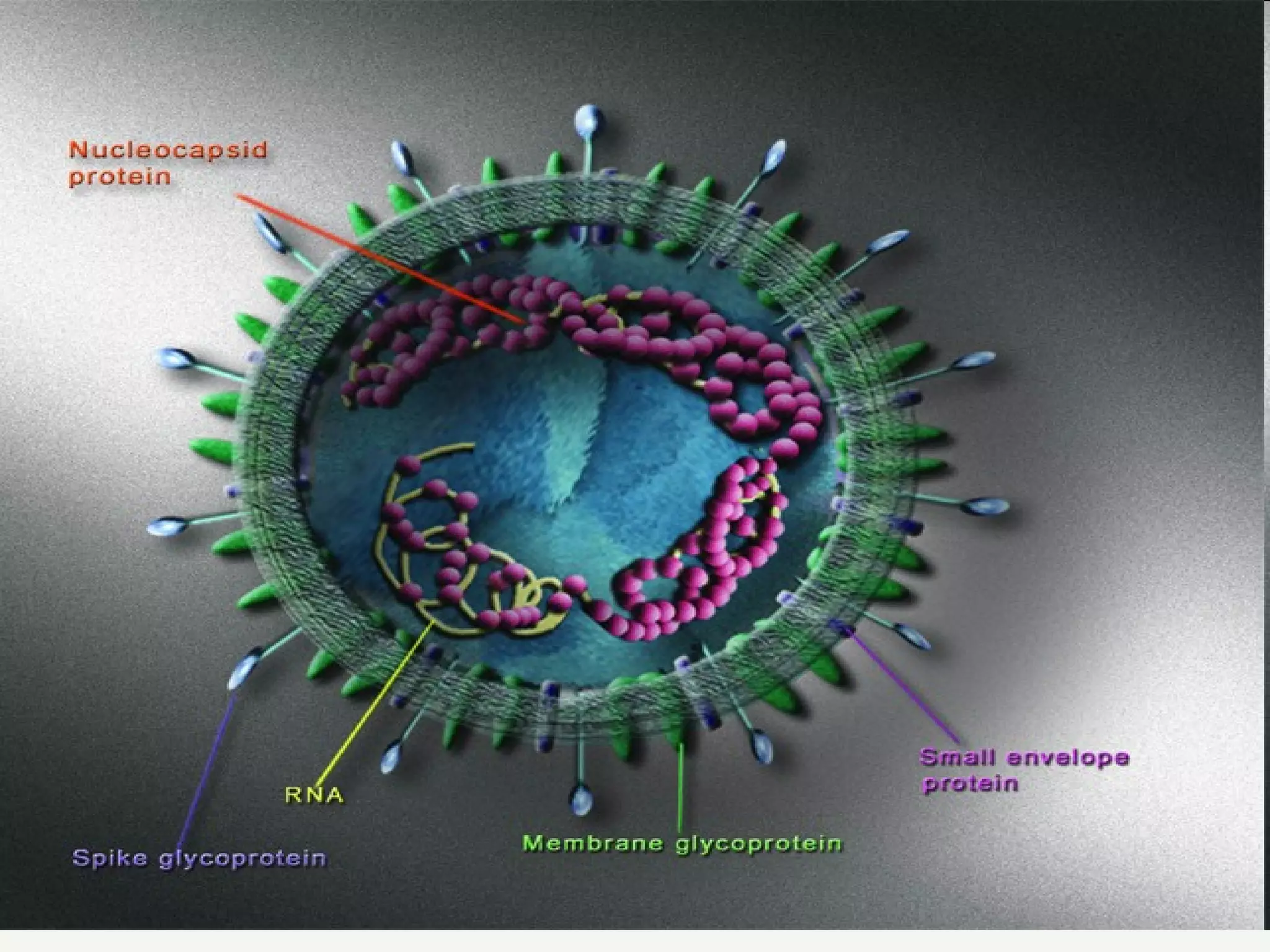
From John Wilbanks, Science Commons, (Data integration, text mining, and the culture of control)
Digitage Web 2.0 Uploaded by ocean.flynn ,  http://www.flickr.com/photos/oceanflynn/315385916/
 
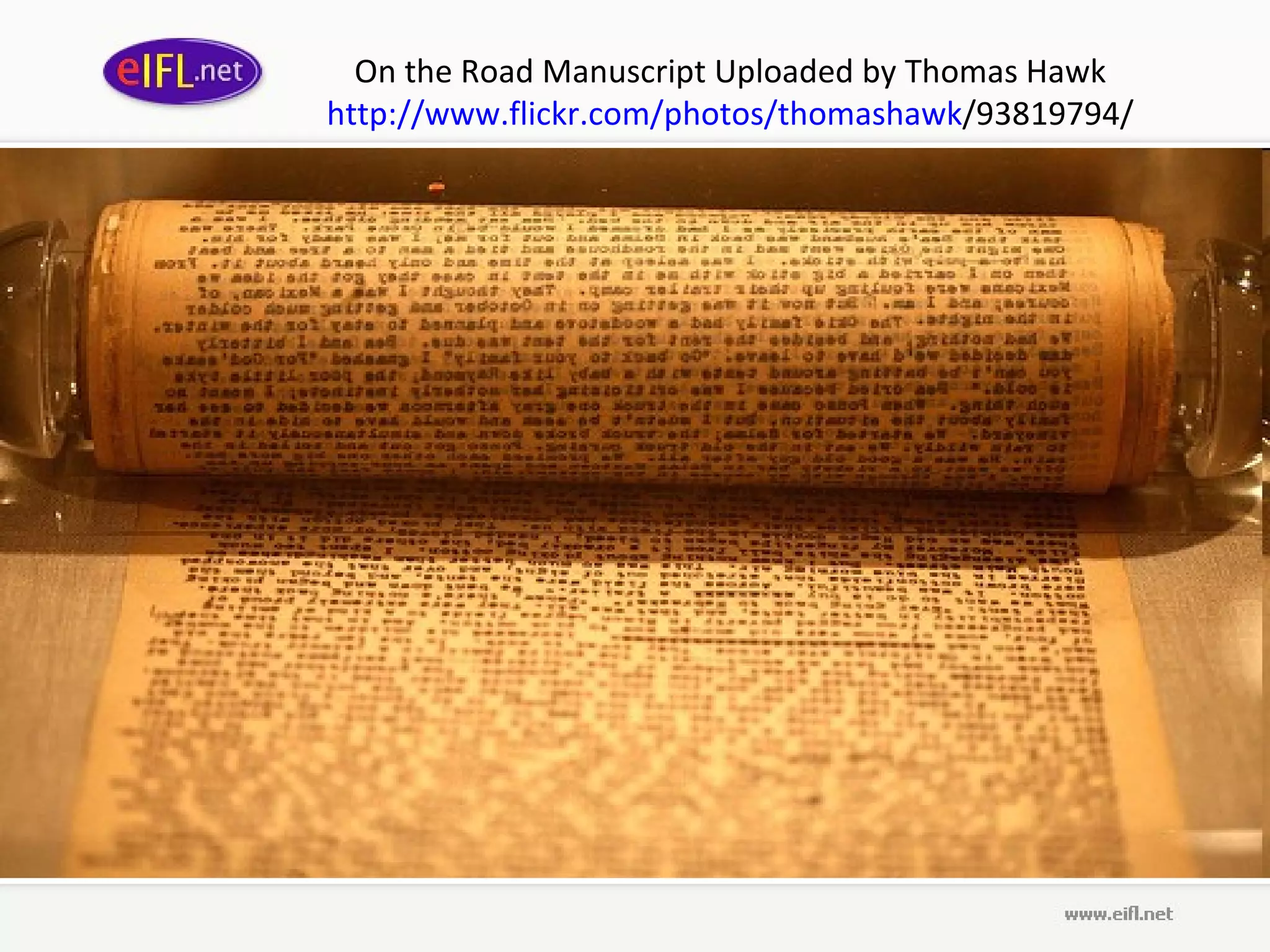
On the Road Manuscript Uploaded by Thomas Hawk http :// www . flickr . com / photos / thomashawk /93819794/
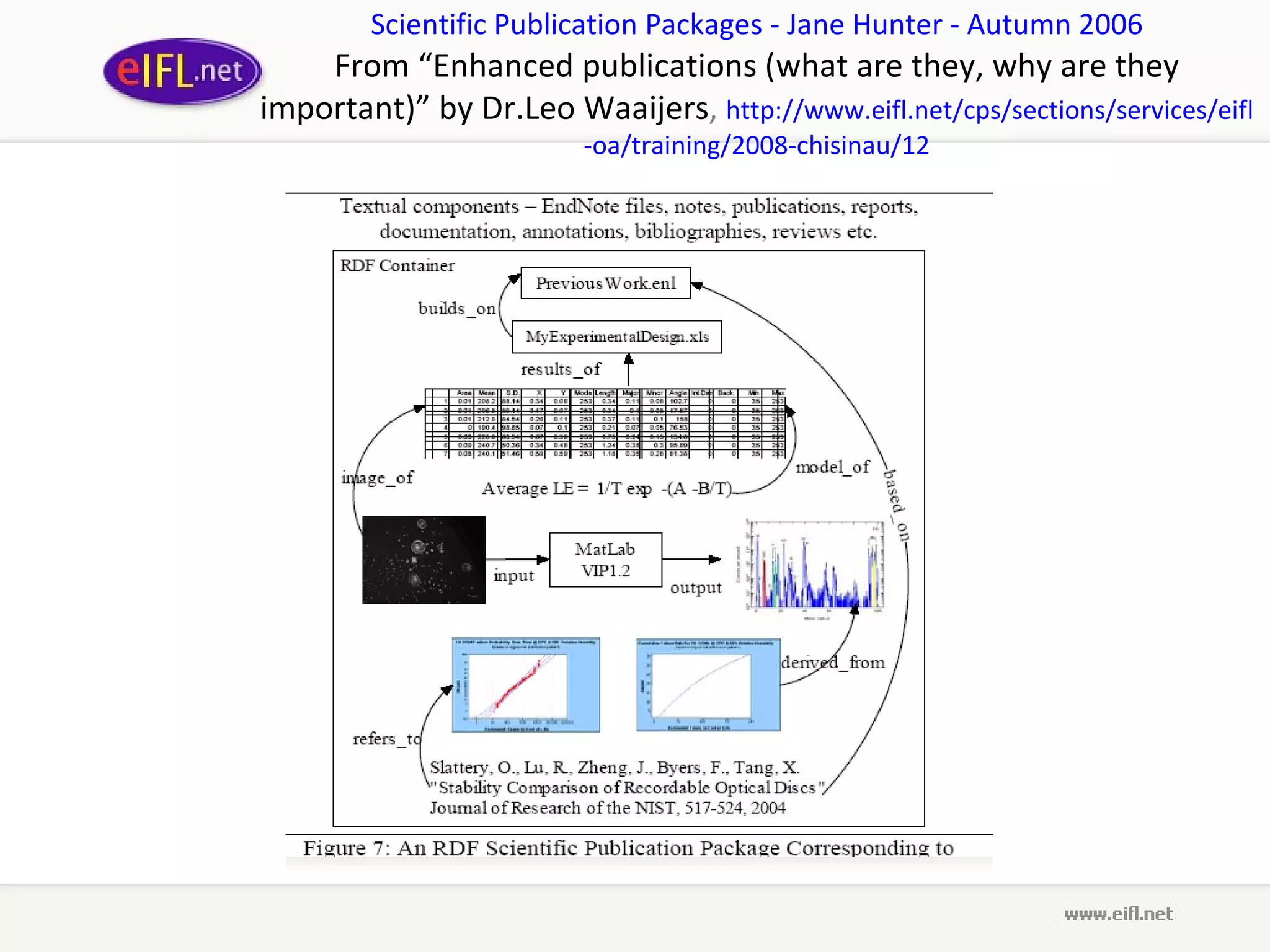
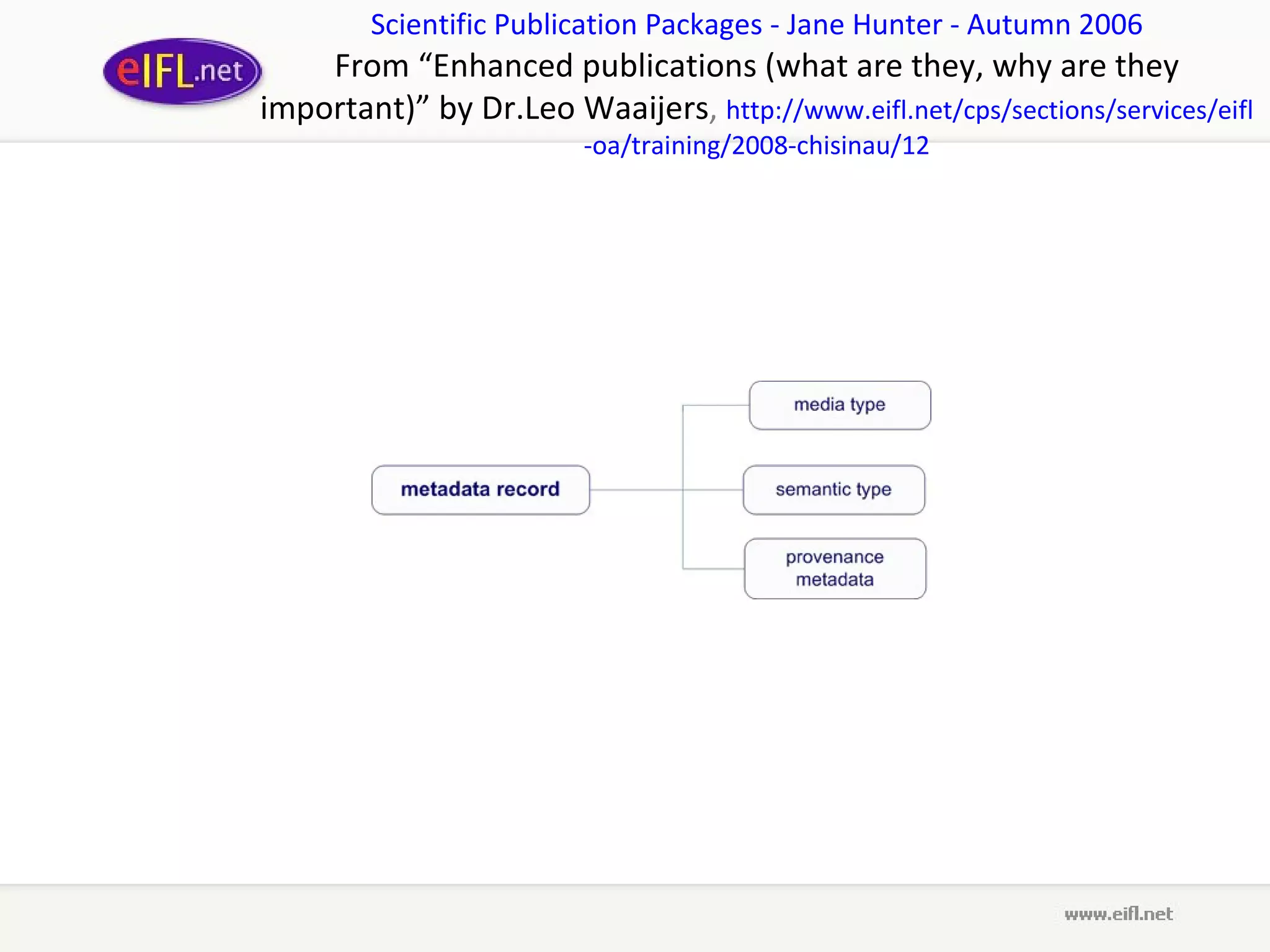
Scientific Publication Packages - Jane Hunter - Autumn 2006 From “ Enhanced publications (what are they, why are they important)” by Dr.Leo Waaijers ,   http://www. eifl .net/cps/sections/services/ eifl - oa /training/2008- chisinau /12
 
 
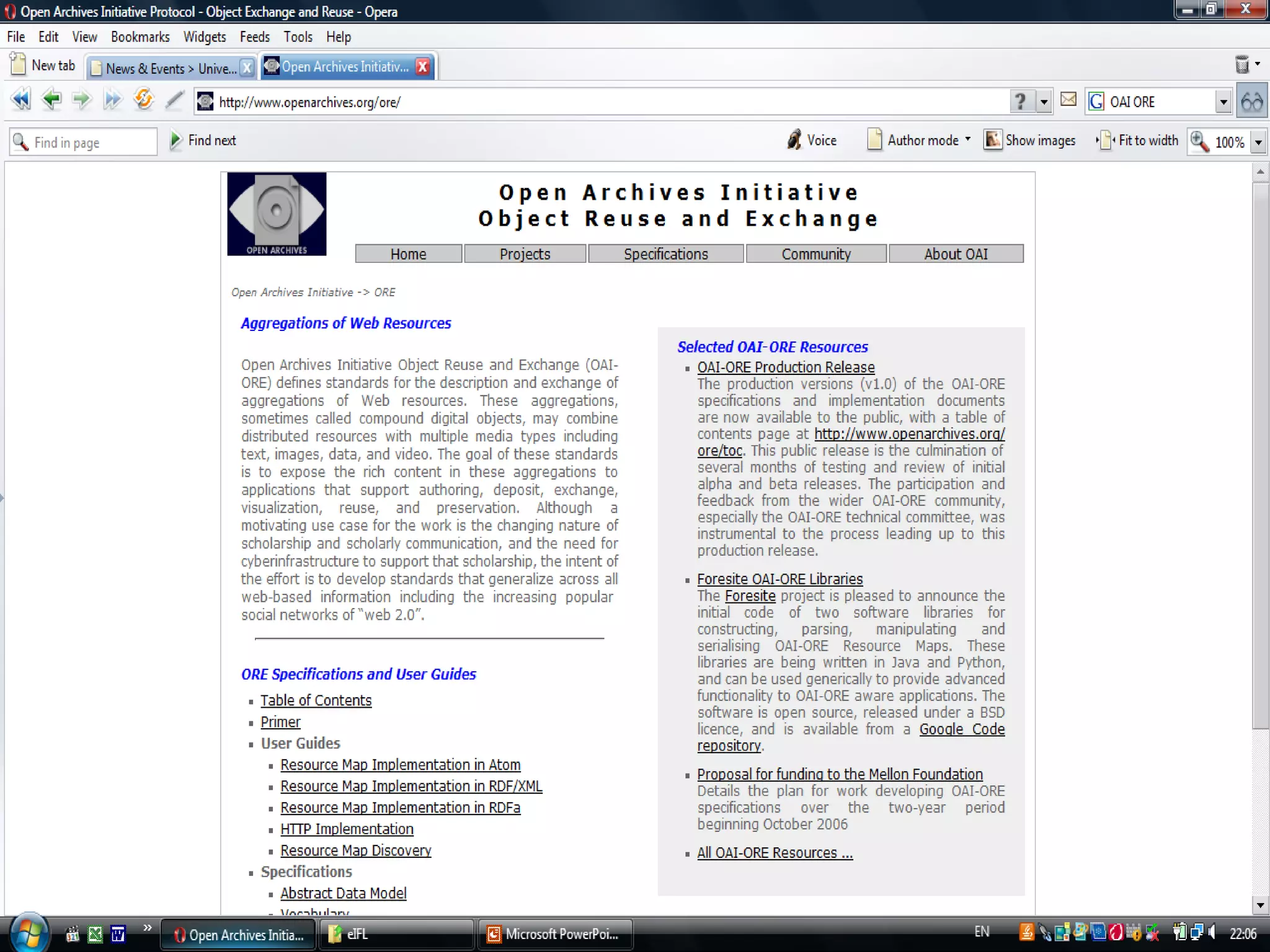
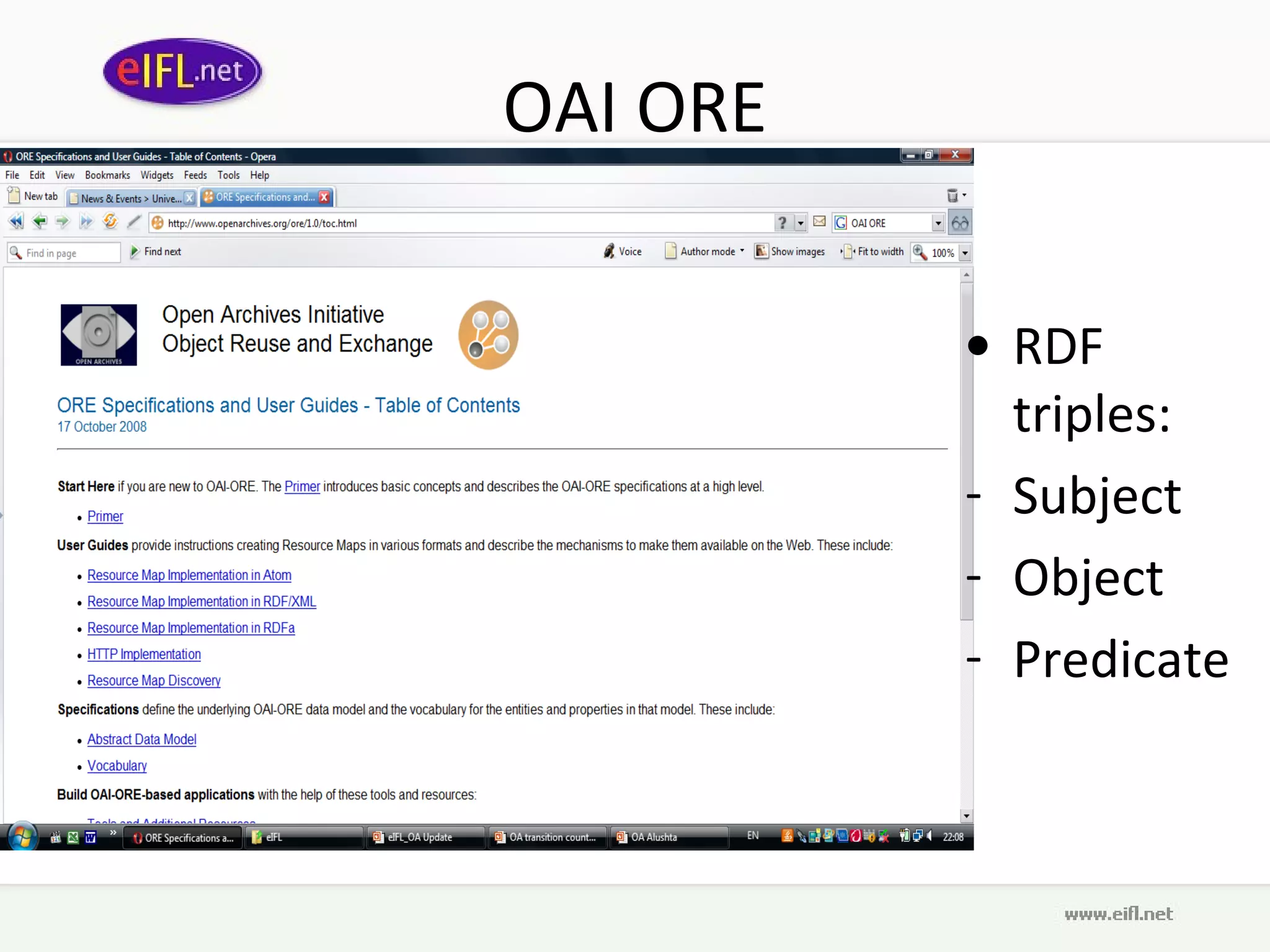
OAI ORE RDF triples : Subject Object Predicate
Innovations "We are and will remain  a net importer of knowledge , so it is in our interest  to promote the freest possible flow   of information  domestically and globally. The arguments for stepping out first on open access are the same as the arguments for stepping out first on emissions trading – the more willing we are to show leadership on this, we more chance we have of persuading other countries to reciprocate.” Senator Carr
UN MDG The UN Millennium Development Goals emphasise the urgent need to address problems such as poverty and hunger eradication, child mortality, maternal health, environmental sustainability and combating diseases such as HIV/AIDS, malaria and other It is very clear that without strong scientific platforms built on the widest possible access to research information, these goals will not be met If sustainable development is dependent on a strong national science base, then permanent access to the widest possible range of publications from the international library of research is a pre-requisite
Why Open Access In this world libraries are no more just reading rooms and collections of books on the shelves From importers of knowledge they turn into exporters of knowledge Libraries as publishers and educators
eIFL Open Access After three years, the eIFL Open Access Program has emerged as the leading organization promoting and advocating for Open Access in developing and transition countries For the developing world, Open Access will increase scientists and academics capacity to both access and contribute to the global research community
eIFL Open Access eIFL-OA seeks to  enhance access to research , thereby  accelerating innovation  and  economic development  in the countries eIFL-OA Program  builds networks of  Open  repositories  and  Open Access  journals ; provides  training and advice on Open Access policies and practices ; empowers library professionals, scientists and scholars, educators and students to become  open access advocates
eIFL Open Access Policy level – Open Access mandates at the national, regional, institutional levels Awareness raising – promoting benefits of Open Access Level of implementation – open repositories and Open Access journals
 
Open Access Open Access is the free online availability of peer reviewed journal literature permitting any user to read ,  download, copy, distribute, print, search, or link to the full texts of articles 2  complementary strategies:  the development of institutional repositories and Open Access journals From the Budapest Open Access Initiative:  http://www. soros .org/ openaccess /read. shtml
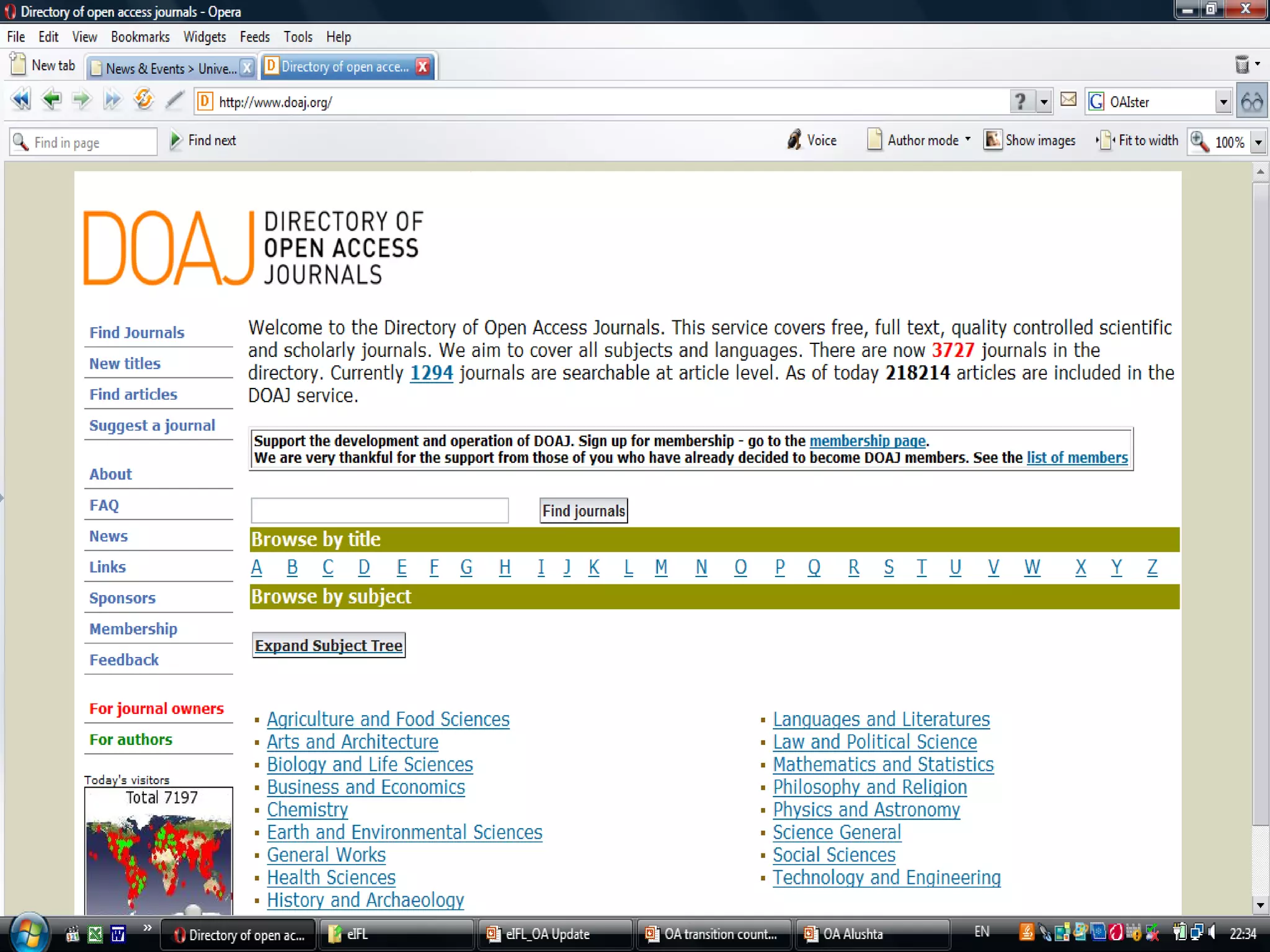
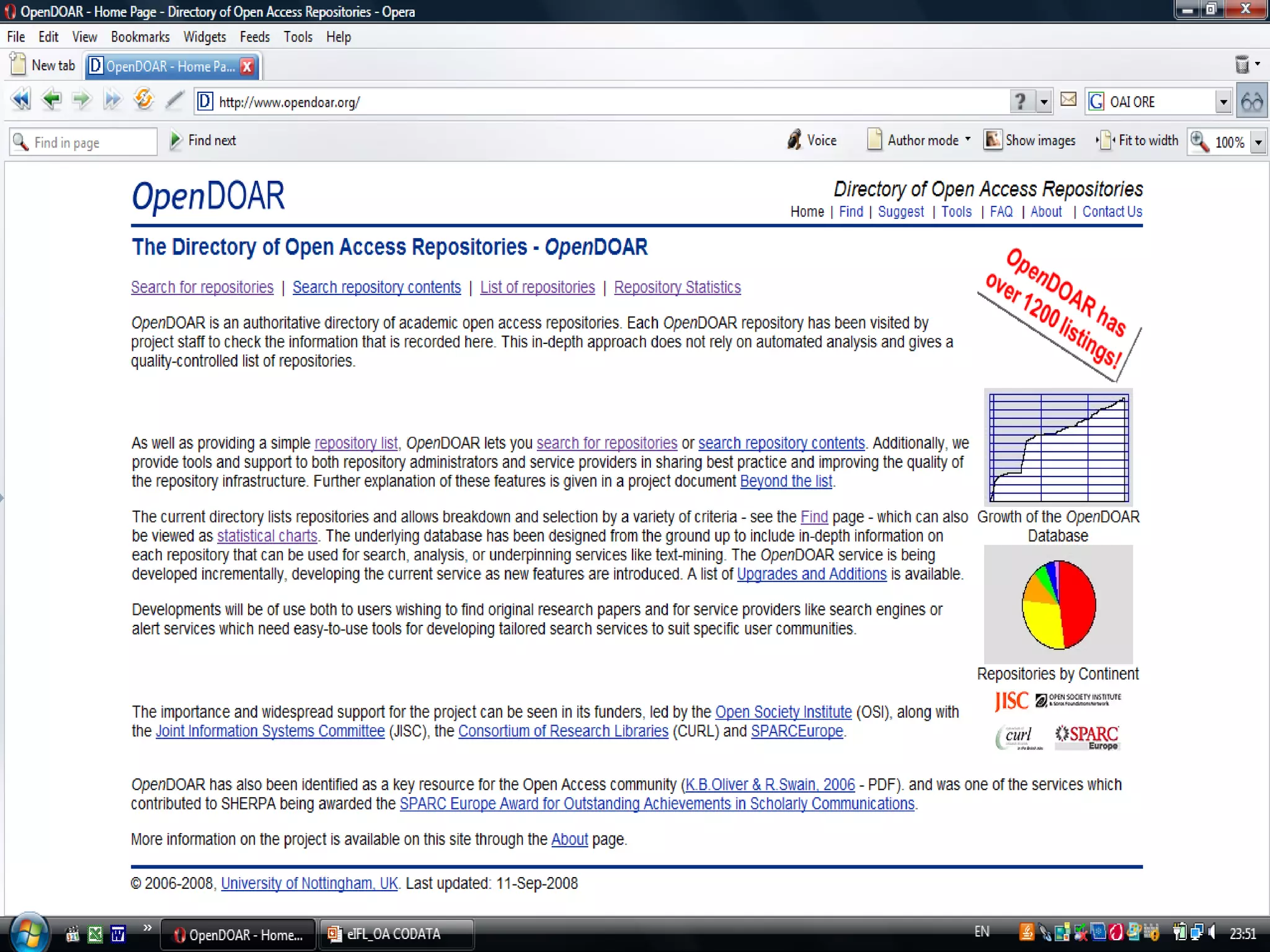
Open Access in numbers OAIster currently provides access to  18,362,804  records from  1035  contributors. 3 727  journal titles (about  15%  of all scientific journals published) in DOAJ, 2.2 new journals per day About  20%  of all current research literature is available in Open Access


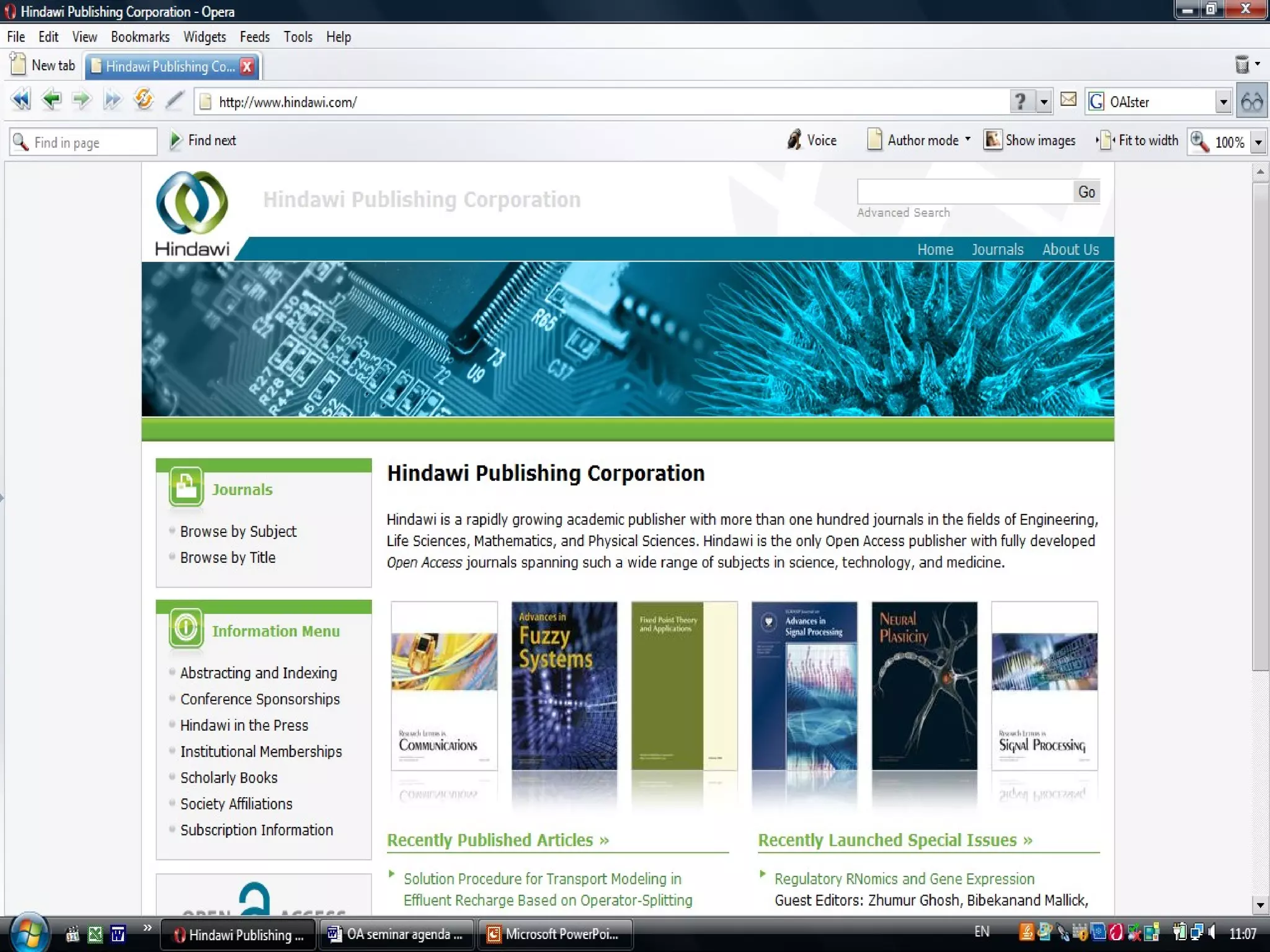
Hindawi Publishing Corporation On February 21, 2007 the Hindawi Publishing Corporation, Egypt, converted the last of its subscription-based journals to an open access model.  Hindawi Publishing Corporation is a commercial publisher of STM (Science, Technology, and Medicine) literature. Founded in 1997, Hindawi currently employs more than 250 people, and publishes more than 100 peer-reviewed journals.
Hindawi Publishing Corporation Over the past several years, Hindawi has seen an increase of more than 40% per year in the number of submitted manuscripts it receives.  Since its full conversion to Open Access in February 2007, Hindawi's growth has continued to accelerate, with monthly submission levels growing by more than 100% during 2007.  Annual impact factor growth more than  14%


Jordan
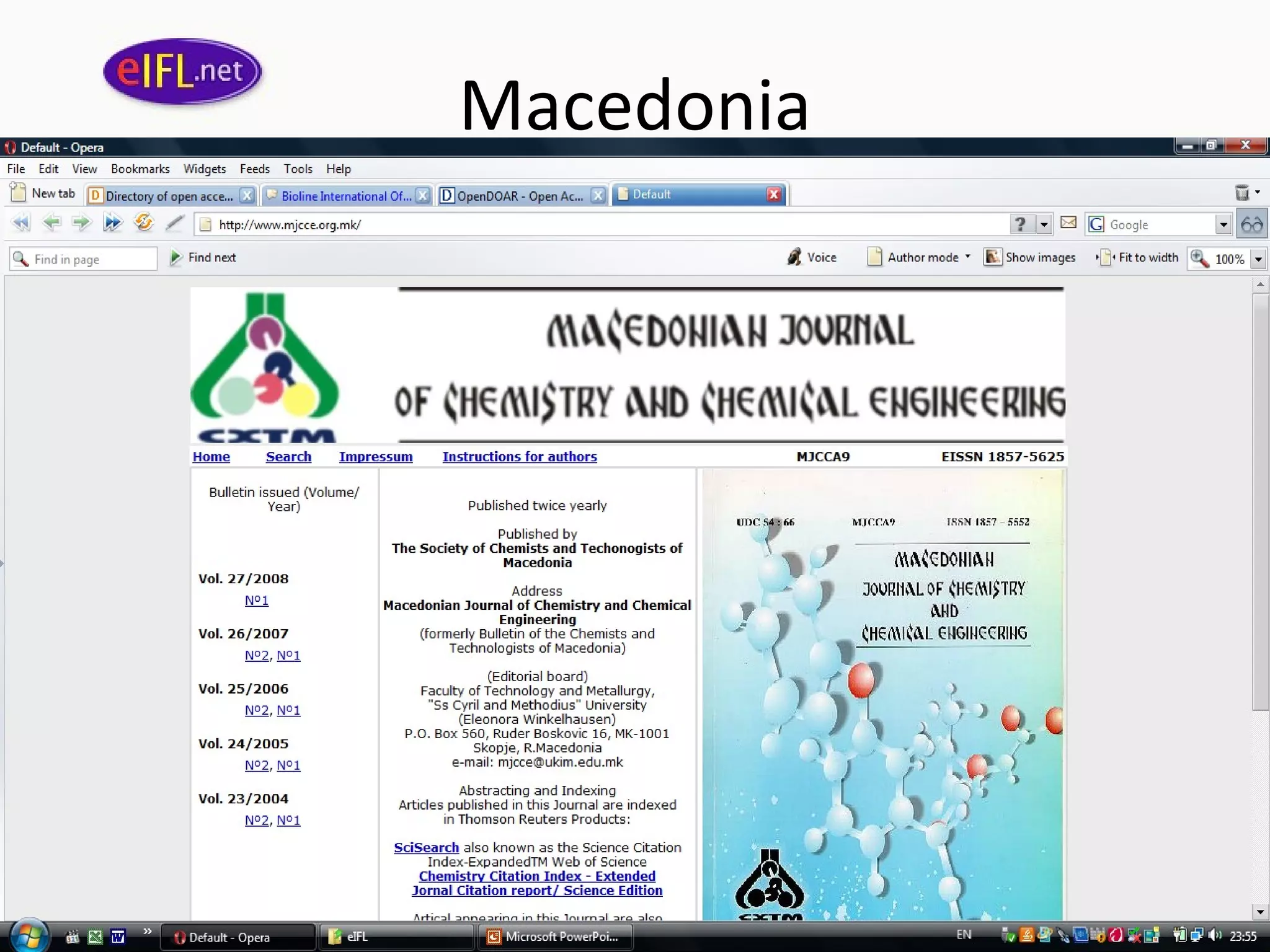
Macedonia
Nepal
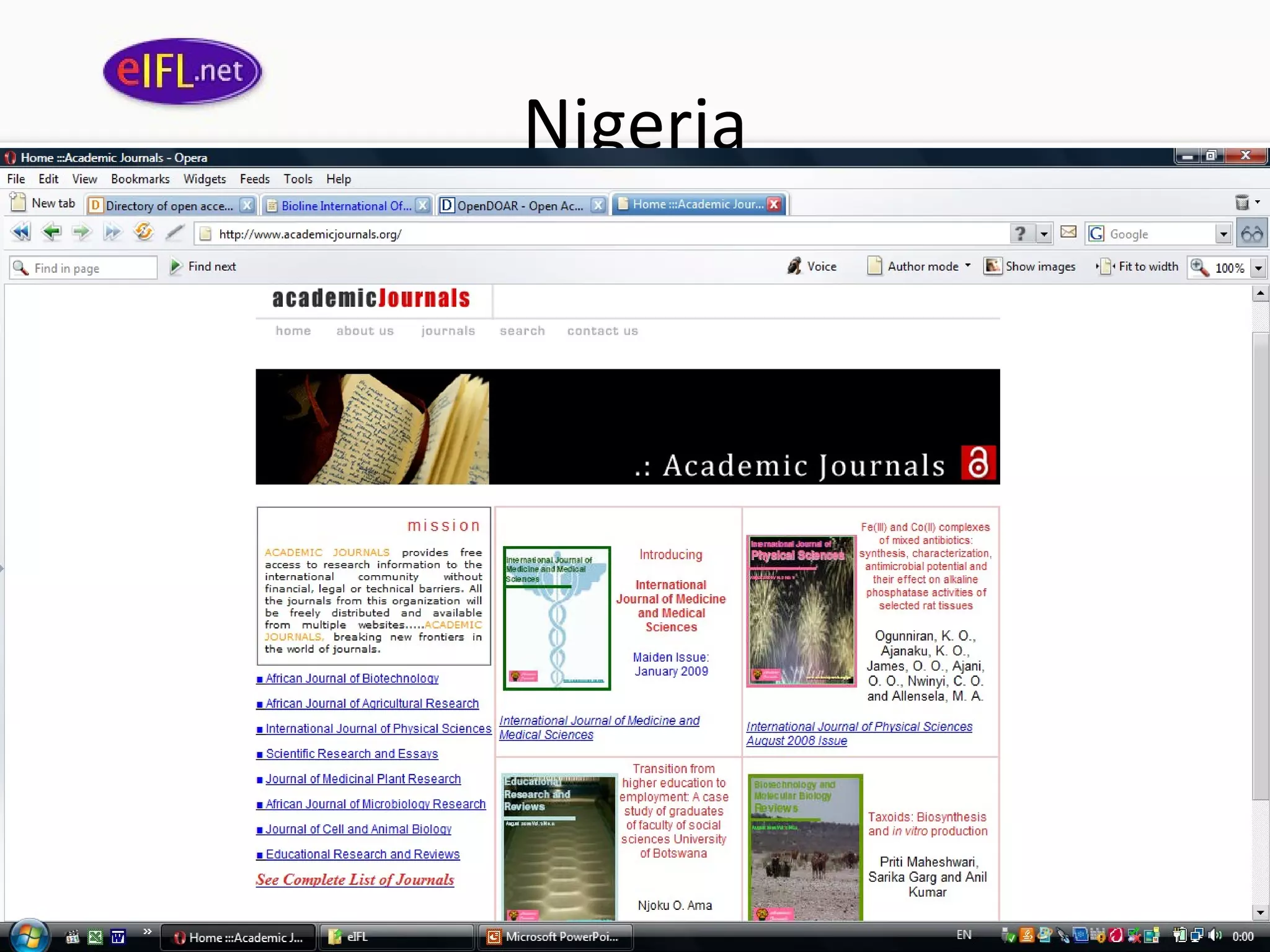
Nigeria


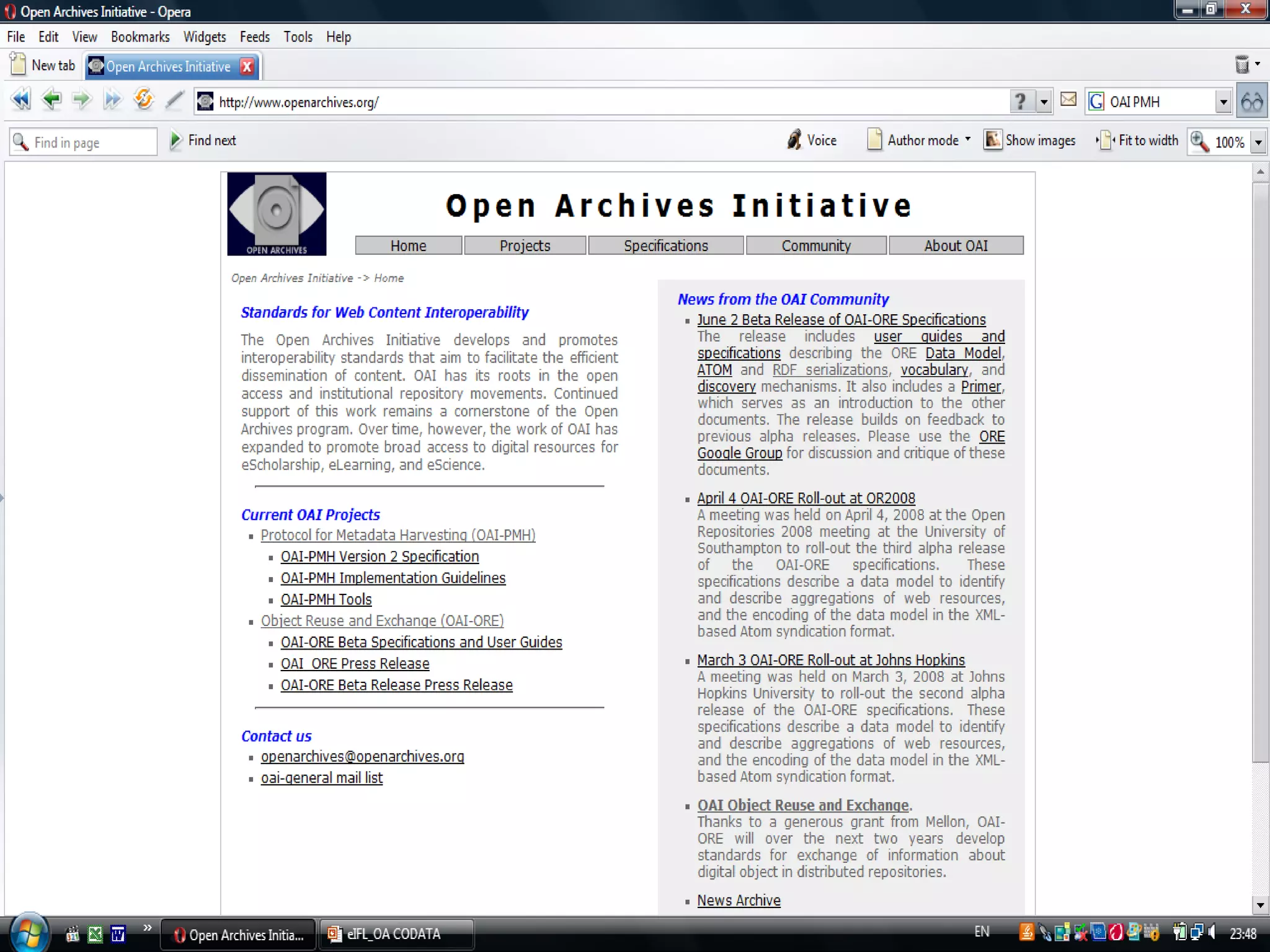
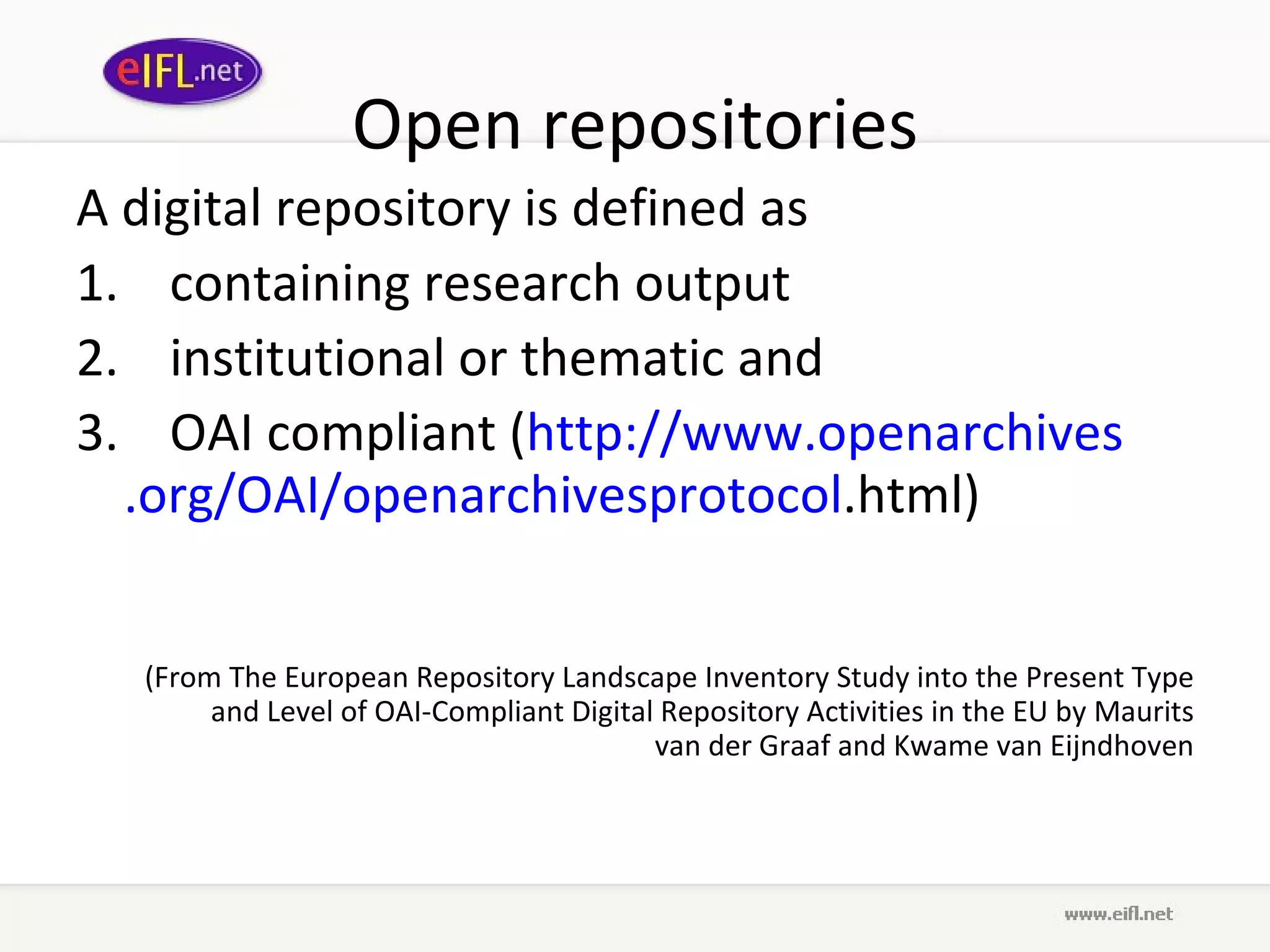
Open repositories A digital repository is defined as  1.    containing research output  2.    institutional or thematic and  3.    OAI compliant ( http://www. openarchives .org/OAI/ openarchivesprotocol .html )  (From The European Repository Landscape Inventory Study into the Present Type and Level of OAI-Compliant Digital Repository Activities in the EU by Maurits van der Graaf and Kwame van Eijndhoven
 
~66% of publishers, 90 - 95% of journals allow self-archiving
 
 
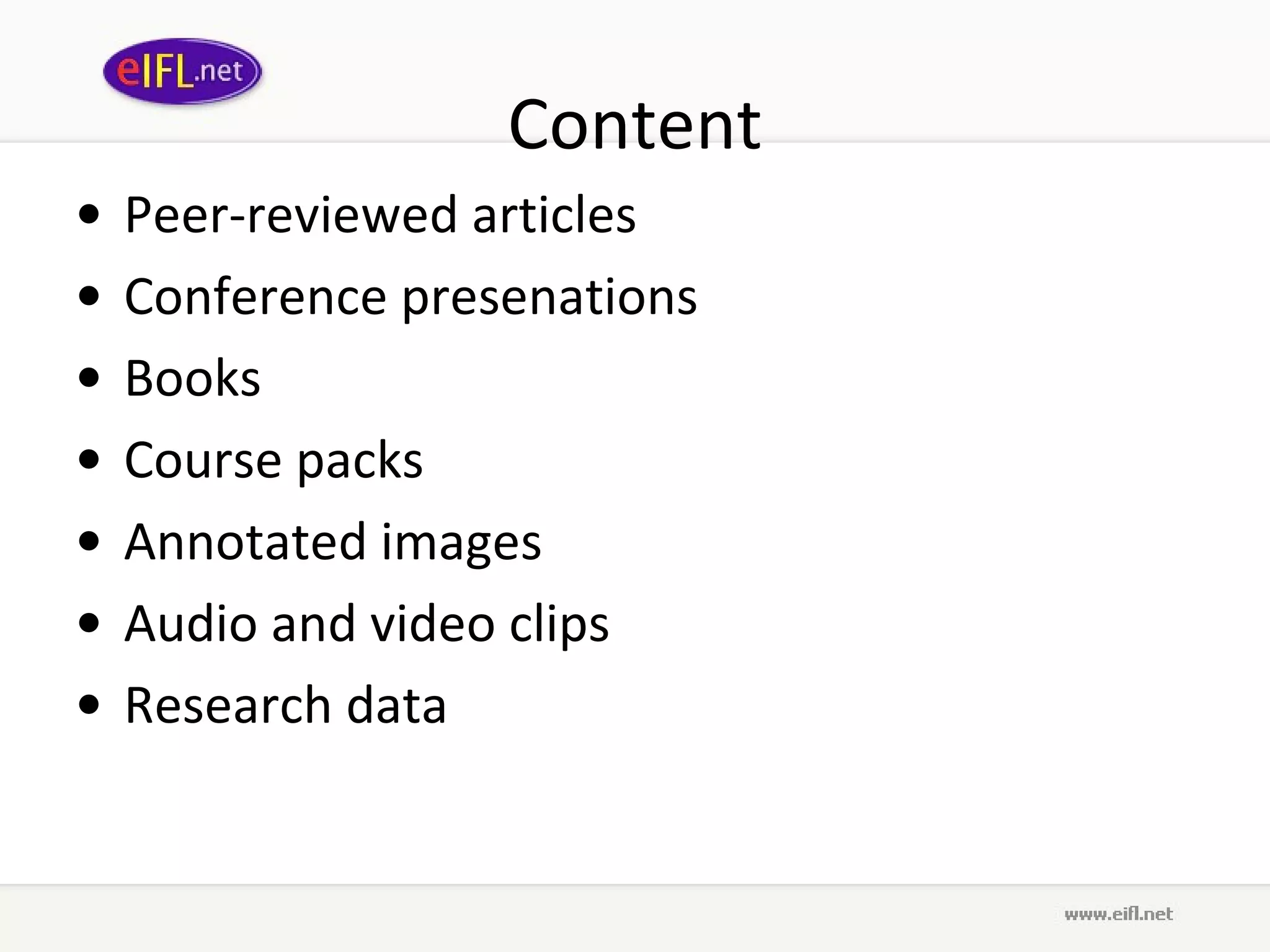
Content Peer-reviewed articles Conference presenations Books Course packs Annotated images Audio and video clips Research data
Content Gray literature : Preprints  /  working materials  / theses and dissertations /  reports  /  conference materials   /  bulletins   /  grant applications   /  reports to the donors   /  memorandums   /  statistical reports   /  technical documentation   /  questionnaires…
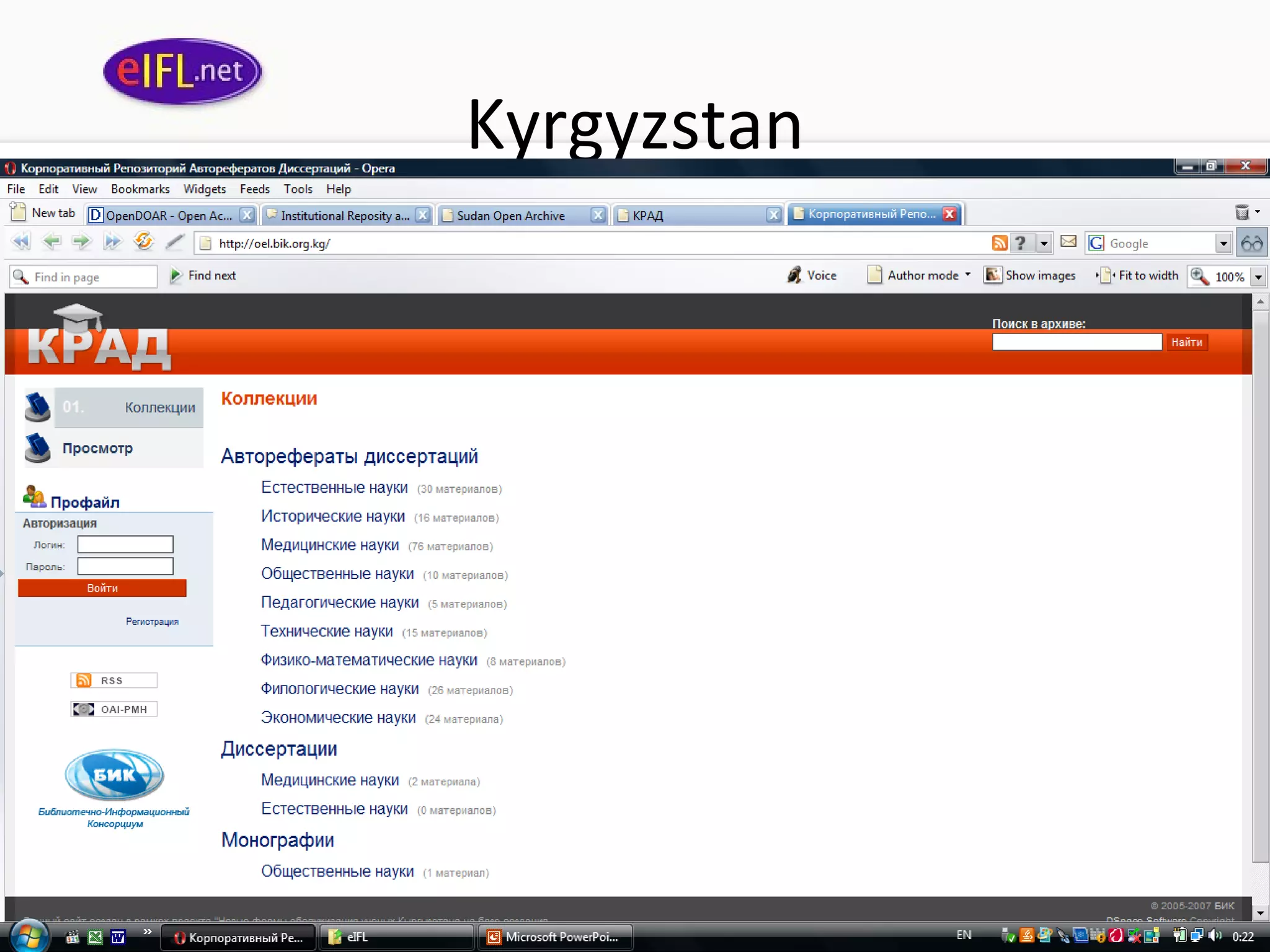
Kyrgyzstan
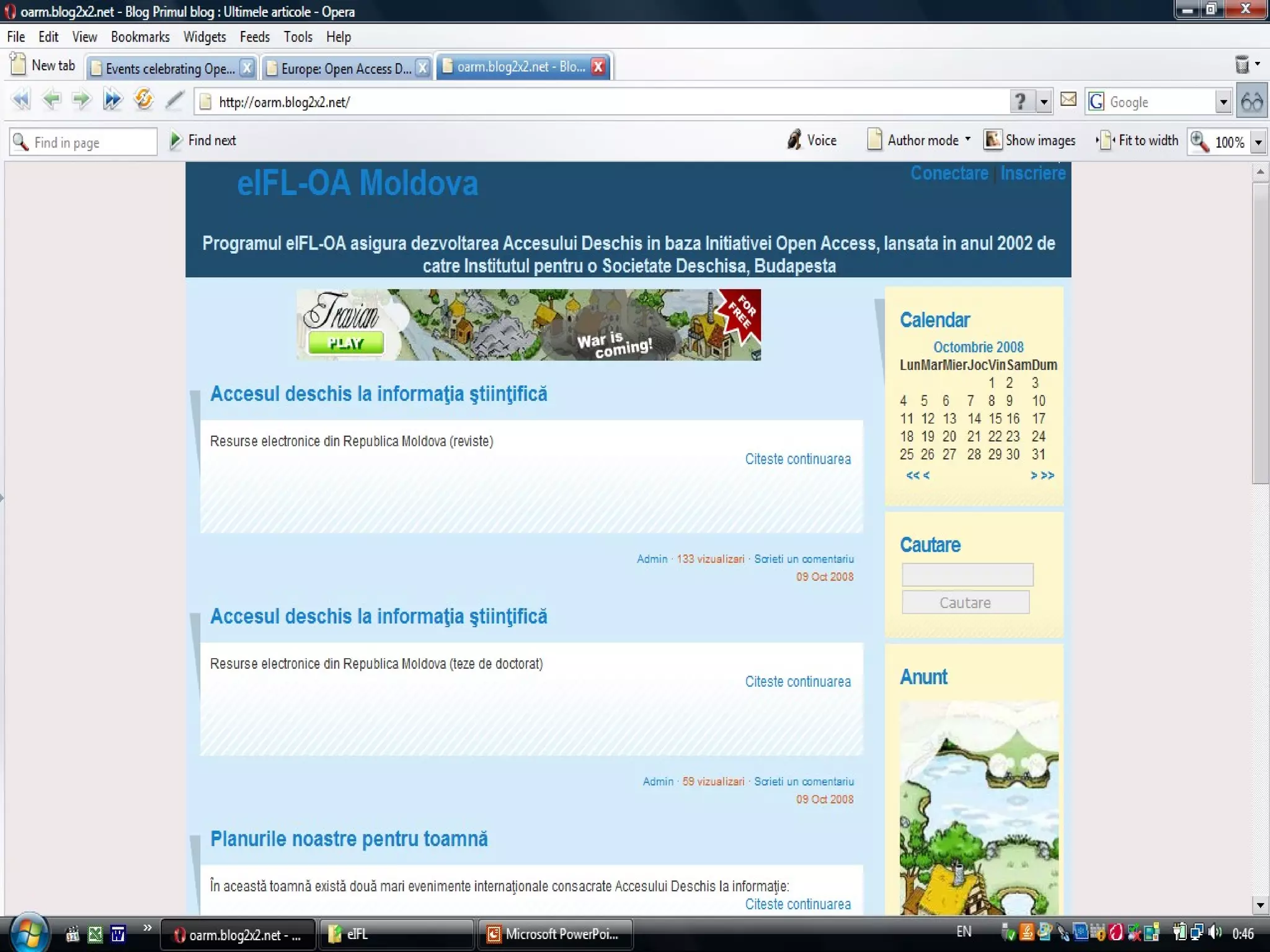
Moldova
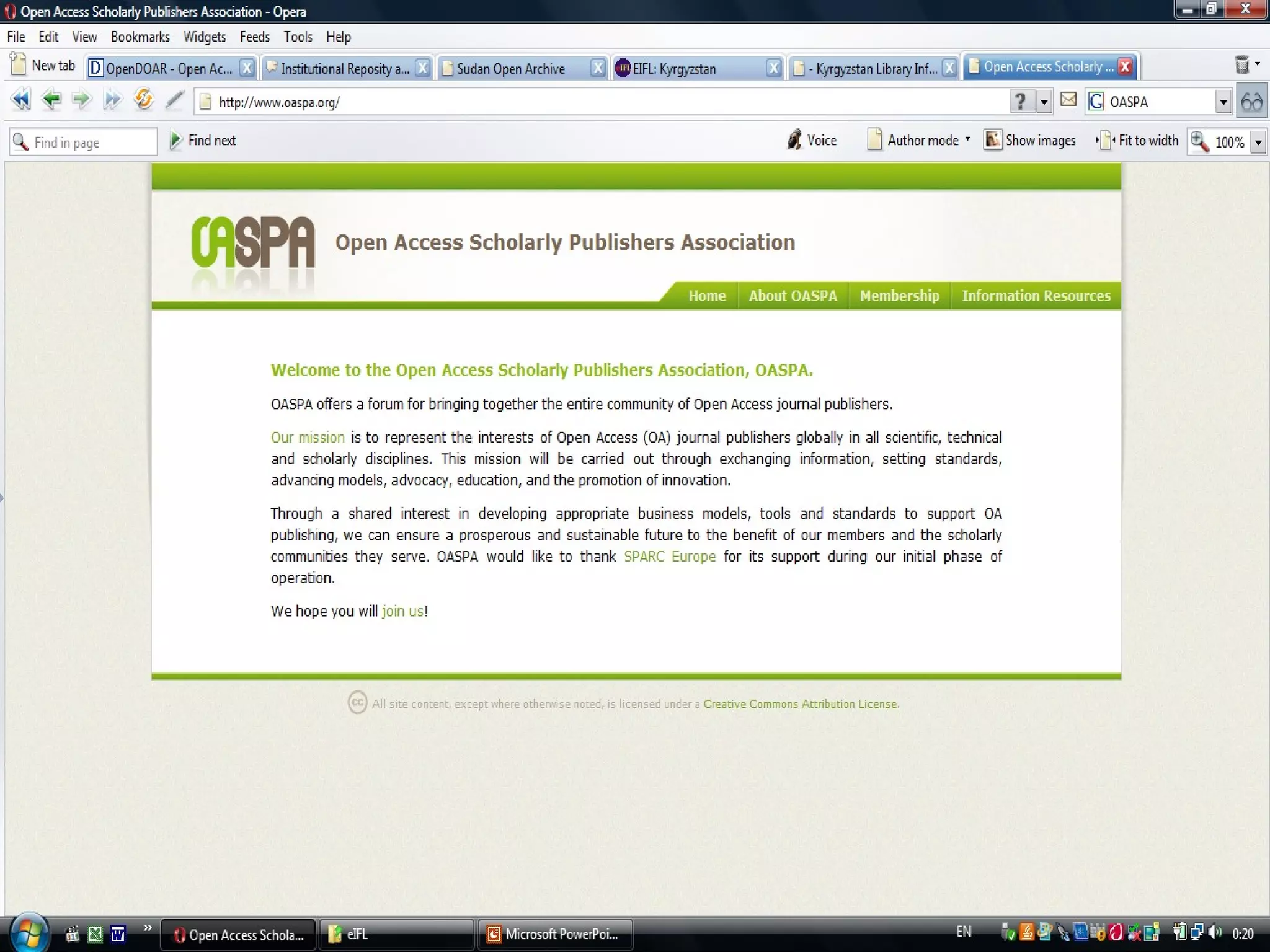
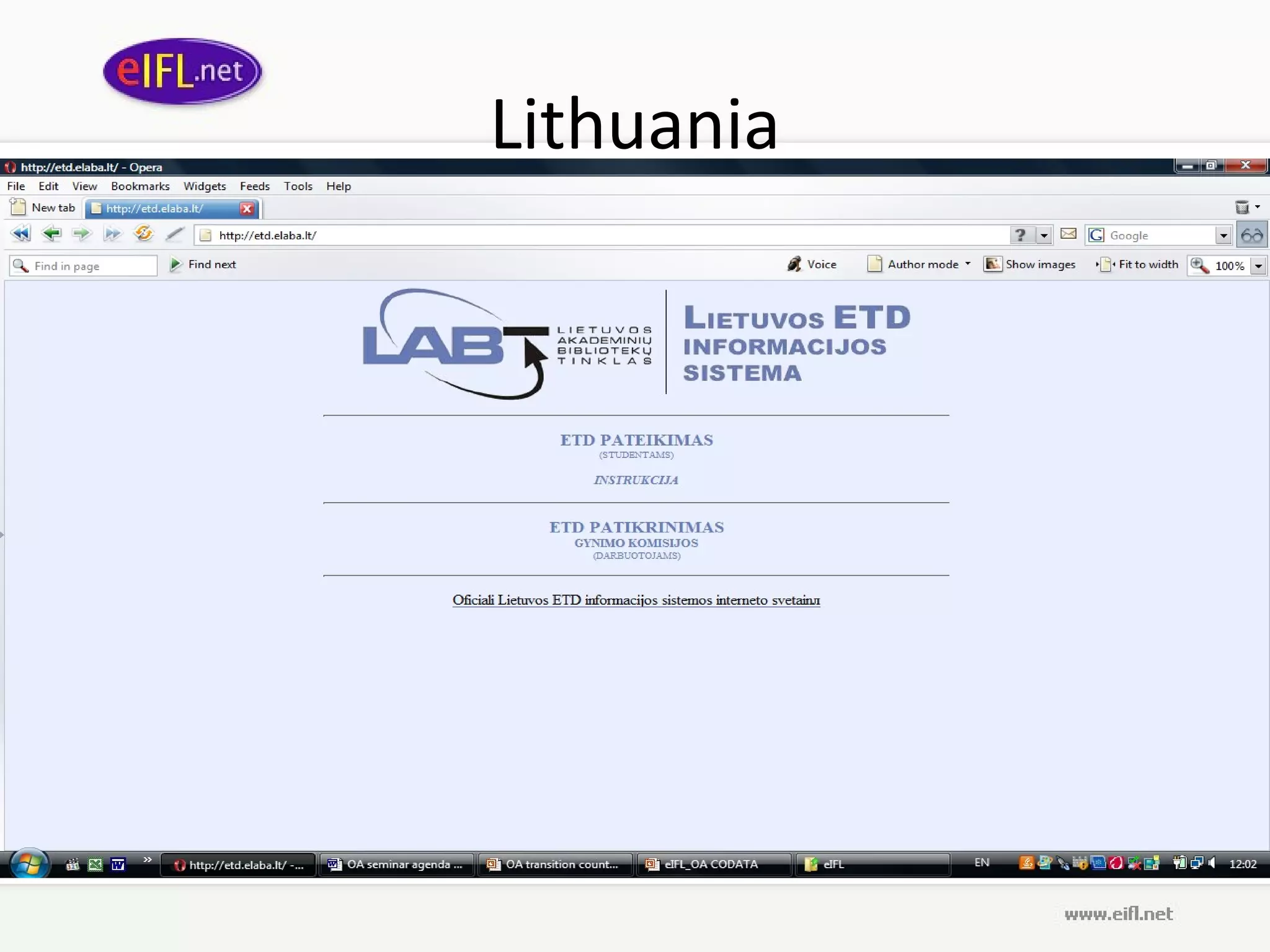
Lithuania
Lithuania the  Lithuanian ETD Project  as a Pilot for Baltic States designed in the framework of a UNESCO programme, prepared by Kaunas University of Technologies and the Lithuanian Network of Academic Libraries (LABT) in 2004.  14 Lithuanian universities and Riga Technical University participated in the ETD Information System project.  The ETD project was supported by the academic communities and the Ministry of Science and Education, and included in the national programs.  The Lithuanian ETD Information System ( http:// etd . elaba . lt /  ) includes 6 150 full-text dissertations, of which 2 386 (38%) are Open Access, others are accessible in the local intranets. It is planned that at the end of year 2008, ETD IS will cover 7 600 dissertations, and 50% of these should be Open Access.
 
Theses and dissertations John Hagen, West Virginia University :  Moving from print to electronic  –  usage growth  145%  The most popular theses and dissertations were downloaded  37,501 times (history ) and 33,752 times (engineering); history one was published and was a long seller 69% of students from the creative writing   department had more successful careers if they went OA with their dissertations – a good marketing tool for them
Azerbaijan
Azerbaijan "I am delighted to be able to congratulate Institutional Repository Working Team! It is excellent to see the range of research journals  published by  Khazar University and know that there is now a clear infrastructure to increase the visibility of researchers."  Prof. Dr. Hamlet Isakhanli,  Founder and Rector of Khazar University, Azerbaijan
Bulgaria
Estonia
 
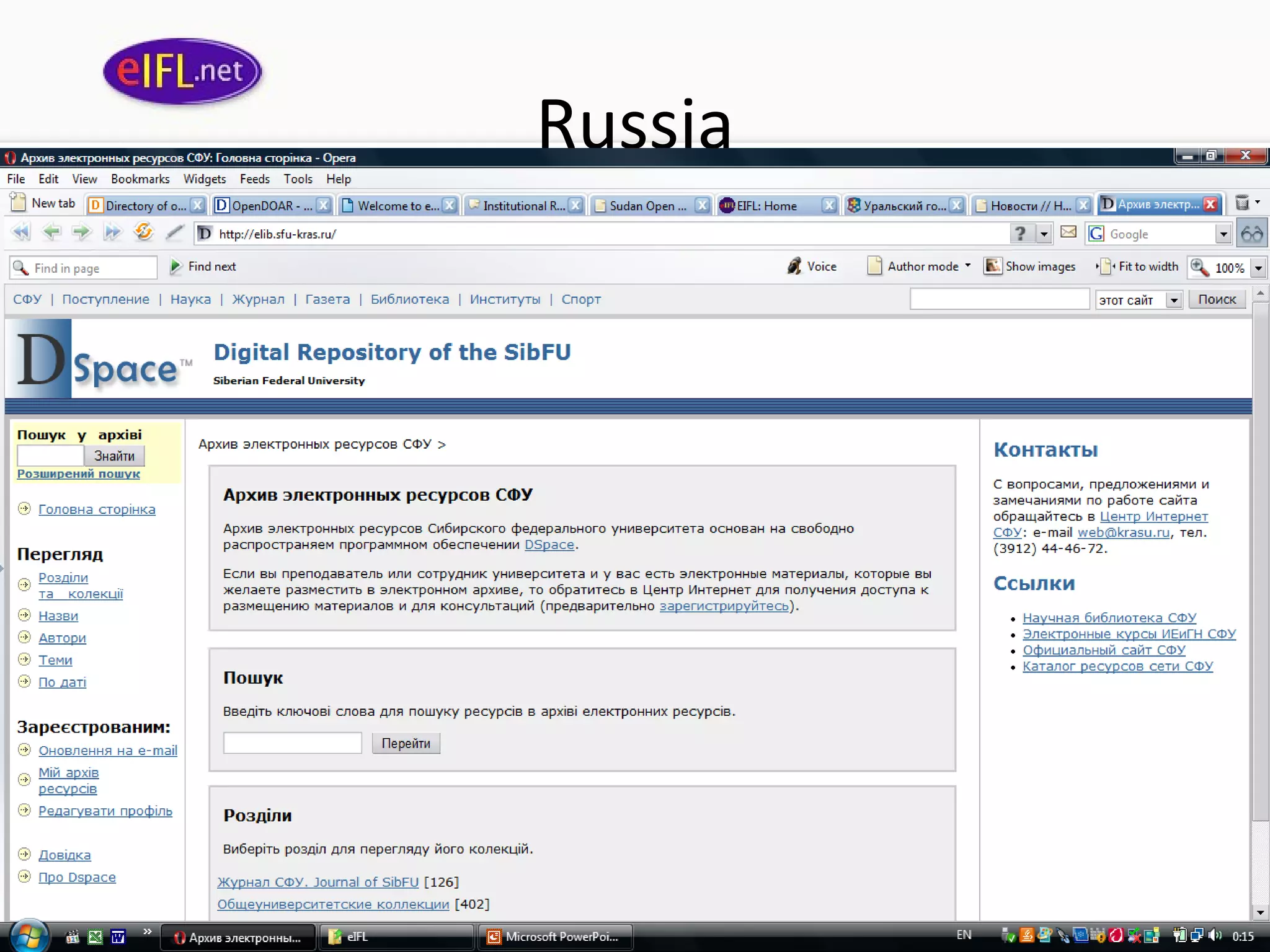
Russia
Slovenia
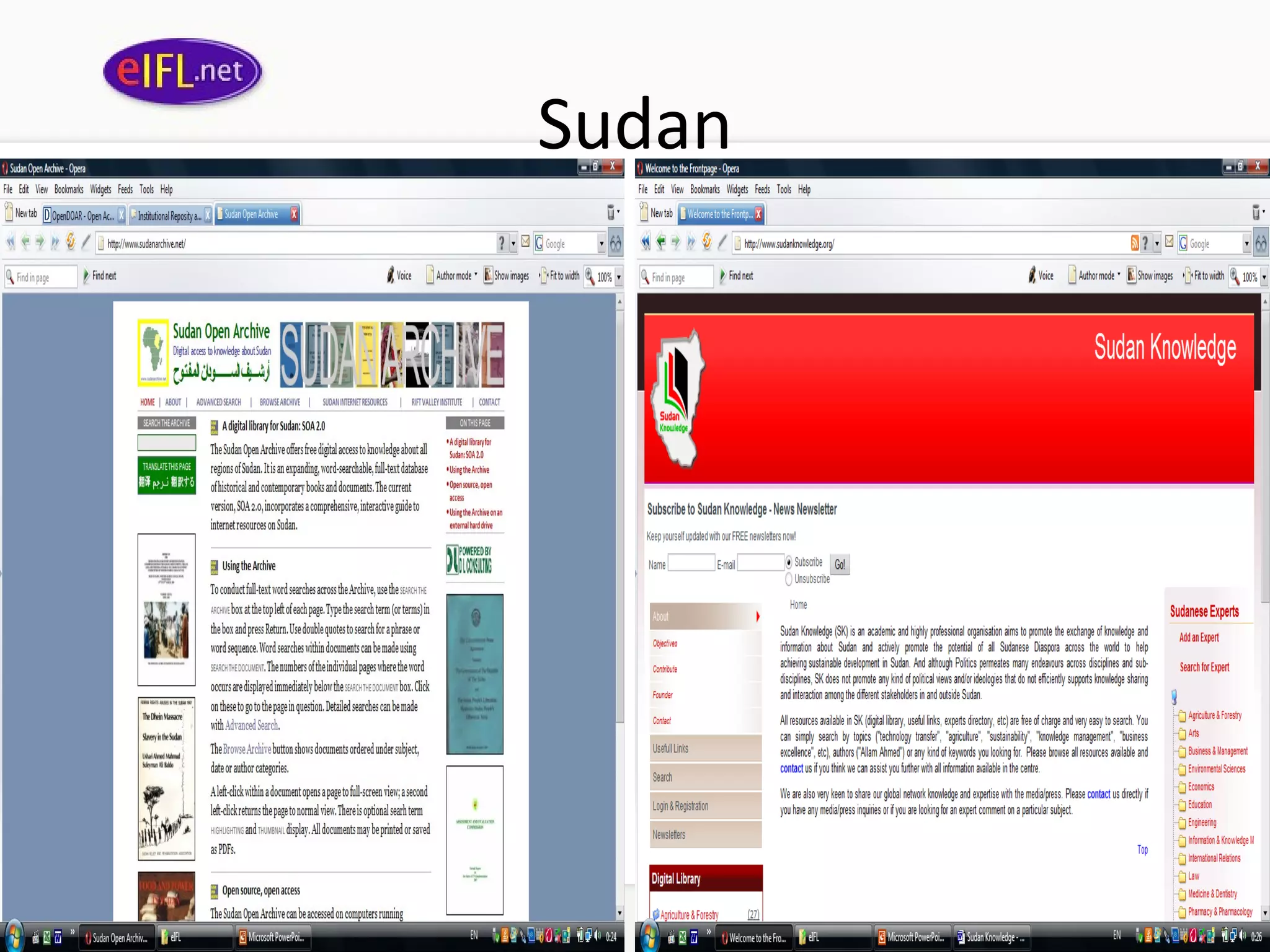
Sudan
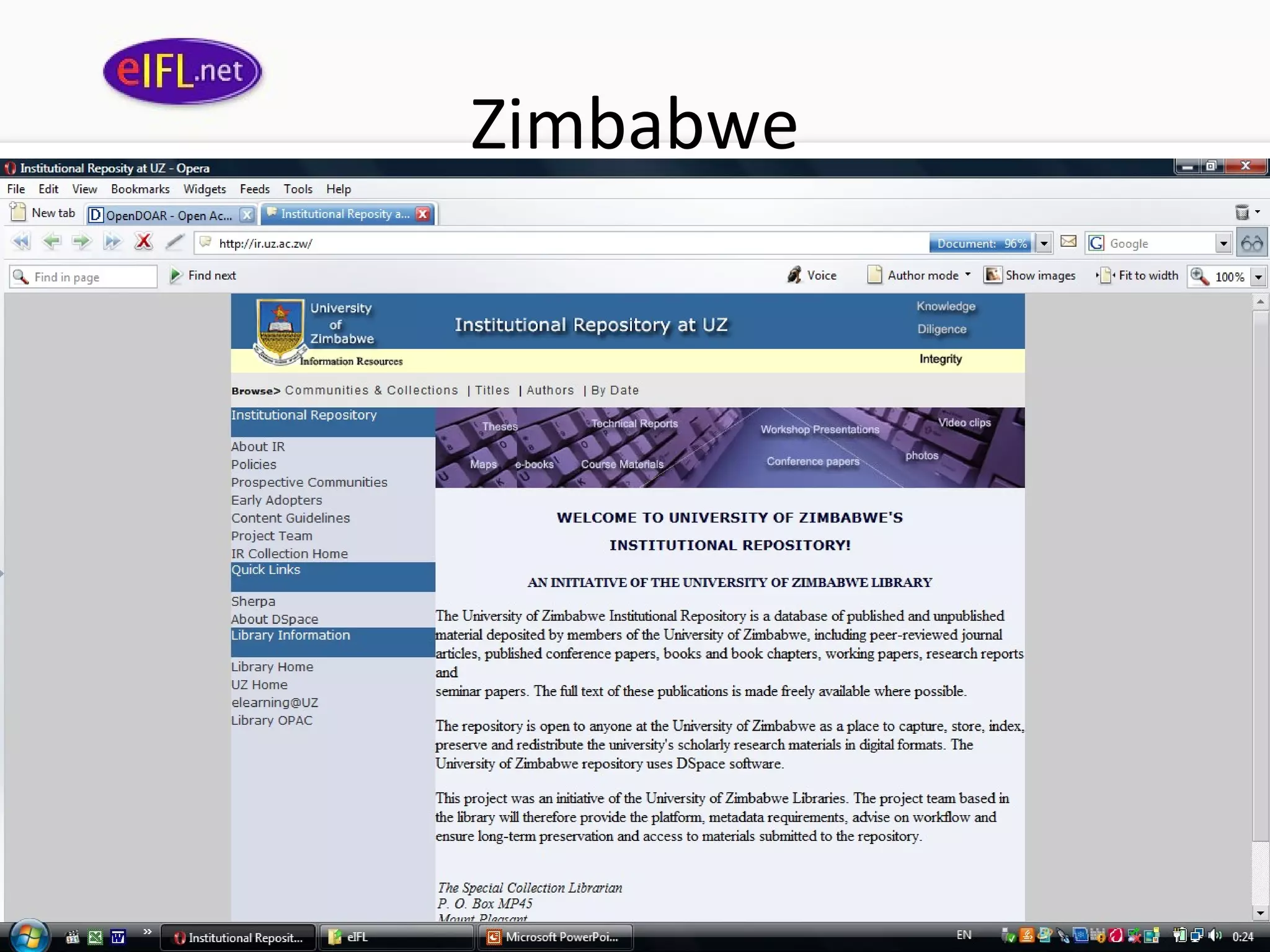
Zimbabwe
 
Costs The costs and benefits of our Institutional Repository:  Running costs: the server costs us R50 000 ($6250) once every three years Running costs: handle license and Red Hat Enterprise Server Licence $100 per year Salaries prove to be a high running cost: 1 full-time IR librarian, 1 full-time IR library assistant, 2 full-time librarians working on IR together with other duties, 1 part-time librarian working on IR together with other duties  South Africa Ukraine – 10,000 USD
Benefits Value of benefits: at this stage the IR does not generate extra income or save administration costs – it actually generates more work and more administration costs. Functions such as metadata editors, content submitters, collection administrators demand extra work from staff The function of the IR is not to have monetary benefits, but to showcase research done at an institution, provide open access to research, prestige for the academics, institutional visibility as well as immediate access to research The IR also provides long-term preservation benefits South Africa
The Netherlands NARCIS – National Academic Research and Collaboration Information System – extended DARenet plus datasets and research descriptions:  http://www. narcis .info   DAREnet  www. darenet . nl   Cream of Science  www. creamofscience .org   Promise of Science  http://www. darenet . nl /en/page/page.view/promise.page   DANS-EASY Electronic Archiving System of the Institute DANS (Data Archiving and Networked Services) –  http://easy. dans . knaw . nl / dms
Policy – Academy of Sciences the Academy of Science (ASSAF) Committee on Scholarly Publishing in South Africa (CSPiSA) and the Department of Science and Technology (DST) has dedicated a substantial three-year budget to fund the implementation of ASSAF's recommendations for the development of scholarly publication in South Africa - a 'gold route' Open Access approach to journal publishing in South Africa Susan Veldsman has been invited to join ASSAF Committee and an expert and advisor for implementation of recommendations
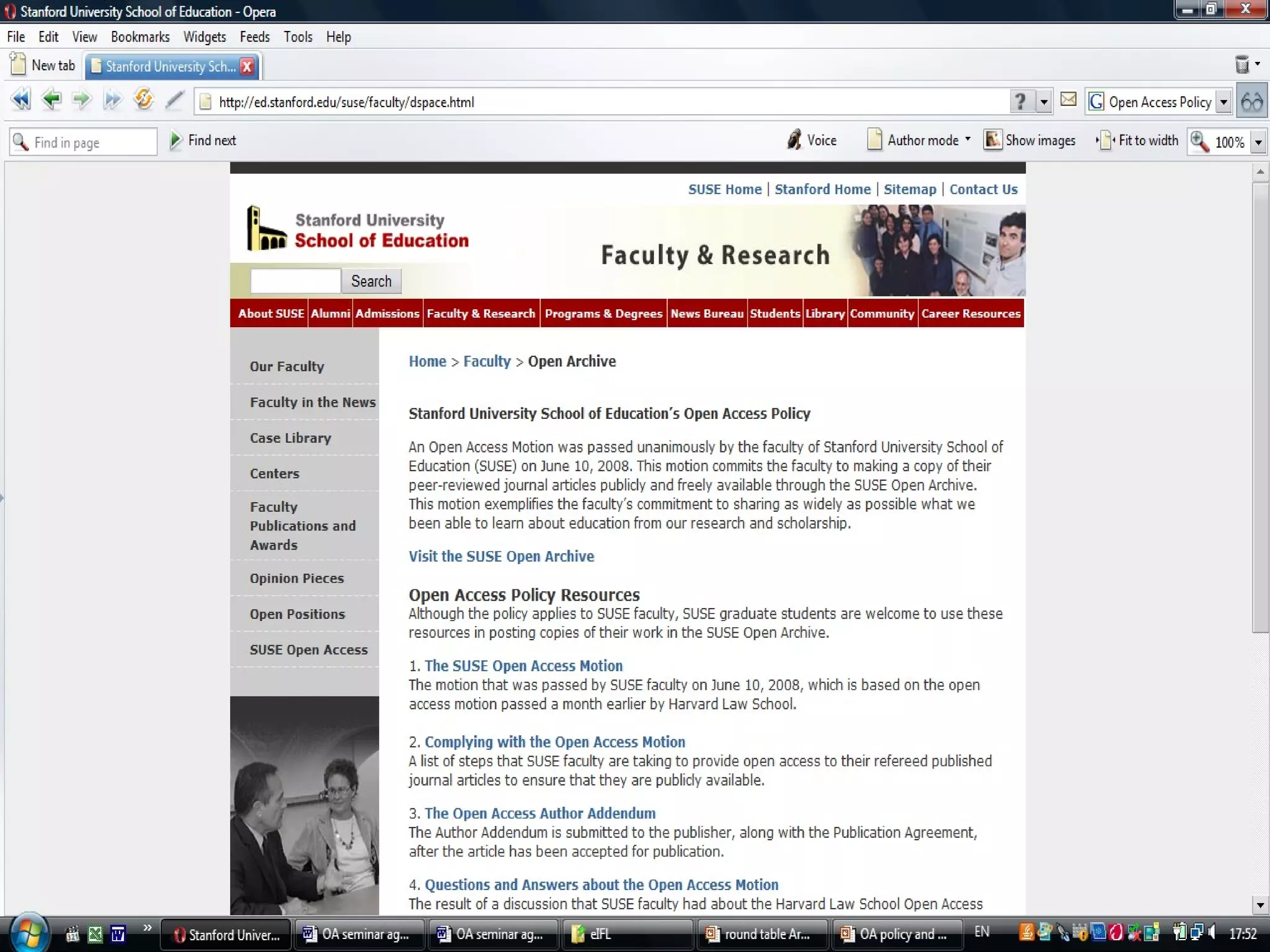
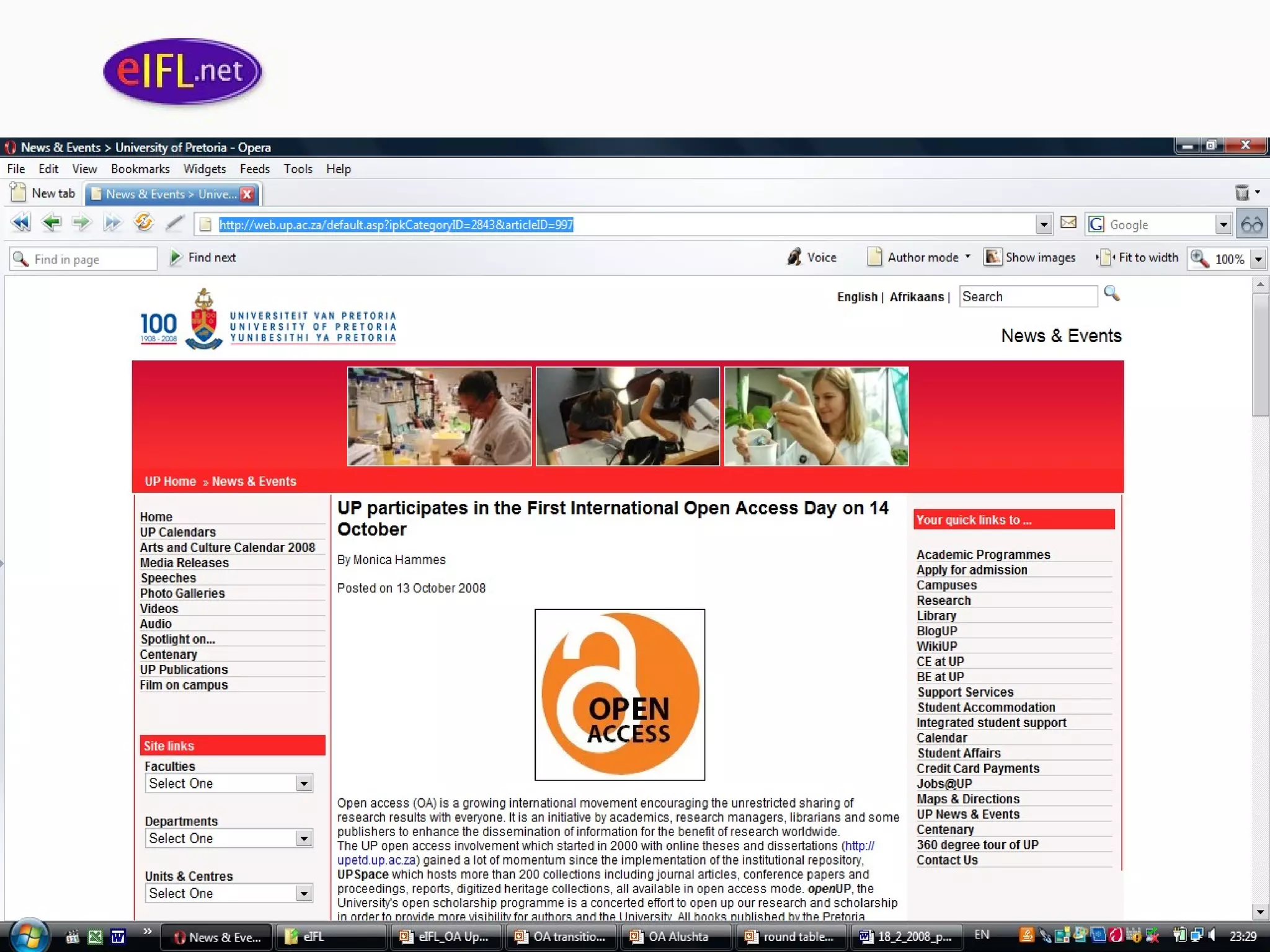
Policy - University https :// www . up . ac . za / dspace /   “ UPSpace is a university-based institutional repository which offers a set of services to the researchers of the UP Community, for the management and dissemination of digital academic/research materials (excluding work of administrative or commercial nature) donated to or created by the institution and its community members. The set of services includes the collection, storage and preservation in digital format, and retrieval of items submitted to UPSpace.”  More than a dozen of well functioning open repositories in South Africa
South Africa – Why?   In a 2006 report, the Academy of Science of South Africa found that over the past 14 years, 1/3rd of South African journals have not had a single paper cited by their international counterparts Fewer than 1 in 10 of South Africa's 255 accredited journals has been cited enough to feature in the main international research databases, despite South Africa being the continent's leading publisher of research
South Africa – Why?   “ Visibility for research output from South Africa, and other developing countries, must be increased dramatically so that research from developing countries is incorporated into the global knowledge pool, so vital to the resolution of global issues such as climate change or the spread of infectious diseases.” ( http://www. scidev .net/ quickguides /index. cfm ? fuseaction = qguideReadItem &type=1& itemid =2828&language=1& qguideid =4 )
 
National Policy - Ukraine Since January 2007 Ukraine has a law - proposed mandate for open access to publicly funded research.   The Law of Ukraine On the principles of developing information society in Ukraine for 2007-20015 at  www. rada . gov . ua


National Policy - China Chinese Ministry of Science and Technology (CHINA) http://www.most. gov . cn /eng/   http://www. codataweb .org/06conf/   Mandate to deposit research data (not yet applicable to research articles themselves)
National Policy - China "We can invest billions of yuan in big science projects, but we also need to invest a tiny 200 million yuan (US$29.4 million) in an open access fund to help the growth of our journals," said Zhu Zuoyan, the recently retired deputy head of the National Science Foundation of China (NSFC) “ Government-funded open access journals would be a breakthrough for science publishing in China. A government-funded open access initiative would reduce or eliminate the cost of publishing — enabling Chinese journals to attract more high-quality papers and improve their impact. Domestic journals can publish papers faster.  (http://www.scidev.net/en/news/make-china-journals-open-access-says-top-scientist.html)
National Policy - China Hong Kong Universities proposed Open Access policy for publicly funded research
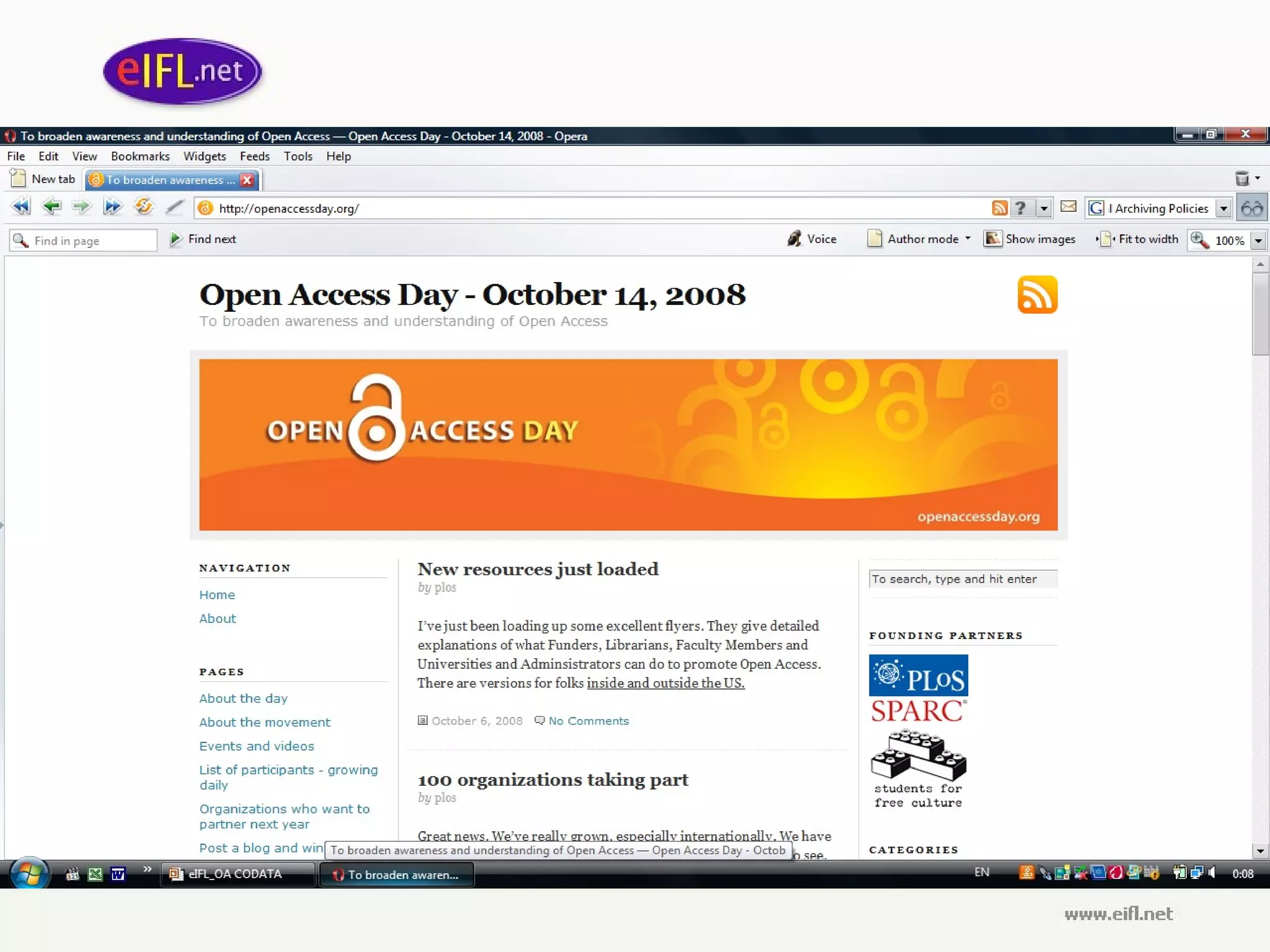
National Policy - Lithuania Discussing Open Access to publicly funded research as a national law Director of SPAR Europe travelled to Vilnius in early May to meet with the decision makers in Lithuania to help them move further with adoption of a draft law  Ministry of Education organised a national Open Access awareness raising seminar during International Open Access Day
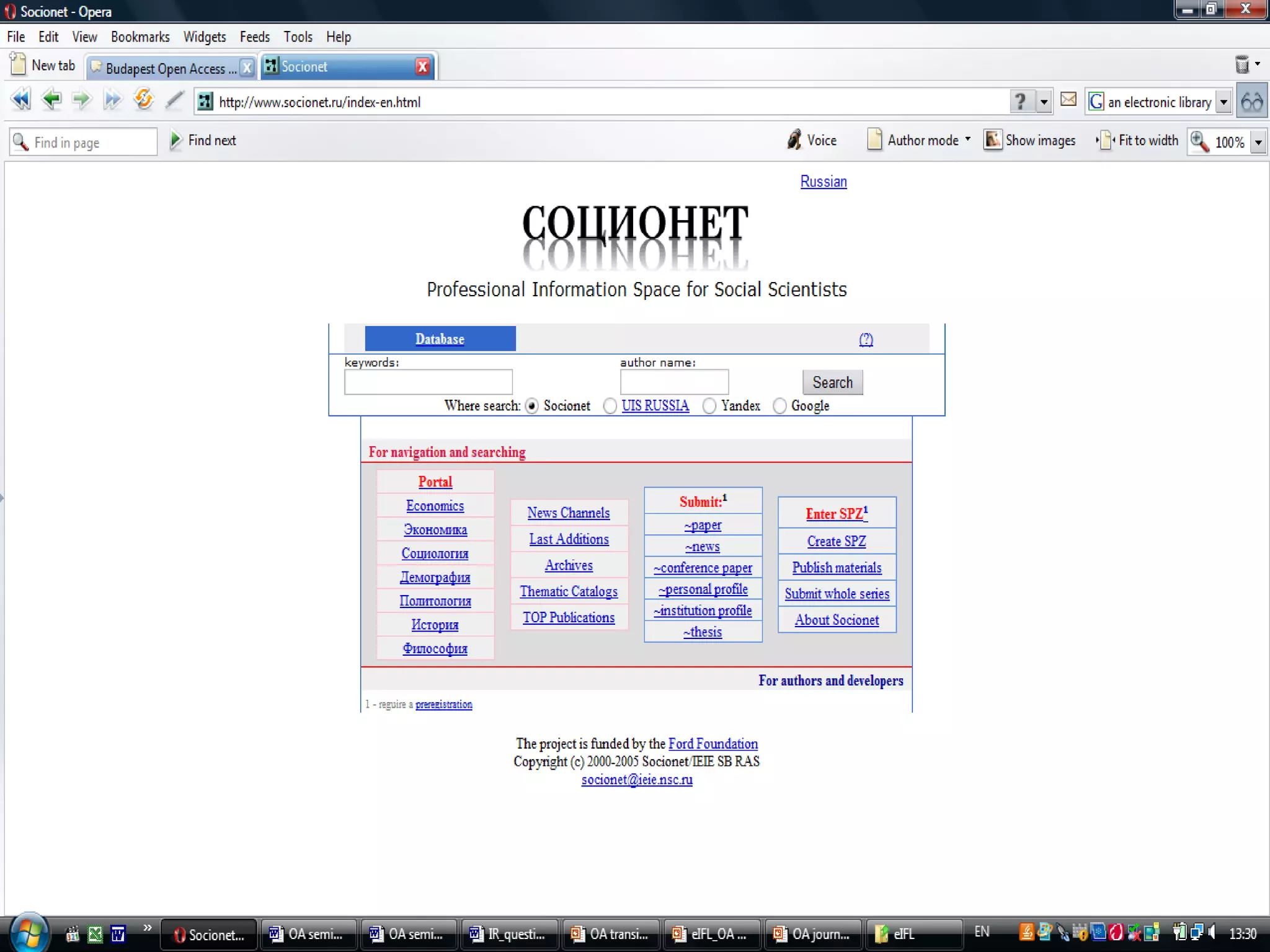
Russia Central Economics and Mathematics Institute of Russian Academy of Sciences (institutional-mandate) http://www. cemi . rssi . ru /   http:// socionet . ru /index-en.html   http:// cemi . socionet . ru /   All researchers of the Central Economics and Mathematics Institute of Russian Academy of Sciences are mandated by director's decree to immediately deposit their papers/articles in the institutional Open Archive. ["...mandate researchers of CEMI RAS to deposit all completed research (in working paper form), including the full text, in institutional OA (repository) not later than 6 months after completion."]  http://www. cemi . rssi . ru / rus /news/ initiat -eng. htm
Russia  -  e-Science CRIS research e- infrastructure - http :// socionet . ru / e-Science « e- Science is based on the Open Access to research results (financed from the public money) »  Sergey Parinov
 
National Polices Nigerian University Commission is working on Open Access recommendations to Nigerian Universities.  The similar request came from the Research Council Zimbabwe.
OA declarations National Open Access declarations are being prepared in Armenia, Moldova, Kyrgyzstan and Ukraine (following the recent Brisbane Declaration on Open Access in Australia).
eIFL Open Access Fast Facts: 354 Open Access journals  in eIFL countries  100+ open repositories  in the eIFL demonstrator ( http:// eifl .cq2.org )  25+  seminars and training
OA workshops 28-29 April, 2008 – Awareness raising – Open Repositories: New Models For Scholarly Communication, Ahmadu Bello University, Zaria,  Nigeria   14-15 May, 2008 – OA awareness raising workshop in  Georgia  hosted by Ilia Chavchavadze State University  18-21 June, 2008 – study visit of Open repository managers from  Azerbaijan, Belarus, Georgia  and  Kyrgyzstan  to the National University Kyiv-Mohyla Academy, Ukraine  23-24 June, 2008 – OA awareness raising workshop in  Moldova   
OA workshops 28-30 July, 2008 – OA awareness raising workshop in  Mozambique  2-3 August, 2008 – Web 2.0 and Open Access: Enhancing Scholarly Communication workshop, AUCA,  Kyrgyzstan ; and OA presentation at the BarCamp Central Asia  3-4 September, 2008 – Monika Segbert presented eIFL OA at the international workshop Open Access to Scientific Literature and Other Digital Scientific Information Resources in  Central America and Caribbean ,  Cuba
OA workshops 2-3 October, 2008 – eIFL OA country coordinators from  Kenya and Malawi  were trained at the Institutional repository workshop, the University of Pretoria,  South Africa  (supported by INASP)   15-16 October, 2008 - OA awareness raising workshop in  Armenia 20-21 October, 2008 - OA awareness raising workshop in  Belaru s  Open Access presentations were given by eIFL members in  South Africa, Uzbekistan and Zimbabwe
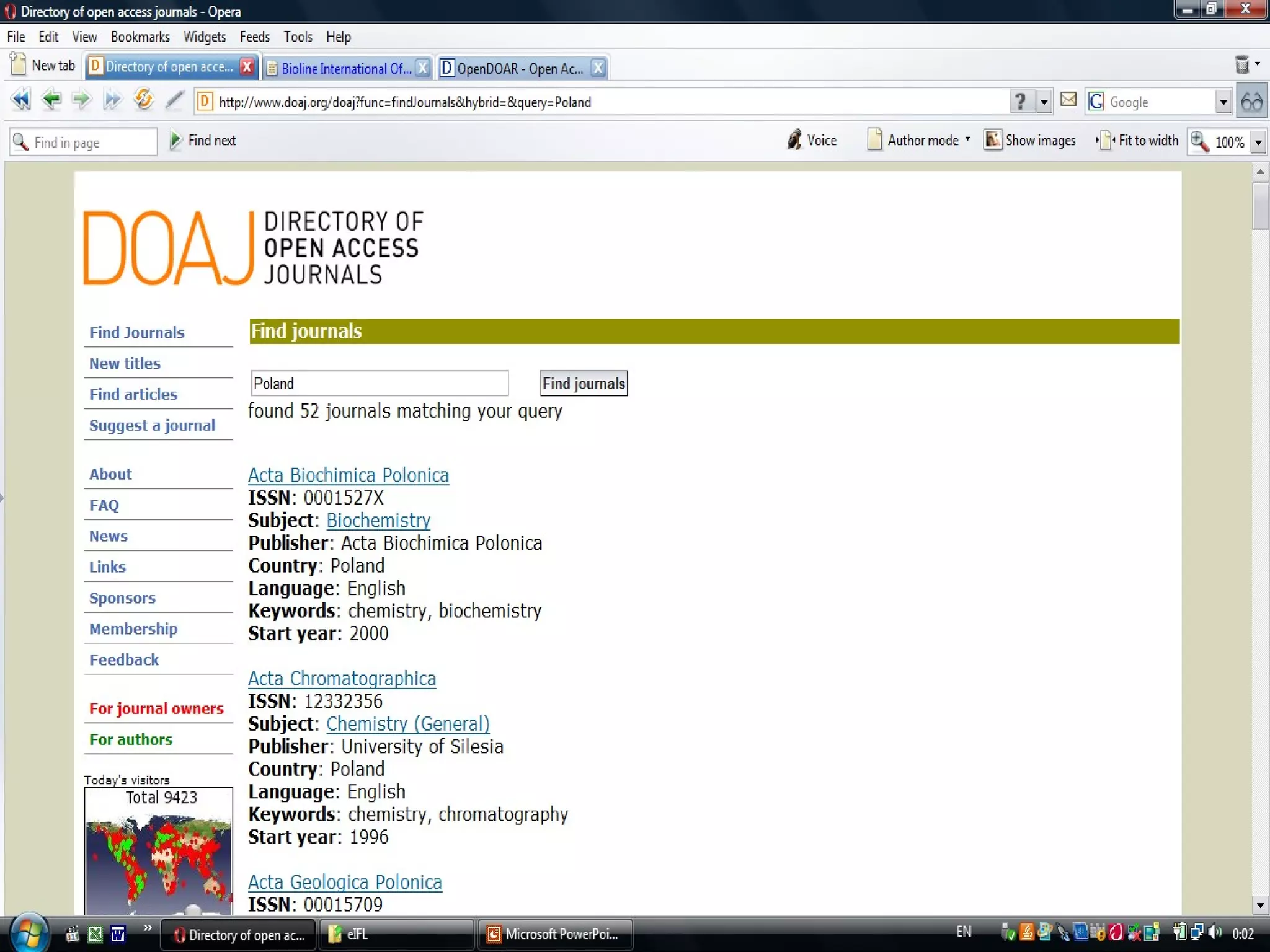
OA workshops For the rest of the year we have planed events in November in  Syria  (supported by TEMPUS program) and in December in  Russia  and  Ethiopia .  There are plans for 2009 events in  Bosnia and Herzegovina, Bulgaria, Cambodia, Kenya  (regional for the journal editors together with Bioline International),  Poland, Senegal and South Africa.  Was your country mentioned?
Repository efficiency   Shared technical infrastructure and distributed management team  National/Regional projects
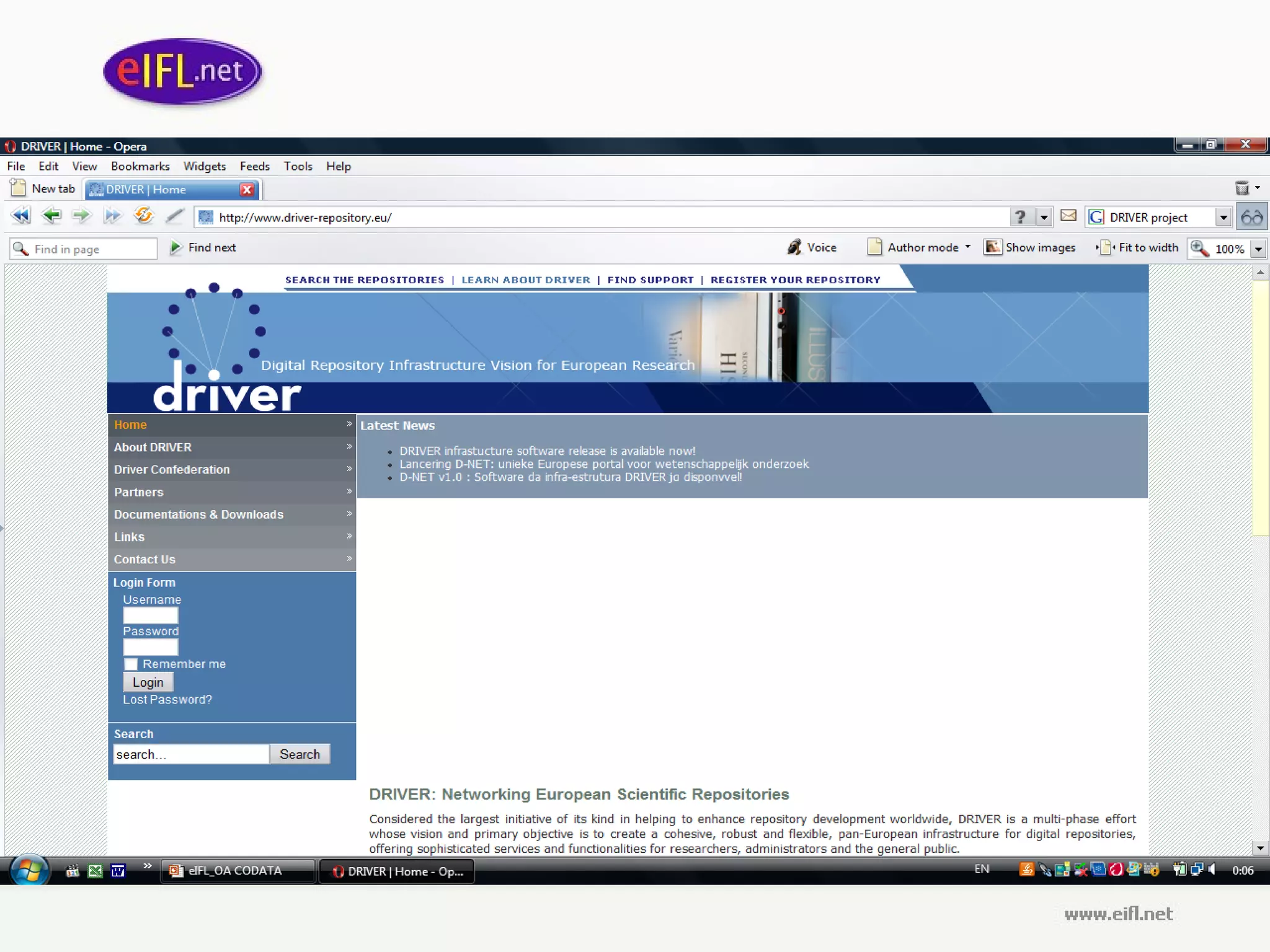
Repository standards DRIVER Guidelines – metadata formats and other technical requirement DRIVER validator eIFL Partnership with DRIVER – developing strong national infrastructures
 
Use and Reuse Confusion  surrounds the use and reuse of material published in Open Access journals Researchers wish to mine  large segments of the literature to discover new, unimagined connections and relationships Librarians wish to host  material locally for preservation purposes Greater clarity  will bring benefits to authors, users, and journals SPARC Europe and the Directory of Open Access Journals Announce the Launch of the SPARC Europe Seal for Open Access Journals Seal to Set Standards for Open Access Journals
SPARC Seal We are advising that all journals provide  clear and unambiguous statements   regarding the copyright statement  of the papers they publish  To qualify for the SPARC Europe Seal a journal must use the  Creative Commons By  (CC-BY)  license  which is the most user-friendly license and corresponds to the ethos of the Budapest Open Access Initiative
SPARC Seal The second strand of the Seal is that journals should provide metadata for all their articles to the DOAJ, who will then make the metadata   OAI-compliant This will   increase the visibility   of the papers and   allow OAI-harvesters   to include details of the journal articles in their services
New partnerships InterAcademyPanel NAS and CODATA Creative Commons International and CCLearn EurOpenScholar  DSpace Foundation (Global Outreach Committee) EPrints Fedora Commons  NDLTD (Networked Digital Library for Theses and Dissertations) CERN the Abdus Salam International Center for Theoretical Physics (Italy) International Crimea Conference
What do authors think?   Allison Fullard conducted a survey of South African responses to open access publishing, which showed that the research community already welcomed open access:  93,21% of respondents agreed, that open access boosts developing countries’ access to scholarly literature;  87,04% - that open access promotes developing countries’ engagement with global science;  91,97 – that open access promotes the advance of scientific knowledge;  Allison Fullard, (2007) “South African responses to Open Access publishing: a survey of the research community”,  South African Journal of Libraries and Information Science  73(1): 40-50.  http:// eprints . rclis .org/archive/00010749/
What do authors think? 57,4% - that open access provides more accountable use of publicly funded research;  70,36% - that open access articles will be read by more people, and probably cited more often;  51,85% - that authors retain copyright and are free to use it as they wish  and 65,43% - that with open access development the serials crisis facing libraries will be broken  Allison Fullard, (2007) “South African responses to Open Access publishing: a survey of the research community”,  South African Journal of Libraries and Information Science  73(1): 40-50.  http:// eprints . rclis .org/archive/00010749/
Comments “ Open access publishing has given us an opportunity to a world of information regardless of where one is. Previously it was almost impossible to know the latest in malaria research unless you read an abstract or an institution got some hard copies which always arrived a month or more after publication. However, with BioMed Central, one is able to have  a wide range of information on research activities . This helps in  providing the much-needed information  on topical issues and one  can learn form diverse methods , geographical settings and be able to participate in the global debate on health issues and also provide quality policy information. It also  enables us form the developing world to publish our research findings and share the information  with other researchers  globally . ”  Dr G Chongwe of tropical Diseases Research Centre in Zambia, Pascalina Chanda of Malaria Control Centre Zambia , Mr Stanley Banda of Ministry of Health Zambia  http://www. biomedcentral .com/ developingcountries /stories/ )
Open Access Impact   The advantages of Open Access are shown in the figures, especially when it comes to increased citation rates : For 72% of papers published in the Astrophysical Journal, free versions of the paper are available (mainly through ArXiv). These 72% of papers are, on average, cited more than twice as often as the remaining 28% that do not have free versions. [1]   In Chinese scientific journals citation indicators of Open Access journals were found to be higher than those of non-Open Access journals. [2]   [1]  Schwarz, G. and Kennicutt Jr., R. C. (2004): Demographic and Citation Trends in Astrophysical Journal Papers and Preprints (pdf 14pp), arxiv.org/pdf/astro-ph/0411275, 10 November 2004, Bulletin of the American Astronomical Society, Vol. 36, 1654-1663  [2]  Cheng, W. H. and Ren, S. L. (2008): Evolution of open access publishing in Chinese scientific journals, Learned Publishing, Vol. 21, No. 2, April 2008, 140-152
 
Open Access Impact   literature mining is good data integration is better open access – access to full text is needed Lars Juhl Jensen, Integration of biomedical literature and databases, Presented at the Fourth Nordic Conference on Scholarly Communication NCSC 2008: Openness - trade, tools and transparency, 21-23 April 2008, Scandic Star Hotel, Glimmervägen 5, Lund, Sweden:  http://www. lub . lu .se/ fileadmin /user_upload/ pdf /NCSC/ncsc2008_ lars _ juhl _ jensen . pdf
Open Access Impact   how  CrystalEye is relevant to repositories... http:// wwmm . ch .cam.ac. uk / crystaleye /   Open notebook science petermr’s blog A Scientist and the  Web:  http:// wwmm . ch .cam.ac. uk / blogs / murrayrust   Jim Downing, University of Cambridge, Dr. CrystalEye Or: How I Learned To Stop Worrying And Love The Web:  From Desktop to Data Repository :  http://www. dspace .cam.ac. uk / bitstream /1810/196186/2/ CrystalEyePresentation . pdf
Open Access Impact John Houghton, Colin Steele and Peter Sheehan in their report to the Department of Education, Science and Training “ Research Communication Costs in Australia: Emerging Opportunities and Benefits ” mentioned  the most important potential benefit of Open Access  – “ enhanced access to, and greater use of, research findings , which would, in turn,  increase the efficiency of R&D  as it builds upon previous research.”
Open Access Impact Among other benefits:  “ Speed of access   speeding up  the research and discovery process,  increasing returns to investment  in R&D and, potentially,  reducing the time/cost  involved for a given outcome, and  increasing the rate of accumulation  of the stock of knowledge;  Improved access  leading to  less duplicative research ,  saving duplicative R&D expenditure  and  improving the efficiency  of R&D;”  John Houghton, Colin Steele and Peter Sheehan, Report to the Department of Education, Science and Training “Research Communication Costs in Australia: Emerging Opportunities and Benefits”  http://www. dest . gov .au/NR/ rdonlyres /0ACB271F-EA7D-4FAF-B3F7-0381F441B175/13935/DEST_Research_Communications_Cost_Report_Sept2006. pdf
Open Access Impact “ Faster access  leading to  better informed research ,  reducing, saving  R&D expenditure and  improving the efficiency  of R&D;  Wider access  providing  enhanced opportunities for multi-disciplinary research ,  inter-institutional and inter-sectoral collaborations ;”  John Houghton, Colin Steele and Peter Sheehan, Report to the Department of Education, Science and Training “Research Communication Costs in Australia: Emerging Opportunities and Benefits”  http://www. dest . gov .au/NR/ rdonlyres /0ACB271F-EA7D-4FAF-B3F7-0381F441B175/13935/DEST_Research_Communications_Cost_Report_Sept2006. pdf
Open Access Impact “ Wider access  enabling researchers  to study their context more broadly , potentially leading to  increased opportunities for , and  rates of, application/commercialization ;  Improved access  leading to  improved education   outcomes , enabling a given education spend to produce  a higher level of educational attainment  (at least at the post secondary level), leading to an  improvement in the quality of the ‘stock’ of researchers and research users .” John Houghton, Colin Steele and Peter Sheehan, Report to the Department of Education, Science and Training “Research Communication Costs in Australia: Emerging Opportunities and Benefits”.   http://www. dest . gov .au/NR/ rdonlyres /0ACB271F-EA7D-4FAF-B3F7-0381F441B175/13935/DEST_Research_Communications_Cost_Report_Sept2006. pdf
Open Access Policy Funders of research are increasingly beginning to mandate Open Access to the research they support According to the Registry of Open Access Repository Material Archiving Policies there are 57 Open Access mandates Major research funders the U.S. National Institutes of Health, implemented a policy requiring that its grant recipients make articles resulting from NIH funding publicly available within 12 months of publication in a peer-reviewed journal  


Open Access While Open Access was only defined six years ago it is now being debated by governments and publishers  and mandated by funding bodies and universities throughout the world Much still remains to be achieved, but it is clear that Open Access has permanently changed the field of scholarly communication
Plans We are working on the letters to national ETDs projects explaining the benefits of Open Access to ETDs,  lists of OA benefits to students, researchers and scholarly societies,  model IP policies for the Universities (together with eIFL IP),  model business plans for OA journals (cooperative project between Armenia, Belarus and Ukraine), integrating distance education and Open repositories and Open repositories and CRIS.  a training for national OA activists how to develop successful OA policy is planned together with SPARC as well as the workshop for the research funders.
 
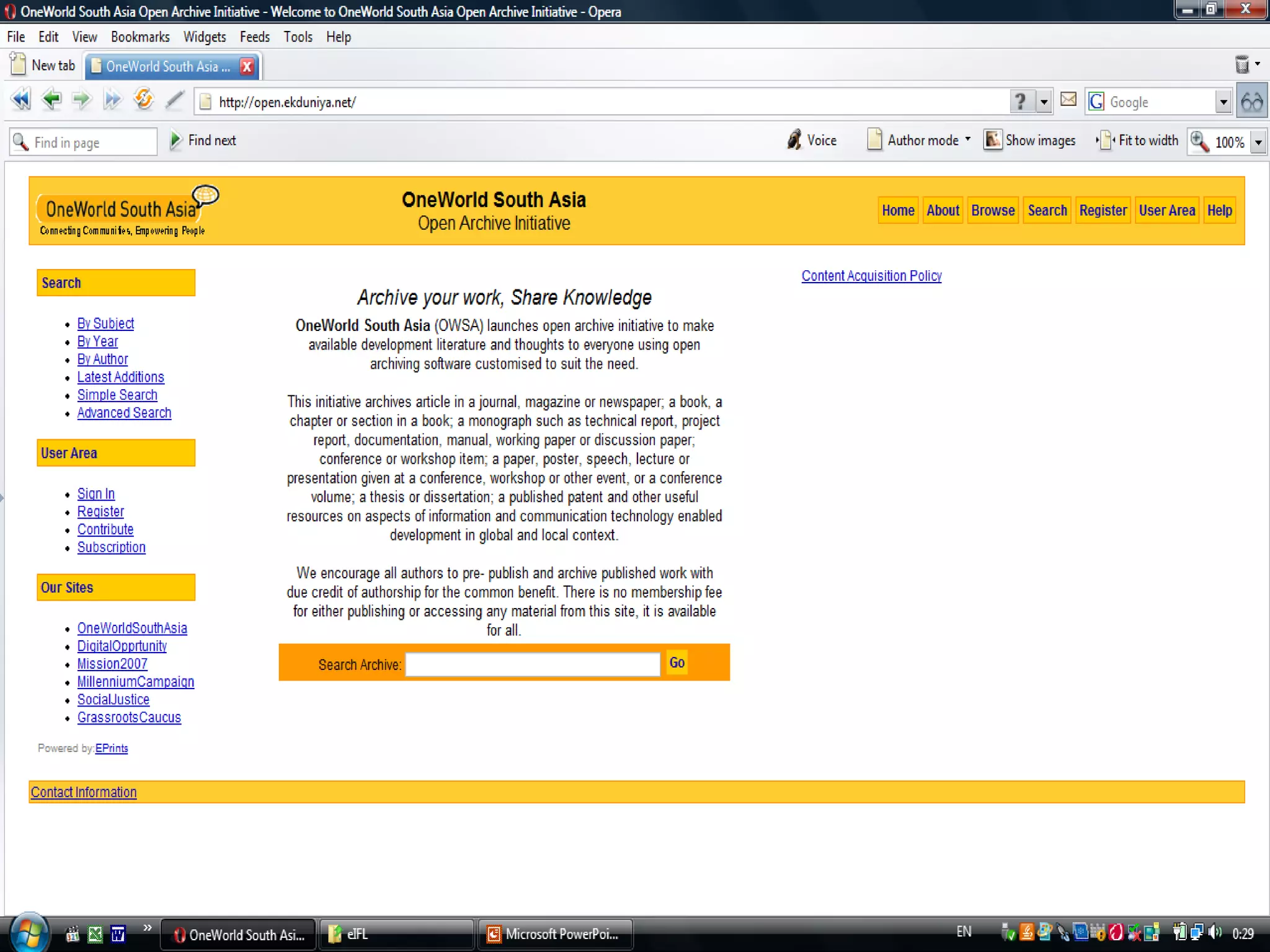
eIFL participants Azerbaijan Lithuania Macedonia Moldova Mozambique Poland South Africa Sudan…


Thank you ! Your Questions and Ideas ? Iryna Kuchma eIFL Open Access program manager iryna.kuchma[at]eifl.net,  www.eifl.net The presentation is licensed with  Creative Commons Attribution 3.0 License

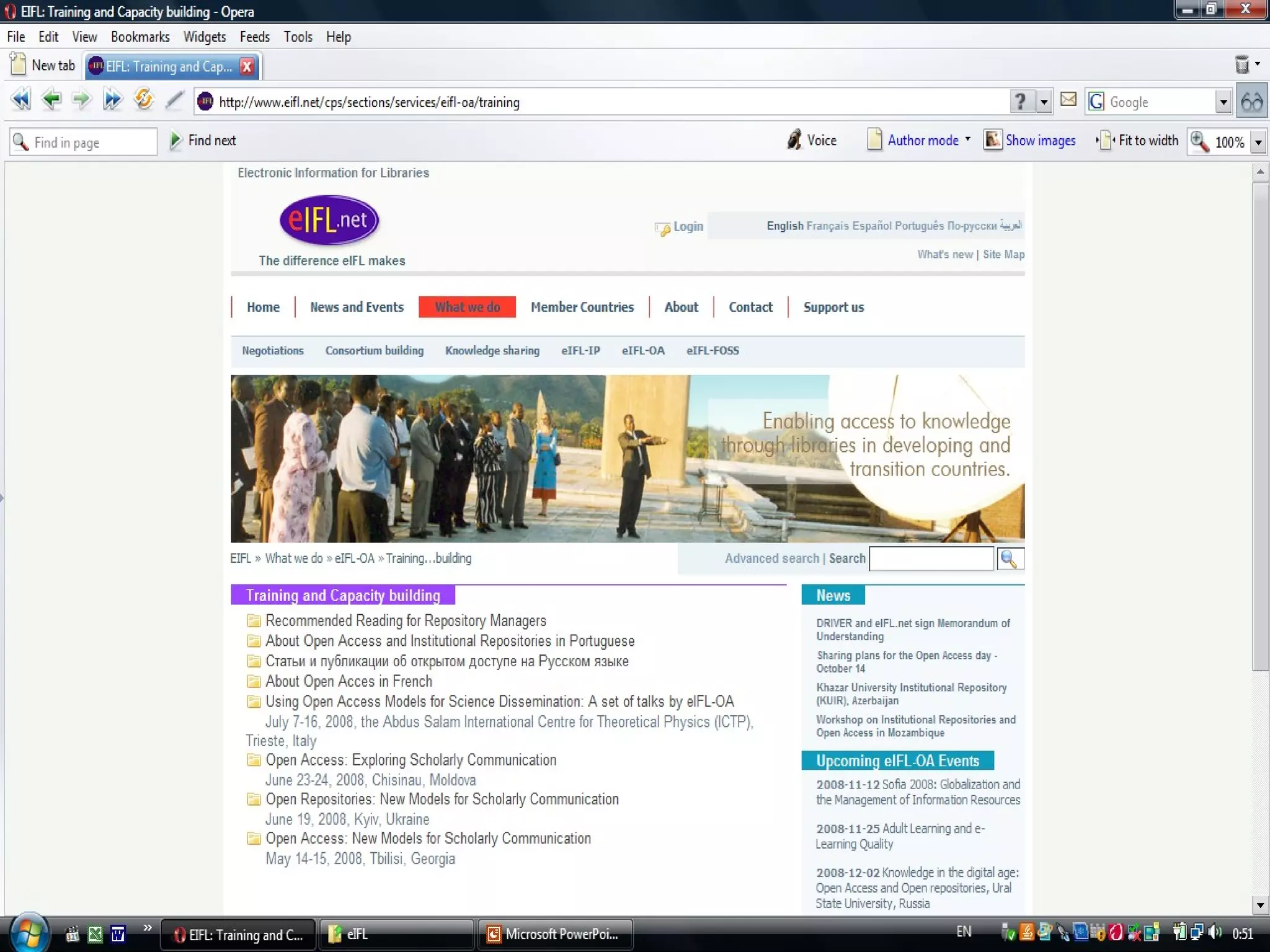
eIFL Open Access: Update

  • 1.
  • 2.
    From John Wilbanks,Science Commons, (Data integration, text mining, and the culture of control)
  • 3.
    Digitage Web 2.0Uploaded by ocean.flynn , http://www.flickr.com/photos/oceanflynn/315385916/
  • 4.
  • 5.
    On the RoadManuscript Uploaded by Thomas Hawk http :// www . flickr . com / photos / thomashawk /93819794/
  • 6.
    Scientific Publication Packages- Jane Hunter - Autumn 2006 From “ Enhanced publications (what are they, why are they important)” by Dr.Leo Waaijers , http://www. eifl .net/cps/sections/services/ eifl - oa /training/2008- chisinau /12
  • 7.
    Scientific Publication Packages- Jane Hunter - Autumn 2006 From “ Enhanced publications (what are they, why are they important)” by Dr.Leo Waaijers , http://www. eifl .net/cps/sections/services/ eifl - oa /training/2008- chisinau /12
  • 8.
    Scientific Publication Packages- Jane Hunter - Autumn 2006 From “ Enhanced publications (what are they, why are they important)” by Dr.Leo Waaijers , http://www. eifl .net/cps/sections/services/ eifl - oa /training/2008- chisinau /12
  • 9.
    Scientific Publication Packages- Jane Hunter - Autumn 2006 From “ Enhanced publications (what are they, why are they important)” by Dr.Leo Waaijers , http://www. eifl .net/cps/sections/services/ eifl - oa /training/2008- chisinau /12
  • 10.
  • 11.
  • 12.
    OAI ORE RDFtriples : Subject Object Predicate
  • 13.
    Innovations "We areand will remain a net importer of knowledge , so it is in our interest to promote the freest possible flow of information domestically and globally. The arguments for stepping out first on open access are the same as the arguments for stepping out first on emissions trading – the more willing we are to show leadership on this, we more chance we have of persuading other countries to reciprocate.” Senator Carr
  • 14.
    UN MDG TheUN Millennium Development Goals emphasise the urgent need to address problems such as poverty and hunger eradication, child mortality, maternal health, environmental sustainability and combating diseases such as HIV/AIDS, malaria and other It is very clear that without strong scientific platforms built on the widest possible access to research information, these goals will not be met If sustainable development is dependent on a strong national science base, then permanent access to the widest possible range of publications from the international library of research is a pre-requisite
  • 15.
    Why Open AccessIn this world libraries are no more just reading rooms and collections of books on the shelves From importers of knowledge they turn into exporters of knowledge Libraries as publishers and educators
  • 16.
    eIFL Open AccessAfter three years, the eIFL Open Access Program has emerged as the leading organization promoting and advocating for Open Access in developing and transition countries For the developing world, Open Access will increase scientists and academics capacity to both access and contribute to the global research community
  • 17.
    eIFL Open AccesseIFL-OA seeks to enhance access to research , thereby accelerating innovation and economic development in the countries eIFL-OA Program builds networks of Open repositories and Open Access journals ; provides training and advice on Open Access policies and practices ; empowers library professionals, scientists and scholars, educators and students to become open access advocates
  • 18.
    eIFL Open AccessPolicy level – Open Access mandates at the national, regional, institutional levels Awareness raising – promoting benefits of Open Access Level of implementation – open repositories and Open Access journals
  • 19.
  • 20.
    Open Access OpenAccess is the free online availability of peer reviewed journal literature permitting any user to read , download, copy, distribute, print, search, or link to the full texts of articles 2 complementary strategies: the development of institutional repositories and Open Access journals From the Budapest Open Access Initiative: http://www. soros .org/ openaccess /read. shtml
  • 21.
    Open Access innumbers OAIster currently provides access to 18,362,804 records from 1035 contributors. 3 727 journal titles (about 15% of all scientific journals published) in DOAJ, 2.2 new journals per day About 20% of all current research literature is available in Open Access
  • 22.
  • 23.
  • 24.
  • 25.
    Hindawi Publishing CorporationOn February 21, 2007 the Hindawi Publishing Corporation, Egypt, converted the last of its subscription-based journals to an open access model. Hindawi Publishing Corporation is a commercial publisher of STM (Science, Technology, and Medicine) literature. Founded in 1997, Hindawi currently employs more than 250 people, and publishes more than 100 peer-reviewed journals.
  • 26.
    Hindawi Publishing CorporationOver the past several years, Hindawi has seen an increase of more than 40% per year in the number of submitted manuscripts it receives. Since its full conversion to Open Access in February 2007, Hindawi's growth has continued to accelerate, with monthly submission levels growing by more than 100% during 2007. Annual impact factor growth more than 14%
  • 27.
  • 28.
  • 29.
  • 30.
  • 31.
  • 32.
  • 33.
  • 34.
  • 35.
  • 36.
  • 37.
  • 38.
  • 39.
  • 40.
  • 41.
  • 42.
  • 43.
    Open repositories Adigital repository is defined as 1.    containing research output 2.    institutional or thematic and 3.    OAI compliant ( http://www. openarchives .org/OAI/ openarchivesprotocol .html ) (From The European Repository Landscape Inventory Study into the Present Type and Level of OAI-Compliant Digital Repository Activities in the EU by Maurits van der Graaf and Kwame van Eijndhoven
  • 44.
  • 45.
    ~66% of publishers,90 - 95% of journals allow self-archiving
  • 46.
  • 47.
  • 48.
    Content Peer-reviewed articlesConference presenations Books Course packs Annotated images Audio and video clips Research data
  • 49.
    Content Gray literature: Preprints / working materials / theses and dissertations / reports / conference materials / bulletins / grant applications / reports to the donors / memorandums / statistical reports / technical documentation / questionnaires…
  • 50.
  • 51.
  • 52.
  • 53.
    Lithuania the Lithuanian ETD Project as a Pilot for Baltic States designed in the framework of a UNESCO programme, prepared by Kaunas University of Technologies and the Lithuanian Network of Academic Libraries (LABT) in 2004. 14 Lithuanian universities and Riga Technical University participated in the ETD Information System project. The ETD project was supported by the academic communities and the Ministry of Science and Education, and included in the national programs. The Lithuanian ETD Information System ( http:// etd . elaba . lt / ) includes 6 150 full-text dissertations, of which 2 386 (38%) are Open Access, others are accessible in the local intranets. It is planned that at the end of year 2008, ETD IS will cover 7 600 dissertations, and 50% of these should be Open Access.
  • 54.
  • 55.
    Theses and dissertationsJohn Hagen, West Virginia University : Moving from print to electronic – usage growth 145% The most popular theses and dissertations were downloaded 37,501 times (history ) and 33,752 times (engineering); history one was published and was a long seller 69% of students from the creative writing department had more successful careers if they went OA with their dissertations – a good marketing tool for them
  • 56.
  • 57.
    Azerbaijan "I amdelighted to be able to congratulate Institutional Repository Working Team! It is excellent to see the range of research journals published by Khazar University and know that there is now a clear infrastructure to increase the visibility of researchers." Prof. Dr. Hamlet Isakhanli, Founder and Rector of Khazar University, Azerbaijan
  • 58.
  • 59.
  • 60.
  • 61.
  • 62.
  • 63.
  • 64.
  • 65.
  • 66.
    Costs The costsand benefits of our Institutional Repository: Running costs: the server costs us R50 000 ($6250) once every three years Running costs: handle license and Red Hat Enterprise Server Licence $100 per year Salaries prove to be a high running cost: 1 full-time IR librarian, 1 full-time IR library assistant, 2 full-time librarians working on IR together with other duties, 1 part-time librarian working on IR together with other duties South Africa Ukraine – 10,000 USD
  • 67.
    Benefits Value ofbenefits: at this stage the IR does not generate extra income or save administration costs – it actually generates more work and more administration costs. Functions such as metadata editors, content submitters, collection administrators demand extra work from staff The function of the IR is not to have monetary benefits, but to showcase research done at an institution, provide open access to research, prestige for the academics, institutional visibility as well as immediate access to research The IR also provides long-term preservation benefits South Africa
  • 68.
    The Netherlands NARCIS– National Academic Research and Collaboration Information System – extended DARenet plus datasets and research descriptions: http://www. narcis .info DAREnet www. darenet . nl Cream of Science www. creamofscience .org Promise of Science http://www. darenet . nl /en/page/page.view/promise.page DANS-EASY Electronic Archiving System of the Institute DANS (Data Archiving and Networked Services) – http://easy. dans . knaw . nl / dms
  • 69.
    Policy – Academyof Sciences the Academy of Science (ASSAF) Committee on Scholarly Publishing in South Africa (CSPiSA) and the Department of Science and Technology (DST) has dedicated a substantial three-year budget to fund the implementation of ASSAF's recommendations for the development of scholarly publication in South Africa - a 'gold route' Open Access approach to journal publishing in South Africa Susan Veldsman has been invited to join ASSAF Committee and an expert and advisor for implementation of recommendations
  • 70.
    Policy - Universityhttps :// www . up . ac . za / dspace / “ UPSpace is a university-based institutional repository which offers a set of services to the researchers of the UP Community, for the management and dissemination of digital academic/research materials (excluding work of administrative or commercial nature) donated to or created by the institution and its community members. The set of services includes the collection, storage and preservation in digital format, and retrieval of items submitted to UPSpace.” More than a dozen of well functioning open repositories in South Africa
  • 71.
    South Africa –Why? In a 2006 report, the Academy of Science of South Africa found that over the past 14 years, 1/3rd of South African journals have not had a single paper cited by their international counterparts Fewer than 1 in 10 of South Africa's 255 accredited journals has been cited enough to feature in the main international research databases, despite South Africa being the continent's leading publisher of research
  • 72.
    South Africa –Why? “ Visibility for research output from South Africa, and other developing countries, must be increased dramatically so that research from developing countries is incorporated into the global knowledge pool, so vital to the resolution of global issues such as climate change or the spread of infectious diseases.” ( http://www. scidev .net/ quickguides /index. cfm ? fuseaction = qguideReadItem &type=1& itemid =2828&language=1& qguideid =4 )
  • 73.
  • 74.
    National Policy -Ukraine Since January 2007 Ukraine has a law - proposed mandate for open access to publicly funded research. The Law of Ukraine On the principles of developing information society in Ukraine for 2007-20015 at www. rada . gov . ua
  • 75.
  • 76.
  • 77.
  • 78.
  • 79.
    National Policy -China Chinese Ministry of Science and Technology (CHINA) http://www.most. gov . cn /eng/ http://www. codataweb .org/06conf/ Mandate to deposit research data (not yet applicable to research articles themselves)
  • 80.
    National Policy -China "We can invest billions of yuan in big science projects, but we also need to invest a tiny 200 million yuan (US$29.4 million) in an open access fund to help the growth of our journals," said Zhu Zuoyan, the recently retired deputy head of the National Science Foundation of China (NSFC) “ Government-funded open access journals would be a breakthrough for science publishing in China. A government-funded open access initiative would reduce or eliminate the cost of publishing — enabling Chinese journals to attract more high-quality papers and improve their impact. Domestic journals can publish papers faster. (http://www.scidev.net/en/news/make-china-journals-open-access-says-top-scientist.html)
  • 81.
    National Policy -China Hong Kong Universities proposed Open Access policy for publicly funded research
  • 82.
    National Policy -Lithuania Discussing Open Access to publicly funded research as a national law Director of SPAR Europe travelled to Vilnius in early May to meet with the decision makers in Lithuania to help them move further with adoption of a draft law Ministry of Education organised a national Open Access awareness raising seminar during International Open Access Day
  • 83.
    Russia Central Economicsand Mathematics Institute of Russian Academy of Sciences (institutional-mandate) http://www. cemi . rssi . ru / http:// socionet . ru /index-en.html http:// cemi . socionet . ru / All researchers of the Central Economics and Mathematics Institute of Russian Academy of Sciences are mandated by director's decree to immediately deposit their papers/articles in the institutional Open Archive. ["...mandate researchers of CEMI RAS to deposit all completed research (in working paper form), including the full text, in institutional OA (repository) not later than 6 months after completion."] http://www. cemi . rssi . ru / rus /news/ initiat -eng. htm
  • 84.
    Russia - e-Science CRIS research e- infrastructure - http :// socionet . ru / e-Science « e- Science is based on the Open Access to research results (financed from the public money) » Sergey Parinov
  • 85.
  • 86.
    National Polices NigerianUniversity Commission is working on Open Access recommendations to Nigerian Universities. The similar request came from the Research Council Zimbabwe.
  • 87.
    OA declarations NationalOpen Access declarations are being prepared in Armenia, Moldova, Kyrgyzstan and Ukraine (following the recent Brisbane Declaration on Open Access in Australia).
  • 88.
    eIFL Open AccessFast Facts: 354 Open Access journals in eIFL countries 100+ open repositories in the eIFL demonstrator ( http:// eifl .cq2.org ) 25+ seminars and training
  • 89.
    OA workshops 28-29April, 2008 – Awareness raising – Open Repositories: New Models For Scholarly Communication, Ahmadu Bello University, Zaria, Nigeria   14-15 May, 2008 – OA awareness raising workshop in Georgia hosted by Ilia Chavchavadze State University  18-21 June, 2008 – study visit of Open repository managers from Azerbaijan, Belarus, Georgia and Kyrgyzstan to the National University Kyiv-Mohyla Academy, Ukraine 23-24 June, 2008 – OA awareness raising workshop in Moldova  
  • 90.
    OA workshops 28-30July, 2008 – OA awareness raising workshop in Mozambique  2-3 August, 2008 – Web 2.0 and Open Access: Enhancing Scholarly Communication workshop, AUCA, Kyrgyzstan ; and OA presentation at the BarCamp Central Asia 3-4 September, 2008 – Monika Segbert presented eIFL OA at the international workshop Open Access to Scientific Literature and Other Digital Scientific Information Resources in Central America and Caribbean , Cuba
  • 91.
    OA workshops 2-3October, 2008 – eIFL OA country coordinators from Kenya and Malawi were trained at the Institutional repository workshop, the University of Pretoria, South Africa (supported by INASP)   15-16 October, 2008 - OA awareness raising workshop in Armenia 20-21 October, 2008 - OA awareness raising workshop in Belaru s Open Access presentations were given by eIFL members in South Africa, Uzbekistan and Zimbabwe
  • 92.
    OA workshops Forthe rest of the year we have planed events in November in Syria (supported by TEMPUS program) and in December in Russia and Ethiopia . There are plans for 2009 events in Bosnia and Herzegovina, Bulgaria, Cambodia, Kenya (regional for the journal editors together with Bioline International), Poland, Senegal and South Africa. Was your country mentioned?
  • 93.
    Repository efficiency Shared technical infrastructure and distributed management team National/Regional projects
  • 94.
    Repository standards DRIVERGuidelines – metadata formats and other technical requirement DRIVER validator eIFL Partnership with DRIVER – developing strong national infrastructures
  • 95.
  • 96.
    Use and ReuseConfusion surrounds the use and reuse of material published in Open Access journals Researchers wish to mine large segments of the literature to discover new, unimagined connections and relationships Librarians wish to host material locally for preservation purposes Greater clarity will bring benefits to authors, users, and journals SPARC Europe and the Directory of Open Access Journals Announce the Launch of the SPARC Europe Seal for Open Access Journals Seal to Set Standards for Open Access Journals
  • 97.
    SPARC Seal Weare advising that all journals provide clear and unambiguous statements regarding the copyright statement of the papers they publish To qualify for the SPARC Europe Seal a journal must use the Creative Commons By (CC-BY) license which is the most user-friendly license and corresponds to the ethos of the Budapest Open Access Initiative
  • 98.
    SPARC Seal Thesecond strand of the Seal is that journals should provide metadata for all their articles to the DOAJ, who will then make the metadata OAI-compliant This will increase the visibility of the papers and allow OAI-harvesters to include details of the journal articles in their services
  • 99.
    New partnerships InterAcademyPanelNAS and CODATA Creative Commons International and CCLearn EurOpenScholar DSpace Foundation (Global Outreach Committee) EPrints Fedora Commons NDLTD (Networked Digital Library for Theses and Dissertations) CERN the Abdus Salam International Center for Theoretical Physics (Italy) International Crimea Conference
  • 100.
    What do authorsthink? Allison Fullard conducted a survey of South African responses to open access publishing, which showed that the research community already welcomed open access: 93,21% of respondents agreed, that open access boosts developing countries’ access to scholarly literature; 87,04% - that open access promotes developing countries’ engagement with global science; 91,97 – that open access promotes the advance of scientific knowledge; Allison Fullard, (2007) “South African responses to Open Access publishing: a survey of the research community”, South African Journal of Libraries and Information Science 73(1): 40-50. http:// eprints . rclis .org/archive/00010749/
  • 101.
    What do authorsthink? 57,4% - that open access provides more accountable use of publicly funded research; 70,36% - that open access articles will be read by more people, and probably cited more often; 51,85% - that authors retain copyright and are free to use it as they wish and 65,43% - that with open access development the serials crisis facing libraries will be broken Allison Fullard, (2007) “South African responses to Open Access publishing: a survey of the research community”, South African Journal of Libraries and Information Science 73(1): 40-50. http:// eprints . rclis .org/archive/00010749/
  • 102.
    Comments “ Openaccess publishing has given us an opportunity to a world of information regardless of where one is. Previously it was almost impossible to know the latest in malaria research unless you read an abstract or an institution got some hard copies which always arrived a month or more after publication. However, with BioMed Central, one is able to have a wide range of information on research activities . This helps in providing the much-needed information on topical issues and one can learn form diverse methods , geographical settings and be able to participate in the global debate on health issues and also provide quality policy information. It also enables us form the developing world to publish our research findings and share the information with other researchers globally . ” Dr G Chongwe of tropical Diseases Research Centre in Zambia, Pascalina Chanda of Malaria Control Centre Zambia , Mr Stanley Banda of Ministry of Health Zambia http://www. biomedcentral .com/ developingcountries /stories/ )
  • 103.
    Open Access Impact The advantages of Open Access are shown in the figures, especially when it comes to increased citation rates : For 72% of papers published in the Astrophysical Journal, free versions of the paper are available (mainly through ArXiv). These 72% of papers are, on average, cited more than twice as often as the remaining 28% that do not have free versions. [1] In Chinese scientific journals citation indicators of Open Access journals were found to be higher than those of non-Open Access journals. [2] [1] Schwarz, G. and Kennicutt Jr., R. C. (2004): Demographic and Citation Trends in Astrophysical Journal Papers and Preprints (pdf 14pp), arxiv.org/pdf/astro-ph/0411275, 10 November 2004, Bulletin of the American Astronomical Society, Vol. 36, 1654-1663 [2] Cheng, W. H. and Ren, S. L. (2008): Evolution of open access publishing in Chinese scientific journals, Learned Publishing, Vol. 21, No. 2, April 2008, 140-152
  • 104.
  • 105.
    Open Access Impact literature mining is good data integration is better open access – access to full text is needed Lars Juhl Jensen, Integration of biomedical literature and databases, Presented at the Fourth Nordic Conference on Scholarly Communication NCSC 2008: Openness - trade, tools and transparency, 21-23 April 2008, Scandic Star Hotel, Glimmervägen 5, Lund, Sweden: http://www. lub . lu .se/ fileadmin /user_upload/ pdf /NCSC/ncsc2008_ lars _ juhl _ jensen . pdf
  • 106.
    Open Access Impact how CrystalEye is relevant to repositories... http:// wwmm . ch .cam.ac. uk / crystaleye / Open notebook science petermr’s blog A Scientist and the Web: http:// wwmm . ch .cam.ac. uk / blogs / murrayrust Jim Downing, University of Cambridge, Dr. CrystalEye Or: How I Learned To Stop Worrying And Love The Web: From Desktop to Data Repository : http://www. dspace .cam.ac. uk / bitstream /1810/196186/2/ CrystalEyePresentation . pdf
  • 107.
    Open Access ImpactJohn Houghton, Colin Steele and Peter Sheehan in their report to the Department of Education, Science and Training “ Research Communication Costs in Australia: Emerging Opportunities and Benefits ” mentioned the most important potential benefit of Open Access – “ enhanced access to, and greater use of, research findings , which would, in turn, increase the efficiency of R&D as it builds upon previous research.”
  • 108.
    Open Access ImpactAmong other benefits: “ Speed of access speeding up the research and discovery process, increasing returns to investment in R&D and, potentially, reducing the time/cost involved for a given outcome, and increasing the rate of accumulation of the stock of knowledge; Improved access leading to less duplicative research , saving duplicative R&D expenditure and improving the efficiency of R&D;” John Houghton, Colin Steele and Peter Sheehan, Report to the Department of Education, Science and Training “Research Communication Costs in Australia: Emerging Opportunities and Benefits” http://www. dest . gov .au/NR/ rdonlyres /0ACB271F-EA7D-4FAF-B3F7-0381F441B175/13935/DEST_Research_Communications_Cost_Report_Sept2006. pdf
  • 109.
    Open Access Impact“ Faster access leading to better informed research , reducing, saving R&D expenditure and improving the efficiency of R&D; Wider access providing enhanced opportunities for multi-disciplinary research , inter-institutional and inter-sectoral collaborations ;” John Houghton, Colin Steele and Peter Sheehan, Report to the Department of Education, Science and Training “Research Communication Costs in Australia: Emerging Opportunities and Benefits” http://www. dest . gov .au/NR/ rdonlyres /0ACB271F-EA7D-4FAF-B3F7-0381F441B175/13935/DEST_Research_Communications_Cost_Report_Sept2006. pdf
  • 110.
    Open Access Impact“ Wider access enabling researchers to study their context more broadly , potentially leading to increased opportunities for , and rates of, application/commercialization ; Improved access leading to improved education outcomes , enabling a given education spend to produce a higher level of educational attainment (at least at the post secondary level), leading to an improvement in the quality of the ‘stock’ of researchers and research users .” John Houghton, Colin Steele and Peter Sheehan, Report to the Department of Education, Science and Training “Research Communication Costs in Australia: Emerging Opportunities and Benefits”. http://www. dest . gov .au/NR/ rdonlyres /0ACB271F-EA7D-4FAF-B3F7-0381F441B175/13935/DEST_Research_Communications_Cost_Report_Sept2006. pdf
  • 111.
    Open Access PolicyFunders of research are increasingly beginning to mandate Open Access to the research they support According to the Registry of Open Access Repository Material Archiving Policies there are 57 Open Access mandates Major research funders the U.S. National Institutes of Health, implemented a policy requiring that its grant recipients make articles resulting from NIH funding publicly available within 12 months of publication in a peer-reviewed journal  
  • 112.
  • 113.
  • 114.
  • 115.
  • 116.
    Open Access WhileOpen Access was only defined six years ago it is now being debated by governments and publishers and mandated by funding bodies and universities throughout the world Much still remains to be achieved, but it is clear that Open Access has permanently changed the field of scholarly communication
  • 117.
    Plans We areworking on the letters to national ETDs projects explaining the benefits of Open Access to ETDs, lists of OA benefits to students, researchers and scholarly societies, model IP policies for the Universities (together with eIFL IP), model business plans for OA journals (cooperative project between Armenia, Belarus and Ukraine), integrating distance education and Open repositories and Open repositories and CRIS. a training for national OA activists how to develop successful OA policy is planned together with SPARC as well as the workshop for the research funders.
  • 118.
  • 119.
    eIFL participants AzerbaijanLithuania Macedonia Moldova Mozambique Poland South Africa Sudan…
  • 120.
  • 121.
  • 122.
  • 123.
  • 124.
  • 125.
  • 126.
  • 127.
  • 128.
  • 129.
  • 130.
  • 131.
  • 132.
  • 133.
    Thank you !Your Questions and Ideas ? Iryna Kuchma eIFL Open Access program manager iryna.kuchma[at]eifl.net, www.eifl.net The presentation is licensed with Creative Commons Attribution 3.0 License