BASIC Operation Theatre GUIDELINES
Prof Dr Y Thamma Reddy
Prof & HOD, Department of Orthopaedics
Osmania Medical College, Hyderabad
Get the Basics Right to Prevent SSI
• REQUIRED FOR
• INFECTION CONTROL
• PATIENT SAFETY
• AVOID WRONG SITE IDENTIFICATION
OT GUIDLINES
❑High global epidemiological burden
SURGICAL SITE INFECTION - SSI
• A concern that can be prevented
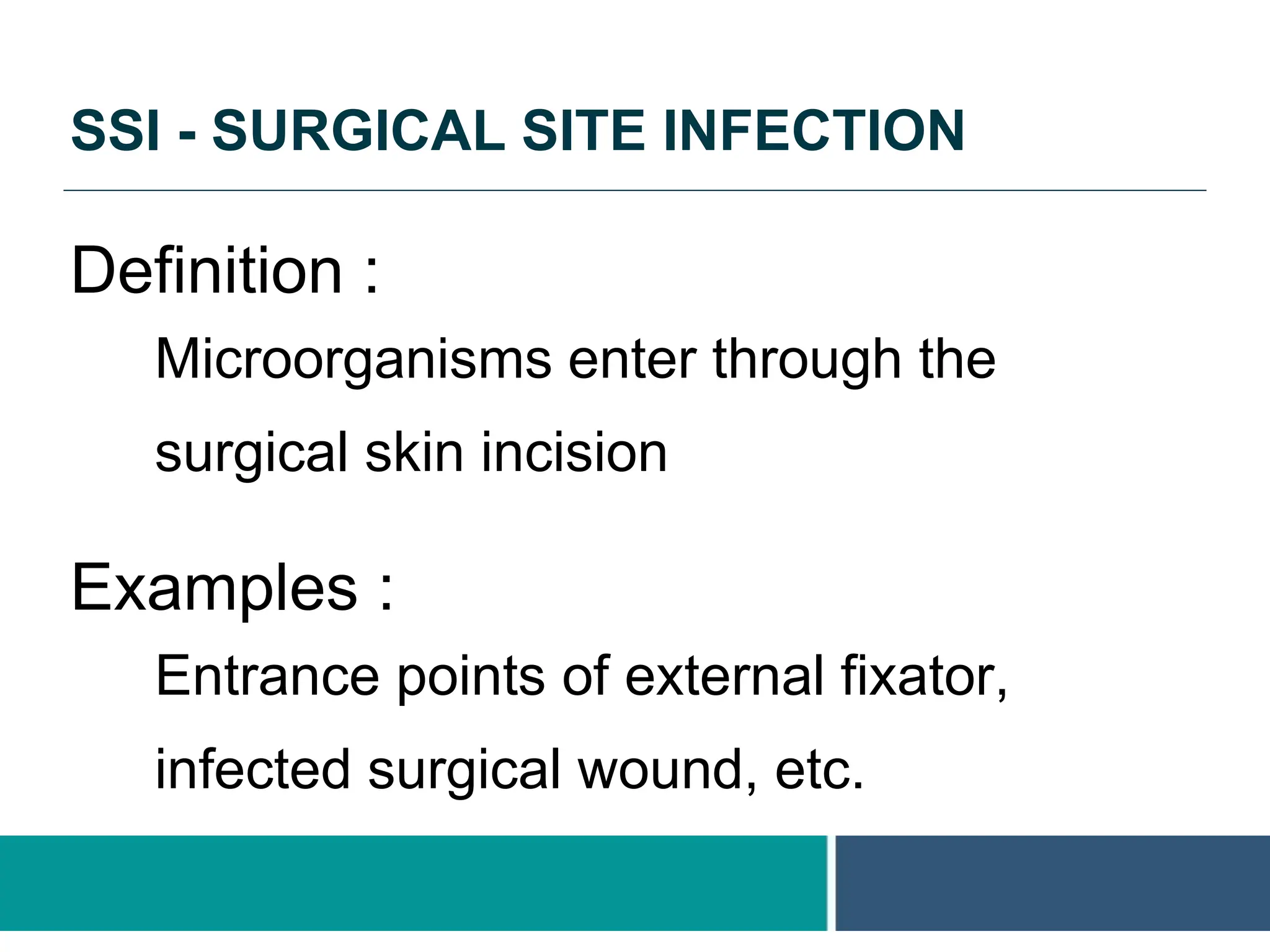
Definition :
Microorganisms enter through the
surgical skin incision
Examples :
Entrance points of external fixator,
infected surgical wound, etc.
SSI - SURGICAL SITE INFECTION
1/3rd of hospital-acquired infections in surgical
patients are SSI.
40–60 % of SSI are preventable
2–5% of operated patients will develop SSI
SSI increases length of stay in hospital by ~ 7 dayS
FACTS ON SSI :
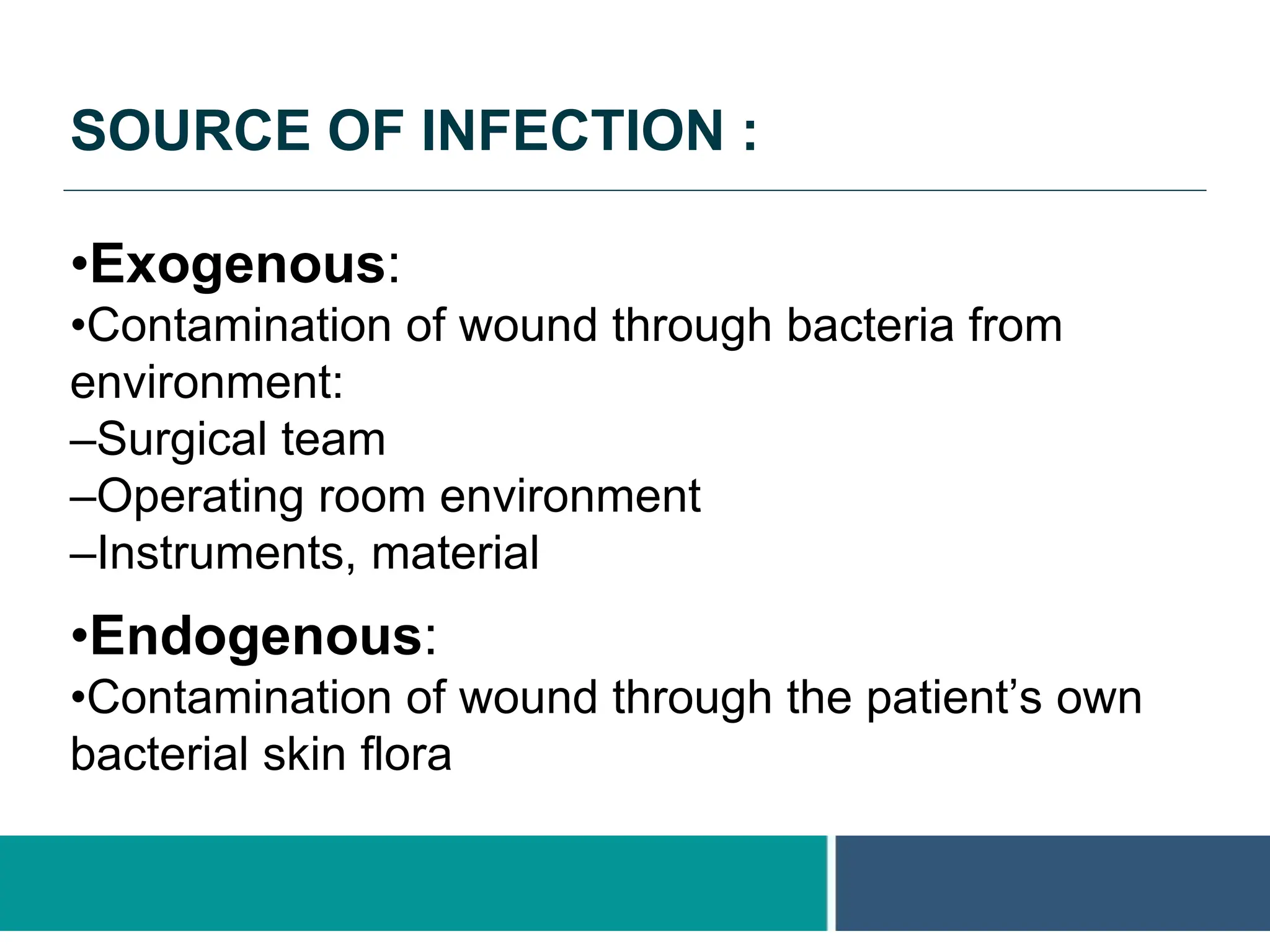
•Exogenous:
•Contamination of wound through bacteria from
environment:
–Surgical team
–Operating room environment
–Instruments, material
•Endogenous:
•Contamination of wound through the patient’s own
bacterial skin flora
SOURCE OF INFECTION :
What are the guidelines so far to
prevent SSI ? ? ? ? ? ? ? ? ? ? ?
SUCCESSFUL GUIDELINES FOLLOWED SO FAR to
prevent SSI
• NICE - UK NHS
• SHEA/IDSA- USA
• CDC - USA
• GDG - Europe
• WHO global guidelines 2016
• WHO GLOBAL GUIDELINES FOR PREVENTION OF SSI 2016
• Widely followed as they are
• Meticulous
• Metaanalysis and RCT`s
• LATEST EVIDENCE
• WORLD WIDE REPRESENTATION
Patient Preparation to prevent SSI
• PRE-OPERATIVE SHOWER OR BATH FOR PATIENTS
• It is good clinical practice for patients to
bath or shower prior to surgery.
• Either plain soap or an antiseptic soap
may be used for this purpose.
• Rationale : Decreases the microbial load
significantly ~ ( NICE 2008/2016; WHO 2016)
• # No recommendation on CHG or antiseptic soap and CHG gowns
to reduce SSI - WHO guidelines 2016
Patients undergoing cardiothoracic and orthopaedic
surgery with known nasal carriage of S. aureus
should receive perioperative intranasal
applications of Mupirocin 2% ointment with or
without a combination of CHG body wash.
Mupirocin 2% - twice a day for 5 days
is used for eradication of both
MRSA and MSSA.
Staphylococcous aureus - Nasal carriers :
Decolenisation
Strong recommendation :
Cardiothoracic and Orthopaedic
Conditional recommendation with moderate
evidence : Other surgeries as well
especially high risk surgeries
A common practise to reduce Hospital
acquired infections in ICU`s.
is now a guideline to prevent SSI -
Nasal Decolenisation
• Common surgical site preparation practices followed :
• Shaving
• Depilation creams
• Clippers (Trimming)
Pre-operative Hair Removal
• Not recommended
• Has high role of developing SSI
• Rationale : Causes multiple skin micro abrasions which can
contaminate the surgical site
SHAVING the surgical sites
• Costly
• Can be allergic to
many , that can
predispose SSI
• Not recommended.
Depilation creams for removal of hair -
Surgical Sites
• Place : OUTSIDE Operation theatre.
• Simple , Inexpensive technique.
• Single patient Clippers to be used to prevent SSI. Catridge can
be changed while the motor can be same.
Clipping of hair - Surgical Site
• WHO Guidelines 2016 :
•STRONG RECOMMENDATION :
AVOID HAIR REMOVAL
• If absolutely necessary, when hair interferes with surgery like
neurosurgery, pubic region - It should be only clipped.
Newer evidence - Hair removal
Preoperative oral antibiotics combined with
mechanical bowel preparation (MBP) should be used
to reduce the risk of SSI in adult patients undergoing
elective colorectal surgery.
MBP - without oral antibiotic had higher rates of
SSI.
MECHANICAL BOWEL
PREPARATION
• MBP - Polyethylene glycol or sodium phosphate were the agents of
choice for MBP in most studies.
• Not proven for paediatric surgeries in the RCT.
• Antibiotics :
• Oral Aminoglycosides (exclusively used for gut preparation) or
IV aminoglysides
• Metronidazole (anaerobic coverage) was used in most studies
basing on which guidelines were issued.
MBP + ANTIBIOTIC
• SCRUB SUITES
• Surgical attire fabric should be
free of lint, provide comfort and
allow for “breathability” (allow
the escape of body heat) while
containing the shedding of skin
squames.
• Scrub suits are made of 100%
spunbound polypropylene in
order to decrease the shedding of
skin squames in to the
environment.
Surgical attire - Health care personnel in OT
• Attire to be worn in semi-restricted and restricted areas.
• Cotton fabrics typically have large pores and are not tightly
woven allowing the dispersal of skin squames into the
environment .
• They can be machine laundered - Inhouse or commercial. Have to
be laundered daily after use.
• Placing attire in designated receptacle after use to prevent
contamination
Scrub Suites
• HOODED Head caps vs Normal head caps
Surgical Suites - HEAD CAPS
CDC Standards for PPE - Personal protective equipment
To be donned first before wearing scrub suites to prevent contamination
Head caps should
be available in
changing rooms
• Hooded caps - covers the entire facial hair
• Surgical team washing for a case should wear them .
• Rest of the OR personnel can wear non hooded cap.
Cap once worn can
be used all day long
unless
contaminated with
fluids or spilled
with water
• EYE Shielding masks - Protective
to scrubbed health care personnel
particularly when irrigating the
wounds or chances of spillage is
more.
• A new one have to be used for each
case to prevent contamination.
Surgical MASK
CDC Standards for PPE - Personal protective equipment
It is recommended that a new mask be used for each procedure
or at the minimum, changed frequently and if it becomes wet
and or contaminated by blood and body fluids.
Hand wash should be done as the mask is being removed to
prevent contamination of hands and thereby spreading germs.
• Regular disposable mask - should cover NOSE and MOUTH
Overhanging of mask on neck while
not in Operating rooms is strongly
not recommended - as used masks
harbor multiple microbes that can
be transferred to the scrub suit and
dispersed into the healthcare facility
environment.
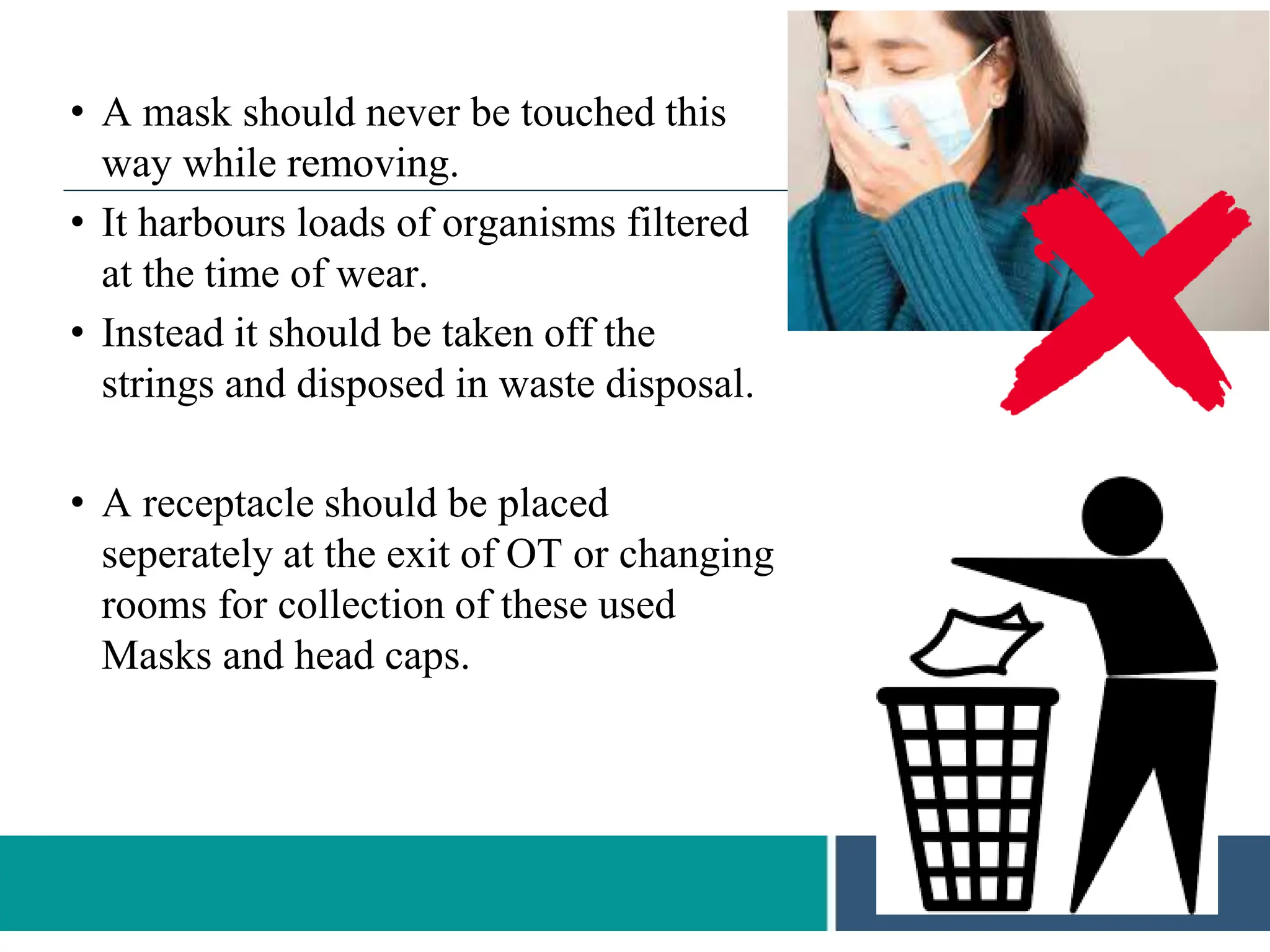
• A mask should never be touched this
way while removing.
• It harbours loads of organisms filtered
at the time of wear.
• Instead it should be taken off the
strings and disposed in waste disposal.
• A receptacle should be placed
seperately at the exit of OT or changing
rooms for collection of these used
Masks and head caps.
Scrubbing - Health care individuals
• No Rings , NO Bracelets, NO ornaments
to wrist and hand
• No Sacred threads !!!
• The fingernails should be kept clean, should
not extend beyond the fingertips and
artificial nails should not be worn.
• The subungual area has been identified as
harboring the majority of microorganisms.
Debris should be removed from the
subungual area
• Cuticles around finger tips and nail tips
should be intact
PRE-SCRUB
• Nail polish, if worn, should be freshly applied and free of chips.
The skin of the hands and forearms
should be intact with no burns,
lesions, abrasions, and cuts
present.
Minor injuries have to be covered in
a sterile way with a
TEGADERM Sterile bandage
after scrubbing & before
gloving
Integrity of SKIN of Scrubbing Personnel
LEVEL of SCRUBBING -
Fingertips up to 2’’ above elbow
• Time duration of scrub :
• Different for different scrubbing
solutions used.
• First scrub vs Subsequent Scrubs - No
evidential guidelines / consensus
• Research - Meta analysis : No role of
shorter subsequent scrubs.
SURGICAL HAND PREPARATION
The hands of the surgical team should be clean upon entering
the OR by washing with a non- medicated soap for 1 minute.
• 5 minutes ideal time of scrub with antimicrobial and water.
• 2 minutes with ABHR (Alcohol based hand rub)
• Every scrub after contamination needs prior one minute of
scrubbing with antiseptic solution.
• Once in the operating area, repeating hand rubbing or
scrubbing without an additional prior handwash is
recommended before switching to the next procedure.
• Association of Professionals of Infection
control (APIC) recommends :
• Common practices : 5 Minutes
• Betadine scrub solution ( PVP-1) in aqueous solution
• Povidone-iodine is a chemical complex of
povidone, hydrogen iodide, and elemental iodine.
• Chlorhexidine scrub solution
• washed with RO treated water - to prevent micro organism
contamination.
• Alcohol based hand Rub : 2 Minutes
• 2% Chlorhexidine in 70 % Alcohol
SCRUB SOLUTION -
• USE RO treated tap water with optimum temperature.
• Prewash the hands and forearms with non-
antimicrobial soap.
• The scrub should begin at the finger tips and end 2”
above the elbows .
• Spread the scrub from hand to forearm on each side
and start scrubbing from hand above without returning
to a clean area.
Surgical Scrubbing Technique
• The fingers, hands and forearms should be visualized as
having four sides (planes) that must be thoroughly scrubbed,
including the web space between each digit.
• Hold hands higher than the elbows so that water runs from the
finger tips toward the elbows.
• Additionally, keep the hands and arms away from the scrub
attire, while keeping the elbows in a flexed position to avoid
water from wetting the scrub suit.
• The surgical team member, after entering the OR, should
thoroughly dry hands and arms using aseptic technique prior to
wearing the sterile gown to prevent strike-through
contamination.
Performing the surgical scrub without a brush or
sponge is acceptable and has no role in preventing
SSI.
A STERILE cloth or STERILE paper towels or air
dryer - to dry wet hands and forearm are used.
All methods have been proven to further reduce the
microbial count.
• After ensuing hands are dried and
Sterilium/ ABHR is air dried, a sterile
gown - either disposable one or a
woven reusable one is worn.
GOWNING of the scrubbed person
• Lift the folded gown upwards from the table
trolley by touching only edges of the inner
aspect of gown.
• If a gowned person is already available, he can
open the gown and stretch it so that hands can
be donned in to the sleeves of the gown.
• Step back in to an unobstructable area.
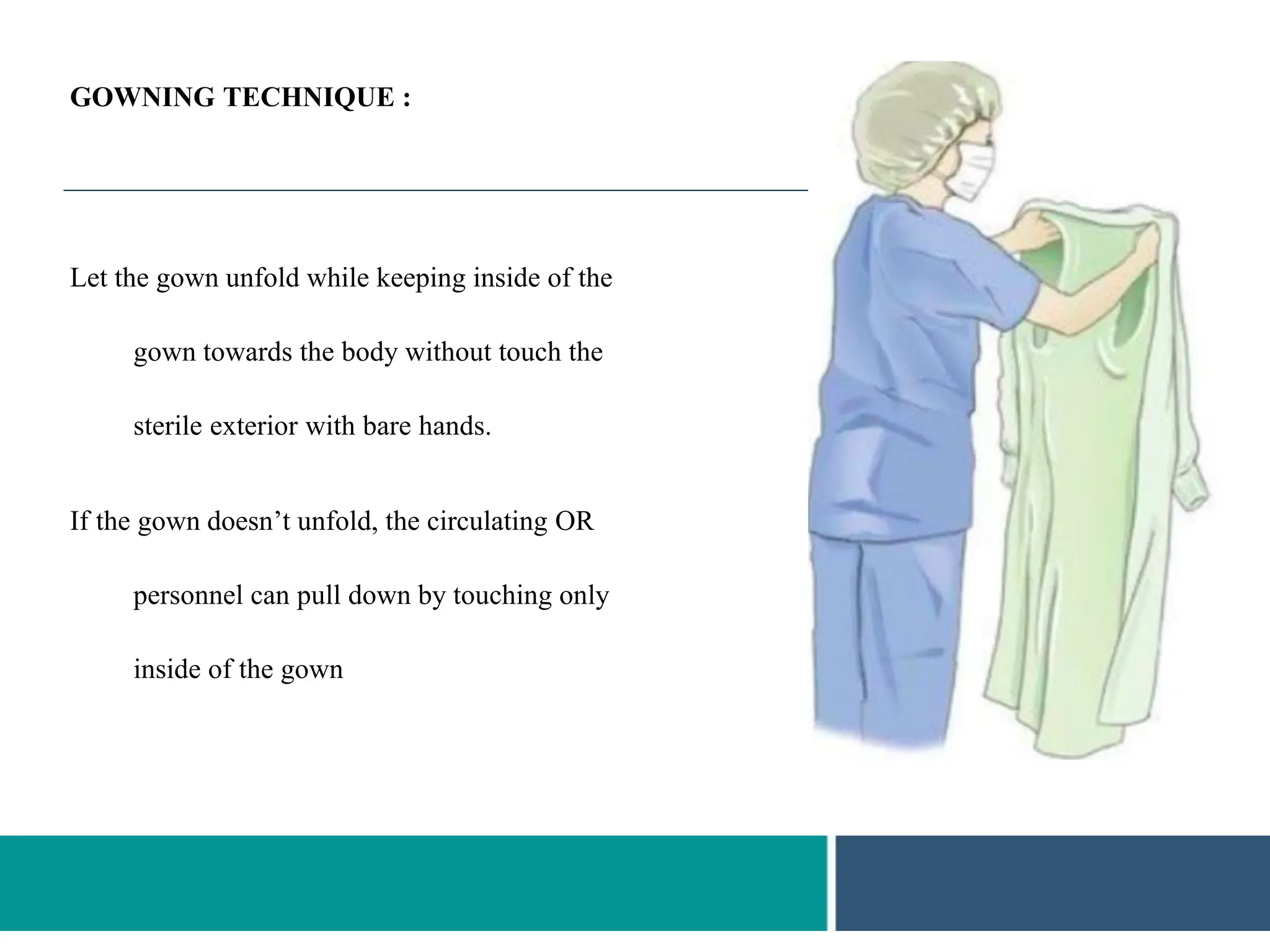
GOWNING TECHNIQUE :
Let the gown unfold while keeping inside of the
gown towards the body without touch the
sterile exterior with bare hands.
If the gown doesn’t unfold, the circulating OR
personnel can pull down by touching only
inside of the gown
GOWNING TECHNIQUE :
GOWNING TECHNIQUE :
Hold in to the hands of the gown while an assistant pull over through the upper limbs
• Circulating OR personnel
can Pull over the gown by
touching the inside of the
gown only and tie at the
back.
• Later the surgeon turns
around and ties the fabric to
front covering all around
without exposing any bare
area.
• Prevention of SSI - Disposable non woven gowns & Reusable
woven gowns both are allowed.
• Disposable - Better. In view of cost constraint and no
available stronger evidence both can be used.
• Standards :
• Proper Size covered until lower third legs and sleeves covered
up to half the hand.
• Completely wrapped in without exposing any bare area over
front of chest and back
• Woven reusable gowns have to be avoided with spillage of
water or fluids to prevent contamination.
GOWNS - Material and standards
GLOVING TECHNIQUE
• 2 layered gloves - strongly recommended.
• To prevent contamination of the surgical field that
may occur in the event of glove perforation.
• Change of gloves @ contamination or @
Perforation recomended.
• No Reuse at all
• No role of decontamination of glove using alcohol
based solutions ( Sterilium )
• No role of coloured glove or Perforator indicator to
prevent SSI
•
• CLOSED TECHNIQUE
• OPEN TECHNIQUE
• ASSISTED TECHNIQUE
GLOVING TECHNIQUES
• TOUCH ONLY GLOVE CUFF WITH BARE HAND
CLOSED TECHNIQUE :
When no assistant available. MUST TO FOLLOW FOR FIRST GLOVE
CLOSED GLOVE TECHNIQUE
• OPEN GLOVE
TECHNIQUE :
• If first glove is intact,
subsequent gloves could
be worn by touching the
sterile glove anywhere
fastly.
• ASSISTED GLOVING
TECHNIQUE :
• When a scrubbed assistant
is available, the first glove
is donned by stretching it
and donning the hands in
to the glove directly.
As microbiological contamination rates of gloves increase with
duration of surgery, glove changes are recommended at least once
per hour.
Furthermore, gloves should be changed after draping, before
handling implants and if visible perforation is seen to reduce
contamination.
CHANGE OF GLOVES
• Sterile manner - Donning
sterile gloves
• Can take help of assistant in
case of limb preparation
• Starting from the surgical
site to the entire planned area
which is exposed after
draping has to be scrubbed.
Surgical Site preparation - Scrubbing
•Common Practises :
• Povidone Iodine is used for scrubbing the patient
• PAINTING THE SURGICAL SITE after SCRUBBING :
• Povidone Iodine Solution
• CHG based alcohol solution ( CHG 2% in isopropyl 70% alcohol)
Scrub Solution
based alcohol preparation to prevent SSI in all
surgeries.
Do not wipe or blot the
surgical preparation.
It should air dry
Possible harms associated with the use of alcohol-based solutions
Not to be used in neonates
Not to be used in contact with mucosa or eyes or genital tract
Not to be used in clean wounds, contaminated wounds and
dirty wounds as it is cytotoxic and caused further damage.
Highly flammable. Excess solution pooled on table @
preparation time should be removed otherwise can cause burns
due to cautery use.
Chlorhexidine based alcohol solution
• Both disposable non woven drapes and Woven reusable drapes
cane used.
• DRAPING has to limit exposure of surgical area as minimum as
possible. However keeping in plan of extension of exposure
should be planned at the time of draping.
• Drapes once put in place should never be removed or pulled
back. Once draped underneath surface is considered unsterile.
• When using reusable woven drapes, the first layer has to be
sterile fluid repellent sheet to prevent contamination through the
drapes to unsterile table top.
• Towel clips once placed should never be removed.
DRAPING
• Commercially available skin
sealants are applied on skin after
draping. They form a film on skin
that need not be peeled off, and
helps in restricting organisms in to
surgical field.
Antimocrobial SKIN SEALANTS
• WHO 2016 guidelines
• No benefit
• Need not be used
• Level of evidence : Strong
Antimicrobial Skin sealants
• No recommendations in
WHO Guidelines
• Other guidelines
recommend it to seal of
the exposed area after
draping.
• Evidence : No significant
difference between plain
and iodine impregnated
films
STERIDRAPE / IOBAN
• Golden Rule : only front part of
chest and upper limbs are
assumed to be sterile.
• BACK of the scrubbed person is
always considered unsterile even
if not touched by anyone.
• Always move such a way that
your back faces the standing
persons back in this way
Moving around near surgical site
•Minimum total air changes should be 30.
•The fresh air component of the air change
is required to be minimum 5 air changes out of
total minimum 30 air changes.
MODULAR OT - HEPA FILTERS
•The airflow needs to be
unidirectional and downwards on
the OT table.
•The air velocity recommended is
GENERAL OTs
•21 +/- 3 Deg C
SPECIALTY OTs
•18 deg C +0 -2 deg C.
Relative humidity between 40 to 60%.
IDEAL OT TEMPERATURE
• Never pass between two scrubbed people !!
• If some one is keen on watching the surgery, easier way is to scrub and assist !! to prevent SSI
• GOLDEN RULE : STAY ONE METRE AWAY from scrubbed people and instrument table
or trolleys
• Circulating staff have to be keen observers and inform if any of the scrubbed people gets
unsterile and they may have to redo scrubbing.
• INFECTION COSTS a LOT, not just money !!!! Avoiding it is easier
Circulating people in OR
• TOO MANY PEOPLE IN OT
LIKE THIS -
• WILL CREATE CHANGE IN
AIR FLOW VELOCITY AND
CONTAMINATIONS AND
NOTHING LIKE EVEN HEPA
FILTERS WORK.
• THAT IT SELF IS THE SOURCE
OF INFECTION
OPERATING ROOM - RESTRICTED
NUMBER
• THIS IS A SMALL PROCEDURE DONE START AND END OF
EVERY SURGERY AND IT HAS PRONOUCEDLY SEEN
REDUCING MORBIDITY, MORTALITY AND WRONG SIDE
SURGERIES IN OT.
WHO PATIENT SAFETY CHECKLIST
References
• Over-the-Counter Topical Antiseptic Products: Drug
Safety Communication - FDA Requests Label
Changes and Single-Use Packaging to Decrease Risk
of Infection. US Food and Drug Administration.
http://www.fda.gov/Safety/MedWatch/SafetyInformat
ion/SafetyAlertsforHumanMedicalProducts/ucm37489
2.htm. Accessed February 11, 2015.
• Guideline for a safe environment of care, part 1. In:
Guidelines for Perioperative Practice. Denver, CO:
AORN, Inc; 2015: 239-263. [IVA]
• Gottardi W. The influence of the chemical behaviour
of iodine on the germicidal action of disinfectant
solutions containing iodine. J Hosp Infect.
1985;6(Suppl A):1-11. [VA]
• National and state healthcare-associated infections
progress report. Atlanta (GA): National Center for
Emerging and Zoonotic Infectious Diseases, Centers
for Disease Control and Prevention; 2016
• Haley RW, Culver DH, White JW, Morgan WM,
Emori TG, Munn VP, et al. The efficacy of infection
surveillance and control programs
in preventing nosocomial infections in US hospitals.
Am J Epidemiol. 1985;121(2): 182-205.
• Naderi N, Maw K, Thomas M, Boyce DE, Shokrollahi
K. A quick and effective method of limb preparation
with health, safety and efficiency benefits. Ann R Coll
Surg Engl. 2012;94(2):83-86. [IIB]
• Incoll IW, Saravanja D, Thorvaldson KT, Small T.
Comparison of the effectiveness of painting onto the
hand and immersing the hand in a bag, in pre-operative
skin preparation of the hand. J Hand Surg Eur Vol.
2009;34(3):371-373. [IIB]
• Chou J, Choudhary A, Dhillon RS. Comparing sterile
bag rubbing and paint on technique in skin preparation
of the hands. ANZ J Surg. 2011;81(9):629-632. [IIC]
• Rodrigues AL, Simoes Mde L. Incidence of surgical
site infection with pre-operative skin preparation using
10% polyvidone-iodine and 0.5% chlorhexidine-
alcohol. Rev Col Bras Cir. 2013;40(6):443-8.
• Centers for Disease Control and Prevention. Guidelines
for evaluating surveillance systems. Morb Mortal Wkly
Rep (MMWR). 1988;37(5):1-18.
• Marchi M, Pan A, Gagliotti C, Morsillo F, Parenti M,
Resi D, et al. The Italian national surgical site infection
surveillance programme and its positive impact, 2009
to 2011. Euro Surveill. 2014;19(21): pii: 20815
http://www.who.int/gpsc/global-guidelines-web.pdf
Thank you

Opearation theatre Etiquette

  • 1.
    BASIC Operation TheatreGUIDELINES Prof Dr Y Thamma Reddy Prof & HOD, Department of Orthopaedics Osmania Medical College, Hyderabad Get the Basics Right to Prevent SSI
  • 2.
    • REQUIRED FOR •INFECTION CONTROL • PATIENT SAFETY • AVOID WRONG SITE IDENTIFICATION OT GUIDLINES
  • 3.
    ❑High global epidemiologicalburden SURGICAL SITE INFECTION - SSI • A concern that can be prevented
  • 4.
    Definition : Microorganisms enterthrough the surgical skin incision Examples : Entrance points of external fixator, infected surgical wound, etc. SSI - SURGICAL SITE INFECTION
  • 5.
    1/3rd of hospital-acquiredinfections in surgical patients are SSI. 40–60 % of SSI are preventable 2–5% of operated patients will develop SSI SSI increases length of stay in hospital by ~ 7 dayS FACTS ON SSI :
  • 6.
    •Exogenous: •Contamination of woundthrough bacteria from environment: –Surgical team –Operating room environment –Instruments, material •Endogenous: •Contamination of wound through the patient’s own bacterial skin flora SOURCE OF INFECTION :
  • 7.
    What are theguidelines so far to prevent SSI ? ? ? ? ? ? ? ? ? ? ?
  • 8.
    SUCCESSFUL GUIDELINES FOLLOWEDSO FAR to prevent SSI • NICE - UK NHS • SHEA/IDSA- USA • CDC - USA • GDG - Europe • WHO global guidelines 2016
  • 9.
    • WHO GLOBALGUIDELINES FOR PREVENTION OF SSI 2016 • Widely followed as they are • Meticulous • Metaanalysis and RCT`s • LATEST EVIDENCE • WORLD WIDE REPRESENTATION
  • 10.
  • 11.
    • PRE-OPERATIVE SHOWEROR BATH FOR PATIENTS • It is good clinical practice for patients to bath or shower prior to surgery. • Either plain soap or an antiseptic soap may be used for this purpose. • Rationale : Decreases the microbial load significantly ~ ( NICE 2008/2016; WHO 2016) • # No recommendation on CHG or antiseptic soap and CHG gowns to reduce SSI - WHO guidelines 2016
  • 12.
    Patients undergoing cardiothoracicand orthopaedic surgery with known nasal carriage of S. aureus should receive perioperative intranasal applications of Mupirocin 2% ointment with or without a combination of CHG body wash. Mupirocin 2% - twice a day for 5 days is used for eradication of both MRSA and MSSA. Staphylococcous aureus - Nasal carriers : Decolenisation
  • 13.
    Strong recommendation : Cardiothoracicand Orthopaedic Conditional recommendation with moderate evidence : Other surgeries as well especially high risk surgeries A common practise to reduce Hospital acquired infections in ICU`s. is now a guideline to prevent SSI - Nasal Decolenisation
  • 14.
    • Common surgicalsite preparation practices followed : • Shaving • Depilation creams • Clippers (Trimming) Pre-operative Hair Removal
  • 15.
    • Not recommended •Has high role of developing SSI • Rationale : Causes multiple skin micro abrasions which can contaminate the surgical site SHAVING the surgical sites
  • 16.
    • Costly • Canbe allergic to many , that can predispose SSI • Not recommended. Depilation creams for removal of hair - Surgical Sites
  • 17.
    • Place :OUTSIDE Operation theatre. • Simple , Inexpensive technique. • Single patient Clippers to be used to prevent SSI. Catridge can be changed while the motor can be same. Clipping of hair - Surgical Site
  • 18.
    • WHO Guidelines2016 : •STRONG RECOMMENDATION : AVOID HAIR REMOVAL • If absolutely necessary, when hair interferes with surgery like neurosurgery, pubic region - It should be only clipped. Newer evidence - Hair removal
  • 19.
    Preoperative oral antibioticscombined with mechanical bowel preparation (MBP) should be used to reduce the risk of SSI in adult patients undergoing elective colorectal surgery. MBP - without oral antibiotic had higher rates of SSI. MECHANICAL BOWEL PREPARATION
  • 20.
    • MBP -Polyethylene glycol or sodium phosphate were the agents of choice for MBP in most studies. • Not proven for paediatric surgeries in the RCT. • Antibiotics : • Oral Aminoglycosides (exclusively used for gut preparation) or IV aminoglysides • Metronidazole (anaerobic coverage) was used in most studies basing on which guidelines were issued. MBP + ANTIBIOTIC
  • 21.
    • SCRUB SUITES •Surgical attire fabric should be free of lint, provide comfort and allow for “breathability” (allow the escape of body heat) while containing the shedding of skin squames. • Scrub suits are made of 100% spunbound polypropylene in order to decrease the shedding of skin squames in to the environment. Surgical attire - Health care personnel in OT
  • 22.
    • Attire tobe worn in semi-restricted and restricted areas. • Cotton fabrics typically have large pores and are not tightly woven allowing the dispersal of skin squames into the environment . • They can be machine laundered - Inhouse or commercial. Have to be laundered daily after use. • Placing attire in designated receptacle after use to prevent contamination Scrub Suites
  • 23.
    • HOODED Headcaps vs Normal head caps Surgical Suites - HEAD CAPS CDC Standards for PPE - Personal protective equipment To be donned first before wearing scrub suites to prevent contamination Head caps should be available in changing rooms
  • 24.
    • Hooded caps- covers the entire facial hair • Surgical team washing for a case should wear them . • Rest of the OR personnel can wear non hooded cap. Cap once worn can be used all day long unless contaminated with fluids or spilled with water
  • 25.
    • EYE Shieldingmasks - Protective to scrubbed health care personnel particularly when irrigating the wounds or chances of spillage is more. • A new one have to be used for each case to prevent contamination. Surgical MASK CDC Standards for PPE - Personal protective equipment
  • 26.
    It is recommendedthat a new mask be used for each procedure or at the minimum, changed frequently and if it becomes wet and or contaminated by blood and body fluids. Hand wash should be done as the mask is being removed to prevent contamination of hands and thereby spreading germs. • Regular disposable mask - should cover NOSE and MOUTH
  • 27.
    Overhanging of maskon neck while not in Operating rooms is strongly not recommended - as used masks harbor multiple microbes that can be transferred to the scrub suit and dispersed into the healthcare facility environment.
  • 28.
    • A maskshould never be touched this way while removing. • It harbours loads of organisms filtered at the time of wear. • Instead it should be taken off the strings and disposed in waste disposal. • A receptacle should be placed seperately at the exit of OT or changing rooms for collection of these used Masks and head caps.
  • 34.
    Scrubbing - Healthcare individuals
  • 35.
    • No Rings, NO Bracelets, NO ornaments to wrist and hand • No Sacred threads !!! • The fingernails should be kept clean, should not extend beyond the fingertips and artificial nails should not be worn. • The subungual area has been identified as harboring the majority of microorganisms. Debris should be removed from the subungual area • Cuticles around finger tips and nail tips should be intact PRE-SCRUB
  • 36.
    • Nail polish,if worn, should be freshly applied and free of chips.
  • 37.
    The skin ofthe hands and forearms should be intact with no burns, lesions, abrasions, and cuts present. Minor injuries have to be covered in a sterile way with a TEGADERM Sterile bandage after scrubbing & before gloving Integrity of SKIN of Scrubbing Personnel
  • 38.
    LEVEL of SCRUBBING- Fingertips up to 2’’ above elbow
  • 39.
    • Time durationof scrub : • Different for different scrubbing solutions used. • First scrub vs Subsequent Scrubs - No evidential guidelines / consensus • Research - Meta analysis : No role of shorter subsequent scrubs. SURGICAL HAND PREPARATION
  • 40.
    The hands ofthe surgical team should be clean upon entering the OR by washing with a non- medicated soap for 1 minute. • 5 minutes ideal time of scrub with antimicrobial and water. • 2 minutes with ABHR (Alcohol based hand rub) • Every scrub after contamination needs prior one minute of scrubbing with antiseptic solution. • Once in the operating area, repeating hand rubbing or scrubbing without an additional prior handwash is recommended before switching to the next procedure. • Association of Professionals of Infection control (APIC) recommends :
  • 41.
    • Common practices: 5 Minutes • Betadine scrub solution ( PVP-1) in aqueous solution • Povidone-iodine is a chemical complex of povidone, hydrogen iodide, and elemental iodine. • Chlorhexidine scrub solution • washed with RO treated water - to prevent micro organism contamination. • Alcohol based hand Rub : 2 Minutes • 2% Chlorhexidine in 70 % Alcohol SCRUB SOLUTION -
  • 42.
    • USE ROtreated tap water with optimum temperature. • Prewash the hands and forearms with non- antimicrobial soap. • The scrub should begin at the finger tips and end 2” above the elbows . • Spread the scrub from hand to forearm on each side and start scrubbing from hand above without returning to a clean area. Surgical Scrubbing Technique
  • 43.
    • The fingers,hands and forearms should be visualized as having four sides (planes) that must be thoroughly scrubbed, including the web space between each digit.
  • 45.
    • Hold handshigher than the elbows so that water runs from the finger tips toward the elbows. • Additionally, keep the hands and arms away from the scrub attire, while keeping the elbows in a flexed position to avoid water from wetting the scrub suit. • The surgical team member, after entering the OR, should thoroughly dry hands and arms using aseptic technique prior to wearing the sterile gown to prevent strike-through contamination.
  • 46.
    Performing the surgicalscrub without a brush or sponge is acceptable and has no role in preventing SSI. A STERILE cloth or STERILE paper towels or air dryer - to dry wet hands and forearm are used. All methods have been proven to further reduce the microbial count.
  • 47.
    • After ensuinghands are dried and Sterilium/ ABHR is air dried, a sterile gown - either disposable one or a woven reusable one is worn. GOWNING of the scrubbed person
  • 48.
    • Lift thefolded gown upwards from the table trolley by touching only edges of the inner aspect of gown. • If a gowned person is already available, he can open the gown and stretch it so that hands can be donned in to the sleeves of the gown. • Step back in to an unobstructable area. GOWNING TECHNIQUE :
  • 49.
    Let the gownunfold while keeping inside of the gown towards the body without touch the sterile exterior with bare hands. If the gown doesn’t unfold, the circulating OR personnel can pull down by touching only inside of the gown GOWNING TECHNIQUE :
  • 50.
    GOWNING TECHNIQUE : Holdin to the hands of the gown while an assistant pull over through the upper limbs
  • 51.
    • Circulating ORpersonnel can Pull over the gown by touching the inside of the gown only and tie at the back. • Later the surgeon turns around and ties the fabric to front covering all around without exposing any bare area.
  • 52.
    • Prevention ofSSI - Disposable non woven gowns & Reusable woven gowns both are allowed. • Disposable - Better. In view of cost constraint and no available stronger evidence both can be used. • Standards : • Proper Size covered until lower third legs and sleeves covered up to half the hand. • Completely wrapped in without exposing any bare area over front of chest and back • Woven reusable gowns have to be avoided with spillage of water or fluids to prevent contamination. GOWNS - Material and standards
  • 53.
    GLOVING TECHNIQUE • 2layered gloves - strongly recommended. • To prevent contamination of the surgical field that may occur in the event of glove perforation. • Change of gloves @ contamination or @ Perforation recomended. • No Reuse at all • No role of decontamination of glove using alcohol based solutions ( Sterilium ) • No role of coloured glove or Perforator indicator to prevent SSI •
  • 54.
    • CLOSED TECHNIQUE •OPEN TECHNIQUE • ASSISTED TECHNIQUE GLOVING TECHNIQUES
  • 55.
    • TOUCH ONLYGLOVE CUFF WITH BARE HAND CLOSED TECHNIQUE : When no assistant available. MUST TO FOLLOW FOR FIRST GLOVE
  • 56.
  • 57.
  • 58.
    • OPEN GLOVE TECHNIQUE: • If first glove is intact, subsequent gloves could be worn by touching the sterile glove anywhere fastly. • ASSISTED GLOVING TECHNIQUE : • When a scrubbed assistant is available, the first glove is donned by stretching it and donning the hands in to the glove directly.
  • 59.
    As microbiological contaminationrates of gloves increase with duration of surgery, glove changes are recommended at least once per hour. Furthermore, gloves should be changed after draping, before handling implants and if visible perforation is seen to reduce contamination. CHANGE OF GLOVES
  • 60.
    • Sterile manner- Donning sterile gloves • Can take help of assistant in case of limb preparation • Starting from the surgical site to the entire planned area which is exposed after draping has to be scrubbed. Surgical Site preparation - Scrubbing
  • 61.
    •Common Practises : •Povidone Iodine is used for scrubbing the patient • PAINTING THE SURGICAL SITE after SCRUBBING : • Povidone Iodine Solution • CHG based alcohol solution ( CHG 2% in isopropyl 70% alcohol) Scrub Solution
  • 62.
    based alcohol preparationto prevent SSI in all surgeries. Do not wipe or blot the surgical preparation. It should air dry
  • 63.
    Possible harms associatedwith the use of alcohol-based solutions Not to be used in neonates Not to be used in contact with mucosa or eyes or genital tract Not to be used in clean wounds, contaminated wounds and dirty wounds as it is cytotoxic and caused further damage. Highly flammable. Excess solution pooled on table @ preparation time should be removed otherwise can cause burns due to cautery use. Chlorhexidine based alcohol solution
  • 64.
    • Both disposablenon woven drapes and Woven reusable drapes cane used. • DRAPING has to limit exposure of surgical area as minimum as possible. However keeping in plan of extension of exposure should be planned at the time of draping. • Drapes once put in place should never be removed or pulled back. Once draped underneath surface is considered unsterile. • When using reusable woven drapes, the first layer has to be sterile fluid repellent sheet to prevent contamination through the drapes to unsterile table top. • Towel clips once placed should never be removed. DRAPING
  • 65.
    • Commercially availableskin sealants are applied on skin after draping. They form a film on skin that need not be peeled off, and helps in restricting organisms in to surgical field. Antimocrobial SKIN SEALANTS
  • 66.
    • WHO 2016guidelines • No benefit • Need not be used • Level of evidence : Strong Antimicrobial Skin sealants
  • 67.
    • No recommendationsin WHO Guidelines • Other guidelines recommend it to seal of the exposed area after draping. • Evidence : No significant difference between plain and iodine impregnated films STERIDRAPE / IOBAN
  • 68.
    • Golden Rule: only front part of chest and upper limbs are assumed to be sterile. • BACK of the scrubbed person is always considered unsterile even if not touched by anyone. • Always move such a way that your back faces the standing persons back in this way Moving around near surgical site
  • 69.
    •Minimum total airchanges should be 30. •The fresh air component of the air change is required to be minimum 5 air changes out of total minimum 30 air changes. MODULAR OT - HEPA FILTERS
  • 70.
    •The airflow needsto be unidirectional and downwards on the OT table. •The air velocity recommended is
  • 71.
    GENERAL OTs •21 +/-3 Deg C SPECIALTY OTs •18 deg C +0 -2 deg C. Relative humidity between 40 to 60%. IDEAL OT TEMPERATURE
  • 72.
    • Never passbetween two scrubbed people !! • If some one is keen on watching the surgery, easier way is to scrub and assist !! to prevent SSI • GOLDEN RULE : STAY ONE METRE AWAY from scrubbed people and instrument table or trolleys • Circulating staff have to be keen observers and inform if any of the scrubbed people gets unsterile and they may have to redo scrubbing. • INFECTION COSTS a LOT, not just money !!!! Avoiding it is easier Circulating people in OR
  • 73.
    • TOO MANYPEOPLE IN OT LIKE THIS - • WILL CREATE CHANGE IN AIR FLOW VELOCITY AND CONTAMINATIONS AND NOTHING LIKE EVEN HEPA FILTERS WORK. • THAT IT SELF IS THE SOURCE OF INFECTION OPERATING ROOM - RESTRICTED NUMBER
  • 74.
    • THIS ISA SMALL PROCEDURE DONE START AND END OF EVERY SURGERY AND IT HAS PRONOUCEDLY SEEN REDUCING MORBIDITY, MORTALITY AND WRONG SIDE SURGERIES IN OT. WHO PATIENT SAFETY CHECKLIST
  • 76.
    References • Over-the-Counter TopicalAntiseptic Products: Drug Safety Communication - FDA Requests Label Changes and Single-Use Packaging to Decrease Risk of Infection. US Food and Drug Administration. http://www.fda.gov/Safety/MedWatch/SafetyInformat ion/SafetyAlertsforHumanMedicalProducts/ucm37489 2.htm. Accessed February 11, 2015. • Guideline for a safe environment of care, part 1. In: Guidelines for Perioperative Practice. Denver, CO: AORN, Inc; 2015: 239-263. [IVA] • Gottardi W. The influence of the chemical behaviour of iodine on the germicidal action of disinfectant solutions containing iodine. J Hosp Infect. 1985;6(Suppl A):1-11. [VA] • National and state healthcare-associated infections progress report. Atlanta (GA): National Center for Emerging and Zoonotic Infectious Diseases, Centers for Disease Control and Prevention; 2016 • Haley RW, Culver DH, White JW, Morgan WM, Emori TG, Munn VP, et al. The efficacy of infection surveillance and control programs in preventing nosocomial infections in US hospitals. Am J Epidemiol. 1985;121(2): 182-205. • Naderi N, Maw K, Thomas M, Boyce DE, Shokrollahi K. A quick and effective method of limb preparation with health, safety and efficiency benefits. Ann R Coll Surg Engl. 2012;94(2):83-86. [IIB] • Incoll IW, Saravanja D, Thorvaldson KT, Small T. Comparison of the effectiveness of painting onto the hand and immersing the hand in a bag, in pre-operative skin preparation of the hand. J Hand Surg Eur Vol. 2009;34(3):371-373. [IIB] • Chou J, Choudhary A, Dhillon RS. Comparing sterile bag rubbing and paint on technique in skin preparation of the hands. ANZ J Surg. 2011;81(9):629-632. [IIC] • Rodrigues AL, Simoes Mde L. Incidence of surgical site infection with pre-operative skin preparation using 10% polyvidone-iodine and 0.5% chlorhexidine- alcohol. Rev Col Bras Cir. 2013;40(6):443-8. • Centers for Disease Control and Prevention. Guidelines for evaluating surveillance systems. Morb Mortal Wkly Rep (MMWR). 1988;37(5):1-18. • Marchi M, Pan A, Gagliotti C, Morsillo F, Parenti M, Resi D, et al. The Italian national surgical site infection surveillance programme and its positive impact, 2009 to 2011. Euro Surveill. 2014;19(21): pii: 20815 http://www.who.int/gpsc/global-guidelines-web.pdf
  • 77.