Dr. Subhadeep Shit
JR-1 (M.D. Emergency and Critical Care Medicine)
HISTORY & EPIDEMIOLOGY OF OP POISONING
Most patients exposed to organophosphates come into contact with insecticides. A lot
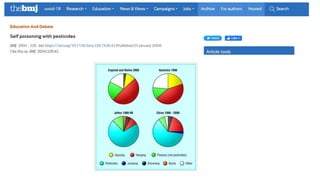
of suicidal cases are reported in developing countries due to easy availability of the
substances.
The first organophosphate insecticide was created in the mid-1800s but was not
widely used until after World War II. Organophosphates are used as medications,
insecticides, and nerve agents as a weapon
Worldwide, an estimated 3,000,000 people are exposed to organophosphate or
carbamate agents each year, with up to 300,000 fatalities.
SARIN INCIDENT
NOVICHOK
*Centre for Tropical Medicine, Nuffield Department of Clinical Medicine,
University of Oxford, Oxford.
PATHO-PHYSIOLOGY
Inhibition of cholinesterase leads to acetylcholine accumulation at nerve synapses
and neuromuscular junctions, resulting in overstimulation of acetylcholine
receptors.
This initial overstimulation is followed by paralysis of cholinergic synaptic
transmission in the CNS, in autonomic ganglia, at parasympathetic and some
sympathetic nerve endings (e.g., sweat glands), and in somatic nerves.
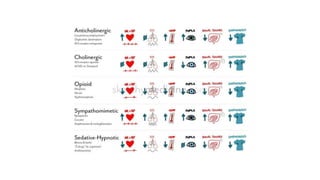
Excess acetylcholine results in a cholinergic crisis that manifests as a central and
peripheral clinical toxidrome.
AGING of the enzyme
ACUTE TOXICITY
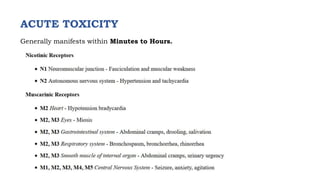
Generally manifests within Minutes to Hours.
Respiratory System
 Aspiration pneumonia from excessive salivation
 Progressive respiratory failure from respiratory muscle weakness, especially
diaphragmatic
 Severe bronchospasm
 Non-cardiogenic pulmonary oedema
Cardiovascular System
 Arrhythmias, especially ventricular tachycardia
 Bradycardia
 Hypertension
 Hypotension
 Prolonged QTc
COMPLICATIONS
COMPLICATIONS
Central Nervous System
 Psychosis
 Seizure
 Change in mental status
 Hallucination
Gastrointestinal and Metabolic Systems
 Electrolyte abnormalities from fluid and electrolyte losses from
the gastrointestinal tract
 Pancreatitis
 Hyperglycaemia
 Low bicarbonate
COMPLICATIONS
Renal System
 Acute kidney injury
There are few case reports of acute kidney injury associated with exposure to
organophosphate pesticides.
 Treatment is usually conservative management or hemodialysis.
INTERMEDIATE SYNDROME
 Occurs 24-96 hours after the exposure (Tintinali-1-5 days)
 Incidence is around 10-40% following ingestion.
 Bulbar, Respiratory, Neck flexor and Proximal Limb muscle weakness are the
prominent features.
 Symptoms of cholinergic excess are absent.
 Supportive care along with Mechanical Breath Support is required.
 Generally resolves within 1-3 weeks
 Assessment done with RBC Ach Levels
 Diagnosis based on Decreased DTR and EMG Studies.
Nerve gas poisoning has not been reported to cause the intermediate syndrome. It
is also rarely documented in Carbamate Poisoning.
DELAYED SYNDROME
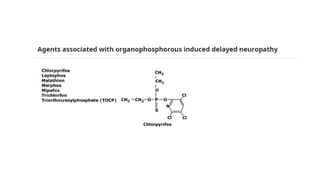
Organo-phosphorus Induced Delayed Neuropathy (OPIDN)
 Usually occurs after several weeks (typically occurs 1-3 weeks after) exposure
and the effects of Acute toxicity are resolved.
 Not associated to severity of acute cholinergic toxicity severity. (TOCP)
 Characterized by cognitive dysfunction, impaired memory, mood changes,
autonomic dysfunction, peripheral neuropathy, and extrapyramidal signs.
Chronic fatigue syndrome have been reported in some patients, predominantly
female, after exposure to very low doses of organophosphate insecticides.
 Symmetric Sensory Neuropathy with Painful in “Stocking Glove” paresthesias.
 May resolve spontaneously. May progress into permanent neurologic
dysfunction. (Spastic lower limb)
 Etiopathogenesis: NSE, Wallerian Degeneration.
DIAGNOSIS
 HISTORY
 STRONG CLINICAL SUSPISION BASED ON SIGNS AND SYMPTOMS (Toxidrome)
 Atropine Challenge Test
 RBC Cholinesterase level estimation
 Plasma Cholinesterase level estimation
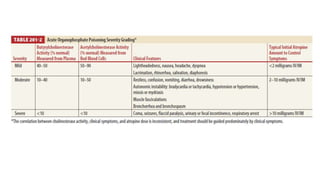
Plasma cholinesterase levels usually decline to less than 50% of the normal
value before any symptoms of poisoning are observed. As a rough guide, plasma
cholinesterase levels of 20-50% of the normal value are found with mild
poisoning, 10-20% with moderate poisoning, and less than 10% in cases of
severe toxicity
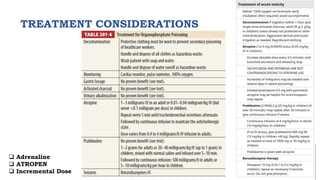
TREATMENT CONSIDERATIONS
 Universal safety Precautions
PPE KIT
 LATEX Gloves must not be used. NITRILE GLOVES and
Impermeable plastic Gowns must be worn.
 Decontamination
WEARABLES MUST BE DISCARDED
SKIN MUST BE WASHED WITH SOAP AND WATER (If suspecting
Body or skin contamination)
 GASTRIC LAVAGE (Controversial, some clinicians prefer/do a lavage if
presented within 1 hour)
 ACTIVATED CHARCOAL (No proven benefit, can be given 1gm/kg, max
dose 50gm)
 Urinary Alkalization (No Proven Benefit)
TREATMENT CONSIDERATIONS
 Adrenaline
 ATROPEN
 Incremental Dose
The carbamate insecticides (aldicarb, carbofuran, carbaryl, ethienocarb,
fenobucarb, oxamyl, methomyl, pirimicarb, propoxur, and trimethacarb)
are cholinesterase inhibitors that are structurally related to the
organophosphate compounds.
These agents are primarily used as insecticides and rodenticides.
COMMERCIALLY AVAILABLE INSECTISIDES
 Carbamates can be toxic after dermal, inhalation, and GI exposure.
 Carbamates transiently and reversibly bind to and inhibit the cholinesterase enzyme.
 Regeneration of enzyme activity by dissociation of the carbamyl-cholinesterase bond
occurs within minutes to a few hours involving rapid, spontaneous hydrolysis of the
carbamate-cholinesterase bond.
 Therefore, aging does not occur, and as a major difference from organophosphate
poisoning, new enzyme does not need to be synthesized before normal function is
restored after carbamate poisoning.
ACTION
 In adults, symptoms of acute carbamate poisoning are similar to the
cholinergic syndrome observed with organophosphate agents but are of
shorter duration.
 Carbamates do-not enter the CNS of Adults. So CNS symptoms are less
common.
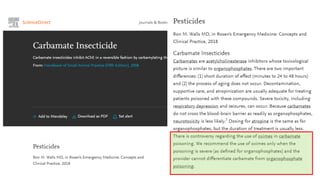
 In treatment Oximes should be avoided in mild to moderate Carbamate only
poisoning. Apart management is similar to OP Poisoning.
 Some authors and clinicians advocate use of Oximes in mixed Poisoning.
SYMPTOMS AND MANAGEMENT
REACTIVATION BY PRALIDOXIME
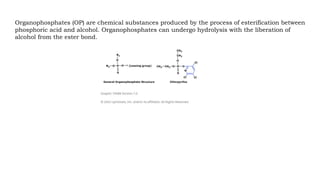
Organophosphates (OP) are chemical substances produced by the process of esterification between
phosphoric acid and alcohol. Organophosphates can undergo hydrolysis with the liberation of
alcohol from the ester bond.
OP Poisoning Dr Subhadeep JR Emmed.pptx

OP Poisoning Dr Subhadeep JR Emmed.pptx

  • 1.
    Dr. Subhadeep Shit JR-1(M.D. Emergency and Critical Care Medicine)
  • 2.
    HISTORY & EPIDEMIOLOGYOF OP POISONING Most patients exposed to organophosphates come into contact with insecticides. A lot of suicidal cases are reported in developing countries due to easy availability of the substances. The first organophosphate insecticide was created in the mid-1800s but was not widely used until after World War II. Organophosphates are used as medications, insecticides, and nerve agents as a weapon Worldwide, an estimated 3,000,000 people are exposed to organophosphate or carbamate agents each year, with up to 300,000 fatalities. SARIN INCIDENT NOVICHOK *Centre for Tropical Medicine, Nuffield Department of Clinical Medicine, University of Oxford, Oxford.
  • 4.
    PATHO-PHYSIOLOGY Inhibition of cholinesteraseleads to acetylcholine accumulation at nerve synapses and neuromuscular junctions, resulting in overstimulation of acetylcholine receptors. This initial overstimulation is followed by paralysis of cholinergic synaptic transmission in the CNS, in autonomic ganglia, at parasympathetic and some sympathetic nerve endings (e.g., sweat glands), and in somatic nerves. Excess acetylcholine results in a cholinergic crisis that manifests as a central and peripheral clinical toxidrome. AGING of the enzyme
  • 5.
    ACUTE TOXICITY Generally manifestswithin Minutes to Hours.
  • 6.
    Respiratory System  Aspirationpneumonia from excessive salivation  Progressive respiratory failure from respiratory muscle weakness, especially diaphragmatic  Severe bronchospasm  Non-cardiogenic pulmonary oedema Cardiovascular System  Arrhythmias, especially ventricular tachycardia  Bradycardia  Hypertension  Hypotension  Prolonged QTc COMPLICATIONS
  • 7.
    COMPLICATIONS Central Nervous System Psychosis  Seizure  Change in mental status  Hallucination Gastrointestinal and Metabolic Systems  Electrolyte abnormalities from fluid and electrolyte losses from the gastrointestinal tract  Pancreatitis  Hyperglycaemia  Low bicarbonate
  • 8.
    COMPLICATIONS Renal System  Acutekidney injury There are few case reports of acute kidney injury associated with exposure to organophosphate pesticides.  Treatment is usually conservative management or hemodialysis.
  • 9.
    INTERMEDIATE SYNDROME  Occurs24-96 hours after the exposure (Tintinali-1-5 days)  Incidence is around 10-40% following ingestion.  Bulbar, Respiratory, Neck flexor and Proximal Limb muscle weakness are the prominent features.  Symptoms of cholinergic excess are absent.  Supportive care along with Mechanical Breath Support is required.  Generally resolves within 1-3 weeks  Assessment done with RBC Ach Levels  Diagnosis based on Decreased DTR and EMG Studies. Nerve gas poisoning has not been reported to cause the intermediate syndrome. It is also rarely documented in Carbamate Poisoning.
  • 10.
    DELAYED SYNDROME Organo-phosphorus InducedDelayed Neuropathy (OPIDN)  Usually occurs after several weeks (typically occurs 1-3 weeks after) exposure and the effects of Acute toxicity are resolved.  Not associated to severity of acute cholinergic toxicity severity. (TOCP)  Characterized by cognitive dysfunction, impaired memory, mood changes, autonomic dysfunction, peripheral neuropathy, and extrapyramidal signs. Chronic fatigue syndrome have been reported in some patients, predominantly female, after exposure to very low doses of organophosphate insecticides.  Symmetric Sensory Neuropathy with Painful in “Stocking Glove” paresthesias.  May resolve spontaneously. May progress into permanent neurologic dysfunction. (Spastic lower limb)  Etiopathogenesis: NSE, Wallerian Degeneration.
  • 11.
    DIAGNOSIS  HISTORY  STRONGCLINICAL SUSPISION BASED ON SIGNS AND SYMPTOMS (Toxidrome)  Atropine Challenge Test  RBC Cholinesterase level estimation  Plasma Cholinesterase level estimation Plasma cholinesterase levels usually decline to less than 50% of the normal value before any symptoms of poisoning are observed. As a rough guide, plasma cholinesterase levels of 20-50% of the normal value are found with mild poisoning, 10-20% with moderate poisoning, and less than 10% in cases of severe toxicity
  • 13.
    TREATMENT CONSIDERATIONS  Universalsafety Precautions PPE KIT  LATEX Gloves must not be used. NITRILE GLOVES and Impermeable plastic Gowns must be worn.  Decontamination WEARABLES MUST BE DISCARDED SKIN MUST BE WASHED WITH SOAP AND WATER (If suspecting Body or skin contamination)  GASTRIC LAVAGE (Controversial, some clinicians prefer/do a lavage if presented within 1 hour)  ACTIVATED CHARCOAL (No proven benefit, can be given 1gm/kg, max dose 50gm)  Urinary Alkalization (No Proven Benefit)
  • 14.
    TREATMENT CONSIDERATIONS  Adrenaline ATROPEN  Incremental Dose
  • 15.
    The carbamate insecticides(aldicarb, carbofuran, carbaryl, ethienocarb, fenobucarb, oxamyl, methomyl, pirimicarb, propoxur, and trimethacarb) are cholinesterase inhibitors that are structurally related to the organophosphate compounds. These agents are primarily used as insecticides and rodenticides.
  • 16.
  • 17.
     Carbamates canbe toxic after dermal, inhalation, and GI exposure.  Carbamates transiently and reversibly bind to and inhibit the cholinesterase enzyme.  Regeneration of enzyme activity by dissociation of the carbamyl-cholinesterase bond occurs within minutes to a few hours involving rapid, spontaneous hydrolysis of the carbamate-cholinesterase bond.  Therefore, aging does not occur, and as a major difference from organophosphate poisoning, new enzyme does not need to be synthesized before normal function is restored after carbamate poisoning. ACTION
  • 18.
     In adults,symptoms of acute carbamate poisoning are similar to the cholinergic syndrome observed with organophosphate agents but are of shorter duration.  Carbamates do-not enter the CNS of Adults. So CNS symptoms are less common.  In treatment Oximes should be avoided in mild to moderate Carbamate only poisoning. Apart management is similar to OP Poisoning.  Some authors and clinicians advocate use of Oximes in mixed Poisoning. SYMPTOMS AND MANAGEMENT
  • 20.
  • 25.
    Organophosphates (OP) arechemical substances produced by the process of esterification between phosphoric acid and alcohol. Organophosphates can undergo hydrolysis with the liberation of alcohol from the ester bond.