Case Presentation
G Kalai Amuthan Gurusamy MD
History
◈ 36 years old female brought into RZ at 10pm
◈ Presentation
� NKMI
� Found unconscious at home
� Noted frothy saliva around the mouth
� Family unsure what happened
� Ambulance called for ? Fitting – IV valium 5mg given in ambulance
� What other relevant history to ask??
Differential diagnosis
◈ Vascular – Stroke, MI
◈ Infection – Meningoencephalitis, Sepsis
◈ Neoplasm – Brain tumor, Advanced malignancy
◈ Drugs – Overdose/Poisoning
◈ Inflammation – Hypoxia
◈ Congenital – AVM
◈ Autoimmune –SLE, vasculitis
◈ Trauma - ICB
◈ Endocrine – DKA/Thyroid storm/Hypoglycemia
◈ Degenerative – Dementia
Further history from family
◈ Not depressed/low mood or any acute psychological stressor
◈ Was seen by family member on the same evening – no altered behavior noted
◈ No history of fitting
◈ Unsure if feverish
◈ Upon arrival to ED :
� No jerky epileptic movements
� Foam from nose and mouth – yellowish
secretion
� No OP/hydrocarbon smell
� Diaphoretic
� Gasping, Pin point pupils, GCS 3
◈ BP 161/50mmHg
◈ PR 102
◈ RR 32
◈ SPO2 100 HFO
� Lungs : crepitation
� Abd :soft active bowel sound
◈ Intubated for airway protection
� Post intubation – hypotensive and bradycardic
Investigation
FBC ABG
◈ Lac 4
◈ UPT – negative
◈ REFLO 11.3
◈ UFEME ketone 2+
Further history
◈ Patient family found a bottle of
insecticide in the rubbish bin at home
◈ Noted patient had changed her attire at
home prior, soaked with sweat
Insecticides
Chemical Group Active ingredients
Organophosphate (Industrial grade) Chlorpyrifos
Malathion
Carbamate Carbofuran
Pyrethin/Pyrethroids (Household pesticides) Cyfluthrin
Cypermetrin
Cyphenothrin
Permetrin
Pyrethrin
Tetrametrin
Others Abamectin
Boric acid
Fipronil
Toxidromes
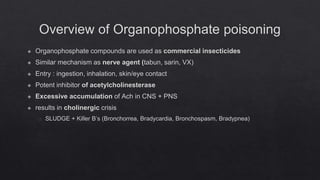
Overview of Organophosphate poisoning
◈ Organophosphate compounds are used as commercial insecticides
◈ Similar mechanism as nerve agent (tabun, sarin, VX)
◈ Entry : ingestion, inhalation, skin/eye contact
◈ Potent inhibitor of acetylcholinesterase
◈ Excessive accumulation of Ach in CNS + PNS
◈ results in cholinergic crisis
� SLUDGE + Killer B’s (Bronchorrea, Bradycardia, Bronchospasm, Bradypnea)
Risk Factors
◈ insecticides/fertilisers
◈ surface and room sprays
◈ baits for cockroaches
◈ shampoos against head lice
◈ pet preparations
◈ crop protection and livestock dipping
◈ fumigation
◈ nerve agents (sarin)
NMJ Physiology
Mechanism of OP poisoning
Inhibit AChE Excess Ach
Muscarinic +
Nicotinic
ACHe-OP
complex
undergo
aging with
time
New ACHe
need to be
synthesized
despite
antidote
Pharmacokinetics
◈ Well absorbed via GI, Resp tract, mucous membrane, skin
◈ Some OP activated into more toxic ‘oxone’ in body
� Parathion � Paraoxon
� Malathion � Malaoxon
◈ Onset : min to hours (depends on agent/route/extend of exposure)
◈ Most OP metabolized in liver to INACTIVE compounds
Organophophate Toxidromes
MUSCARINIC NICOTINIC
S – Salivation M – Muscle cramps
L – Lacrimation T – Tachycardia
U – Urination W – Weakness muscle
D – Defecation H – Hypertension
G - GI Cramp F – Fasciculation
E – Emesis S – Sugar (hyperglycemia)
Killer B’s – Bronchorrea, Bradypnea,
Bronchospasm, Bradycardia
Other clinical features
◈ CVS
� No cardiogenic pulmonary edema
� Hypotension
� Arythmias (Prolong QtC, PVC, VT/VF)
◈ CNS
� Irritablity
� Restless
� Agitation
� Confusion
◈ GI
� Acute panceratitis
OP vs Carbamate
OP Carbamate
Binding at NMJ Irreversible Reversible
Action at active site on AChE
molecule
Phosphorylation Carbamoylation
Half Life 10 days 1 day
CNS action Yes No
Treatment Atropine + Pralidoxime Atropine
Investigations
◈ Treatment should be started based of CLINICAL FEATURES!
◈ Diagnostic test only for suspected cases
◈ Specific insecticide and metabolite level not available in most centres
1. Serum Plasma Cholinesterases
2. RBC Cholinesterase level
Plasma Serum cholinesterase
◈ Low level ~ Toxicity
◈ Metabolizes various compounds ie suxamethonium/codeine
◈ Less specific as indication for exposure to OP
◈ More reflective of ACUTE poisoning (decline and regenerate faster than RBC
cholinesterase)
◈ Can be low in various conditions
� Hereditery, malnutrition, chronic debilitating illness
RBC Cholinesterase
◈ Not available most centers
◈ More specific
◈ Regenerates slower – use as historical marker of exposure
◈ Can be used as monitoring in occupational exposure
◈ Low levels can be found in
� Pernicious anemia, hemoglobinopathy, on antimalarial tx
Principle of Management
◈ Early decontamination
◈ Supportive care
◈ Appropriate use of antidote
◈ Treat the complication
◈ Police report
Early decontamination
◈ Staff protection
� Prevention of secondary poisoning from vomitus, lavage fluid, surface contaminant
� Universal precaution
◈ Dermal decontamination with copious soap and water
◈ Remove clothing
◈ Gastric lavage
� Substantial amount of OP ingested - <1H
Supportive care
◈ Airway support – intubation and frequent suctioning
� Non depolarizing agent used as muscle relaxant as depolarizing agent(suxa) may have
prolonged action in the face of depleted ACHe
◈ Seizure – benzodiazepines
◈ Fluids - Give 500 –1000 ml (10–20 ml/kg) of normal saline over 10–20 min
Antidote (ATROPINE)
◈ To reverse muscarinic effect (no nicotinic effect)
◈ Dose
� IV 0.8 to 1.2mg ( paeds 0.01mg/kg, not less than 0.1mg to prevent paradoxical brady)
� Double the dose every 5 minutes if no improvement (up to 1000mg/day)
� Infusion can follow after initial dose at 10-20% of total initial bolus per hour
◈ AIM
� Clear chest
� HR > 80
� SBP > 80
� Dry Axillae
� Pupil not pinpoint
◈ Confusion, pyrexia + absent bowel sound/urinary retention � atropine toxicity
Modified Atropine Chart ®
Time Signs of atropinization Signs of atropine toxicity Drugs and doses
HR>80 Clear Lung Pupil size
dilated
Dry Axilla SBP>80 Bowel sound
absent
Confused Fever
(>37.5)
Atropine
infusion
(mg/H)
Bolus
(mg)
0000H
0005H
0010H
Antidote (Oximes-Pralidoxime)
◈ MOA
� Reactivates the phosphorylated AChE by binding to the OP molecule
� Does not work if aging has occur (<48H)
◈ Synergistic effect with atropine
◈ No definite evidence to prove/disprove efficacy of oxime
◈ Reasonable to start in severe poisoning with 24H-36H
◈ DOSE
� 1-2g in 100mls NaCl over 30 mins (do not give bolus—fatal)
� Followed by infusion 8-20mg/kg/H
� Child : 25-50mg/kg 15-30min (rpt 1-2H)
◈ Continue until OP toxicity subside
Literature
Intermediate syndrome (IMS)
◈ Occur after cholinergic symptom resolves
◈ Occur up to 20-50% cases
◈ Early sign : weakness of neck flexion
◈ Respiratory paralysis, muscle weakness, motor cranial nerve palsy, no sensory deficit
◈ Recover 1-3 weeks
◈ Treatment supportive
Organophosphate induced
delayed peripheral neuropathies
(OPIND)
◈ Days to weeks to occur
◈ Occur through inhibition of neuropathiy
target esterase (NTE)
Delayed Neuropsychiatric
sequalae
◈ Chronic neurological sequalae after stop
OP exposure
◈ Cognitive defect – memory, concentration,
problem solving
◈ Depression and anxiety
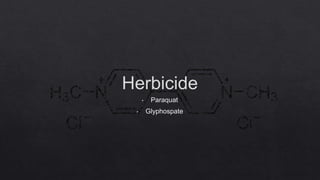
Herbicide
• Paraquat
• Glyphospate
Paraquat
◈ Banned on 2002 – but lifted after few years
◈ Swallowing 20-24% paraquat
� > 10ml of � significant illness
� > 30ml (mouthful) � Lethal
◈ Rapidly-acting, effective, nonselective and relatively inexpensive widespread
◈ Used in much of the developing countries
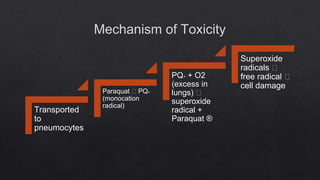
Mechanism of Toxicity
Transported
to
pneumocytes
Paraquat � PQ+
(monocation
radical)
PQ+ + O2
(excess in
lungs) �
superoxide
radical +
Paraquat ®
Superoxide
radicals �
free radical �
cell damage
Clinical Features
◈ Corrosive – GI tract
◈ Early death � cardiac toxicity + shock
◈ Late death � pulmonary fibrosis / Respiratory failure
◈ Multi-organ failure
Investigation
◈ Urine paraquat
� To confirm exposure
� Remain positive 6H-few days
◈ Serum Paraquat
Management
◈ Precaution
◈ Resuscitation – avoid O2 therapy unless significant hypoxia
◈ GI Decontamination (<2H)
� Recommended to limit systemic exposure (grade 2C)
� Activated charcoal (1g/kg in water, max 50g)
� Fullers earth (2g/kg in water, max 150g)
◈ Gastric lavage and forced emesis are contraindicated due to paraquat-induced
caustic injury
◈ Definitive tx � NONE
Specific treatment & antidotal treatment
• Treatment with hemoperfusion for four
hours
• if it can be initiated within four hours of
ingestion (grade 2c)
Extracorporeal
therapies
• Glucocorticoid with cyclophosphamide for
paraquat induced lung fibrosis – may be
beneficial
Anti-inflammatory and
Immunosuppressant
• Acetylcysteine – under study
Anti-oxidant therapy
Glyphosate (Roundup®)
◈ Non selective herbicide
◈ Kills any green plant with little environmental persistence
Clinical features
◈ Most toxicity is a believed to be due to the surfactant component
◈ Most common surfactant polyoxyethyleamine (POEA), concentration up to 50%
◈ GI : NVD, corrosive injury to GI tract (>85ml)
◈ Respiratory : Bronchospasm, Laryngeal corrosive injury, ARDS
◈ CVS + CNS : hypotension, cardiogenic shock, AMS, cerebral edema
Treatment
◈ Supportive
◈ GI Decontamination
Reference
◈ Shirley Ooi
◈ UptoDate ®
◈ Clinical Toxicology Coursebook 2017

OP POISONING-case presentation.pptx

  • 1.
    Case Presentation G KalaiAmuthan Gurusamy MD
  • 2.
    History ◈ 36 yearsold female brought into RZ at 10pm ◈ Presentation � NKMI � Found unconscious at home � Noted frothy saliva around the mouth � Family unsure what happened � Ambulance called for ? Fitting – IV valium 5mg given in ambulance � What other relevant history to ask??
  • 3.
    Differential diagnosis ◈ Vascular– Stroke, MI ◈ Infection – Meningoencephalitis, Sepsis ◈ Neoplasm – Brain tumor, Advanced malignancy ◈ Drugs – Overdose/Poisoning ◈ Inflammation – Hypoxia ◈ Congenital – AVM ◈ Autoimmune –SLE, vasculitis ◈ Trauma - ICB ◈ Endocrine – DKA/Thyroid storm/Hypoglycemia ◈ Degenerative – Dementia
  • 4.
    Further history fromfamily ◈ Not depressed/low mood or any acute psychological stressor ◈ Was seen by family member on the same evening – no altered behavior noted ◈ No history of fitting ◈ Unsure if feverish
  • 5.
    ◈ Upon arrivalto ED : � No jerky epileptic movements � Foam from nose and mouth – yellowish secretion � No OP/hydrocarbon smell � Diaphoretic � Gasping, Pin point pupils, GCS 3 ◈ BP 161/50mmHg ◈ PR 102 ◈ RR 32 ◈ SPO2 100 HFO � Lungs : crepitation � Abd :soft active bowel sound ◈ Intubated for airway protection � Post intubation – hypotensive and bradycardic
  • 6.
  • 7.
    ◈ UPT –negative ◈ REFLO 11.3 ◈ UFEME ketone 2+
  • 10.
    Further history ◈ Patientfamily found a bottle of insecticide in the rubbish bin at home ◈ Noted patient had changed her attire at home prior, soaked with sweat
  • 11.
    Insecticides Chemical Group Activeingredients Organophosphate (Industrial grade) Chlorpyrifos Malathion Carbamate Carbofuran Pyrethin/Pyrethroids (Household pesticides) Cyfluthrin Cypermetrin Cyphenothrin Permetrin Pyrethrin Tetrametrin Others Abamectin Boric acid Fipronil
  • 12.
  • 14.
    Overview of Organophosphatepoisoning ◈ Organophosphate compounds are used as commercial insecticides ◈ Similar mechanism as nerve agent (tabun, sarin, VX) ◈ Entry : ingestion, inhalation, skin/eye contact ◈ Potent inhibitor of acetylcholinesterase ◈ Excessive accumulation of Ach in CNS + PNS ◈ results in cholinergic crisis � SLUDGE + Killer B’s (Bronchorrea, Bradycardia, Bronchospasm, Bradypnea)
  • 15.
    Risk Factors ◈ insecticides/fertilisers ◈surface and room sprays ◈ baits for cockroaches ◈ shampoos against head lice ◈ pet preparations ◈ crop protection and livestock dipping ◈ fumigation ◈ nerve agents (sarin)
  • 16.
  • 17.
    Mechanism of OPpoisoning Inhibit AChE Excess Ach Muscarinic + Nicotinic ACHe-OP complex undergo aging with time New ACHe need to be synthesized despite antidote
  • 18.
    Pharmacokinetics ◈ Well absorbedvia GI, Resp tract, mucous membrane, skin ◈ Some OP activated into more toxic ‘oxone’ in body � Parathion � Paraoxon � Malathion � Malaoxon ◈ Onset : min to hours (depends on agent/route/extend of exposure) ◈ Most OP metabolized in liver to INACTIVE compounds
  • 19.
    Organophophate Toxidromes MUSCARINIC NICOTINIC S– Salivation M – Muscle cramps L – Lacrimation T – Tachycardia U – Urination W – Weakness muscle D – Defecation H – Hypertension G - GI Cramp F – Fasciculation E – Emesis S – Sugar (hyperglycemia) Killer B’s – Bronchorrea, Bradypnea, Bronchospasm, Bradycardia
  • 20.
    Other clinical features ◈CVS � No cardiogenic pulmonary edema � Hypotension � Arythmias (Prolong QtC, PVC, VT/VF) ◈ CNS � Irritablity � Restless � Agitation � Confusion ◈ GI � Acute panceratitis
  • 21.
    OP vs Carbamate OPCarbamate Binding at NMJ Irreversible Reversible Action at active site on AChE molecule Phosphorylation Carbamoylation Half Life 10 days 1 day CNS action Yes No Treatment Atropine + Pralidoxime Atropine
  • 22.
    Investigations ◈ Treatment shouldbe started based of CLINICAL FEATURES! ◈ Diagnostic test only for suspected cases ◈ Specific insecticide and metabolite level not available in most centres 1. Serum Plasma Cholinesterases 2. RBC Cholinesterase level
  • 23.
    Plasma Serum cholinesterase ◈Low level ~ Toxicity ◈ Metabolizes various compounds ie suxamethonium/codeine ◈ Less specific as indication for exposure to OP ◈ More reflective of ACUTE poisoning (decline and regenerate faster than RBC cholinesterase) ◈ Can be low in various conditions � Hereditery, malnutrition, chronic debilitating illness
  • 24.
    RBC Cholinesterase ◈ Notavailable most centers ◈ More specific ◈ Regenerates slower – use as historical marker of exposure ◈ Can be used as monitoring in occupational exposure ◈ Low levels can be found in � Pernicious anemia, hemoglobinopathy, on antimalarial tx
  • 25.
    Principle of Management ◈Early decontamination ◈ Supportive care ◈ Appropriate use of antidote ◈ Treat the complication ◈ Police report
  • 26.
    Early decontamination ◈ Staffprotection � Prevention of secondary poisoning from vomitus, lavage fluid, surface contaminant � Universal precaution ◈ Dermal decontamination with copious soap and water ◈ Remove clothing ◈ Gastric lavage � Substantial amount of OP ingested - <1H
  • 27.
    Supportive care ◈ Airwaysupport – intubation and frequent suctioning � Non depolarizing agent used as muscle relaxant as depolarizing agent(suxa) may have prolonged action in the face of depleted ACHe ◈ Seizure – benzodiazepines ◈ Fluids - Give 500 –1000 ml (10–20 ml/kg) of normal saline over 10–20 min
  • 28.
    Antidote (ATROPINE) ◈ Toreverse muscarinic effect (no nicotinic effect) ◈ Dose � IV 0.8 to 1.2mg ( paeds 0.01mg/kg, not less than 0.1mg to prevent paradoxical brady) � Double the dose every 5 minutes if no improvement (up to 1000mg/day) � Infusion can follow after initial dose at 10-20% of total initial bolus per hour ◈ AIM � Clear chest � HR > 80 � SBP > 80 � Dry Axillae � Pupil not pinpoint ◈ Confusion, pyrexia + absent bowel sound/urinary retention � atropine toxicity
  • 30.
    Modified Atropine Chart® Time Signs of atropinization Signs of atropine toxicity Drugs and doses HR>80 Clear Lung Pupil size dilated Dry Axilla SBP>80 Bowel sound absent Confused Fever (>37.5) Atropine infusion (mg/H) Bolus (mg) 0000H 0005H 0010H
  • 31.
    Antidote (Oximes-Pralidoxime) ◈ MOA �Reactivates the phosphorylated AChE by binding to the OP molecule � Does not work if aging has occur (<48H) ◈ Synergistic effect with atropine ◈ No definite evidence to prove/disprove efficacy of oxime ◈ Reasonable to start in severe poisoning with 24H-36H ◈ DOSE � 1-2g in 100mls NaCl over 30 mins (do not give bolus—fatal) � Followed by infusion 8-20mg/kg/H � Child : 25-50mg/kg 15-30min (rpt 1-2H) ◈ Continue until OP toxicity subside
  • 32.
  • 34.
    Intermediate syndrome (IMS) ◈Occur after cholinergic symptom resolves ◈ Occur up to 20-50% cases ◈ Early sign : weakness of neck flexion ◈ Respiratory paralysis, muscle weakness, motor cranial nerve palsy, no sensory deficit ◈ Recover 1-3 weeks ◈ Treatment supportive
  • 35.
    Organophosphate induced delayed peripheralneuropathies (OPIND) ◈ Days to weeks to occur ◈ Occur through inhibition of neuropathiy target esterase (NTE) Delayed Neuropsychiatric sequalae ◈ Chronic neurological sequalae after stop OP exposure ◈ Cognitive defect – memory, concentration, problem solving ◈ Depression and anxiety
  • 36.
  • 37.
    Paraquat ◈ Banned on2002 – but lifted after few years ◈ Swallowing 20-24% paraquat � > 10ml of � significant illness � > 30ml (mouthful) � Lethal ◈ Rapidly-acting, effective, nonselective and relatively inexpensive widespread ◈ Used in much of the developing countries
  • 38.
    Mechanism of Toxicity Transported to pneumocytes Paraquat� PQ+ (monocation radical) PQ+ + O2 (excess in lungs) � superoxide radical + Paraquat ® Superoxide radicals � free radical � cell damage
  • 39.
    Clinical Features ◈ Corrosive– GI tract ◈ Early death � cardiac toxicity + shock ◈ Late death � pulmonary fibrosis / Respiratory failure ◈ Multi-organ failure
  • 40.
    Investigation ◈ Urine paraquat �To confirm exposure � Remain positive 6H-few days ◈ Serum Paraquat
  • 41.
    Management ◈ Precaution ◈ Resuscitation– avoid O2 therapy unless significant hypoxia ◈ GI Decontamination (<2H) � Recommended to limit systemic exposure (grade 2C) � Activated charcoal (1g/kg in water, max 50g) � Fullers earth (2g/kg in water, max 150g) ◈ Gastric lavage and forced emesis are contraindicated due to paraquat-induced caustic injury ◈ Definitive tx � NONE
  • 42.
    Specific treatment &antidotal treatment • Treatment with hemoperfusion for four hours • if it can be initiated within four hours of ingestion (grade 2c) Extracorporeal therapies • Glucocorticoid with cyclophosphamide for paraquat induced lung fibrosis – may be beneficial Anti-inflammatory and Immunosuppressant • Acetylcysteine – under study Anti-oxidant therapy
  • 43.
    Glyphosate (Roundup®) ◈ Nonselective herbicide ◈ Kills any green plant with little environmental persistence
  • 44.
    Clinical features ◈ Mosttoxicity is a believed to be due to the surfactant component ◈ Most common surfactant polyoxyethyleamine (POEA), concentration up to 50% ◈ GI : NVD, corrosive injury to GI tract (>85ml) ◈ Respiratory : Bronchospasm, Laryngeal corrosive injury, ARDS ◈ CVS + CNS : hypotension, cardiogenic shock, AMS, cerebral edema
  • 45.
  • 46.
    Reference ◈ Shirley Ooi ◈UptoDate ® ◈ Clinical Toxicology Coursebook 2017