
REVISED FIGO STAGING
      SYSTEMS FOR
GYNAECOLOGICAL CANCERS
         (2009)
  Glenn McCluggage, Belfast Trust
BACKGROUND
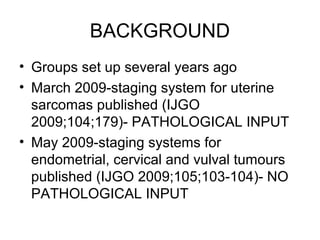
• Groups set up several years ago
• March 2009-staging system for uterine
  sarcomas published (IJGO
  2009;104;179)- PATHOLOGICAL INPUT
• May 2009-staging systems for
  endometrial, cervical and vulval tumours
  published (IJGO 2009;105;103-104)- NO
  PATHOLOGICAL INPUT
OTHER TUMOURS
• groups set up to look at staging of ovarian,
  fallopian tube and trophoblastic
  neoplasms
NEW FIGO STAGING FOR
     UTERINE SARCOMAS
• never had staging system previously
• carcinosarcomas staged as per uterine
  carcinomas
• staging system for leiomyosarcomas
• different system for ESS and
  adenosarcoma
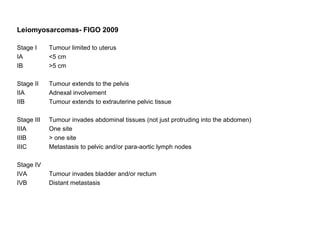
Leiomyosarcomas- FIGO 2009

Stage I     Tumour limited to uterus
IA          <5 cm
IB          >5 cm

Stage II    Tumour extends to the pelvis
IIA         Adnexal involvement
IIB         Tumour extends to extrauterine pelvic tissue

Stage III   Tumour invades abdominal tissues (not just protruding into the abdomen)
IIIA        One site
IIIB        > one site
IIIC        Metastasis to pelvic and/or para-aortic lymph nodes

Stage IV
IVA         Tumour invades bladder and/or rectum
IVB         Distant metastasis
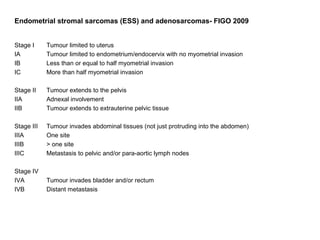
Endometrial stromal sarcomas (ESS) and adenosarcomas- FIGO 2009


Stage I     Tumour limited to uterus
IA          Tumour limited to endometrium/endocervix with no myometrial invasion
IB          Less than or equal to half myometrial invasion
IC          More than half myometrial invasion

Stage II    Tumour extends to the pelvis
IIA         Adnexal involvement
IIB         Tumour extends to extrauterine pelvic tissue

Stage III   Tumour invades abdominal tissues (not just protruding into the abdomen)
IIIA        One site
IIIB        > one site
IIIC        Metastasis to pelvic and/or para-aortic lymph nodes

Stage IV
IVA         Tumour invades bladder and/or rectum
IVB         Distant metastasis
ENDOMETRIAL CARCINOMA
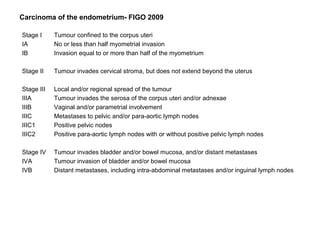
Carcinoma of the endometrium- FIGO 2009

Stage I     Tumour confined to the corpus uteri
IA          No or less than half myometrial invasion
IB          Invasion equal to or more than half of the myometrium

Stage II    Tumour invades cervical stroma, but does not extend beyond the uterus

Stage III   Local and/or regional spread of the tumour
IIIA        Tumour invades the serosa of the corpus uteri and/or adnexae
IIIB        Vaginal and/or parametrial involvement
IIIC        Metastases to pelvic and/or para-aortic lymph nodes
IIIC1       Positive pelvic nodes
IIIC2       Positive para-aortic lymph nodes with or without positive pelvic lymph nodes

Stage IV    Tumour invades bladder and/or bowel mucosa, and/or distant metastases
IVA         Tumour invasion of bladder and/or bowel mucosa
IVB         Distant metastases, including intra-abdominal metastases and/or inguinal lymph nodes
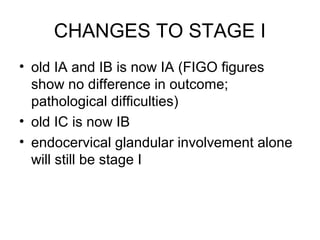
CHANGES TO STAGE I
• old IA and IB is now IA (FIGO figures
  show no difference in outcome;
  pathological difficulties)
• old IC is now IB
• endocervical glandular involvement alone
  will still be stage I
CHANGES TO STAGE II
• single category of stage II (cervical
  stromal involvement)
CHANGES TO STAGE III
• IIIA- uterine serosal or adnexal
  involvement
• IIIB- vaginal and/or parametrial
  involvement
• IIIC- pelvic and/or para-aortic nodes
  (IIIC1-pelvic nodes; IIIC2- para-aortic
  nodes)
CHANGES TO STAGE IV
• none
PERITONEAL WASHINGS
• to be performed and reported separately
  ie not part of staging system
• significance to be discussed at MDTM
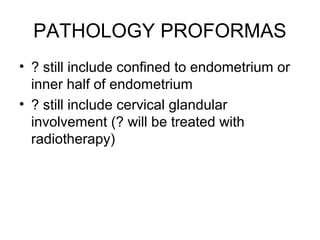
PATHOLOGY PROFORMAS
• ? still include confined to endometrium or
  inner half of endometrium
• ? still include cervical glandular
  involvement (? will be treated with
  radiotherapy)
CERVICAL CARCINOMA
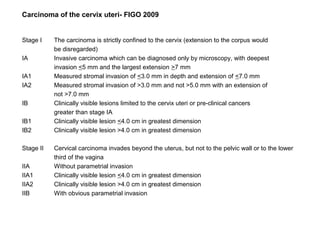
Carcinoma of the cervix uteri- FIGO 2009


Stage I    The carcinoma is strictly confined to the cervix (extension to the corpus would
           be disregarded)
IA         Invasive carcinoma which can be diagnosed only by microscopy, with deepest
           invasion <5 mm and the largest extension >7 mm
IA1        Measured stromal invasion of <3.0 mm in depth and extension of <7.0 mm
IA2        Measured stromal invasion of >3.0 mm and not >5.0 mm with an extension of
           not >7.0 mm
IB         Clinically visible lesions limited to the cervix uteri or pre-clinical cancers
           greater than stage IA
IB1        Clinically visible lesion <4.0 cm in greatest dimension
IB2        Clinically visible lesion >4.0 cm in greatest dimension

Stage II   Cervical carcinoma invades beyond the uterus, but not to the pelvic wall or to the lower
           third of the vagina
IIA        Without parametrial invasion
IIA1       Clinically visible lesion <4.0 cm in greatest dimension
IIA2       Clinically visible lesion >4.0 cm in greatest dimension
IIB        With obvious parametrial invasion
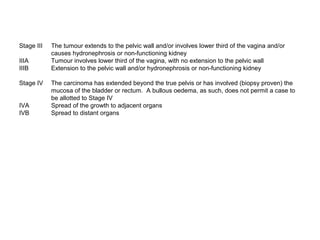
Stage III   The tumour extends to the pelvic wall and/or involves lower third of the vagina and/or
            causes hydronephrosis or non-functioning kidney
IIIA        Tumour involves lower third of the vagina, with no extension to the pelvic wall
IIIB        Extension to the pelvic wall and/or hydronephrosis or non-functioning kidney

Stage IV    The carcinoma has extended beyond the true pelvis or has involved (biopsy proven) the
            mucosa of the bladder or rectum. A bullous oedema, as such, does not permit a case to
            be allotted to Stage IV
IVA         Spread of the growth to adjacent organs
IVB         Spread to distant organs
CERVICAL CARCINOMA
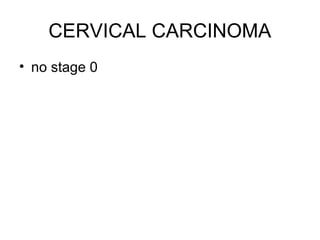
• no stage 0
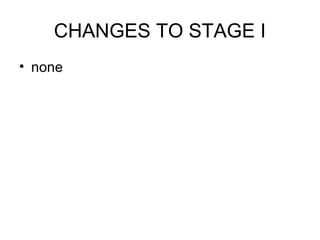
CHANGES TO STAGE I
• none
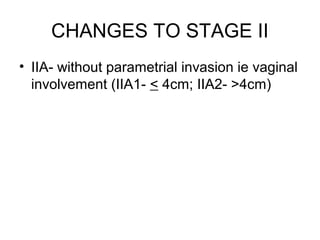
CHANGES TO STAGE II
• IIA- without parametrial invasion ie vaginal
  involvement (IIA1- < 4cm; IIA2- >4cm)
CHANGES TO STAGE III
• none
CHANGES TO STAGE IV
• none
VULVAL CARCINOMA
• MUCH MORE COMPLICATED
• significant changes
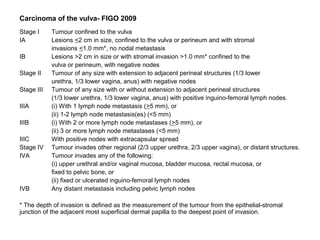
Carcinoma of the vulva- FIGO 2009
Stage I     Tumour confined to the vulva
IA          Lesions <2 cm in size, confined to the vulva or perineum and with stromal
            invasions <1.0 mm*, no nodal metastasis
IB          Lesions >2 cm in size or with stromal invasion >1.0 mm* confined to the
            vulva or perineum, with negative nodes
Stage II    Tumour of any size with extension to adjacent perineal structures (1/3 lower
            urethra, 1/3 lower vagina, anus) with negative nodes
Stage III   Tumour of any size with or without extension to adjacent perineal structures
            (1/3 lower urethra, 1/3 lower vagina, anus) with positive inguino-femoral lymph nodes.
IIIA        (i) With 1 lymph node metastasis (>5 mm), or
            (ii) 1-2 lymph node metastasis(es) (<5 mm)
IIIB        (i) With 2 or more lymph node metastases (>5 mm), or
            (ii) 3 or more lymph node metastases (<5 mm)
IIIC        With positive nodes with extracapsular spread
Stage IV    Tumour invades other regional (2/3 upper urethra, 2/3 upper vagina), or distant structures.
IVA         Tumour invades any of the following:
            (i) upper urethral and/or vaginal mucosa, bladder mucosa, rectal mucosa, or
            fixed to pelvic bone, or
            (ii) fixed or ulcerated inguino-femoral lymph nodes
IVB         Any distant metastasis including pelvic lymph nodes

* The depth of invasion is defined as the measurement of the tumour from the epithelial-stromal
junction of the adjacent most superficial dermal papilla to the deepest point of invasion.
CHANGES TO STAGE I
• IA- < 2cm, stromal invasion <1mm,
  confined to vulval or perineum, no nodal
  metastasis
• IB- previous IB and II combined- >2cm
  size or with stromal invasion >1mm,
  confined to vulval or perineum, no nodal
  metastasis
CHANGES TO STAGE II
• any size with extension to lower third of
  urethra, lower third of vagina or anus and
  negative nodes
CHANGES TO STAGE III
• any size, with or without extension to
  lower third of urethra, lower third of vagina
  or anus and positive inguino-femoral
  nodes
• IIIA- 1 nodal metastasis > 5mm or up to 2
  nodes <5mm
• IIIB- 2 or more nodes >5mm or 3 or more
  nodes <5mm
• IIIC- extracapsular spread
CHANGES TO STAGE IV
• upper two thirds of urethra or vagina or
  distant structures
• various substages
• bilateral nodal involvement now not taken
  into account
IMPLICATIONS/DIFFICULTIES
• dissemination of information to surgical oncologists,
  gynaecologists, non-surgical oncologists, pathologists,
  radiologists
• ? set start date
• endocervical glandular involvement in endometrial
  cancer (marked interobserver variation)
• pathologists difficulty in distinguishing cervical glandular
  from stromal involvement
• TNM will differ for a while- will be updated in 7th TNM
  edition (? drop TNM from pathology proformas)
WIDER QUESTIONS
• rest of UK (role of British Gynaecological
  Cancer Society, British Association of
  Gynaecological Pathologists)
• if piecemeal introduction, will create
  difficulties

Figo staging systems

  • 1.
    REVISED FIGO STAGING SYSTEMS FOR GYNAECOLOGICAL CANCERS (2009) Glenn McCluggage, Belfast Trust
  • 2.
    BACKGROUND • Groups setup several years ago • March 2009-staging system for uterine sarcomas published (IJGO 2009;104;179)- PATHOLOGICAL INPUT • May 2009-staging systems for endometrial, cervical and vulval tumours published (IJGO 2009;105;103-104)- NO PATHOLOGICAL INPUT
  • 3.
    OTHER TUMOURS • groupsset up to look at staging of ovarian, fallopian tube and trophoblastic neoplasms
  • 4.
    NEW FIGO STAGINGFOR UTERINE SARCOMAS • never had staging system previously • carcinosarcomas staged as per uterine carcinomas • staging system for leiomyosarcomas • different system for ESS and adenosarcoma
  • 5.
    Leiomyosarcomas- FIGO 2009 StageI Tumour limited to uterus IA <5 cm IB >5 cm Stage II Tumour extends to the pelvis IIA Adnexal involvement IIB Tumour extends to extrauterine pelvic tissue Stage III Tumour invades abdominal tissues (not just protruding into the abdomen) IIIA One site IIIB > one site IIIC Metastasis to pelvic and/or para-aortic lymph nodes Stage IV IVA Tumour invades bladder and/or rectum IVB Distant metastasis
  • 6.
    Endometrial stromal sarcomas(ESS) and adenosarcomas- FIGO 2009 Stage I Tumour limited to uterus IA Tumour limited to endometrium/endocervix with no myometrial invasion IB Less than or equal to half myometrial invasion IC More than half myometrial invasion Stage II Tumour extends to the pelvis IIA Adnexal involvement IIB Tumour extends to extrauterine pelvic tissue Stage III Tumour invades abdominal tissues (not just protruding into the abdomen) IIIA One site IIIB > one site IIIC Metastasis to pelvic and/or para-aortic lymph nodes Stage IV IVA Tumour invades bladder and/or rectum IVB Distant metastasis
  • 7.
  • 8.
    Carcinoma of theendometrium- FIGO 2009 Stage I Tumour confined to the corpus uteri IA No or less than half myometrial invasion IB Invasion equal to or more than half of the myometrium Stage II Tumour invades cervical stroma, but does not extend beyond the uterus Stage III Local and/or regional spread of the tumour IIIA Tumour invades the serosa of the corpus uteri and/or adnexae IIIB Vaginal and/or parametrial involvement IIIC Metastases to pelvic and/or para-aortic lymph nodes IIIC1 Positive pelvic nodes IIIC2 Positive para-aortic lymph nodes with or without positive pelvic lymph nodes Stage IV Tumour invades bladder and/or bowel mucosa, and/or distant metastases IVA Tumour invasion of bladder and/or bowel mucosa IVB Distant metastases, including intra-abdominal metastases and/or inguinal lymph nodes
  • 9.
    CHANGES TO STAGEI • old IA and IB is now IA (FIGO figures show no difference in outcome; pathological difficulties) • old IC is now IB • endocervical glandular involvement alone will still be stage I
  • 10.
    CHANGES TO STAGEII • single category of stage II (cervical stromal involvement)
  • 11.
    CHANGES TO STAGEIII • IIIA- uterine serosal or adnexal involvement • IIIB- vaginal and/or parametrial involvement • IIIC- pelvic and/or para-aortic nodes (IIIC1-pelvic nodes; IIIC2- para-aortic nodes)
  • 12.
    CHANGES TO STAGEIV • none
  • 13.
    PERITONEAL WASHINGS • tobe performed and reported separately ie not part of staging system • significance to be discussed at MDTM
  • 15.
    PATHOLOGY PROFORMAS • ?still include confined to endometrium or inner half of endometrium • ? still include cervical glandular involvement (? will be treated with radiotherapy)
  • 16.
  • 17.
    Carcinoma of thecervix uteri- FIGO 2009 Stage I The carcinoma is strictly confined to the cervix (extension to the corpus would be disregarded) IA Invasive carcinoma which can be diagnosed only by microscopy, with deepest invasion <5 mm and the largest extension >7 mm IA1 Measured stromal invasion of <3.0 mm in depth and extension of <7.0 mm IA2 Measured stromal invasion of >3.0 mm and not >5.0 mm with an extension of not >7.0 mm IB Clinically visible lesions limited to the cervix uteri or pre-clinical cancers greater than stage IA IB1 Clinically visible lesion <4.0 cm in greatest dimension IB2 Clinically visible lesion >4.0 cm in greatest dimension Stage II Cervical carcinoma invades beyond the uterus, but not to the pelvic wall or to the lower third of the vagina IIA Without parametrial invasion IIA1 Clinically visible lesion <4.0 cm in greatest dimension IIA2 Clinically visible lesion >4.0 cm in greatest dimension IIB With obvious parametrial invasion
  • 18.
    Stage III The tumour extends to the pelvic wall and/or involves lower third of the vagina and/or causes hydronephrosis or non-functioning kidney IIIA Tumour involves lower third of the vagina, with no extension to the pelvic wall IIIB Extension to the pelvic wall and/or hydronephrosis or non-functioning kidney Stage IV The carcinoma has extended beyond the true pelvis or has involved (biopsy proven) the mucosa of the bladder or rectum. A bullous oedema, as such, does not permit a case to be allotted to Stage IV IVA Spread of the growth to adjacent organs IVB Spread to distant organs
  • 19.
  • 20.
    CHANGES TO STAGEI • none
  • 21.
    CHANGES TO STAGEII • IIA- without parametrial invasion ie vaginal involvement (IIA1- < 4cm; IIA2- >4cm)
  • 22.
    CHANGES TO STAGEIII • none
  • 23.
    CHANGES TO STAGEIV • none
  • 24.
    VULVAL CARCINOMA • MUCHMORE COMPLICATED • significant changes
  • 25.
    Carcinoma of thevulva- FIGO 2009 Stage I Tumour confined to the vulva IA Lesions <2 cm in size, confined to the vulva or perineum and with stromal invasions <1.0 mm*, no nodal metastasis IB Lesions >2 cm in size or with stromal invasion >1.0 mm* confined to the vulva or perineum, with negative nodes Stage II Tumour of any size with extension to adjacent perineal structures (1/3 lower urethra, 1/3 lower vagina, anus) with negative nodes Stage III Tumour of any size with or without extension to adjacent perineal structures (1/3 lower urethra, 1/3 lower vagina, anus) with positive inguino-femoral lymph nodes. IIIA (i) With 1 lymph node metastasis (>5 mm), or (ii) 1-2 lymph node metastasis(es) (<5 mm) IIIB (i) With 2 or more lymph node metastases (>5 mm), or (ii) 3 or more lymph node metastases (<5 mm) IIIC With positive nodes with extracapsular spread Stage IV Tumour invades other regional (2/3 upper urethra, 2/3 upper vagina), or distant structures. IVA Tumour invades any of the following: (i) upper urethral and/or vaginal mucosa, bladder mucosa, rectal mucosa, or fixed to pelvic bone, or (ii) fixed or ulcerated inguino-femoral lymph nodes IVB Any distant metastasis including pelvic lymph nodes * The depth of invasion is defined as the measurement of the tumour from the epithelial-stromal junction of the adjacent most superficial dermal papilla to the deepest point of invasion.
  • 26.
    CHANGES TO STAGEI • IA- < 2cm, stromal invasion <1mm, confined to vulval or perineum, no nodal metastasis • IB- previous IB and II combined- >2cm size or with stromal invasion >1mm, confined to vulval or perineum, no nodal metastasis
  • 27.
    CHANGES TO STAGEII • any size with extension to lower third of urethra, lower third of vagina or anus and negative nodes
  • 28.
    CHANGES TO STAGEIII • any size, with or without extension to lower third of urethra, lower third of vagina or anus and positive inguino-femoral nodes • IIIA- 1 nodal metastasis > 5mm or up to 2 nodes <5mm • IIIB- 2 or more nodes >5mm or 3 or more nodes <5mm • IIIC- extracapsular spread
  • 29.
    CHANGES TO STAGEIV • upper two thirds of urethra or vagina or distant structures • various substages • bilateral nodal involvement now not taken into account
  • 30.
    IMPLICATIONS/DIFFICULTIES • dissemination ofinformation to surgical oncologists, gynaecologists, non-surgical oncologists, pathologists, radiologists • ? set start date • endocervical glandular involvement in endometrial cancer (marked interobserver variation) • pathologists difficulty in distinguishing cervical glandular from stromal involvement • TNM will differ for a while- will be updated in 7th TNM edition (? drop TNM from pathology proformas)
  • 31.
    WIDER QUESTIONS • restof UK (role of British Gynaecological Cancer Society, British Association of Gynaecological Pathologists) • if piecemeal introduction, will create difficulties