
















DEVELOPMENT AND VALIDATION  OF ONLINE INSTRUCTIONAL  MODULES FOR COLLEGE  ENGLISH  Arlene Salve Opina, Ph.D.
What is online  teaching  and learning? Online teaching and learning, or eLearning, is teaching and learning using technology and internet.  It is utilized in face-to-face classrooms and in distance education.  It can be used to extend the teaching and learning day. It can be teaching and learning anytime, anywhere.
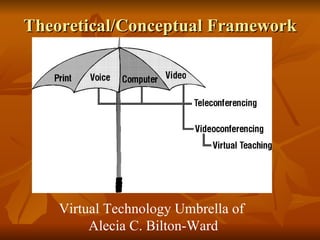
Theoretical/Conceptual Framework Virtual Technology Umbrella of  Alecia C. Bilton-Ward
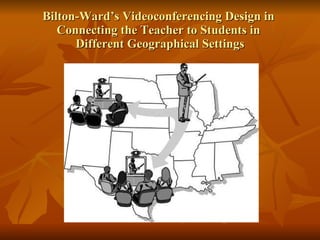
Bilton-Ward’s Videoconferencing Design in  Connecting the Teacher to Students in  Different Geographical Settings
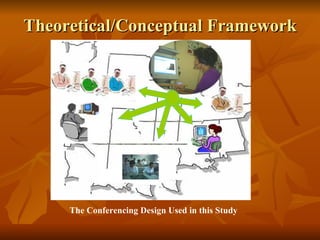
Theoretical/Conceptual Framework The Conferencing Design Used in this Study
Methods and Procedure Experimental Descriptive Survey
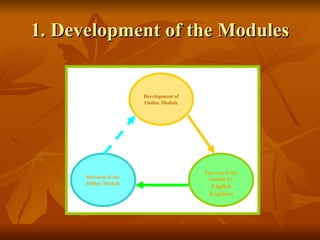
1. Development of the Modules Revision of the Online Module Development   of Online Module Test run of the module by  English Teachers
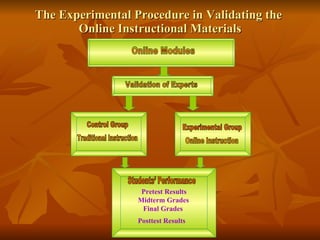
The Experimental Procedure in Validating the  Online Instructional Materials Online Modules Validation of Experts Control Group Traditional Instruction Experimental Group Online Instruction Pretest Results Midterm Grades Final Grades Posttest Results   Students’ Performance
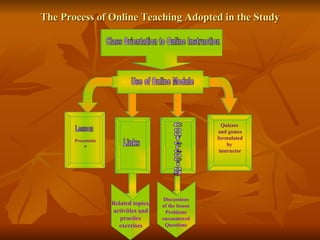
The Process of Online Teaching Adopted in the Study Quizzes  and games formulated by  instructor Class Orientation to Online Instruction Use of Online Module Presentation Lesson Links Conferencing Related topics, activities and practice exercises Discussions of the lesson Problems encountered Questions Class Orientation to Online Instruction Use of Online Module Presentation Lesson Links Conferencing Quizzes  and games formulated by  instructor
2. Creating a virtual Class and Uploading the modules www.quia.com www.nicenet.org www.slideshare.net http://trackstar.4teachers.org/ www.quizmoz.com/
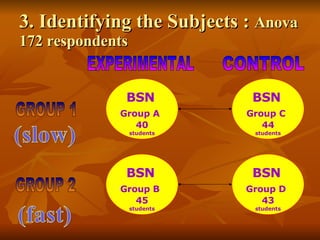
3. Identifying the Subjects :  Anova 172 respondents BSN   Group A   40 students GROUP 1 GROUP 2 EXPERIMENTAL CONTROL BSN   Group C   44 students BSN   Group B   45 students BSN   Group D   43 students
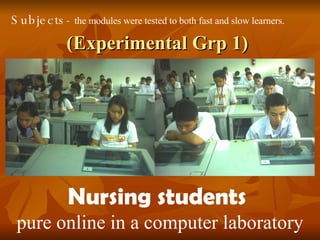
(Experimental Grp 1) Nursing students  pure online in a computer laboratory Subjects-  the modules were tested to both fast and slow learners.
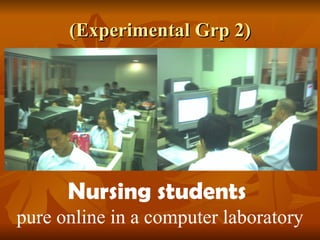
(Experimental Grp 2) Nursing students  pure online in a computer laboratory
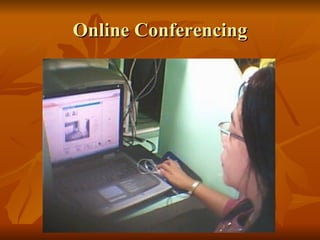
Online Conferencing
Control Group  2 nursing sections Used Traditional Textbook In their respective classroom
 
 
Treatment of Data ANOVA –  to identify which classes become the experimental and control groups.  percentage, arithmetic mean and standard deviations –  to describe the profile and performances of the subjects linear correlation –  to test for the reliability of the questionnaire Likert Scale –  to assess the Instructional modules   t-test for independent population –  to compare the performance of the experimental and control groups) The data of this research were statistically processed by the CEU Evaluation and Data Processing Department.
Summary of Findings 1.  Profile of the subjects in terms of: Type of high school graduated from private sectarian high school.   Language spoken at home Filipino  Filipino and English Ilocano, Visayan, Bicolano   Chinese
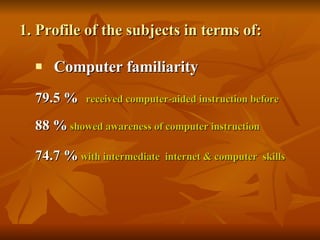
1. Profile of the subjects in terms of: Computer familiarity 79.5 %   received computer-aided instruction before  88 %   showed awareness of computer instruction   74.7 %   with intermediate  internet & computer  skills
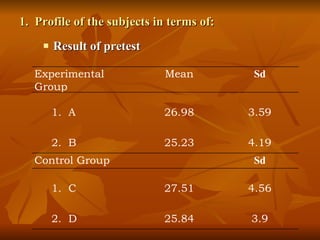
1.  Profile of the subjects in terms of: Result of pretest Experimental Group  Mean Sd 1.  A 26.98 3.59 2.  B 25.23 4.19 Control Group Sd 1.  C 27.51 4.56 2.  D 25.84 3.9
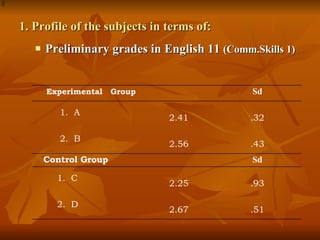
Preliminary grades in English 11  (Comm.Skills 1) 1. Profile of the subjects in terms of: Experimental  Group Sd 1.  A 2.41 .32 2.  B 2.56 .43 Control Group Sd 1.  C 2.25 .93 2.  D 2.67 .51
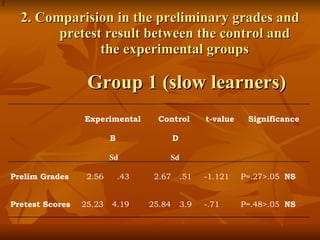
2. Comparision in the preliminary grades and pretest result between the control and the experimental groups Group 1 (slow learners) Experimental B Sd Control D Sd t-value Significance Prelim Grades 2.56 .43 2.67 .51 -1.121 P=.27>.05  NS Pretest Scores 25.23 4.19 25.84 3.9 -.71 P=.48>.05  NS
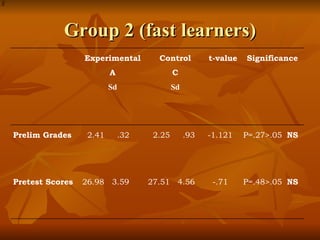
Group 2 (fast learners) Experimental A Sd Control C Sd t-value Significance Prelim Grades 2.41 .32 2.25 .93 -1.121 P=.27>.05  NS Pretest Scores 26.98 3.59 27.51 4.56 -.71 P=.48>.05  NS
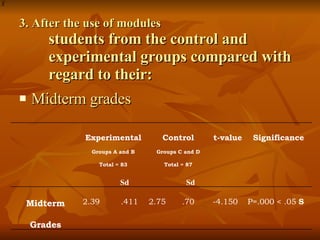
3. After the use of modules students from the control and experimental groups compared with regard to their: Midterm grades Experimental Groups A and B Total = 83 Sd Control Groups C and D Total = 87 Sd t-value Significance Midterm Grades 2.39 .411 2.75 .70 -4.150 P=.000 < .05  S
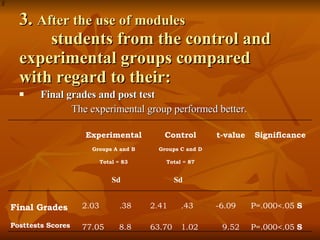
3.  After the use of modules students from the control and  experimental groups compared  with regard to their: Final grades and post test The experimental group performed better. Experimental Groups A and B Total = 83 Sd Control Groups C and D Total = 87 Sd t-value Significance Final Grades 2.03 .38 2.41 .43 -6.09 P=.000<.05  S Posttests Scores 77.05 8.8 63.70 1.02 9.52 P=.000<.05  S
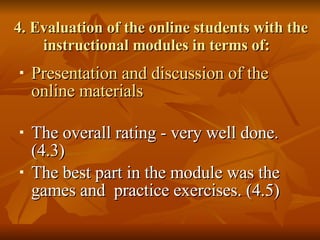
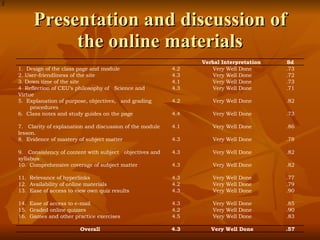
4. Evaluation of the online students with the instructional modules in terms of: Presentation and discussion of the online materials The overall rating - very well done. (4.3) The best part in the module was the games and  practice exercises. (4.5)
Presentation and discussion of the online materials Verbal Interpretation  Sd 1.  Design of the class page and module 4.2 Very Well Done .73 2. User-friendliness of the site 4.3 Very Well Done .72 3. Down time of the site 4.1 Very Well Done .73 4  Reflection of CEU’s philosophy of  Science and Virtue 4.3 Very Well Done .71 5.  Explanation of purpose, objectives,  and grading procedures 4.2 Very Well Done .82 6.  Class notes and study guides on the page 4.4 Very Well Done .73 7.  Clarity of explanation and discussion of the module lesson. 4.1 Very Well Done .86 8.  Evidence of mastery of subject matter 4.3 Very Well Done .78 9.  Consistency of content with subject  objectives and syllabus 4.3 Very Well Done .82 10.  Comprehensive coverage of subject matter 4.3 Very Well Done .82 11.  Relevance of hyperlinks 4.3 Very Well Done .77 12.  Availability of online materials 4.2 Very Well Done .79 13.  Ease of access to view own quiz results 4.3 Very Well Done .90 14.  Ease of access to e-mail 4.3 Very Well Done .85 15.  Graded online quizzes 4.2 Very Well Done .90 16.  Games and other practice exercises 4.5 Very Well Done .83 Overall 4.3 Very Well Done .57
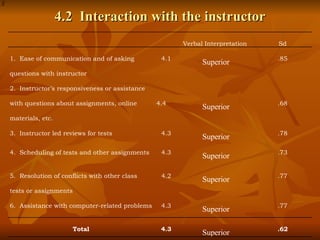
4. How did the online students evaluate their virtual experience with  the instructional modules in terms of: 4.2  Interaction with the instructor The overall rating -  superior
4.2  Interaction with the instructor Verbal Interpretation  Sd 1.  Ease of communication and of asking questions with instructor 4.1 Superior .85 2.  Instructor’s responsiveness or assistance with questions about assignments, online materials, etc. 4.4  Superior .68 3.  Instructor led reviews for tests 4.3 Superior .78 4.  Scheduling of tests and other assignments 4.3 Superior .73 5.  Resolution of conflicts with other class tests or assignments 4.2 Superior .77 6.  Assistance with computer-related problems 4.3 Superior .77 Total 4.3 Superior .62
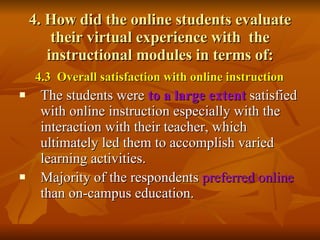
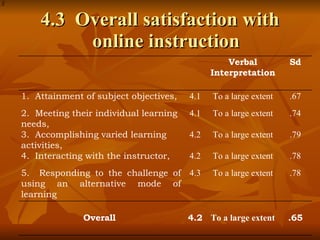
4. How did the online students evaluate their virtual experience with  the instructional modules in terms of: 4.3  Overall satisfaction with online instruction The students were  to a large extent   satisfied with online instruction especially with the interaction with their teacher, which ultimately led them to accomplish varied learning activities.  Majority of the respondents  preferred online  than on-campus education.
4.3  Overall satisfaction with online instruction Verbal Interpretation  Sd 1.  Attainment of subject objectives, 4.1 To a large extent .67 2.  Meeting their individual learning  needs, 4.1 To a large extent .74 3.  Accomplishing varied learning activities, 4.2 To a large extent .79 4.  Interacting with the instructor, 4.2 To a large extent .78 5.  Responding to the challenge of using an alternative mode of learning 4.3 To a large extent .78 Overall  4.2 To a large extent .65
Conclusions Online teaching is a competitive alternative for the traditional classroom education.
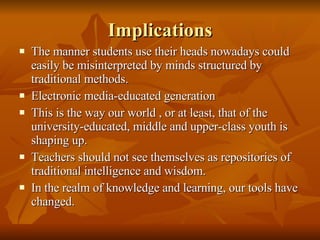
Implications The manner students use their heads nowadays could easily be misinterpreted by minds structured by traditional methods. Electronic media-educated generation This is the way our world , or at least, that of the university-educated, middle and upper-class youth is shaping up. Teachers should not see themselves as repositories of traditional intelligence and wisdom. In the realm of knowledge and learning, our tools have changed.
Whether we, as adults and educators, like the differences we see in today's students, the differences are undeniable and, as educators, it is our responsibility to reach and teach this &quot;new breed” of students.  In the realm of knowledge and learning, our tools have changed. Teaching online, using the very technology that has changed our world, and our students, is one significant way that we can leverage to reach the &quot;Net generation.&quot;
Conclusions Online games, quizzes, and exercises are innovations in reinforcing the lesson.
Technology Technology will become a billion times more powerful, likely more powerful than the human brain.  Technology will serve our students and children better in 20 years – memorized multiplication tables or fundamental knowledge of programming concepts or the ability to think logically and critically or the ability to create meaningfully in multimedia.
Conclusions    Success in online learning depends on strict compliance of time table and schedule and regular interaction with teacher.
Conclusions For online materials to effectively address students’ needs, they should contain all the required sources for learning including objectives, instruction, format, dynamics, and evaluation.
Conclusions In addition, students with convenient access to computer and internet, and at the same time with motivation, and self-discipline to participate regularly, are most likely to succeed.
Conclusions Modules with graphic presentations are attractive designs in enhancing students’ attention.
Recommendations The development of online materials for other subjects (professional or basic) may upgrade the university’s delivery of education. The reinforcement of lesson discussed, through games whether online or traditional can be integrated to heighten students’ interest in learning any subject. The conduct of similar study will validate other modules of various subjects.
Recommendations The various freesites available in the internet can be combined for the development of online modules and quizzes in all courses. Another study involving school’s facilities and teachers’ preparedness for online education can give insight to the administration for future undertaking.
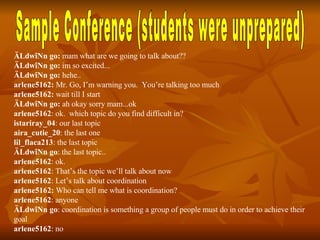
Sample Conference (students were unprepared) ÄLdwîNn go:  mam what are we going to talk about?? ÄLdwîNn go:  im so excited... ÄLdwîNn go:  hehe.. arlene5162:  Mr. Go, I’m warning you.  You’re talking too much arlene5162:  wait till I start ÄLdwîNn go:  ah okay sorry mam...ok arlene5162 : ok.  which topic do you find difficult in? istariray_04 : our last topic aira_cutie_20 : the last one lil_flaca213 : the last topic ÄLdwîNn go : the last topic.. arlene5162 : ok.  arlene5162 : That’s the topic we’ll talk about now arlene5162 : Let’s talk about coordination arlene5162:  Who can tell me what is coordination? arlene5162 : anyone ÄLdwîNn go : coordination is something a group of people must do in order to achieve their goal arlene5162 : no
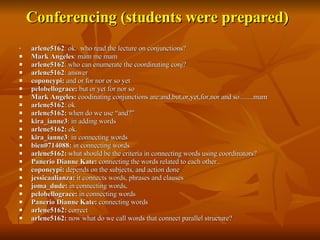
Conferencing (students were prepared) arlene5162 : ok.  who read the lecture on conjunctions? Mark Angeles : mam me mam arlene5162 : who can enumerate the coordinating conj? arlene5162 : answer coponeypi:  and or for nor or so yet pelobellograce:  but or yet for nor so  Mark Angeles:  coodinating conjunctions are:and,but,or,yet,for,nor and so........mam arlene5162 : ok arlene5162:  when do we use “and?” kira_ianne3 : in adding words arlene5162:  ok. kira_ianne3 : in connecting words bien0714088:  in connecting words arlene5162:  what should be the criteria in connecting words using coordinators? Panerio Dianne Kate:  connecting the words related to each other.. coponeypi:  depends on the subjects, and action done jessicaalianza:  it connects words, phrases and clauses joma_dude:  in connecting words, pelobellograce:  in connecting words Panerio Dianne Kate:  connecting words   arlene5162:  correct arlene5162:  now what do we call words that connect parallel structure?
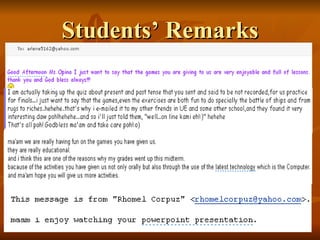
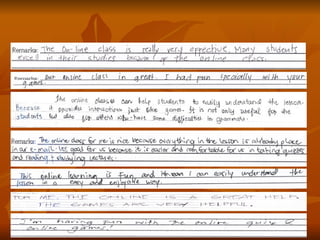
Students’ Remarks
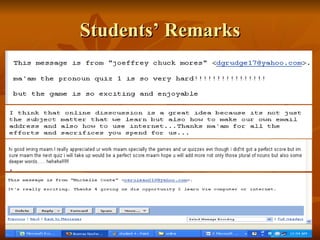
Students’ Remarks
 
 
Video Presentation
Online Movie http://www.youtube.com/watch?v=2SUQeJyghh0
Resource sites for teachers Virtual classrooms: www.nicenet.org www.quia.com http://trackstar.4teachers.org http://wizard.4teachers.org
Resource sites for teachers Creation of quizzes: www.quia.com   www.quizmoz.com http://quizstar.4teachers.org/ www.quizilla.com http://schoolexpress.com/quiz/quiz01.php http://rubistar.4teachers.org/index.php
Support sites http://makeworksheets.com/ http://www.elllo.org/english/home.htm http://www.eleaston.com/pr/home.html http://www.public-speaking.org/default.htm http://www.mes-english.com/ http://www.usingenglish.com/teachers.html http://www.schoolexpress.com/ http://www.teachingheart.net/readerstheater.htm http://www.funbrain.com/brain/SweepsBrain/sweepsbrain.html http://www.tolearnenglish.com/cgi2/myexam/liaison.php?liaison=_audio_alphabet_video_&id=17819&auteur=webmaster http://www.tolearnenglish.com/
Support sites http://www.clicknkids.com/SampleLessonSelf.asp http://www.toolsforeducators.com/ http://www.sparklebox.co.uk/ http://www.free-clipart-pictures.net/ http://www.teacherplanet.com/calendar /09-SEP-08.htm http://www.songsforteaching.com/ http://www.cliparthome.net/ http://abcteach.com/ http://www.topenglishteaching.com/
Support sites http://www.englisch-hilfen.de/en/index.htm http://www.primarygames.com/ http://www.tlsbooks.com/ http://www.gamequarium.com/ http://www.50states.com/ http://notestar.4teachers.org/ http://rubistar.4teachers.org/index.php http://www.arcademicskillbuilders.com/ http://persuadestar.4teachers.org/ http://classroom.4teachers.org/ http://equity.4teachers.org/index.php http://thinktank.4teachers.org/ http://pblchecklist.4teachers.org/
Best sites for reviews  (Literature and studies) www.findarticles.com http://journals.cambrige.org http://muse.jhu.edu./journals/index.html www.doaj.org www.sciencedirect.com http://journalseek.net/ http://ssrn.com http://www3.interscience.wiley.com www.e-journal.org/ http://www.eduref.org/ www.scrius.com http://ejournals.ebsco.com http://www.scre.ac.uk/is/webjournals.html http://www.proquest.com http://www.ingentaconnect.com http://www.springer.com/east/home
MetaSearch and Metacrawler Engines http://www.metacrawler.com/ http://webcrawler.com http://www.seach.com www.dogpile.com http://vivisimo.com/ http://www.mamhttp://www.tlsbooks.com/ma.com http://www.kartoo.com/ http://www.surfwax.com http://www.info.com http://www.izito.com/ http://www.jux2.com/
Salamat po Thank you Jakarta, Indonesia, November 8-9, 2008 (Asia Pacific Computer-Aided Language Learning Pusan, Korea – April 10-11, 2009 (Asian English as a Foreign Language) Also presented:

Online Powerpoint2

  • 1.
    DEVELOPMENT AND VALIDATION OF ONLINE INSTRUCTIONAL MODULES FOR COLLEGE ENGLISH Arlene Salve Opina, Ph.D.
  • 2.
    What is online teaching and learning? Online teaching and learning, or eLearning, is teaching and learning using technology and internet. It is utilized in face-to-face classrooms and in distance education. It can be used to extend the teaching and learning day. It can be teaching and learning anytime, anywhere.
  • 3.
    Theoretical/Conceptual Framework VirtualTechnology Umbrella of Alecia C. Bilton-Ward
  • 4.
    Bilton-Ward’s Videoconferencing Designin Connecting the Teacher to Students in Different Geographical Settings
  • 5.
    Theoretical/Conceptual Framework TheConferencing Design Used in this Study
  • 6.
    Methods and ProcedureExperimental Descriptive Survey
  • 7.
    1. Development ofthe Modules Revision of the Online Module Development of Online Module Test run of the module by English Teachers
  • 8.
    The Experimental Procedurein Validating the Online Instructional Materials Online Modules Validation of Experts Control Group Traditional Instruction Experimental Group Online Instruction Pretest Results Midterm Grades Final Grades Posttest Results Students’ Performance
  • 9.
    The Process ofOnline Teaching Adopted in the Study Quizzes and games formulated by instructor Class Orientation to Online Instruction Use of Online Module Presentation Lesson Links Conferencing Related topics, activities and practice exercises Discussions of the lesson Problems encountered Questions Class Orientation to Online Instruction Use of Online Module Presentation Lesson Links Conferencing Quizzes and games formulated by instructor
  • 10.
    2. Creating avirtual Class and Uploading the modules www.quia.com www.nicenet.org www.slideshare.net http://trackstar.4teachers.org/ www.quizmoz.com/
  • 11.
    3. Identifying theSubjects : Anova 172 respondents BSN Group A 40 students GROUP 1 GROUP 2 EXPERIMENTAL CONTROL BSN Group C 44 students BSN Group B 45 students BSN Group D 43 students
  • 12.
    (Experimental Grp 1)Nursing students pure online in a computer laboratory Subjects- the modules were tested to both fast and slow learners.
  • 13.
    (Experimental Grp 2)Nursing students pure online in a computer laboratory
  • 14.
  • 15.
    Control Group 2 nursing sections Used Traditional Textbook In their respective classroom
  • 16.
  • 17.
  • 18.
    Treatment of DataANOVA – to identify which classes become the experimental and control groups. percentage, arithmetic mean and standard deviations – to describe the profile and performances of the subjects linear correlation – to test for the reliability of the questionnaire Likert Scale – to assess the Instructional modules t-test for independent population – to compare the performance of the experimental and control groups) The data of this research were statistically processed by the CEU Evaluation and Data Processing Department.
  • 19.
    Summary of Findings1. Profile of the subjects in terms of: Type of high school graduated from private sectarian high school. Language spoken at home Filipino Filipino and English Ilocano, Visayan, Bicolano Chinese
  • 20.
    1. Profile ofthe subjects in terms of: Computer familiarity 79.5 % received computer-aided instruction before 88 % showed awareness of computer instruction 74.7 % with intermediate internet & computer skills
  • 21.
    1. Profileof the subjects in terms of: Result of pretest Experimental Group Mean Sd 1. A 26.98 3.59 2. B 25.23 4.19 Control Group Sd 1. C 27.51 4.56 2. D 25.84 3.9
  • 22.
    Preliminary grades inEnglish 11 (Comm.Skills 1) 1. Profile of the subjects in terms of: Experimental Group Sd 1. A 2.41 .32 2. B 2.56 .43 Control Group Sd 1. C 2.25 .93 2. D 2.67 .51
  • 23.
    2. Comparision inthe preliminary grades and pretest result between the control and the experimental groups Group 1 (slow learners) Experimental B Sd Control D Sd t-value Significance Prelim Grades 2.56 .43 2.67 .51 -1.121 P=.27>.05 NS Pretest Scores 25.23 4.19 25.84 3.9 -.71 P=.48>.05 NS
  • 24.
    Group 2 (fastlearners) Experimental A Sd Control C Sd t-value Significance Prelim Grades 2.41 .32 2.25 .93 -1.121 P=.27>.05 NS Pretest Scores 26.98 3.59 27.51 4.56 -.71 P=.48>.05 NS
  • 25.
    3. After theuse of modules students from the control and experimental groups compared with regard to their: Midterm grades Experimental Groups A and B Total = 83 Sd Control Groups C and D Total = 87 Sd t-value Significance Midterm Grades 2.39 .411 2.75 .70 -4.150 P=.000 < .05 S
  • 26.
    3. Afterthe use of modules students from the control and experimental groups compared with regard to their: Final grades and post test The experimental group performed better. Experimental Groups A and B Total = 83 Sd Control Groups C and D Total = 87 Sd t-value Significance Final Grades 2.03 .38 2.41 .43 -6.09 P=.000<.05 S Posttests Scores 77.05 8.8 63.70 1.02 9.52 P=.000<.05 S
  • 27.
    4. Evaluation ofthe online students with the instructional modules in terms of: Presentation and discussion of the online materials The overall rating - very well done. (4.3) The best part in the module was the games and practice exercises. (4.5)
  • 28.
    Presentation and discussionof the online materials Verbal Interpretation Sd 1. Design of the class page and module 4.2 Very Well Done .73 2. User-friendliness of the site 4.3 Very Well Done .72 3. Down time of the site 4.1 Very Well Done .73 4 Reflection of CEU’s philosophy of Science and Virtue 4.3 Very Well Done .71 5. Explanation of purpose, objectives, and grading procedures 4.2 Very Well Done .82 6. Class notes and study guides on the page 4.4 Very Well Done .73 7. Clarity of explanation and discussion of the module lesson. 4.1 Very Well Done .86 8. Evidence of mastery of subject matter 4.3 Very Well Done .78 9. Consistency of content with subject objectives and syllabus 4.3 Very Well Done .82 10. Comprehensive coverage of subject matter 4.3 Very Well Done .82 11. Relevance of hyperlinks 4.3 Very Well Done .77 12. Availability of online materials 4.2 Very Well Done .79 13. Ease of access to view own quiz results 4.3 Very Well Done .90 14. Ease of access to e-mail 4.3 Very Well Done .85 15. Graded online quizzes 4.2 Very Well Done .90 16. Games and other practice exercises 4.5 Very Well Done .83 Overall 4.3 Very Well Done .57
  • 29.
    4. How didthe online students evaluate their virtual experience with the instructional modules in terms of: 4.2 Interaction with the instructor The overall rating - superior
  • 30.
    4.2 Interactionwith the instructor Verbal Interpretation Sd 1. Ease of communication and of asking questions with instructor 4.1 Superior .85 2. Instructor’s responsiveness or assistance with questions about assignments, online materials, etc. 4.4 Superior .68 3. Instructor led reviews for tests 4.3 Superior .78 4. Scheduling of tests and other assignments 4.3 Superior .73 5. Resolution of conflicts with other class tests or assignments 4.2 Superior .77 6. Assistance with computer-related problems 4.3 Superior .77 Total 4.3 Superior .62
  • 31.
    4. How didthe online students evaluate their virtual experience with the instructional modules in terms of: 4.3 Overall satisfaction with online instruction The students were to a large extent satisfied with online instruction especially with the interaction with their teacher, which ultimately led them to accomplish varied learning activities. Majority of the respondents preferred online than on-campus education.
  • 32.
    4.3 Overallsatisfaction with online instruction Verbal Interpretation Sd 1. Attainment of subject objectives, 4.1 To a large extent .67 2. Meeting their individual learning needs, 4.1 To a large extent .74 3. Accomplishing varied learning activities, 4.2 To a large extent .79 4. Interacting with the instructor, 4.2 To a large extent .78 5. Responding to the challenge of using an alternative mode of learning 4.3 To a large extent .78 Overall 4.2 To a large extent .65
  • 33.
    Conclusions Online teachingis a competitive alternative for the traditional classroom education.
  • 34.
    Implications The mannerstudents use their heads nowadays could easily be misinterpreted by minds structured by traditional methods. Electronic media-educated generation This is the way our world , or at least, that of the university-educated, middle and upper-class youth is shaping up. Teachers should not see themselves as repositories of traditional intelligence and wisdom. In the realm of knowledge and learning, our tools have changed.
  • 35.
    Whether we, asadults and educators, like the differences we see in today's students, the differences are undeniable and, as educators, it is our responsibility to reach and teach this &quot;new breed” of students. In the realm of knowledge and learning, our tools have changed. Teaching online, using the very technology that has changed our world, and our students, is one significant way that we can leverage to reach the &quot;Net generation.&quot;
  • 36.
    Conclusions Online games,quizzes, and exercises are innovations in reinforcing the lesson.
  • 37.
    Technology Technology willbecome a billion times more powerful, likely more powerful than the human brain. Technology will serve our students and children better in 20 years – memorized multiplication tables or fundamental knowledge of programming concepts or the ability to think logically and critically or the ability to create meaningfully in multimedia.
  • 38.
    Conclusions   Success in online learning depends on strict compliance of time table and schedule and regular interaction with teacher.
  • 39.
    Conclusions For onlinematerials to effectively address students’ needs, they should contain all the required sources for learning including objectives, instruction, format, dynamics, and evaluation.
  • 40.
    Conclusions In addition,students with convenient access to computer and internet, and at the same time with motivation, and self-discipline to participate regularly, are most likely to succeed.
  • 41.
    Conclusions Modules withgraphic presentations are attractive designs in enhancing students’ attention.
  • 42.
    Recommendations The developmentof online materials for other subjects (professional or basic) may upgrade the university’s delivery of education. The reinforcement of lesson discussed, through games whether online or traditional can be integrated to heighten students’ interest in learning any subject. The conduct of similar study will validate other modules of various subjects.
  • 43.
    Recommendations The variousfreesites available in the internet can be combined for the development of online modules and quizzes in all courses. Another study involving school’s facilities and teachers’ preparedness for online education can give insight to the administration for future undertaking.
  • 44.
    Sample Conference (studentswere unprepared) ÄLdwîNn go: mam what are we going to talk about?? ÄLdwîNn go: im so excited... ÄLdwîNn go: hehe.. arlene5162: Mr. Go, I’m warning you. You’re talking too much arlene5162: wait till I start ÄLdwîNn go: ah okay sorry mam...ok arlene5162 : ok. which topic do you find difficult in? istariray_04 : our last topic aira_cutie_20 : the last one lil_flaca213 : the last topic ÄLdwîNn go : the last topic.. arlene5162 : ok. arlene5162 : That’s the topic we’ll talk about now arlene5162 : Let’s talk about coordination arlene5162: Who can tell me what is coordination? arlene5162 : anyone ÄLdwîNn go : coordination is something a group of people must do in order to achieve their goal arlene5162 : no
  • 45.
    Conferencing (students wereprepared) arlene5162 : ok. who read the lecture on conjunctions? Mark Angeles : mam me mam arlene5162 : who can enumerate the coordinating conj? arlene5162 : answer coponeypi: and or for nor or so yet pelobellograce: but or yet for nor so Mark Angeles: coodinating conjunctions are:and,but,or,yet,for,nor and so........mam arlene5162 : ok arlene5162: when do we use “and?” kira_ianne3 : in adding words arlene5162: ok. kira_ianne3 : in connecting words bien0714088: in connecting words arlene5162: what should be the criteria in connecting words using coordinators? Panerio Dianne Kate: connecting the words related to each other.. coponeypi: depends on the subjects, and action done jessicaalianza: it connects words, phrases and clauses joma_dude: in connecting words, pelobellograce: in connecting words Panerio Dianne Kate: connecting words arlene5162: correct arlene5162: now what do we call words that connect parallel structure?
  • 46.
  • 47.
  • 48.
  • 49.
  • 50.
  • 51.
  • 52.
    Resource sites forteachers Virtual classrooms: www.nicenet.org www.quia.com http://trackstar.4teachers.org http://wizard.4teachers.org
  • 53.
    Resource sites forteachers Creation of quizzes: www.quia.com www.quizmoz.com http://quizstar.4teachers.org/ www.quizilla.com http://schoolexpress.com/quiz/quiz01.php http://rubistar.4teachers.org/index.php
  • 54.
    Support sites http://makeworksheets.com/http://www.elllo.org/english/home.htm http://www.eleaston.com/pr/home.html http://www.public-speaking.org/default.htm http://www.mes-english.com/ http://www.usingenglish.com/teachers.html http://www.schoolexpress.com/ http://www.teachingheart.net/readerstheater.htm http://www.funbrain.com/brain/SweepsBrain/sweepsbrain.html http://www.tolearnenglish.com/cgi2/myexam/liaison.php?liaison=_audio_alphabet_video_&id=17819&auteur=webmaster http://www.tolearnenglish.com/
  • 55.
    Support sites http://www.clicknkids.com/SampleLessonSelf.asphttp://www.toolsforeducators.com/ http://www.sparklebox.co.uk/ http://www.free-clipart-pictures.net/ http://www.teacherplanet.com/calendar /09-SEP-08.htm http://www.songsforteaching.com/ http://www.cliparthome.net/ http://abcteach.com/ http://www.topenglishteaching.com/
  • 56.
    Support sites http://www.englisch-hilfen.de/en/index.htmhttp://www.primarygames.com/ http://www.tlsbooks.com/ http://www.gamequarium.com/ http://www.50states.com/ http://notestar.4teachers.org/ http://rubistar.4teachers.org/index.php http://www.arcademicskillbuilders.com/ http://persuadestar.4teachers.org/ http://classroom.4teachers.org/ http://equity.4teachers.org/index.php http://thinktank.4teachers.org/ http://pblchecklist.4teachers.org/
  • 57.
    Best sites forreviews (Literature and studies) www.findarticles.com http://journals.cambrige.org http://muse.jhu.edu./journals/index.html www.doaj.org www.sciencedirect.com http://journalseek.net/ http://ssrn.com http://www3.interscience.wiley.com www.e-journal.org/ http://www.eduref.org/ www.scrius.com http://ejournals.ebsco.com http://www.scre.ac.uk/is/webjournals.html http://www.proquest.com http://www.ingentaconnect.com http://www.springer.com/east/home
  • 58.
    MetaSearch and MetacrawlerEngines http://www.metacrawler.com/ http://webcrawler.com http://www.seach.com www.dogpile.com http://vivisimo.com/ http://www.mamhttp://www.tlsbooks.com/ma.com http://www.kartoo.com/ http://www.surfwax.com http://www.info.com http://www.izito.com/ http://www.jux2.com/
  • 59.
    Salamat po Thankyou Jakarta, Indonesia, November 8-9, 2008 (Asia Pacific Computer-Aided Language Learning Pusan, Korea – April 10-11, 2009 (Asian English as a Foreign Language) Also presented: