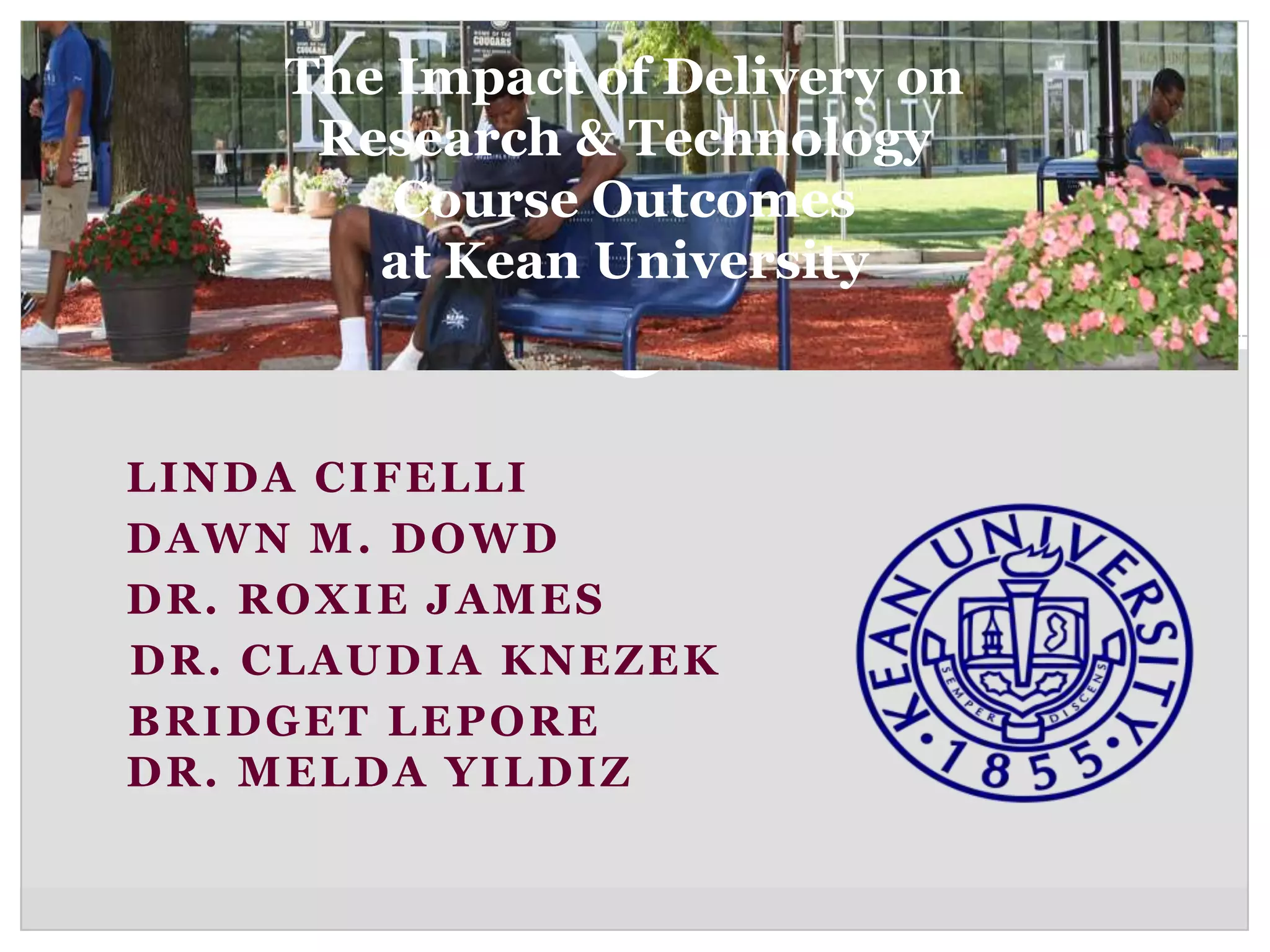
The Impact of Delivery on
     Research & Technology
        Course Outcomes
       at Kean University


LINDA CIFELLI
DAWN M. DOWD
DR. ROXIE JAMES
DR. CLAUDIA KNEZEK
BRIDGET LEPORE
DR. MELDA YILDIZ
INTRODUCTION

Undergraduate Degree Programs General Education
  Requirements
    GE 1000: Transition to Kean
    ENG 1030: College Composition
    COMM 1402: Speech Communication as
     Critical Citizenship
    GE 202X: Research and Technology
    MATH 1000: College Level Math
COURSE DESCRIPTION

This course will introduce students to research design and
methodology, as well as to disciplinary and interdisciplinary
perspectives on the research process. Students will learn how
to design and implement a research project appropriate for
the discipline of education. Students will learn how to use
technology for research and for the communication of
research results. Students will also learn how to critically
evaluate the validity, reliability, and limitations of research
results. Emphasis will be placed on adherence of the
university’s standards and academic integrity.
Typical Course Research Assignment: Students must choose a
research      topic,    then   search      for    and     locate    12-15
articles on the topic from scholarly or professional journals. Ultimately
students will write a 15-page research paper with at least 12 primary
references cited using the APA format.
BACKGROUND


2007-2012 Strategic Plan Directed Kean to Provide a
Broad and Challenging General Education Component
 Collaboration With the Office of Academic
  Assessment Collaboration with the Library and
  General Education Administration on Project SAILS
  (Kent State University)
 Expand On-line Learning Opportunities for Research
  and Technology
 Address Challenges of Millennial or Digital Natives
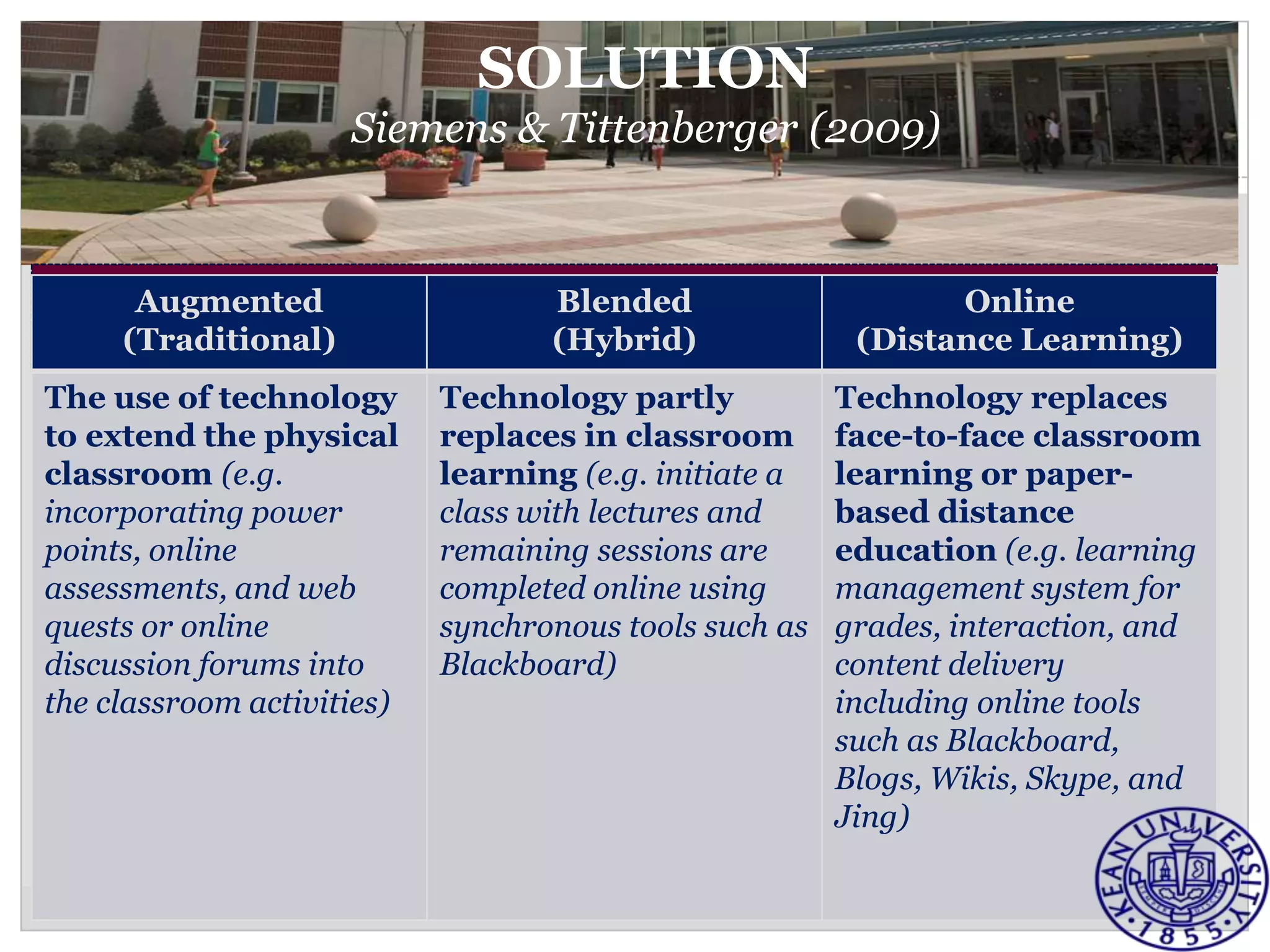
SOLUTION
                     Siemens & Tittenberger (2009)


      Augmented                    Blended                     Online
     (Traditional)                 (Hybrid)              (Distance Learning)
The use of technology       Technology partly           Technology replaces
to extend the physical      replaces in classroom       face-to-face classroom
classroom (e.g.             learning (e.g. initiate a   learning or paper-
incorporating power         class with lectures and     based distance
points, online              remaining sessions are      education (e.g. learning
assessments, and web        completed online using      management system for
quests or online            synchronous tools such as   grades, interaction, and
discussion forums into      Blackboard)                 content delivery
the classroom activities)                               including online tools
                                                        such as Blackboard,
                                                        Blogs, Wikis, Skype, and
                                                        Jing)
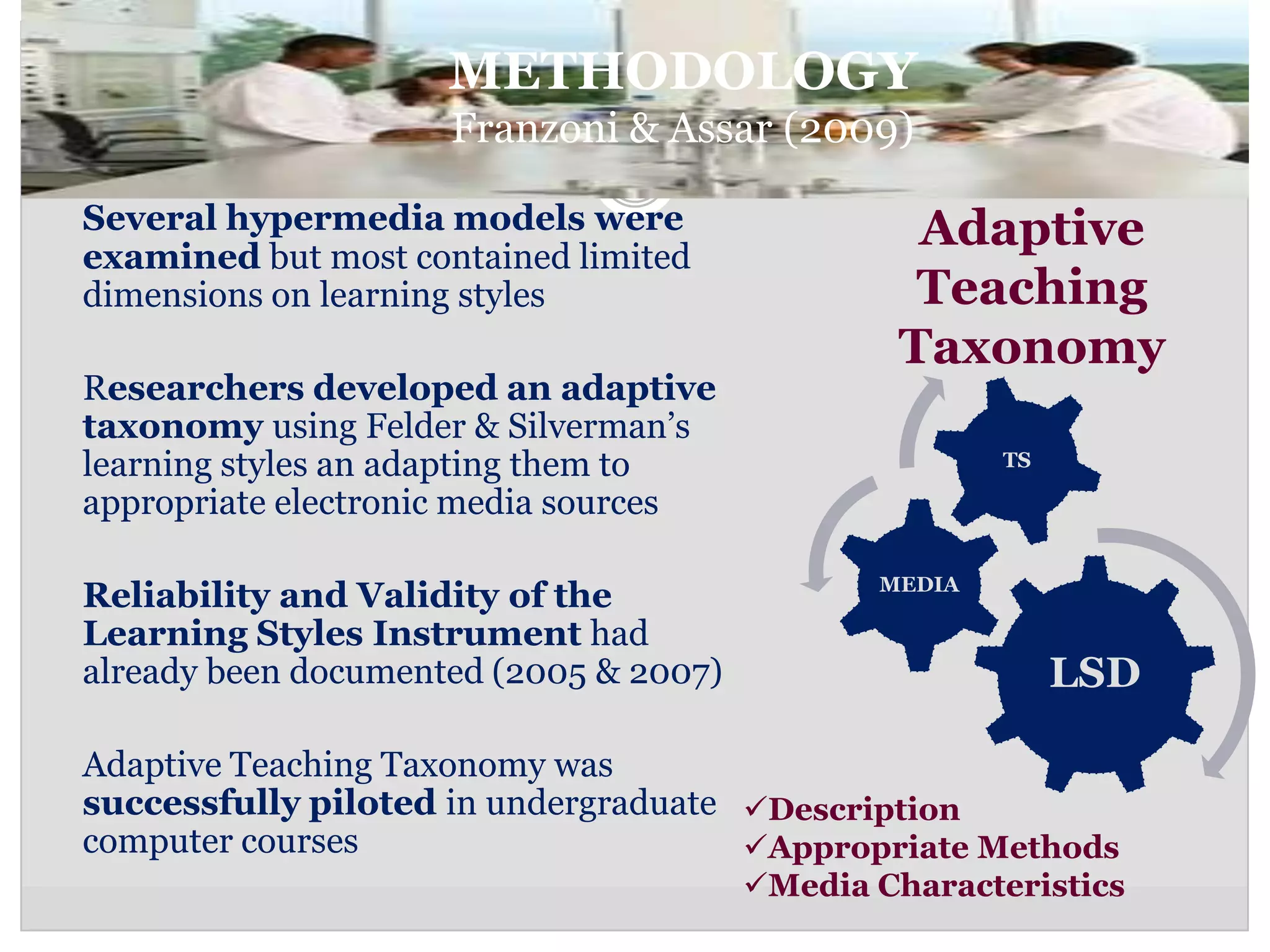
METHODOLOGY
                     Franzoni & Assar (2009)

Several hypermedia models were                   Adaptive
examined but most contained limited
dimensions on learning styles                    Teaching
                                                Taxonomy
Researchers developed an adaptive
taxonomy using Felder & Silverman’s
learning styles an adapting them to                    TS

appropriate electronic media sources

                                               MEDIA
Reliability and Validity of the
Learning Styles Instrument had
already been documented (2005 & 2007)                       LSD

Adaptive Teaching Taxonomy was
successfully piloted in undergraduate Description
computer courses                      Appropriate Methods
                                        Media Characteristics
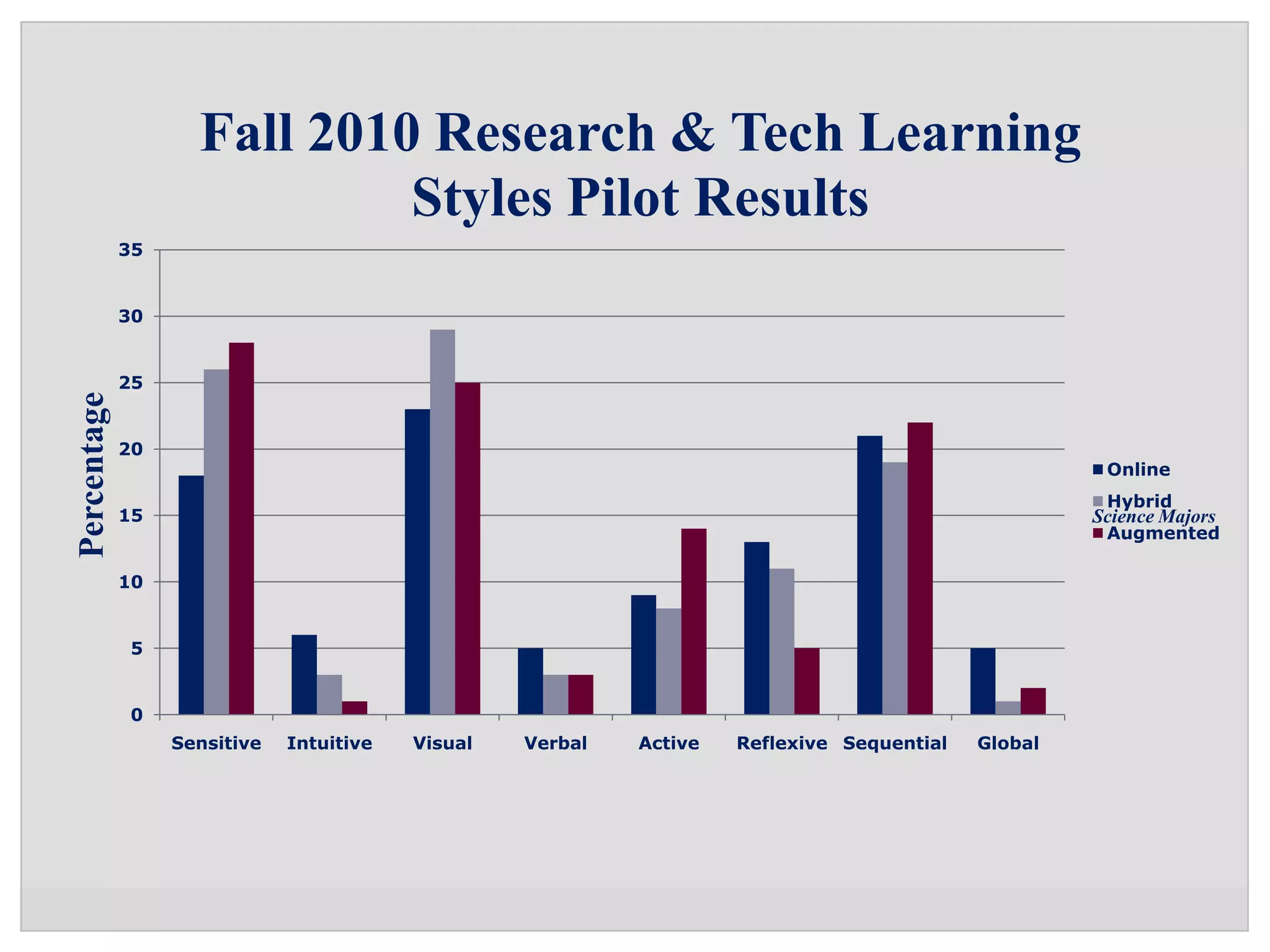
Fall 2010 Research & Tech Learning
                             Styles Pilot Results
             35


             30


             25
Percentage


             20
                                                                                                      Online
                                                                                                      Hybrid
             15                                                                                      Science Majors
                                                                                                      Augmented

             10


             5


             0
                  Sensitive   Intuitive   Visual   Verbal   Active   Reflexive Sequential   Global
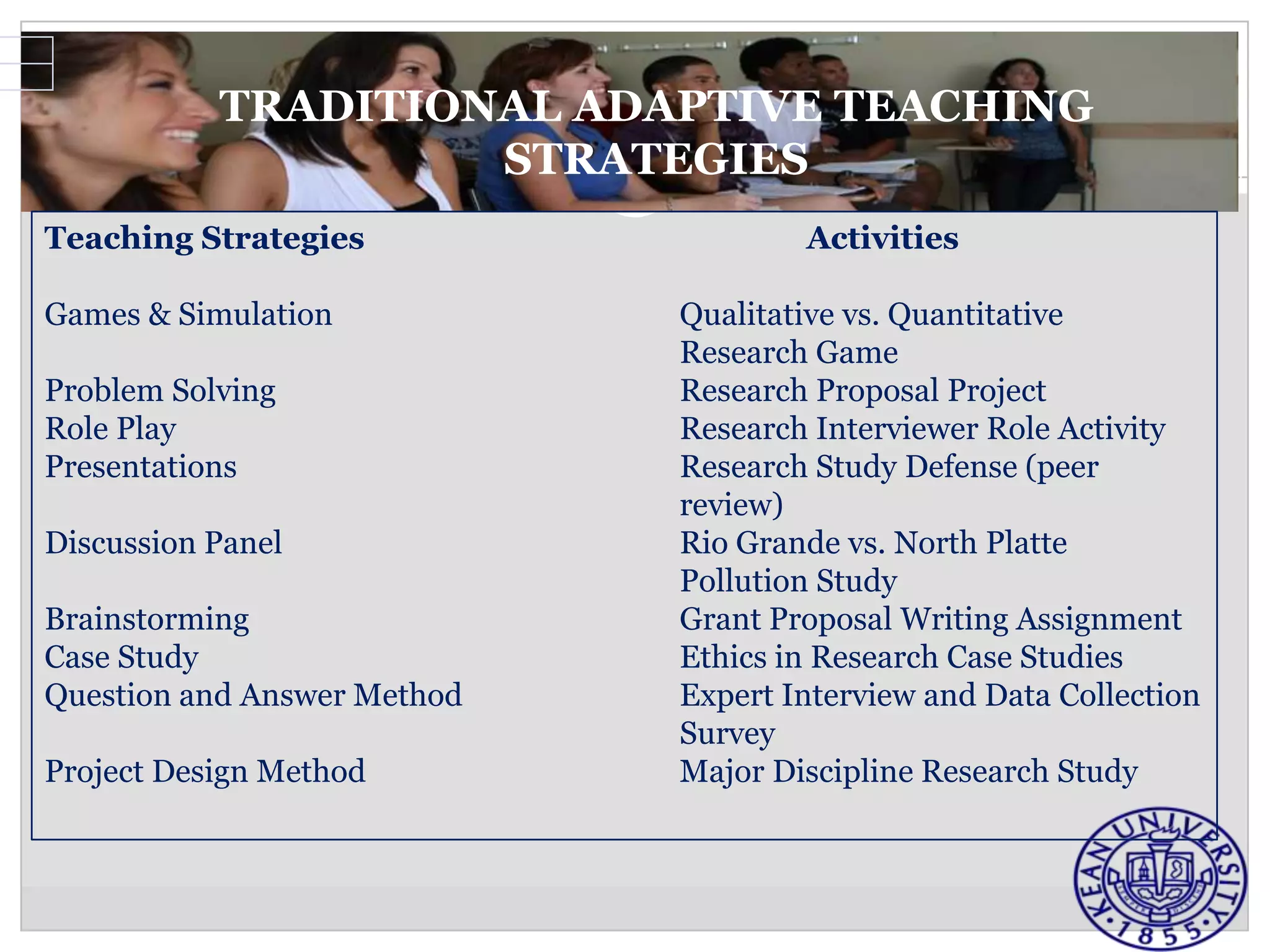
TRADITIONAL ADAPTIVE TEACHING
                    STRATEGIES
Teaching Strategies                  Activities

Games & Simulation           Qualitative vs. Quantitative
                             Research Game
Problem Solving              Research Proposal Project
Role Play                    Research Interviewer Role Activity
Presentations                Research Study Defense (peer
                             review)
Discussion Panel             Rio Grande vs. North Platte
                             Pollution Study
Brainstorming                Grant Proposal Writing Assignment
Case Study                   Ethics in Research Case Studies
Question and Answer Method   Expert Interview and Data Collection
                             Survey
Project Design Method        Major Discipline Research Study
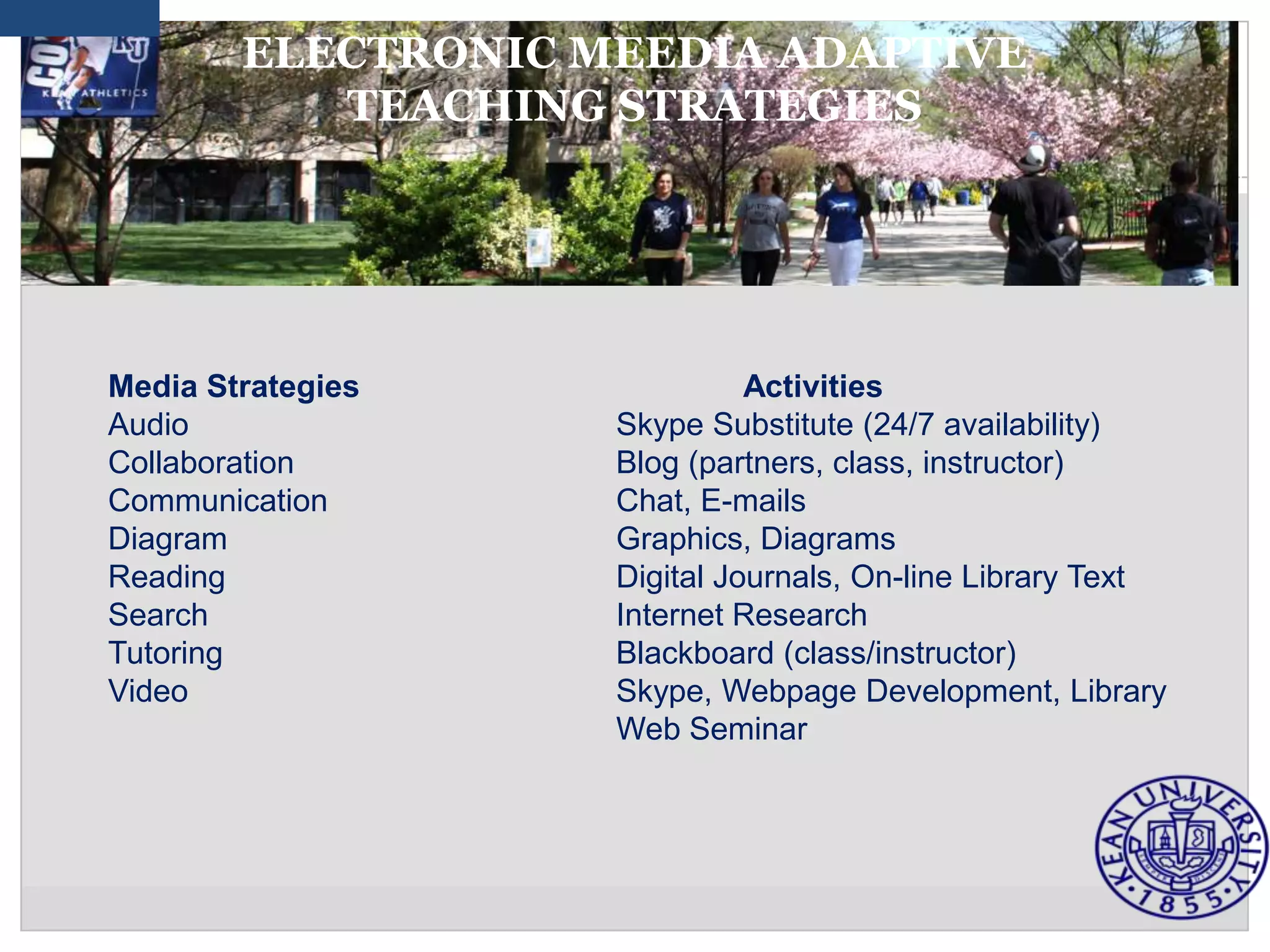
ELECTRONIC MEEDIA ADAPTIVE
           TEACHING STRATEGIES


Media Strategies              Activities
Audio               Skype Substitute (24/7 availability)
Collaboration       Blog (partners, class, instructor)
Communication       Chat, E-mails
Diagram             Graphics, Diagrams
Reading             Digital Journals, On-line Library Text
Search              Internet Research
Tutoring            Blackboard (class/instructor)
Video               Skype, Webpage Development, Library
                    Web Seminar
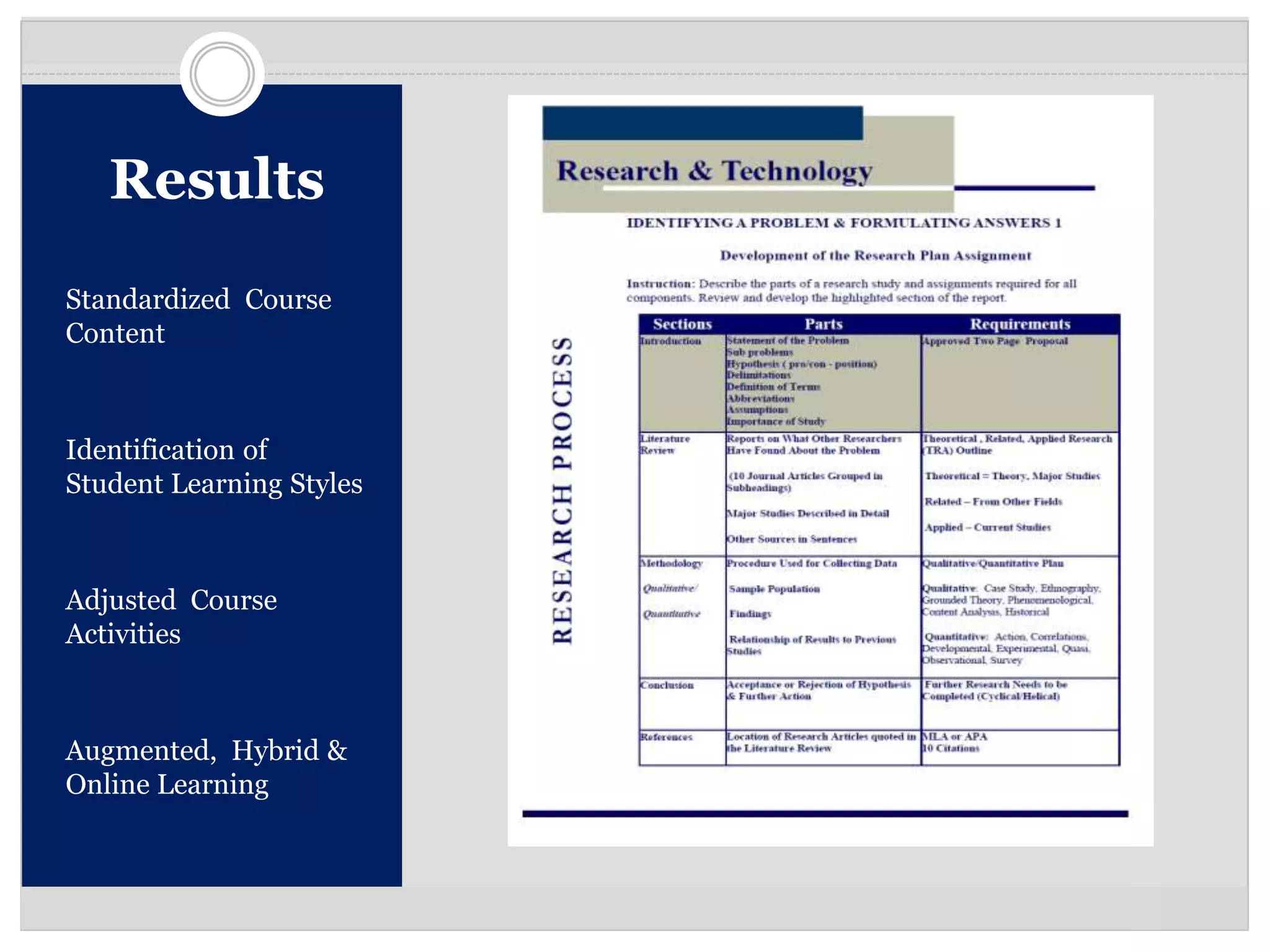
Results
Standardized Course
Content


Identification of
Student Learning Styles


Adjusted Course
Activities


Augmented, Hybrid &
Online Learning
Pilot Results


 Compare SIRII Overall Evaluation Means
 and Class Averages of Pilot Groups

 Compare SIRII Overall Evaluation Means
 for Control and TA Groups

 Conduct Comparison of Overall Class Grade
 Averages for Control and TA Groups
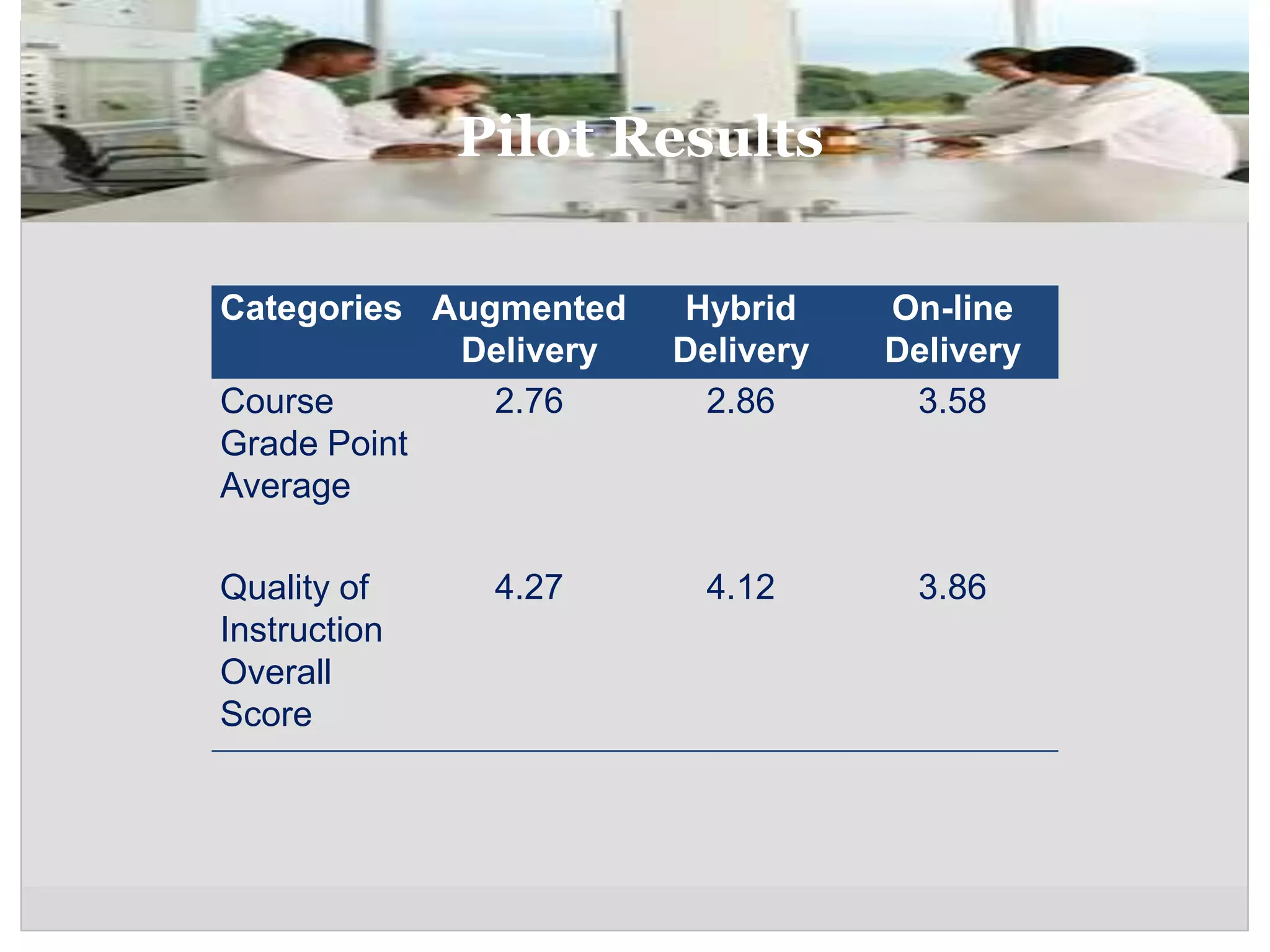
Pilot Results

Categories Augmented   Hybrid     On-line
            Delivery   Delivery   Delivery
Course        2.76      2.86       3.58
Grade Point
Average

Quality of     4.27     4.12       3.86
Instruction
Overall
Score
STUDY RESULTS


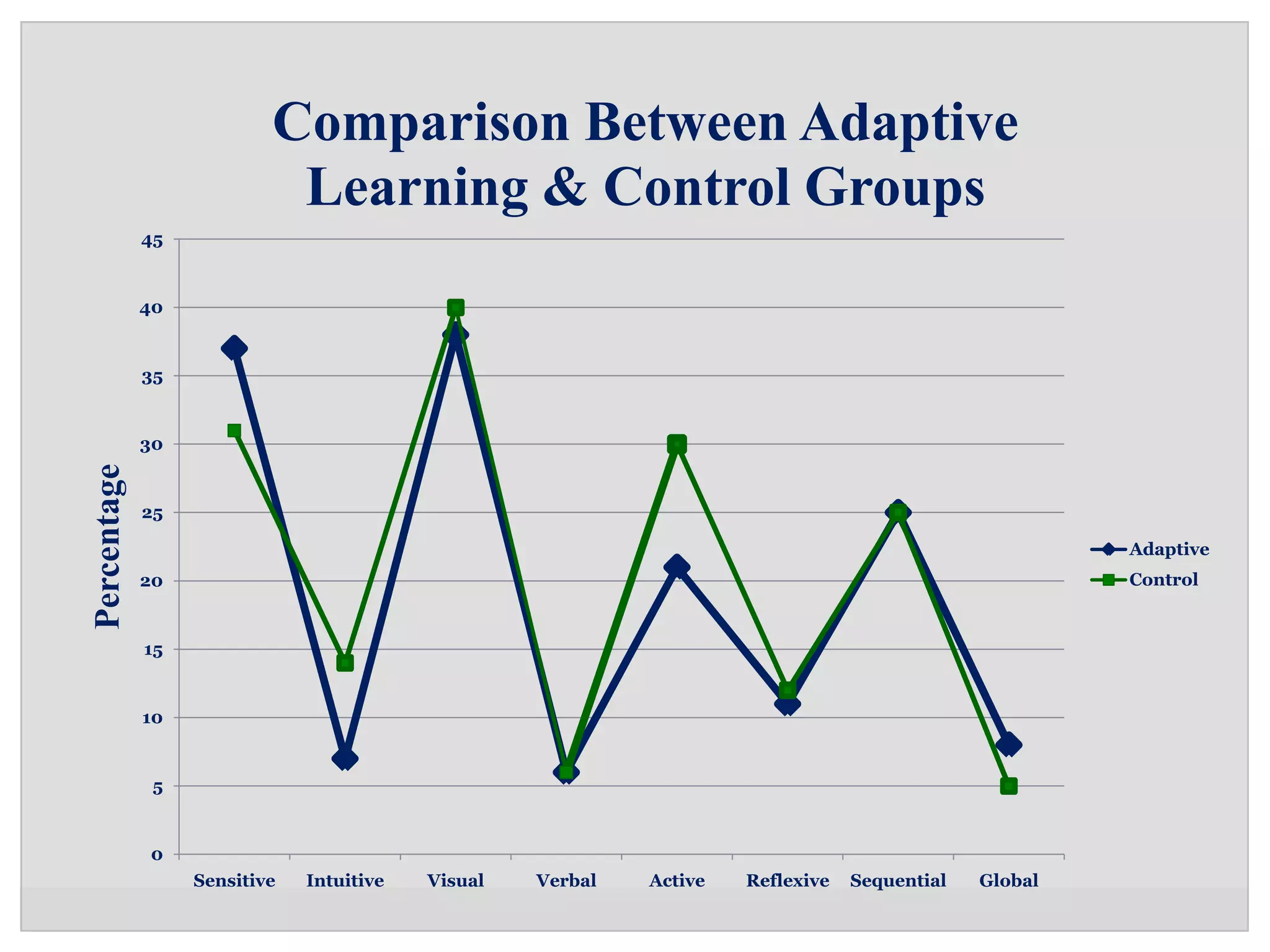
 Compare SIRII Overall Evaluation Means
 for Control and TA Groups

 Conduct Comparison of Overall Class Grade
 Averages for Control and TA Groups
Comparison Between Adaptive
                           Learning & Control Groups
             45


             40


             35


             30
Percentage


             25

                                                                                                       Adaptive
             20                                                                                        Control


             15


             10


              5


             0
                  Sensitive   Intuitive   Visual   Verbal   Active   Reflexive   Sequential   Global
STUDY RESULTS


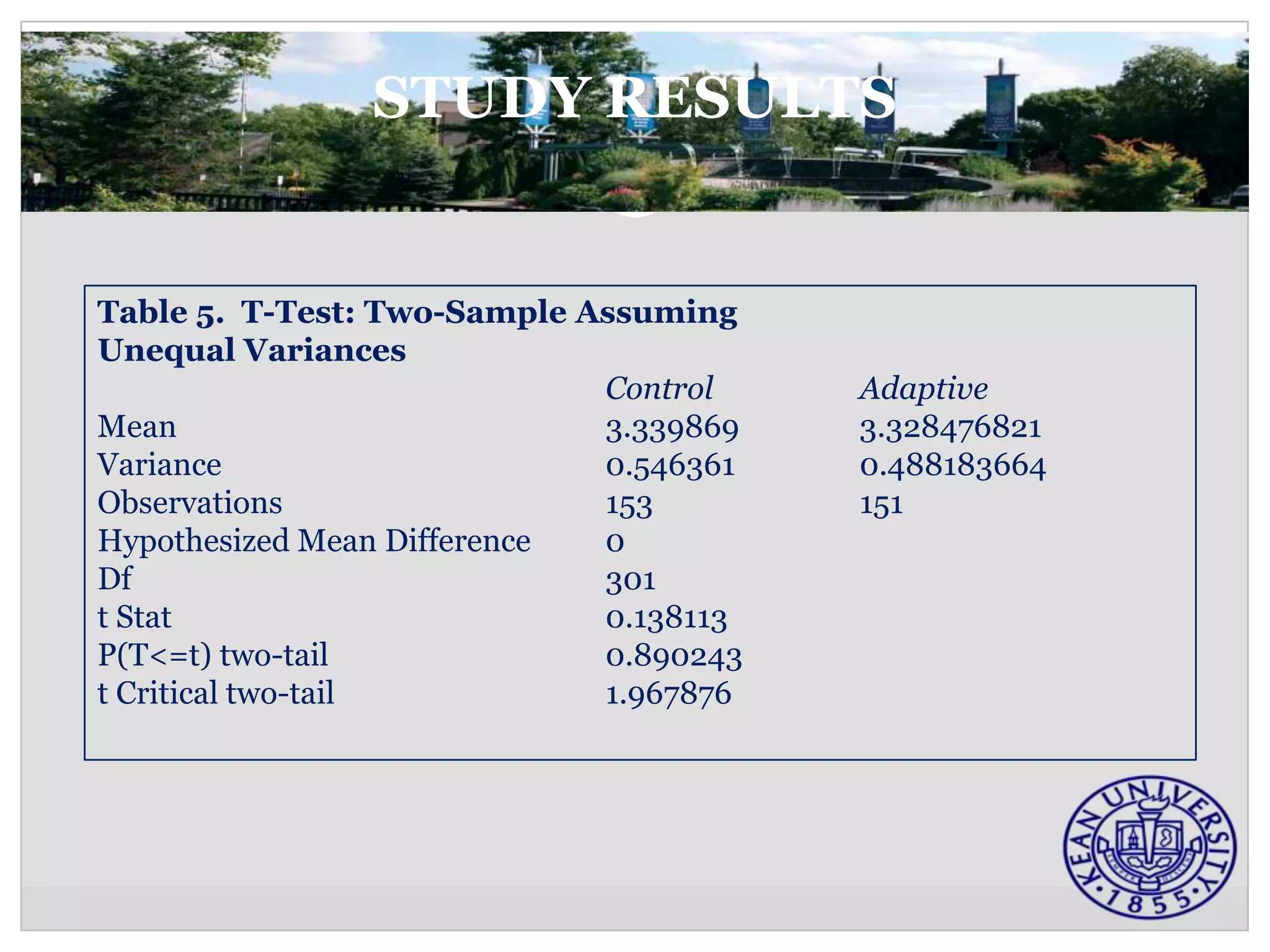
Table 5. T-Test: Two-Sample Assuming
Unequal Variances
                             Control    Adaptive
Mean                         3.339869   3.328476821
Variance                     0.546361   0.488183664
Observations                 153        151
Hypothesized Mean Difference 0
Df                           301
t Stat                       0.138113
P(T<=t) two-tail             0.890243
t Critical two-tail          1.967876
NEXT STEP


Next Step: Continue to Conduct
Comparison of Overall Class Grade
Averages for Control and AL Groups
QUESTIONS?

Dawn Marie Dowd
Managing Assistant Director
General Education Program
ddowd@kean.edu
908-737-0352

Dr. Claudia Knezek (Prin. Investigator)
Safety Program Director, Gen. Education
cknezek@kean.edu
908-737-0366

Dr. Melda Yildiz (Faculty)
Professor, School of Global Education &
Innovation
myildiz@kean.edu
908-737-7152

The impact of delivery on research & technology

  • 1.
    The Impact ofDelivery on Research & Technology Course Outcomes at Kean University LINDA CIFELLI DAWN M. DOWD DR. ROXIE JAMES DR. CLAUDIA KNEZEK BRIDGET LEPORE DR. MELDA YILDIZ
  • 2.
    INTRODUCTION Undergraduate Degree ProgramsGeneral Education Requirements  GE 1000: Transition to Kean  ENG 1030: College Composition  COMM 1402: Speech Communication as Critical Citizenship  GE 202X: Research and Technology  MATH 1000: College Level Math
  • 3.
    COURSE DESCRIPTION This coursewill introduce students to research design and methodology, as well as to disciplinary and interdisciplinary perspectives on the research process. Students will learn how to design and implement a research project appropriate for the discipline of education. Students will learn how to use technology for research and for the communication of research results. Students will also learn how to critically evaluate the validity, reliability, and limitations of research results. Emphasis will be placed on adherence of the university’s standards and academic integrity. Typical Course Research Assignment: Students must choose a research topic, then search for and locate 12-15 articles on the topic from scholarly or professional journals. Ultimately students will write a 15-page research paper with at least 12 primary references cited using the APA format.
  • 4.
    BACKGROUND 2007-2012 Strategic PlanDirected Kean to Provide a Broad and Challenging General Education Component  Collaboration With the Office of Academic Assessment Collaboration with the Library and General Education Administration on Project SAILS (Kent State University)  Expand On-line Learning Opportunities for Research and Technology  Address Challenges of Millennial or Digital Natives
  • 5.
    SOLUTION Siemens & Tittenberger (2009) Augmented Blended Online (Traditional) (Hybrid) (Distance Learning) The use of technology Technology partly Technology replaces to extend the physical replaces in classroom face-to-face classroom classroom (e.g. learning (e.g. initiate a learning or paper- incorporating power class with lectures and based distance points, online remaining sessions are education (e.g. learning assessments, and web completed online using management system for quests or online synchronous tools such as grades, interaction, and discussion forums into Blackboard) content delivery the classroom activities) including online tools such as Blackboard, Blogs, Wikis, Skype, and Jing)
  • 6.
    METHODOLOGY Franzoni & Assar (2009) Several hypermedia models were Adaptive examined but most contained limited dimensions on learning styles Teaching Taxonomy Researchers developed an adaptive taxonomy using Felder & Silverman’s learning styles an adapting them to TS appropriate electronic media sources MEDIA Reliability and Validity of the Learning Styles Instrument had already been documented (2005 & 2007) LSD Adaptive Teaching Taxonomy was successfully piloted in undergraduate Description computer courses Appropriate Methods Media Characteristics
  • 7.
    Fall 2010 Research& Tech Learning Styles Pilot Results 35 30 25 Percentage 20 Online Hybrid 15 Science Majors Augmented 10 5 0 Sensitive Intuitive Visual Verbal Active Reflexive Sequential Global
  • 8.
    TRADITIONAL ADAPTIVE TEACHING STRATEGIES Teaching Strategies Activities Games & Simulation Qualitative vs. Quantitative Research Game Problem Solving Research Proposal Project Role Play Research Interviewer Role Activity Presentations Research Study Defense (peer review) Discussion Panel Rio Grande vs. North Platte Pollution Study Brainstorming Grant Proposal Writing Assignment Case Study Ethics in Research Case Studies Question and Answer Method Expert Interview and Data Collection Survey Project Design Method Major Discipline Research Study
  • 9.
    ELECTRONIC MEEDIA ADAPTIVE TEACHING STRATEGIES Media Strategies Activities Audio Skype Substitute (24/7 availability) Collaboration Blog (partners, class, instructor) Communication Chat, E-mails Diagram Graphics, Diagrams Reading Digital Journals, On-line Library Text Search Internet Research Tutoring Blackboard (class/instructor) Video Skype, Webpage Development, Library Web Seminar
  • 10.
    Results Standardized Course Content Identification of StudentLearning Styles Adjusted Course Activities Augmented, Hybrid & Online Learning
  • 11.
    Pilot Results  CompareSIRII Overall Evaluation Means and Class Averages of Pilot Groups  Compare SIRII Overall Evaluation Means for Control and TA Groups  Conduct Comparison of Overall Class Grade Averages for Control and TA Groups
  • 12.
    Pilot Results Categories Augmented Hybrid On-line Delivery Delivery Delivery Course 2.76 2.86 3.58 Grade Point Average Quality of 4.27 4.12 3.86 Instruction Overall Score
  • 13.
    STUDY RESULTS  CompareSIRII Overall Evaluation Means for Control and TA Groups  Conduct Comparison of Overall Class Grade Averages for Control and TA Groups
  • 14.
    Comparison Between Adaptive Learning & Control Groups 45 40 35 30 Percentage 25 Adaptive 20 Control 15 10 5 0 Sensitive Intuitive Visual Verbal Active Reflexive Sequential Global
  • 15.
    STUDY RESULTS Table 5.T-Test: Two-Sample Assuming Unequal Variances Control Adaptive Mean 3.339869 3.328476821 Variance 0.546361 0.488183664 Observations 153 151 Hypothesized Mean Difference 0 Df 301 t Stat 0.138113 P(T<=t) two-tail 0.890243 t Critical two-tail 1.967876
  • 16.
    NEXT STEP Next Step:Continue to Conduct Comparison of Overall Class Grade Averages for Control and AL Groups
  • 17.
    QUESTIONS? Dawn Marie Dowd ManagingAssistant Director General Education Program ddowd@kean.edu 908-737-0352 Dr. Claudia Knezek (Prin. Investigator) Safety Program Director, Gen. Education cknezek@kean.edu 908-737-0366 Dr. Melda Yildiz (Faculty) Professor, School of Global Education & Innovation myildiz@kean.edu 908-737-7152

Editor's Notes

  • #4 DiscussGE 2021GE 2022GE 2023GE 2024GE 2025GE 2026GE 2027