Online Payment
Fraud Detection
System
Machine learning/python
Group Members
 Ali Usman
 Ahmad Riaz
 Hizra Amjad
 Ayesha Imran
Introduction
● Development of a machine learning model to detect fraudulent
transactions.
● Utilized a dataset containing various features of online transactions.
● Applied Random Forest Classifier for prediction.
● Focused on handling imbalanced data using SMOTE (Synthetic
Minority Over-sampling Technique).
● Evaluated model performance using accuracy, confusion matrix, and
other metrics.
Background and Motivation
● Online payment fraud is a growing concern in the digital world.
● With the increasing volume of online transactions, the risk of
fraudulent activities has also surged.
● Our project aims to tackle this issue by developing an effective fraud
detection system using machine learning algorithms.
Objectives
● Accurately detect fraudulent transactions
● Reduce false positives
● Improve the overall security of online payment systems.
● Create a robust model that can differentiate between legitimate and
fraudulent activities.
Importance of Fraud Detection in Online Transactions:
● Prevents financial losses for businesses and customers.
● Maintains trust and security in online financial systems.
● Detects fraudulent activities in real-time.
● Enhances overall cybersecurity measures for financial
institutions.
Methodology
● we used a dataset consisting of online payment transactions.
● We performed data preprocessing to handle missing values and
normalize the data.
● Our chosen machine learning algorithms include, Random Forest,
XGBoost and Logistic Regression.
● We split the dataset into training and testing sets to evaluate our models
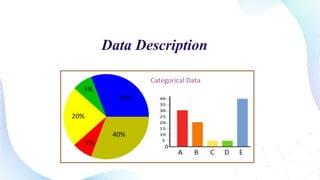
Data Description
Data Source
• Dataset is collected from Kaggle website. Which is
publically available. By using this website, you can
access many more dataset for any kind of project.
https://www.kaggle.com/
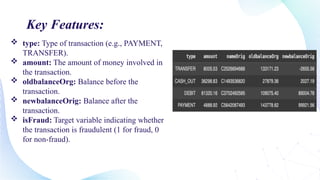
Key Features:
 type: Type of transaction (e.g., PAYMENT,
TRANSFER).
 amount: The amount of money involved in
the transaction.
 oldbalanceOrg: Balance before the
transaction.
 newbalanceOrig: Balance after the
transaction.
 isFraud: Target variable indicating whether
the transaction is fraudulent (1 for fraud, 0
for non-fraud).
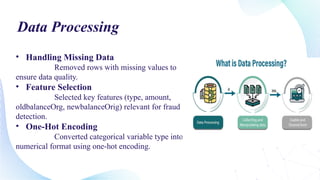
Data Processing
• Handling Missing Data
Removed rows with missing values to
ensure data quality.
• Feature Selection
Selected key features (type, amount,
oldbalanceOrg, newbalanceOrig) relevant for fraud
detection.
• One-Hot Encoding
Converted categorical variable type into
numerical format using one-hot encoding.
data.dropna(inplace=True)
data.isnull().sum()
x = data[['type', 'amount', 'oldbalanceOrg',
'newbalanceOrig']]
y = data['isFraud']
Feature Selection
Handling Missing Data
CODE
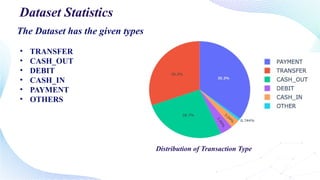
Dataset Statistics
The Dataset has the given types
• TRANSFER
• CASH_OUT
• DEBIT
• CASH_IN
• PAYMENT
• OTHERS
Distribution of Transaction Type
type=data['type'].value_counts()
transactions=type.index
quantity=type.values
figure=px.pie(data,
values=quantity,
names=transactions,
title='Distribution of Transaction Type')
figure.show()
CODE:
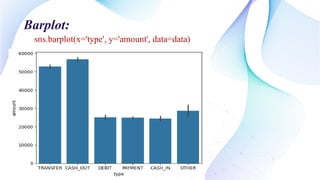
Barplot:
sns.barplot(x='type', y='amount', data=data)
Implementation
● Data collection, feature extraction, model training
● We used Python and libraries such as scikit-learn for model
development.
● The trained model was then to detect fraudulent transactions in
real-time
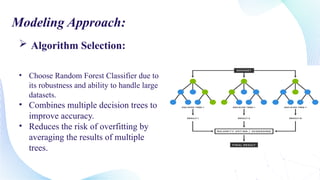
Modeling Approach:
 Algorithm Selection:
• Choose Random Forest Classifier due to
its robustness and ability to handle large
datasets.
• Combines multiple decision trees to
improve accuracy.
• Reduces the risk of overfitting by
averaging the results of multiple
trees.
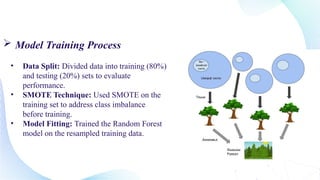
• Data Split: Divided data into training (80%)
and testing (20%) sets to evaluate
performance.
• SMOTE Technique: Used SMOTE on the
training set to address class imbalance
before training.
• Model Fitting: Trained the Random Forest
model on the resampled training data.
 Model Training Process
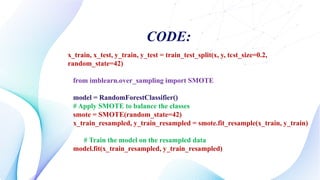
x_train, x_test, y_train, y_test = train_test_split(x, y, test_size=0.2,
random_state=42)
from imblearn.over_sampling import SMOTE
model = RandomForestClassifier()
# Apply SMOTE to balance the classes
smote = SMOTE(random_state=42)
x_train_resampled, y_train_resampled = smote.fit_resample(x_train, y_train)
# Train the model on the resampled data
model.fit(x_train_resampled, y_train_resampled)
CODE:
Model Evaluation:
• Accuracy: Present the accuracy of your model on the test
set (86.91%).
• Confusion Matrix: Show a visual of the confusion matrix
to illustrate true positives, true negatives, false positives, and
false negatives.
• Classification Report: Mention other key metrics like
precision, recall, and F1-score, and explain what they mean.
Precision
F1 = 2 x
 FORMULAS:
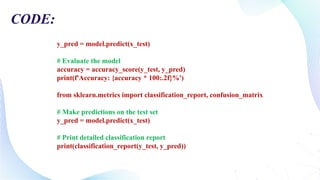
y_pred = model.predict(x_test)
# Evaluate the model
accuracy = accuracy_score(y_test, y_pred)
print(f'Accuracy: {accuracy * 100:.2f}%')
from sklearn.metrics import classification_report, confusion_matrix
# Make predictions on the test set
y_pred = model.predict(x_test)
# Print detailed classification report
print(classification_report(y_test, y_pred))
CODE:
• A table used to evaluate the performance of a classification model.
• Displays the counts of actual vs. predicted classifications across
all classes.
 Key Components:
• True Positives (TP)
• True Negatives (TN)
• False Positives (FP)
• False Negatives (FN)
Confusion Matrix:
• Heatmap color intensity indicates the number of instances in each
category (TP, TN, FP, FN).
Visualization
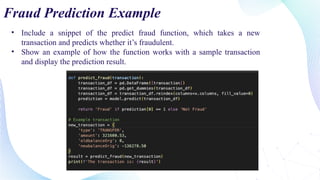
• Include a snippet of the predict fraud function, which takes a new
transaction and predicts whether it’s fraudulent.
• Show an example of how the function works with a sample transaction
and display the prediction result.
Fraud Prediction Example
Conclusion:
Successfully developed and implemented a
Random Forest model to detect fraudulent online
transactions.
Visual tools like the confusion matrix and feature
importance helped in evaluating and
understanding the model's effectiveness.
Future improvements could involve exploring
more advanced models and incorporating
additional features to further enhance fraud
detection accuracy.
Thanks!
•

Online Payment fraud Detection Final Project

  • 1.
  • 2.
    Group Members  AliUsman  Ahmad Riaz  Hizra Amjad  Ayesha Imran
  • 3.
    Introduction ● Development ofa machine learning model to detect fraudulent transactions. ● Utilized a dataset containing various features of online transactions. ● Applied Random Forest Classifier for prediction. ● Focused on handling imbalanced data using SMOTE (Synthetic Minority Over-sampling Technique). ● Evaluated model performance using accuracy, confusion matrix, and other metrics.
  • 4.
    Background and Motivation ●Online payment fraud is a growing concern in the digital world. ● With the increasing volume of online transactions, the risk of fraudulent activities has also surged. ● Our project aims to tackle this issue by developing an effective fraud detection system using machine learning algorithms.
  • 5.
    Objectives ● Accurately detectfraudulent transactions ● Reduce false positives ● Improve the overall security of online payment systems. ● Create a robust model that can differentiate between legitimate and fraudulent activities.
  • 6.
    Importance of FraudDetection in Online Transactions: ● Prevents financial losses for businesses and customers. ● Maintains trust and security in online financial systems. ● Detects fraudulent activities in real-time. ● Enhances overall cybersecurity measures for financial institutions.
  • 7.
    Methodology ● we useda dataset consisting of online payment transactions. ● We performed data preprocessing to handle missing values and normalize the data. ● Our chosen machine learning algorithms include, Random Forest, XGBoost and Logistic Regression. ● We split the dataset into training and testing sets to evaluate our models
  • 8.
  • 9.
    Data Source • Datasetis collected from Kaggle website. Which is publically available. By using this website, you can access many more dataset for any kind of project. https://www.kaggle.com/
  • 10.
    Key Features:  type:Type of transaction (e.g., PAYMENT, TRANSFER).  amount: The amount of money involved in the transaction.  oldbalanceOrg: Balance before the transaction.  newbalanceOrig: Balance after the transaction.  isFraud: Target variable indicating whether the transaction is fraudulent (1 for fraud, 0 for non-fraud).
  • 11.
    Data Processing • HandlingMissing Data Removed rows with missing values to ensure data quality. • Feature Selection Selected key features (type, amount, oldbalanceOrg, newbalanceOrig) relevant for fraud detection. • One-Hot Encoding Converted categorical variable type into numerical format using one-hot encoding.
  • 12.
    data.dropna(inplace=True) data.isnull().sum() x = data[['type','amount', 'oldbalanceOrg', 'newbalanceOrig']] y = data['isFraud'] Feature Selection Handling Missing Data CODE
  • 13.
    Dataset Statistics The Datasethas the given types • TRANSFER • CASH_OUT • DEBIT • CASH_IN • PAYMENT • OTHERS Distribution of Transaction Type
  • 14.
  • 15.
  • 16.
    Implementation ● Data collection,feature extraction, model training ● We used Python and libraries such as scikit-learn for model development. ● The trained model was then to detect fraudulent transactions in real-time
  • 17.
    Modeling Approach:  AlgorithmSelection: • Choose Random Forest Classifier due to its robustness and ability to handle large datasets. • Combines multiple decision trees to improve accuracy. • Reduces the risk of overfitting by averaging the results of multiple trees.
  • 18.
    • Data Split:Divided data into training (80%) and testing (20%) sets to evaluate performance. • SMOTE Technique: Used SMOTE on the training set to address class imbalance before training. • Model Fitting: Trained the Random Forest model on the resampled training data.  Model Training Process
  • 19.
    x_train, x_test, y_train,y_test = train_test_split(x, y, test_size=0.2, random_state=42) from imblearn.over_sampling import SMOTE model = RandomForestClassifier() # Apply SMOTE to balance the classes smote = SMOTE(random_state=42) x_train_resampled, y_train_resampled = smote.fit_resample(x_train, y_train) # Train the model on the resampled data model.fit(x_train_resampled, y_train_resampled) CODE:
  • 20.
    Model Evaluation: • Accuracy:Present the accuracy of your model on the test set (86.91%). • Confusion Matrix: Show a visual of the confusion matrix to illustrate true positives, true negatives, false positives, and false negatives. • Classification Report: Mention other key metrics like precision, recall, and F1-score, and explain what they mean.
  • 21.
    Precision F1 = 2x  FORMULAS:
  • 22.
    y_pred = model.predict(x_test) #Evaluate the model accuracy = accuracy_score(y_test, y_pred) print(f'Accuracy: {accuracy * 100:.2f}%') from sklearn.metrics import classification_report, confusion_matrix # Make predictions on the test set y_pred = model.predict(x_test) # Print detailed classification report print(classification_report(y_test, y_pred)) CODE:
  • 23.
    • A tableused to evaluate the performance of a classification model. • Displays the counts of actual vs. predicted classifications across all classes.  Key Components: • True Positives (TP) • True Negatives (TN) • False Positives (FP) • False Negatives (FN) Confusion Matrix:
  • 24.
    • Heatmap colorintensity indicates the number of instances in each category (TP, TN, FP, FN). Visualization
  • 25.
    • Include asnippet of the predict fraud function, which takes a new transaction and predicts whether it’s fraudulent. • Show an example of how the function works with a sample transaction and display the prediction result. Fraud Prediction Example
  • 26.
    Conclusion: Successfully developed andimplemented a Random Forest model to detect fraudulent online transactions. Visual tools like the confusion matrix and feature importance helped in evaluating and understanding the model's effectiveness. Future improvements could involve exploring more advanced models and incorporating additional features to further enhance fraud detection accuracy.
  • 27.