Title Slide
• Fraud Detection Insights for Online Payments
• Dataset: Credit-Card Fraud 2013-EUR (Kaggle)
• Presented by: Your Name
• Date: August 2025
1. Introduction
• Understanding the importance of online
payment fraud detection
• Overview of supervised and unsupervised
approaches
• Need for real-time analysis and adaptive
systems
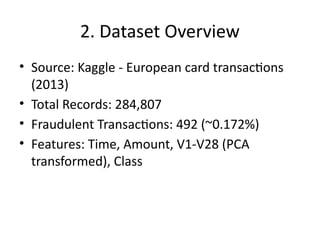
2. Dataset Overview
• Source: Kaggle - European card transactions
(2013)
• Total Records: 284,807
• Fraudulent Transactions: 492 (~0.172%)
• Features: Time, Amount, V1-V28 (PCA
transformed), Class
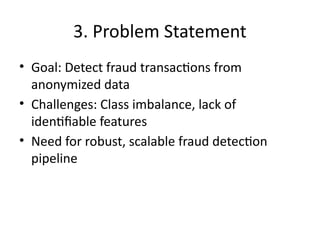
3. Problem Statement
• Goal: Detect fraud transactions from
anonymized data
• Challenges: Class imbalance, lack of
identifiable features
• Need for robust, scalable fraud detection
pipeline
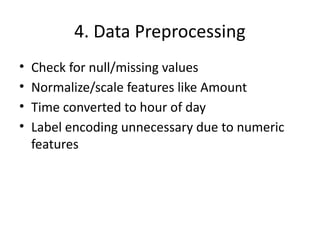
4. Data Preprocessing
• Check for null/missing values
• Normalize/scale features like Amount
• Time converted to hour of day
• Label encoding unnecessary due to numeric
features
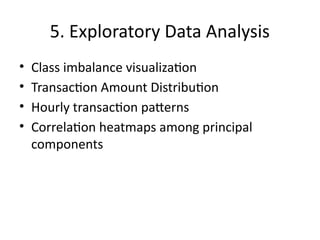
5. Exploratory Data Analysis
• Class imbalance visualization
• Transaction Amount Distribution
• Hourly transaction patterns
• Correlation heatmaps among principal
components
6. Class Imbalance Challenges
• Fraud cases are less than 0.2%
• Standard accuracy metric is misleading
• Focus on Recall, Precision, F1-score, and ROC
AUC
7. Techniques to Handle Imbalance
• SMOTE - Synthetic Minority Over-sampling
Technique
• Random undersampling
• Hybrid sampling
• Cost-sensitive learning (e.g., class weights)
8. Modeling Approaches
• Baseline: Logistic Regression
• Tree-based: Decision Tree, Random Forest
• Boosted Models: XGBoost, LightGBM,
CatBoost
• Advanced: TabNet, AutoML frameworks
9. Unsupervised & Deep Learning
Models
• Autoencoders for anomaly detection
• RBMs and GANs for fraud pattern generation
• LSTM networks for sequence detection
• Hybrid: DeepNet + KNN
10. Feature Engineering
• Aggregate transaction statistics per card
• Rolling time-window features
• Transaction frequency features
• Graph-based features like centrality, clustering
coefficient
11. Evaluation Metrics
• Confusion Matrix
• Precision = TP / (TP + FP)
• Recall = TP / (TP + FN)
• F1-Score =
2*(Precision*Recall)/(Precision+Recall)
• ROC AUC Curve
12. Model Performance Summary
• XGBoost: AUROC ~0.989
• Random Forest: AUROC ~0.988
• Logistic Regression: Baseline
• Deep Learning + SMOTE: F1-score ~0.95
13. Real-World Constraints
• Latency: real-time prediction under 1s
• Scalability: millions of transactions/hour
• Explainability for legal compliance
• Concept drift over time
14. Concept Drift & Retraining
• Continuous learning is required
• Drift detection algorithms
• Model versioning and monitoring
• Auto-retraining pipelines
15. Recommendations
• Use ensemble methods like LightGBM
• Balance classes using SMOTE
• Incorporate graph features
• Deploy using scalable APIs with monitoring
16. Future Work
• Introduce federated learning for privacy
• Integrate behavioral biometrics
• Build interpretable AI models (SHAP/LIME)
• Combine with geolocation and device
fingerprints
17. References
• •
https://www.kaggle.com/datasets/mlg-ulb/cre
ditcardfraud
• • SMOTE: SSRN 4412674
• • XGBoost & RF performance:
arXiv:1904.10604
• • Deep Learning models: arXiv:2205.15300
• • Concept Drift: arXiv:2010.06479

Enhanced_Fraud_Detection_Presentation.pptx

  • 1.
    Title Slide • FraudDetection Insights for Online Payments • Dataset: Credit-Card Fraud 2013-EUR (Kaggle) • Presented by: Your Name • Date: August 2025
  • 2.
    1. Introduction • Understandingthe importance of online payment fraud detection • Overview of supervised and unsupervised approaches • Need for real-time analysis and adaptive systems
  • 3.
    2. Dataset Overview •Source: Kaggle - European card transactions (2013) • Total Records: 284,807 • Fraudulent Transactions: 492 (~0.172%) • Features: Time, Amount, V1-V28 (PCA transformed), Class
  • 4.
    3. Problem Statement •Goal: Detect fraud transactions from anonymized data • Challenges: Class imbalance, lack of identifiable features • Need for robust, scalable fraud detection pipeline
  • 5.
    4. Data Preprocessing •Check for null/missing values • Normalize/scale features like Amount • Time converted to hour of day • Label encoding unnecessary due to numeric features
  • 6.
    5. Exploratory DataAnalysis • Class imbalance visualization • Transaction Amount Distribution • Hourly transaction patterns • Correlation heatmaps among principal components
  • 7.
    6. Class ImbalanceChallenges • Fraud cases are less than 0.2% • Standard accuracy metric is misleading • Focus on Recall, Precision, F1-score, and ROC AUC
  • 8.
    7. Techniques toHandle Imbalance • SMOTE - Synthetic Minority Over-sampling Technique • Random undersampling • Hybrid sampling • Cost-sensitive learning (e.g., class weights)
  • 9.
    8. Modeling Approaches •Baseline: Logistic Regression • Tree-based: Decision Tree, Random Forest • Boosted Models: XGBoost, LightGBM, CatBoost • Advanced: TabNet, AutoML frameworks
  • 10.
    9. Unsupervised &Deep Learning Models • Autoencoders for anomaly detection • RBMs and GANs for fraud pattern generation • LSTM networks for sequence detection • Hybrid: DeepNet + KNN
  • 11.
    10. Feature Engineering •Aggregate transaction statistics per card • Rolling time-window features • Transaction frequency features • Graph-based features like centrality, clustering coefficient
  • 12.
    11. Evaluation Metrics •Confusion Matrix • Precision = TP / (TP + FP) • Recall = TP / (TP + FN) • F1-Score = 2*(Precision*Recall)/(Precision+Recall) • ROC AUC Curve
  • 13.
    12. Model PerformanceSummary • XGBoost: AUROC ~0.989 • Random Forest: AUROC ~0.988 • Logistic Regression: Baseline • Deep Learning + SMOTE: F1-score ~0.95
  • 14.
    13. Real-World Constraints •Latency: real-time prediction under 1s • Scalability: millions of transactions/hour • Explainability for legal compliance • Concept drift over time
  • 15.
    14. Concept Drift& Retraining • Continuous learning is required • Drift detection algorithms • Model versioning and monitoring • Auto-retraining pipelines
  • 16.
    15. Recommendations • Useensemble methods like LightGBM • Balance classes using SMOTE • Incorporate graph features • Deploy using scalable APIs with monitoring
  • 17.
    16. Future Work •Introduce federated learning for privacy • Integrate behavioral biometrics • Build interpretable AI models (SHAP/LIME) • Combine with geolocation and device fingerprints
  • 18.
    17. References • • https://www.kaggle.com/datasets/mlg-ulb/cre ditcardfraud •• SMOTE: SSRN 4412674 • • XGBoost & RF performance: arXiv:1904.10604 • • Deep Learning models: arXiv:2205.15300 • • Concept Drift: arXiv:2010.06479