Agenda:
Fraud
Detection
Introduction
Overview of the dataset
Data Collection
Exploratory Data Analysis (EDA) And
Visualization
Machine Learning Model Development
Financial Impact Analysis
Conclusion
Introduction
• Importance of Detecting Fraudulent Transactions:
• Fraudulent transactions are a growing risk for
businesses, leading to financial losses and
damaging consumer trust. As digital commerce
expands, detecting fraud is critical to prevent
reputational harm and regulatory penalties.
Machine learning offers a solution by analyzing
transaction data to detect fraud patterns, helping
companies minimize losses and safeguard
customers.
Overview of
the Dataset
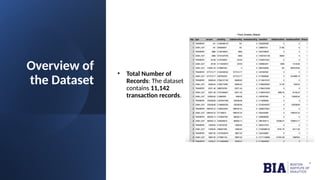
• Total Number of
Records: The dataset
contains 11,142
transaction records.
Overview of
the Dataset
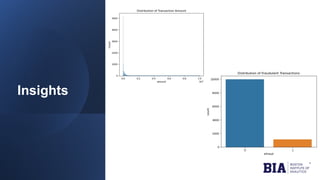
• Class Imbalance:
• The dataset is highly imbalanced with 10,000 legitimate
transactions and 1,142 fraudulent transactions, making fraud
detection more challenging.
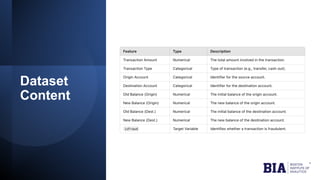
• Features: The dataset has 10 features, including both categorical
and numerical variables:
• Categorical Variables:
• type: Type of transaction (e.g., transfer, cash out).
• nameOrig: Origin account identifier.
• nameDest: Destination account identifier.
• Numerical Variables:
• amount: The transaction amount.
• oldbalanceOrg, newbalanceOrig: Original and new balance
of the origin account.
• oldbalanceDest, newbalanceDest: Original and new
balance of the destination account.
• Target Variable (isFraud): Identifies whether a transaction is
fraudulent (1) or legitimate (0).
Dataset
Content
Data Exploration (EDA)
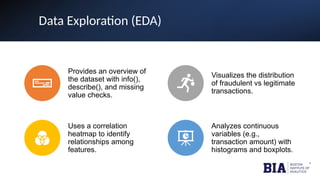
Provides an overview of
the dataset with info(),
describe(), and missing
value checks.
Visualizes the distribution
of fraudulent vs legitimate
transactions.
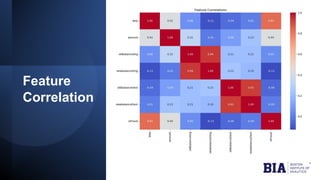
Uses a correlation
heatmap to identify
relationships among
features.
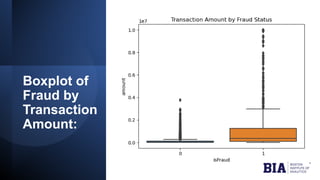
Analyzes continuous
variables (e.g.,
transaction amount) with
histograms and boxplots.
Insights
Feature
Correlation
Boxplot of
Fraud by
Transaction
Amount:
Feature
Engineering
•Categorical Variable Encoding:
• The categorical variables (e.g.,
transaction type, location)
cannot be used directly by
machine learning algorithms.
These were encoded into
numerical values using
LabelEncoder, which assigns a
unique integer to each
category.
•Numeric Variable Encoding:
• Purpose: Scale the amount
column to have a mean of 0 and
standard deviation of 1 (for better
performance with models).
• Output: The amount column will
now contain standardized values.
Model
Selection
and Training
• Purpose: Split the dataset into features (X) and target (y)
and then into training (70%) and testing sets (30%).
• Output: You’ll have separate data for training and testing.
Training
and
Evaluation:
•Purpose: Train each
model and print
performance metrics.
•Output: You’ll get
accuracy, precision, recall,
F1 score, and ROC AUC for
each model, helping you
determine which model
performs best.
Performance
Evaluation:
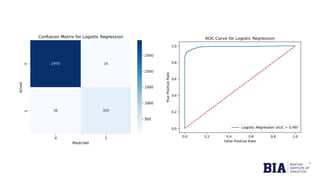
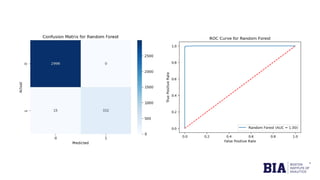
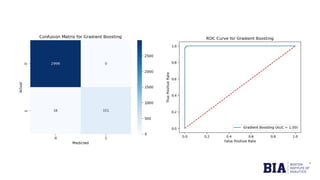
• Purpose:
• Plot confusion matrices to visualize the distribution of
predictions.
• Plot ROC curves to compare the models' ability to differentiate
between classes.
• Output:
• Confusion Matrix: A heatmap showing true positives, true
negatives, false positives, and false negatives.
• ROC Curve: A curve showing the model’s performance across
various thresholds.
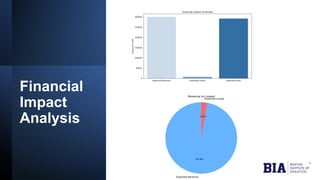
Financial
Impact
Analysis
Conclusion
In this fraud detection analysis, we used three machine
learning models: Logistic Regression, Random Forest,
and Gradient Boosting to identify fraudulent transactions.
• The best-performing model was Gradient Boosting, as
it achieved the highest ROC AUC score, indicating a
better ability to distinguish between fraudulent and
legitimate transactions.
• Random Forest also performed well, offering a good
balance of precision and recall, making it effective for
handling complex patterns in the data.
• Logistic Regression provided a baseline performance,
but its simpler nature made it less effective in detecting
the more nuanced cases of fraud.
Key limitations include the significant class imbalance,
where fraudulent transactions make up only a small
portion of the dataset. This may lead to biases toward
predicting legitimate transactions and could affect the
recall and precision of our models.
Questions ?
Thank You !

Detecting Deception: Advanced Techniques in Fraud Detection

  • 2.
    Agenda: Fraud Detection Introduction Overview of thedataset Data Collection Exploratory Data Analysis (EDA) And Visualization Machine Learning Model Development Financial Impact Analysis Conclusion
  • 3.
    Introduction • Importance ofDetecting Fraudulent Transactions: • Fraudulent transactions are a growing risk for businesses, leading to financial losses and damaging consumer trust. As digital commerce expands, detecting fraud is critical to prevent reputational harm and regulatory penalties. Machine learning offers a solution by analyzing transaction data to detect fraud patterns, helping companies minimize losses and safeguard customers.
  • 4.
    Overview of the Dataset •Total Number of Records: The dataset contains 11,142 transaction records.
  • 5.
    Overview of the Dataset •Class Imbalance: • The dataset is highly imbalanced with 10,000 legitimate transactions and 1,142 fraudulent transactions, making fraud detection more challenging. • Features: The dataset has 10 features, including both categorical and numerical variables: • Categorical Variables: • type: Type of transaction (e.g., transfer, cash out). • nameOrig: Origin account identifier. • nameDest: Destination account identifier. • Numerical Variables: • amount: The transaction amount. • oldbalanceOrg, newbalanceOrig: Original and new balance of the origin account. • oldbalanceDest, newbalanceDest: Original and new balance of the destination account. • Target Variable (isFraud): Identifies whether a transaction is fraudulent (1) or legitimate (0).
  • 6.
  • 7.
    Data Exploration (EDA) Providesan overview of the dataset with info(), describe(), and missing value checks. Visualizes the distribution of fraudulent vs legitimate transactions. Uses a correlation heatmap to identify relationships among features. Analyzes continuous variables (e.g., transaction amount) with histograms and boxplots.
  • 8.
  • 9.
  • 10.
  • 11.
    Feature Engineering •Categorical Variable Encoding: •The categorical variables (e.g., transaction type, location) cannot be used directly by machine learning algorithms. These were encoded into numerical values using LabelEncoder, which assigns a unique integer to each category. •Numeric Variable Encoding: • Purpose: Scale the amount column to have a mean of 0 and standard deviation of 1 (for better performance with models). • Output: The amount column will now contain standardized values.
  • 12.
    Model Selection and Training • Purpose:Split the dataset into features (X) and target (y) and then into training (70%) and testing sets (30%). • Output: You’ll have separate data for training and testing.
  • 13.
    Training and Evaluation: •Purpose: Train each modeland print performance metrics. •Output: You’ll get accuracy, precision, recall, F1 score, and ROC AUC for each model, helping you determine which model performs best.
  • 14.
    Performance Evaluation: • Purpose: • Plotconfusion matrices to visualize the distribution of predictions. • Plot ROC curves to compare the models' ability to differentiate between classes. • Output: • Confusion Matrix: A heatmap showing true positives, true negatives, false positives, and false negatives. • ROC Curve: A curve showing the model’s performance across various thresholds.
  • 18.
  • 19.
    Conclusion In this frauddetection analysis, we used three machine learning models: Logistic Regression, Random Forest, and Gradient Boosting to identify fraudulent transactions. • The best-performing model was Gradient Boosting, as it achieved the highest ROC AUC score, indicating a better ability to distinguish between fraudulent and legitimate transactions. • Random Forest also performed well, offering a good balance of precision and recall, making it effective for handling complex patterns in the data. • Logistic Regression provided a baseline performance, but its simpler nature made it less effective in detecting the more nuanced cases of fraud. Key limitations include the significant class imbalance, where fraudulent transactions make up only a small portion of the dataset. This may lead to biases toward predicting legitimate transactions and could affect the recall and precision of our models.
  • 20.
  • 21.