MICROSOFT EXCEL
MS EXCEL is an
application
program used to
create
spreadsheets that
deal with
numerical data
more efficiently.
Functions of the MS Excel Screen Elements
All you have to
remember when you
want to use MS Excel
quickly and easier is to
get acquainted with the
functions of the screen
elements that are
presented.
Office
Button
01
This button is used to open,
save or print and to see
everything else you can do with
your workbook.
Quick
Access
Toolbar
02
This toolbar provides shortcut
buttons for common commands to
achieve easier access. It also
allows the user to customize the
equivalent keyboard shortcuts of
the commands
Title Bar
03
This bar displays the program
name which is the Microsoft
Excel and the name of the
workbook. BOOK1 is the default
filename of an Excel Workbook.
Minimize
button
04
It shrinks the window to a button
on the taskbar. To reopen it, just
click its button on the taskbar.
Maximize
button
05
This button enlarges the program
window filling the entire screen. As
you click this button, it changes to
restore down button which is used
to bring back the original size of the
window.
Close
Button
06 The close button exits the
application window.
Ribbon
07
This is a bar across the top of the
window which contains the tabbed
pages of commands and buttons. It
replaces the previous versions
which menu bar and drop-down
menu.
Row and
column
heading
08 It serves as a guide in naming the
cells in a worksheet.
Active cell
09 This cell is the selected cell in a
worksheet.
Vertical
and
Horizontal
Scrollbar
10 It is used to scroll the sheet up or
down and left to right to see the
information that is currently out of
view.
Worksheet
11 This is where you can work with
your workbook.
Status bar
12 It reports information about the
workbook or any operation in
progress and provides shortcuts
for changing the view and the
zoom.
View
button
13 These are buttons used to view the
workbook in different layouts.
Zoom
level
14 This is used to change the zoom
level of a workbook.
Naming Cells
A workbook consists of worksheets and
worksheets consist of cells. A cell is the
intersection of a row and a column
Naming Cells
Each worksheet has column headings to
name the columns, and row headings to
name the rows. In MS Excel office, there
are 16,384 columns in one worksheet that
is columns A-Z, AA-AZ, BA-BZ… XFA-
XFD. There are also about 1,048,576 rows
in one worksheet. Multiplying the number
of columns and rows, would give you
about 17.17 billion cells in a single
worksheet.
Naming Cells
With that number of cells in a worksheet, it
is just proper for every user to know how
to name them before one can finally
create a workbook. This is also especially
helpful when you enter formulas and
functions which will be discussed in the
latter part of this chapter.
Naming Cells
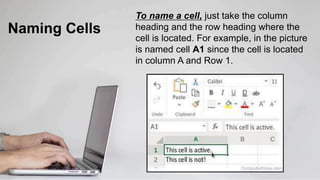
To name a cell, just take the column
heading and the row heading where the
cell is located. For example, in the picture
is named cell A1 since the cell is located
in column A and Row 1.
Naming Cells
To name a group of adjacent cells, just
take the name of the first cell, followed by
a colon, and then take the name of the last
cell. For example, the group of adjacent
cells is named A1:B3 since the first cell is
located in Column A and Row 1 and is
named A1, and the last cell is located in
Column B and Row 3 and is named B3.
these two are then separated by a colon.
Naming Cells
To name a group of non-adjacent cells,
just take the name of the different groups
of cells and separate them by a comma.
For example, the group of non-adjacent
cells is named as a cell A1:B3, D1:D2
since the first group of cells is named as
A1:B3 and the other group of cells is
named D1:D2. These two are then
separated by a comma.
Select Cells Selecting cell/s is the process of highlighting a
cell or group cells.
To select a cell, just click the cell that you want
to activate or you may press the arrow keys to
move to the cell.
To select group of adjacent cells, click exactly
the center of the first cell then drag to the last
cell, or you may hold down SHIFT while the
ARROW KEY extends the selection.
Remember that when highlighting, your mouse pointer should look like a fat cross.
Select Cells
To select a group of non-adjacent cells, just
select the first cell or group of cells and then
hold down the CTRL key while selecting the
other group of cells.
To select all the cells in a worksheet, just
click the SELECT ALL button or press CTRL+A.
Entering Data
DATA can be in form of text,
date, time, numbers, or a
combination of these.
To enter data, follow the steps:
1. On the worksheet/spreadsheet, click a cell where you would like to
enter the data.
2. Do one of the following:
 To enter text or numbers
- type the text or numbers, and then press ENTER or TAB
 To enter the date
- use a slash or hyphen to separate the parts of a date (e.g.
5/19/2022. 4-Nov-22) and then press ENTER or TAB.
 To enter the time
- Type the time followed by a space, and then type a or p after
the time which indicates whether it is AM or PM (e.g. 1:00 p.), and
then press ENTER or TAB.
01
Select the cells where you want to enter the
same data.
02 Type the data in the active cell.
03 Press CTRL+ ENTER
In entering the same
data into Several Cells
at the same time.
Editing Cell
Contents
Once you are editing the cell contents, Excel is
actually operating in the Edit mode. There are
three ways of editing cell contents. You can
apply any of the following steps to enter in the
Edit Mode.
01 Double-click the cell that contains the
data that you want to edit. This
positions the cursor in the cell where
you double-clicked. The cell contents
are also displayed in the formula bar.
02 Click the cell that contains the data you
want to edit, and then click anywhere in
the formula bar. This positions the
cursor in the formula bar where you
clicked.
03 Click the cell that contains the data that you want to
edit, and then press F12. the positions of the cursor
at the end of the cell contents.
Online Delivery Service.PPt

Online Delivery Service.PPt

  • 1.
  • 2.
    MS EXCEL isan application program used to create spreadsheets that deal with numerical data more efficiently.
  • 4.
    Functions of theMS Excel Screen Elements All you have to remember when you want to use MS Excel quickly and easier is to get acquainted with the functions of the screen elements that are presented.
  • 5.
    Office Button 01 This button isused to open, save or print and to see everything else you can do with your workbook. Quick Access Toolbar 02 This toolbar provides shortcut buttons for common commands to achieve easier access. It also allows the user to customize the equivalent keyboard shortcuts of the commands Title Bar 03 This bar displays the program name which is the Microsoft Excel and the name of the workbook. BOOK1 is the default filename of an Excel Workbook.
  • 6.
    Minimize button 04 It shrinks thewindow to a button on the taskbar. To reopen it, just click its button on the taskbar. Maximize button 05 This button enlarges the program window filling the entire screen. As you click this button, it changes to restore down button which is used to bring back the original size of the window. Close Button 06 The close button exits the application window.
  • 7.
    Ribbon 07 This is abar across the top of the window which contains the tabbed pages of commands and buttons. It replaces the previous versions which menu bar and drop-down menu. Row and column heading 08 It serves as a guide in naming the cells in a worksheet. Active cell 09 This cell is the selected cell in a worksheet.
  • 8.
    Vertical and Horizontal Scrollbar 10 It isused to scroll the sheet up or down and left to right to see the information that is currently out of view. Worksheet 11 This is where you can work with your workbook. Status bar 12 It reports information about the workbook or any operation in progress and provides shortcuts for changing the view and the zoom.
  • 9.
    View button 13 These arebuttons used to view the workbook in different layouts. Zoom level 14 This is used to change the zoom level of a workbook.
  • 10.
    Naming Cells A workbookconsists of worksheets and worksheets consist of cells. A cell is the intersection of a row and a column
  • 11.
    Naming Cells Each worksheethas column headings to name the columns, and row headings to name the rows. In MS Excel office, there are 16,384 columns in one worksheet that is columns A-Z, AA-AZ, BA-BZ… XFA- XFD. There are also about 1,048,576 rows in one worksheet. Multiplying the number of columns and rows, would give you about 17.17 billion cells in a single worksheet.
  • 12.
    Naming Cells With thatnumber of cells in a worksheet, it is just proper for every user to know how to name them before one can finally create a workbook. This is also especially helpful when you enter formulas and functions which will be discussed in the latter part of this chapter.
  • 13.
    Naming Cells To namea cell, just take the column heading and the row heading where the cell is located. For example, in the picture is named cell A1 since the cell is located in column A and Row 1.
  • 14.
    Naming Cells To namea group of adjacent cells, just take the name of the first cell, followed by a colon, and then take the name of the last cell. For example, the group of adjacent cells is named A1:B3 since the first cell is located in Column A and Row 1 and is named A1, and the last cell is located in Column B and Row 3 and is named B3. these two are then separated by a colon.
  • 15.
    Naming Cells To namea group of non-adjacent cells, just take the name of the different groups of cells and separate them by a comma. For example, the group of non-adjacent cells is named as a cell A1:B3, D1:D2 since the first group of cells is named as A1:B3 and the other group of cells is named D1:D2. These two are then separated by a comma.
  • 16.
    Select Cells Selectingcell/s is the process of highlighting a cell or group cells. To select a cell, just click the cell that you want to activate or you may press the arrow keys to move to the cell. To select group of adjacent cells, click exactly the center of the first cell then drag to the last cell, or you may hold down SHIFT while the ARROW KEY extends the selection. Remember that when highlighting, your mouse pointer should look like a fat cross.
  • 17.
    Select Cells To selecta group of non-adjacent cells, just select the first cell or group of cells and then hold down the CTRL key while selecting the other group of cells. To select all the cells in a worksheet, just click the SELECT ALL button or press CTRL+A.
  • 18.
    Entering Data DATA canbe in form of text, date, time, numbers, or a combination of these. To enter data, follow the steps:
  • 19.
    1. On theworksheet/spreadsheet, click a cell where you would like to enter the data. 2. Do one of the following:  To enter text or numbers - type the text or numbers, and then press ENTER or TAB  To enter the date - use a slash or hyphen to separate the parts of a date (e.g. 5/19/2022. 4-Nov-22) and then press ENTER or TAB.  To enter the time - Type the time followed by a space, and then type a or p after the time which indicates whether it is AM or PM (e.g. 1:00 p.), and then press ENTER or TAB.
  • 20.
    01 Select the cellswhere you want to enter the same data. 02 Type the data in the active cell. 03 Press CTRL+ ENTER In entering the same data into Several Cells at the same time.
  • 21.
    Editing Cell Contents Once youare editing the cell contents, Excel is actually operating in the Edit mode. There are three ways of editing cell contents. You can apply any of the following steps to enter in the Edit Mode.
  • 22.
    01 Double-click thecell that contains the data that you want to edit. This positions the cursor in the cell where you double-clicked. The cell contents are also displayed in the formula bar. 02 Click the cell that contains the data you want to edit, and then click anywhere in the formula bar. This positions the cursor in the formula bar where you clicked. 03 Click the cell that contains the data that you want to edit, and then press F12. the positions of the cursor at the end of the cell contents.