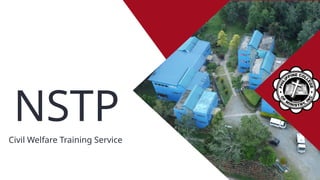
Civil Welfare Training Service
NSTP
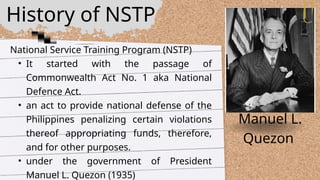
National Service Training Program (NSTP)
• It started with the passage of
Commonwealth Act No. 1 aka National
Defence Act.
• an act to provide national defense of the
Philippines penalizing certain violations
thereof appropriating funds, therefore,
and for other purposes.
• under the government of President
Manuel L. Quezon (1935)
Manuel L.
Quezon
History of NSTP
COMMONWEALTH ACT NO. REQUIRES:
• College students, specifically males
• finish 2 years or 4 semesters of
Military Training to be reserved cadets
of the National Defence of the
country
August 8, 1980, the Commonwealth Act No. 1 was amended to
give existence to
• Presidential Decree No. 1790 or National Service Law
• Mandates compulsory national service to all citizens of the
county
• composed of three main component programs, namely:
⚬ Civic Welfare Service (CWTS),
⚬ Law Enforcement Service (LES), and
⚬ Military Service.
• College students were allowed to choose one among these
components to comply as a tertiary education requirement.
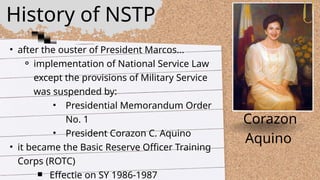
• after the ouster of President Marcos...
⚬ implementation of National Service Law
except the provisions of Military Service
was suspended by:
• Presidential Memorandum Order
No. 1
• President Corazon C. Aquino
• it became the Basic Reserve Officer Training
Corps (ROTC)
■ Effectie on SY 1986-1987
Corazon
Aquino
History of NSTP
In the year 1991...
⚬ the Implementing Rules and Regulations of Republic Act
7077 modified the:
• Basic ROTC course to Expanded ROTC Program as
mandated
• the modification is composed of military subjects in
the first year and any of the following components:
• MTS, CWTS, and LES in the secondary year
curriculum
On March 18, 2001
• A dead body was found wrapped in a carpet and floating in the
Pasig river
⚬ the face was wrapped in packing tape and the hands and
face were bounded
⚬ the body was identified as Mark Welson Chua, 19-year-old
⚬ engineering student
⚬ university of Santo Tomas (UST)
⚬ reportedly a victim of illegal ROTC practices leading to a
massive protest of the college students and concerned
parents against the ROTC program.
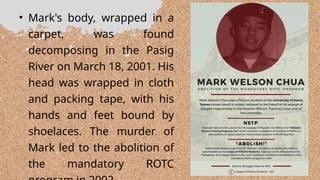
• Mark's body, wrapped in a
carpet, was found
decomposing in the Pasig
River on March 18, 2001. His
head was wrapped in cloth
and packing tape, with his
hands and feet bound by
shoelaces. The murder of
Mark led to the abolition of
the mandatory ROTC
• Comprises of three program
component:
⚬ Civic Welfare Training
Service (CWTS)
⚬ Literacy Training Services
(LTS)
⚬ Reserve Officer Training
Corps (ROTC)
• A new and latest amendment
was brought for creating the
Republic Act 9163
⚬ also known as the National
Service Training Program
⚬ signed into law on July 23,
2001
⚬ implemented in SY 2002-
2003
July 23, 2001
Republic Act
No. 9163
The act shall known as the ...
“ National Service Training Program (NSTP) of 2001”
• an act establishing the NSTP for tertiary students, amending
the RA 7077 and PD 1906, and other purposes.
• NSTP is designed to develop and enhance consciousness and
defense preparedness among Filipino youth by developing the
ethics of service, nationalism, and patriotism while training in
any of its three program components.
a) RESERVE OFFICER TRAINING CORPS (ROTC)
• Designed to give military training to tertiary-level
students
• Aims to motivate, train, organize, and mobilize
them for national preparedness
b.) LITERACY TRAINING SERVICE (LTS)
• Designed to train the students to become teachers
of literacy and numeracy skills
• focuses on school children, out-of-school youth,
and other segments of society
c.) CIVIL WELFARE TRAINING SERVICE (CWTS)
• Contributory to the general welfare and
betterment of life for the members of the
community
• Or for enhancement of its facilities, especially those
devoted to improving health, education,
environment, entrepreneurship, safety, recreation,
COMPONENT
S of NSTP
For courses involving
military services though
optional, it is highly
recommended to take
the Reserve Officers
Training Corps (ROTC).
All incoming freshmen
students are required
and may choose among
the three components.

IRR
OF
NSTP
under section 12 of Republic Act No. 9163 otherwise known as the
National Service Training Program (NSTP) Act of 2001, the
Commission on Higher Education (CHED), Technical Education and
Skills Development Authority (TESDA), and Department of National
Defense (DND), in consultation with concern government agencies,
the Philippine Association of State Universities and Colleges (PASUC),
Coordinating Council of Private Educational Association of the
Philippines (COCOPEA), Non- Government Organizations (NGOs) and
recognized student organization, hereby jointly issue, adopt and
promulgate the following implementing rules and regulation to
implement the provision of the Act.
Implementing Rules and regulations of the National Service Training
Program
What is the prime duty of
the government to its
citizens?
RULE: I - Guiding
Principles
RULE: I - Guiding
Principles
SECTION 1: Guiding Principle:
while it is the prime duty of the government to serve and
protect its citizens, in turn, it shall be the responsibility of all
citizens to defend the security of the state, and in fulfillment
thereof, the government may require each citizen to render
personal, military or civil service.
How does the government
recognize to the role of
the youth in nation-
building?
RULE: I - Guiding
Principles
SECTION 2: Role of the Youth
in recognition of the vital of the youth in nation-building, the
state shall promote civic consciousness among them and shall
develop their physical, moral, spiritual, intellectual, and social
well-being. it shall inculcate the ideas of patriotism, and
nationalism, and advance their involvement in public and civic
affairs.
as the most valuable resource of the nations, youth, shall be
motivated, trained, organized and get involved in the military,
literacy, civic welfare program, and other similar endeavors in
the service of the nation.
DEFINITIO
N
TERM
OF
RULE -II
Section 3 - Used in this implementing
Rules and Regulation (IRR), the following
terms shall mean:
A. NATIONAL SERVICE TRAINING PROGRAM (NSTP)
• refers to the program aimed at enhancing civic
consciousness and defense preparedness in the
youth, by developing the ethics of the three (3)
program components specifically designed to
enhance the youth’s active contribution to the
general welfare.
Section 3 - Used in this implementing
Rules and Regulation (IRR), the following
terms shall mean:
B. RESERVE OFFICERS’ TRAINING CORPS (ROTC)
• refers to the program component, institutionalized
under sections 38 and 39 of Republic Act No., 7077,
designed to prove military training to tertiary-level
students to motivate, train, organize, and mobilize
them for national defense preparedness.
Section 3 - Used in this implementing
Rules and Regulation (IRR), the following
terms shall mean:
C. LITERACY TRAINING SERVICE (LTS)
• refers to the program component designed to train
the students to teach literacy and numeracy skills to
school children, out-of-school youths, and other
segments of society which is considerably in need of
their services.
Section 3 - Used in this implementing
Rules and Regulation (IRR), the following
terms shall mean:
D. CIVIC WELFARE TRAINING SERVICES (CWTS)
• refers to the program component of activities
contributing to the general welfare and the betterment
of life for the members of the community or the
enhancement of their facilities, especially those
devoted to improving health, education environment,
entrepreneurship, safety, recreation and moral of the
citizenry and other social welfare services.
Section 3 - Used in this implementing
Rules and Regulation (IRR), the following
terms shall mean:
E. PROGRAM COMPONENT
• refers to the service components of the NSTP as
defined herein.
F. CLUSTERING
• Refers to the grouping of students enrolled in different
schools and taking up the same NSTP component into
one (1) group under the management and supervision of
the designated school.
Section 3 - Used in this implementing
Rules and Regulation (IRR), the following
terms shall mean:
G. CROSS ENROLLMENT
• refers to the system of enrollment where a student is
officially enrolled in an academic program of a school
but allowed to enroll in the NSTP component of other
school, and
Section 3 - Used in this implementing
Rules and Regulation (IRR), the following
terms shall mean:
H. NON-GOVERNMENT ORGANIZATION (NGO)
• refers to any private organization duly accredited by
CHED or recognized by TESDA.
PROGRAM
IMPLEMENTA
TION
RULE -III
who are required to
complete one (1) NSTP
component of their choice
as a graduation
requirements?
Section 4: Coverage
All incoming freshmen students, male and female,
stating school year (SY) 2002-2003, enrolled in any
baccalaureate and at least two (2) year technical -
vocational or associate courses, are required to complete
one (1) NSTP component of their choice, as a graduation
requirement.
Section 4: Coverage
a. All higher and technical vocational educational
institutions must offer at least one (1) of the NSTP
component.
b. State Universities and Colleges (SUCs), shall offer the
ROTC component and at least one (1) other NSTP
component.
Section 4: Coverage
c. The Philippine Military Academy (PMA), Philippine
Merchant Marine Academy (PMMA), Philippine National
Police Academy (PNPA), and other SUCs of similar
nature, in view of the special character of this
constitution are exempted from the NSTP.
Section 4: Coverage
d. Private higher and technical-vocational education
institutions with at least(350) student cadets may offer
the ROTC component and consequently
establish/maintain a Department of Military Science and
Tactics (DMST), subject to the existing rules and
regulations of the armed force of the Philippines (AFP).
what is the duration of the
NSTP components and
equivalent course per
semester?
Section 6: Duration and Equivalent
Course Unit
a. each of aforementioned NSTP components shall be
undertaken for an academic period of two (2) semesters.
it shall be credited three (3) units per semester, for a
duration of fifty-four (54) to ninety (90) training hours
per semester.
Section 6: Duration and Equivalent
Course Unit
b. one (1) summer program in lieu of two (2) semester
program may be designed, formulated and adopted by
the DND, CHED, and TESDA. however, it will be subjected
to the capability of the school and the AFP to handle the
same.
ORGANIZA
TION
NSTP
GRADUATES
of
Section: 11, Organization of NSTP
graduates.
a. Graduates of the non-ROTC components of the NSTP
shall belong to the National Service Reserve Corps
(NSRC) that could be tapped by the state for literacy and
civic welfare activities through the joint efforts of DND,
CHED, and TESDA in coordination with DILG, DSWD and
other concerned agencies/associations.
Section: 11, Organization of NSTP
graduates.
b. the CHED, TESDA, and DND, in consultation with other
concerned government and non-government agencies,
shall issue the necessary guidelines for the
establishment, organization, maintenance, and
utilization of the National Service Reserve Corps.
Section: 11, Organization of NSTP
graduates.
c. Graduates of the ROTC program shall for part of the
Citizen Armed Force under R.A. 7077, subject to the
requirements of DND.

National Service Training Program (CWTS) pptx

  • 1.
  • 2.
    National Service TrainingProgram (NSTP) • It started with the passage of Commonwealth Act No. 1 aka National Defence Act. • an act to provide national defense of the Philippines penalizing certain violations thereof appropriating funds, therefore, and for other purposes. • under the government of President Manuel L. Quezon (1935) Manuel L. Quezon History of NSTP
  • 3.
    COMMONWEALTH ACT NO.REQUIRES: • College students, specifically males • finish 2 years or 4 semesters of Military Training to be reserved cadets of the National Defence of the country
  • 4.
    August 8, 1980,the Commonwealth Act No. 1 was amended to give existence to • Presidential Decree No. 1790 or National Service Law • Mandates compulsory national service to all citizens of the county • composed of three main component programs, namely: ⚬ Civic Welfare Service (CWTS), ⚬ Law Enforcement Service (LES), and ⚬ Military Service. • College students were allowed to choose one among these components to comply as a tertiary education requirement.
  • 5.
    • after theouster of President Marcos... ⚬ implementation of National Service Law except the provisions of Military Service was suspended by: • Presidential Memorandum Order No. 1 • President Corazon C. Aquino • it became the Basic Reserve Officer Training Corps (ROTC) ■ Effectie on SY 1986-1987 Corazon Aquino History of NSTP
  • 6.
    In the year1991... ⚬ the Implementing Rules and Regulations of Republic Act 7077 modified the: • Basic ROTC course to Expanded ROTC Program as mandated • the modification is composed of military subjects in the first year and any of the following components: • MTS, CWTS, and LES in the secondary year curriculum
  • 7.
    On March 18,2001 • A dead body was found wrapped in a carpet and floating in the Pasig river ⚬ the face was wrapped in packing tape and the hands and face were bounded ⚬ the body was identified as Mark Welson Chua, 19-year-old ⚬ engineering student ⚬ university of Santo Tomas (UST) ⚬ reportedly a victim of illegal ROTC practices leading to a massive protest of the college students and concerned parents against the ROTC program.
  • 8.
    • Mark's body,wrapped in a carpet, was found decomposing in the Pasig River on March 18, 2001. His head was wrapped in cloth and packing tape, with his hands and feet bound by shoelaces. The murder of Mark led to the abolition of the mandatory ROTC
  • 9.
    • Comprises ofthree program component: ⚬ Civic Welfare Training Service (CWTS) ⚬ Literacy Training Services (LTS) ⚬ Reserve Officer Training Corps (ROTC) • A new and latest amendment was brought for creating the Republic Act 9163 ⚬ also known as the National Service Training Program ⚬ signed into law on July 23, 2001 ⚬ implemented in SY 2002- 2003
  • 10.
  • 11.
    The act shallknown as the ... “ National Service Training Program (NSTP) of 2001” • an act establishing the NSTP for tertiary students, amending the RA 7077 and PD 1906, and other purposes. • NSTP is designed to develop and enhance consciousness and defense preparedness among Filipino youth by developing the ethics of service, nationalism, and patriotism while training in any of its three program components.
  • 12.
    a) RESERVE OFFICERTRAINING CORPS (ROTC) • Designed to give military training to tertiary-level students • Aims to motivate, train, organize, and mobilize them for national preparedness b.) LITERACY TRAINING SERVICE (LTS) • Designed to train the students to become teachers of literacy and numeracy skills • focuses on school children, out-of-school youth, and other segments of society c.) CIVIL WELFARE TRAINING SERVICE (CWTS) • Contributory to the general welfare and betterment of life for the members of the community • Or for enhancement of its facilities, especially those devoted to improving health, education, environment, entrepreneurship, safety, recreation, COMPONENT S of NSTP For courses involving military services though optional, it is highly recommended to take the Reserve Officers Training Corps (ROTC). All incoming freshmen students are required and may choose among the three components.
  • 13.
  • 14.
    under section 12of Republic Act No. 9163 otherwise known as the National Service Training Program (NSTP) Act of 2001, the Commission on Higher Education (CHED), Technical Education and Skills Development Authority (TESDA), and Department of National Defense (DND), in consultation with concern government agencies, the Philippine Association of State Universities and Colleges (PASUC), Coordinating Council of Private Educational Association of the Philippines (COCOPEA), Non- Government Organizations (NGOs) and recognized student organization, hereby jointly issue, adopt and promulgate the following implementing rules and regulation to implement the provision of the Act. Implementing Rules and regulations of the National Service Training Program
  • 15.
    What is theprime duty of the government to its citizens? RULE: I - Guiding Principles
  • 16.
    RULE: I -Guiding Principles SECTION 1: Guiding Principle: while it is the prime duty of the government to serve and protect its citizens, in turn, it shall be the responsibility of all citizens to defend the security of the state, and in fulfillment thereof, the government may require each citizen to render personal, military or civil service.
  • 17.
    How does thegovernment recognize to the role of the youth in nation- building? RULE: I - Guiding Principles
  • 18.
    SECTION 2: Roleof the Youth in recognition of the vital of the youth in nation-building, the state shall promote civic consciousness among them and shall develop their physical, moral, spiritual, intellectual, and social well-being. it shall inculcate the ideas of patriotism, and nationalism, and advance their involvement in public and civic affairs. as the most valuable resource of the nations, youth, shall be motivated, trained, organized and get involved in the military, literacy, civic welfare program, and other similar endeavors in the service of the nation.
  • 19.
  • 20.
    Section 3 -Used in this implementing Rules and Regulation (IRR), the following terms shall mean: A. NATIONAL SERVICE TRAINING PROGRAM (NSTP) • refers to the program aimed at enhancing civic consciousness and defense preparedness in the youth, by developing the ethics of the three (3) program components specifically designed to enhance the youth’s active contribution to the general welfare.
  • 21.
    Section 3 -Used in this implementing Rules and Regulation (IRR), the following terms shall mean: B. RESERVE OFFICERS’ TRAINING CORPS (ROTC) • refers to the program component, institutionalized under sections 38 and 39 of Republic Act No., 7077, designed to prove military training to tertiary-level students to motivate, train, organize, and mobilize them for national defense preparedness.
  • 22.
    Section 3 -Used in this implementing Rules and Regulation (IRR), the following terms shall mean: C. LITERACY TRAINING SERVICE (LTS) • refers to the program component designed to train the students to teach literacy and numeracy skills to school children, out-of-school youths, and other segments of society which is considerably in need of their services.
  • 23.
    Section 3 -Used in this implementing Rules and Regulation (IRR), the following terms shall mean: D. CIVIC WELFARE TRAINING SERVICES (CWTS) • refers to the program component of activities contributing to the general welfare and the betterment of life for the members of the community or the enhancement of their facilities, especially those devoted to improving health, education environment, entrepreneurship, safety, recreation and moral of the citizenry and other social welfare services.
  • 24.
    Section 3 -Used in this implementing Rules and Regulation (IRR), the following terms shall mean: E. PROGRAM COMPONENT • refers to the service components of the NSTP as defined herein. F. CLUSTERING • Refers to the grouping of students enrolled in different schools and taking up the same NSTP component into one (1) group under the management and supervision of the designated school.
  • 25.
    Section 3 -Used in this implementing Rules and Regulation (IRR), the following terms shall mean: G. CROSS ENROLLMENT • refers to the system of enrollment where a student is officially enrolled in an academic program of a school but allowed to enroll in the NSTP component of other school, and
  • 26.
    Section 3 -Used in this implementing Rules and Regulation (IRR), the following terms shall mean: H. NON-GOVERNMENT ORGANIZATION (NGO) • refers to any private organization duly accredited by CHED or recognized by TESDA.
  • 27.
  • 28.
    who are requiredto complete one (1) NSTP component of their choice as a graduation requirements?
  • 29.
    Section 4: Coverage Allincoming freshmen students, male and female, stating school year (SY) 2002-2003, enrolled in any baccalaureate and at least two (2) year technical - vocational or associate courses, are required to complete one (1) NSTP component of their choice, as a graduation requirement.
  • 30.
    Section 4: Coverage a.All higher and technical vocational educational institutions must offer at least one (1) of the NSTP component. b. State Universities and Colleges (SUCs), shall offer the ROTC component and at least one (1) other NSTP component.
  • 31.
    Section 4: Coverage c.The Philippine Military Academy (PMA), Philippine Merchant Marine Academy (PMMA), Philippine National Police Academy (PNPA), and other SUCs of similar nature, in view of the special character of this constitution are exempted from the NSTP.
  • 32.
    Section 4: Coverage d.Private higher and technical-vocational education institutions with at least(350) student cadets may offer the ROTC component and consequently establish/maintain a Department of Military Science and Tactics (DMST), subject to the existing rules and regulations of the armed force of the Philippines (AFP).
  • 33.
    what is theduration of the NSTP components and equivalent course per semester?
  • 34.
    Section 6: Durationand Equivalent Course Unit a. each of aforementioned NSTP components shall be undertaken for an academic period of two (2) semesters. it shall be credited three (3) units per semester, for a duration of fifty-four (54) to ninety (90) training hours per semester.
  • 35.
    Section 6: Durationand Equivalent Course Unit b. one (1) summer program in lieu of two (2) semester program may be designed, formulated and adopted by the DND, CHED, and TESDA. however, it will be subjected to the capability of the school and the AFP to handle the same.
  • 36.
  • 37.
    Section: 11, Organizationof NSTP graduates. a. Graduates of the non-ROTC components of the NSTP shall belong to the National Service Reserve Corps (NSRC) that could be tapped by the state for literacy and civic welfare activities through the joint efforts of DND, CHED, and TESDA in coordination with DILG, DSWD and other concerned agencies/associations.
  • 38.
    Section: 11, Organizationof NSTP graduates. b. the CHED, TESDA, and DND, in consultation with other concerned government and non-government agencies, shall issue the necessary guidelines for the establishment, organization, maintenance, and utilization of the National Service Reserve Corps.
  • 39.
    Section: 11, Organizationof NSTP graduates. c. Graduates of the ROTC program shall for part of the Citizen Armed Force under R.A. 7077, subject to the requirements of DND.