CASE TITLEThe Devastating Fire That Engulfed The ONGC Mumbai High North PlatformPresentation to Dr. Mandira Aggarwal, Faculty HSEMuzahid KhanIntegrated BBA + MBA (Oil & Gas Management), 2007-11muzahidkhan123@gmail.com
HSE Foretalk(w.r.t the Case)OIL AND  NATURAL GAS CORPORATION LIMITED@
HSE Management System in ONGCIs top driven efficient
Effective and vibrant management system.
Top management  is committed for maintaining highest HSE standards
HSE Committee Board comprises of members of Board from ONGC including representative from Ministry of Petroleum and Natural Gas.
A dedicated HSE website has been developed for creating awareness among company employees
ONGC has Institute of Petroleum Safety Health and Environment Management (IPSHEM) the nodal institute which deals with all HSE related trainingsONGC HSE PolicyWe are committed to maintain highest standards of Occupational health, safety and environment protection.
We shall comply with all applicable codes and requirements to promote occupational health, safety and environment protection.
We shall be always alert, equipped and ready to respond to emergencies.
We shall take all actions necessary to protect the integrity of the system in order to avoid accidental release of hazardous substances.
We shall enhance awareness and involvement in promotion of occupational health, safety and environment protection wherever we work and reside.4 PHASE ANALYSIS OF THE CASEIntroduction: Mumbai High NorthThe AccidentAftermath (Key Safety Issues)Conclusion
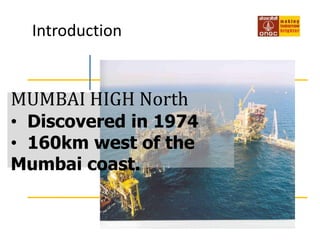
IntroductionMUMBAI HIGH North  Discovered in 1974
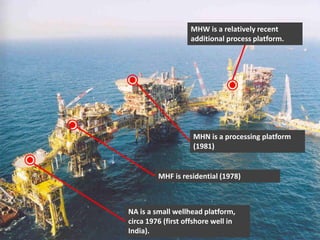
  160km west of the Mumbai coast.MHW is a relatively recent additional process platform. MHN is a processing platform (1981)MHF is residential (1978)NA is a small wellhead platform, circa 1976 (first offshore well in India).
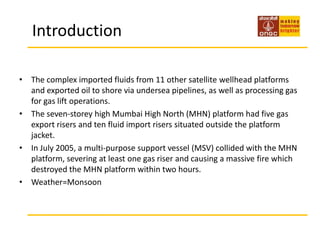
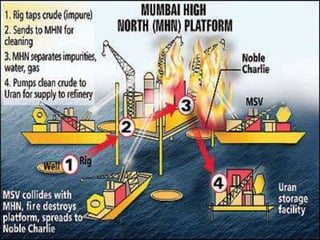
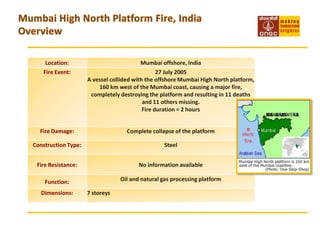
IntroductionThe complex imported fluids from 11 other satellite wellhead platforms and exported oil to shore via undersea pipelines, as well as processing gas for gas lift operations. The seven-storey high Mumbai High North (MHN) platform had five gas export risers and ten fluid import risers situated outside the platform jacket. In July 2005, a multi-purpose support vessel (MSV) collided with the MHN platform, severing at least one gas riser and causing a massive fire which destroyed the MHN platform within two hours.Weather=Monsoon
Mumbai High North Platform Fire, IndiaOverview
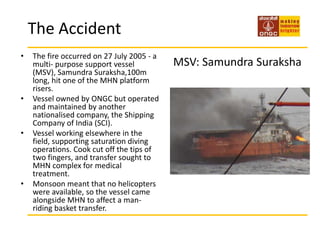
The AccidentThe fire occurred on 27 July 2005 - a multi- purpose support vessel (MSV), Samundra Suraksha,100m long, hit one of the MHN platform risers.Vessel owned by ONGC but operated and maintained by another nationalised company, the Shipping Company of India (SCI).Vessel working elsewhere in the field, supporting saturation diving operations. Cook cut off the tips of two fingers, and transfer sought to MHN complex for medical treatment.Monsoon meant that no helicopters were available, so the vessel came alongside MHN to affect a man-riding basket transfer. MSV: SamundraSuraksha
The AccidentLeeward crane on MHN was not working, so vessel came onto the windward side (wind 35 knots, swell 5 metres, sea current 3 knots). Problems with azimuth thrusters – came alongside under manual (joy stick) control in emergency mode, stern first. The casualty was transferred off the deck by craneThe vessel experienced a strong heave, and the helideck struck the risers (export gas lift).The resulting leak ignited very quickly afterwards. The resulting fire engulfed virtually all of MHN and MHF, with NA and the Noble rig severely affected by heat radiation.

Ongc mumbai high accident

  • 1.
    CASE TITLEThe DevastatingFire That Engulfed The ONGC Mumbai High North PlatformPresentation to Dr. Mandira Aggarwal, Faculty HSEMuzahid KhanIntegrated BBA + MBA (Oil & Gas Management), 2007-11muzahidkhan123@gmail.com
  • 2.
    HSE Foretalk(w.r.t theCase)OIL AND NATURAL GAS CORPORATION LIMITED@
  • 3.
    HSE Management Systemin ONGCIs top driven efficient
  • 4.
    Effective and vibrantmanagement system.
  • 5.
    Top management is committed for maintaining highest HSE standards
  • 6.
    HSE Committee Boardcomprises of members of Board from ONGC including representative from Ministry of Petroleum and Natural Gas.
  • 7.
    A dedicated HSEwebsite has been developed for creating awareness among company employees
  • 8.
    ONGC has Instituteof Petroleum Safety Health and Environment Management (IPSHEM) the nodal institute which deals with all HSE related trainingsONGC HSE PolicyWe are committed to maintain highest standards of Occupational health, safety and environment protection.
  • 9.
    We shall complywith all applicable codes and requirements to promote occupational health, safety and environment protection.
  • 10.
    We shall bealways alert, equipped and ready to respond to emergencies.
  • 11.
    We shall takeall actions necessary to protect the integrity of the system in order to avoid accidental release of hazardous substances.
  • 12.
    We shall enhanceawareness and involvement in promotion of occupational health, safety and environment protection wherever we work and reside.4 PHASE ANALYSIS OF THE CASEIntroduction: Mumbai High NorthThe AccidentAftermath (Key Safety Issues)Conclusion
  • 13.
  • 14.
    160kmwest of the Mumbai coast.MHW is a relatively recent additional process platform. MHN is a processing platform (1981)MHF is residential (1978)NA is a small wellhead platform, circa 1976 (first offshore well in India).
  • 15.
    IntroductionThe complex importedfluids from 11 other satellite wellhead platforms and exported oil to shore via undersea pipelines, as well as processing gas for gas lift operations. The seven-storey high Mumbai High North (MHN) platform had five gas export risers and ten fluid import risers situated outside the platform jacket. In July 2005, a multi-purpose support vessel (MSV) collided with the MHN platform, severing at least one gas riser and causing a massive fire which destroyed the MHN platform within two hours.Weather=Monsoon
  • 17.
    Mumbai High NorthPlatform Fire, IndiaOverview
  • 18.
    The AccidentThe fireoccurred on 27 July 2005 - a multi- purpose support vessel (MSV), Samundra Suraksha,100m long, hit one of the MHN platform risers.Vessel owned by ONGC but operated and maintained by another nationalised company, the Shipping Company of India (SCI).Vessel working elsewhere in the field, supporting saturation diving operations. Cook cut off the tips of two fingers, and transfer sought to MHN complex for medical treatment.Monsoon meant that no helicopters were available, so the vessel came alongside MHN to affect a man-riding basket transfer. MSV: SamundraSuraksha
  • 19.
    The AccidentLeeward craneon MHN was not working, so vessel came onto the windward side (wind 35 knots, swell 5 metres, sea current 3 knots). Problems with azimuth thrusters – came alongside under manual (joy stick) control in emergency mode, stern first. The casualty was transferred off the deck by craneThe vessel experienced a strong heave, and the helideck struck the risers (export gas lift).The resulting leak ignited very quickly afterwards. The resulting fire engulfed virtually all of MHN and MHF, with NA and the Noble rig severely affected by heat radiation.