On Cooking: A Textbook of Culinary
Fundamentals
Sixth Edition
Chapter 8
Dairy Products
Copyright © 2019, 2015, 2012, 2009 Pearson Education, Inc. All Rights Reserved
Learning Objectives
After studying this chapter, you will be able to
8.1 Identify, store and cook with a variety of milk and milk-
based products
8.2 Describe basic cheese-making processes
8.3 Classify the characteristics of the five categories of fine
cheeses: fresh or unripened, soft, semisoft, firm and hard
8.4 Describe the characteristics of goat’s-milk cheeses
8.5 Identify, store and serve fine cheeses
Copyright © 2019, 2015, 2012, 2009 Pearson Education, Inc. All Rights Reserved
Milk and Milk Products
• Provides texture, flavor, color and nutritional value for
cooked or baked items
• Whole milk contains
– 88% water
– 3.5% milk fat
– 8.5% milk solids
• Whole milk is graded A, B or C
Copyright © 2019, 2015, 2012, 2009 Pearson Education, Inc. All Rights Reserved
Milk-Processing Techniques (1 of 2)
• Pasteurization
– Process of heating milk to a sufficiently high
temperature for a sufficient length of time to destroy
pathogenic bacteria
• Ultra-pasteurization
– Process by which milk is heated to a very high
temperature for a very short time
Copyright © 2019, 2015, 2012, 2009 Pearson Education, Inc. All Rights Reserved
Milk-Processing Techniques (2 of 2)
• Ultra-high-temperature processing (UHT)
– Process by which milk is heated to a very high
temperature for a short period of time and is then
packaged in sterile packages under sterile conditions
• Homogenization
– Process in which the fat globules in whole milk are
reduced in size and permanently dispersed
throughout the liquid
Copyright © 2019, 2015, 2012, 2009 Pearson Education, Inc. All Rights Reserved
Milk Fat Removal
Whole milk can be processed in a centrifuge to remove fat.
• Reduced-fat
– 2%
• Low-fat
– 1%
• Nonfat
– 0%
Copyright © 2019, 2015, 2012, 2009 Pearson Education, Inc. All Rights Reserved
Concentrated Milks
• Whole milk can be processed using a vacuum to remove
some or all of the water.
• Evaporated
– 60% of the water is removed
• Sweetened condensed
– 60% of the water is removed and 40%-45% sugar has
been added
• Dry milk powder
– Virtually all of the water has been removed
Copyright © 2019, 2015, 2012, 2009 Pearson Education, Inc. All Rights Reserved
Safety Alert - Milk Storage
• Canned milk, aseptically-packaged milk and dry milk
powder are shelf-stable. They need no refrigeration
• After opening or reconstituting, milk products become (T
CS) foods
– time and temperature controlled for safety
• Refrigerate at or below 41°Fahrenheit
Copyright © 2019, 2015, 2012, 2009 Pearson Education, Inc. All Rights Reserved
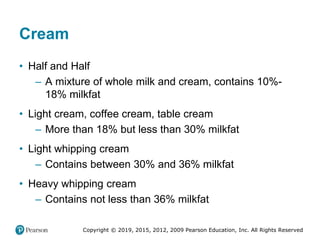
Cream
• Half and Half
– A mixture of whole milk and cream, contains 10%-
18% milkfat
• Light cream, coffee cream, table cream
– More than 18% but less than 30% milkfat
• Light whipping cream
– Contains between 30% and 36% milkfat
• Heavy whipping cream
– Contains not less than 36% milkfat
Copyright © 2019, 2015, 2012, 2009 Pearson Education, Inc. All Rights Reserved
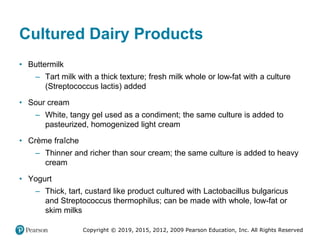
Cultured Dairy Products
• Buttermilk
– Tart milk with a thick texture; fresh milk whole or low-fat with a culture
(Streptococcus lactis) added
• Sour cream
– White, tangy gel used as a condiment; the same culture is added to
pasteurized, homogenized light cream
• Crème fraîche
– Thinner and richer than sour cream; the same culture is added to heavy
cream
• Yogurt
– Thick, tart, custard like product cultured with Lactobacillus bulgaricus
and Streptococcus thermophilus; can be made with whole, low-fat or
skim milks
Copyright © 2019, 2015, 2012, 2009 Pearson Education, Inc. All Rights Reserved
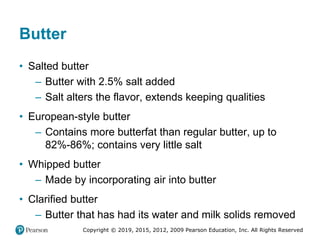
Butter
• Salted butter
– Butter with 2.5% salt added
– Salt alters the flavor, extends keeping qualities
• European-style butter
– Contains more butterfat than regular butter, up to
82%-86%; contains very little salt
• Whipped butter
– Made by incorporating air into butter
• Clarified butter
– Butter that has had its water and milk solids removed
Copyright © 2019, 2015, 2012, 2009 Pearson Education, Inc. All Rights Reserved
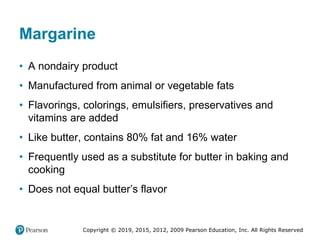
Margarine
• A nondairy product
• Manufactured from animal or vegetable fats
• Flavorings, colorings, emulsifiers, preservatives and
vitamins are added
• Like butter, contains 80% fat and 16% water
• Frequently used as a substitute for butter in baking and
cooking
• Does not equal butter’s flavor
Copyright © 2019, 2015, 2012, 2009 Pearson Education, Inc. All Rights Reserved
Natural Cheeses (1 of 2)
• Cheese is one of the oldest and most widely used foods
known to man
• Hundreds of natural cheeses are produced worldwide
• Cheeses are a product of their environment
• Cheese is made from a variety of animal milks
• Milk proteins (casein) coagulated with rennet (enzyme)
Copyright © 2019, 2015, 2012, 2009 Pearson Education, Inc. All Rights Reserved
Natural Cheeses (2 of 2)
• Cheeses may develop a natural rind
• The higher the moisture content the softer and more
perishable a cheese will be
• Fat content
– Less than 20% (low fat)
– At least 60% (double cream)
– At least 72% (triple cream)
• FDA rules require that raw milk cheeses must be aged
more than 60 days at 35°Fahrenheit
Copyright © 2019, 2015, 2012, 2009 Pearson Education, Inc. All Rights Reserved
Fresh or Unripened Cheeses
• Cream Cheese
– Soft cow’s-milk cheese; smooth and mild flavor
• Feta
– Semisoft made from sheep’s or goat’s milk; white
flaky cheese that is stored in brine
• Mascarpone
– Soft cow’s-milk cheese originally from Italy; extremely
smooth and creamy
• Mozzarella
– Firm Italian cheese traditionally made with water
buffalo’s milk; very mild white cheese that is stringy
Copyright © 2019, 2015, 2012, 2009 Pearson Education, Inc. All Rights Reserved
Soft Cheeses
• Brie
– Rind-ripened French cheese, creamy and rich;
contains 60% fat
• Camembert
– Rind-ripened French cheese, creamy and rich;
contains 45% fat; milder than brie
• Taleggio
– Orange-colored washed rind cheese made from
cow’s milk; contains 48% fat
Copyright © 2019, 2015, 2012, 2009 Pearson Education, Inc. All Rights Reserved
Semisoft Cheeses (1 of 2)
• Cabrales
– Blue-veined cheese, made from a blend of raw cow’s, ewe’s and
goat’s milks
• Fontina
– Has a dark gold, crusty rind; the pale gold, dense interior has
few small holes; nutty and rich
• Gorgonzola
– Italian blue-veined cow’s-milk cheese; creamier than other blues
• Gouda
– Dutch cheese is yellow with few small holes and a mild buttery
flavor
Copyright © 2019, 2015, 2012, 2009 Pearson Education, Inc. All Rights Reserved
Semisoft Cheeses (2 of 2)
• Havarti
– Cow’s-milk cheese from Denmark; mild flavor and creamy
texture
• Port du Salut
– French cow’s-milk cheese; smooth, rich and savory
• Roquefort
– Blue-veined sheep’s-milk cheese from France; intensely
pungent with a rich, salty flavor and strong aroma
• Stilton
– Blue-veined cheese of Great Britain; pungent, rich and
tangy; combines the best of blues and cheddars
Copyright © 2019, 2015, 2012, 2009 Pearson Education, Inc. All Rights Reserved
Firm Cheeses (1 of 2)
• Cheddars
– Product of North America and Great Britain; flavors range
from mild to very sharp
• Emmenthaler
– The original Swiss cheese; mellow, rich and nutty
• Gruyère
– Cow’s-milk cheese made in the Swiss Alps; moist and
highly flavorful
• Jarlsberg
– Swiss-type cheese from Norway; mild with a delicate
sweet flavor
Copyright © 2019, 2015, 2012, 2009 Pearson Education, Inc. All Rights Reserved
Firm Cheeses (2 of 2)
• Manchego
– Spanish sheep's-milk cheese; it has a buttery and slightly
piquant flavor
• Monterey Jack
– A cheddar like cow’s-milk cheese from California; often
flavored with peppers and herbs
• Provolone
– A cow’s-milk cheese of southern Italy; commonly used for
melting and in pizza and pasta dishes
– Provolone dolce; aged 2 months
– Provolone piccante; aged up to six months
Copyright © 2019, 2015, 2012, 2009 Pearson Education, Inc. All Rights Reserved
Hard Cheeses
Hard cheeses are most often used for grating
• Asiago
– Sharp and nutty with a cheddar-like flavor; aged 1 year
• Parmigiano-Reggiano
– Made exclusively in the Parma region of Italy; primarily
used for grating, it has a rich, spicy and sharp flavor
• Pecorino Romano
– A goat’s-milk cheese; brittle and sharper than other grating
cheeses, with a “sheepy” tang
Copyright © 2019, 2015, 2012, 2009 Pearson Education, Inc. All Rights Reserved
Goat’s-Milk Cheese
• Chèvre
– French for goat, refers to small, soft, creamy cheeses
produced in a variety of shapes
– Often coated with ash, herbs and seasonings
Copyright © 2019, 2015, 2012, 2009 Pearson Education, Inc. All Rights Reserved
Processed Cheeses
• Pasteurized processed cheese
– Made from a combination of aged and green cheeses
mixed with emulsifiers and flavorings, pasteurized
and poured into molds
• Processed cheese food
– Contains less natural cheese; often has vegetable oils
and milk solids added
• Imitation cheese
– Manufactured with dairy by-products and soy
products mixed with emulsifiers, coloring and
flavoring agents and enzymes
Copyright © 2019, 2015, 2012, 2009 Pearson Education, Inc. All Rights Reserved
Serving Cheese
• Cheese may be served any time of the day
• Best served at room temperature
• Use a variety of shapes and colors for visual appeal
• Use a variety of flavors and textures
• Provide a separate serving knife for each cheese
• Serve with plain bread or crackers
• Non-citrus fruits are a nice accompaniment
Copyright © 2019, 2015, 2012, 2009 Pearson Education, Inc. All Rights Reserved
Cooking with Cheese
• Because of its high protein content, cheese can melt into
a tough stringy mass
• Heating can cause cheese to curdle or separate
– Use low temperatures and short cooking times. Do
not boil.
– Grate cheese before stirring into warm sauces/soups.
Keep warm in a bain marie
Copyright © 2019, 2015, 2012, 2009 Pearson Education, Inc. All Rights Reserved
Copyright
This work is protected by United States copyright laws and is
provided solely for the use of instructors in teaching their courses
and assessing student learning. Dissemination or sale of any part
of this work (including on the World Wide Web) will destroy the
integrity of the work and is not permitted. The work and materials
from it should never be made available to students except by
instructors using the accompanying text in their classes. All
recipients of this work are expected to abide by these restrictions
and to honor the intended pedagogical purposes and the needs of
other instructors who rely on these materials.

OnCooking6CH8PPLecture_accessible.pptx

  • 1.
    On Cooking: ATextbook of Culinary Fundamentals Sixth Edition Chapter 8 Dairy Products Copyright © 2019, 2015, 2012, 2009 Pearson Education, Inc. All Rights Reserved
  • 2.
    Copyright © 2019,2015, 2012, 2009 Pearson Education, Inc. All Rights Reserved Learning Objectives After studying this chapter, you will be able to 8.1 Identify, store and cook with a variety of milk and milk- based products 8.2 Describe basic cheese-making processes 8.3 Classify the characteristics of the five categories of fine cheeses: fresh or unripened, soft, semisoft, firm and hard 8.4 Describe the characteristics of goat’s-milk cheeses 8.5 Identify, store and serve fine cheeses
  • 3.
    Copyright © 2019,2015, 2012, 2009 Pearson Education, Inc. All Rights Reserved Milk and Milk Products • Provides texture, flavor, color and nutritional value for cooked or baked items • Whole milk contains – 88% water – 3.5% milk fat – 8.5% milk solids • Whole milk is graded A, B or C
  • 4.
    Copyright © 2019,2015, 2012, 2009 Pearson Education, Inc. All Rights Reserved Milk-Processing Techniques (1 of 2) • Pasteurization – Process of heating milk to a sufficiently high temperature for a sufficient length of time to destroy pathogenic bacteria • Ultra-pasteurization – Process by which milk is heated to a very high temperature for a very short time
  • 5.
    Copyright © 2019,2015, 2012, 2009 Pearson Education, Inc. All Rights Reserved Milk-Processing Techniques (2 of 2) • Ultra-high-temperature processing (UHT) – Process by which milk is heated to a very high temperature for a short period of time and is then packaged in sterile packages under sterile conditions • Homogenization – Process in which the fat globules in whole milk are reduced in size and permanently dispersed throughout the liquid
  • 6.
    Copyright © 2019,2015, 2012, 2009 Pearson Education, Inc. All Rights Reserved Milk Fat Removal Whole milk can be processed in a centrifuge to remove fat. • Reduced-fat – 2% • Low-fat – 1% • Nonfat – 0%
  • 7.
    Copyright © 2019,2015, 2012, 2009 Pearson Education, Inc. All Rights Reserved Concentrated Milks • Whole milk can be processed using a vacuum to remove some or all of the water. • Evaporated – 60% of the water is removed • Sweetened condensed – 60% of the water is removed and 40%-45% sugar has been added • Dry milk powder – Virtually all of the water has been removed
  • 8.
    Copyright © 2019,2015, 2012, 2009 Pearson Education, Inc. All Rights Reserved Safety Alert - Milk Storage • Canned milk, aseptically-packaged milk and dry milk powder are shelf-stable. They need no refrigeration • After opening or reconstituting, milk products become (T CS) foods – time and temperature controlled for safety • Refrigerate at or below 41°Fahrenheit
  • 9.
    Copyright © 2019,2015, 2012, 2009 Pearson Education, Inc. All Rights Reserved Cream • Half and Half – A mixture of whole milk and cream, contains 10%- 18% milkfat • Light cream, coffee cream, table cream – More than 18% but less than 30% milkfat • Light whipping cream – Contains between 30% and 36% milkfat • Heavy whipping cream – Contains not less than 36% milkfat
  • 10.
    Copyright © 2019,2015, 2012, 2009 Pearson Education, Inc. All Rights Reserved Cultured Dairy Products • Buttermilk – Tart milk with a thick texture; fresh milk whole or low-fat with a culture (Streptococcus lactis) added • Sour cream – White, tangy gel used as a condiment; the same culture is added to pasteurized, homogenized light cream • Crème fraîche – Thinner and richer than sour cream; the same culture is added to heavy cream • Yogurt – Thick, tart, custard like product cultured with Lactobacillus bulgaricus and Streptococcus thermophilus; can be made with whole, low-fat or skim milks
  • 11.
    Copyright © 2019,2015, 2012, 2009 Pearson Education, Inc. All Rights Reserved Butter • Salted butter – Butter with 2.5% salt added – Salt alters the flavor, extends keeping qualities • European-style butter – Contains more butterfat than regular butter, up to 82%-86%; contains very little salt • Whipped butter – Made by incorporating air into butter • Clarified butter – Butter that has had its water and milk solids removed
  • 12.
    Copyright © 2019,2015, 2012, 2009 Pearson Education, Inc. All Rights Reserved Margarine • A nondairy product • Manufactured from animal or vegetable fats • Flavorings, colorings, emulsifiers, preservatives and vitamins are added • Like butter, contains 80% fat and 16% water • Frequently used as a substitute for butter in baking and cooking • Does not equal butter’s flavor
  • 13.
    Copyright © 2019,2015, 2012, 2009 Pearson Education, Inc. All Rights Reserved Natural Cheeses (1 of 2) • Cheese is one of the oldest and most widely used foods known to man • Hundreds of natural cheeses are produced worldwide • Cheeses are a product of their environment • Cheese is made from a variety of animal milks • Milk proteins (casein) coagulated with rennet (enzyme)
  • 14.
    Copyright © 2019,2015, 2012, 2009 Pearson Education, Inc. All Rights Reserved Natural Cheeses (2 of 2) • Cheeses may develop a natural rind • The higher the moisture content the softer and more perishable a cheese will be • Fat content – Less than 20% (low fat) – At least 60% (double cream) – At least 72% (triple cream) • FDA rules require that raw milk cheeses must be aged more than 60 days at 35°Fahrenheit
  • 15.
    Copyright © 2019,2015, 2012, 2009 Pearson Education, Inc. All Rights Reserved Fresh or Unripened Cheeses • Cream Cheese – Soft cow’s-milk cheese; smooth and mild flavor • Feta – Semisoft made from sheep’s or goat’s milk; white flaky cheese that is stored in brine • Mascarpone – Soft cow’s-milk cheese originally from Italy; extremely smooth and creamy • Mozzarella – Firm Italian cheese traditionally made with water buffalo’s milk; very mild white cheese that is stringy
  • 16.
    Copyright © 2019,2015, 2012, 2009 Pearson Education, Inc. All Rights Reserved Soft Cheeses • Brie – Rind-ripened French cheese, creamy and rich; contains 60% fat • Camembert – Rind-ripened French cheese, creamy and rich; contains 45% fat; milder than brie • Taleggio – Orange-colored washed rind cheese made from cow’s milk; contains 48% fat
  • 17.
    Copyright © 2019,2015, 2012, 2009 Pearson Education, Inc. All Rights Reserved Semisoft Cheeses (1 of 2) • Cabrales – Blue-veined cheese, made from a blend of raw cow’s, ewe’s and goat’s milks • Fontina – Has a dark gold, crusty rind; the pale gold, dense interior has few small holes; nutty and rich • Gorgonzola – Italian blue-veined cow’s-milk cheese; creamier than other blues • Gouda – Dutch cheese is yellow with few small holes and a mild buttery flavor
  • 18.
    Copyright © 2019,2015, 2012, 2009 Pearson Education, Inc. All Rights Reserved Semisoft Cheeses (2 of 2) • Havarti – Cow’s-milk cheese from Denmark; mild flavor and creamy texture • Port du Salut – French cow’s-milk cheese; smooth, rich and savory • Roquefort – Blue-veined sheep’s-milk cheese from France; intensely pungent with a rich, salty flavor and strong aroma • Stilton – Blue-veined cheese of Great Britain; pungent, rich and tangy; combines the best of blues and cheddars
  • 19.
    Copyright © 2019,2015, 2012, 2009 Pearson Education, Inc. All Rights Reserved Firm Cheeses (1 of 2) • Cheddars – Product of North America and Great Britain; flavors range from mild to very sharp • Emmenthaler – The original Swiss cheese; mellow, rich and nutty • Gruyère – Cow’s-milk cheese made in the Swiss Alps; moist and highly flavorful • Jarlsberg – Swiss-type cheese from Norway; mild with a delicate sweet flavor
  • 20.
    Copyright © 2019,2015, 2012, 2009 Pearson Education, Inc. All Rights Reserved Firm Cheeses (2 of 2) • Manchego – Spanish sheep's-milk cheese; it has a buttery and slightly piquant flavor • Monterey Jack – A cheddar like cow’s-milk cheese from California; often flavored with peppers and herbs • Provolone – A cow’s-milk cheese of southern Italy; commonly used for melting and in pizza and pasta dishes – Provolone dolce; aged 2 months – Provolone piccante; aged up to six months
  • 21.
    Copyright © 2019,2015, 2012, 2009 Pearson Education, Inc. All Rights Reserved Hard Cheeses Hard cheeses are most often used for grating • Asiago – Sharp and nutty with a cheddar-like flavor; aged 1 year • Parmigiano-Reggiano – Made exclusively in the Parma region of Italy; primarily used for grating, it has a rich, spicy and sharp flavor • Pecorino Romano – A goat’s-milk cheese; brittle and sharper than other grating cheeses, with a “sheepy” tang
  • 22.
    Copyright © 2019,2015, 2012, 2009 Pearson Education, Inc. All Rights Reserved Goat’s-Milk Cheese • Chèvre – French for goat, refers to small, soft, creamy cheeses produced in a variety of shapes – Often coated with ash, herbs and seasonings
  • 23.
    Copyright © 2019,2015, 2012, 2009 Pearson Education, Inc. All Rights Reserved Processed Cheeses • Pasteurized processed cheese – Made from a combination of aged and green cheeses mixed with emulsifiers and flavorings, pasteurized and poured into molds • Processed cheese food – Contains less natural cheese; often has vegetable oils and milk solids added • Imitation cheese – Manufactured with dairy by-products and soy products mixed with emulsifiers, coloring and flavoring agents and enzymes
  • 24.
    Copyright © 2019,2015, 2012, 2009 Pearson Education, Inc. All Rights Reserved Serving Cheese • Cheese may be served any time of the day • Best served at room temperature • Use a variety of shapes and colors for visual appeal • Use a variety of flavors and textures • Provide a separate serving knife for each cheese • Serve with plain bread or crackers • Non-citrus fruits are a nice accompaniment
  • 25.
    Copyright © 2019,2015, 2012, 2009 Pearson Education, Inc. All Rights Reserved Cooking with Cheese • Because of its high protein content, cheese can melt into a tough stringy mass • Heating can cause cheese to curdle or separate – Use low temperatures and short cooking times. Do not boil. – Grate cheese before stirring into warm sauces/soups. Keep warm in a bain marie
  • 26.
    Copyright © 2019,2015, 2012, 2009 Pearson Education, Inc. All Rights Reserved Copyright This work is protected by United States copyright laws and is provided solely for the use of instructors in teaching their courses and assessing student learning. Dissemination or sale of any part of this work (including on the World Wide Web) will destroy the integrity of the work and is not permitted. The work and materials from it should never be made available to students except by instructors using the accompanying text in their classes. All recipients of this work are expected to abide by these restrictions and to honor the intended pedagogical purposes and the needs of other instructors who rely on these materials.