Copyright 2023, Hawkes, Stine
One Pot Chicken & Rice Dinner
This week’s recipe from the
Student Workbook is:
This method will be putting a
combination cooking method
to the test. We will start off
dry with a little oil, sweating
the vegetables, then add the
chicken to sear it off, followed
by the rice. We then add in
some of our fresh chicken
stock.
Chapter Recipe
Types of Pests & Rodents
Rodents
Rats and mice are the most common type of rodents.
Types of Pests & Rodents
Flies
• Flies are not just a nuisance to staff
and customers, as they can carry and
spread hundreds of diseases (e.g.,
Shigella spp.).
• Flies are attracted to food,
predominantly liquid food.
• They can only eat liquid food but are
able to dissolve solid food by
vomiting on it and sucking the vomit
back up using their straw-shaped
tongue.
Types of Pests & Rodents
Cockroaches
• One of the problems is that before
they walk across sanitized surfaces or
unadulterated food, they have most
certainly spent time in the trash,
contaminated water, or mold and
mildew found in hard-to-clean areas.
• Roaches carry many bad bugs, such as
Salmonella (bacteria) and Hepatitis
(virus) which can lead to foodborne
illness.
Types of Pests & Rodents
Insects
• Many types of insects can find their
way into stored or packaged
products, such as beetles, moths,
weevils, mites, etc.
• They have plenty of food and refuge
where they multiply, excrete waste,
and die.
• When these pests contaminate the
food, they can cause foodborne
illness or allergic reactions when
consumed.
Types of Pests & Rodents
Service Animals
• While pets are prohibited from food
establishments, service animals are an
exception and are not considered pets.
• This exception is a right afforded by the
Americans with Disabilities Act (ADA) which
prevents privately owned businesses that
serve the public from discriminating
Types of Pests & Rodents
Pet Dogs in Outdoor Dining Areas
• Starting with the 2022
Food Code, if approved by
the regulatory authority,
food establishments may
allow pet dogs in outdoor
dining areas.
• Food employees are not
allowed to touch pet dogs
or any other animal that
may be present, e.g. patrol
dogs.
Types of Pests & Rodents
Taking Precautions
Exterior Areas
There are several pest control-related
precautions to take outside the food
establishment.
• Outdoor Dining
• Lighting
• Trash storage
• Exterior openings
Taking Precautions
Interior Areas
There are several pest control-related precautions to take inside the
food establishment.
• Dining
• Food Preparation
• Storage
• Trash
• Floor Drains
Taking Precautions
Integrated Pest
Management (IPM)
Program
An IPM program is designed to:
• Keep pests from entering the premises
• Prevent unacceptable levels of pest damage
• Minimize health risks to people, property,
and the environment
What is it?
IPM is a science-based process that uses biological, environmental, and
technological information to manage pest damage to minimize
economic costs and risks to people, property, and the environment.
Optimal results are obtained working with a professional pest control
operator (PCO) when developing an IPM program. These specialists
have specific training and experience in preventing pest entry and
dealing with infestations safely within a food operation.
Integrated Pest Management (IPM) Program
Pest Management Logs
The PIC must be able to explain the integrated pest management (IPM)
program to an inspector and show logs, pest traps, and related
chemicals stored on the premises. The following is an example of a
daily pest control management log.
Integrated Pest Management (IPM) Program
Poisonous or Toxic
Materials
What is it?
Poisonous or Toxic Materials
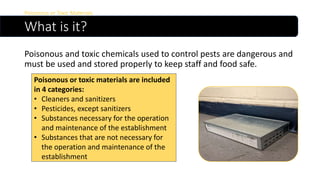
Poisonous and toxic chemicals used to control pests are dangerous and
must be used and stored properly to keep staff and food safe.
Poisonous or toxic materials are included
in 4 categories:
• Cleaners and sanitizers
• Pesticides, except sanitizers
• Substances necessary for the operation
and maintenance of the establishment
• Substances that are not necessary for
the operation and maintenance of the
establishment
ICAM Chapter 12.pptx

ICAM Chapter 12.pptx

  • 1.
  • 3.
    One Pot Chicken& Rice Dinner This week’s recipe from the Student Workbook is: This method will be putting a combination cooking method to the test. We will start off dry with a little oil, sweating the vegetables, then add the chicken to sear it off, followed by the rice. We then add in some of our fresh chicken stock. Chapter Recipe
  • 4.
    Types of Pests& Rodents
  • 5.
    Rodents Rats and miceare the most common type of rodents. Types of Pests & Rodents
  • 6.
    Flies • Flies arenot just a nuisance to staff and customers, as they can carry and spread hundreds of diseases (e.g., Shigella spp.). • Flies are attracted to food, predominantly liquid food. • They can only eat liquid food but are able to dissolve solid food by vomiting on it and sucking the vomit back up using their straw-shaped tongue. Types of Pests & Rodents
  • 7.
    Cockroaches • One ofthe problems is that before they walk across sanitized surfaces or unadulterated food, they have most certainly spent time in the trash, contaminated water, or mold and mildew found in hard-to-clean areas. • Roaches carry many bad bugs, such as Salmonella (bacteria) and Hepatitis (virus) which can lead to foodborne illness. Types of Pests & Rodents
  • 8.
    Insects • Many typesof insects can find their way into stored or packaged products, such as beetles, moths, weevils, mites, etc. • They have plenty of food and refuge where they multiply, excrete waste, and die. • When these pests contaminate the food, they can cause foodborne illness or allergic reactions when consumed. Types of Pests & Rodents
  • 9.
    Service Animals • Whilepets are prohibited from food establishments, service animals are an exception and are not considered pets. • This exception is a right afforded by the Americans with Disabilities Act (ADA) which prevents privately owned businesses that serve the public from discriminating Types of Pests & Rodents
  • 10.
    Pet Dogs inOutdoor Dining Areas • Starting with the 2022 Food Code, if approved by the regulatory authority, food establishments may allow pet dogs in outdoor dining areas. • Food employees are not allowed to touch pet dogs or any other animal that may be present, e.g. patrol dogs. Types of Pests & Rodents
  • 11.
  • 12.
    Exterior Areas There areseveral pest control-related precautions to take outside the food establishment. • Outdoor Dining • Lighting • Trash storage • Exterior openings Taking Precautions
  • 13.
    Interior Areas There areseveral pest control-related precautions to take inside the food establishment. • Dining • Food Preparation • Storage • Trash • Floor Drains Taking Precautions
  • 14.
  • 15.
    An IPM programis designed to: • Keep pests from entering the premises • Prevent unacceptable levels of pest damage • Minimize health risks to people, property, and the environment What is it? IPM is a science-based process that uses biological, environmental, and technological information to manage pest damage to minimize economic costs and risks to people, property, and the environment. Optimal results are obtained working with a professional pest control operator (PCO) when developing an IPM program. These specialists have specific training and experience in preventing pest entry and dealing with infestations safely within a food operation. Integrated Pest Management (IPM) Program
  • 16.
    Pest Management Logs ThePIC must be able to explain the integrated pest management (IPM) program to an inspector and show logs, pest traps, and related chemicals stored on the premises. The following is an example of a daily pest control management log. Integrated Pest Management (IPM) Program
  • 17.
  • 18.
    What is it? Poisonousor Toxic Materials Poisonous and toxic chemicals used to control pests are dangerous and must be used and stored properly to keep staff and food safe. Poisonous or toxic materials are included in 4 categories: • Cleaners and sanitizers • Pesticides, except sanitizers • Substances necessary for the operation and maintenance of the establishment • Substances that are not necessary for the operation and maintenance of the establishment