Copyright 2023, Hawkes, Stine
American Meringue Cookies & Vacherin
This week’s recipe from the
Student Workbook is:
The American meringue
method is the simplest
preparation with great results.
This reliable recipe will
produce light, fluffy meringue
cookies and nests (called
Vacherin in French).
Chapter Recipe
Introduction
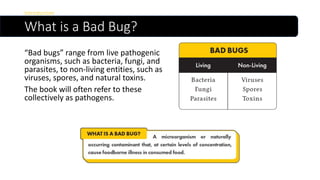
What is a Bad Bug?
“Bad bugs” range from live pathogenic
organisms, such as bacteria, fungi, and
parasites, to non-living entities, such as
viruses, spores, and natural toxins.
The book will often refer to these
collectively as pathogens.
Introduction
The Big 6
Of the over 40 pathogens leading to foodborne illness, the Food and
Drug Administration (FDA) and Centers for Disease Control (CDC) name
six that are highly infective and easily transmitted by food employees.
Introduction
Living Organisms
Bacteria
Bacteria is a common foodborne contaminant made
up of a single cell. Most bacteria are not harmful, but
some can cause illness when ingested, usually with
food.
Another source of foodborne illness is spores and
toxins produced by bacteria, which are covered later
in this chapter.
Living Organisms
Bad Bugs Bacteria
Living Organisms
• Salmonella spp. (nontyphoidal)
• Salmonella Typhi (typhoid-like fever)
• Campylobacter jejuni
• Shigella spp.
• Clostridium perfringens
• Clostridium botulinum
• Staphylococcus aureus
• Streptococcus spp.
• Bacillus cereus
• Listeria monocytogenes
• Vibrio vulnificus
• Vibrio parahaemolyticus
FAT TOM
Living Organisms
Understanding and
controlling these six
intrinsic and extrinsic
factors greatly reduce the
potential for foodborne
contamination and
consumer illness.
 Intrinsic: Inherent to food, such as
additives or pH level.
 Extrinsic: External conditions under which
food is stored, such as temperature and
moisture or oxygen levels.
FAT TOM
Living Organisms
FAT TOM
Living Organisms
FAT TOM
Living Organisms
FAT TOM
Living Organisms
FAT TOM
Living Organisms
There are four phases of
bacterial growth:
• Slow growth (lag-phase)
• Rapid growth (log-phase)
• Equilibrium (stationary phase)
• Reduction (death phase)
Refrigeration & Cooking are
important safety measures.
Fungi
Living Organisms
The presence of fungi (i.e., mushrooms, molds, and yeasts) is
widespread in the air, ground, and in some foods. Certain fungi are safe
to eat, while others are the most dangerous due to naturally occurring
toxins.
Mushrooms
Living Organisms
Certain mushrooms contain
toxins that cause foodborne
illness. Moreover, the poison
is rarely destroyed by
washing, cooking, freezing,
or canning.
Mold
Living Organisms
Molds are spores produced by fungi that
live on plant or animal matter. Unlike
one-celled bacteria, molds are made of
many cells and can sometimes be seen
without a microscope. The spores can be
transported by air, water, or insects.
Molds can thrive within a wide range of
environmental conditions, such as:
 pH: 2 – 9
 Temperature: 50°F – 95°F (10°C – 35°C)
 Water activity: 0.85 aW or lower
Aflatoxin is a toxin produced
by mold and associated with
the following foods:
 Corn and corn products
 Peanuts and peanut
products
 Cottonseed, milk, and
tree nuts such as Brazil
nuts
 Pecans, pistachio nuts,
and walnuts
Yeast
Living Organisms
Yeasts are single-celled microorganisms, with over 1,500 species
documented, which are a form of fungi. Some yeasts are used safely as
an ingredient in food preparation. For example, yeast is a leavening
agent that causes bread to rise. It is also used to promote fermentation
in the production of beer and wine.
However, some species of yeast can cause infection in people; the most
common is Candida albicans, according to the CDC. Candida usually
lives on the skin and inside the body without causing problems.
Candida can cause infections if it grows out of control or enters deep
into the body.
Parasites
Living Organisms
Parasites are organisms that derive protection
and nourishment from a host (a human or
animal) in a way that is of no advantage to the
host or harms it by restricting normal organ
functions or robbing nutrients.
There are three ways parasites usually enter the food chain.
• Direct contamination of food ingredients or farm-fresh produce
• Contaminated water sources used in irrigation, washing, or
processing foods
• Direct human transfer by food handlers
Non-living Entities
Viruses
Unlike bacteria, viruses are not living
organisms but are essentially DNA or RNA
covered by protein. Viruses are not able to
reproduce on their own. Instead, they multiply
in a host rather than growing, technically.
A virus enters the cells of other living things,
including humans, and appropriates those
cellular substances to multiply itself. The virus
can mass-produce copies of itself in this way.
Non-living Entities
Norovirus
Norovirus is a very contagious virus that causes vomiting and diarrhea.
It is the leading cause of illness from contaminated food or water in the
U.S. Anyone can get infected and sick with norovirus.
Non-living Entities
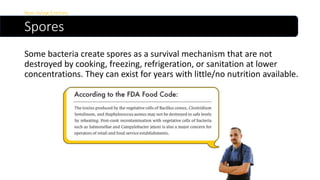
Spores
Some bacteria create spores as a survival mechanism that are not
destroyed by cooking, freezing, refrigeration, or sanitation at lower
concentrations. They can exist for years with little/no nutrition available.
Non-living Entities
Toxins
A toxin is a poison created by a living organism
but is a non-living substance. Dangerous toxins
exist in some mushrooms, fish, and shellfish.
Additionally, some animals have toxins in the
form of venom.
Shiga toxin-producing Escherichia coli (STEC) is
one of the “Big 6” foodborne causing illnesses.
Non-living Entities
Bad Bug Symptoms
Common Symptoms – Part I
Bad Bug Symptoms
Common Symptoms – Part II
Bad Bug Symptoms
ICAM Chapter 3.pptx
ICAM Chapter 3.pptx

ICAM Chapter 3.pptx

  • 1.
  • 3.
    American Meringue Cookies& Vacherin This week’s recipe from the Student Workbook is: The American meringue method is the simplest preparation with great results. This reliable recipe will produce light, fluffy meringue cookies and nests (called Vacherin in French). Chapter Recipe
  • 4.
  • 5.
    What is aBad Bug? “Bad bugs” range from live pathogenic organisms, such as bacteria, fungi, and parasites, to non-living entities, such as viruses, spores, and natural toxins. The book will often refer to these collectively as pathogens. Introduction
  • 6.
    The Big 6 Ofthe over 40 pathogens leading to foodborne illness, the Food and Drug Administration (FDA) and Centers for Disease Control (CDC) name six that are highly infective and easily transmitted by food employees. Introduction
  • 7.
  • 8.
    Bacteria Bacteria is acommon foodborne contaminant made up of a single cell. Most bacteria are not harmful, but some can cause illness when ingested, usually with food. Another source of foodborne illness is spores and toxins produced by bacteria, which are covered later in this chapter. Living Organisms
  • 9.
    Bad Bugs Bacteria LivingOrganisms • Salmonella spp. (nontyphoidal) • Salmonella Typhi (typhoid-like fever) • Campylobacter jejuni • Shigella spp. • Clostridium perfringens • Clostridium botulinum • Staphylococcus aureus • Streptococcus spp. • Bacillus cereus • Listeria monocytogenes • Vibrio vulnificus • Vibrio parahaemolyticus
  • 10.
    FAT TOM Living Organisms Understandingand controlling these six intrinsic and extrinsic factors greatly reduce the potential for foodborne contamination and consumer illness.  Intrinsic: Inherent to food, such as additives or pH level.  Extrinsic: External conditions under which food is stored, such as temperature and moisture or oxygen levels.
  • 11.
  • 12.
  • 13.
  • 14.
  • 15.
    FAT TOM Living Organisms Thereare four phases of bacterial growth: • Slow growth (lag-phase) • Rapid growth (log-phase) • Equilibrium (stationary phase) • Reduction (death phase) Refrigeration & Cooking are important safety measures.
  • 16.
    Fungi Living Organisms The presenceof fungi (i.e., mushrooms, molds, and yeasts) is widespread in the air, ground, and in some foods. Certain fungi are safe to eat, while others are the most dangerous due to naturally occurring toxins.
  • 17.
    Mushrooms Living Organisms Certain mushroomscontain toxins that cause foodborne illness. Moreover, the poison is rarely destroyed by washing, cooking, freezing, or canning.
  • 18.
    Mold Living Organisms Molds arespores produced by fungi that live on plant or animal matter. Unlike one-celled bacteria, molds are made of many cells and can sometimes be seen without a microscope. The spores can be transported by air, water, or insects. Molds can thrive within a wide range of environmental conditions, such as:  pH: 2 – 9  Temperature: 50°F – 95°F (10°C – 35°C)  Water activity: 0.85 aW or lower Aflatoxin is a toxin produced by mold and associated with the following foods:  Corn and corn products  Peanuts and peanut products  Cottonseed, milk, and tree nuts such as Brazil nuts  Pecans, pistachio nuts, and walnuts
  • 19.
    Yeast Living Organisms Yeasts aresingle-celled microorganisms, with over 1,500 species documented, which are a form of fungi. Some yeasts are used safely as an ingredient in food preparation. For example, yeast is a leavening agent that causes bread to rise. It is also used to promote fermentation in the production of beer and wine. However, some species of yeast can cause infection in people; the most common is Candida albicans, according to the CDC. Candida usually lives on the skin and inside the body without causing problems. Candida can cause infections if it grows out of control or enters deep into the body.
  • 20.
    Parasites Living Organisms Parasites areorganisms that derive protection and nourishment from a host (a human or animal) in a way that is of no advantage to the host or harms it by restricting normal organ functions or robbing nutrients. There are three ways parasites usually enter the food chain. • Direct contamination of food ingredients or farm-fresh produce • Contaminated water sources used in irrigation, washing, or processing foods • Direct human transfer by food handlers
  • 21.
  • 22.
    Viruses Unlike bacteria, virusesare not living organisms but are essentially DNA or RNA covered by protein. Viruses are not able to reproduce on their own. Instead, they multiply in a host rather than growing, technically. A virus enters the cells of other living things, including humans, and appropriates those cellular substances to multiply itself. The virus can mass-produce copies of itself in this way. Non-living Entities
  • 23.
    Norovirus Norovirus is avery contagious virus that causes vomiting and diarrhea. It is the leading cause of illness from contaminated food or water in the U.S. Anyone can get infected and sick with norovirus. Non-living Entities
  • 24.
    Spores Some bacteria createspores as a survival mechanism that are not destroyed by cooking, freezing, refrigeration, or sanitation at lower concentrations. They can exist for years with little/no nutrition available. Non-living Entities
  • 25.
    Toxins A toxin isa poison created by a living organism but is a non-living substance. Dangerous toxins exist in some mushrooms, fish, and shellfish. Additionally, some animals have toxins in the form of venom. Shiga toxin-producing Escherichia coli (STEC) is one of the “Big 6” foodborne causing illnesses. Non-living Entities
  • 26.
  • 27.
    Common Symptoms –Part I Bad Bug Symptoms
  • 28.
    Common Symptoms –Part II Bad Bug Symptoms