Copyright 2023, Hawkes, Stine
Broccoli & Cheddar Soup
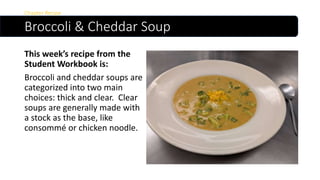
This week’s recipe from the
Student Workbook is:
Broccoli and cheddar soups are
categorized into two main
choices: thick and clear. Clear
soups are generally made with
a stock as the base, like
consommé or chicken noodle.
Chapter Recipe
Food Sources
U.S. Food Law Requirements
Aimed at protecting the
consumer’s health, safety,
and economic resources, the
FDA enforces its regulations
and laws enacted by the U.S.
Congress.
Food Sources
To comply with the U.S. Food Law, the source of food must:
• Comply with the law.
• Not be prepared in a private residence.
• Have package labeling in compliance with the law.
• Be from a supplier that properly freezes (and retains
records) for fish intended to be eaten raw.
• Be from a supplier that meets specific whole-muscle,
intact beef requirements.
• Be labeled appropriately for safe handling instructions:
• Meat and poultry that is not an RTE Food.
• Eggs not treated to destroy all visible salmonellae.
FDA Food Code Requirements
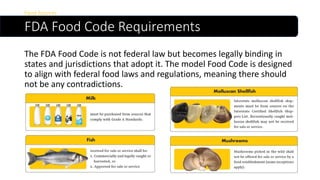
The FDA Food Code is not federal law but becomes legally binding in
states and jurisdictions that adopt it. The model Food Code is designed
to align with federal food laws and regulations, meaning there should
not be any contradictions.
Food Sources
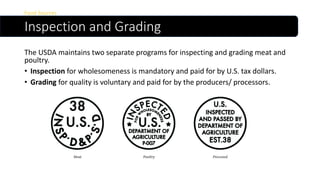
Inspection and Grading
The USDA maintains two separate programs for inspecting and grading meat and
poultry.
• Inspection for wholesomeness is mandatory and paid for by U.S. tax dollars.
• Grading for quality is voluntary and paid for by the producers/ processors.
Food Sources
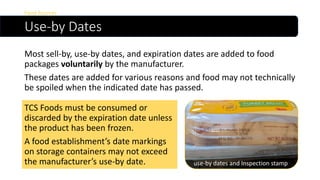
Use-by Dates
Most sell-by, use-by dates, and expiration dates are added to food
packages voluntarily by the manufacturer.
These dates are added for various reasons and food may not technically
be spoiled when the indicated date has passed.
Food Sources
TCS Foods must be consumed or
discarded by the expiration date unless
the product has been frozen.
A food establishment’s date markings
on storage containers may not exceed
the manufacturer’s use-by date. use-by dates and Inspection stamp
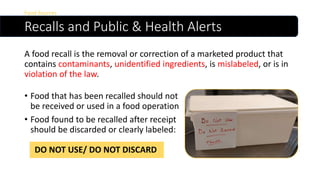
Recalls and Public & Health Alerts
A food recall is the removal or correction of a marketed product that
contains contaminants, unidentified ingredients, is mislabeled, or is in
violation of the law.
Food Sources
• Food that has been recalled should not
be received or used in a food operation
• Food found to be recalled after receipt
should be discarded or clearly labeled:
DO NOT USE/ DO NOT DISCARD
Receiving
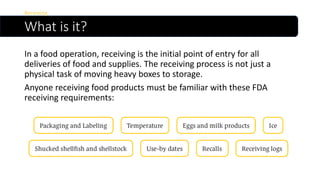
What is it?
In a food operation, receiving is the initial point of entry for all
deliveries of food and supplies. The receiving process is not just a
physical task of moving heavy boxes to storage.
Anyone receiving food products must be familiar with these FDA
receiving requirements:
Receiving
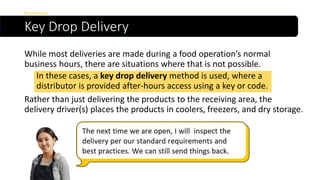
Key Drop Delivery
While most deliveries are made during a food operation’s normal
business hours, there are situations where that is not possible.
In these cases, a key drop delivery method is used, where a
distributor is provided after-hours access using a key or code.
Rather than just delivering the products to the receiving area, the
delivery driver(s) places the products in coolers, freezers, and dry storage.
Receiving
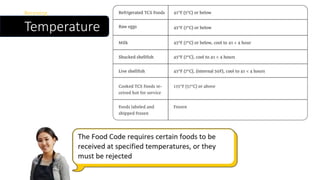
Temperature
Receiving
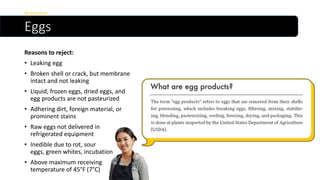
Eggs
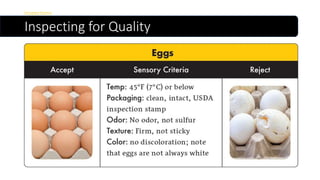
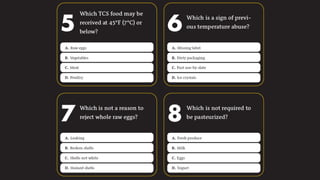
Reasons to reject:
• Leaking egg
• Broken shell or crack, but membrane
intact and not leaking
• Liquid, frozen eggs, dried eggs, and
egg products are not pasteurized
• Adhering dirt, foreign material, or
prominent stains
• Raw eggs not delivered in
refrigerated equipment
• Inedible due to rot, sour
eggs, green whites, incubation
• Above maximum receiving
temperature of 45°F (7°C)
Receiving
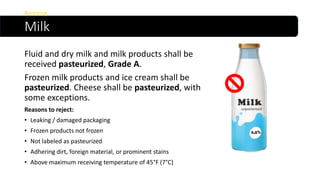
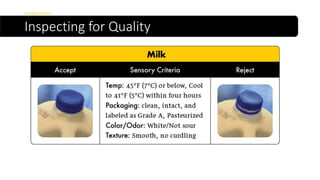
Milk
Fluid and dry milk and milk products shall be
received pasteurized, Grade A.
Frozen milk products and ice cream shall be
pasteurized. Cheese shall be pasteurized, with
some exceptions.
Reasons to reject:
• Leaking / damaged packaging
• Frozen products not frozen
• Not labeled as pasteurized
• Adhering dirt, foreign material, or prominent stains
• Above maximum receiving temperature of 45°F (7°C)
Receiving
Shucked Shellfish
Raw shucked shellfish must be received in nonreturnable packages
bearing a legible label that includes the following information:
Receiving
• Name, address, and certification number of the
shucker, packer, or repacker.
• The “sell by” or “best if used by” date for packages
with a capacity of less than ½ gallon (1.89 L) or the
date shucked for larger packages.
Shellstock
Shellstock must be received in containers bearing legible source-
identification tags. This shellstock identification tag or label must
contain the following information in order:
Receiving
• The harvester’s identification number
• The date of harvesting
• Harvest location
• The type and quantity of shellfish
• The following statement in bold, capitalized type:
THIS TAG IS REQUIRED TO BE ATTACHED UNTIL CONTAINER IS EMPTY OR
RETAGGED AND THEREAFTER KEPT ON FILE FOR 90 DAYS
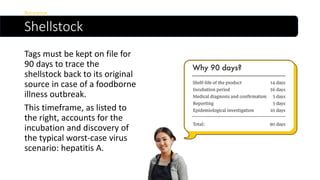
Shellstock
Tags must be kept on file for
90 days to trace the
shellstock back to its original
source in case of a foodborne
illness outbreak.
This timeframe, as listed to
the right, accounts for the
incubation and discovery of
the typical worst-case virus
scenario: hepatitis A.
Receiving
Inspections
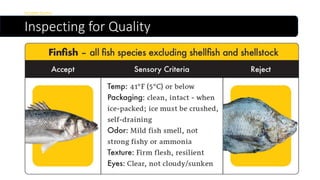
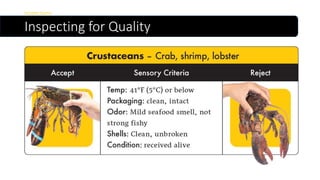
Inspecting for Quality
Inspections
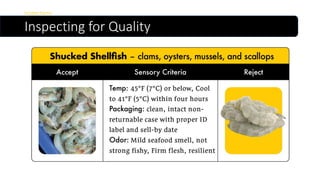
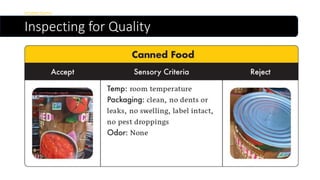
Inspecting for Quality
Inspections
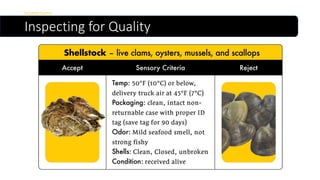
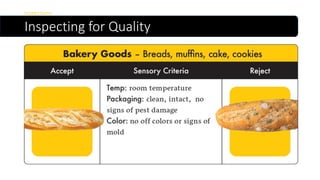
Inspecting for Quality
Inspections
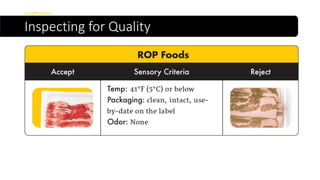
Inspecting for Quality
Inspections
Inspecting for Quality
Inspections
Inspecting for Quality
Inspections
Inspecting for Quality
Inspections
Inspecting for Quality
Inspections
Inspecting for Quality
Inspections
Inspecting for Quality
Inspections
Inspecting for Quality
Inspections
Inspecting for Quality
Inspections
Inspecting for Quality
Inspections
Inspecting for Quality
Inspections
ICAM Chapter 6.pptx
ICAM Chapter 6.pptx

ICAM Chapter 6.pptx

  • 1.
  • 3.
    Broccoli & CheddarSoup This week’s recipe from the Student Workbook is: Broccoli and cheddar soups are categorized into two main choices: thick and clear. Clear soups are generally made with a stock as the base, like consommé or chicken noodle. Chapter Recipe
  • 4.
  • 5.
    U.S. Food LawRequirements Aimed at protecting the consumer’s health, safety, and economic resources, the FDA enforces its regulations and laws enacted by the U.S. Congress. Food Sources To comply with the U.S. Food Law, the source of food must: • Comply with the law. • Not be prepared in a private residence. • Have package labeling in compliance with the law. • Be from a supplier that properly freezes (and retains records) for fish intended to be eaten raw. • Be from a supplier that meets specific whole-muscle, intact beef requirements. • Be labeled appropriately for safe handling instructions: • Meat and poultry that is not an RTE Food. • Eggs not treated to destroy all visible salmonellae.
  • 6.
    FDA Food CodeRequirements The FDA Food Code is not federal law but becomes legally binding in states and jurisdictions that adopt it. The model Food Code is designed to align with federal food laws and regulations, meaning there should not be any contradictions. Food Sources
  • 7.
    Inspection and Grading TheUSDA maintains two separate programs for inspecting and grading meat and poultry. • Inspection for wholesomeness is mandatory and paid for by U.S. tax dollars. • Grading for quality is voluntary and paid for by the producers/ processors. Food Sources
  • 8.
    Use-by Dates Most sell-by,use-by dates, and expiration dates are added to food packages voluntarily by the manufacturer. These dates are added for various reasons and food may not technically be spoiled when the indicated date has passed. Food Sources TCS Foods must be consumed or discarded by the expiration date unless the product has been frozen. A food establishment’s date markings on storage containers may not exceed the manufacturer’s use-by date. use-by dates and Inspection stamp
  • 9.
    Recalls and Public& Health Alerts A food recall is the removal or correction of a marketed product that contains contaminants, unidentified ingredients, is mislabeled, or is in violation of the law. Food Sources • Food that has been recalled should not be received or used in a food operation • Food found to be recalled after receipt should be discarded or clearly labeled: DO NOT USE/ DO NOT DISCARD
  • 10.
  • 11.
    What is it? Ina food operation, receiving is the initial point of entry for all deliveries of food and supplies. The receiving process is not just a physical task of moving heavy boxes to storage. Anyone receiving food products must be familiar with these FDA receiving requirements: Receiving
  • 12.
    Key Drop Delivery Whilemost deliveries are made during a food operation’s normal business hours, there are situations where that is not possible. In these cases, a key drop delivery method is used, where a distributor is provided after-hours access using a key or code. Rather than just delivering the products to the receiving area, the delivery driver(s) places the products in coolers, freezers, and dry storage. Receiving
  • 13.
  • 14.
    Eggs Reasons to reject: •Leaking egg • Broken shell or crack, but membrane intact and not leaking • Liquid, frozen eggs, dried eggs, and egg products are not pasteurized • Adhering dirt, foreign material, or prominent stains • Raw eggs not delivered in refrigerated equipment • Inedible due to rot, sour eggs, green whites, incubation • Above maximum receiving temperature of 45°F (7°C) Receiving
  • 15.
    Milk Fluid and drymilk and milk products shall be received pasteurized, Grade A. Frozen milk products and ice cream shall be pasteurized. Cheese shall be pasteurized, with some exceptions. Reasons to reject: • Leaking / damaged packaging • Frozen products not frozen • Not labeled as pasteurized • Adhering dirt, foreign material, or prominent stains • Above maximum receiving temperature of 45°F (7°C) Receiving
  • 16.
    Shucked Shellfish Raw shuckedshellfish must be received in nonreturnable packages bearing a legible label that includes the following information: Receiving • Name, address, and certification number of the shucker, packer, or repacker. • The “sell by” or “best if used by” date for packages with a capacity of less than ½ gallon (1.89 L) or the date shucked for larger packages.
  • 17.
    Shellstock Shellstock must bereceived in containers bearing legible source- identification tags. This shellstock identification tag or label must contain the following information in order: Receiving • The harvester’s identification number • The date of harvesting • Harvest location • The type and quantity of shellfish • The following statement in bold, capitalized type: THIS TAG IS REQUIRED TO BE ATTACHED UNTIL CONTAINER IS EMPTY OR RETAGGED AND THEREAFTER KEPT ON FILE FOR 90 DAYS
  • 18.
    Shellstock Tags must bekept on file for 90 days to trace the shellstock back to its original source in case of a foodborne illness outbreak. This timeframe, as listed to the right, accounts for the incubation and discovery of the typical worst-case virus scenario: hepatitis A. Receiving
  • 19.
  • 20.
  • 21.
  • 22.
  • 23.
  • 24.
  • 25.
  • 26.
  • 27.
  • 28.
  • 29.
  • 30.
  • 31.
  • 32.
  • 33.