great platforms are great ecosystems
ideas from facebook and mobile
(and a few other anecdotes)
nat brown
natbro@gmail.com
@natbro
hi. i’ve worked on all of these
• microsoft windows (Win16/Win32) ‘90-’00
• microsoft COM/OLE, IE/ActiveX ‘92-’97
• web ‘96-present, early mobile ‘99-’03
• xbox ’98-’99
an intermission
• facebook platform ’06-’10 (iLike.com)
• iOS and Android ’08-present (misc)
to me platforms start with…
• a workflow – a place users spend time
creating and/or consuming content
• a business model – a way for people to
make a living
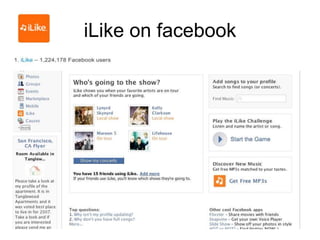
facebook platform ‘07
• prior to june ‘07, only proprietary features
• bi-direction RESTful “platform” protocol
supported native-looking “apps”
– user-acquisition, notifications baked into feed
– controlled direct user communication (email)
– a display language, FBML/FBJS => HTML
– navigation: apps existed within the facebook
URL hierarchy
iLike on facebook
facebook platform
• facebook is a social “workflow” akin to email
• what did facebook platform fix for “apps”?
– huge addressable market with strong engagement
– discovery, distribution/installation, versioning/updates
– communication, navigation
• what didn’t it fix?
– stability, business-model
• out-of-balance / unsustainable ecosystem
– facebook was only interested in users & engagement
– apps looking to make money had misaligned priorities, didn’t
control enough of their own destiny or user communication
– huge user numbers and engagement at any cost were the only
plausible monetization paths (ads, venture, buyout)
– app behaviors led to bad user experience, shutdown
mobile platforms (iOS and Android)
• prior to july ‘08, mostly proprietary apps
• app stores dropped carrier distribution barrier
for native apps
– added direct developer payment infrastructure,
stable APIs
– UI/design language: reusable controls, including
Web/HTML
– simple, consistent navigation model and
guidelines for app-internal, app-app navigation
– iOS opted for app-reviews & tight-control, Android
for “open”
mobile platforms
• phones/tablets with web connectivity are a “workflow” around
social/communication/expression (UGC), casual/snacking entertainment,
and increasingly productivity
• what did mobile platforms fix for apps?
– vast addressable market
– partial connectivity vs. web on mobile (“rich client UI & logic”)
– distribution/installation, versioning/updates, communication, navigation
– stability, payments (to some degree)
• what didn’t it fix?
– discovery
• a sustainable ecosystem, but with rough business-model issues
– in-app purchasing and addiction-/gambling-ware “whale” pursuit
– malware on Android
– poor ads throughout
– extreme price pressure
mobile monetization
• i’ve sold about 1.5M apps since ’08
• discovery: from difficult to impossible
• volumes: declining over time:
– paid to free-to-try: 50% increase leading to a decline
to 25%
– to free-with-in-app-purchases: 50% increase again
leading to decline to 25%
• users and regulators are not amused by
gambling/addiction “whale” tactics - the payment
pendulum swings back
• in hindsight, ideally never let prices drop to zero
and set consumer expectations at zero
some contrast
• Windows grew addressable market for graphical applications
stabilized APIs: graphics, sound, file-system, input-system; created
great toolchains. failed to innovate in overall stability (apps crash
each other), security (malware), and in digital discovery, distribution
& payment.
• Consoles xBox attempted to bring PC developers + Windows
platform to consoles, grow market, break cycle of custom hardware,
difficult custom tools, no backwards compatibility. failed some PC
tenets in the 360 generation. consoles are doing poorly at usability
and monolithic app installation, mixed on curation vs. open.
• Web HTML/HTTP and the browser defined a non-centralized and
cheap information & “app” / site distribution mechanism and a
consistent navigation metaphor that brings only parts of the “app” as
needed. weak security and the “ad-supported-assumption” and lack
of micro-payments prevent a great deal of innovation.
some parting thoughts
• huge addressable markets often involve a segue market
• user-interaction/navigation models between content/apps
which maintain workflow are more important than most think
• bake in sustainable payments around access, specific
content, or time, in a way which doesn’t race to $0 or hinge
entirely on ads
• look for content providers (“apps”) of all sizes (not just big
publishers) who have stable businesses
• ideally apps make >> more $ aggregate than the platform
• greatest platforms have UGC (kid-/novice-created content –
Visual Basic, HTML, YouTube) and sub-ecosystems that are
also virtuous
• great tools, stability, security, privacy, distribution
• ideally, non-game-able discovery
thanks!
nat brown
natbro@gmail.com
@natbro

On Platforms

  • 1.
    great platforms aregreat ecosystems ideas from facebook and mobile (and a few other anecdotes) nat brown natbro@gmail.com @natbro
  • 2.
    hi. i’ve workedon all of these • microsoft windows (Win16/Win32) ‘90-’00 • microsoft COM/OLE, IE/ActiveX ‘92-’97 • web ‘96-present, early mobile ‘99-’03 • xbox ’98-’99 an intermission • facebook platform ’06-’10 (iLike.com) • iOS and Android ’08-present (misc)
  • 3.
    to me platformsstart with… • a workflow – a place users spend time creating and/or consuming content • a business model – a way for people to make a living
  • 4.
    facebook platform ‘07 •prior to june ‘07, only proprietary features • bi-direction RESTful “platform” protocol supported native-looking “apps” – user-acquisition, notifications baked into feed – controlled direct user communication (email) – a display language, FBML/FBJS => HTML – navigation: apps existed within the facebook URL hierarchy
  • 5.
  • 6.
    facebook platform • facebookis a social “workflow” akin to email • what did facebook platform fix for “apps”? – huge addressable market with strong engagement – discovery, distribution/installation, versioning/updates – communication, navigation • what didn’t it fix? – stability, business-model • out-of-balance / unsustainable ecosystem – facebook was only interested in users & engagement – apps looking to make money had misaligned priorities, didn’t control enough of their own destiny or user communication – huge user numbers and engagement at any cost were the only plausible monetization paths (ads, venture, buyout) – app behaviors led to bad user experience, shutdown
  • 7.
    mobile platforms (iOSand Android) • prior to july ‘08, mostly proprietary apps • app stores dropped carrier distribution barrier for native apps – added direct developer payment infrastructure, stable APIs – UI/design language: reusable controls, including Web/HTML – simple, consistent navigation model and guidelines for app-internal, app-app navigation – iOS opted for app-reviews & tight-control, Android for “open”
  • 8.
    mobile platforms • phones/tabletswith web connectivity are a “workflow” around social/communication/expression (UGC), casual/snacking entertainment, and increasingly productivity • what did mobile platforms fix for apps? – vast addressable market – partial connectivity vs. web on mobile (“rich client UI & logic”) – distribution/installation, versioning/updates, communication, navigation – stability, payments (to some degree) • what didn’t it fix? – discovery • a sustainable ecosystem, but with rough business-model issues – in-app purchasing and addiction-/gambling-ware “whale” pursuit – malware on Android – poor ads throughout – extreme price pressure
  • 9.
    mobile monetization • i’vesold about 1.5M apps since ’08 • discovery: from difficult to impossible • volumes: declining over time: – paid to free-to-try: 50% increase leading to a decline to 25% – to free-with-in-app-purchases: 50% increase again leading to decline to 25% • users and regulators are not amused by gambling/addiction “whale” tactics - the payment pendulum swings back • in hindsight, ideally never let prices drop to zero and set consumer expectations at zero
  • 10.
    some contrast • Windowsgrew addressable market for graphical applications stabilized APIs: graphics, sound, file-system, input-system; created great toolchains. failed to innovate in overall stability (apps crash each other), security (malware), and in digital discovery, distribution & payment. • Consoles xBox attempted to bring PC developers + Windows platform to consoles, grow market, break cycle of custom hardware, difficult custom tools, no backwards compatibility. failed some PC tenets in the 360 generation. consoles are doing poorly at usability and monolithic app installation, mixed on curation vs. open. • Web HTML/HTTP and the browser defined a non-centralized and cheap information & “app” / site distribution mechanism and a consistent navigation metaphor that brings only parts of the “app” as needed. weak security and the “ad-supported-assumption” and lack of micro-payments prevent a great deal of innovation.
  • 11.
    some parting thoughts •huge addressable markets often involve a segue market • user-interaction/navigation models between content/apps which maintain workflow are more important than most think • bake in sustainable payments around access, specific content, or time, in a way which doesn’t race to $0 or hinge entirely on ads • look for content providers (“apps”) of all sizes (not just big publishers) who have stable businesses • ideally apps make >> more $ aggregate than the platform • greatest platforms have UGC (kid-/novice-created content – Visual Basic, HTML, YouTube) and sub-ecosystems that are also virtuous • great tools, stability, security, privacy, distribution • ideally, non-game-able discovery
  • 12.