What is Entrepreneurship?
Chapter 1
1.1
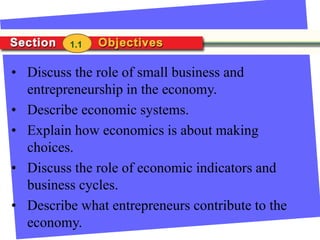
• Discuss the role of small business and
entrepreneurship in the economy.
• Describe economic systems.
• Explain how economics is about making
choices.
• Discuss the role of economic indicators and
business cycles.
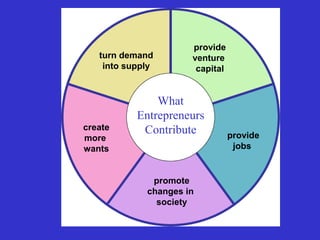
• Describe what entrepreneurs contribute to the
economy.
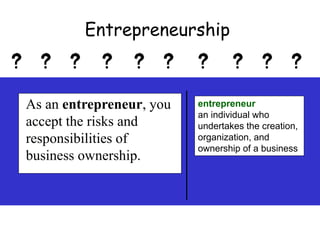
As an entrepreneur, you
accept the risks and
responsibilities of
business ownership.
entrepreneur
an individual who
undertakes the creation,
organization, and
ownership of a business
Entrepreneurship
Entrepreneurship
Creating and running a
business venture requires
a variety of skills.
venture a new
business undertaking
that involves risk
acting like an
entrepreneur or having an
entrepreneurial mind-set
the process of
recognizing an
opportunity, testing it in
the market, and gathering
resources necessary to
go into business
Entrepreneurship vs. Entrepreneurial
• About one in three households is involved
in an entrepreneurial enterprise.
• Most businesses, 90%, are small
businesses with fewer than 100 employees.
• Why is owning and operating a business
today much different than the past???
• The global marketplace and Information
Technology have opened new markets
Question:
Howdo entrepreneurs relate to the economy?
Entrepreneurship Today
Knowledge of economics
contributes to an
understanding of how
entrepreneurs and
customers interact.
economics the study of
how people allocate
scarce resources to fulfill
their unlimited wants
Economic Systems
• An economic system includes a set of laws, institutions,
and activities that guide economic decision making
Economic Systems
? ?
? ?
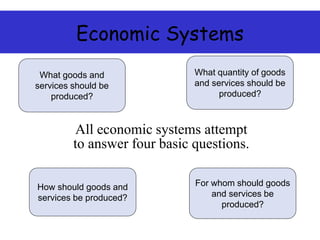
All economic systems attempt
to answer four basic questions.
What goods and
services should be
produced?
What quantity of goods
and services should be
produced?
How should goods and
services be produced?
For whom should goods
and services be
produced?
The Free Enterprise System
Most democratic nations
have a free enterprise
system.
A free enterprise system is
also known as capitalism
or a market economy.
With a Free Enterprise System
 People can choose what to buy.
 They can choose to own private property.
 They can choose to start a business and
compete.
The Free Enterprise System
What is the primary incentive of free
enterprise?
PROFIT - money that is left
over after all expenses of running
a business have been deducted
from the income
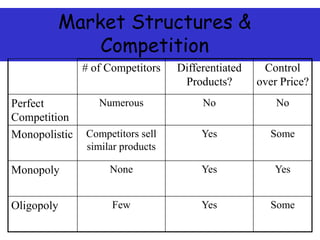
Market Structures &
Competition
# of Competitors Differentiated
Products?
Control
over Price?
Perfect
Competition
Numerous No No
Monopolistic Competitors sell
similar products
Yes Some
Monopoly None Yes Yes
Oligopoly Few Yes Some
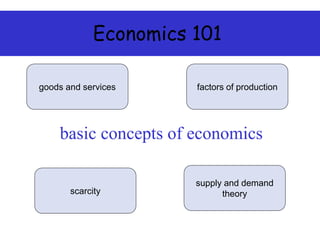
Economics 101
basic concepts of economics
goods and services factors of production
scarcity
supply and demand
theory
Economics 101
• Goods and services are the products of
our economic system.
•Entrepreneurs respond to consumers’
wants and needs with goods and services.
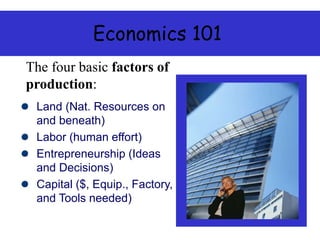
Economics 101
Land (Nat. Resources on
and beneath)
Labor (human effort)
Entrepreneurship (Ideas
and Decisions)
Capital ($, Equip., Factory,
and Tools needed)
The four basic factors of
production:
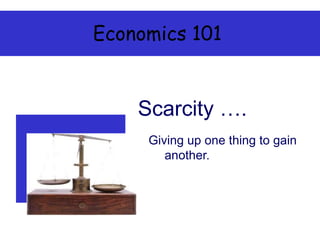
Economics 101
Giving up one thing to gain
another.
Scarcity ….
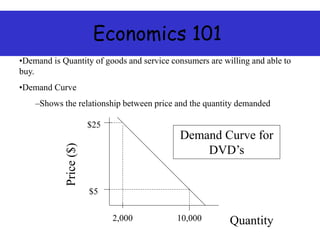
Economics 101
$25
$5
2,000 10,000
Price
($)
Demand Curve for
DVD’s
Quantity
•Demand is Quantity of goods and service consumers are willing and able to
buy.
•Demand Curve
–Shows the relationship between price and the quantity demanded
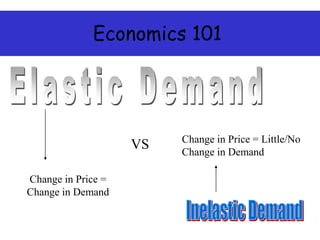
Economics 101
VS
Change in Price =
Change in Demand
Change in Price = Little/No
Change in Demand
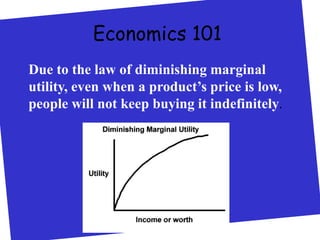
Economics 101
Due to the law of diminishing marginal
utility, even when a product’s price is low,
people will not keep buying it indefinitely.
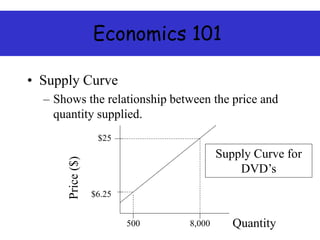
Economics 101
• Supply Curve
– Shows the relationship between the price and
quantity supplied.
$25
$6.25
500 8,000
Price
($)
Supply Curve for
DVD’s
Quantity
Economics 101
• If something is in heavy demand, but in short
supply, prices will go up.
• If something is in heavy supply, but in short
demand, prices will go down.
Economics 101
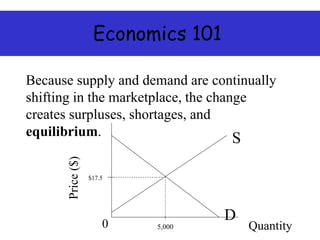
Because supply and demand are continually
shifting in the marketplace, the change
creates surpluses, shortages, and
equilibrium.
$17.5
5,000
S
D
0 Quantity
Economic Indicators
The federal government
publishes statistics,
called economic
indicators, that help
entrepreneurs understand
the economy and predict
possible changes.
Ex. Gross Domestic Product (GDP)
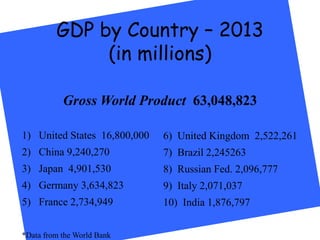
GDP by Country – 2013
(in millions)
1) United States 16,800,000
2) China 9,240,270
3) Japan 4,901,530
4) Germany 3,634,823
5) France 2,734,949
*Data from the World Bank
6) United Kingdom 2,522,261
7) Brazil 2,245263
8) Russian Fed. 2,096,777
9) Italy 2,071,037
10) India 1,876,797
Gross World Product 63,048,823
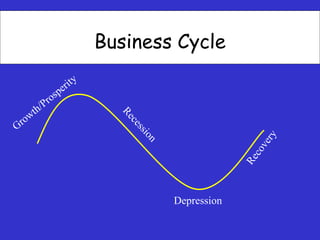
Business Cycle
Depression
What
Entrepreneurs
Contribute
turn demand
into supply
provide
venture
capital
provide
jobs
promote
changes in
society
create
more
wants
Small Businesses and
Entrepreneurial Ventures
The difference between small businesses and
entrepreneurial ventures is that owners start small
businesses to create jobs for themselves.
Founders of entrepreneurial ventures have a
desire to innovate, grow, and create new value.
1.2
• Describe entrepreneurship from a historical
perspective.
• Discuss the five components of the
entrepreneurial start-up process.
• Explain how to achieve business success.
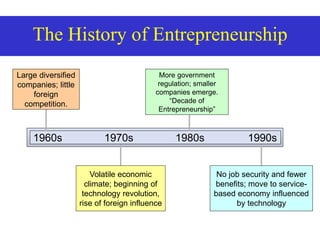
The History of Entrepreneurship
1960s 1990s
1970s 1980s
Large diversified
companies; little
foreign
competition.
Volatile economic
climate; beginning of
technology revolution,
rise of foreign influence
No job security and fewer
benefits; move to service-
based economy influenced
by technology
More government
regulation; smaller
companies emerge.
“Decade of
Entrepreneurship”
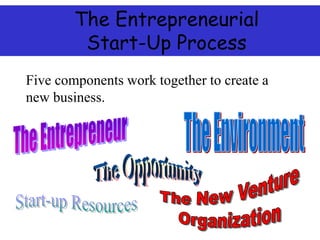
The Entrepreneurial
Start-Up Process
Five components work together to create a
new business.
The Entrepreneur
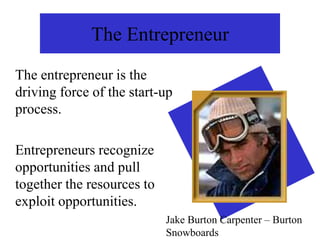
The entrepreneur is the
driving force of the start-up
process.
Entrepreneurs recognize
opportunities and pull
together the resources to
exploit opportunities.
Jake Burton Carpenter – Burton
Snowboards
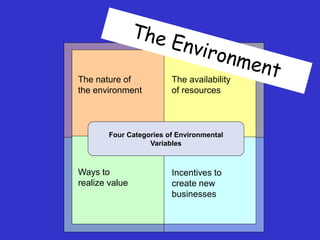
The nature of
the environment
The availability
of resources
Ways to
realize value
Incentives to
create new
businesses
Four Categories of Environmental
Variables
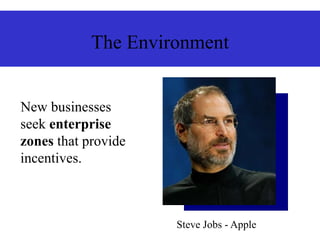
The Environment
New businesses
seek enterprise
zones that provide
incentives.
Steve Jobs - Apple
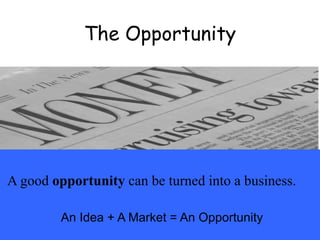
The Opportunity
A good opportunity can be turned into a business.
An Idea + A Market = An Opportunity
Start-Up Resources
When entrepreneurs are
ready to start up a new
business, they must use
creative talent to put
together the necessary
start-up resources.
The New Venture Organization
The new venture organization is the
infrastructure/foundation that supports all the
products, processes, and services of a new
business
Business Failures
A business failure files Chapter 7
bankruptcy.
A business that disappears from the tax rolls may
be a failure or a discontinuance.
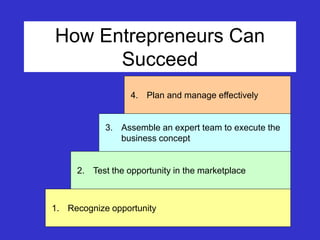
How Entrepreneurs Can
Succeed
4. Plan and manage effectively
1. Recognize opportunity
2. Test the opportunity in the marketplace
3. Assemble an expert team to execute the
business concept

Chapter 1 Presentation.ppt

  • 1.
  • 2.
    1.1 • Discuss therole of small business and entrepreneurship in the economy. • Describe economic systems. • Explain how economics is about making choices. • Discuss the role of economic indicators and business cycles. • Describe what entrepreneurs contribute to the economy.
  • 3.
    As an entrepreneur,you accept the risks and responsibilities of business ownership. entrepreneur an individual who undertakes the creation, organization, and ownership of a business Entrepreneurship
  • 4.
    Entrepreneurship Creating and runninga business venture requires a variety of skills. venture a new business undertaking that involves risk
  • 5.
    acting like an entrepreneuror having an entrepreneurial mind-set the process of recognizing an opportunity, testing it in the market, and gathering resources necessary to go into business Entrepreneurship vs. Entrepreneurial
  • 6.
    • About onein three households is involved in an entrepreneurial enterprise. • Most businesses, 90%, are small businesses with fewer than 100 employees.
  • 7.
    • Why isowning and operating a business today much different than the past??? • The global marketplace and Information Technology have opened new markets
  • 8.
  • 9.
    Entrepreneurship Today Knowledge ofeconomics contributes to an understanding of how entrepreneurs and customers interact. economics the study of how people allocate scarce resources to fulfill their unlimited wants
  • 10.
    Economic Systems • Aneconomic system includes a set of laws, institutions, and activities that guide economic decision making
  • 11.
    Economic Systems ? ? ?? All economic systems attempt to answer four basic questions. What goods and services should be produced? What quantity of goods and services should be produced? How should goods and services be produced? For whom should goods and services be produced?
  • 12.
    The Free EnterpriseSystem Most democratic nations have a free enterprise system. A free enterprise system is also known as capitalism or a market economy.
  • 13.
    With a FreeEnterprise System  People can choose what to buy.  They can choose to own private property.  They can choose to start a business and compete.
  • 14.
    The Free EnterpriseSystem What is the primary incentive of free enterprise? PROFIT - money that is left over after all expenses of running a business have been deducted from the income
  • 15.
    Market Structures & Competition #of Competitors Differentiated Products? Control over Price? Perfect Competition Numerous No No Monopolistic Competitors sell similar products Yes Some Monopoly None Yes Yes Oligopoly Few Yes Some
  • 16.
    Economics 101 basic conceptsof economics goods and services factors of production scarcity supply and demand theory
  • 17.
    Economics 101 • Goodsand services are the products of our economic system. •Entrepreneurs respond to consumers’ wants and needs with goods and services.
  • 18.
    Economics 101 Land (Nat.Resources on and beneath) Labor (human effort) Entrepreneurship (Ideas and Decisions) Capital ($, Equip., Factory, and Tools needed) The four basic factors of production:
  • 19.
    Economics 101 Giving upone thing to gain another. Scarcity ….
  • 20.
    Economics 101 $25 $5 2,000 10,000 Price ($) DemandCurve for DVD’s Quantity •Demand is Quantity of goods and service consumers are willing and able to buy. •Demand Curve –Shows the relationship between price and the quantity demanded
  • 21.
    Economics 101 VS Change inPrice = Change in Demand Change in Price = Little/No Change in Demand
  • 22.
    Economics 101 Due tothe law of diminishing marginal utility, even when a product’s price is low, people will not keep buying it indefinitely.
  • 23.
    Economics 101 • SupplyCurve – Shows the relationship between the price and quantity supplied. $25 $6.25 500 8,000 Price ($) Supply Curve for DVD’s Quantity
  • 24.
    Economics 101 • Ifsomething is in heavy demand, but in short supply, prices will go up. • If something is in heavy supply, but in short demand, prices will go down.
  • 25.
    Economics 101 Because supplyand demand are continually shifting in the marketplace, the change creates surpluses, shortages, and equilibrium. $17.5 5,000 S D 0 Quantity
  • 26.
    Economic Indicators The federalgovernment publishes statistics, called economic indicators, that help entrepreneurs understand the economy and predict possible changes. Ex. Gross Domestic Product (GDP)
  • 27.
    GDP by Country– 2013 (in millions) 1) United States 16,800,000 2) China 9,240,270 3) Japan 4,901,530 4) Germany 3,634,823 5) France 2,734,949 *Data from the World Bank 6) United Kingdom 2,522,261 7) Brazil 2,245263 8) Russian Fed. 2,096,777 9) Italy 2,071,037 10) India 1,876,797 Gross World Product 63,048,823
  • 28.
  • 29.
  • 30.
    Small Businesses and EntrepreneurialVentures The difference between small businesses and entrepreneurial ventures is that owners start small businesses to create jobs for themselves. Founders of entrepreneurial ventures have a desire to innovate, grow, and create new value.
  • 31.
    1.2 • Describe entrepreneurshipfrom a historical perspective. • Discuss the five components of the entrepreneurial start-up process. • Explain how to achieve business success.
  • 32.
    The History ofEntrepreneurship 1960s 1990s 1970s 1980s Large diversified companies; little foreign competition. Volatile economic climate; beginning of technology revolution, rise of foreign influence No job security and fewer benefits; move to service- based economy influenced by technology More government regulation; smaller companies emerge. “Decade of Entrepreneurship”
  • 33.
    The Entrepreneurial Start-Up Process Fivecomponents work together to create a new business.
  • 34.
    The Entrepreneur The entrepreneuris the driving force of the start-up process. Entrepreneurs recognize opportunities and pull together the resources to exploit opportunities. Jake Burton Carpenter – Burton Snowboards
  • 35.
    The nature of theenvironment The availability of resources Ways to realize value Incentives to create new businesses Four Categories of Environmental Variables
  • 36.
    The Environment New businesses seekenterprise zones that provide incentives. Steve Jobs - Apple
  • 37.
    The Opportunity A goodopportunity can be turned into a business. An Idea + A Market = An Opportunity
  • 38.
    Start-Up Resources When entrepreneursare ready to start up a new business, they must use creative talent to put together the necessary start-up resources.
  • 39.
    The New VentureOrganization The new venture organization is the infrastructure/foundation that supports all the products, processes, and services of a new business
  • 40.
    Business Failures A businessfailure files Chapter 7 bankruptcy. A business that disappears from the tax rolls may be a failure or a discontinuance.
  • 41.
    How Entrepreneurs Can Succeed 4.Plan and manage effectively 1. Recognize opportunity 2. Test the opportunity in the marketplace 3. Assemble an expert team to execute the business concept