Big Data Analytics Lifecycle
K.Sathyaseelan
Assistant Professor,
Department of Information Technology,
Sri Ramakrishna Institute of Technology,
Coimbatore.
Overview
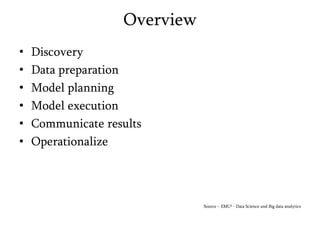
• Discovery
• Data preparation
• Model planning
• Model execution
• Communicate results
• Operationalize
Source – EMC² - Data Science and Big data analytics
Key stakeholders of an analytics project.
• Since data science consist of various phases similarly it involves various
stake holders.
• Totally seven roles are specified in the process for successful completion of
the project.
• Business User: Someone who understands the domain area
• This person can consult and advise the project team on the context of the project,
the value of the results, and how the outputs will be operationalized.
– Usually a business analyst, line manager, or deep subject matter expert in the
project domain fulfills this role.
Source – EMC² - Data Science and Big data analytics
Key stakeholders of an analytics project.
• Project Sponsor: Responsible for the genesis of the project.
• Project Manager: Ensures that key milestones and objectives are met on
time and at the expected quality.
• Business Intelligence Analyst: Provides business domain expertise based
on a deep understanding of the data, key performance indicators (KPIs),
key metrics, and business intelligence from a reporting perspective.
• Database Administrator (DBA): Provisions and configures the database
environment to support the analytics needs of the working team.
• Data Engineer: Leverages deep technical skills to assist with tuning SQL
queries for data management and data extraction, and provides support
for data ingestion.
Source – EMC² - Data Science and Big data analytics
Data Analytics Lifecycle
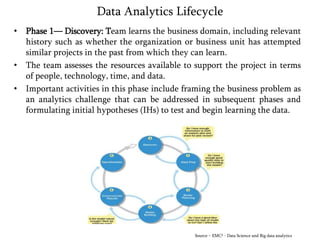
• Phase 1— Discovery: Team learns the business domain, including relevant
history such as whether the organization or business unit has attempted
similar projects in the past from which they can learn.
• The team assesses the resources available to support the project in terms
of people, technology, time, and data.
• Important activities in this phase include framing the business problem as
an analytics challenge that can be addressed in subsequent phases and
formulating initial hypotheses (IHs) to test and begin learning the data.
Source – EMC² - Data Science and Big data analytics
Phase 1— Discovery:
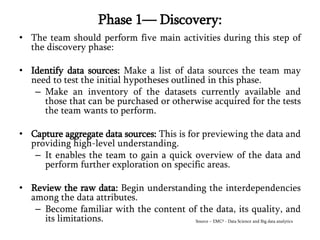
• The team should perform five main activities during this step of
the discovery phase:
• Identify data sources: Make a list of data sources the team may
need to test the initial hypotheses outlined in this phase.
– Make an inventory of the datasets currently available and
those that can be purchased or otherwise acquired for the tests
the team wants to perform.
• Capture aggregate data sources: This is for previewing the data and
providing high-level understanding.
– It enables the team to gain a quick overview of the data and
perform further exploration on specific areas.
• Review the raw data: Begin understanding the interdependencies
among the data attributes.
– Become familiar with the content of the data, its quality, and
its limitations. Source – EMC² - Data Science and Big data analytics
Phase 1— Discovery:
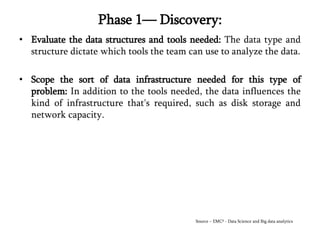
• Evaluate the data structures and tools needed: The data type and
structure dictate which tools the team can use to analyze the data.
• Scope the sort of data infrastructure needed for this type of
problem: In addition to the tools needed, the data influences the
kind of infrastructure that's required, such as disk storage and
network capacity.
Source – EMC² - Data Science and Big data analytics
Data Analytics Lifecycle
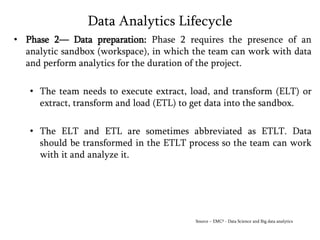
• Phase 2— Data preparation: Phase 2 requires the presence of an
analytic sandbox (workspace), in which the team can work with data
and perform analytics for the duration of the project.
• The team needs to execute extract, load, and transform (ELT) or
extract, transform and load (ETL) to get data into the sandbox.
• The ELT and ETL are sometimes abbreviated as ETLT. Data
should be transformed in the ETLT process so the team can work
with it and analyze it.
Source – EMC² - Data Science and Big data analytics
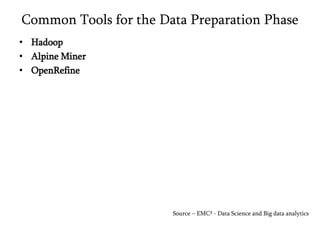
Common Tools for the Data Preparation Phase
• Hadoop
• Alpine Miner
• OpenRefine
Source – EMC² - Data Science and Big data analytics
Data Analytics Lifecycle
• Phase 3— Model planning:
Phase 3 is model planning, where the
team determines the methods, techniques, and workflow it intends to
follow for the subsequent model building phase.
Source – EMC² - Data Science and Big data analytics
Common Tools for the Model Planning Phase
Here are several of the more common ones:
• R
• SQL Analysis
• SAS/ ACCESS
Source – EMC² - Data Science and Big data analytics
Data Analytics Lifecycle
• Phase 4 Model building:
In Phase 4, the team develops datasets for testing, training, and
production purposes.
– In addition, in this phase the team builds and executes models
based on the work done in the model planning phase.
Source – EMC² - Data Science and Big data analytics
Data Analytics Lifecycle
• Phase 5— Communicate results: In Phase 5, the team, in
collaboration with major stakeholders, determines if the results
of the project are a success or a failure based on the criteria
developed in Phase 1.
• Phase 6— Operationalize: In Phase 6, the team delivers final
reports, briefings, code, and technical documents. In addition,
the team may run a pilot project to implement the models in a
production environment.
Source – EMC² - Data Science and Big data analytics
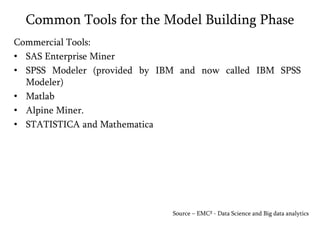
Common Tools for the Model Building Phase
Commercial Tools:
• SAS Enterprise Miner
• SPSS Modeler (provided by IBM and now called IBM SPSS
Modeler)
• Matlab
• Alpine Miner.
• STATISTICA and Mathematica
Source – EMC² - Data Science and Big data analytics
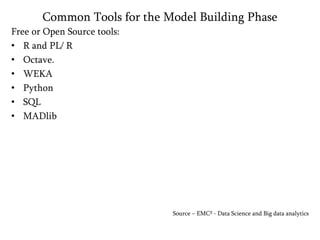
Common Tools for the Model Building Phase
Free or Open Source tools:
• R and PL/ R
• Octave.
• WEKA
• Python
• SQL
• MADlib
Source – EMC² - Data Science and Big data analytics

Data Analytics Life Cycle [EMC² - Data Science and Big data analytics]

  • 1.
    Big Data AnalyticsLifecycle K.Sathyaseelan Assistant Professor, Department of Information Technology, Sri Ramakrishna Institute of Technology, Coimbatore.
  • 2.
    Overview • Discovery • Datapreparation • Model planning • Model execution • Communicate results • Operationalize Source – EMC² - Data Science and Big data analytics
  • 3.
    Key stakeholders ofan analytics project. • Since data science consist of various phases similarly it involves various stake holders. • Totally seven roles are specified in the process for successful completion of the project. • Business User: Someone who understands the domain area • This person can consult and advise the project team on the context of the project, the value of the results, and how the outputs will be operationalized. – Usually a business analyst, line manager, or deep subject matter expert in the project domain fulfills this role. Source – EMC² - Data Science and Big data analytics
  • 4.
    Key stakeholders ofan analytics project. • Project Sponsor: Responsible for the genesis of the project. • Project Manager: Ensures that key milestones and objectives are met on time and at the expected quality. • Business Intelligence Analyst: Provides business domain expertise based on a deep understanding of the data, key performance indicators (KPIs), key metrics, and business intelligence from a reporting perspective. • Database Administrator (DBA): Provisions and configures the database environment to support the analytics needs of the working team. • Data Engineer: Leverages deep technical skills to assist with tuning SQL queries for data management and data extraction, and provides support for data ingestion. Source – EMC² - Data Science and Big data analytics
  • 5.
    Data Analytics Lifecycle •Phase 1— Discovery: Team learns the business domain, including relevant history such as whether the organization or business unit has attempted similar projects in the past from which they can learn. • The team assesses the resources available to support the project in terms of people, technology, time, and data. • Important activities in this phase include framing the business problem as an analytics challenge that can be addressed in subsequent phases and formulating initial hypotheses (IHs) to test and begin learning the data. Source – EMC² - Data Science and Big data analytics
  • 6.
    Phase 1— Discovery: •The team should perform five main activities during this step of the discovery phase: • Identify data sources: Make a list of data sources the team may need to test the initial hypotheses outlined in this phase. – Make an inventory of the datasets currently available and those that can be purchased or otherwise acquired for the tests the team wants to perform. • Capture aggregate data sources: This is for previewing the data and providing high-level understanding. – It enables the team to gain a quick overview of the data and perform further exploration on specific areas. • Review the raw data: Begin understanding the interdependencies among the data attributes. – Become familiar with the content of the data, its quality, and its limitations. Source – EMC² - Data Science and Big data analytics
  • 7.
    Phase 1— Discovery: •Evaluate the data structures and tools needed: The data type and structure dictate which tools the team can use to analyze the data. • Scope the sort of data infrastructure needed for this type of problem: In addition to the tools needed, the data influences the kind of infrastructure that's required, such as disk storage and network capacity. Source – EMC² - Data Science and Big data analytics
  • 8.
    Data Analytics Lifecycle •Phase 2— Data preparation: Phase 2 requires the presence of an analytic sandbox (workspace), in which the team can work with data and perform analytics for the duration of the project. • The team needs to execute extract, load, and transform (ELT) or extract, transform and load (ETL) to get data into the sandbox. • The ELT and ETL are sometimes abbreviated as ETLT. Data should be transformed in the ETLT process so the team can work with it and analyze it. Source – EMC² - Data Science and Big data analytics
  • 9.
    Common Tools forthe Data Preparation Phase • Hadoop • Alpine Miner • OpenRefine Source – EMC² - Data Science and Big data analytics
  • 10.
    Data Analytics Lifecycle •Phase 3— Model planning: Phase 3 is model planning, where the team determines the methods, techniques, and workflow it intends to follow for the subsequent model building phase. Source – EMC² - Data Science and Big data analytics
  • 11.
    Common Tools forthe Model Planning Phase Here are several of the more common ones: • R • SQL Analysis • SAS/ ACCESS Source – EMC² - Data Science and Big data analytics
  • 12.
    Data Analytics Lifecycle •Phase 4 Model building: In Phase 4, the team develops datasets for testing, training, and production purposes. – In addition, in this phase the team builds and executes models based on the work done in the model planning phase. Source – EMC² - Data Science and Big data analytics
  • 13.
    Data Analytics Lifecycle •Phase 5— Communicate results: In Phase 5, the team, in collaboration with major stakeholders, determines if the results of the project are a success or a failure based on the criteria developed in Phase 1. • Phase 6— Operationalize: In Phase 6, the team delivers final reports, briefings, code, and technical documents. In addition, the team may run a pilot project to implement the models in a production environment. Source – EMC² - Data Science and Big data analytics
  • 14.
    Common Tools forthe Model Building Phase Commercial Tools: • SAS Enterprise Miner • SPSS Modeler (provided by IBM and now called IBM SPSS Modeler) • Matlab • Alpine Miner. • STATISTICA and Mathematica Source – EMC² - Data Science and Big data analytics
  • 15.
    Common Tools forthe Model Building Phase Free or Open Source tools: • R and PL/ R • Octave. • WEKA • Python • SQL • MADlib Source – EMC² - Data Science and Big data analytics