Introduction to Oil
and Gas Industry
Upstream Midstream
Downstream
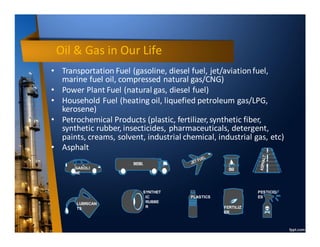
Oil & Gas in Our Life
• Transportation Fuel (gasoline, diesel fuel, jet/aviationfuel,
marine fuel oil, compressed natural gas/CNG)
• Power Plant Fuel (natural gas, diesel fuel)
• Household Fuel (heating oil, liquefied petroleum gas/LPG,
kerosene)
• Petrochemical Products (plastic, fertilizer,synthetic fiber,
synthetic rubber, insecticides, pharmaceuticals, detergent,
paints, creams, solvent, industrial chemical, industrial gas, etc)
• Asphalt
FERTILIZ
ER
GASOLI
NE
LUBRICAN
TS
SYNTHET
IC
RUBBE
R
PLASTICS
PESTICID
ES
HEATIN
G
Oil & Gas Formation
• It is formed from the
accumulation ofdecomposition
of plants and marine animals
which died millionyearsago and
trappedbeneaththe ground
under high pressure and
temperatures.
• Oil & gas compoundconsist of
Carbon & HydrogenAtom, that’s
why it is calledHYDROCARBON.
• Crude Oil is liquidwhileNatural
Gas is gaseoushydrocarbonat
room temperature.
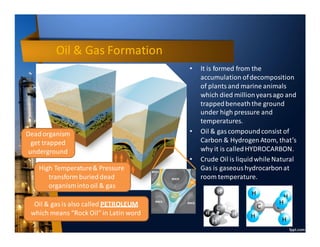
Deadorganism
get trapped
underground
High Temperature& Pressure
transform burieddead
organismintooil & gas
Oil & gasis also called PETROLEUM
which means “Rock Oil” in Latin word
Oil & Gas Early History
• Oil & gas had been used for centuries like
ancient peoples worshipped sacred fires
(eternal flame) fuelled by natural gas
seeping to the surface through pores and
cracks.
• About 6000 BC, thick gummy asphalt was
used to waterproof boats and heat homes.
• About 3000 BC, the Egyptians used asphalt
in the construction of the pyramids, to
grease axles of the Pharaoh’s chariots, and
as an embalming agent for mummies &
medicines.
• When whale oil (extracted from whale fat),
the main source of lamp fuel in early 1980,
became scarce, a new source is introduced
by distilling natural petroleum seeps and
coal into lamp oil / kerosene.
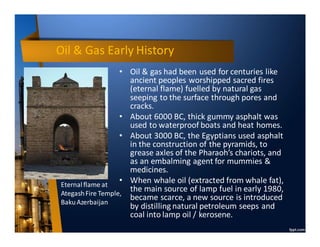
Eternalflame at
AtegashFire Temple,
BakuAzerbaijan
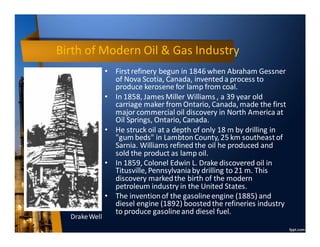
Birth of Modern Oil & Gas Industry
• Firstrefinery begun in 1846 when Abraham Gessner
of Nova Scotia, Canada, inventeda process to
produce kerosene for lamp from coal.
• In 1858, James Miller Williams , a 39 year old
carriage maker from Ontario, Canada, made the first
major commercial oil discovery in North America at
Oil Springs, Ontario, Canada.
• He struck oil at a depth of only 18 m by drilling in
"gum beds" in LambtonCounty, 25 km southeastof
Sarnia. Williams refined the oil he produced and
sold the product as lamp oil.
• In 1859, Colonel Edwin L. Drake discovered oil in
Titusville, Pennsylvaniaby drilling to 21 m. This
discovery markedthe birth of the modern
petroleum industry in the United States.
• The inventionof the gasolineengine (1885) and
diesel engine (1892) boostedthe refineries industry
to produce gasolineand diesel fuel.
DrakeWell
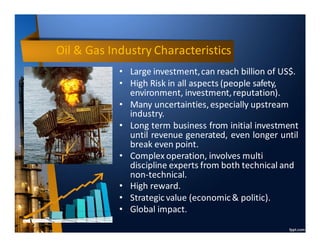
Oil & Gas Industry Characteristics
• Large investment,can reach billion of US$.
• High Risk in all aspects (people safety,
environment, investment,reputation).
• Many uncertainties,especially upstream
industry.
• Long term business from initial investment
until revenue generated, even longer until
break even point.
• Complex operation, involves multi
discipline experts from both technical and
non-technical.
• High reward.
• Strategicvalue (economic& politic).
• Global impact.
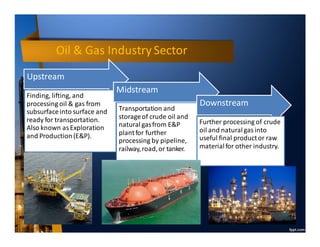
Upstream
Finding, lifting, and
processing oil & gas from
subsurfaceinto surface and
ready for transportation.
Also known as Exploration
and Production(E&P).
Midstream
Transportation and
storageof crude oil and
natural gasfrom E&P
plantfor further
processing by pipeline,
railway,road,or tanker.
Downstream
Further processing of crude
oil and natural gas into
useful final productor raw
material for other industry.
Oil & Gas Industry Sector
UPSTREAM
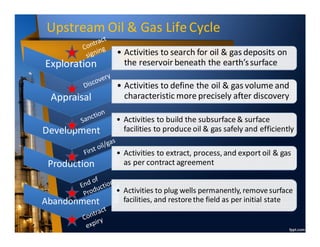
Upstream Oil & Gas LifeCycle
Exploration
• Activities to search for oil & gas deposits on
the reservoir beneath the earth’ssurface
Appraisal
• Activities to define the oil & gas volume and
characteristic more precisely after discovery
Development
• Activities to build the subsurface & surface
facilities to produce oil & gas safely and efficiently
Production
• Activities to extract, process,and export oil & gas
as per contract agreement
Abandonment
• Activities to plug wells permanently, removesurface
facilities, and restorethe field as per initial state
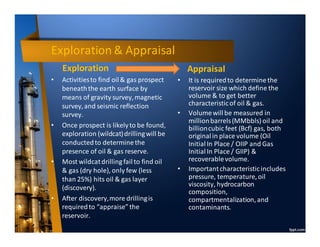
Exploration & Appraisal
Exploration
• Activitiesto find oil& gas prospect
beneaththe earth surface by
means of gravity survey,magnetic
survey,and seismic reflection
survey.
• Once prospect is likelyto be found,
exploration (wildcat)drillingwill be
conductedto determinethe
presence of oil & gas reserve.
• Most wildcatdrillingfailto find oil
& gas (dry hole), only few (less
than 25%) hits oil & gas layer
(discovery).
• After discovery,more drillingis
requiredto “appraise”the
reservoir.
Appraisal
• It is requiredto determinethe
reservoir size which define the
volume & to get better
characteristicof oil & gas.
• Volumewillbe measured in
millionbarrels(MMbbls) oil and
billioncubic feet (Bcf) gas, both
originalin place volume (Oil
InitialIn Place / OIIP and Gas
InitialIn Place / GIIP) &
recoverablevolume.
• Importantcharacteristicincludes
pressure, temperature,oil
viscosity, hydrocarbon
composition,
compartmentalization,and
contaminants.
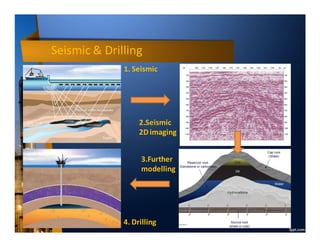
Seismic & Drilling
1. Seismic
2.Seismic
2Dimaging
3.Further
modelling
4. Drilling
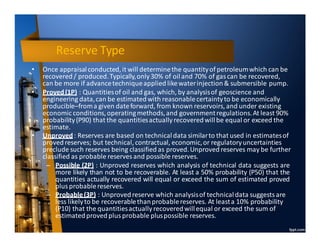
Reserve Type
• Once appraisalconducted,it will determinethe quantityof petroleumwhich can be
recovered/ produced.Typically,only30% of oiland 70% of gascan be recovered,
can be more if advancetechniqueapplied likewaterinjection& submersible pump.
• Proved(1P) : Quantitiesof oil and gas, which, by analysisof geoscience and
engineering data,can be estimatedwith reasonablecertaintyto be economically
producible–froma given dateforward, from known reservoirs, and under existing
economic conditions,operatingmethods,and governmentregulations.At least 90%
probability(P90) that the quantitiesactually recoveredwillbe equal or exceed the
estimate.
• Unproved: Reserves are based on technical data similarto that used in estimatesof
proved reserves; but technical, contractual, economic,or regulatoryuncertainties
preclude such reserves being classified as proved.Unproved reserves may be further
classified as probable reserves and possible reserves.
– Possible (2P) : Unproved reserves which analysis of technical data suggests are
more likely than not to be recoverable. At least a 50% probability (P50) that the
quantities actually recovered will equal or exceed the sum of estimated proved
plus probablereserves.
– Probable(3P) : Unprovedreserve which analysisof technical data suggests are
less likelyto be recoverablethanprobablereserves. At leasta 10% probability
(P10) that the quantitiesactually recoveredwillequal or exceed the sum of
estimatedproved plus probable pluspossible reserves.
Field Development Plan (FDP)
• Once the estimatedrecoverablevalueis determined,the Companywillpreparea plan
to monetize the reserve, calledFieldDevelopmentPlan / Plan of Development (PoD).
• FDP shall containat least :
➢ Subsurfacecharacteristic(OIIP, GIIP, contaminants, etc)
➢ Recoverablereserve in P90-P50-P10
➢ ProductionRate& Field Life
➢ ProductionFacilities(number & type of wells, surface facilities type)
➢ Project Plan (includingCost, Schedule, Quality)
➢ Project Economics
➢ Other aspects likeRisk, HealthSafety Environment (HSE)
• FDP shall be approvedby the host authority.Once approved,the Companywill
conduct a tender for facilities development.
• In the same time, Company will secure the hydrocarbon sales, especially gas, known
as Gas Sales Agreement (GSA). While for oil, it will be absorbed by the market as per
oil price trend.
• Once the GSA secured and cost of developmentknown from proposedtender price,
the Companywill further calculatethe project economic. If it meet the criteria,the
Companywill sanction(commit to investmoney) the project, known as Final
InvestmentDecision(FID)
Production Facilities
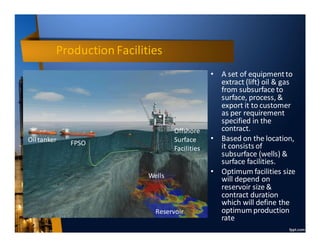
• A set of equipmentto
extract (lift) oil & gas
from subsurface to
surface, process, &
export it to customer
as per requirement
specified in the
contract.
• Based on the location,
it consists of
subsurface (wells) &
surface facilities.
• Optimum facilities size
will depend on
reservoir size &
contract duration
which will define the
optimum production
rate
FPSO
Oiltanker
Offshore
Surface
Facilities
Wells
Reservoir
Drilling & Completion (Wells)
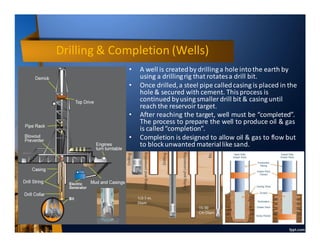
• A well is createdby drillinga hole intothe earth by
using a drillingrig that rotatesa drill bit.
• Once drilled,a steel pipe calledcasing is placed in the
hole & secured with cement. This process is
continued byusing smaller drill bit & casing until
reach the reservoir target.
• After reaching the target, well must be “completed”.
The process to prepare the well to produce oil & gas
is called“completion”.
• Completion is designed to allow oil & gas to flow but
to blockunwanted materiallike sand.
Surface Production Facilities
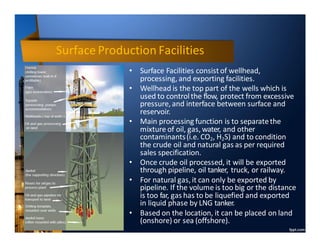
• Surface Facilities consist of wellhead,
processing, and exporting facilities.
• Wellhead is the top part of the wells which is
used to controlthe flow, protect from excessive
pressure, and interface between surface and
reservoir.
• Main processing function is to separatethe
mixture of oil, gas, water, and other
contaminants(i.e. CO2, H2S) and to condition
the crude oil and natural gas as per required
sales specification.
• Once crude oil processed, it will be exported
through pipeline, oil tanker, truck, or railway.
• For natural gas, it can only be exported by
pipeline. If the volume is too big or the distance
is too far, gas has to be liquefied and exported
in liquid phase by LNG tanker.
• Based on the location, it can be placed on land
(onshore) or sea (offshore).
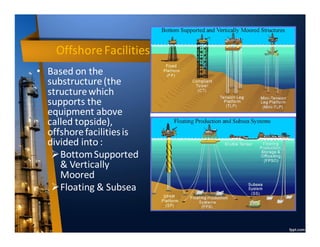
OffshoreFacilities
• Based on the
substructure(the
structurewhich
supports the
equipment above
called topside),
offshorefacilitiesis
divided into :
➢BottomSupported
& Vertically
Moored
➢Floating & Subsea
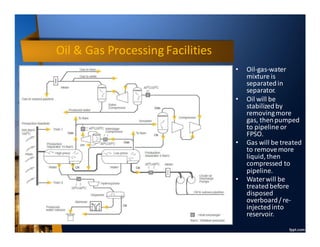
Oil & Gas Processing Facilities
• Oil-gas-water
mixture is
separatedin
separator.
• Oil will be
stabilized by
removingmore
gas, thenpumped
to pipeline or
FPSO.
• Gas will be treated
to removemore
liquid,then
compressed to
pipeline.
• Waterwill be
treatedbefore
disposed
overboard/ re-
injectedinto
reservoir.
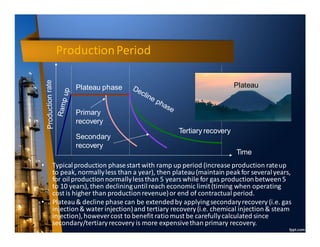
ProductionPeriod
Time
• Typicalproduction phasestart with ramp up period (increase production rateup
to peak, normallyless than a year), then plateau(maintain peakfor severalyears,
for oilproduction normallylessthan 5 years while for gas productionbetween5
to 10 years), then declininguntilreach economic limit(timing when operating
cost is higher than productionrevenue)or end of contractual period.
• Plateau& decline phase can be extendedby applyingsecondaryrecovery (i.e. gas
injection& water injection)and tertiary recovery(i.e. chemical injection & steam
injection),howevercost to benefit ratiomust be carefullycalculated since
secondary/tertiaryrecovery is more expensivethan primary recovery.
Plateau phase
Primary
recovery
Secondary
recovery
Tertiary recovery
Plateau
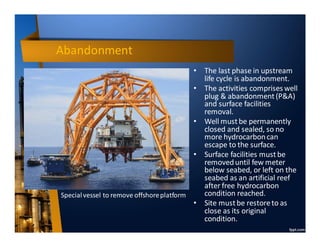
Abandonment
• The last phase in upstream
life cycle is abandonment.
• The activities comprises well
plug & abandonment (P&A)
and surface facilities
removal.
• Well mustbe permanently
closed and sealed, so no
more hydrocarboncan
escape to the surface.
• Surface facilities must be
removeduntil few meter
below seabed, or left on the
seabed as an artificial reef
after free hydrocarbon
condition reached.
• Site mustbe restoreto as
close as its original
condition.
Specialvessel to remove offshoreplatform
MIDSTREAM
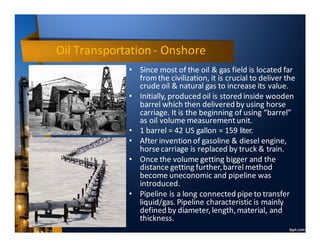
Oil Transportation- Onshore
• Since most of the oil & gas field is located far
fromthe civilization, it is crucial to deliver the
crude oil & natural gas to increase its value.
• Initially, produced oil is stored inside wooden
barrel which then delivered by using horse
carriage. It is the beginning of using “barrel”
as oil volume measurement unit.
• 1 barrel = 42 US gallon = 159 liter.
• After invention of gasoline & diesel engine,
horsecarriage is replaced by truck & train.
• Once the volume getting bigger and the
distance getting further,barrel method
become uneconomic and pipeline was
introduced.
• Pipeline is a long connected pipe to transfer
liquid/gas. Pipeline characteristic is mainly
defined by diameter,length,material, and
thickness.
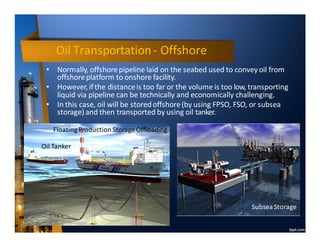
Oil Transportation- Offshore
• Normally, offshorepipeline laid on the seabed used to conveyoil from
offshoreplatform to onshore facility.
• However, ifthe distanceis too far or the volume is too low, transporting
liquid via pipeline can be technically and economically challenging.
• In this case, oil will be storedoffshore(by using FPSO, FSO, or subsea
storage)and then transported by using oil tanker.
FloatingProduction StorageOffloading
Oil Tanker
SubseaStorage
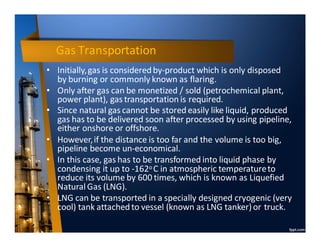
Gas Transportation
• Initially,gas is consideredby-product which is only disposed
by burning or commonly known as flaring.
• Only after gas can be monetized / sold (petrochemical plant,
power plant), gas transportation is required.
• Since natural gas cannot be storedeasily like liquid, produced
gas has to be delivered soon after processed by using pipeline,
either onshore or offshore.
• However,if the distance is too far and the volume is too big,
pipeline become un-economical.
• In this case, gas has to be transformed into liquid phase by
condensing it up to -162o C in atmospheric temperatureto
reduce its volume by 600 times, which is known as Liquefied
Natural Gas (LNG).
• LNG can be transported in a specially designed cryogenic (very
cool) tank attached to vessel (known as LNG tanker)or truck.
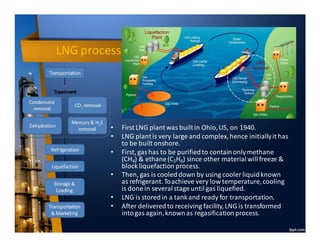
LNG process
• First LNG plantwas builtin Ohio,US, on 1940.
• LNG plantis very large and complex,hence initiallyit has
to be built onshore.
• First, gas has to be purifiedto containonlymethane
(CH4) & ethane(C2H6) since other materialwill freeze &
block liquefaction process.
• Then, gas is cooleddown by using cooler liquidknown
as refrigerant.Toachieve very low temperature,cooling
is done in several stage untilgas liquefied.
• LNG is storedin a tankand ready for transportation.
• After deliveredto receiving facility,LNG is transformed
intogas again,knownas regasification process.
Floating LNG (FLNG)
• If large gas field is locatedvery far from shore, transportinglarge quantityof
gas via pipelineis technically& economically challenging.
• Small & medium size gas field locatedfarfrom shore sometimes cannot
justify the large investmentto builtLNG plant onshore.
• Another problemwith onshoreLNG is land acquisition.
• Long research had been conductedto bring LNG process and export facility
intoa floatingplatform.
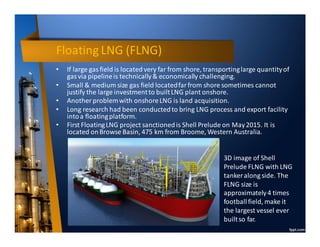
• First FloatingLNG project sanctionedis Shell Prelude on May2015. It is
located onBrowse Basin, 475 km from Broome, Western Australia.
3D image of Shell
Prelude FLNG with LNG
tankeralong side. The
FLNG size is
approximately4 times
football field, make it
the largest vessel ever
builtso far.
DOWNSTREAM
DownstreamIndustry
• A portion of the industry that is responsible for
the refining, distributing, and retail of
petroleum products, sometimes also called
Refining & Marketing (R&M).
• Refining means process the raw materials
(crude oil & natural gas) into higher value
product, either final product (ready to consume
like LPG for home cooking) or intermediate
product (raw material for further processing
like ammonia for fertilizer).
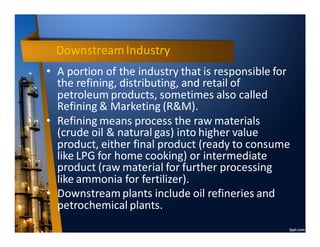
• Downstreamplants include oil refineries and
petrochemical plants.
Oil Refinery
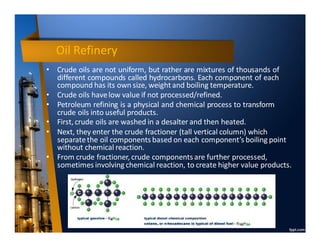
• Crude oils are not uniform, but rather are mixtures of thousands of
different compounds called hydrocarbons. Each component of each
compound has its own size, weightand boiling temperature.
• Crude oils havelow value if not processed/refined.
• Petroleum refining is a physical and chemical process to transform
crude oils into useful products.
• First, crude oils are washed in a desalter and then heated.
• Next, they enter the crude fractioner (tall vertical column) which
separatethe oil components based on each component’s boiling point
without chemical reaction.
• From crude fractioner, crude components are further processed,
sometimes involving chemical reaction, to create higher value products.
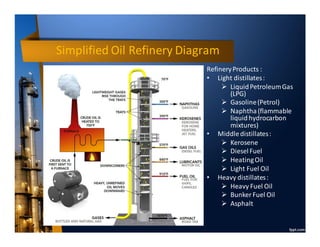
Simplified Oil Refinery Diagram
RefineryProducts :
• Light distillates:
➢ LiquidPetroleumGas
(LPG)
➢ Gasoline(Petrol)
➢ Naphtha(flammable
liquidhydrocarbon
mixtures)
• Middledistillates:
➢ Kerosene
➢ DieselFuel
➢ HeatingOil
➢ Light Fuel Oil
• Heavy distillates:
➢ Heavy Fuel Oil
➢ Bunker Fuel Oil
➢ Asphalt
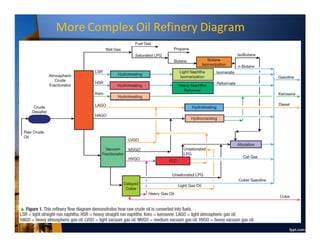
More Complex Oil Refinery Diagram
Petrochemical
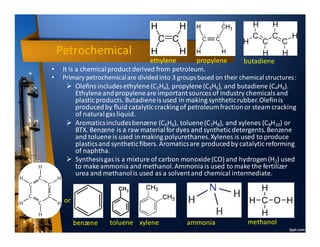
ethylene propylene butadiene
benzene toluene xylene ammonia methanol
• It is a chemical productderived from petroleum.
• Primary petrochemicalare divided into 3 groupsbased on their chemical structures:
➢ Olefinsincludesethylene(C2H4), propylene(C3H6), and butadiene (C4H6).
Ethyleneandpropyleneare importantsources of industry chemicalsand
plasticproducts. Butadieneis used in making syntheticrubber.Olefinis
producedby fluid catalyticcrackingof petroleumfractionor steam cracking
of naturalgas liquid.
➢ Aromaticsincludesbenzene (C6H6), toluene(C7H8), and xylenes (C8H10) or
BTX. Benzene is a raw material for dyes and syntheticdetergents.Benzene
and toluene is used in making polyurethanes.Xylenes is used to produce
plasticsand syntheticfibers. Aromaticsare producedby catalyticreforming
of naphtha.
➢ Synthesisgasis a mixture of carbon monoxide(CO) and hydrogen(H2) used
to makeammonia and methanol.Ammoniais used to make the fertilizer
urea and methanolis used as a solventand chemical intermediate.
•
or
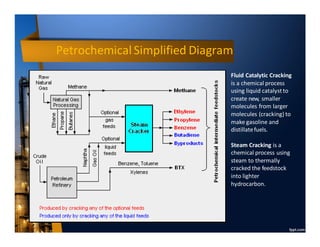
PetrochemicalSimplified Diagram
Fluid Catalytic Cracking
is a chemical process
using liquid catalystto
create new, smaller
molecules from larger
molecules (cracking) to
make gasoline and
distillatefuels.
Steam Cracking is a
chemical process using
steam to thermally
cracked the feedstock
into lighter
hydrocarbon.
Marketing
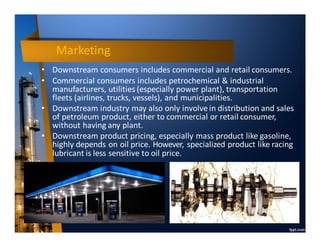
• Downstream consumers includes commercial and retail consumers.
• Commercial consumers includes petrochemical & industrial
manufacturers, utilities (especially power plant), transportation
fleets (airlines, trucks, vessels), and municipalities.
• Downstream industry may also only involve in distribution and sales
of petroleum product, either to commercial or retail consumer,
without having any plant.
• Downstream product pricing, especially mass product like gasoline,
highly depends on oil price. However, specialized product like racing
lubricant is less sensitive to oil price.
Oil & Gas Industry Sector Boundary
• Actually, the boundary between upstream, midstream,
and downstream is sometimes not clear / gray area.
• Pipeline from upstream industry to downstream industry
may be owned by upstream company or independent
midstream company.
• LNG industry is normally considered midstream or
downstream industry,however with FLNG revolution, it is
now part of upstream sector.
• Due to large investment & complex requirement,
normally a company only involve in one sector only,
however some very large companies involve in upstream-
midstream-downstream sector, known as integrated oil &
gas companies, i.e. Shell, ExxonMobil, and Petronas.
Thank You

Oil and Gas Industry.pdf

  • 1.
    Introduction to Oil andGas Industry Upstream Midstream Downstream
  • 2.
    Oil & Gasin Our Life • Transportation Fuel (gasoline, diesel fuel, jet/aviationfuel, marine fuel oil, compressed natural gas/CNG) • Power Plant Fuel (natural gas, diesel fuel) • Household Fuel (heating oil, liquefied petroleum gas/LPG, kerosene) • Petrochemical Products (plastic, fertilizer,synthetic fiber, synthetic rubber, insecticides, pharmaceuticals, detergent, paints, creams, solvent, industrial chemical, industrial gas, etc) • Asphalt FERTILIZ ER GASOLI NE LUBRICAN TS SYNTHET IC RUBBE R PLASTICS PESTICID ES HEATIN G
  • 3.
    Oil & GasFormation • It is formed from the accumulation ofdecomposition of plants and marine animals which died millionyearsago and trappedbeneaththe ground under high pressure and temperatures. • Oil & gas compoundconsist of Carbon & HydrogenAtom, that’s why it is calledHYDROCARBON. • Crude Oil is liquidwhileNatural Gas is gaseoushydrocarbonat room temperature. Deadorganism get trapped underground High Temperature& Pressure transform burieddead organismintooil & gas Oil & gasis also called PETROLEUM which means “Rock Oil” in Latin word
  • 4.
    Oil & GasEarly History • Oil & gas had been used for centuries like ancient peoples worshipped sacred fires (eternal flame) fuelled by natural gas seeping to the surface through pores and cracks. • About 6000 BC, thick gummy asphalt was used to waterproof boats and heat homes. • About 3000 BC, the Egyptians used asphalt in the construction of the pyramids, to grease axles of the Pharaoh’s chariots, and as an embalming agent for mummies & medicines. • When whale oil (extracted from whale fat), the main source of lamp fuel in early 1980, became scarce, a new source is introduced by distilling natural petroleum seeps and coal into lamp oil / kerosene. Eternalflame at AtegashFire Temple, BakuAzerbaijan
  • 5.
    Birth of ModernOil & Gas Industry • Firstrefinery begun in 1846 when Abraham Gessner of Nova Scotia, Canada, inventeda process to produce kerosene for lamp from coal. • In 1858, James Miller Williams , a 39 year old carriage maker from Ontario, Canada, made the first major commercial oil discovery in North America at Oil Springs, Ontario, Canada. • He struck oil at a depth of only 18 m by drilling in "gum beds" in LambtonCounty, 25 km southeastof Sarnia. Williams refined the oil he produced and sold the product as lamp oil. • In 1859, Colonel Edwin L. Drake discovered oil in Titusville, Pennsylvaniaby drilling to 21 m. This discovery markedthe birth of the modern petroleum industry in the United States. • The inventionof the gasolineengine (1885) and diesel engine (1892) boostedthe refineries industry to produce gasolineand diesel fuel. DrakeWell
  • 6.
    Oil & GasIndustry Characteristics • Large investment,can reach billion of US$. • High Risk in all aspects (people safety, environment, investment,reputation). • Many uncertainties,especially upstream industry. • Long term business from initial investment until revenue generated, even longer until break even point. • Complex operation, involves multi discipline experts from both technical and non-technical. • High reward. • Strategicvalue (economic& politic). • Global impact.
  • 7.
    Upstream Finding, lifting, and processingoil & gas from subsurfaceinto surface and ready for transportation. Also known as Exploration and Production(E&P). Midstream Transportation and storageof crude oil and natural gasfrom E&P plantfor further processing by pipeline, railway,road,or tanker. Downstream Further processing of crude oil and natural gas into useful final productor raw material for other industry. Oil & Gas Industry Sector
  • 8.
  • 9.
    Upstream Oil &Gas LifeCycle Exploration • Activities to search for oil & gas deposits on the reservoir beneath the earth’ssurface Appraisal • Activities to define the oil & gas volume and characteristic more precisely after discovery Development • Activities to build the subsurface & surface facilities to produce oil & gas safely and efficiently Production • Activities to extract, process,and export oil & gas as per contract agreement Abandonment • Activities to plug wells permanently, removesurface facilities, and restorethe field as per initial state
  • 10.
    Exploration & Appraisal Exploration •Activitiesto find oil& gas prospect beneaththe earth surface by means of gravity survey,magnetic survey,and seismic reflection survey. • Once prospect is likelyto be found, exploration (wildcat)drillingwill be conductedto determinethe presence of oil & gas reserve. • Most wildcatdrillingfailto find oil & gas (dry hole), only few (less than 25%) hits oil & gas layer (discovery). • After discovery,more drillingis requiredto “appraise”the reservoir. Appraisal • It is requiredto determinethe reservoir size which define the volume & to get better characteristicof oil & gas. • Volumewillbe measured in millionbarrels(MMbbls) oil and billioncubic feet (Bcf) gas, both originalin place volume (Oil InitialIn Place / OIIP and Gas InitialIn Place / GIIP) & recoverablevolume. • Importantcharacteristicincludes pressure, temperature,oil viscosity, hydrocarbon composition, compartmentalization,and contaminants.
  • 11.
    Seismic & Drilling 1.Seismic 2.Seismic 2Dimaging 3.Further modelling 4. Drilling
  • 12.
    Reserve Type • Onceappraisalconducted,it will determinethe quantityof petroleumwhich can be recovered/ produced.Typically,only30% of oiland 70% of gascan be recovered, can be more if advancetechniqueapplied likewaterinjection& submersible pump. • Proved(1P) : Quantitiesof oil and gas, which, by analysisof geoscience and engineering data,can be estimatedwith reasonablecertaintyto be economically producible–froma given dateforward, from known reservoirs, and under existing economic conditions,operatingmethods,and governmentregulations.At least 90% probability(P90) that the quantitiesactually recoveredwillbe equal or exceed the estimate. • Unproved: Reserves are based on technical data similarto that used in estimatesof proved reserves; but technical, contractual, economic,or regulatoryuncertainties preclude such reserves being classified as proved.Unproved reserves may be further classified as probable reserves and possible reserves. – Possible (2P) : Unproved reserves which analysis of technical data suggests are more likely than not to be recoverable. At least a 50% probability (P50) that the quantities actually recovered will equal or exceed the sum of estimated proved plus probablereserves. – Probable(3P) : Unprovedreserve which analysisof technical data suggests are less likelyto be recoverablethanprobablereserves. At leasta 10% probability (P10) that the quantitiesactually recoveredwillequal or exceed the sum of estimatedproved plus probable pluspossible reserves.
  • 13.
    Field Development Plan(FDP) • Once the estimatedrecoverablevalueis determined,the Companywillpreparea plan to monetize the reserve, calledFieldDevelopmentPlan / Plan of Development (PoD). • FDP shall containat least : ➢ Subsurfacecharacteristic(OIIP, GIIP, contaminants, etc) ➢ Recoverablereserve in P90-P50-P10 ➢ ProductionRate& Field Life ➢ ProductionFacilities(number & type of wells, surface facilities type) ➢ Project Plan (includingCost, Schedule, Quality) ➢ Project Economics ➢ Other aspects likeRisk, HealthSafety Environment (HSE) • FDP shall be approvedby the host authority.Once approved,the Companywill conduct a tender for facilities development. • In the same time, Company will secure the hydrocarbon sales, especially gas, known as Gas Sales Agreement (GSA). While for oil, it will be absorbed by the market as per oil price trend. • Once the GSA secured and cost of developmentknown from proposedtender price, the Companywill further calculatethe project economic. If it meet the criteria,the Companywill sanction(commit to investmoney) the project, known as Final InvestmentDecision(FID)
  • 14.
    Production Facilities • Aset of equipmentto extract (lift) oil & gas from subsurface to surface, process, & export it to customer as per requirement specified in the contract. • Based on the location, it consists of subsurface (wells) & surface facilities. • Optimum facilities size will depend on reservoir size & contract duration which will define the optimum production rate FPSO Oiltanker Offshore Surface Facilities Wells Reservoir
  • 15.
    Drilling & Completion(Wells) • A well is createdby drillinga hole intothe earth by using a drillingrig that rotatesa drill bit. • Once drilled,a steel pipe calledcasing is placed in the hole & secured with cement. This process is continued byusing smaller drill bit & casing until reach the reservoir target. • After reaching the target, well must be “completed”. The process to prepare the well to produce oil & gas is called“completion”. • Completion is designed to allow oil & gas to flow but to blockunwanted materiallike sand.
  • 16.
    Surface Production Facilities •Surface Facilities consist of wellhead, processing, and exporting facilities. • Wellhead is the top part of the wells which is used to controlthe flow, protect from excessive pressure, and interface between surface and reservoir. • Main processing function is to separatethe mixture of oil, gas, water, and other contaminants(i.e. CO2, H2S) and to condition the crude oil and natural gas as per required sales specification. • Once crude oil processed, it will be exported through pipeline, oil tanker, truck, or railway. • For natural gas, it can only be exported by pipeline. If the volume is too big or the distance is too far, gas has to be liquefied and exported in liquid phase by LNG tanker. • Based on the location, it can be placed on land (onshore) or sea (offshore).
  • 17.
    OffshoreFacilities • Based onthe substructure(the structurewhich supports the equipment above called topside), offshorefacilitiesis divided into : ➢BottomSupported & Vertically Moored ➢Floating & Subsea
  • 18.
    Oil & GasProcessing Facilities • Oil-gas-water mixture is separatedin separator. • Oil will be stabilized by removingmore gas, thenpumped to pipeline or FPSO. • Gas will be treated to removemore liquid,then compressed to pipeline. • Waterwill be treatedbefore disposed overboard/ re- injectedinto reservoir.
  • 19.
    ProductionPeriod Time • Typicalproduction phasestartwith ramp up period (increase production rateup to peak, normallyless than a year), then plateau(maintain peakfor severalyears, for oilproduction normallylessthan 5 years while for gas productionbetween5 to 10 years), then declininguntilreach economic limit(timing when operating cost is higher than productionrevenue)or end of contractual period. • Plateau& decline phase can be extendedby applyingsecondaryrecovery (i.e. gas injection& water injection)and tertiary recovery(i.e. chemical injection & steam injection),howevercost to benefit ratiomust be carefullycalculated since secondary/tertiaryrecovery is more expensivethan primary recovery. Plateau phase Primary recovery Secondary recovery Tertiary recovery Plateau
  • 20.
    Abandonment • The lastphase in upstream life cycle is abandonment. • The activities comprises well plug & abandonment (P&A) and surface facilities removal. • Well mustbe permanently closed and sealed, so no more hydrocarboncan escape to the surface. • Surface facilities must be removeduntil few meter below seabed, or left on the seabed as an artificial reef after free hydrocarbon condition reached. • Site mustbe restoreto as close as its original condition. Specialvessel to remove offshoreplatform
  • 21.
  • 22.
    Oil Transportation- Onshore •Since most of the oil & gas field is located far fromthe civilization, it is crucial to deliver the crude oil & natural gas to increase its value. • Initially, produced oil is stored inside wooden barrel which then delivered by using horse carriage. It is the beginning of using “barrel” as oil volume measurement unit. • 1 barrel = 42 US gallon = 159 liter. • After invention of gasoline & diesel engine, horsecarriage is replaced by truck & train. • Once the volume getting bigger and the distance getting further,barrel method become uneconomic and pipeline was introduced. • Pipeline is a long connected pipe to transfer liquid/gas. Pipeline characteristic is mainly defined by diameter,length,material, and thickness.
  • 23.
    Oil Transportation- Offshore •Normally, offshorepipeline laid on the seabed used to conveyoil from offshoreplatform to onshore facility. • However, ifthe distanceis too far or the volume is too low, transporting liquid via pipeline can be technically and economically challenging. • In this case, oil will be storedoffshore(by using FPSO, FSO, or subsea storage)and then transported by using oil tanker. FloatingProduction StorageOffloading Oil Tanker SubseaStorage
  • 24.
    Gas Transportation • Initially,gasis consideredby-product which is only disposed by burning or commonly known as flaring. • Only after gas can be monetized / sold (petrochemical plant, power plant), gas transportation is required. • Since natural gas cannot be storedeasily like liquid, produced gas has to be delivered soon after processed by using pipeline, either onshore or offshore. • However,if the distance is too far and the volume is too big, pipeline become un-economical. • In this case, gas has to be transformed into liquid phase by condensing it up to -162o C in atmospheric temperatureto reduce its volume by 600 times, which is known as Liquefied Natural Gas (LNG). • LNG can be transported in a specially designed cryogenic (very cool) tank attached to vessel (known as LNG tanker)or truck.
  • 25.
    LNG process • FirstLNG plantwas builtin Ohio,US, on 1940. • LNG plantis very large and complex,hence initiallyit has to be built onshore. • First, gas has to be purifiedto containonlymethane (CH4) & ethane(C2H6) since other materialwill freeze & block liquefaction process. • Then, gas is cooleddown by using cooler liquidknown as refrigerant.Toachieve very low temperature,cooling is done in several stage untilgas liquefied. • LNG is storedin a tankand ready for transportation. • After deliveredto receiving facility,LNG is transformed intogas again,knownas regasification process.
  • 26.
    Floating LNG (FLNG) •If large gas field is locatedvery far from shore, transportinglarge quantityof gas via pipelineis technically& economically challenging. • Small & medium size gas field locatedfarfrom shore sometimes cannot justify the large investmentto builtLNG plant onshore. • Another problemwith onshoreLNG is land acquisition. • Long research had been conductedto bring LNG process and export facility intoa floatingplatform. • First FloatingLNG project sanctionedis Shell Prelude on May2015. It is located onBrowse Basin, 475 km from Broome, Western Australia. 3D image of Shell Prelude FLNG with LNG tankeralong side. The FLNG size is approximately4 times football field, make it the largest vessel ever builtso far.
  • 27.
  • 28.
    DownstreamIndustry • A portionof the industry that is responsible for the refining, distributing, and retail of petroleum products, sometimes also called Refining & Marketing (R&M). • Refining means process the raw materials (crude oil & natural gas) into higher value product, either final product (ready to consume like LPG for home cooking) or intermediate product (raw material for further processing like ammonia for fertilizer). • Downstreamplants include oil refineries and petrochemical plants.
  • 29.
    Oil Refinery • Crudeoils are not uniform, but rather are mixtures of thousands of different compounds called hydrocarbons. Each component of each compound has its own size, weightand boiling temperature. • Crude oils havelow value if not processed/refined. • Petroleum refining is a physical and chemical process to transform crude oils into useful products. • First, crude oils are washed in a desalter and then heated. • Next, they enter the crude fractioner (tall vertical column) which separatethe oil components based on each component’s boiling point without chemical reaction. • From crude fractioner, crude components are further processed, sometimes involving chemical reaction, to create higher value products.
  • 30.
    Simplified Oil RefineryDiagram RefineryProducts : • Light distillates: ➢ LiquidPetroleumGas (LPG) ➢ Gasoline(Petrol) ➢ Naphtha(flammable liquidhydrocarbon mixtures) • Middledistillates: ➢ Kerosene ➢ DieselFuel ➢ HeatingOil ➢ Light Fuel Oil • Heavy distillates: ➢ Heavy Fuel Oil ➢ Bunker Fuel Oil ➢ Asphalt
  • 31.
    More Complex OilRefinery Diagram
  • 32.
    Petrochemical ethylene propylene butadiene benzenetoluene xylene ammonia methanol • It is a chemical productderived from petroleum. • Primary petrochemicalare divided into 3 groupsbased on their chemical structures: ➢ Olefinsincludesethylene(C2H4), propylene(C3H6), and butadiene (C4H6). Ethyleneandpropyleneare importantsources of industry chemicalsand plasticproducts. Butadieneis used in making syntheticrubber.Olefinis producedby fluid catalyticcrackingof petroleumfractionor steam cracking of naturalgas liquid. ➢ Aromaticsincludesbenzene (C6H6), toluene(C7H8), and xylenes (C8H10) or BTX. Benzene is a raw material for dyes and syntheticdetergents.Benzene and toluene is used in making polyurethanes.Xylenes is used to produce plasticsand syntheticfibers. Aromaticsare producedby catalyticreforming of naphtha. ➢ Synthesisgasis a mixture of carbon monoxide(CO) and hydrogen(H2) used to makeammonia and methanol.Ammoniais used to make the fertilizer urea and methanolis used as a solventand chemical intermediate. • or
  • 33.
    PetrochemicalSimplified Diagram Fluid CatalyticCracking is a chemical process using liquid catalystto create new, smaller molecules from larger molecules (cracking) to make gasoline and distillatefuels. Steam Cracking is a chemical process using steam to thermally cracked the feedstock into lighter hydrocarbon.
  • 34.
    Marketing • Downstream consumersincludes commercial and retail consumers. • Commercial consumers includes petrochemical & industrial manufacturers, utilities (especially power plant), transportation fleets (airlines, trucks, vessels), and municipalities. • Downstream industry may also only involve in distribution and sales of petroleum product, either to commercial or retail consumer, without having any plant. • Downstream product pricing, especially mass product like gasoline, highly depends on oil price. However, specialized product like racing lubricant is less sensitive to oil price.
  • 35.
    Oil & GasIndustry Sector Boundary • Actually, the boundary between upstream, midstream, and downstream is sometimes not clear / gray area. • Pipeline from upstream industry to downstream industry may be owned by upstream company or independent midstream company. • LNG industry is normally considered midstream or downstream industry,however with FLNG revolution, it is now part of upstream sector. • Due to large investment & complex requirement, normally a company only involve in one sector only, however some very large companies involve in upstream- midstream-downstream sector, known as integrated oil & gas companies, i.e. Shell, ExxonMobil, and Petronas.
  • 36.