Introduction to
Oil & Gas Industry
• Introduction to Oil and Gas industry
consists of the following sections:
– 1. Oil formation and Historical perspective
– 2. Upstream & Downstream
– 3. Life cycle of oil field
Oil Formation
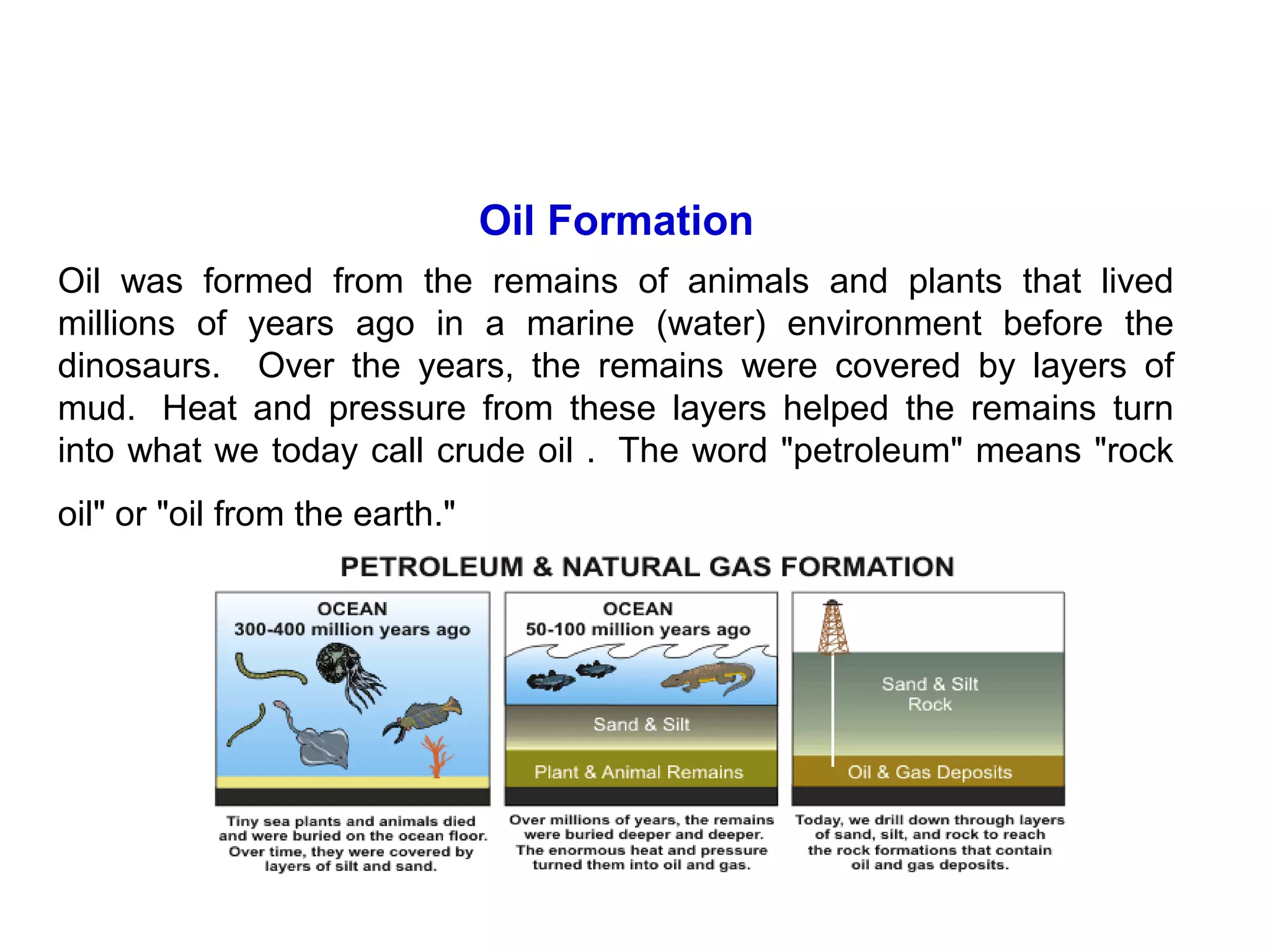
Oil was formed from the remains of animals and plants that lived
millions of years ago in a marine (water) environment before the
dinosaurs. Over the years, the remains were covered by layers of
mud. Heat and pressure from these layers helped the remains turn
into what we today call crude oil . The word "petroleum" means "rock
oil" or "oil from the earth."
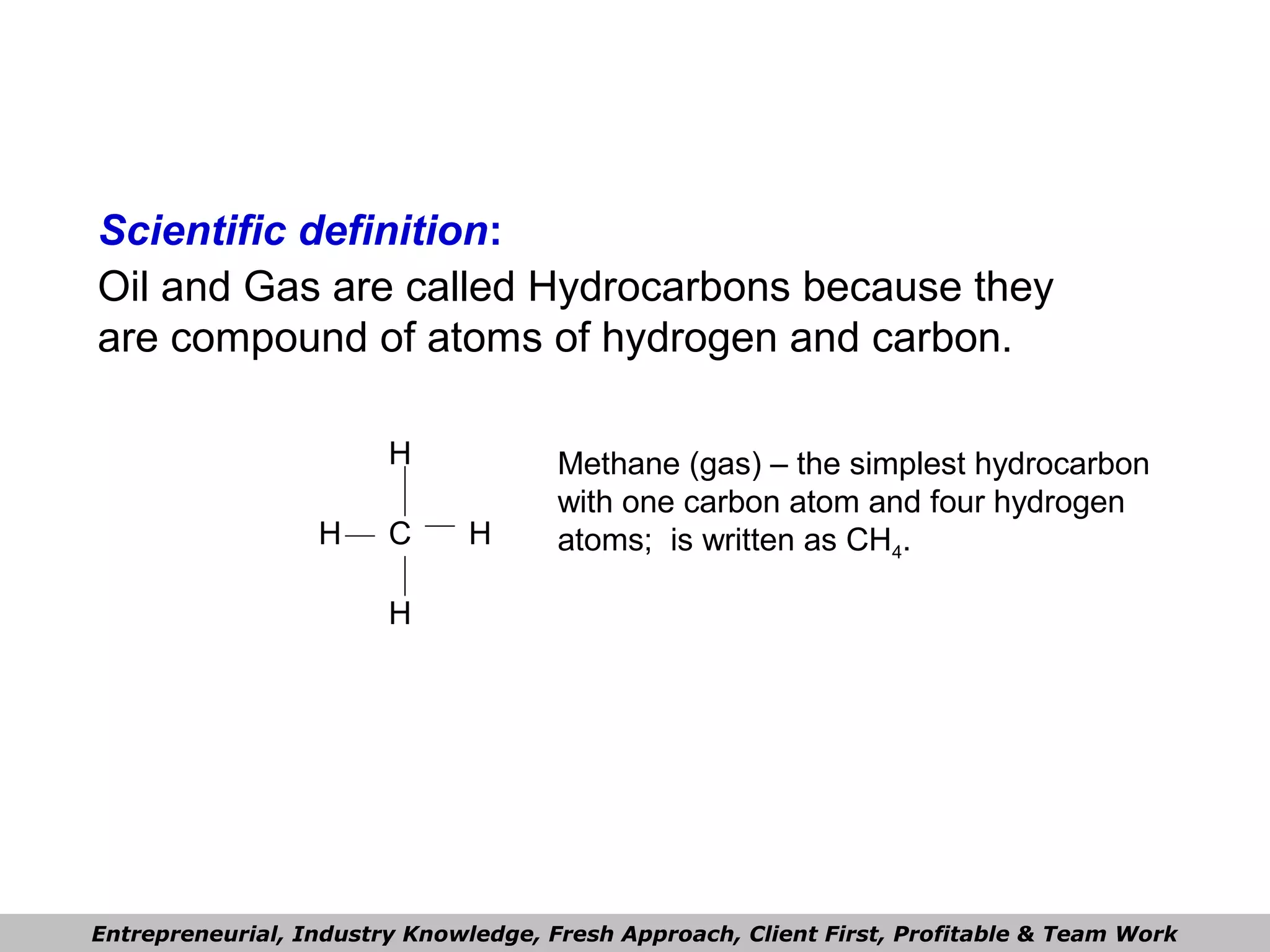
Scientific definition:
Oil and Gas are called Hydrocarbons because they
are compound of atoms of hydrogen and carbon.
Methane (gas) – the simplest hydrocarbon
with one carbon atom and four hydrogen
atoms; is written as CH4.
Entrepreneurial, Industry Knowledge, Fresh Approach, Client First, Profitable & Team Work
H
HH
H
C
World Oil Reserves Chart
By country, proved reserves at the end of 2009
Historical Perspective
• The use of oil based products were recorded in the
earliest writing of man:
– Bitumen was used in the building of the tower of Babel
– Sumerians used it for paving the Hanging Gardens of Babylon
– In India, Burma pitch was used for buildings and as fuel for lamp
– In North America native Indians had been collecting oil for use
as a medicine
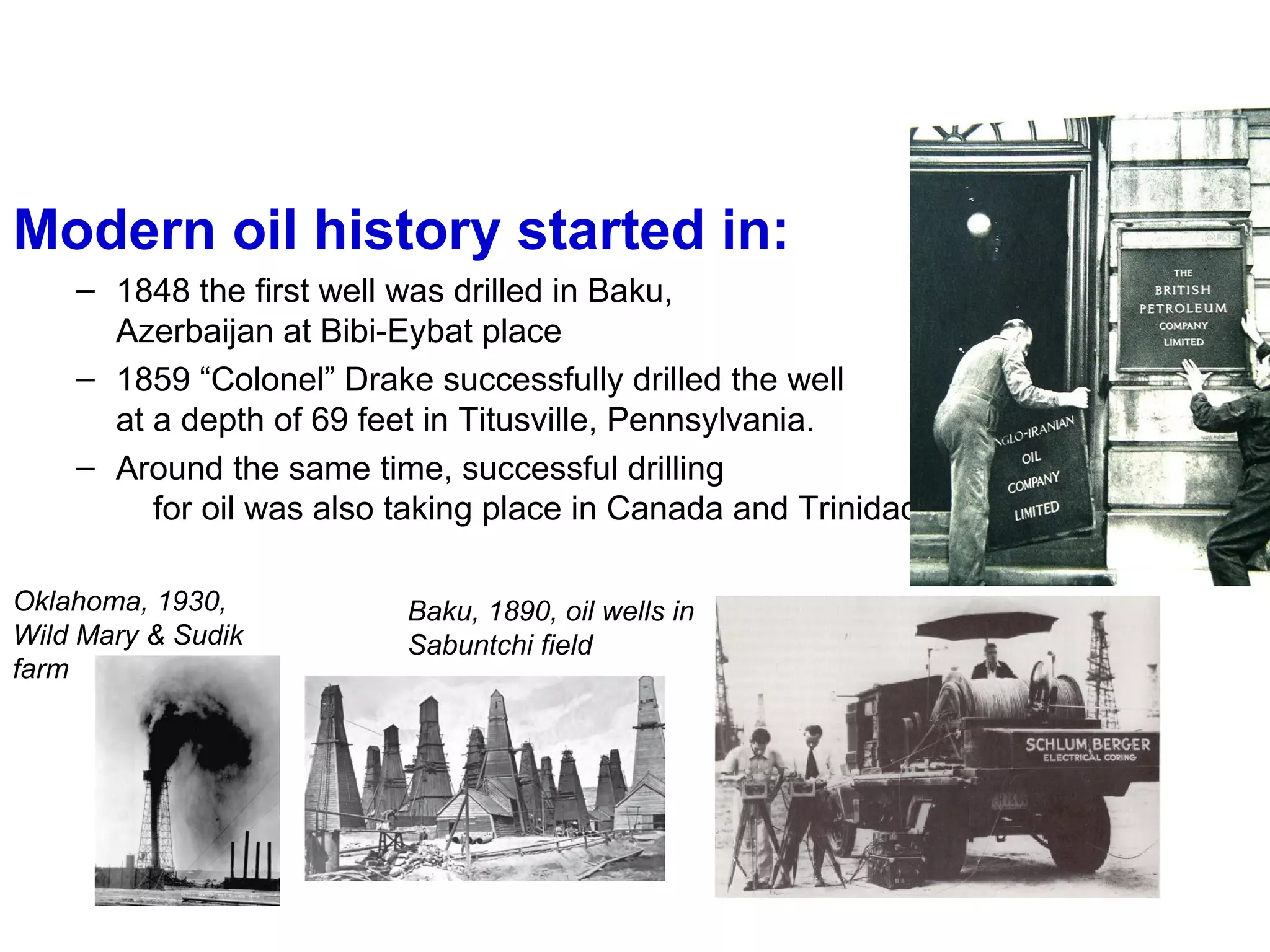
Modern oil history started in:
– 1848 the first well was drilled in Baku,
Azerbaijan at Bibi-Eybat place
– 1859 “Colonel” Drake successfully drilled the well
at a depth of 69 feet in Titusville, Pennsylvania.
– Around the same time, successful drilling
for oil was also taking place in Canada and Trinidad.
Oklahoma, 1930,
Wild Mary & Sudik
farm
Baku, 1890, oil wells in
Sabuntchi field
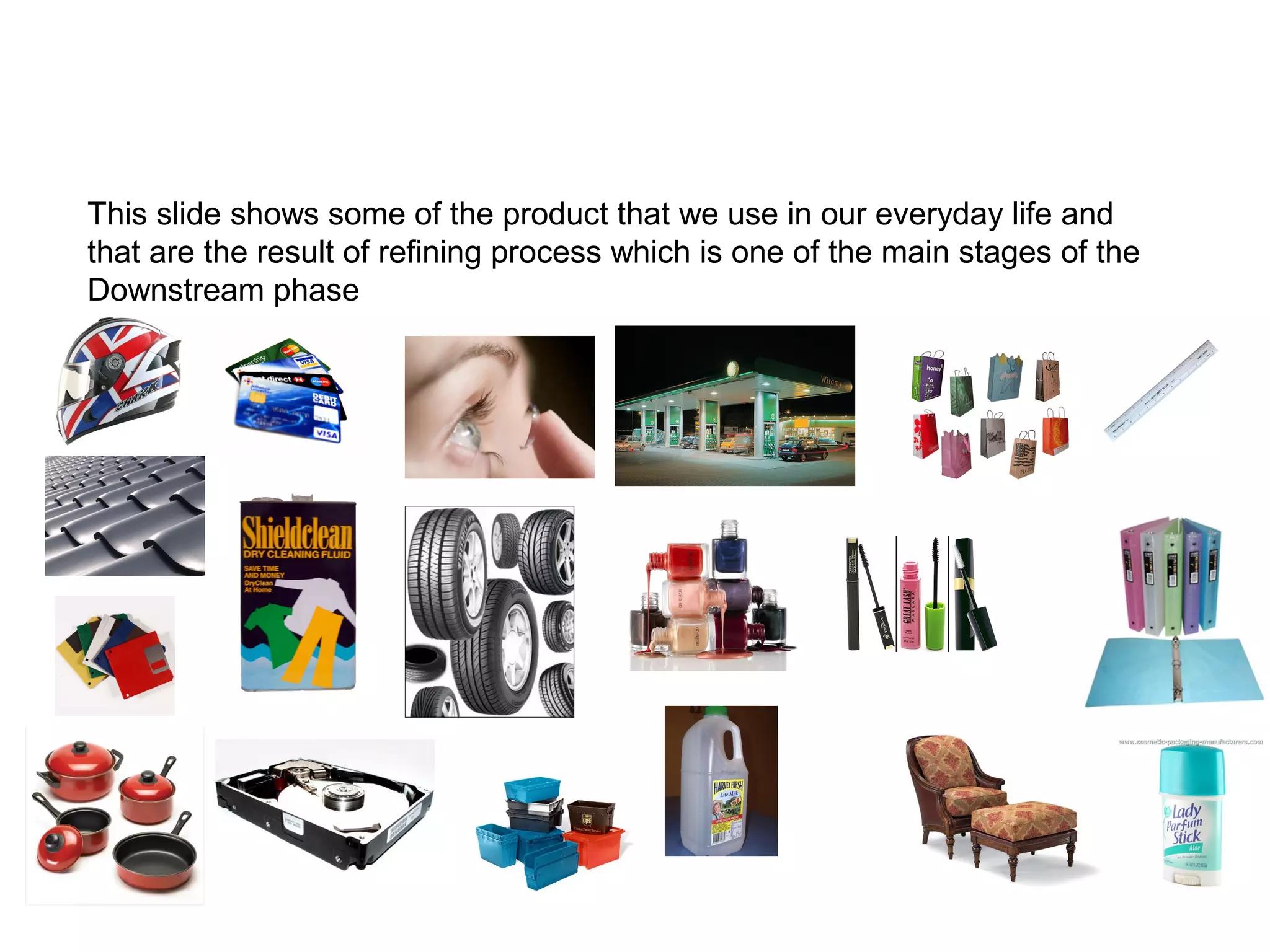
This slide shows some of the product that we use in our everyday life and
that are the result of refining process which is one of the main stages of the
Downstream phase
2. Upstream and Downstream side of oil
industry
The oil industry is divided into two major sectors. The sectors are defined to
categorize the operations within each.
(1) Upstream: Exploration & Production or E&P. Involves
operations in searching for underground or underwater oil and gas fields
and drilling exploratory wells and at the same time, operating the
wells that recover to re-direct the crude oil or raw natural gas to the
surface.
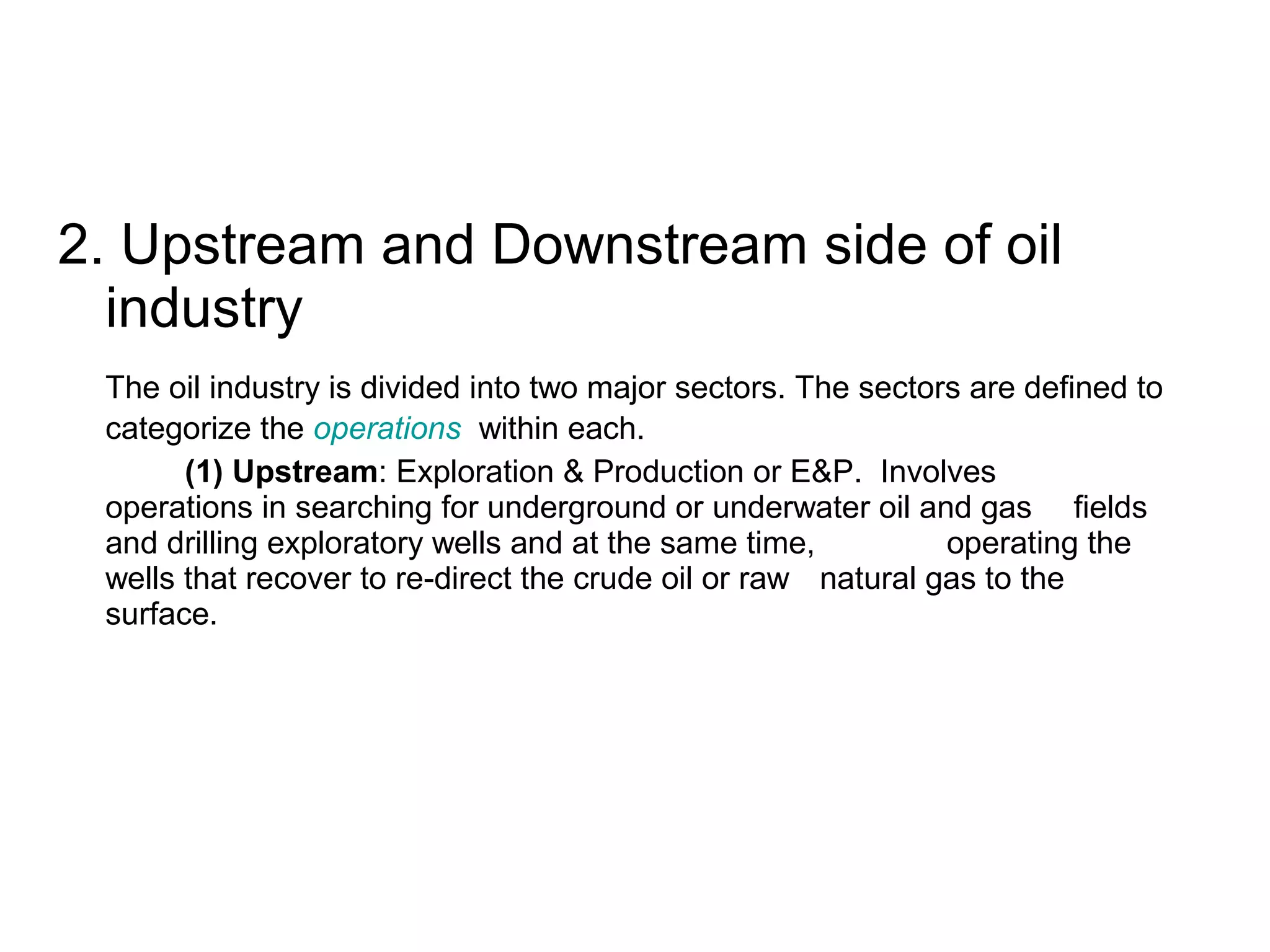
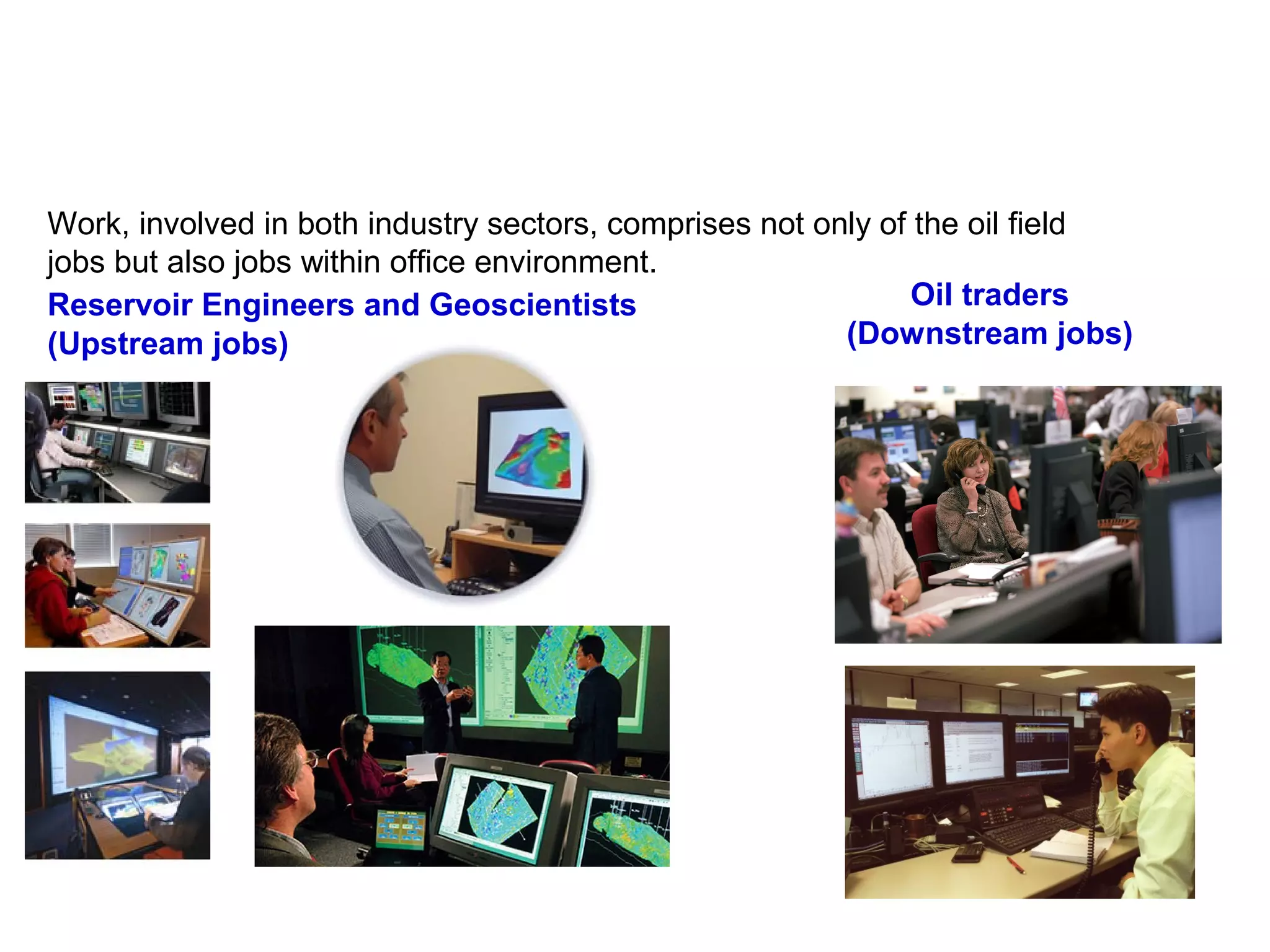
Work, involved in both industry sectors, comprises not only of the oil field
jobs but also jobs within office environment.
Oil traders
(Downstream jobs)
Reservoir Engineers and Geoscientists
(Upstream jobs)
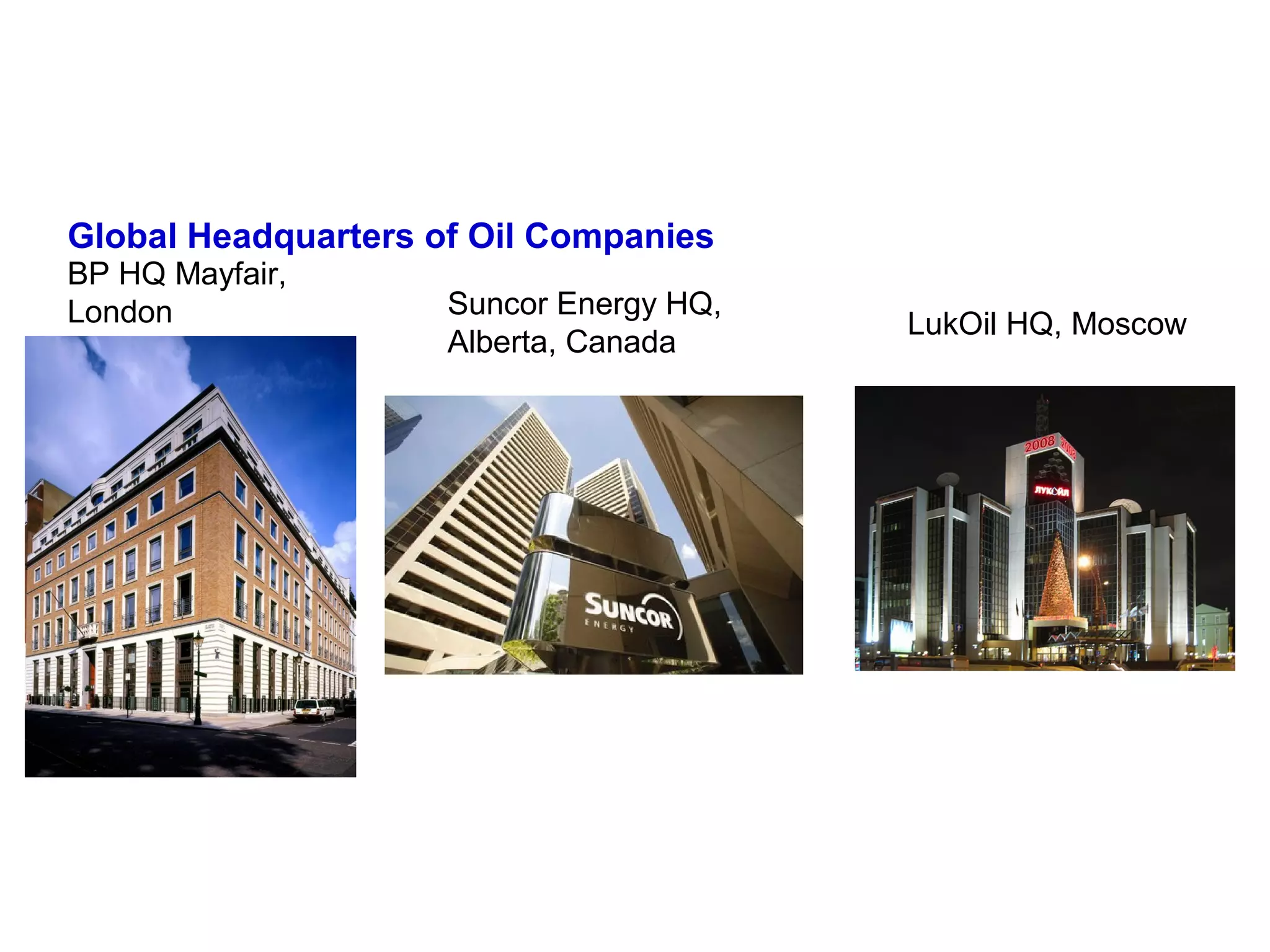
BP HQ Mayfair,
London Suncor Energy HQ,
Alberta, Canada
LukOil HQ, Moscow
Global Headquarters of Oil Companies
What is Downstream?
• (2) Downstream: Includes operations that processes
and stores, markets and transports crude oil, natural gas
liquids like ethane, butane and propane.
The downstream sector includes:
–all oils refineries and petrochemical plants,
–petroleum product distribution via the affiliated retail outlets
–and natural gas distribution companies, within the operations.
The downstream industry markets products such as petrol and
diesel and jet fuel, asphalt, lubricants, plastics fertilizers,
antifreeze and even pharmaceuticals and cosmetics.
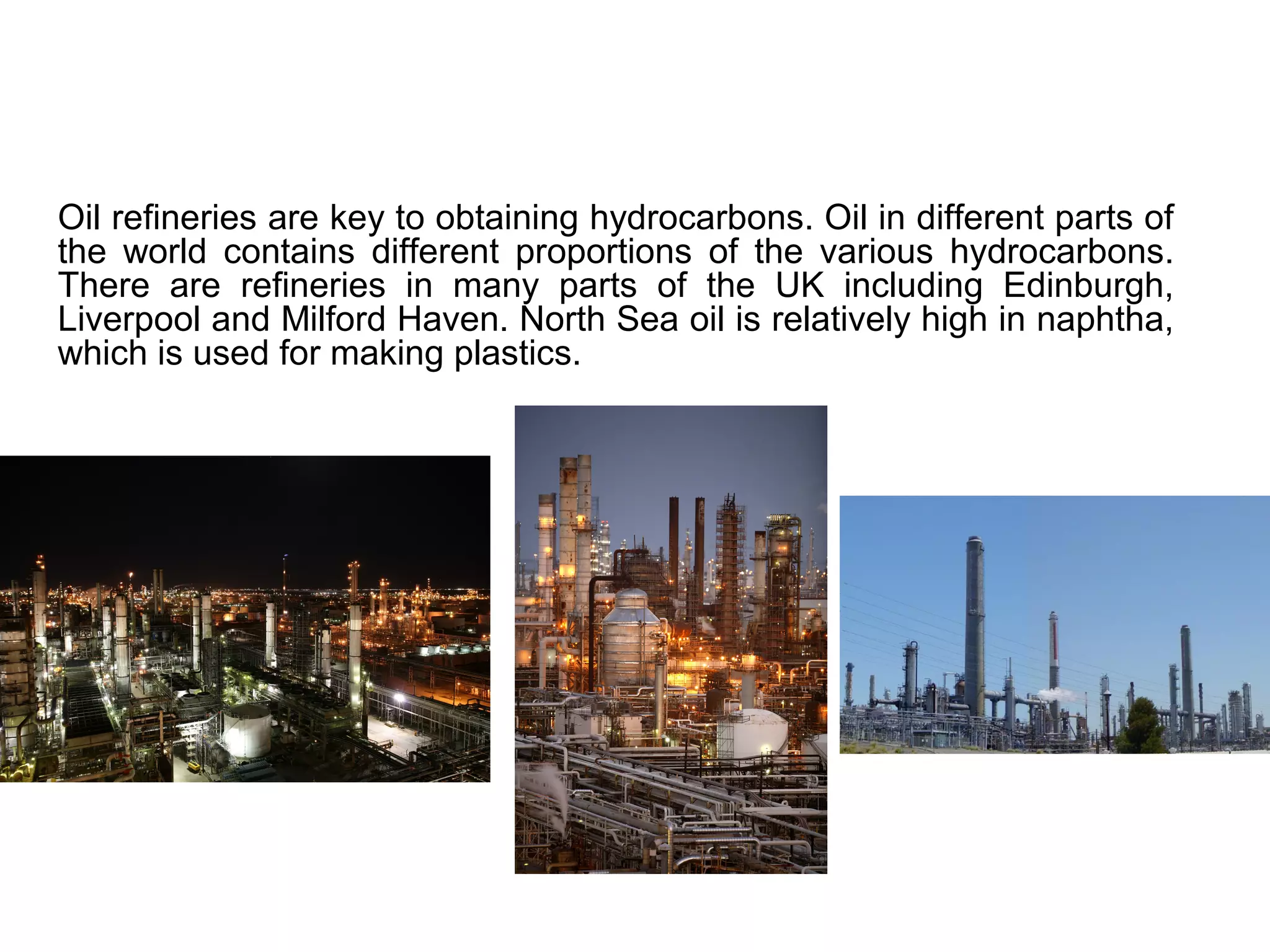
Oil refineries are key to obtaining hydrocarbons. Oil in different parts of
the world contains different proportions of the various hydrocarbons.
There are refineries in many parts of the UK including Edinburgh,
Liverpool and Milford Haven. North Sea oil is relatively high in naphtha,
which is used for making plastics.
Refining process
Oil
Refinery
Residual
Fuel Oil
Gasoil/ Diesel
Jet/Kerosene
Naphtha
Gasoline
LPG
Refinery Gases
Fuel/Energy
Crude
Oil
NGLs
Other
Feedstocks
(Naphtha,
Residues,
Blending
Components)
Fuel/Energy
3.Life cycle of processing of oil field consists
of 5 stages:
– Exploration
– Appraisal
– Development
– Production
– Abandonment
Entrepreneurial, Industry Knowledge, Fresh Approach, Client First, Profitable & Team Work
-20
-10
0
10
20
30
40
-10
-9
-8
-7
-6
-5
-4
-3
-2
-1
0
1
2
3
4
5
6
7
8
9
10
11
12
13
14
15
16
17
18
19
20
21
Year
Revenue
Revenue
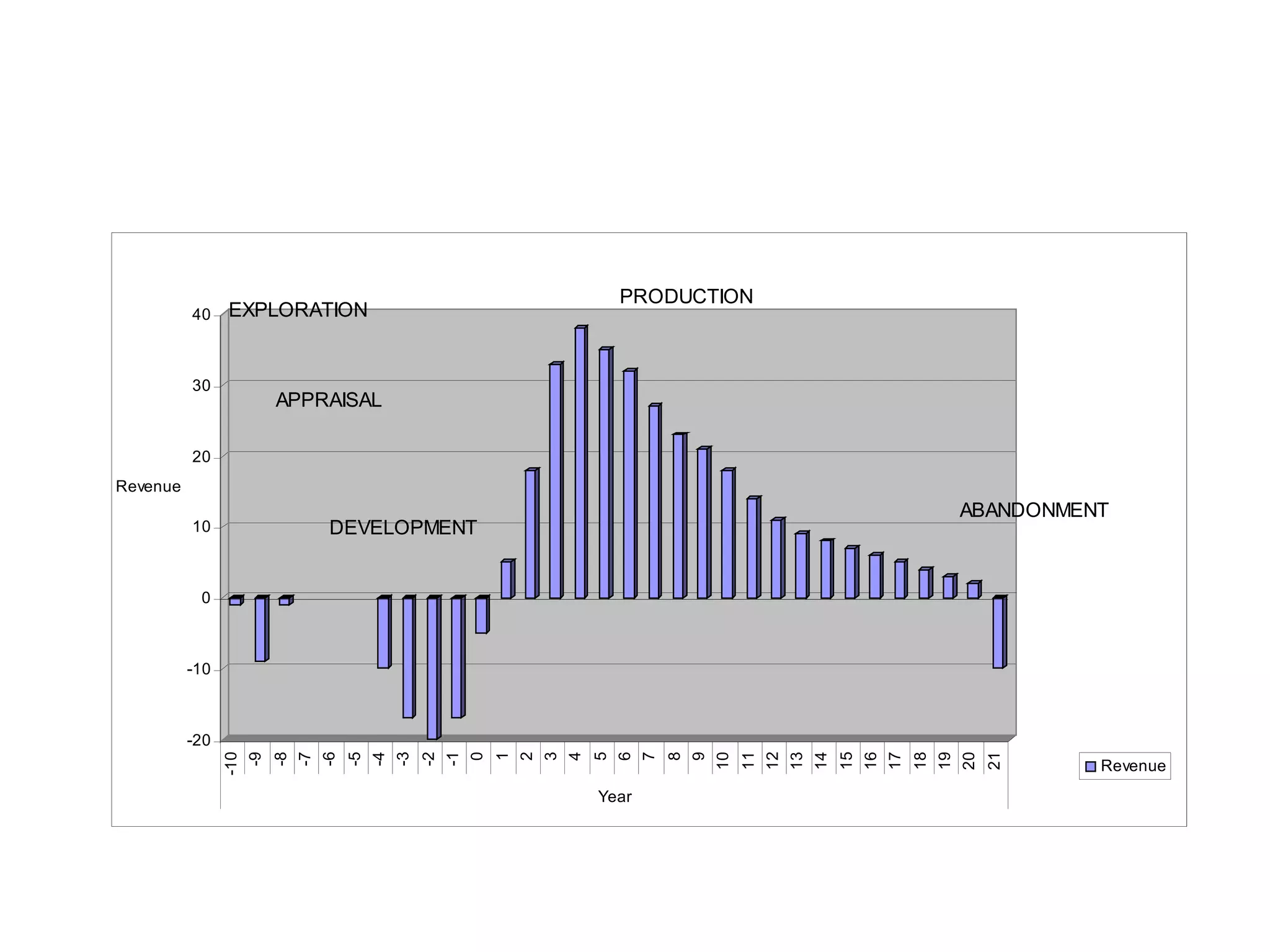
EXPLORATION
APPRAISAL
DEVELOPMENT
PRODUCTION
ABANDONMENT
• Exploration is about finding oil and gas fields. Main goal is to identify and
deliver commercially viable field development opportunities. The following
geological and geophysical (G&G) activities would take place:
– Conduct seismic surveys
– Process and interpret the seismic data and map the potential reservoir
– select exploration well locations
– drill and evaluate exploration well data:
– core analysis to establish porosity and permeability
– logging data to determine porosity, water and hydrocarbon saturation
– production test data to determine flow rates and maximum production
potential
– PVT to allow reservoir fluid analysis and ascertain oil/gas quality and
the shrinkage or expansion factor
– build a computer model of the reservoir and identify and where possible
remove major uncertainties by further data analysis, seismic reprocessing etc
Exploration phase of life cycle closely intertwines with the next stage of
processing which is Appraisal. The objective of Appraisal is to obtain
information about the reservoir in order to make a decision whether or not to
proceed with development of the field. This stage comprises of the following
activities:
– planning and execution of a data acquisition programme of additional
seismic,
– reprocessing existing seismic data to obtain enhanced results and the
drilling of
– appraisal wells
– evaluation of the results from the seismic and appraisal drilling activities
– using the information from the seismic and drilling programmes to update
the computer reservoir simulation models
– conduct initial conceptual field development planning and an environmental
impact assessment (EIA) study of these conceptual plans
Development stage
The initial phase of field development planning could involve the
assessment of more than one development option. Four components
of a development plan can be used to describe each option:
1. Reservoir: number, location, type of wells; assessment of oil
recovery mechanism; assessment of production over the
development stage
2. Wells: the design of wells to meet production requirements
3. Facilities: process facilities, infrastructure, terminal/export facilities
4. Operating and Maintenance strategies: manning level, daily
production level, support requirements, for ex. helicopters, supply
vessels
Production phase is targeted at bringing the well fluids to the
surface and preparing them for use in refinery or processing plant. All
production and maintenance activities would be carried out to meet
strict safety and environmental policies and procedures. The main
activities consist of the following:
– regulate production and injection to meet approved plans for the
quantity and quality of product.
– monitor and record all information to manage the reservoir, wells and
facilities.
– This could lead to further reservoir development or modifications to the
facilities
– plan and schedule all production and maintenance activities to minimise
production deferment and operating costs
– carry out maintenance to safeguard the technical integrity of all wells
and facilities and ensure their availability over the life of the field.
Oil Production
ONSHORE OFFSHORE
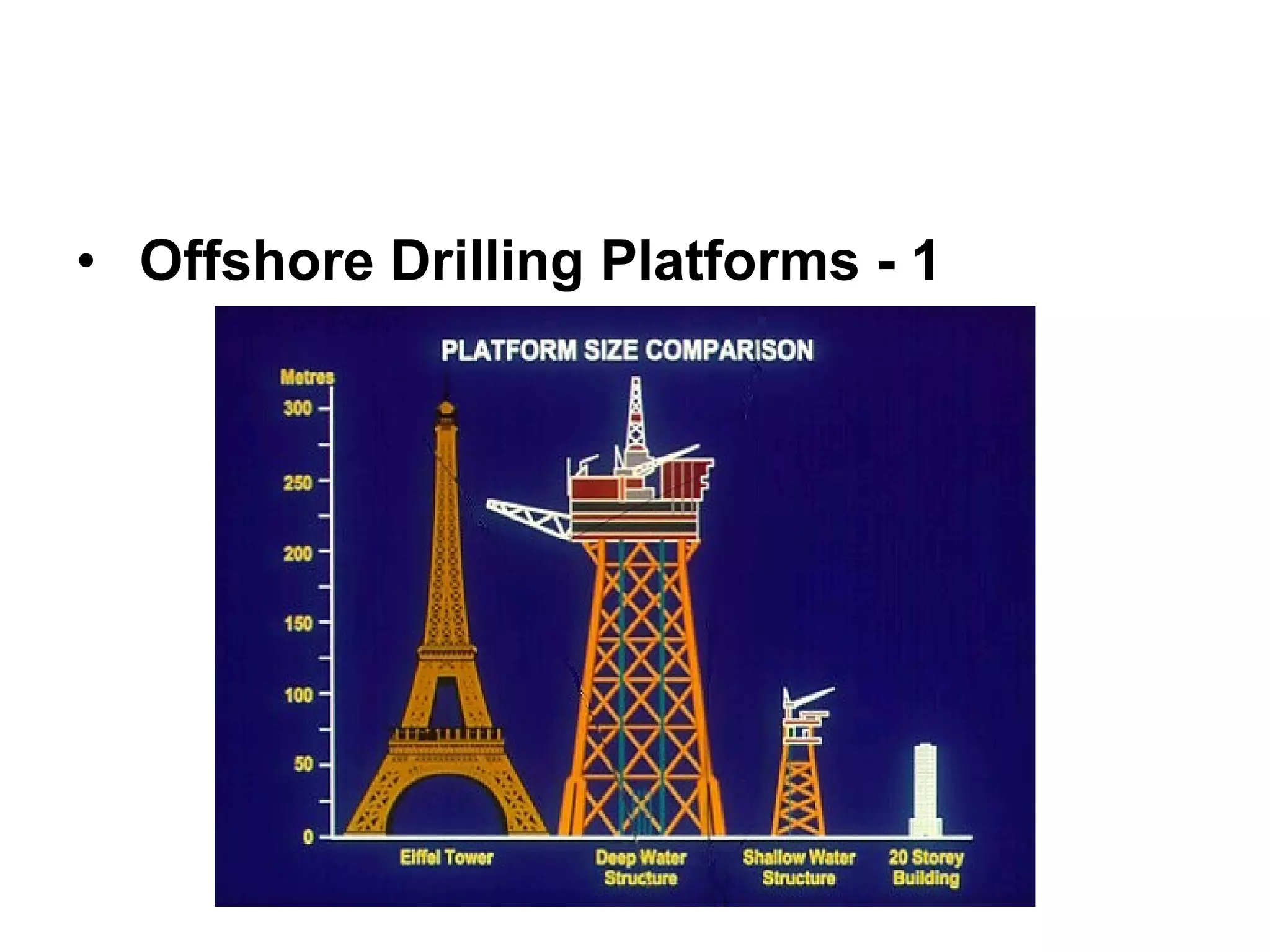
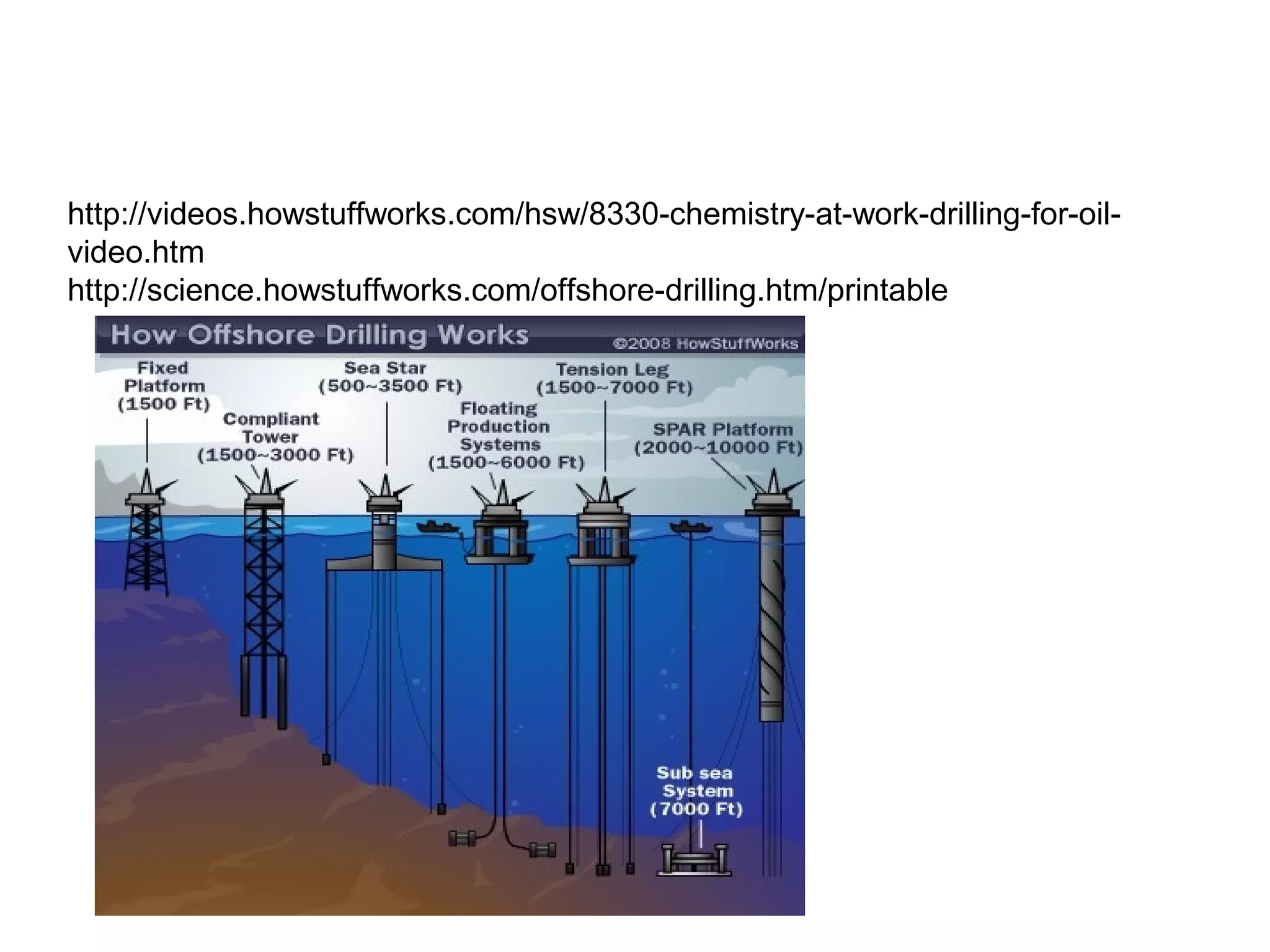
• Offshore Drilling Platforms - 1
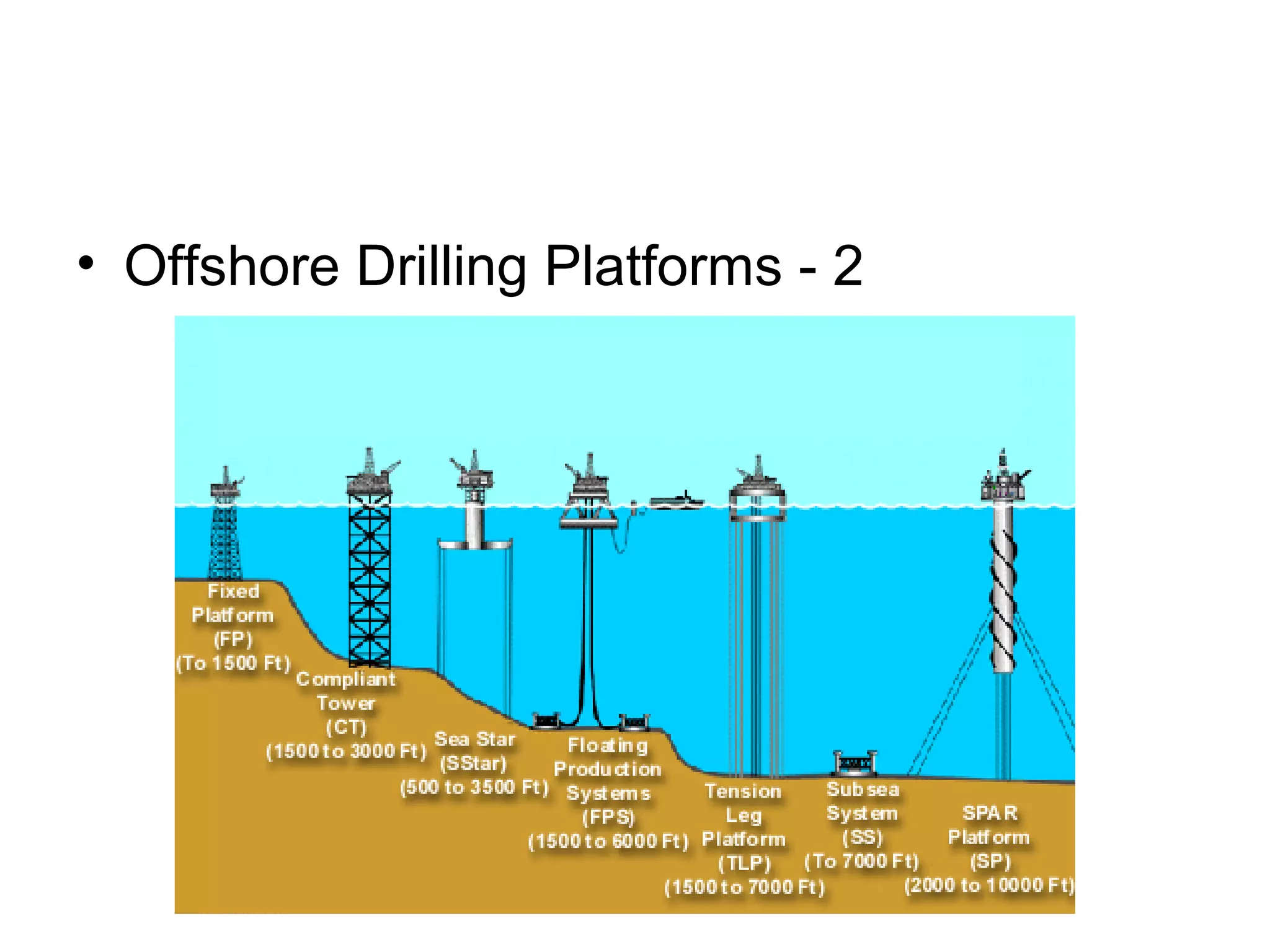
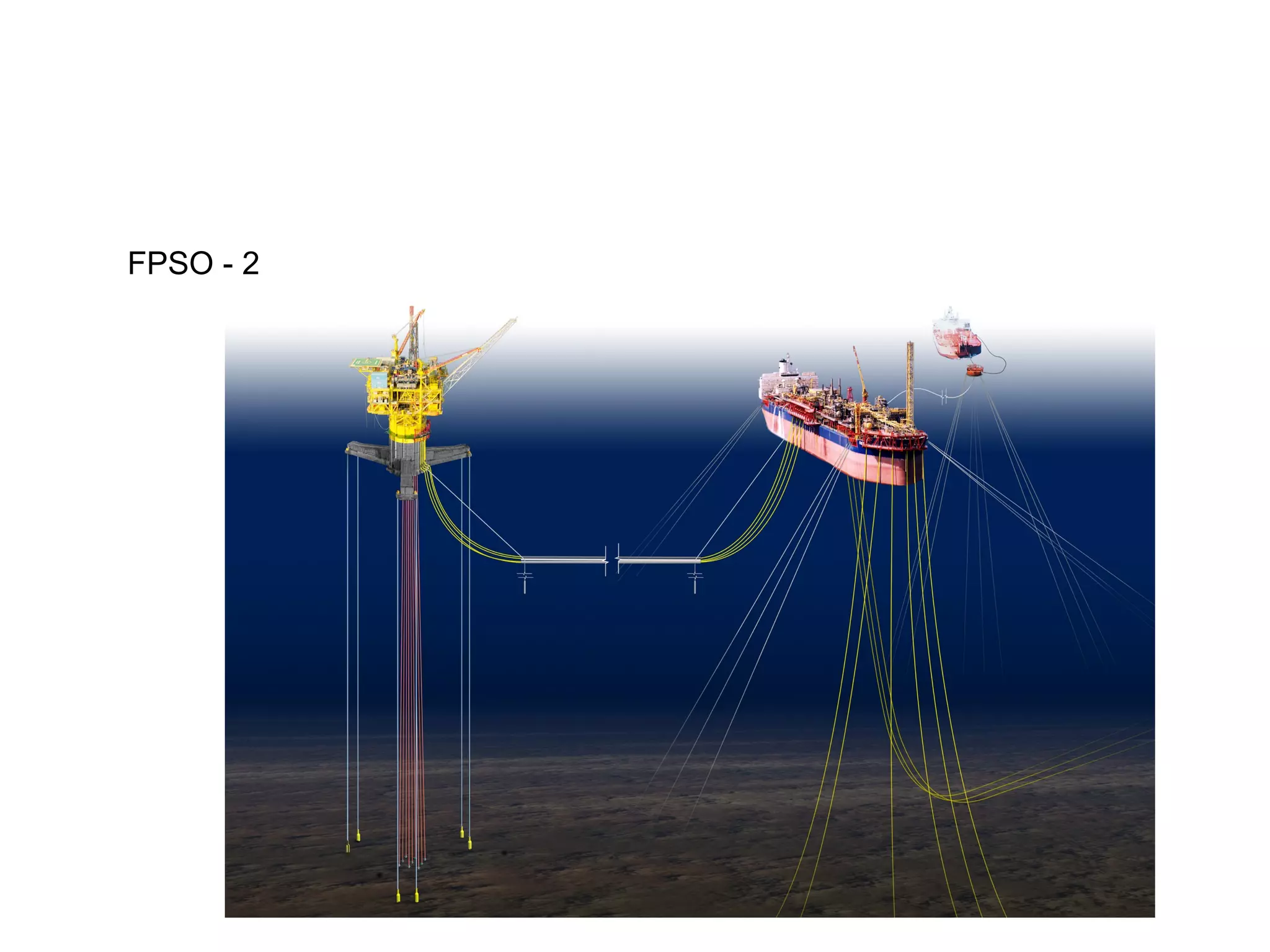
• Offshore Drilling Platforms - 2
Decommissioning/Abandonment phase
The end of the life of the field is when it is no longer economic for the
operator to continue production, i.e. when the operating costs exceed the
revenue from the sale of production. It is common around the world that
operator might abandon the field prior to its depletion as a result of sale to
other interested party. Such acquisition takes place between the super
major operating company and independent oil company when production
declines to the level not commercially attractive to the super-major.
It is becoming increasingly common around the world that offshore facilities
must be dismantled and removed and the site restored to its original
condition. The major activities during the decommissioning phase are:
– plug and abandon wells by putting cement plugs into the wells at
various depths and remove the well-head and casing to a depth of
about 2 metres below the surface or seabed
– dismantle and remove the jacket and all facilities from the site,
ensuring that there is no contamination of the environment from
any oil or waste material remaining in the process facilities
– restore the site to its original condition
– conduct a final environmental impact study
APPENDIX
Complementary slides to enhance general overview about oil and gas industry
http://www.eia.doe.gov/energy_in_brief/world_oil_market.cfm#
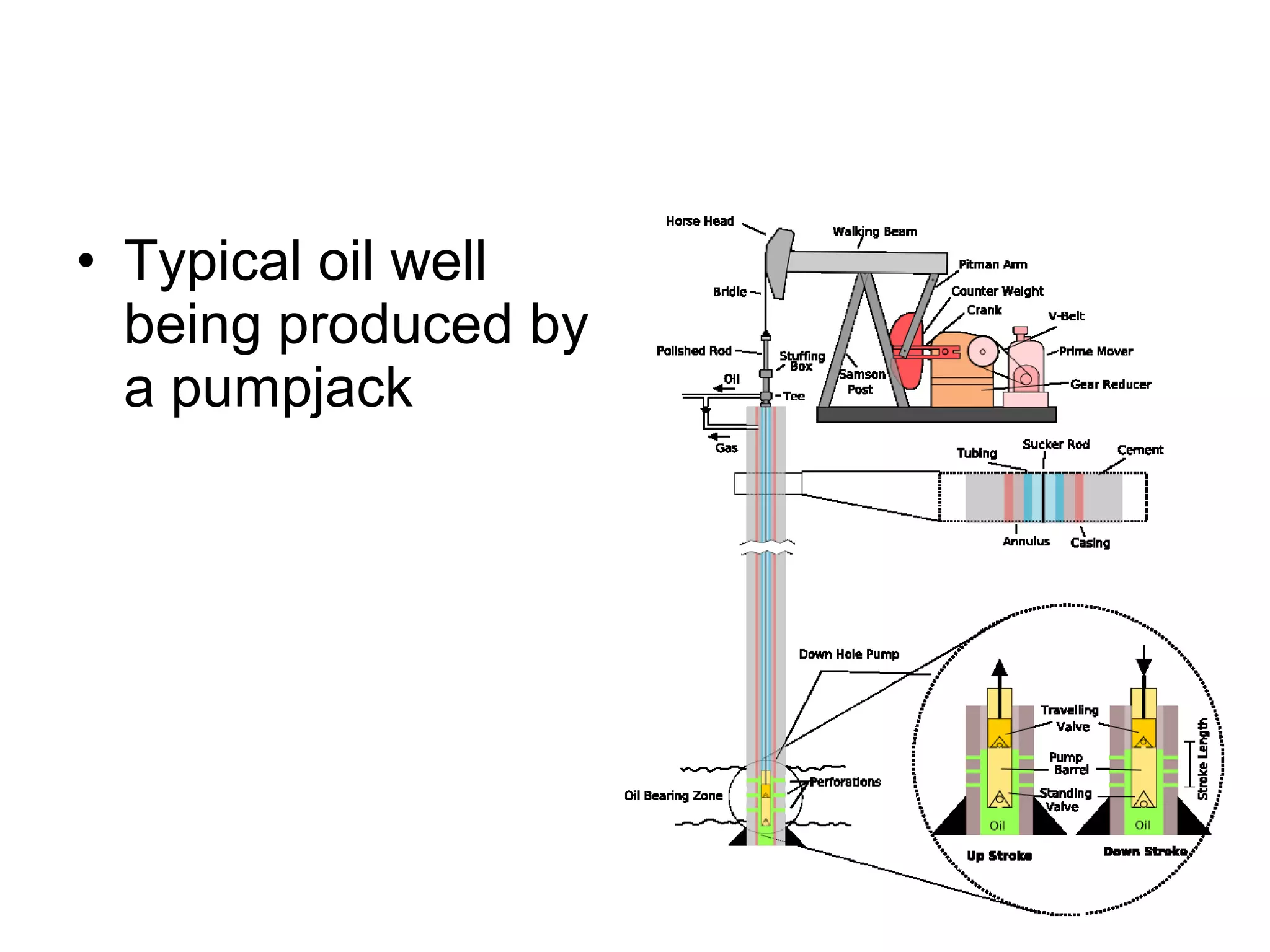
• Typical oil well
being produced by
a pumpjack
http://videos.howstuffworks.com/hsw/8330-chemistry-at-work-drilling-for-oil-
video.htm
http://science.howstuffworks.com/offshore-drilling.htm/printable
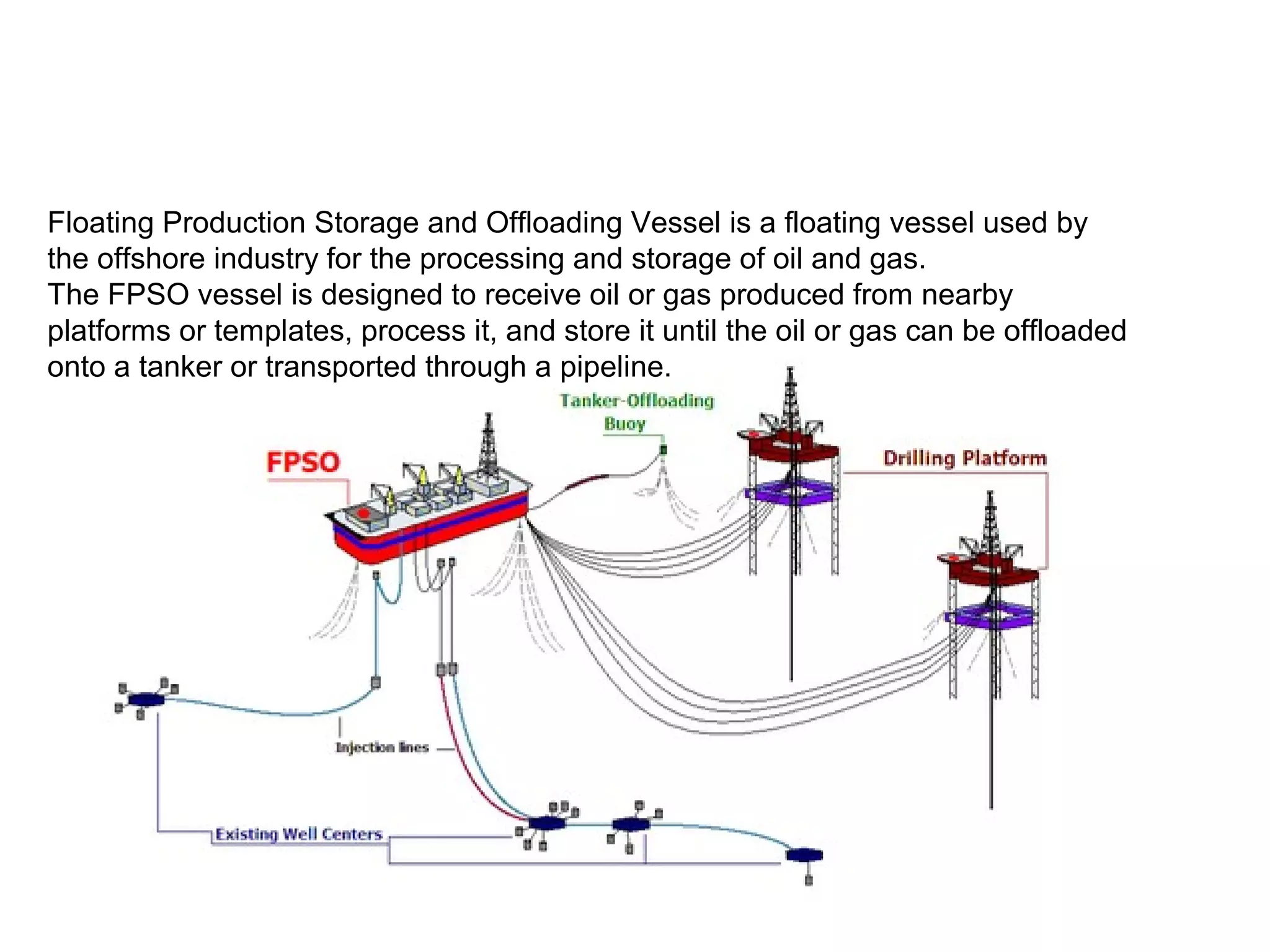
Floating Production Storage and Offloading Vessel is a floating vessel used by
the offshore industry for the processing and storage of oil and gas.
The FPSO vessel is designed to receive oil or gas produced from nearby
platforms or templates, process it, and store it until the oil or gas can be offloaded
onto a tanker or transported through a pipeline.
FPSO - 2
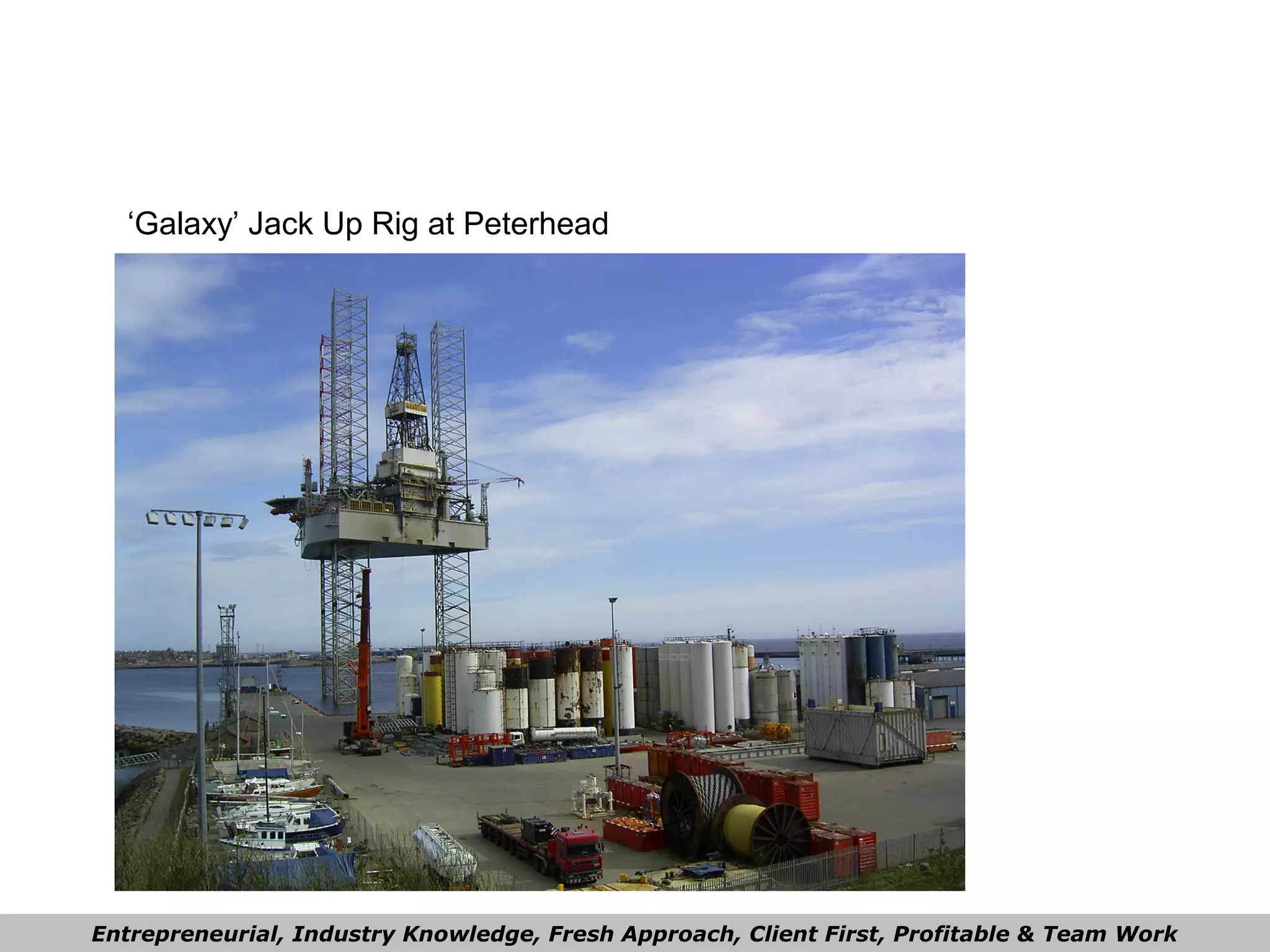
‘Galaxy’ Jack Up Rig at Peterhead
Entrepreneurial, Industry Knowledge, Fresh Approach, Client First, Profitable & Team Work
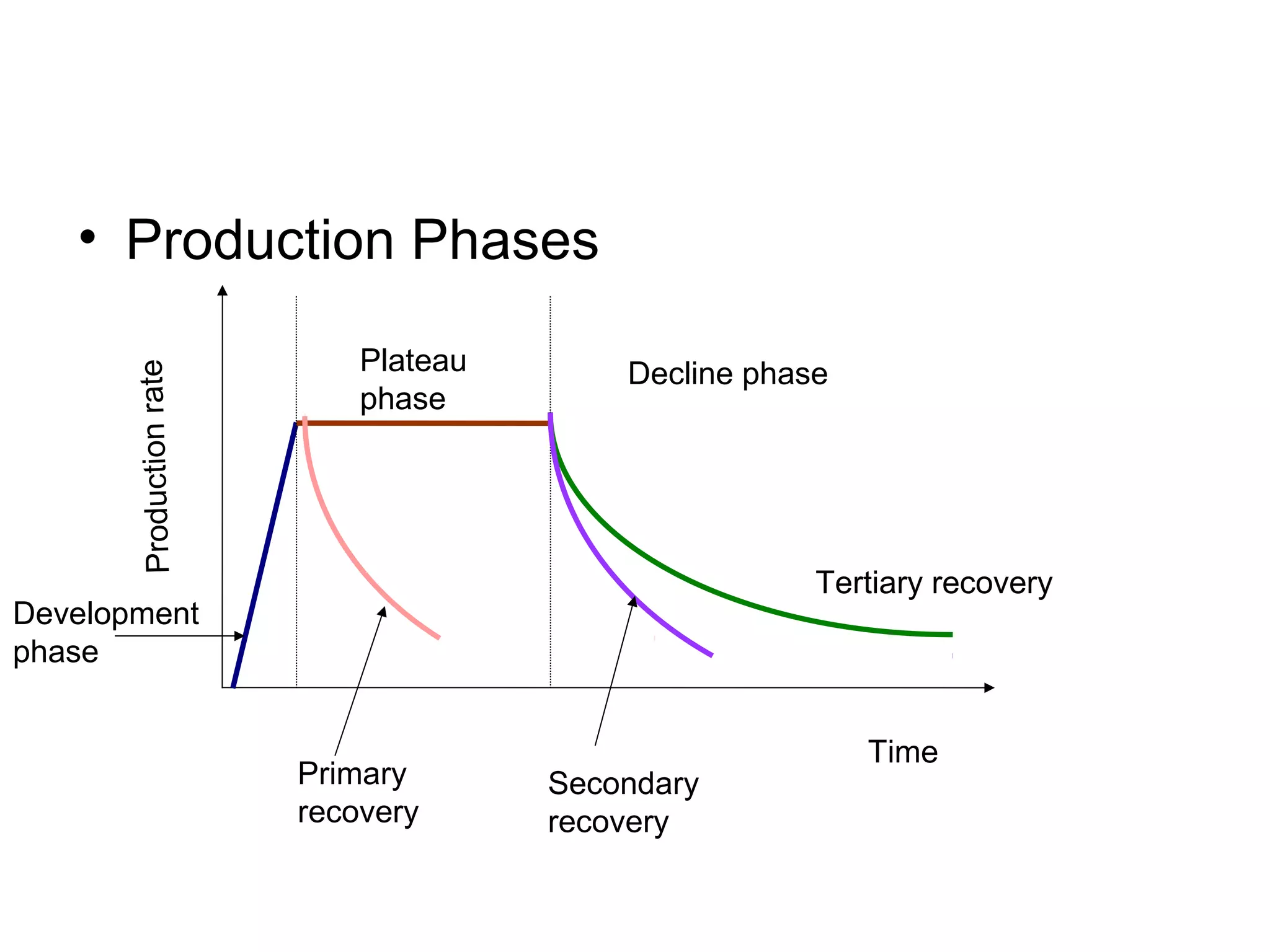
• Production Phases
Time
Productionrate
Decline phasePlateau
phase
Development
phase
Primary
recovery
Secondary
recovery
Tertiary recovery
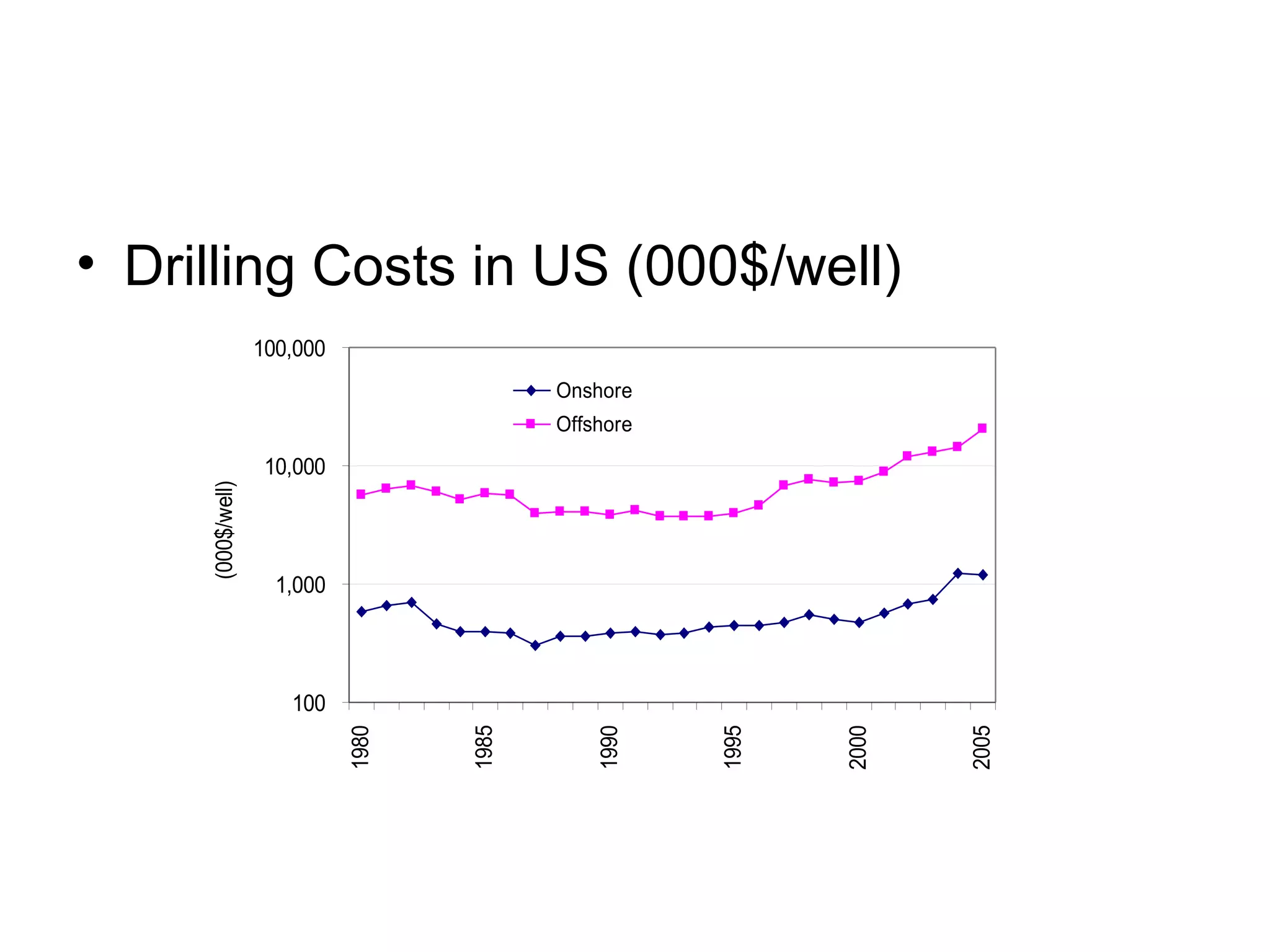
• Drilling Costs in US (000$/well)
100
1,000
10,000
100,000
1980
1985
1990
1995
2000
2005
(000$/well)
Onshore
Offshore
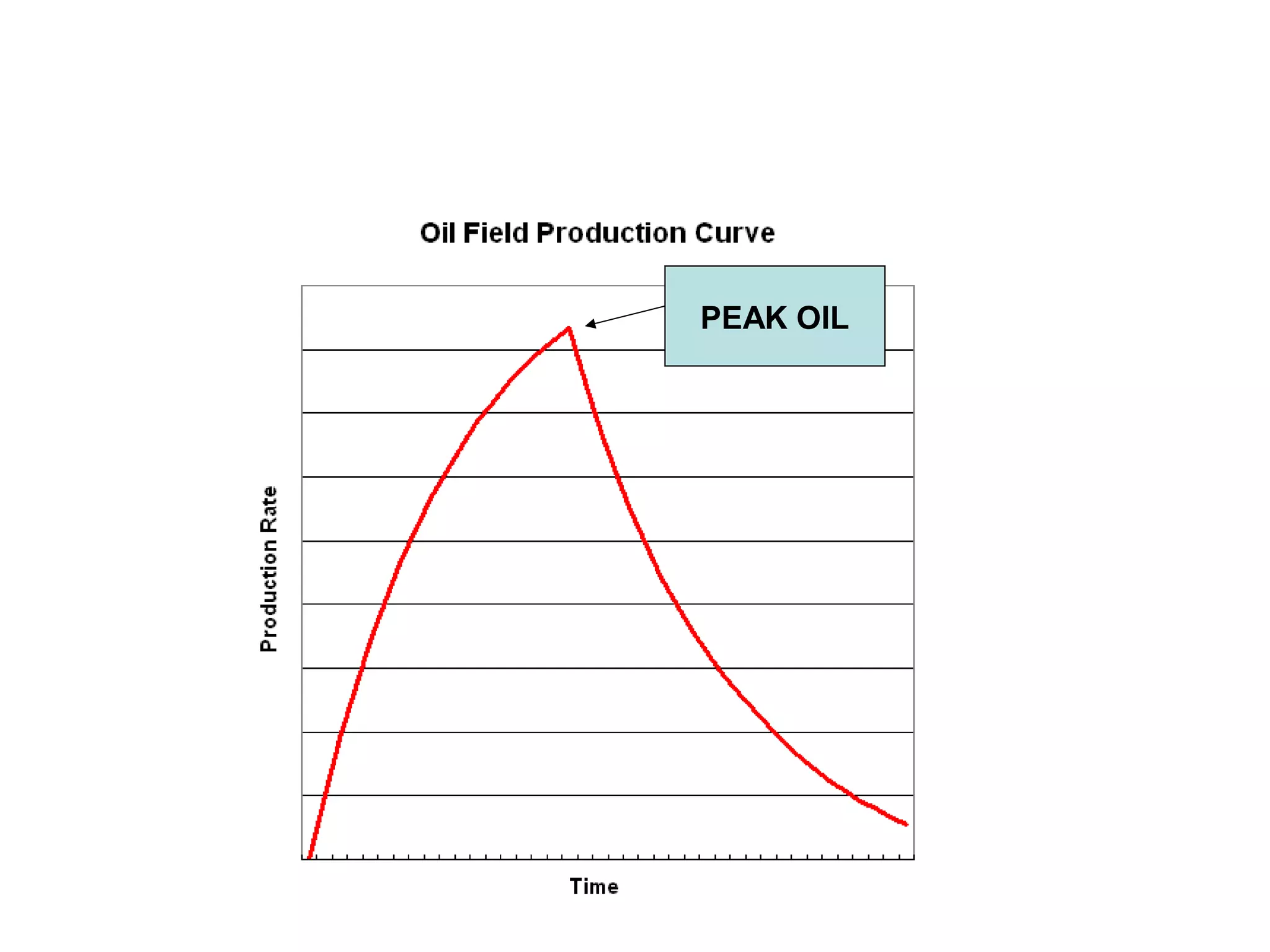
PEAK OIL
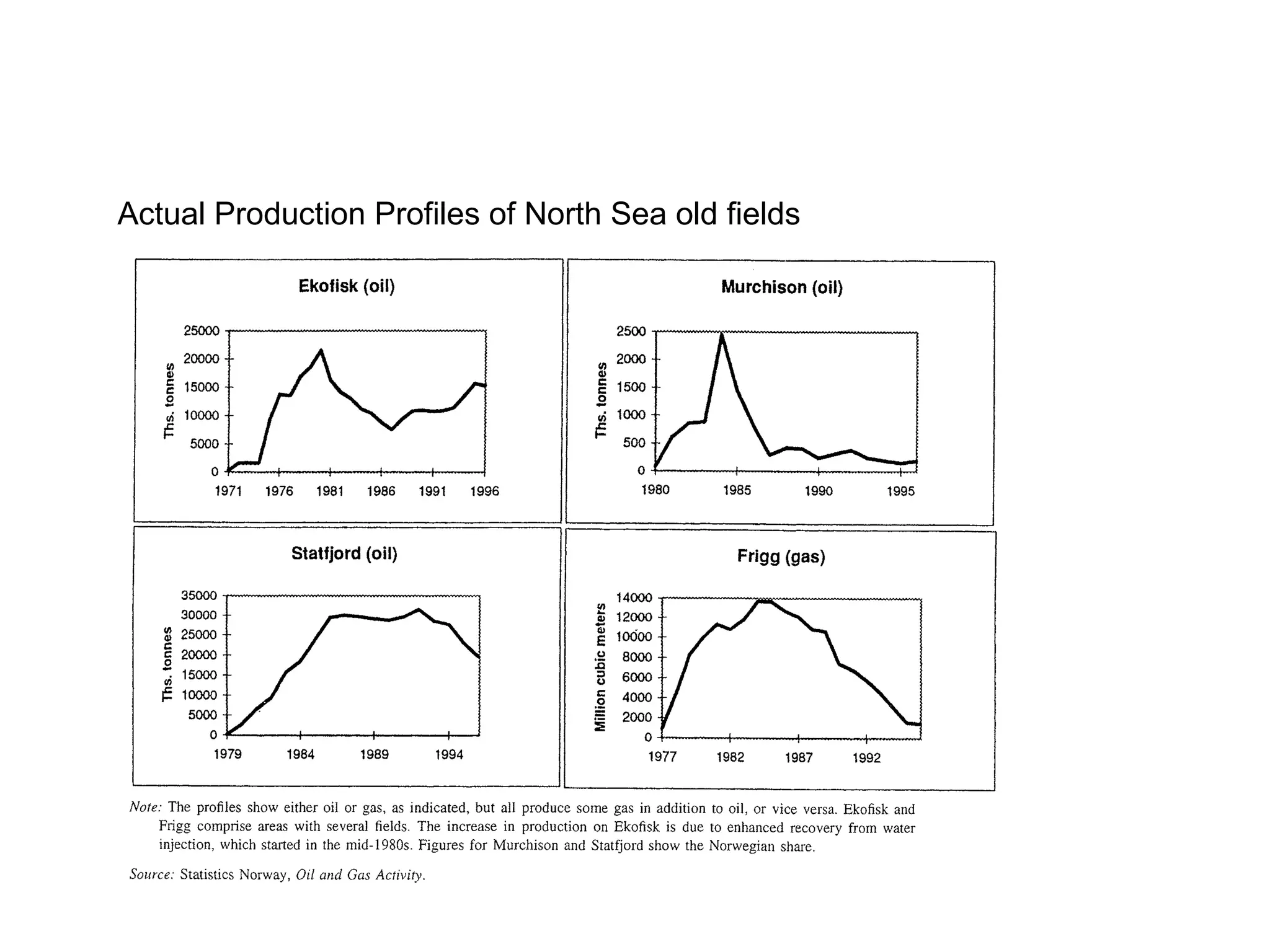
Actual Production Profiles of North Sea old fields

Ogintro 110517110816-phpapp01

  • 1.
  • 2.
    • Introduction toOil and Gas industry consists of the following sections: – 1. Oil formation and Historical perspective – 2. Upstream & Downstream – 3. Life cycle of oil field
  • 3.
    Oil Formation Oil wasformed from the remains of animals and plants that lived millions of years ago in a marine (water) environment before the dinosaurs. Over the years, the remains were covered by layers of mud. Heat and pressure from these layers helped the remains turn into what we today call crude oil . The word "petroleum" means "rock oil" or "oil from the earth."
  • 4.
    Scientific definition: Oil andGas are called Hydrocarbons because they are compound of atoms of hydrogen and carbon. Methane (gas) – the simplest hydrocarbon with one carbon atom and four hydrogen atoms; is written as CH4. Entrepreneurial, Industry Knowledge, Fresh Approach, Client First, Profitable & Team Work H HH H C
  • 5.
    World Oil ReservesChart By country, proved reserves at the end of 2009
  • 6.
    Historical Perspective • Theuse of oil based products were recorded in the earliest writing of man: – Bitumen was used in the building of the tower of Babel – Sumerians used it for paving the Hanging Gardens of Babylon – In India, Burma pitch was used for buildings and as fuel for lamp – In North America native Indians had been collecting oil for use as a medicine
  • 7.
    Modern oil historystarted in: – 1848 the first well was drilled in Baku, Azerbaijan at Bibi-Eybat place – 1859 “Colonel” Drake successfully drilled the well at a depth of 69 feet in Titusville, Pennsylvania. – Around the same time, successful drilling for oil was also taking place in Canada and Trinidad. Oklahoma, 1930, Wild Mary & Sudik farm Baku, 1890, oil wells in Sabuntchi field
  • 8.
    This slide showssome of the product that we use in our everyday life and that are the result of refining process which is one of the main stages of the Downstream phase
  • 9.
    2. Upstream andDownstream side of oil industry The oil industry is divided into two major sectors. The sectors are defined to categorize the operations within each. (1) Upstream: Exploration & Production or E&P. Involves operations in searching for underground or underwater oil and gas fields and drilling exploratory wells and at the same time, operating the wells that recover to re-direct the crude oil or raw natural gas to the surface.
  • 10.
    Work, involved inboth industry sectors, comprises not only of the oil field jobs but also jobs within office environment. Oil traders (Downstream jobs) Reservoir Engineers and Geoscientists (Upstream jobs)
  • 11.
    BP HQ Mayfair, LondonSuncor Energy HQ, Alberta, Canada LukOil HQ, Moscow Global Headquarters of Oil Companies
  • 12.
    What is Downstream? •(2) Downstream: Includes operations that processes and stores, markets and transports crude oil, natural gas liquids like ethane, butane and propane. The downstream sector includes: –all oils refineries and petrochemical plants, –petroleum product distribution via the affiliated retail outlets –and natural gas distribution companies, within the operations. The downstream industry markets products such as petrol and diesel and jet fuel, asphalt, lubricants, plastics fertilizers, antifreeze and even pharmaceuticals and cosmetics.
  • 13.
    Oil refineries arekey to obtaining hydrocarbons. Oil in different parts of the world contains different proportions of the various hydrocarbons. There are refineries in many parts of the UK including Edinburgh, Liverpool and Milford Haven. North Sea oil is relatively high in naphtha, which is used for making plastics.
  • 14.
    Refining process Oil Refinery Residual Fuel Oil Gasoil/Diesel Jet/Kerosene Naphtha Gasoline LPG Refinery Gases Fuel/Energy Crude Oil NGLs Other Feedstocks (Naphtha, Residues, Blending Components) Fuel/Energy
  • 15.
    3.Life cycle ofprocessing of oil field consists of 5 stages: – Exploration – Appraisal – Development – Production – Abandonment Entrepreneurial, Industry Knowledge, Fresh Approach, Client First, Profitable & Team Work
  • 16.
  • 17.
    • Exploration isabout finding oil and gas fields. Main goal is to identify and deliver commercially viable field development opportunities. The following geological and geophysical (G&G) activities would take place: – Conduct seismic surveys – Process and interpret the seismic data and map the potential reservoir – select exploration well locations – drill and evaluate exploration well data: – core analysis to establish porosity and permeability – logging data to determine porosity, water and hydrocarbon saturation – production test data to determine flow rates and maximum production potential – PVT to allow reservoir fluid analysis and ascertain oil/gas quality and the shrinkage or expansion factor – build a computer model of the reservoir and identify and where possible remove major uncertainties by further data analysis, seismic reprocessing etc
  • 18.
    Exploration phase oflife cycle closely intertwines with the next stage of processing which is Appraisal. The objective of Appraisal is to obtain information about the reservoir in order to make a decision whether or not to proceed with development of the field. This stage comprises of the following activities: – planning and execution of a data acquisition programme of additional seismic, – reprocessing existing seismic data to obtain enhanced results and the drilling of – appraisal wells – evaluation of the results from the seismic and appraisal drilling activities – using the information from the seismic and drilling programmes to update the computer reservoir simulation models – conduct initial conceptual field development planning and an environmental impact assessment (EIA) study of these conceptual plans
  • 19.
    Development stage The initialphase of field development planning could involve the assessment of more than one development option. Four components of a development plan can be used to describe each option: 1. Reservoir: number, location, type of wells; assessment of oil recovery mechanism; assessment of production over the development stage 2. Wells: the design of wells to meet production requirements 3. Facilities: process facilities, infrastructure, terminal/export facilities 4. Operating and Maintenance strategies: manning level, daily production level, support requirements, for ex. helicopters, supply vessels
  • 20.
    Production phase istargeted at bringing the well fluids to the surface and preparing them for use in refinery or processing plant. All production and maintenance activities would be carried out to meet strict safety and environmental policies and procedures. The main activities consist of the following: – regulate production and injection to meet approved plans for the quantity and quality of product. – monitor and record all information to manage the reservoir, wells and facilities. – This could lead to further reservoir development or modifications to the facilities – plan and schedule all production and maintenance activities to minimise production deferment and operating costs – carry out maintenance to safeguard the technical integrity of all wells and facilities and ensure their availability over the life of the field.
  • 21.
  • 22.
    • Offshore DrillingPlatforms - 1
  • 23.
    • Offshore DrillingPlatforms - 2
  • 24.
    Decommissioning/Abandonment phase The endof the life of the field is when it is no longer economic for the operator to continue production, i.e. when the operating costs exceed the revenue from the sale of production. It is common around the world that operator might abandon the field prior to its depletion as a result of sale to other interested party. Such acquisition takes place between the super major operating company and independent oil company when production declines to the level not commercially attractive to the super-major. It is becoming increasingly common around the world that offshore facilities must be dismantled and removed and the site restored to its original condition. The major activities during the decommissioning phase are: – plug and abandon wells by putting cement plugs into the wells at various depths and remove the well-head and casing to a depth of about 2 metres below the surface or seabed – dismantle and remove the jacket and all facilities from the site, ensuring that there is no contamination of the environment from any oil or waste material remaining in the process facilities – restore the site to its original condition – conduct a final environmental impact study
  • 25.
    APPENDIX Complementary slides toenhance general overview about oil and gas industry http://www.eia.doe.gov/energy_in_brief/world_oil_market.cfm#
  • 26.
    • Typical oilwell being produced by a pumpjack
  • 27.
  • 28.
    Floating Production Storageand Offloading Vessel is a floating vessel used by the offshore industry for the processing and storage of oil and gas. The FPSO vessel is designed to receive oil or gas produced from nearby platforms or templates, process it, and store it until the oil or gas can be offloaded onto a tanker or transported through a pipeline.
  • 29.
  • 30.
    ‘Galaxy’ Jack UpRig at Peterhead Entrepreneurial, Industry Knowledge, Fresh Approach, Client First, Profitable & Team Work
  • 31.
    • Production Phases Time Productionrate DeclinephasePlateau phase Development phase Primary recovery Secondary recovery Tertiary recovery
  • 32.
    • Drilling Costsin US (000$/well) 100 1,000 10,000 100,000 1980 1985 1990 1995 2000 2005 (000$/well) Onshore Offshore
  • 33.
  • 34.
    Actual Production Profilesof North Sea old fields