Overview of the stages
involved in the oil and
gas.
Karthik P
S
Tube Star
karthik.P.S 1
Energy
What is energy?
Energy is that which is capable of
producing a change in matter.
According to the conservation principle
this is not created nor destroyed,
it is only transformed and may be
transferred between objects
and bodies.
Energy can be:
• Transformed
• Transferred
• Stored
• Transported karthik.P.S 2
Types of Energy
karthik.P.S 3
Mechanical
Kinetic
Electric
Solar
Eolic
Hydraulic
Thermal
Chemical
Energy
Renewable Non-Renewable
Energies which derives from
natural, inexhaustible
sources.
Types of renewable energies
• Solar
• Hydraulic
• Water
• Eolic
• Biomass
• Geothermic
Energies which is obtained from fossil
fuels.
Types of nonrenewable energy
• Petroleum
• Natural gas
• Coal
• Nuclear Energy
karthik.P.S 4
Characteristics
Non-Renewable
• Their use causes pollution through
emissions and waste
• They are limited in nature and
called
exhaustible energy sources
• They create dependency on non-
indigenous sources
karthik.P.S 5
Renewable
• They are clean, nearly inexhaustible
natural resources
• Their indigenous nature reduces reliance
on external supply
• They promote technological
development and job opportunities
HOW DOES OIL AND GAS
PRODUCTIONWORK ?
karthik.P.S 6
karthik.P.S 7
PRODUCTION PROCESS
Exploration
Development
and
Planning
Drilling Production
Separation
and
Treatment
Transportation
Processing
and
Refining
Storage
Distribution
and
Marketing
Decommission
and
Abandonment
karthik.P.S 8
Seismic Surveys: Before drilling, seismic surveys are conducted
to map the subsurface and identify potential locations for
drilling. Seismic waves are sent into the ground, and their
reflections are analyzed to determine the location, size, and
nature of the oil and gas reservoirs.
Exploratory Drilling: Once a promising site is identified,
exploratory wells are drilled to confirm the presence of oil or
gas. These wells are typically drilled to assess the depth,
pressure, and volume of the reservoir.
Geological Assessment: After drilling, data collected from the
well (such as core samples) is analyzed to determine the quality
and viability of the oil or gas reservoir.
karthik.P.S 9
karthik.P.S 10
Seismic Survey on Shore Seismic Survey Off-Shore
Field Development: If the exploration phase confirms the
presence of commercial quantities of oil or gas, the next phase
is development. This involves the planning and design of the
infrastructure needed for extraction.
Reservoir Modeling: Engineers create a model of the reservoir
to predict its behavior and plan the most efficient extraction
method. This includes determining the well locations, number
of wells, and recovery methods.
Infrastructure Design: Facilities for drilling, storage,
transportation, and processing are planned. This might include
offshore platforms, pipelines, storage tanks, and processing
plants.
karthik.P.S 11
Well Drilling: Drilling rigs are used to drill wells into the
reservoir. In offshore operations, drilling rigs are placed on the
seabed or anchored to floating platforms.
Casing and Cementing: As the well is drilled, steel pipes
(casings) are inserted to prevent the well from collapsing and to
isolate different underground layers. Cement is pumped
between the casing and the wellbore to seal it.
Completion: Once the well reaches the target depth, the well is
completed by perforating the casing to allow oil or gas to flow
into the wellbore.
karthik.P.S 12
Primary Recovery: Initially, oil or gas flows naturally to the
surface due to reservoir pressure. This is known as primary
recovery, which uses the natural pressure of the reservoir to
force the oil or gas to the surface.
Secondary Recovery: When natural pressure decreases,
additional methods are used to extract more oil. This usually
involves injecting water or gas into the reservoir to maintain
pressure and push the oil or gas toward the wellbore. This is
known as water flooding or gas injection.
Tertiary (Enhanced) Recovery: In some cases, tertiary recovery
techniques are used to extract even more oil from the reservoir.
Methods include injecting steam, carbon dioxide (CO2), or
chemicals into the reservoir to reduce the viscosity of the oil and
increase production. This technique is commonly referred to as
enhanced oil recovery (EOR).
karthik.P.S 13
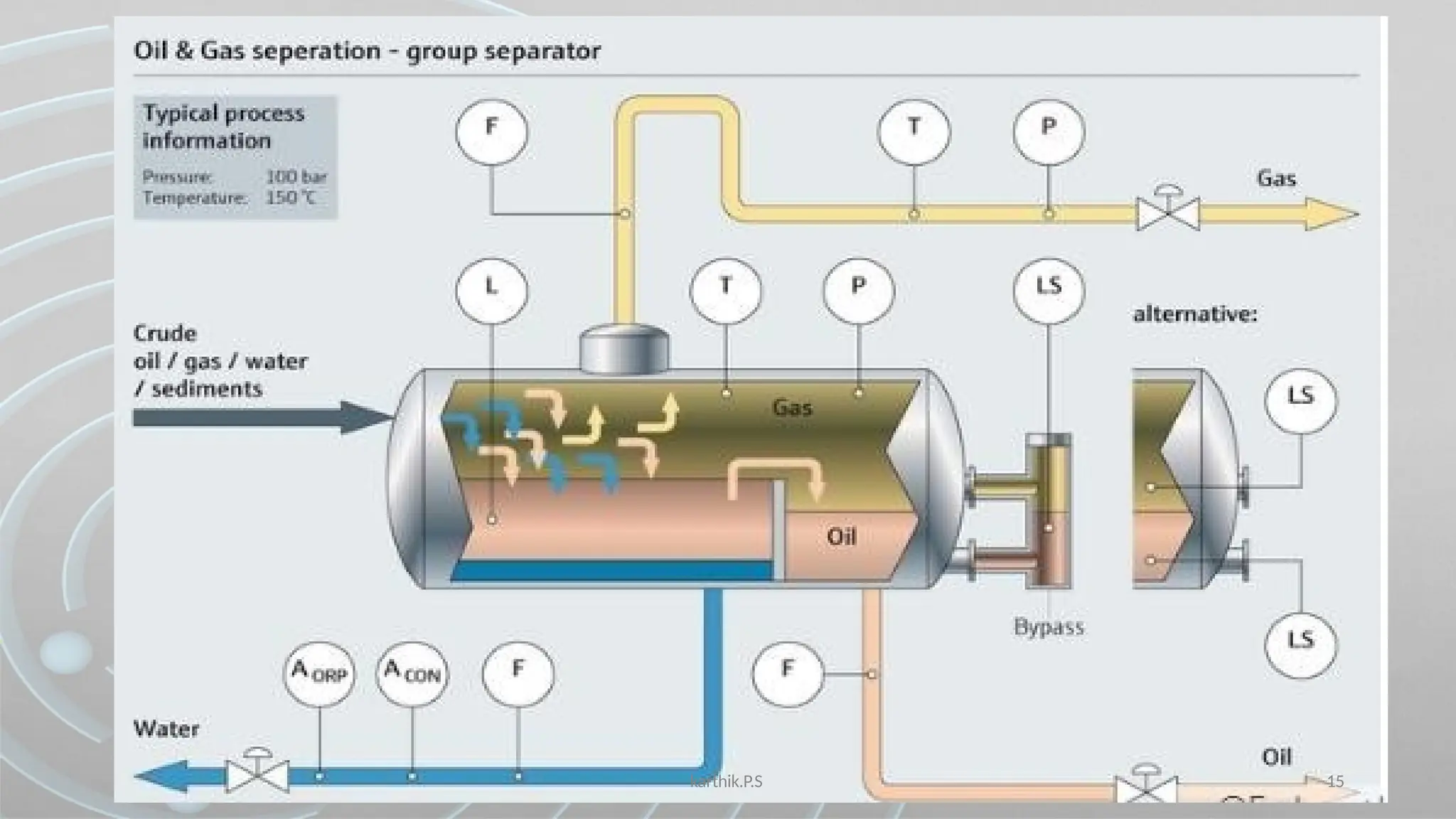
Once extracted, the raw oil and gas mixture needs to be
separated from unwanted impurities, such as water, sand, and
other gases.
Separation: The crude oil and natural gas are separated using a
series of separation units. Typically, the mixture is first sent to a
amine gas treating or adsorption.
**separator, where gravity helps separate the oil, gas, and
water.
Water Treatment: Any water extracted with the oil (called
"produced water") is separated and treated. Water treatment
can involve filtering, desalting, and removing any remaining
hydrocarbons before it is disposed of or reinjected into the
reservoir.
Gas Treatment: Natural gas may contain impurities like
hydrogen sulfide (H2S) and carbon dioxide (CO2), which need
to be removed. This is done through various processes such as
karthik.P.S 14
karthik.P.S 15
karthik.P.S 16
After separation and treatment, the oil and gas are transported
to refineries or processing plants.
Pipelines: Oil and gas are often transported over long distances
using pipelines. Pipelines can be onshore or offshore (for
underwater transport).
Tankers and Trucks: For regions without pipeline infrastructure,
crude oil and natural gas are transported by tankers (for oil) or
trucks (for both oil and gas).
Rail: In some cases, oil and gas are transported by rail, especially
in regions where pipelines or tankers are not practical.
karthik.P.S 17
The crude oil and natural gas extracted from the reservoir are
usually not ready for consumer use in their raw state. They
need to undergo processing and refining.
Oil Refining: Crude oil is sent to a refinery, where it undergoes
processes like distillation, cracking, and reforming to produce
various petroleum products such as gasoline, diesel, jet fuel,
and petrochemicals.
Natural Gas Processing: Natural gas undergoes several steps to
remove impurities, including separating natural gas liquids
(NGLs) like propane and butane. The processed natural gas is
then ready for distribution as a fuel source.
karthik.P.S 18
Oil Storage: After refining, oil and its products are stored in
tanks at storage facilities. These facilities are strategically
located near refineries, transportation hubs, or major
consumption centers.
Gas Storage: Natural gas is stored in underground reservoirs or
large above-ground storage tanks, especially for use in colder
months or during supply disruptions.
The countries with the largest crude oil reserves in the world
are:-
• Venezuela: 304 billion barrels
• Saudi Arabia: 298 billion barrels
• Canada: 170 billion barrels
• Iran: 158 billion barrels
• Iraq: 142 billion barrels
• Kuwait: 101 billion barrels
• UAE: 97.8 billion barrels
• Russia: 80 billion barrels
karthik.P.S 19
Distribution: Refined petroleum products are distributed
through pipelines, trucks, ships, and rail to various
locations, such as gas stations, industries, or power plants.
Retail and Sale: Once distributed, these products are sold
to end users, whether as fuel for vehicles, industrial
applications, or household use.
karthik.P.S 20
Once an oil and gas field reaches the end of its productive life,
the facility is decommissioned.
Well Plugging: Wells are plugged to prevent leakage and
contamination of the environment. This involves sealing the
wellbore with cement and removing any equipment.
Site Cleanup: The site is cleaned up, and any structures or
equipment are dismantled and removed.
Environmental Monitoring: Environmental monitoring
continues after decommissioning to ensure that no harmful
substances are leaking into the environment.
karthik.P.S 21
karthik.P.S 22
karthik.P.S 23
• The first oil well was found in the year 1938 by Bedouin who helped to in American
petroleum geologist to find the first kingdoms oil well name Dammam no -7.
• The biggest oil well in the world is located in the easter region (Al-Ahsa Dammam)
• Total we have 142 Fields in the kingdom.
• Saudi Arabia has the second-largest proven oil reserves in the world, with about 266
billion barrels.
• Saudi Arabia has an oil production capacity of about 12 million barrels per day (bpd),
and it is capable of ramping up production quickly in response to market needs or
geopolitical events..
• Renewable Energy Push: As part of its Vision 2030, Saudi Arabia is focusing on building
a renewable energy sector, particularly in solar and wind energy, to reduce its
dependence on oil for domestic power generation.
• These facts highlight Saudi Arabia's pivotal role in the global oil market, its efforts to
diversify its economy, and the strategic importance of its oil and gas sector.
Facts about Saudi Arabia
karthik.P.S 24

Overview Stages of OIl and Gas Industry.pptx

  • 1.
    Overview of thestages involved in the oil and gas. Karthik P S Tube Star karthik.P.S 1
  • 2.
    Energy What is energy? Energyis that which is capable of producing a change in matter. According to the conservation principle this is not created nor destroyed, it is only transformed and may be transferred between objects and bodies. Energy can be: • Transformed • Transferred • Stored • Transported karthik.P.S 2
  • 3.
    Types of Energy karthik.P.S3 Mechanical Kinetic Electric Solar Eolic Hydraulic Thermal Chemical
  • 4.
    Energy Renewable Non-Renewable Energies whichderives from natural, inexhaustible sources. Types of renewable energies • Solar • Hydraulic • Water • Eolic • Biomass • Geothermic Energies which is obtained from fossil fuels. Types of nonrenewable energy • Petroleum • Natural gas • Coal • Nuclear Energy karthik.P.S 4
  • 5.
    Characteristics Non-Renewable • Their usecauses pollution through emissions and waste • They are limited in nature and called exhaustible energy sources • They create dependency on non- indigenous sources karthik.P.S 5 Renewable • They are clean, nearly inexhaustible natural resources • Their indigenous nature reduces reliance on external supply • They promote technological development and job opportunities
  • 6.
    HOW DOES OILAND GAS PRODUCTIONWORK ? karthik.P.S 6
  • 7.
  • 8.
  • 9.
    Seismic Surveys: Beforedrilling, seismic surveys are conducted to map the subsurface and identify potential locations for drilling. Seismic waves are sent into the ground, and their reflections are analyzed to determine the location, size, and nature of the oil and gas reservoirs. Exploratory Drilling: Once a promising site is identified, exploratory wells are drilled to confirm the presence of oil or gas. These wells are typically drilled to assess the depth, pressure, and volume of the reservoir. Geological Assessment: After drilling, data collected from the well (such as core samples) is analyzed to determine the quality and viability of the oil or gas reservoir. karthik.P.S 9
  • 10.
    karthik.P.S 10 Seismic Surveyon Shore Seismic Survey Off-Shore
  • 11.
    Field Development: Ifthe exploration phase confirms the presence of commercial quantities of oil or gas, the next phase is development. This involves the planning and design of the infrastructure needed for extraction. Reservoir Modeling: Engineers create a model of the reservoir to predict its behavior and plan the most efficient extraction method. This includes determining the well locations, number of wells, and recovery methods. Infrastructure Design: Facilities for drilling, storage, transportation, and processing are planned. This might include offshore platforms, pipelines, storage tanks, and processing plants. karthik.P.S 11
  • 12.
    Well Drilling: Drillingrigs are used to drill wells into the reservoir. In offshore operations, drilling rigs are placed on the seabed or anchored to floating platforms. Casing and Cementing: As the well is drilled, steel pipes (casings) are inserted to prevent the well from collapsing and to isolate different underground layers. Cement is pumped between the casing and the wellbore to seal it. Completion: Once the well reaches the target depth, the well is completed by perforating the casing to allow oil or gas to flow into the wellbore. karthik.P.S 12
  • 13.
    Primary Recovery: Initially,oil or gas flows naturally to the surface due to reservoir pressure. This is known as primary recovery, which uses the natural pressure of the reservoir to force the oil or gas to the surface. Secondary Recovery: When natural pressure decreases, additional methods are used to extract more oil. This usually involves injecting water or gas into the reservoir to maintain pressure and push the oil or gas toward the wellbore. This is known as water flooding or gas injection. Tertiary (Enhanced) Recovery: In some cases, tertiary recovery techniques are used to extract even more oil from the reservoir. Methods include injecting steam, carbon dioxide (CO2), or chemicals into the reservoir to reduce the viscosity of the oil and increase production. This technique is commonly referred to as enhanced oil recovery (EOR). karthik.P.S 13
  • 14.
    Once extracted, theraw oil and gas mixture needs to be separated from unwanted impurities, such as water, sand, and other gases. Separation: The crude oil and natural gas are separated using a series of separation units. Typically, the mixture is first sent to a amine gas treating or adsorption. **separator, where gravity helps separate the oil, gas, and water. Water Treatment: Any water extracted with the oil (called "produced water") is separated and treated. Water treatment can involve filtering, desalting, and removing any remaining hydrocarbons before it is disposed of or reinjected into the reservoir. Gas Treatment: Natural gas may contain impurities like hydrogen sulfide (H2S) and carbon dioxide (CO2), which need to be removed. This is done through various processes such as karthik.P.S 14
  • 15.
  • 16.
  • 17.
    After separation andtreatment, the oil and gas are transported to refineries or processing plants. Pipelines: Oil and gas are often transported over long distances using pipelines. Pipelines can be onshore or offshore (for underwater transport). Tankers and Trucks: For regions without pipeline infrastructure, crude oil and natural gas are transported by tankers (for oil) or trucks (for both oil and gas). Rail: In some cases, oil and gas are transported by rail, especially in regions where pipelines or tankers are not practical. karthik.P.S 17
  • 18.
    The crude oiland natural gas extracted from the reservoir are usually not ready for consumer use in their raw state. They need to undergo processing and refining. Oil Refining: Crude oil is sent to a refinery, where it undergoes processes like distillation, cracking, and reforming to produce various petroleum products such as gasoline, diesel, jet fuel, and petrochemicals. Natural Gas Processing: Natural gas undergoes several steps to remove impurities, including separating natural gas liquids (NGLs) like propane and butane. The processed natural gas is then ready for distribution as a fuel source. karthik.P.S 18
  • 19.
    Oil Storage: Afterrefining, oil and its products are stored in tanks at storage facilities. These facilities are strategically located near refineries, transportation hubs, or major consumption centers. Gas Storage: Natural gas is stored in underground reservoirs or large above-ground storage tanks, especially for use in colder months or during supply disruptions. The countries with the largest crude oil reserves in the world are:- • Venezuela: 304 billion barrels • Saudi Arabia: 298 billion barrels • Canada: 170 billion barrels • Iran: 158 billion barrels • Iraq: 142 billion barrels • Kuwait: 101 billion barrels • UAE: 97.8 billion barrels • Russia: 80 billion barrels karthik.P.S 19
  • 20.
    Distribution: Refined petroleumproducts are distributed through pipelines, trucks, ships, and rail to various locations, such as gas stations, industries, or power plants. Retail and Sale: Once distributed, these products are sold to end users, whether as fuel for vehicles, industrial applications, or household use. karthik.P.S 20
  • 21.
    Once an oiland gas field reaches the end of its productive life, the facility is decommissioned. Well Plugging: Wells are plugged to prevent leakage and contamination of the environment. This involves sealing the wellbore with cement and removing any equipment. Site Cleanup: The site is cleaned up, and any structures or equipment are dismantled and removed. Environmental Monitoring: Environmental monitoring continues after decommissioning to ensure that no harmful substances are leaking into the environment. karthik.P.S 21
  • 22.
  • 23.
    karthik.P.S 23 • Thefirst oil well was found in the year 1938 by Bedouin who helped to in American petroleum geologist to find the first kingdoms oil well name Dammam no -7. • The biggest oil well in the world is located in the easter region (Al-Ahsa Dammam) • Total we have 142 Fields in the kingdom. • Saudi Arabia has the second-largest proven oil reserves in the world, with about 266 billion barrels. • Saudi Arabia has an oil production capacity of about 12 million barrels per day (bpd), and it is capable of ramping up production quickly in response to market needs or geopolitical events.. • Renewable Energy Push: As part of its Vision 2030, Saudi Arabia is focusing on building a renewable energy sector, particularly in solar and wind energy, to reduce its dependence on oil for domestic power generation. • These facts highlight Saudi Arabia's pivotal role in the global oil market, its efforts to diversify its economy, and the strategic importance of its oil and gas sector. Facts about Saudi Arabia
  • 24.