ORGANIZATIONAL CHANGE (4TH ED.)
Barbara Senior & Stephen Swailes
Chapter 2: the nature of organizational change
LEARNING OBJECTIVES
By the end of this chapter, you will be able to:
 describe and discuss the multi-dimensional nature
of organizational change;
 analyze change situations in terms of the different
types of change experienced;
 explain limitations to the ‘common-sense’ approach
to managing change arising from cultural, political
and leadership influences;
 critically evaluate the theoretical perspectives
relating to the types of change that organizations
experience.
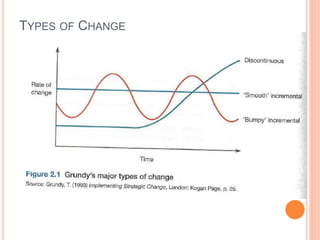
TYPES OF CHANGE
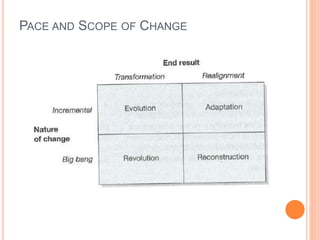
PACE AND SCOPE OF CHANGE
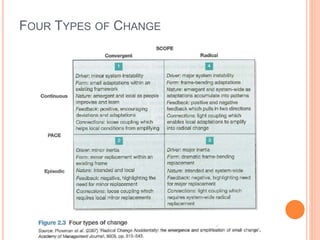
FOUR TYPES OF CHANGE
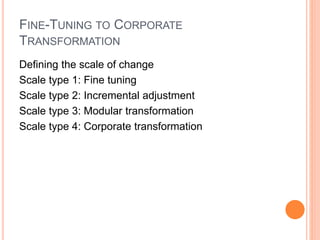
FINE-TUNING TO CORPORATE
TRANSFORMATION
Defining the scale of change
Scale type 1: Fine tuning
Scale type 2: Incremental adjustment
Scale type 3: Modular transformation
Scale type 4: Corporate transformation
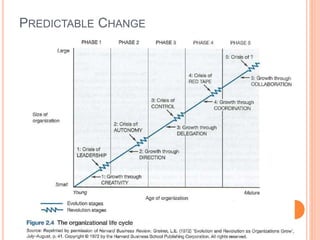
PREDICTABLE CHANGE
A TYPICAL LIFECYCLE PATTERN
Illustration 2.8
1. The entrepreneurial stage
2. The collective stage
3. The formalization stage
4. The elaboration stage
COMPLEXITY THEORY
1. Chaos Theory
2. Dissipative Theory
3. Complex Adaptive Systems
Three implications of applying complexity
theory to organizations:
1. Need more democracy in equalization of power
2. A continuous approach based on self-organization
to improving products and process
3. Need the presence of order-generating rutles.
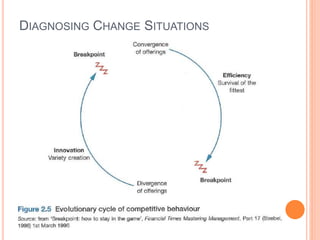
DIAGNOSING CHANGE SITUATIONS
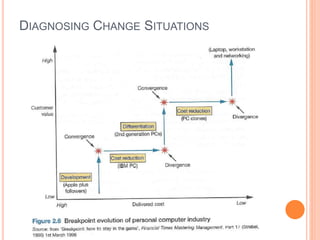
Looking for breakpoints: Typical indicators
 Competitors
 Customers
 Distributors
 Suppliers
When several of these are in place, all that is needed is a
player, or event, to trigger the breakpoint.
DIAGNOSING CHANGE SITUATIONS
Looking for breakpoints: Divergence
Divergence is more difficult to anticipate because it is
based on new offering that does not yet exist. If the
following are in place, the industry is ready for a new
offering that breaks with the past.
 Customers: restless customers
 New entrants: restless customers attract new entrants
 Competitors: experiment with new offerings or look
elsewhere for profits
 Suppliers: new resources and technology a source of
divergent breakpoint
 Distributors: lag behind because they have to adapt to the
new offering
DIAGNOSING CHANGE SITUATIONS
Hard (difficult) and soft (messy) problems
Difficulties are bounded
Messes are unbounded

Ogc chap 2

  • 1.
    ORGANIZATIONAL CHANGE (4THED.) Barbara Senior & Stephen Swailes Chapter 2: the nature of organizational change
  • 2.
    LEARNING OBJECTIVES By theend of this chapter, you will be able to:  describe and discuss the multi-dimensional nature of organizational change;  analyze change situations in terms of the different types of change experienced;  explain limitations to the ‘common-sense’ approach to managing change arising from cultural, political and leadership influences;  critically evaluate the theoretical perspectives relating to the types of change that organizations experience.
  • 3.
  • 4.
    PACE AND SCOPEOF CHANGE
  • 5.
  • 6.
    FINE-TUNING TO CORPORATE TRANSFORMATION Definingthe scale of change Scale type 1: Fine tuning Scale type 2: Incremental adjustment Scale type 3: Modular transformation Scale type 4: Corporate transformation
  • 7.
  • 8.
    A TYPICAL LIFECYCLEPATTERN Illustration 2.8 1. The entrepreneurial stage 2. The collective stage 3. The formalization stage 4. The elaboration stage
  • 9.
    COMPLEXITY THEORY 1. ChaosTheory 2. Dissipative Theory 3. Complex Adaptive Systems Three implications of applying complexity theory to organizations: 1. Need more democracy in equalization of power 2. A continuous approach based on self-organization to improving products and process 3. Need the presence of order-generating rutles.
  • 10.
    DIAGNOSING CHANGE SITUATIONS Lookingfor breakpoints: Typical indicators  Competitors  Customers  Distributors  Suppliers When several of these are in place, all that is needed is a player, or event, to trigger the breakpoint.
  • 11.
    DIAGNOSING CHANGE SITUATIONS Lookingfor breakpoints: Divergence Divergence is more difficult to anticipate because it is based on new offering that does not yet exist. If the following are in place, the industry is ready for a new offering that breaks with the past.  Customers: restless customers  New entrants: restless customers attract new entrants  Competitors: experiment with new offerings or look elsewhere for profits  Suppliers: new resources and technology a source of divergent breakpoint  Distributors: lag behind because they have to adapt to the new offering
  • 12.
  • 13.
  • 14.
    DIAGNOSING CHANGE SITUATIONS Hard(difficult) and soft (messy) problems Difficulties are bounded Messes are unbounded