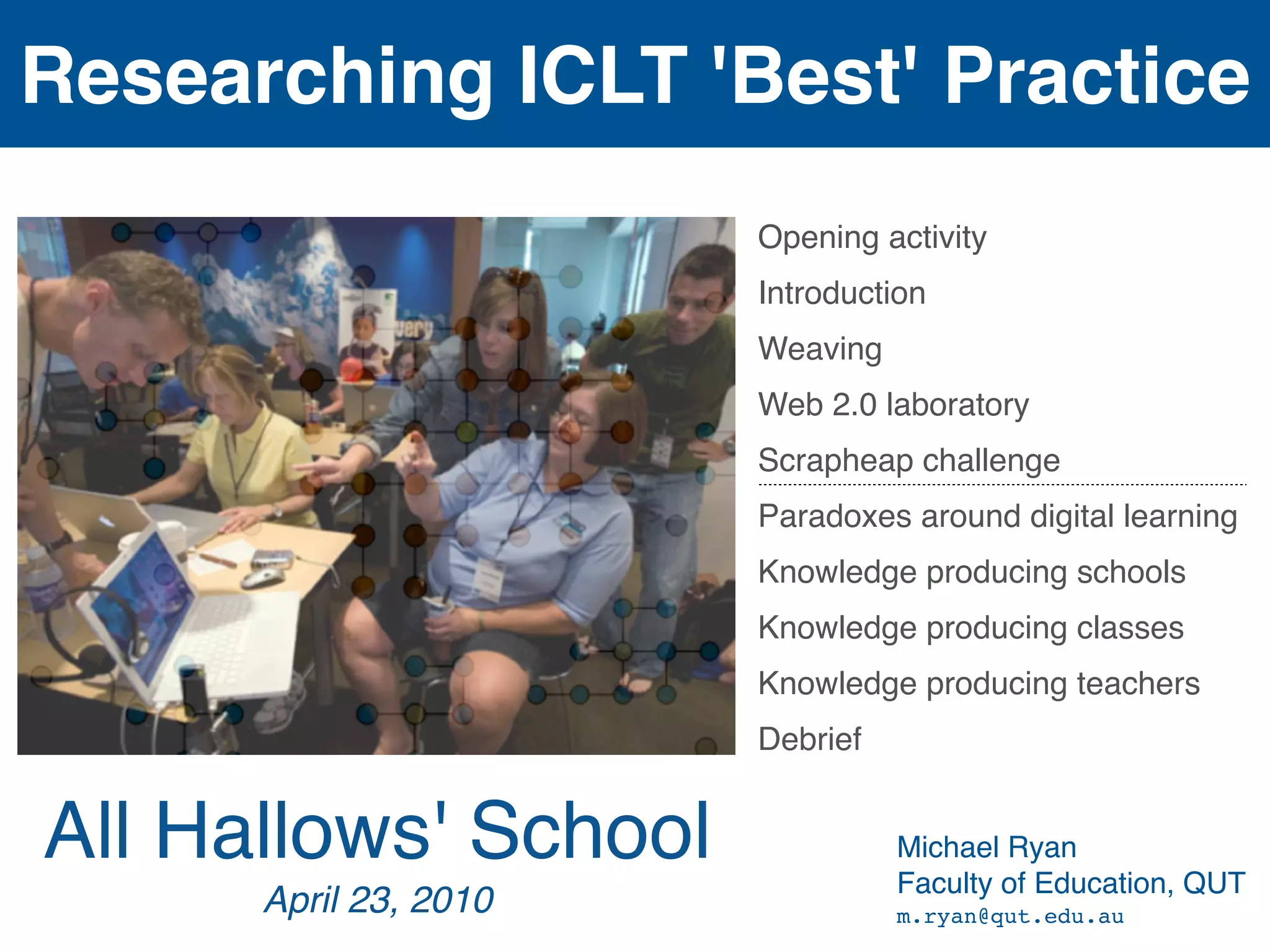
Researching ICLT 'Best' Practice
                       Opening activity
                       Introduction
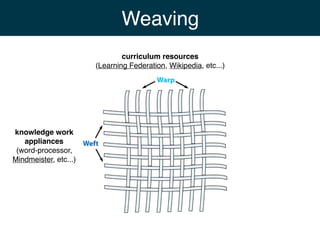
                       Weaving
                       Web 2.0 laboratory
                       Scrapheap challenge
                       Paradoxes around digital learning
                       Knowledge producing schools
                       Knowledge producing classes
                       Knowledge producing teachers
                       Debrief


All Hallows' School              Michael Ryan
                                 Faculty of Education, QUT
      April 23, 2010             m.ryan@qut.edu.au
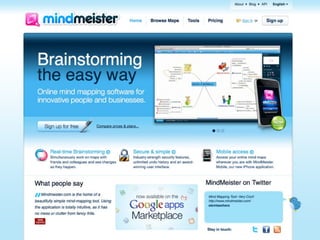
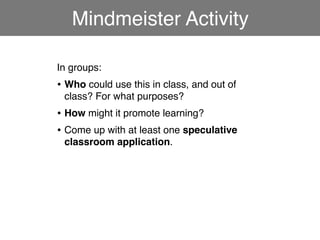
Mindmeister Activity

In groups:
• Who could use this in class, and out of
 class? For what purposes?
• How might it promote learning?
• Come up with at least one speculative
 classroom application.
Mindmeister Wrap-up

•!   an appliance with low-barriers to entry but long scope
•!   reappropriation (Feenberg, 1999)
•!   informed opportunism
•!   sharing risks
•!   spill-over
•!   learning fractals
•!   reflection *
•!   collaboration *
Introduction
Introduction
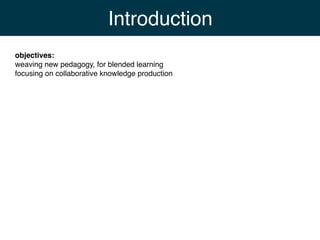
objectives:
weaving new pedagogy, for blended learning
focusing on collaborative knowledge production
Introduction
objectives:
weaving new pedagogy, for blended learning
focusing on collaborative knowledge production


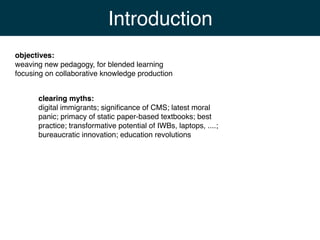
      clearing myths:
      digital immigrants; significance of CMS; latest moral
      panic; primacy of static paper-based textbooks; best
      practice; transformative potential of IWBs, laptops, ....;
      bureaucratic innovation; education revolutions
Introduction
objectives:
weaving new pedagogy, for blended learning
focusing on collaborative knowledge production


      clearing myths:
      digital immigrants; significance of CMS; latest moral
      panic; primacy of static paper-based textbooks; best
      practice; transformative potential of IWBs, laptops, ....;
      bureaucratic innovation; education revolutions


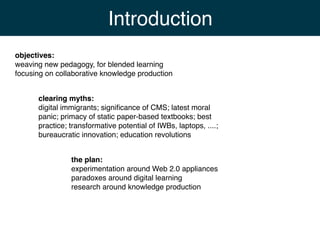
                the plan:
                experimentation around Web 2.0 appliances
                paradoxes around digital learning
                research around knowledge production
Weaving
                               curriculum resources
                       (Learning Federation, Wikipedia, etc...)


knowledge work
   appliances
 (word-processor,
Mindmeister, etc...)
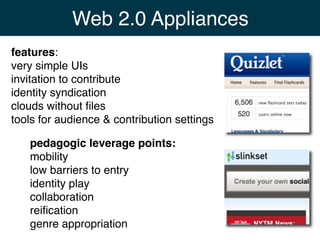
Web 2.0 Appliances
features:
very simple UIs
invitation to contribute
identity syndication
clouds without files
tools for audience & contribution settings

   pedagogic leverage points:
   mobility
   low barriers to entry
   identity play
   collaboration
   reification
   genre appropriation
Web 2.0 Laboratory

In groups:
• Experiment with Quizlet and slinkset
• Who could use them in class, and out of
 class? For what purposes?
• How might they promote learning?
• Come up with at least one speculative
 classroom application for each.
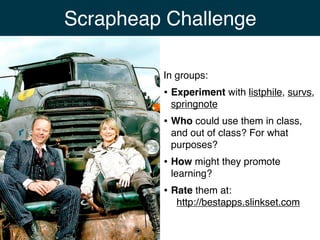
Scrapheap Challenge

         In groups:
         • Experiment with listphile, survs,
          springnote
         • Who could use them in class,
          and out of class? For what
          purposes?
         • How might they promote
          learning?
         • Rate them at:
            http://bestapps.slinkset.com
Paradoxes around digital learning
  late age of print ←→ a post-typographic society
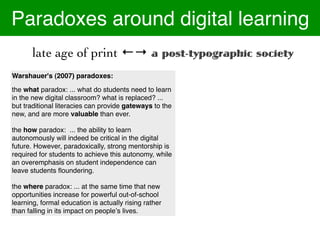
Paradoxes around digital learning
       late age of print ←→ a post-typographic society
Warshauer's (2007) paradoxes:

the what paradox: ... what do students need to learn
in the new digital classroom? what is replaced? ...
but traditional literacies can provide gateways to the
new, and are more valuable than ever.

the how paradox: ... the ability to learn
autonomously will indeed be critical in the digital
future. However, paradoxically, strong mentorship is
required for students to achieve this autonomy, while
an overemphasis on student independence can
leave students floundering.!

the where paradox: ... at the same time that new
opportunities increase for powerful out-of-school
learning, formal education is actually rising rather
than falling in its impact on peopleʼs lives.
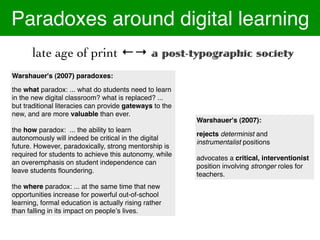
Paradoxes around digital learning
       late age of print ←→ a post-typographic society
Warshauer's (2007) paradoxes:

the what paradox: ... what do students need to learn
in the new digital classroom? what is replaced? ...
but traditional literacies can provide gateways to the
new, and are more valuable than ever.
                                                         Warshauer's (2007):
the how paradox: ... the ability to learn
                                                         rejects determinist and
autonomously will indeed be critical in the digital
                                                         instrumentalist positions
future. However, paradoxically, strong mentorship is
required for students to achieve this autonomy, while
                                                         advocates a critical, interventionist
an overemphasis on student independence can
                                                         position involving stronger roles for
leave students floundering.!
                                                         teachers.
the where paradox: ... at the same time that new
opportunities increase for powerful out-of-school
learning, formal education is actually rising rather
than falling in its impact on peopleʼs lives.
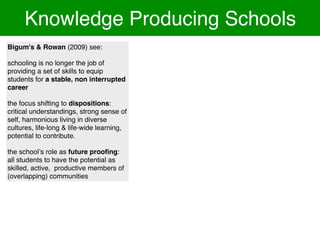
Knowledge Producing Schools
Bigum's & Rowan (2009) see:

schooling is no longer the job of
providing a set of skills to equip
students for a stable, non interrupted
career

the focus shifting to dispositions:
critical understandings, strong sense of
self, harmonious living in diverse
cultures, life-long & life-wide learning,
potential to contribute.

the schoolʼs role as future proofing:
all students to have the potential as
skilled, active, productive members of
(overlapping) communities
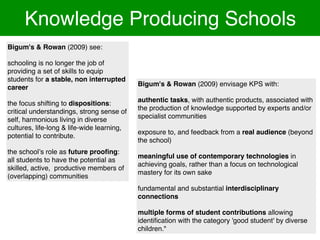
Knowledge Producing Schools
Bigum's & Rowan (2009) see:

schooling is no longer the job of
providing a set of skills to equip
students for a stable, non interrupted
                                            Bigum's & Rowan (2009) envisage KPS with:
career
                                            authentic tasks, with authentic products, associated with
the focus shifting to dispositions:
                                            the production of knowledge supported by experts and/or
critical understandings, strong sense of
                                            specialist communities
self, harmonious living in diverse
cultures, life-long & life-wide learning,
                                            exposure to, and feedback from a real audience (beyond
potential to contribute.
                                            the school)
the schoolʼs role as future proofing:
                                            meaningful use of contemporary technologies in
all students to have the potential as
                                            achieving goals, rather than a focus on technological
skilled, active, productive members of
                                            mastery for its own sake
(overlapping) communities
                                            fundamental and substantial interdisciplinary
                                            connections

                                            multiple forms of student contributions allowing
                                            identification with the category 'good student' by diverse
                                            children."
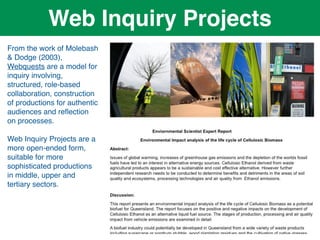
Web Inquiry Projects
From the work of Molebash
& Dodge (2003),
Webquests are a model for
inquiry involving,
structured, role-based
collaboration, construction
of productions for authentic
audiences and reflection
on processes.

Web Inquiry Projects are a
more open-ended form,
suitable for more
sophisticated productions
in middle, upper and
tertiary sectors.
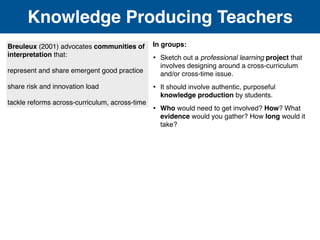
Knowledge Producing Teachers
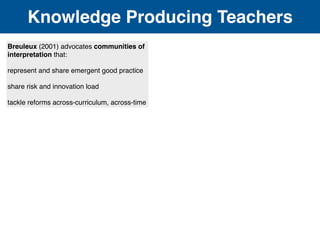
Breuleux (2001) advocates communities of
interpretation that:

represent and share emergent good practice

share risk and innovation load

tackle reforms across-curriculum, across-time
Knowledge Producing Teachers
Breuleux (2001) advocates communities of        In groups:
interpretation that:
                                                •   Sketch out a professional learning project that
                                                    involves designing around a cross-curriculum
represent and share emergent good practice          and/or cross-time issue.
share risk and innovation load                  •   It should involve authentic, purposeful
                                                    knowledge production by students.! !
tackle reforms across-curriculum, across-time
                                                •   Who would need to get involved? How? What
                                                    evidence would you gather? How long would it
                                                    take?
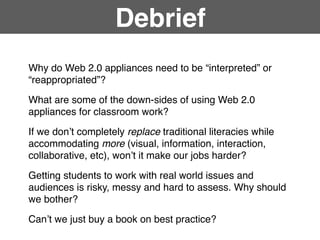
Debrief
Why do Web 2.0 appliances need to be “interpreted” or
“reappropriated”?

What are some of the down-sides of using Web 2.0
appliances for classroom work?

If we donʼt completely replace traditional literacies while
accommodating more (visual, information, interaction,
collaborative, etc), wonʼt it make our jobs harder?

Getting students to work with real world issues and
audiences is risky, messy and hard to assess. Why should
we bother?

Canʼt we just buy a book on best practice?
References
Allen, M. (2010). Using Web 2.0 in your teaching: ideas, applications and affordances for enhanced educational outcomes.
Retrieved April 22, 2010 from http://netcrit.net/content/2010handoutallenweb2presentation.pdf

Breuleux, A. (2001). Imagining the present, interpreting the possible, cultivating the future: Technology and the renewal of teaching
and learning. Education Canada, 41 (3). Retrieved April 22, 2010 from http://www.education.mcgill.ca/profs/breuleux/onlinepubs/
BreuleuxEdCanFall2001.html

de Brun Design (2007). listphile [Computer software]. Retrieved April 22, 2010 from http://www.listphile.com/

Education Services Australia (2010). The Learning Federation. Retrieved April 22, 2010 from
http://www.thelearningfederation.edu.au

Enough Pepper (2010). Survs [Computer software]. Retrieved April 22, 2010 from http://www.survs.com/

Feenberg, A. (1999). Questioning Technology. London: Routledge.

MeisterLabs (2010). Mindmeister [Computer software]. Retrieved April 22, 2010 from http://www.mindmeister.com/

Molebash, P. and Dodge, B. (2003). Kickstarting inquiry with Webquests and Web Inquiry Projects. Social Education, 67(3),
158-162.

Openmaru Studio (2010). Springnote [Computer software]. Retrieved April 22, 2010 from http://www.springnote.com/

Posterous.com (2010). Slinkset [Computer software]. Retrieved April 22, 2010 from http://slinkset.com/

Sutherland, A. (2010) Quizlet [Computer software]. Retrieved April 22, 2010 from http://quizlet.com/

Warschauer, M. (2007). The paradoxical future of digital learning. Learning Inquiry, 1(1), 41-49. Retrieved April 22, 2010 from http://
www.gse.uci.edu/person/warschauer_m/docs/paradox.pdf

Wikipedia Foundation (2010). Wikipedia. Retrieved April 22, 2010 from http://en.wikipedia.org

Researching ICLT 'Best' Practice

  • 1.
    Researching ICLT 'Best'Practice Opening activity Introduction Weaving Web 2.0 laboratory Scrapheap challenge Paradoxes around digital learning Knowledge producing schools Knowledge producing classes Knowledge producing teachers Debrief All Hallows' School Michael Ryan Faculty of Education, QUT April 23, 2010 m.ryan@qut.edu.au
  • 3.
    Mindmeister Activity In groups: •Who could use this in class, and out of class? For what purposes? • How might it promote learning? • Come up with at least one speculative classroom application.
  • 4.
    Mindmeister Wrap-up •! an appliance with low-barriers to entry but long scope •! reappropriation (Feenberg, 1999) •! informed opportunism •! sharing risks •! spill-over •! learning fractals •! reflection * •! collaboration *
  • 5.
  • 6.
    Introduction objectives: weaving new pedagogy,for blended learning focusing on collaborative knowledge production
  • 7.
    Introduction objectives: weaving new pedagogy,for blended learning focusing on collaborative knowledge production clearing myths: digital immigrants; significance of CMS; latest moral panic; primacy of static paper-based textbooks; best practice; transformative potential of IWBs, laptops, ....; bureaucratic innovation; education revolutions
  • 8.
    Introduction objectives: weaving new pedagogy,for blended learning focusing on collaborative knowledge production clearing myths: digital immigrants; significance of CMS; latest moral panic; primacy of static paper-based textbooks; best practice; transformative potential of IWBs, laptops, ....; bureaucratic innovation; education revolutions the plan: experimentation around Web 2.0 appliances paradoxes around digital learning research around knowledge production
  • 9.
    Weaving curriculum resources (Learning Federation, Wikipedia, etc...) knowledge work appliances (word-processor, Mindmeister, etc...)
  • 10.
    Web 2.0 Appliances features: verysimple UIs invitation to contribute identity syndication clouds without files tools for audience & contribution settings pedagogic leverage points: mobility low barriers to entry identity play collaboration reification genre appropriation
  • 11.
    Web 2.0 Laboratory Ingroups: • Experiment with Quizlet and slinkset • Who could use them in class, and out of class? For what purposes? • How might they promote learning? • Come up with at least one speculative classroom application for each.
  • 12.
    Scrapheap Challenge In groups: • Experiment with listphile, survs, springnote • Who could use them in class, and out of class? For what purposes? • How might they promote learning? • Rate them at: http://bestapps.slinkset.com
  • 13.
    Paradoxes around digitallearning late age of print ←→ a post-typographic society
  • 14.
    Paradoxes around digitallearning late age of print ←→ a post-typographic society Warshauer's (2007) paradoxes: the what paradox: ... what do students need to learn in the new digital classroom? what is replaced? ... but traditional literacies can provide gateways to the new, and are more valuable than ever. the how paradox: ... the ability to learn autonomously will indeed be critical in the digital future. However, paradoxically, strong mentorship is required for students to achieve this autonomy, while an overemphasis on student independence can leave students floundering.! the where paradox: ... at the same time that new opportunities increase for powerful out-of-school learning, formal education is actually rising rather than falling in its impact on peopleʼs lives.
  • 15.
    Paradoxes around digitallearning late age of print ←→ a post-typographic society Warshauer's (2007) paradoxes: the what paradox: ... what do students need to learn in the new digital classroom? what is replaced? ... but traditional literacies can provide gateways to the new, and are more valuable than ever. Warshauer's (2007): the how paradox: ... the ability to learn rejects determinist and autonomously will indeed be critical in the digital instrumentalist positions future. However, paradoxically, strong mentorship is required for students to achieve this autonomy, while advocates a critical, interventionist an overemphasis on student independence can position involving stronger roles for leave students floundering.! teachers. the where paradox: ... at the same time that new opportunities increase for powerful out-of-school learning, formal education is actually rising rather than falling in its impact on peopleʼs lives.
  • 16.
  • 17.
    Knowledge Producing Schools Bigum's& Rowan (2009) see: schooling is no longer the job of providing a set of skills to equip students for a stable, non interrupted career the focus shifting to dispositions: critical understandings, strong sense of self, harmonious living in diverse cultures, life-long & life-wide learning, potential to contribute. the schoolʼs role as future proofing: all students to have the potential as skilled, active, productive members of (overlapping) communities
  • 18.
    Knowledge Producing Schools Bigum's& Rowan (2009) see: schooling is no longer the job of providing a set of skills to equip students for a stable, non interrupted Bigum's & Rowan (2009) envisage KPS with: career authentic tasks, with authentic products, associated with the focus shifting to dispositions: the production of knowledge supported by experts and/or critical understandings, strong sense of specialist communities self, harmonious living in diverse cultures, life-long & life-wide learning, exposure to, and feedback from a real audience (beyond potential to contribute. the school) the schoolʼs role as future proofing: meaningful use of contemporary technologies in all students to have the potential as achieving goals, rather than a focus on technological skilled, active, productive members of mastery for its own sake (overlapping) communities fundamental and substantial interdisciplinary connections multiple forms of student contributions allowing identification with the category 'good student' by diverse children."
  • 19.
    Web Inquiry Projects Fromthe work of Molebash & Dodge (2003), Webquests are a model for inquiry involving, structured, role-based collaboration, construction of productions for authentic audiences and reflection on processes. Web Inquiry Projects are a more open-ended form, suitable for more sophisticated productions in middle, upper and tertiary sectors.
  • 24.
  • 25.
    Knowledge Producing Teachers Breuleux(2001) advocates communities of interpretation that: represent and share emergent good practice share risk and innovation load tackle reforms across-curriculum, across-time
  • 26.
    Knowledge Producing Teachers Breuleux(2001) advocates communities of In groups: interpretation that: • Sketch out a professional learning project that involves designing around a cross-curriculum represent and share emergent good practice and/or cross-time issue. share risk and innovation load • It should involve authentic, purposeful knowledge production by students.! ! tackle reforms across-curriculum, across-time • Who would need to get involved? How? What evidence would you gather? How long would it take?
  • 27.
    Debrief Why do Web2.0 appliances need to be “interpreted” or “reappropriated”? What are some of the down-sides of using Web 2.0 appliances for classroom work? If we donʼt completely replace traditional literacies while accommodating more (visual, information, interaction, collaborative, etc), wonʼt it make our jobs harder? Getting students to work with real world issues and audiences is risky, messy and hard to assess. Why should we bother? Canʼt we just buy a book on best practice?
  • 28.
    References Allen, M. (2010).Using Web 2.0 in your teaching: ideas, applications and affordances for enhanced educational outcomes. Retrieved April 22, 2010 from http://netcrit.net/content/2010handoutallenweb2presentation.pdf Breuleux, A. (2001). Imagining the present, interpreting the possible, cultivating the future: Technology and the renewal of teaching and learning. Education Canada, 41 (3). Retrieved April 22, 2010 from http://www.education.mcgill.ca/profs/breuleux/onlinepubs/ BreuleuxEdCanFall2001.html de Brun Design (2007). listphile [Computer software]. Retrieved April 22, 2010 from http://www.listphile.com/ Education Services Australia (2010). The Learning Federation. Retrieved April 22, 2010 from http://www.thelearningfederation.edu.au Enough Pepper (2010). Survs [Computer software]. Retrieved April 22, 2010 from http://www.survs.com/ Feenberg, A. (1999). Questioning Technology. London: Routledge. MeisterLabs (2010). Mindmeister [Computer software]. Retrieved April 22, 2010 from http://www.mindmeister.com/ Molebash, P. and Dodge, B. (2003). Kickstarting inquiry with Webquests and Web Inquiry Projects. Social Education, 67(3), 158-162. Openmaru Studio (2010). Springnote [Computer software]. Retrieved April 22, 2010 from http://www.springnote.com/ Posterous.com (2010). Slinkset [Computer software]. Retrieved April 22, 2010 from http://slinkset.com/ Sutherland, A. (2010) Quizlet [Computer software]. Retrieved April 22, 2010 from http://quizlet.com/ Warschauer, M. (2007). The paradoxical future of digital learning. Learning Inquiry, 1(1), 41-49. Retrieved April 22, 2010 from http:// www.gse.uci.edu/person/warschauer_m/docs/paradox.pdf Wikipedia Foundation (2010). Wikipedia. Retrieved April 22, 2010 from http://en.wikipedia.org