
1
OECD DAC Evaluation Standards
A knowledge sharing initiative for MEAL users
Maksud Hasan, MEAL Enthusiastic
WHAT IS OECD DAC EVALUATION STANDARDS
The OECD DAC Network on
Development Evaluation (EvalNet) has
defined six evaluation criteria and two
principles for their use
A knowledge sharing initiative for MEAL users
WHAT IS OECD DAC EVALUATION STANDARDS
These criteria provide a normative
framework used to determine the merit
of an intervention (policy, strategy,
program, project or activity).
They serve as the basis upon which
evaluative judgements are made.
A knowledge sharing initiative for MEAL users
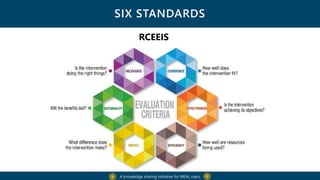
SIX STANDARDS
A knowledge sharing initiative for MEAL users
RCEEIS
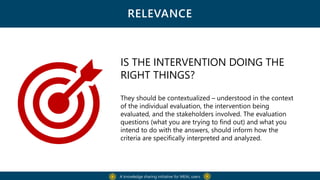
RELEVANCE
A knowledge sharing initiative for MEAL users
IS THE INTERVENTION DOING THE
RIGHT THINGS?
They should be contextualized – understood in the context
of the individual evaluation, the intervention being
evaluated, and the stakeholders involved. The evaluation
questions (what you are trying to find out) and what you
intend to do with the answers, should inform how the
criteria are specifically interpreted and analyzed.
COHERENCE
A knowledge sharing initiative for MEAL users
HOW WELL DOES THE
INTERVENTION FIT?
The compatibility of the intervention with other
interventions in a country, sector or institution.
EFFECTIVENESS
A knowledge sharing initiative for MEAL users
IS THE INTERVENTION ACHIEVING
ITS OBJECTIVES?
The extent to which the intervention achieved, or is expected
to achieve, its objectives, and its results, including any
differential results across groups.
EFFICIENCY
A knowledge sharing initiative for MEAL users
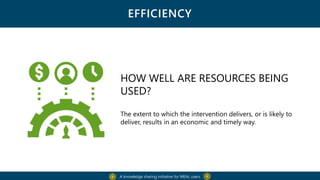
HOW WELL ARE RESOURCES BEING
USED?
The extent to which the intervention delivers, or is likely to
deliver, results in an economic and timely way.
IMPACT
A knowledge sharing initiative for MEAL users
WHAT DIFFERENCE DOES THE
INTERVENTION MAKE?
The extent to which the intervention has generated or is
expected to generate significant positive or negative,
intended or unintended, higher-level effects.
SUSTAINABILITY
A knowledge sharing initiative for MEAL users
WILL THE BENEFITS LAST?
The extent to which the net benefits of the intervention
continue or are likely to continue.
TWO PRINCIPLES
Principle One: The criteria should be
applied thoughtfully to support high
quality, useful evaluation.
They should be contextualized – understood in the context of the
individual evaluation, the intervention being evaluated, and the
stakeholders involved. The evaluation questions (what you are
trying to find out) and what you intend to do with the answers,
should inform how the criteria are specifically interpreted and
analyzed.
A knowledge sharing initiative for MEAL users
TWO PRINCIPLES
Principle Two: The use of the criteria
depends on the purpose of the
evaluation. The criteria should not be
applied mechanistically.
Instead, they should be covered according to the needs of the
relevant stakeholders and the context of the evaluation. More or
less time and resources may be devoted to the evaluative
analysis for each criterion depending on the evaluation purpose.
A knowledge sharing initiative for MEAL users
INFORMATION SOURCES
www.oecd.org
www.annmurraybrown.com
www.dx.doi.org
www.3ieimpact.org
www.collaboracion.dnp.gov.com
www.fao.org
www.publications.iadb.org
A knowledge sharing initiative for MEAL users
Maksud Hasan
MEAL Enthusiastic
WhatsApp: +880 1755 577 775
Email: maksudsoc@gmail.com
LinkedIn: www.linkedin.com/in/maksudsoc

OECD-DAC-Standards-Maksud-Hasan-monitoring-and-evaluation.pptx

  • 1.
    1 OECD DAC EvaluationStandards A knowledge sharing initiative for MEAL users Maksud Hasan, MEAL Enthusiastic
  • 2.
    WHAT IS OECDDAC EVALUATION STANDARDS The OECD DAC Network on Development Evaluation (EvalNet) has defined six evaluation criteria and two principles for their use A knowledge sharing initiative for MEAL users
  • 3.
    WHAT IS OECDDAC EVALUATION STANDARDS These criteria provide a normative framework used to determine the merit of an intervention (policy, strategy, program, project or activity). They serve as the basis upon which evaluative judgements are made. A knowledge sharing initiative for MEAL users
  • 4.
    SIX STANDARDS A knowledgesharing initiative for MEAL users RCEEIS
  • 5.
    RELEVANCE A knowledge sharinginitiative for MEAL users IS THE INTERVENTION DOING THE RIGHT THINGS? They should be contextualized – understood in the context of the individual evaluation, the intervention being evaluated, and the stakeholders involved. The evaluation questions (what you are trying to find out) and what you intend to do with the answers, should inform how the criteria are specifically interpreted and analyzed.
  • 6.
    COHERENCE A knowledge sharinginitiative for MEAL users HOW WELL DOES THE INTERVENTION FIT? The compatibility of the intervention with other interventions in a country, sector or institution.
  • 7.
    EFFECTIVENESS A knowledge sharinginitiative for MEAL users IS THE INTERVENTION ACHIEVING ITS OBJECTIVES? The extent to which the intervention achieved, or is expected to achieve, its objectives, and its results, including any differential results across groups.
  • 8.
    EFFICIENCY A knowledge sharinginitiative for MEAL users HOW WELL ARE RESOURCES BEING USED? The extent to which the intervention delivers, or is likely to deliver, results in an economic and timely way.
  • 9.
    IMPACT A knowledge sharinginitiative for MEAL users WHAT DIFFERENCE DOES THE INTERVENTION MAKE? The extent to which the intervention has generated or is expected to generate significant positive or negative, intended or unintended, higher-level effects.
  • 10.
    SUSTAINABILITY A knowledge sharinginitiative for MEAL users WILL THE BENEFITS LAST? The extent to which the net benefits of the intervention continue or are likely to continue.
  • 11.
    TWO PRINCIPLES Principle One:The criteria should be applied thoughtfully to support high quality, useful evaluation. They should be contextualized – understood in the context of the individual evaluation, the intervention being evaluated, and the stakeholders involved. The evaluation questions (what you are trying to find out) and what you intend to do with the answers, should inform how the criteria are specifically interpreted and analyzed. A knowledge sharing initiative for MEAL users
  • 12.
    TWO PRINCIPLES Principle Two:The use of the criteria depends on the purpose of the evaluation. The criteria should not be applied mechanistically. Instead, they should be covered according to the needs of the relevant stakeholders and the context of the evaluation. More or less time and resources may be devoted to the evaluative analysis for each criterion depending on the evaluation purpose. A knowledge sharing initiative for MEAL users
  • 13.
  • 14.
    Maksud Hasan MEAL Enthusiastic WhatsApp:+880 1755 577 775 Email: maksudsoc@gmail.com LinkedIn: www.linkedin.com/in/maksudsoc