INTRODUCTION TO
BUDGET IMPACT
ANALYSIS
Nazmi Liana Azmi, Pharmacist
1
Health Technology Assessment
Multidisciplinary process, summarizes information on:
• Safety
• Effectiveness
• Cost-effectiveness
•BIA
• Organizational impact / resource implications
• Social & ethical issues
2
• BUDGET is crucial for healthcare providers as
it allows an organization to better understand which
funds can be spent on a certain project or section, and
how much spending should be allotted to each
3
Money makes
the (medical) world go around
• P.S : It’s true 
4
Ref: Dr Asrul’s Presentation in BIA Workshop 2015 5
Budget impact analysis (BIA)
•An economic assessment that
estimates the financial
consequences of adopting a new
intervention
•Intervention = example new
technology or NEW DRUG
6
BIA
• Essential part of comprehensive economic
assessment, along with Cost Effective Analysis
• Tool to predict the financial impact of the adoption
and diffusion of a new technology into a healthcare
system with fixed resources
• To address feasibility / affordability
• Users: those who manage and plan healthcare budgets
7
Why need to do BIA?
• How new intervention impacts on health plan budget?
• Required to make an informed listing / reimbursement
decision:
 New technology may have increased acquisition cost
 New technology may add cost or offset its higher cost
due to changes in condition cost (e.g: adverse effects,
inpatients days)
 New technology may have different impact on different
cost centres e.g drug costs, laboratory costs, staff costs
8
Uses of BIA
• Budget planning
• Forecasting
• Estimating impact of health technology
changes on health insurance premiums
• Estimating (potential) fiscal impact of
pursuing an intervention at the national level
9
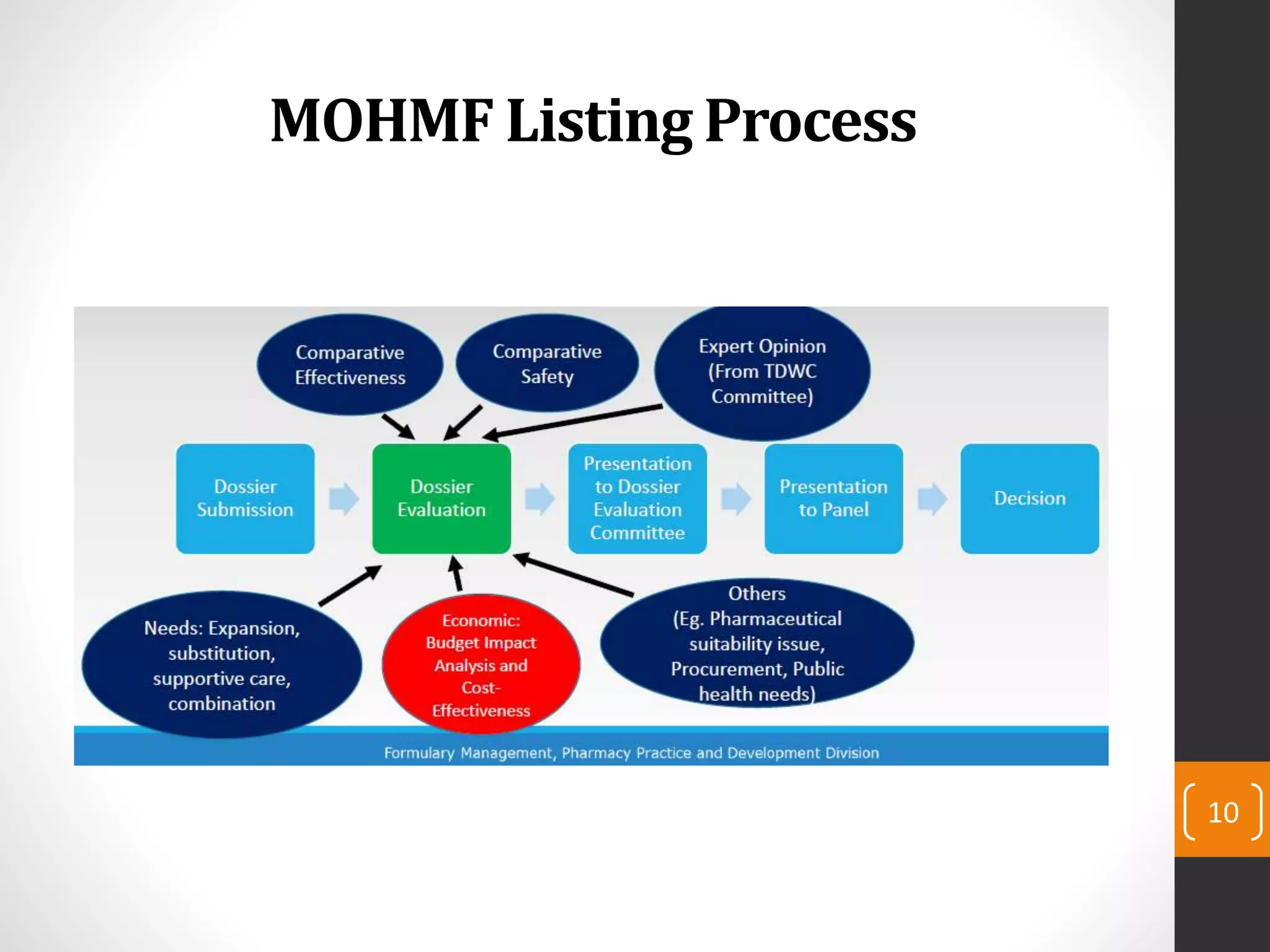
MOHMF Listing Process
10
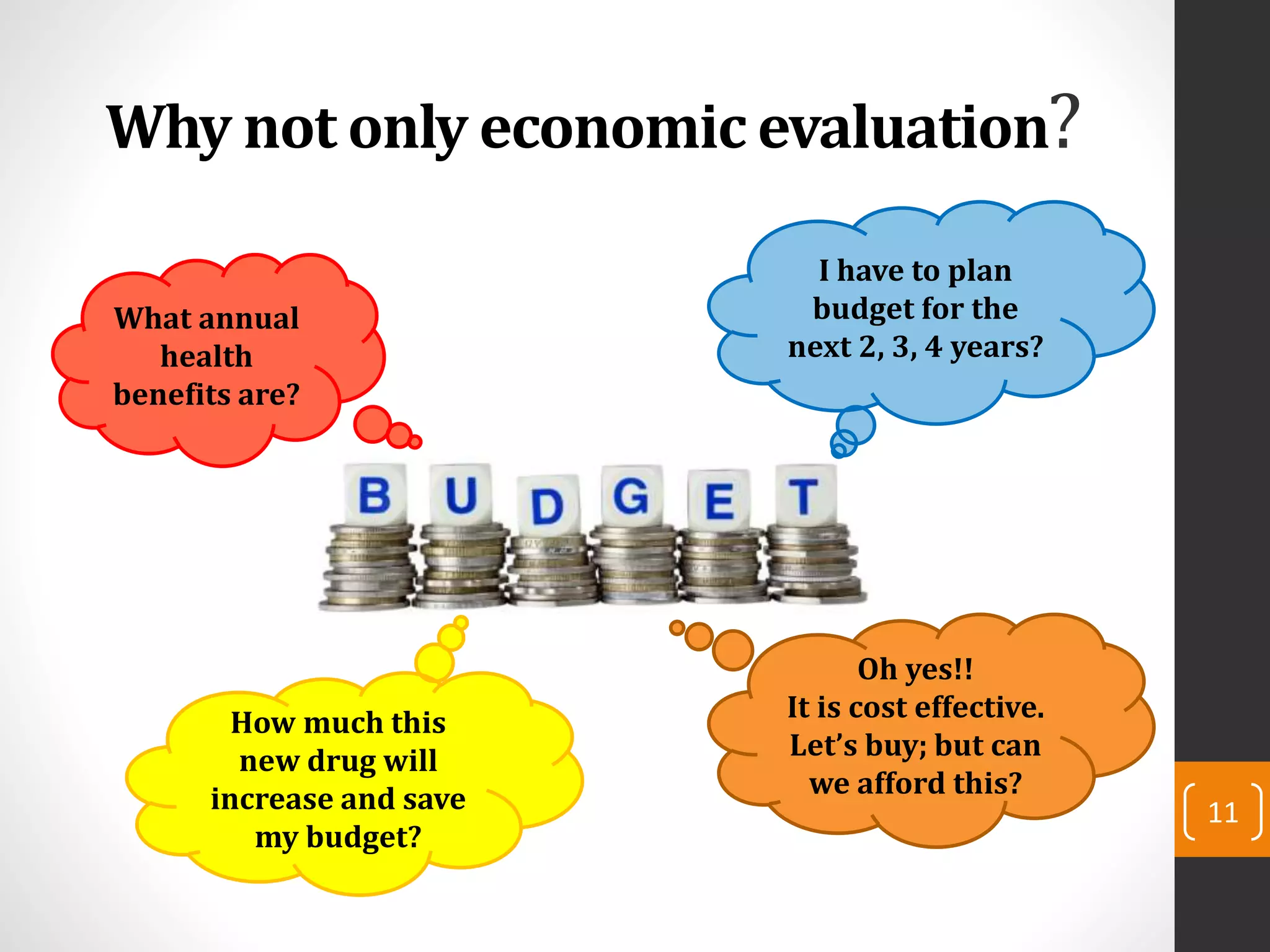
Why not only economic evaluation?
I have to plan
budget for the
next 2, 3, 4 years?
What annual
health
benefits are?
How much this
new drug will
increase and save
my budget?
Oh yes!!
It is cost effective.
Let’s buy; but can
we afford this?
11
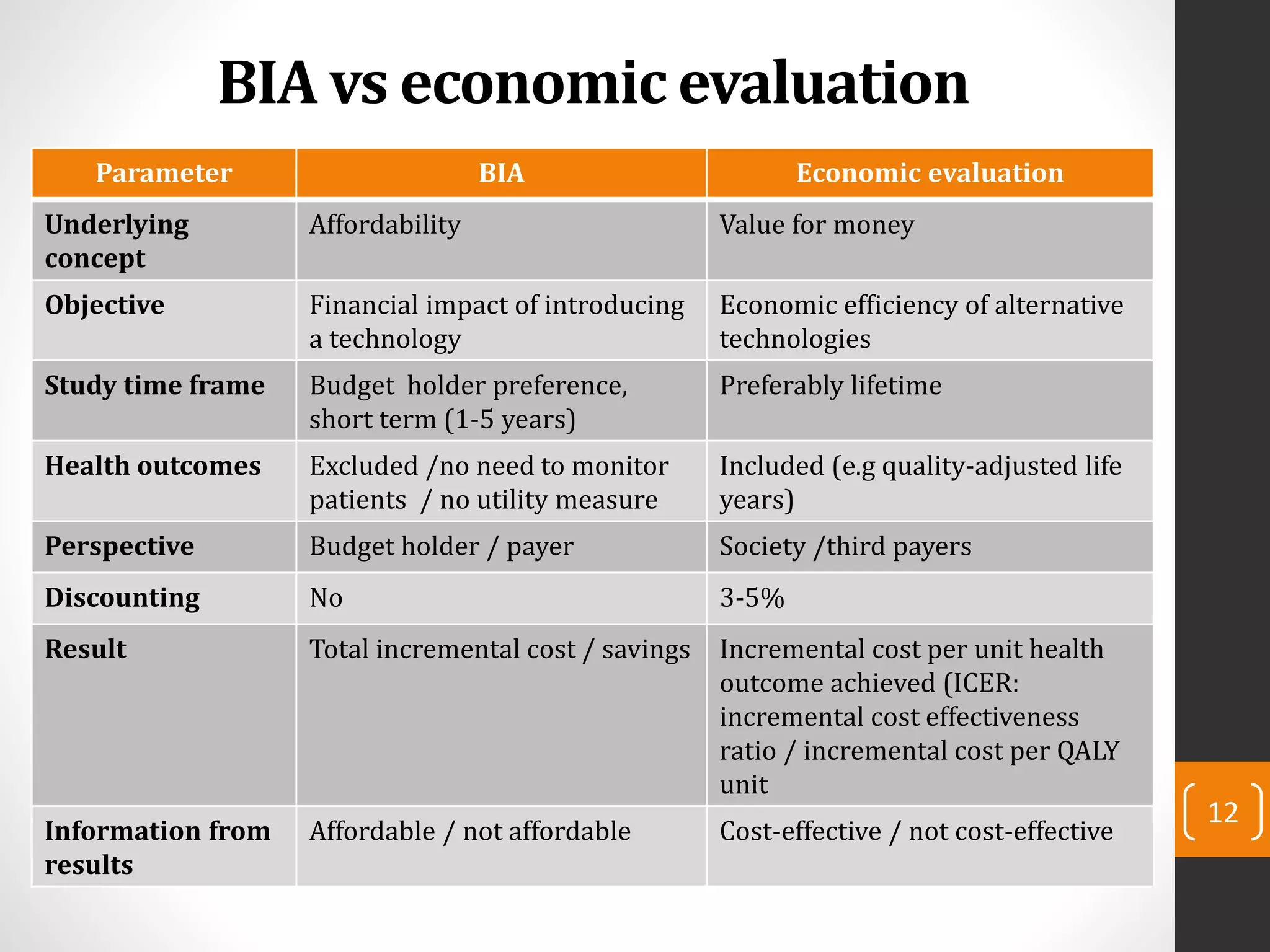
BIA vs economic evaluation
Parameter BIA Economic evaluation
Underlying
concept
Affordability Value for money
Objective Financial impact of introducing
a technology
Economic efficiency of alternative
technologies
Study time frame Budget holder preference,
short term (1-5 years)
Preferably lifetime
Health outcomes Excluded /no need to monitor
patients / no utility measure
Included (e.g quality-adjusted life
years)
Perspective Budget holder / payer Society /third payers
Discounting No 3-5%
Result Total incremental cost / savings Incremental cost per unit health
outcome achieved (ICER:
incremental cost effectiveness
ratio / incremental cost per QALY
unit
Information from
results
Affordable / not affordable Cost-effective / not cost-effective
12
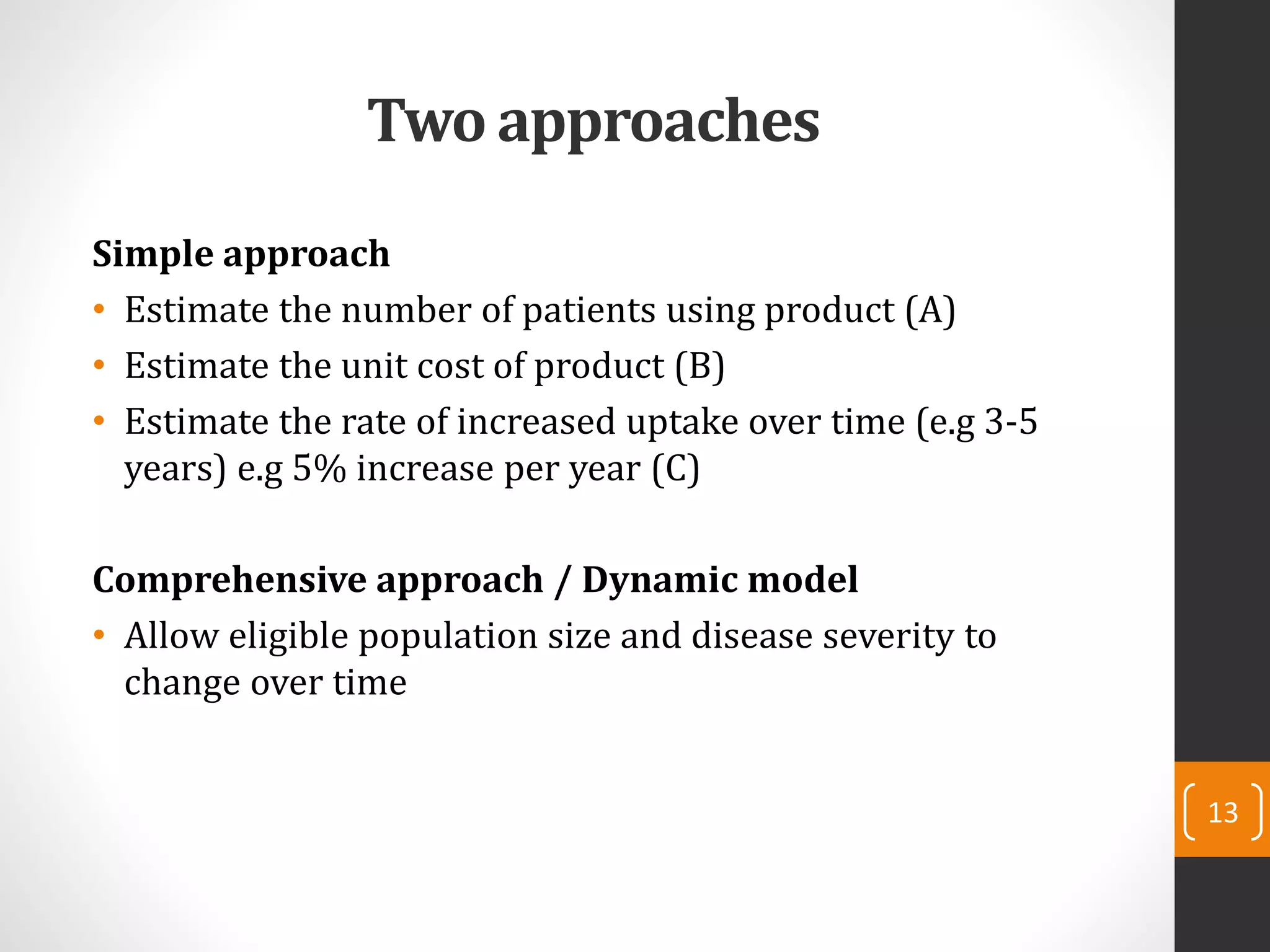
Two approaches
Simple approach
• Estimate the number of patients using product (A)
• Estimate the unit cost of product (B)
• Estimate the rate of increased uptake over time (e.g 3-5
years) e.g 5% increase per year (C)
Comprehensive approach / Dynamic model
• Allow eligible population size and disease severity to
change over time
13
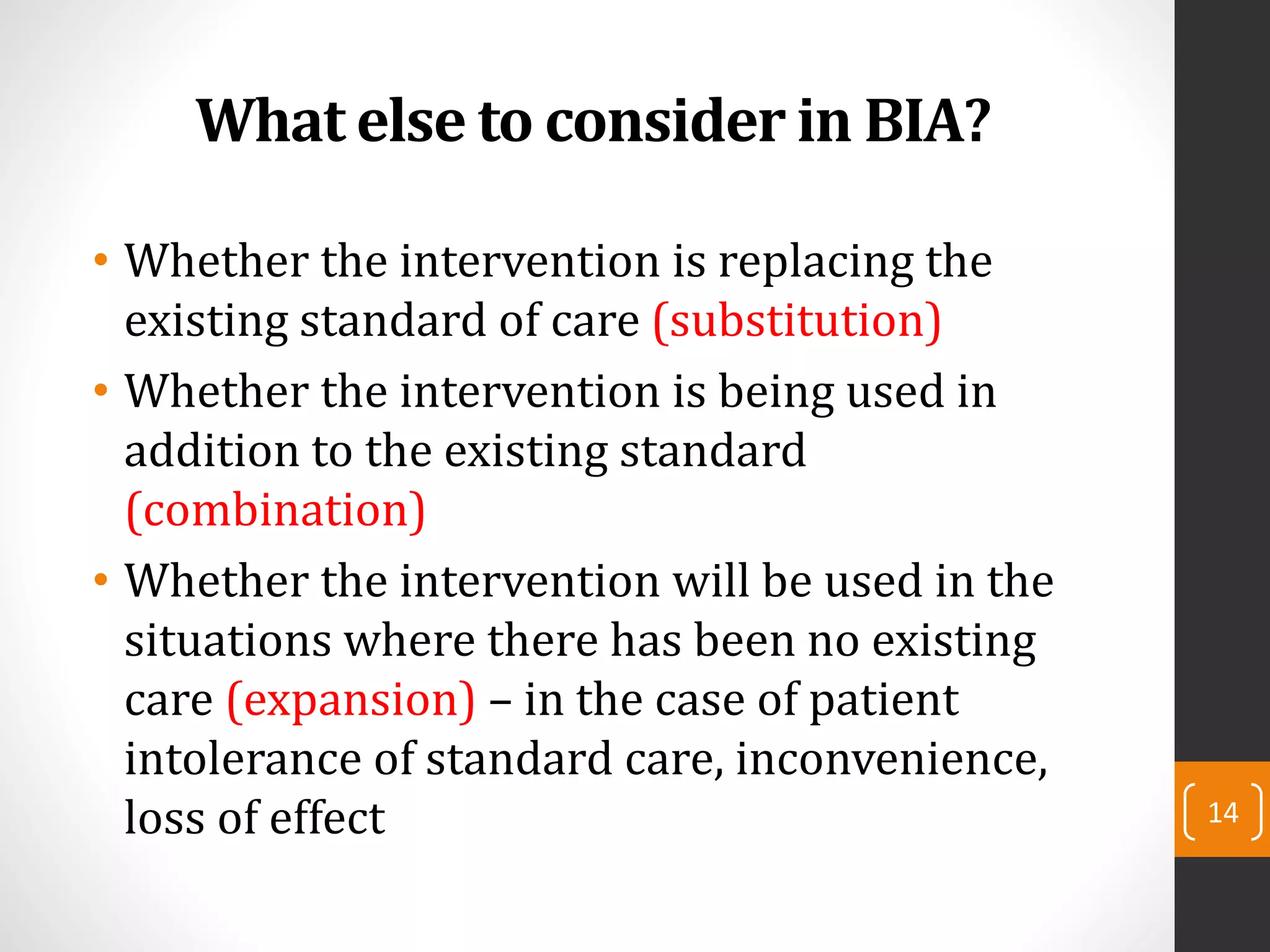
What else to consider in BIA?
• Whether the intervention is replacing the
existing standard of care (substitution)
• Whether the intervention is being used in
addition to the existing standard
(combination)
• Whether the intervention will be used in the
situations where there has been no existing
care (expansion) – in the case of patient
intolerance of standard care, inconvenience,
loss of effect 14
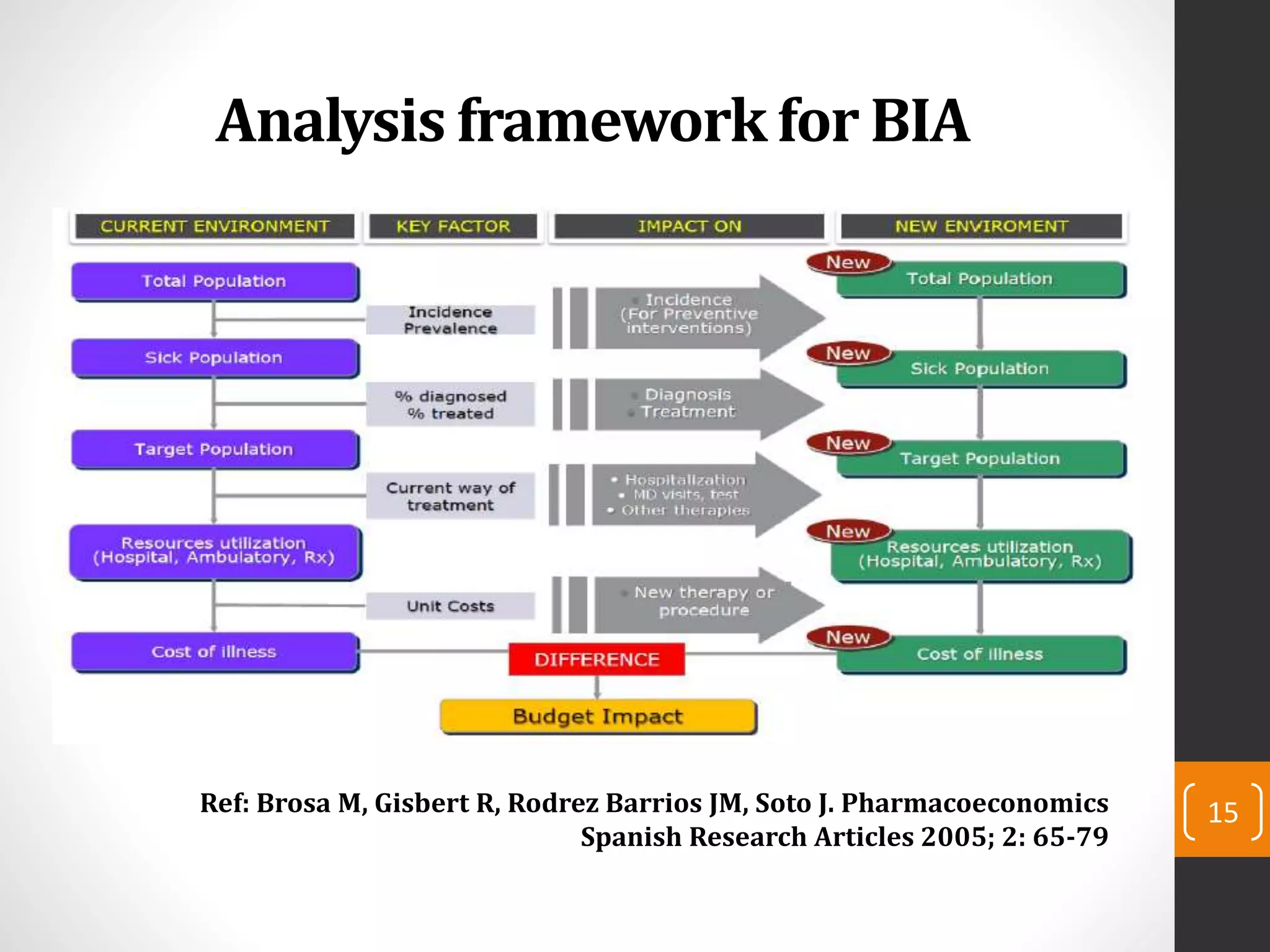
Analysis framework for BIA
Ref: Brosa M, Gisbert R, Rodrez Barrios JM, Soto J. Pharmacoeconomics
Spanish Research Articles 2005; 2: 65-79
15
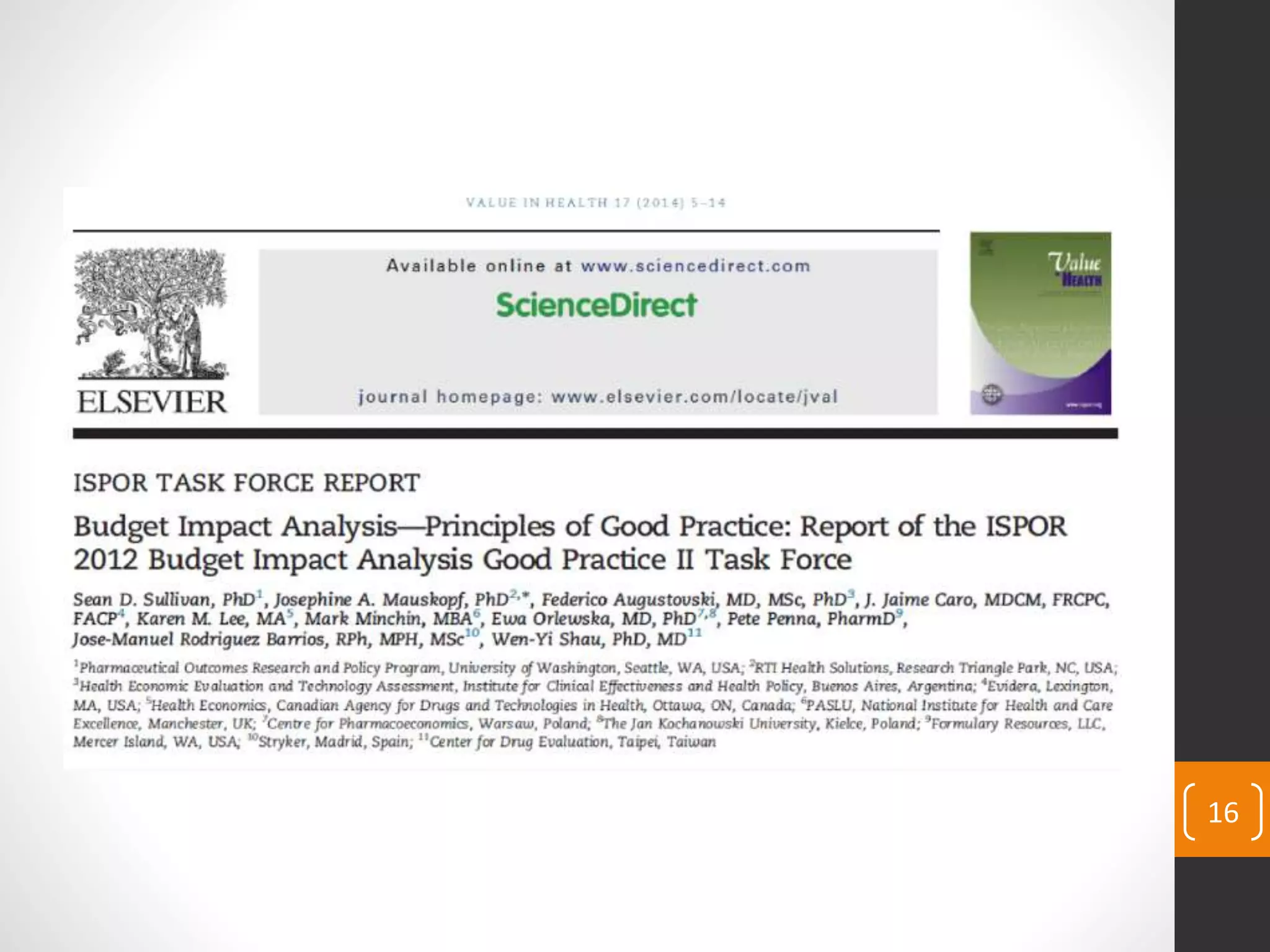
16
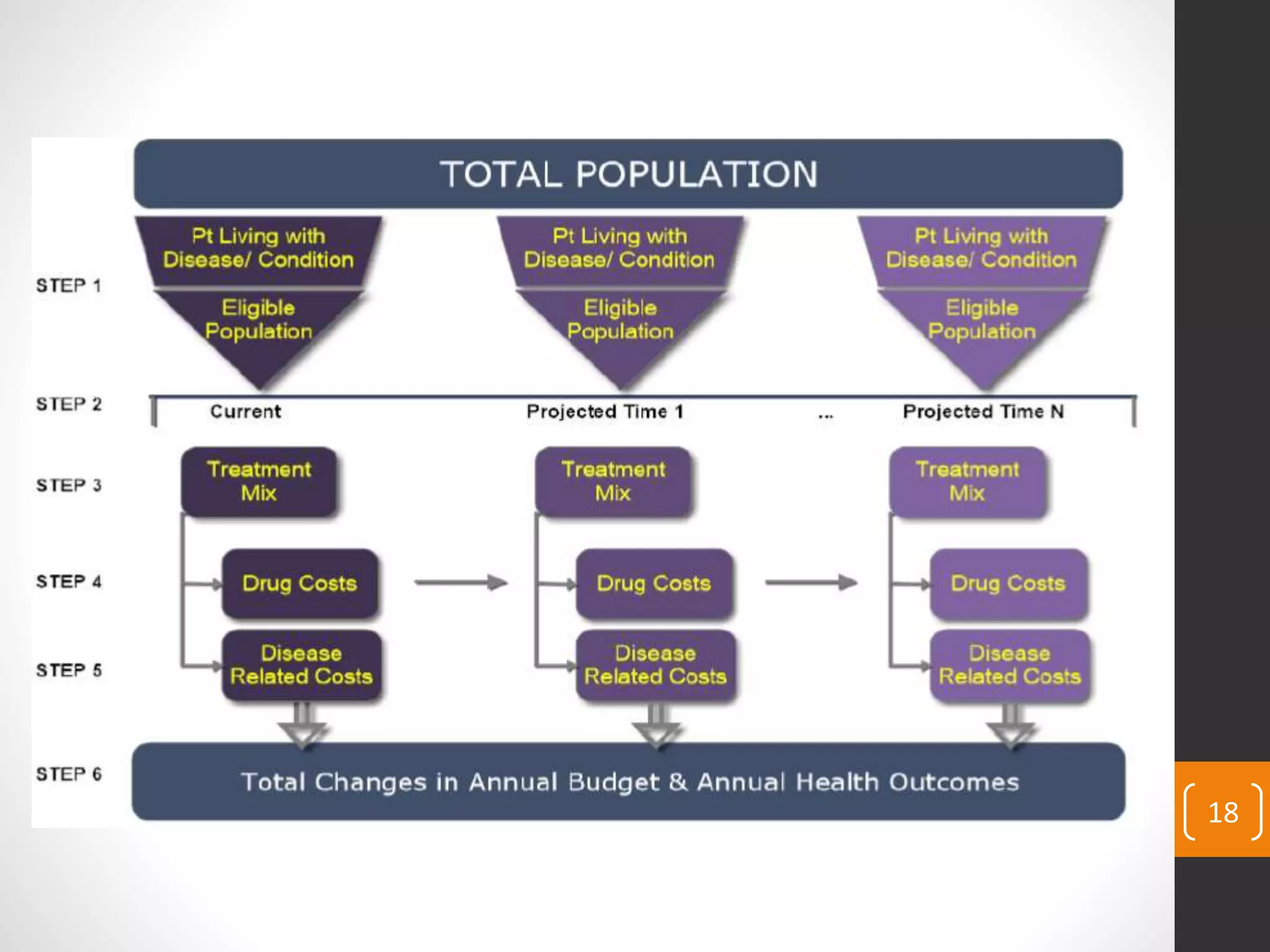
6 steps approach
in BIA
17
18
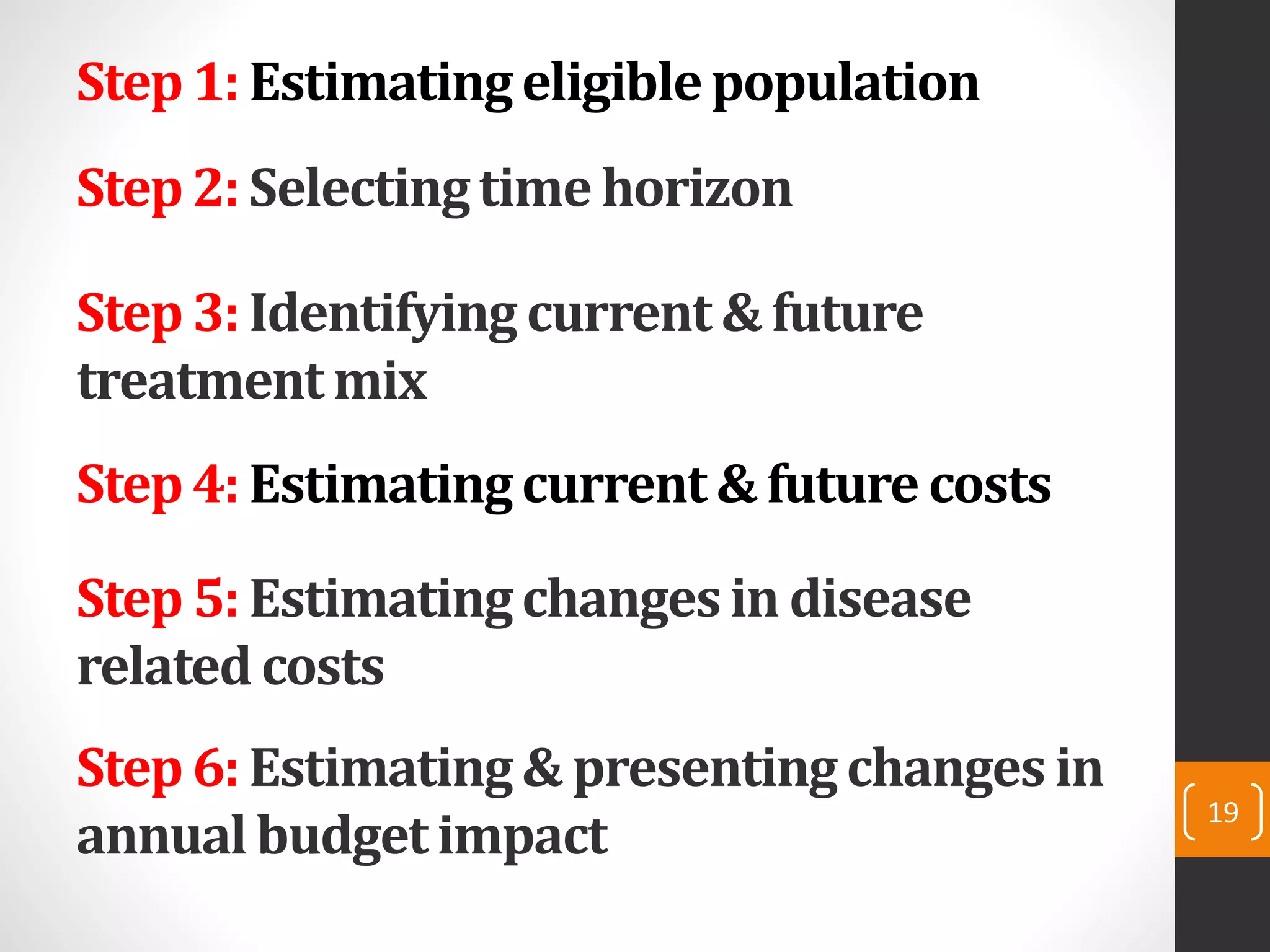
Step1: Estimatingeligiblepopulation
19
Step2: Selectingtime horizon
Step3: Identifying current & future
treatmentmix
Step4: Estimatingcurrent & future costs
Step5: Estimatingchangesin disease
relatedcosts
Step6: Estimating& presentingchanges in
annual budgetimpact
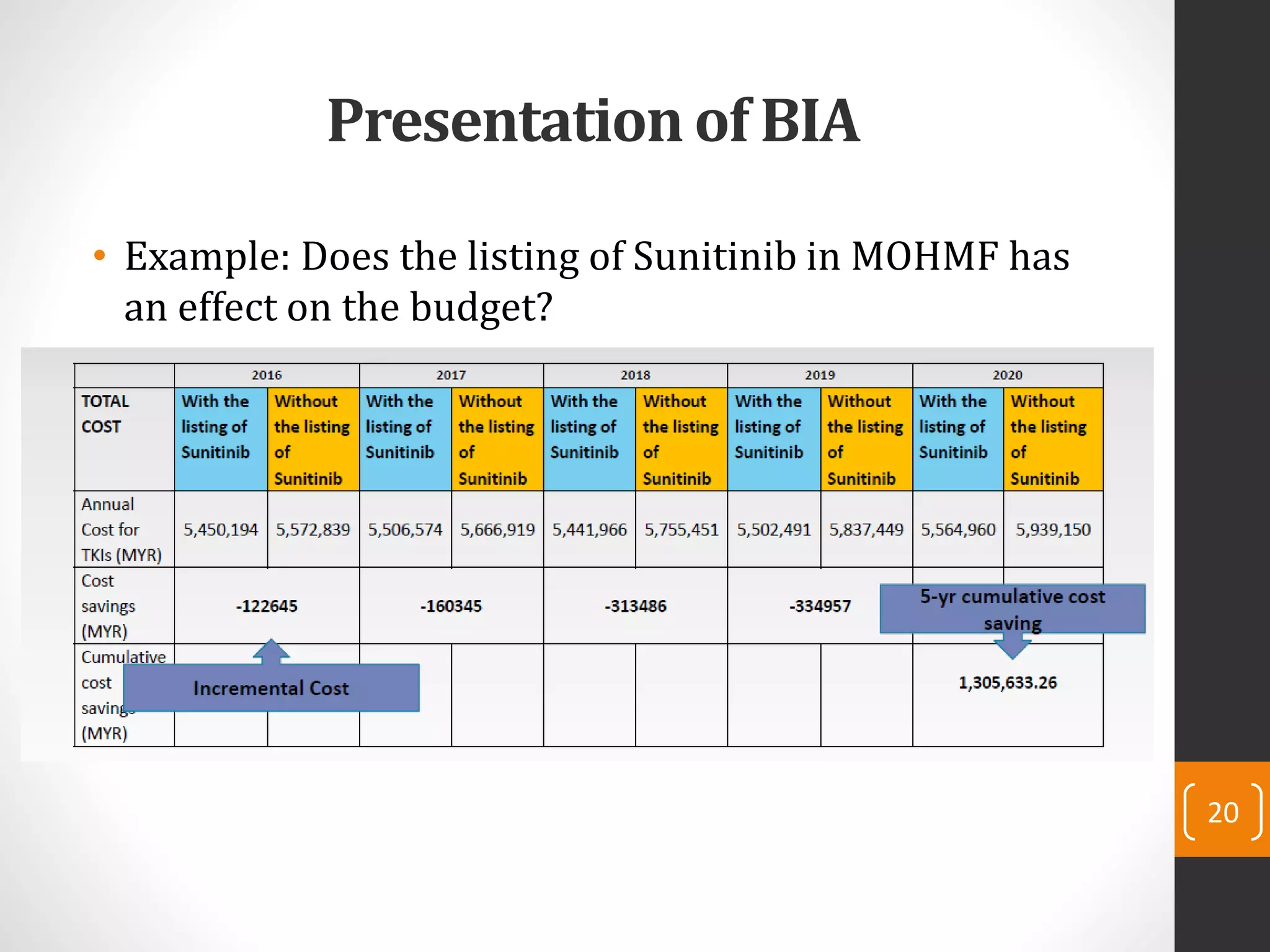
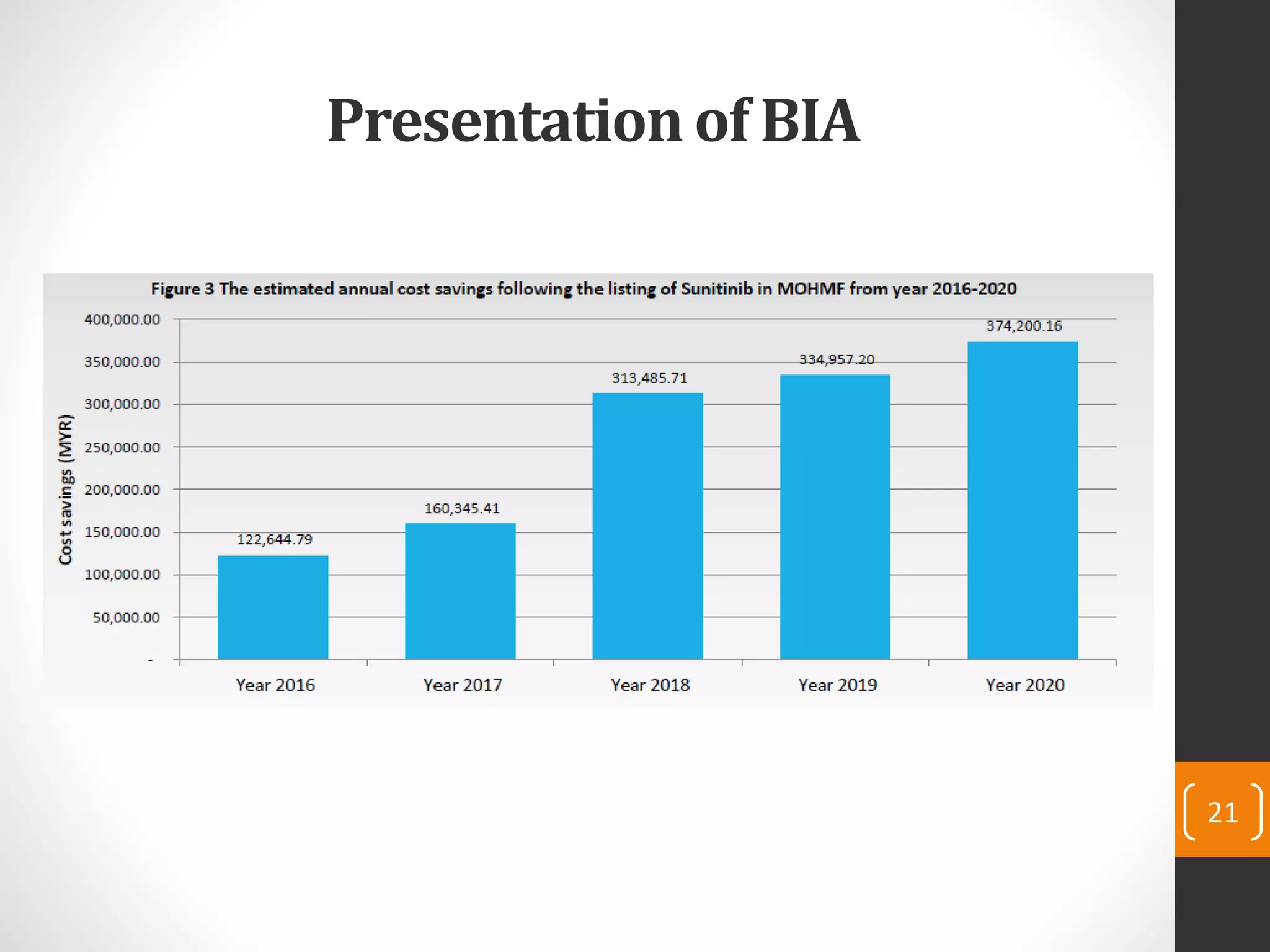
• Example: Does the listing of Sunitinib in MOHMF has
an effect on the budget?
20
Presentation of BIA
21
Presentation of BIA
Addressing uncertainty
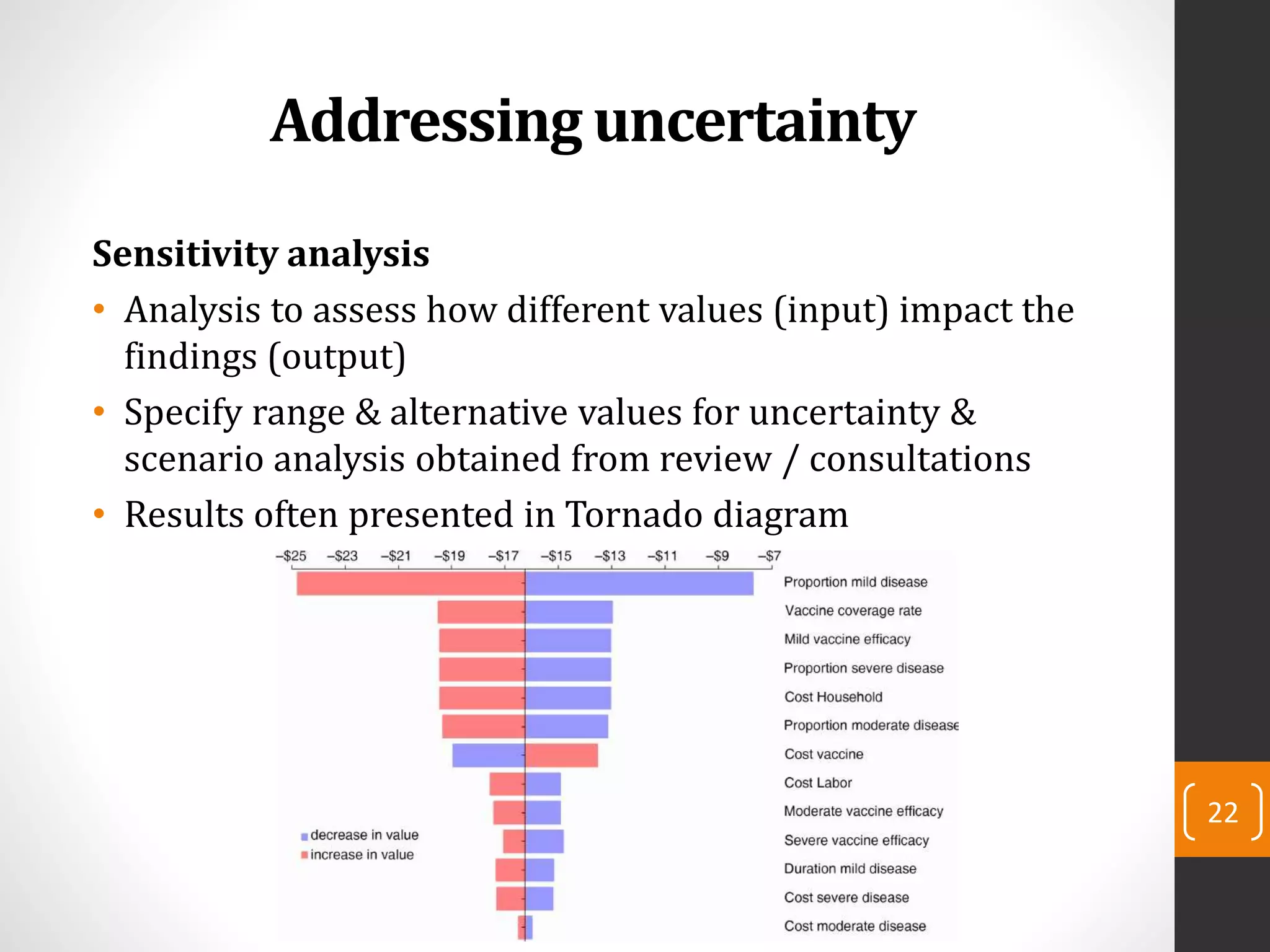
Sensitivity analysis
• Analysis to assess how different values (input) impact the
findings (output)
• Specify range & alternative values for uncertainty &
scenario analysis obtained from review / consultations
• Results often presented in Tornado diagram
22
Want to know more?
Do contact me  23

Introduction to budget impact analysis

  • 1.
  • 2.
    Health Technology Assessment Multidisciplinaryprocess, summarizes information on: • Safety • Effectiveness • Cost-effectiveness •BIA • Organizational impact / resource implications • Social & ethical issues 2
  • 3.
    • BUDGET iscrucial for healthcare providers as it allows an organization to better understand which funds can be spent on a certain project or section, and how much spending should be allotted to each 3
  • 4.
    Money makes the (medical)world go around • P.S : It’s true  4
  • 5.
    Ref: Dr Asrul’sPresentation in BIA Workshop 2015 5
  • 6.
    Budget impact analysis(BIA) •An economic assessment that estimates the financial consequences of adopting a new intervention •Intervention = example new technology or NEW DRUG 6
  • 7.
    BIA • Essential partof comprehensive economic assessment, along with Cost Effective Analysis • Tool to predict the financial impact of the adoption and diffusion of a new technology into a healthcare system with fixed resources • To address feasibility / affordability • Users: those who manage and plan healthcare budgets 7
  • 8.
    Why need todo BIA? • How new intervention impacts on health plan budget? • Required to make an informed listing / reimbursement decision:  New technology may have increased acquisition cost  New technology may add cost or offset its higher cost due to changes in condition cost (e.g: adverse effects, inpatients days)  New technology may have different impact on different cost centres e.g drug costs, laboratory costs, staff costs 8
  • 9.
    Uses of BIA •Budget planning • Forecasting • Estimating impact of health technology changes on health insurance premiums • Estimating (potential) fiscal impact of pursuing an intervention at the national level 9
  • 10.
  • 11.
    Why not onlyeconomic evaluation? I have to plan budget for the next 2, 3, 4 years? What annual health benefits are? How much this new drug will increase and save my budget? Oh yes!! It is cost effective. Let’s buy; but can we afford this? 11
  • 12.
    BIA vs economicevaluation Parameter BIA Economic evaluation Underlying concept Affordability Value for money Objective Financial impact of introducing a technology Economic efficiency of alternative technologies Study time frame Budget holder preference, short term (1-5 years) Preferably lifetime Health outcomes Excluded /no need to monitor patients / no utility measure Included (e.g quality-adjusted life years) Perspective Budget holder / payer Society /third payers Discounting No 3-5% Result Total incremental cost / savings Incremental cost per unit health outcome achieved (ICER: incremental cost effectiveness ratio / incremental cost per QALY unit Information from results Affordable / not affordable Cost-effective / not cost-effective 12
  • 13.
    Two approaches Simple approach •Estimate the number of patients using product (A) • Estimate the unit cost of product (B) • Estimate the rate of increased uptake over time (e.g 3-5 years) e.g 5% increase per year (C) Comprehensive approach / Dynamic model • Allow eligible population size and disease severity to change over time 13
  • 14.
    What else toconsider in BIA? • Whether the intervention is replacing the existing standard of care (substitution) • Whether the intervention is being used in addition to the existing standard (combination) • Whether the intervention will be used in the situations where there has been no existing care (expansion) – in the case of patient intolerance of standard care, inconvenience, loss of effect 14
  • 15.
    Analysis framework forBIA Ref: Brosa M, Gisbert R, Rodrez Barrios JM, Soto J. Pharmacoeconomics Spanish Research Articles 2005; 2: 65-79 15
  • 16.
  • 17.
  • 18.
  • 19.
    Step1: Estimatingeligiblepopulation 19 Step2: Selectingtimehorizon Step3: Identifying current & future treatmentmix Step4: Estimatingcurrent & future costs Step5: Estimatingchangesin disease relatedcosts Step6: Estimating& presentingchanges in annual budgetimpact
  • 20.
    • Example: Doesthe listing of Sunitinib in MOHMF has an effect on the budget? 20 Presentation of BIA
  • 21.
  • 22.
    Addressing uncertainty Sensitivity analysis •Analysis to assess how different values (input) impact the findings (output) • Specify range & alternative values for uncertainty & scenario analysis obtained from review / consultations • Results often presented in Tornado diagram 22
  • 23.
    Want to knowmore? Do contact me  23