CGIAR and IFAD - Sharing and
 Scaling up Innovations?
Presented by Thomas Randolph (ILRI), Peter Ballantyne (ILRI),
Nicole Lefore (IWMI), Barbara Rischkowsky (ICARDA) at the
IFAD ESA Regional Workshop, Addis Ababa, 15 November
2012
Overview


• Introductions and Process
• Research, CGIAR and IFAD – current
  collaboration experience ...
• Research for development in the new CGIAR
• CGIAR Research Programs
• CGIAR and IFAD – future opportunities?
CGIAR and IFAD today

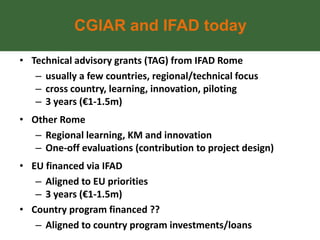
• Technical advisory grants (TAG) from IFAD Rome
   – usually a few countries, regional/technical focus
   – cross country, learning, innovation, piloting
   – 3 years (€1-1.5m)
• Other Rome
   – Regional learning, KM and innovation
   – One-off evaluations (contribution to project design)
• EU financed via IFAD
   – Aligned to EU priorities
   – 3 years (€1-1.5m)
• Country program financed ??
   – Aligned to country program investments/loans
CGIAR and IFAD today

• Experience to date
  – Repeated expression of intent to link research to loan
    portfolio
  – Research to address loan project needs
  – Technical Advisory Notes (TANs) – scale out technical
    results
  – Drawing on specific CGIAR expertise (consultancy mode)

• Frustrating!
• Can we make the partnership more
  meaningful?
CGIAR- IFAD examples

• Improving Livelihoods of Small Farmers and Rural Women
  through Value-Added Processing and Export of Cashmere, Wool
  and Mohair (ICARDA)
• Enhancing dairy-based livelihoods in India and Tanzania through
  feed value chain improvement (ILRI)
• Improved management of agricultural water in Eastern and
  Southern Africa (IMWI)
• Small ruminant value chains to reduce poverty and increase
  food security in drylands of India and Mozambique (EU -ILRI)
• Catalysing the emerging smallholder pig value chains in Uganda
  to increase rural incomes and assets (EU- ILRI)
• Conservation agriculture for smallholder farmers in Eastern and
  Southern Africa (EU –CIMMYT)
Discussion: You and research!


• What positives do you have working with
  research, especially the CGIAR?
   – Any concrete examples

• What negatives do you have working with
  research, especially the CGIAR?
   • Any concrete examples
New CGIAR

• CGIAR Reform process
  – Efficiency in resource mobilization and
    implementation
  – Relevance and impact
• Loose association of Centres and donors 
  Consortium and CG Fund
• Diffused, uncoordinated research decided by
  individual Centres and donors  Problem
  focused, integrated CGIAR Research Programs
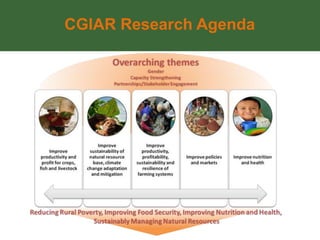
CGIAR Research Agenda
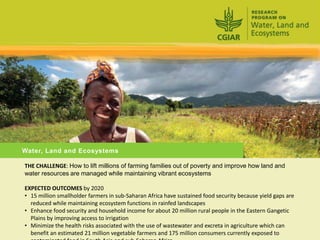
Water, Land and Ecosystems

THE CHALLENGE: How to lift millions of farming families out of poverty and improve how land and
water resources are managed while maintaining vibrant ecosystems

EXPECTED OUTCOMES by 2020
• 15 million smallholder farmers in sub-Saharan Africa have sustained food security because yield gaps are
  reduced while maintaining ecosystem functions in rainfed landscapes
• Enhance food security and household income for about 20 million rural people in the Eastern Gangetic
  Plains by improving access to irrigation
• Minimize the health risks associated with the use of wastewater and excreta in agriculture which can
  benefit an estimated 21 million vegetable farmers and 175 million consumers currently exposed to
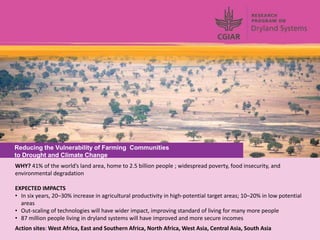
Reducing the Vulnerability of Farming Communities
to Drought and Climate Change
WHY? 41% of the world’s land area, home to 2.5 billion people ; widespread poverty, food insecurity, and
environmental degradation

EXPECTED IMPACTS
• In six years, 20–30% increase in agricultural productivity in high-potential target areas; 10–20% in low potential
  areas
• Out-scaling of technologies will have wider impact, improving standard of living for many more people
• 87 million people living in dryland systems will have improved and more secure incomes
Action sites: West Africa, East and Southern Africa, North Africa, West Asia, Central Asia, South Asia
Dryland Systems
Targeted region-specific outcomes
• West Africa: Increased plant and livestock productivity, and rural
  livelihoods through improved nutrient availability and water-use efficiency
  reducing lean periods and risk of system shocks.
• East and Southern Africa: Increased productivity, income, and resilience
  among pastoralists through better crop-livestock integration and more
  efficient use of soil, water and other natural resources.
• North Africa and West Asia: Improved technology transfer to farmers and
  agro-pastoralists for better food, feed, health practices, and animal breeds
  using better policies, market access, financial tools, and extension
  systems.
• Central Asia: Improvements in mixed agricultural systems to improve
  productivity, human nutrition and rural employment, through integrated
  water and land resources management.
• South Asia: Increased biomass production to provide food, feed, and
  reverse land degradation, reducing household vulnerability to price and
  climate shocks.
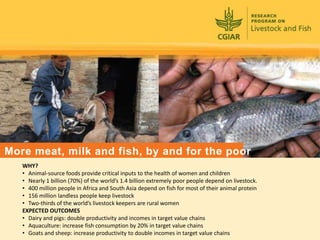
More meat, milk and fish, by and for the poor
   WHY?
   • Animal-source foods provide critical inputs to the health of women and children
   • Nearly 1 billion (70%) of the world’s 1.4 billion extremely poor people depend on livestock.
   • 400 million people in Africa and South Asia depend on fish for most of their animal protein
   • 156 million landless people keep livestock
   • Two-thirds of the world’s livestock keepers are rural women
   EXPECTED OUTCOMES
   • Dairy and pigs: double productivity and incomes in target value chains
   • Aquaculture: increase fish consumption by 20% in target value chains
   • Goats and sheep: increase productivity to double incomes in target value chains
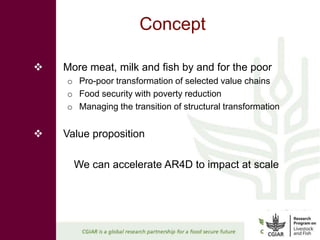
Concept

   More meat, milk and fish by and for the poor
    o Pro-poor transformation of selected value chains
    o Food security with poverty reduction
    o Managing the transition of structural transformation


   Value proposition

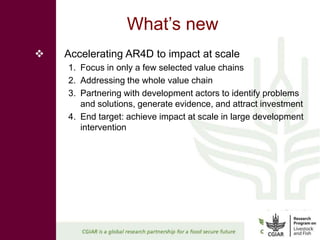
      We can accelerate AR4D to impact at scale
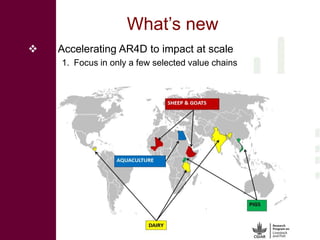
What’s new
   Accelerating AR4D to impact at scale
    1. Focus in only a few selected value chains
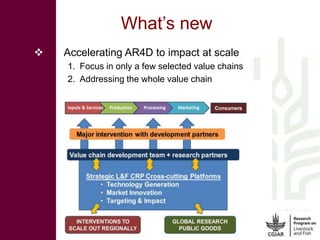
What’s new
   Accelerating AR4D to impact at scale
    1. Focus in only a few selected value chains
    2. Addressing the whole value chain
What’s new
   Accelerating AR4D to impact at scale
    1. Focus in only a few selected value chains
    2. Addressing the whole value chain
    3. Partnering with development actors to identify problems
       and solutions, generate evidence, and attract investment
    4. End target: achieve impact at scale in large development
       intervention
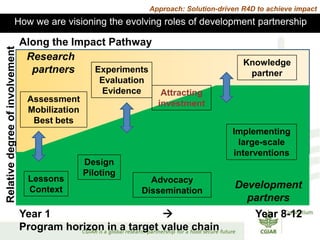
Approach: Solution-driven R4D to achieve impact
                        How we are visioning the evolving roles of development partnership

                                 Along the Impact Pathway
Relative degree of involvement


                                  Research
                                                                                            Knowledge
                                   partners    Experiments                                   partner
                                                     Evaluation
                                                     Evidence        Attracting
                                  Assessment                        investment
                                  Mobilization
                                   Best bets
                                                                                         Implementing
                                                                                          large-scale
                                                                                         interventions
                                                 Design
                                                 Piloting
                                  Lessons                       Advocacy
                                  Context                     Dissemination
                                                                                         Development
                                                                                           partners
                                 Year 1                                                       Year 8-12
                                 Program horizon in a target value chain
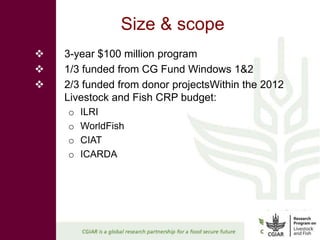
Size & scope
   3-year $100 million program
   1/3 funded from CG Fund Windows 1&2
   2/3 funded from donor projectsWithin the 2012
    Livestock and Fish CRP budget:
    o   ILRI
    o   WorldFish
    o   CIAT
    o   ICARDA
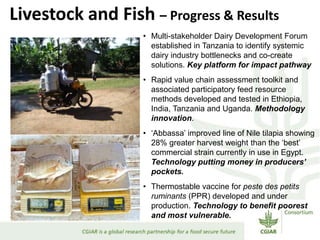
Livestock and Fish – Progress & Results
                   • Multi-stakeholder Dairy Development Forum
                     established in Tanzania to identify systemic
                     dairy industry bottlenecks and co-create
                     solutions. Key platform for impact pathway
                   • Rapid value chain assessment toolkit and
                     associated participatory feed resource
                     methods developed and tested in Ethiopia,
                     India, Tanzania and Uganda. Methodology
                     innovation.
                   • ‘Abbassa’ improved line of Nile tilapia showing
                     28% greater harvest weight than the ‘best’
                     commercial strain currently in use in Egypt.
                     Technology putting money in producers’
                     pockets.
                   • Thermostable vaccine for peste des petits
                     ruminants (PPR) developed and under
                     production. Technology to benefit poorest
                     and most vulnerable.
How do we partner better?

• Establish a more systematic role of the CGIAR as IFAD’s
  knowledge partner: win-win for both!
• Harvest better lessons from IFAD loan project to scale out
   – CG can help identify, track, test, and validate innovations in projects
   – Use the CG to help capture the learnings from projects: what works,
     what doesn’t, and why?
   – CG can contribute to knowledge and learning networks (country,
     thematic, regional)
How do we partner better?

• Feed research results into IFAD loan projects to scale out
   – Involve CG partners in the planning of investment programs to make
     full use of technology and institutional innovations from CG and
     partners
   – CG can carry out cross country learning reviews and assessments of
     key opportunities/issues
   – Establish capacity to continuously review emerging CG research results
     into ongoing IFAD projects
   – Use CG to provide capacity, training, mentoring support and training
     materials/guides to IFAD and its partners
   – For bigger problems, target CGIAR TAG/research projects more
     strategically with country projects in implementation
   – Together, develop an evidence-based policy agenda to foster an
     enabling national environment for uptake of our innovations
Discussion

• Any direct feedback on what you heard on the three CRPs?

• What specific products or opportunities do you look for from
  research, especially the CGIAR?

   – Country-specific?

   – Across-countries?
t.randolph@cgiar.org
    n.lefore@cgiar.org
b.rischkowsky@cgiar.org