OCEAN THERMAL ENERGY
CONVERSION
CONVERSION
Presented by,
Presented by,
NAVANEETHA KRISHNAN .R
SABARIGIRISH.G
SABARIGIRISH.G
SAI LAVANYA.S
SAI LAVANYA.S
OCEAN THERMAL ENERGY
CONVERSION
CONVERSION
Presented by,
Presented by,
NAVANEETHA KRISHNAN .R
SABARIGIRISH.G
SABARIGIRISH.G
SAI LAVANYA.S
SAI LAVANYA.S
What is OTEC?
• Manifestation of solar energy
• Top layers of ocean receive solar heating
• Bottom layers receive water from polar regions
• Natural temperature gradient
• Use in Thermodynamic cycle – Generate electricity
INVENTION
INVENTION
1.
1. Georges Claude who actually built
Georges Claude who actually built
The first OTEC plant, in Cuba in 1930.
The system generated 22 kW of
electricity with a low-pressure
turbine.
turbine.
2.
2. 1970 the Tokyo Electric Power
1970 the Tokyo Electric Power
Company successfully built and
deployed a 100 kW closed-cycle OTEC
plant on the island of Nauru.
PRINCIPLE
PRINCIPLE
• OTEC utilizes the temperature-
OTEC utilizes the temperature-
difference existing between warm
surface
surface sea
sea water of around
water of around 27
27°
° C
C to
to
29
29°
° C and the cold deep sea water of
C and the cold deep sea water of
around
around 5
5 ° C
° C to
to 7
7°
° C,
C, which is available
which is available
at a depth of 800m to-l000 m.
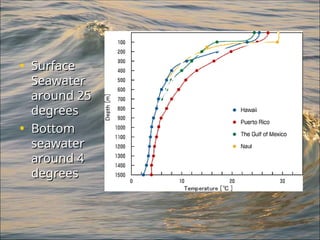
• Surface
Surface
Seawater
Seawater
around 25
around 25
degrees
degrees
• Bottom
Bottom
seawater
seawater
around 4
around 4
degrees
degrees
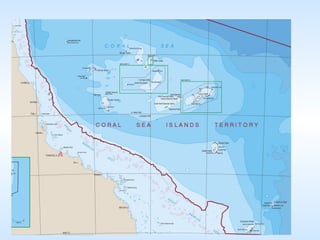
Coral Sea
PLANT LOCATION
PLANT LOCATION
1.
1. Land based
Land based - Favoured locations : narrow shelves
- Favoured locations : narrow shelves
(volcanic islands), steep (15-20 deg) offshore
slopes, and relatively smooth sea floors.
2.
2. Shelf mounted
Shelf mounted - OTEC plants can be mounted to
- OTEC plants can be mounted to
the continental shelf at depths up to 100 meters. A
shelf-mounted plant could be built in a shipyard,
towed to the site, and fixed to the sea bottom.
3.
3. Off shore
Off shore floating
floating plants
plants
Depending on the cycle used
• Open cycle
Open cycle
• Closed cycle
Closed cycle
• Hybrid cycle
Hybrid cycle
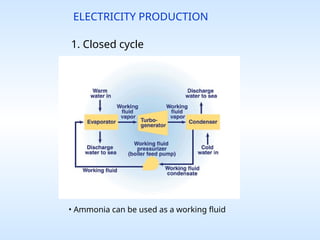
ELECTRICITY PRODUCTION
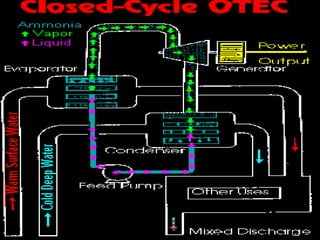
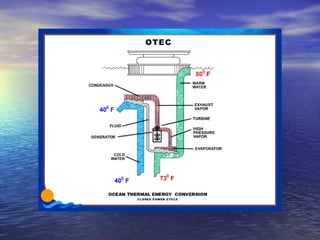
1. Closed cycle
• Ammonia can be used as a working fluid
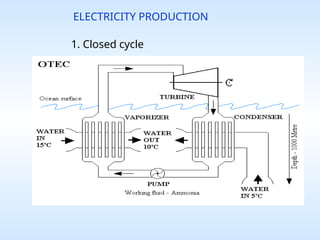
ELECTRICITY PRODUCTION
1. Closed cycle
• In 1979, the Natural Energy Laboratory
In 1979, the Natural Energy Laboratory
and several private-sector partners
developed the mini OTEC experiment,
which achieved the first successful at-
sea production of net electrical power
from closed-cycle OTEC.
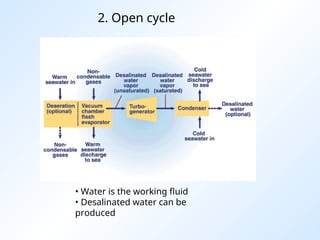
2. Open cycle
• Water is the working fluid
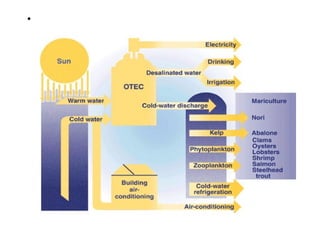
• Desalinated water can be
produced
Open cycle
Open cycle
• This method has the advantage of
This method has the advantage of
producing desalinized fresh water,
suitable for drinking water or irrigation.
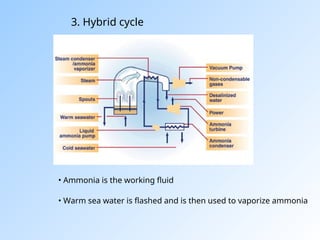
3. Hybrid cycle
• Ammonia is the working fluid
• Warm sea water is flashed and is then used to vaporize ammonia
Classification
Classification
OTEC systems can be classified as two
types based on the thermodynamic
cycle
cycle
• (1) Closed cycle and
(1) Closed cycle and
• (2) Open cycle.
(2) Open cycle.
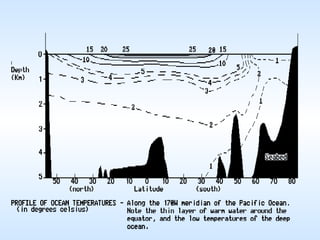
Variation of ocean
Variation of ocean
temperature with depth
• The total insolation received by the
The total insolation received by the
oceans = (5.457 × 10
oceans = (5.457 × 10¹⁸
18
MJ/yr) × 0.7 = 1.9
MJ/yr) × 0.7 = 1.9
× 10
× 1018
18
MJ/yr.
MJ/yr.
(taking an average clearness index of 0.5)
Only 15% of this energy is retained as
thermal energy.
thermal energy.
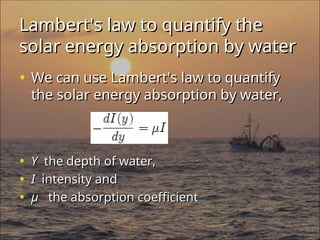
Lambert's law to quantify the
solar energy absorption by water
• We can use Lambert's law to quantify
We can use Lambert's law to quantify
the solar energy absorption by water,
• Y
Y the depth of water,
the depth of water,
• I
I intensity and
intensity and
• μ
μ the absorption coefficient
the absorption coefficient
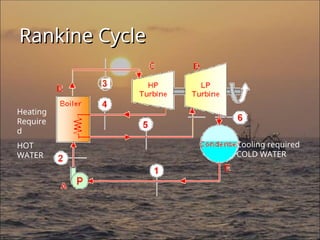
Rankine Cycle
Rankine Cycle
Cooling required
COLD WATER
Heating
Require
d
HOT
WATER
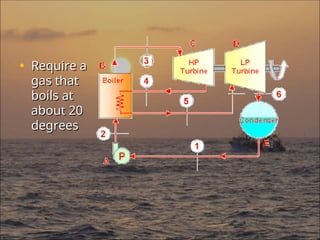
• Require a
Require a
gas that
gas that
boils at
boils at
about 20
about 20
degrees
degrees
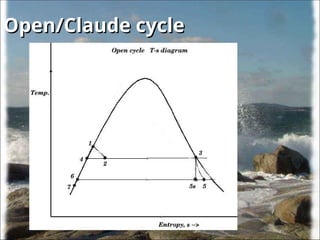
Open/Claude cycle
Open/Claude cycle
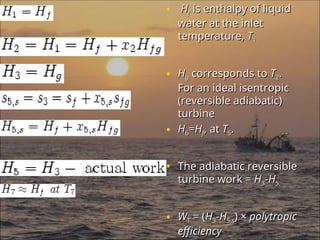
• H
Hf
f is enthalpy of liquid
is enthalpy of liquid
water at the inlet
water at the inlet
temperature,
temperature, T
T1
1
• H
Hg
g corresponds to
corresponds to T
T2
2.
.
For an ideal isentropic
(reversible adiabatic)
turbine
turbine
• H
H6
6=
=H
Hf
f, at
, at T
T5
5.
.
• The adiabatic reversible
The adiabatic reversible
turbine work =
turbine work = H
H3
3-
-H
H5,
5,
• W
WT
T = (
= (H
H3
3-
-H
H5,
5,s
s) ×
) × polytropic
polytropic
efficiency
efficiency
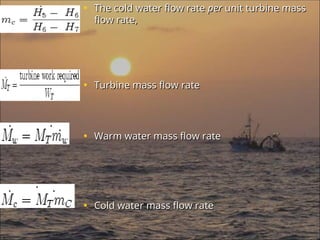
• The cold water flow rate
The cold water flow rate per
per unit turbine mass
unit turbine mass
flow rate,
flow rate,
• Turbine mass flow rate
Turbine mass flow rate
• Warm water mass flow rate
Warm water mass flow rate
• Cold water mass flow rate
Cold water mass flow rate
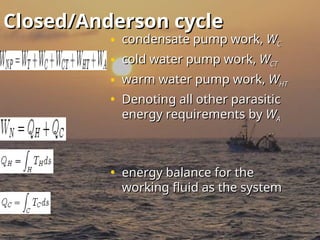
Closed/Anderson cycle
• condensate pump work,
condensate pump work, W
WC
C
• cold water pump work,
cold water pump work, W
WCT
CT
• warm water pump work,
warm water pump work, W
WHT
HT
• Denoting all other parasitic
Denoting all other parasitic
energy requirements by
energy requirements by W
WA
A
• energy balance for the
energy balance for the
working fluid as the system
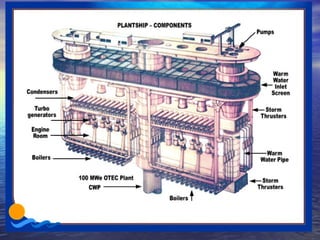
MAIN COMPONENTS OF AN OTEC SYSTEM
• Evaporators
Evaporators
• Condensers
Condensers
• Cold-water pipe
Cold-water pipe
• Turbines
Turbines
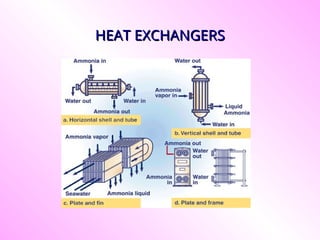
HEAT EXCHANGERS
HEAT EXCHANGERS
• Shell and tube design can be enhanced by using fluted tubes:
Shell and tube design can be enhanced by using fluted tubes:
the working fluid flows into the grooves and over the crests,
producing a thin film that evaporates more effectively
• In an advanced plate-and-fin design, working fluid and seawater
In an advanced plate-and-fin design, working fluid and seawater
flow through alternating parallel plates; fins between the plates
enhance the heat transfer
• Original material chosen – Titanium - Expensive, so alternative
Original material chosen – Titanium - Expensive, so alternative
material – Aluminium.
Selected Aluminium alloys may last 20 years in seawater.
TURBINES
TURBINES
• Characterized by low pressure ratios and high mass flow of
Characterized by low pressure ratios and high mass flow of
working fluids.
working fluids.
• The turbine is to be designed to have a good isentropic
The turbine is to be designed to have a good isentropic
expansion efficiency over a considerable range of pressure
ratio
ratio
For a 1 MW OTEC plant, a 4-stage axial flow reaction turbine
coupled to a synchronous generator through 2 : 1 speed
reduction gear box is chosen.
For a considerable range of pressure ratios the turbine
efficiency remains above
efficiency remains above 0.85
0.85.
.
For 100 MW – low speed 200 rpm unit around 45 m in dia.
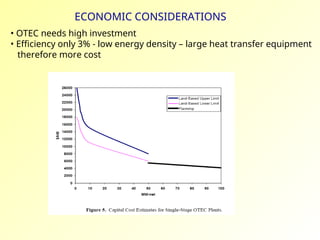
ECONOMIC CONSIDERATIONS
• OTEC needs high investment
• Efficiency only 3% - low energy density – large heat transfer equipment
therefore more cost
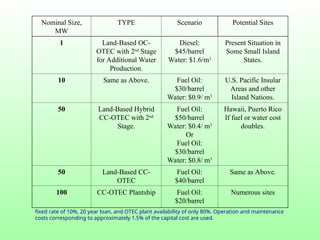
Nominal Size,
MW
TYPE Scenario Potential Sites
1 Land-Based OC-
OTEC with 2nd
Stage
for Additional Water
Production.
Diesel:
$45/barrel
Water: $1.6/m3
Present Situation in
Some Small Island
States.
10 Same as Above. Fuel Oil:
$30/barrel
Water: $0.9/ m3
U.S. Pacific Insular
Areas and other
Island Nations.
50 Land-Based Hybrid
CC-OTEC with 2nd
Stage.
Fuel Oil:
$50/barrel
Water: $0.4/ m3
Or
Fuel Oil:
$30/barrel
Water: $0.8/ m3
Hawaii, Puerto Rico
If fuel or water cost
doubles.
50 Land-Based CC-
OTEC
Fuel Oil:
$40/barrel
Same as Above.
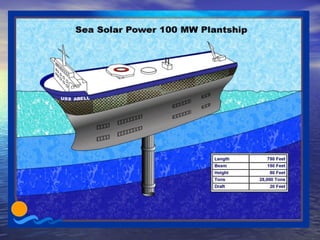
100 CC-OTEC Plantship Fuel Oil:
$20/barrel
Numerous sites
fixed rate of 10%, 20 year loan, and OTEC plant availability of only 80%. Operation and maintenance
costs corresponding to approximately 1.5% of the capital cost are used.
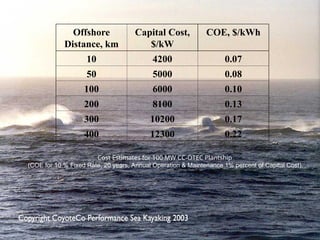
Offshore
Distance, km
Capital Cost,
$/kW
COE, $/kWh
10 4200 0.07
50 5000 0.08
100 6000 0.10
200 8100 0.13
300 10200 0.17
400 12300 0.22
Cost Estimates for 100 MW CC-OTEC Plantship
(COE for 10 % Fixed Rate, 20 years, Annual Operation & Maintenance 1% percent of Capital Cost).
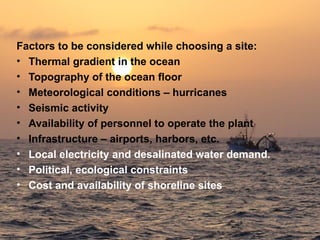
Factors to be considered while choosing a site:
• Thermal gradient in the ocean
• Topography of the ocean floor
• Meteorological conditions – hurricanes
• Seismic activity
• Availability of personnel to operate the plant
• Infrastructure – airports, harbors, etc.
• Local electricity and desalinated water demand.
• Political, ecological constraints
• Cost and availability of shoreline sites
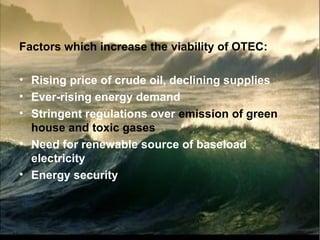
Factors which increase the viability of OTEC:
• Rising price of crude oil, declining supplies
• Ever-rising energy demand
• Stringent regulations over emission of green
house and toxic gases
• Need for renewable source of baseload
electricity
• Energy security
POTENTIAL
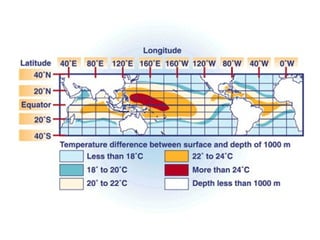
• Equatorial, tropical and sub-tropical regions i.e.
20 °N to 20 °S, have favorable temperature profile
• Total estimated potential – 577000 MW
• 99 nations and territories have access to the
OTEC thermal resource:
Americas—Mainland - 15
Americas—Island - 23
Africa—Mainland - 18
Africa—Island - 5
Indian/Pacific Ocean—Mainland - 11
Indian/Pacific Ocean—Island - 27
Countries with access to deep ocean water within 10Km of
shore and favorable business climate:
• Americas—Mainland - 1, Mexico
• Americas—Island - 12
• Africa—Mainland - 1, Tanzania
• Africa—Island - 1, Madagascar
• Indian/Pacific Ocean—Mainland - 1, India
• Indian/Pacific Ocean—Island – 13
OTEC has a high potential especially in small island nations
Potential in SIDS
• Islands have a large EEZ (SL’s EEZ = 27*area)
• Favorable temperature gradient
• SIDS have to import fuels and energy
• OTEC provides cheaper energy and energy
security
• OTEC promotes agriculture – food self-sufficiency
• Fresh water at cheaper cost
• Provides transportation fuels
• Refrigeration, air-conditioning
• Full use of the benefits of OTEC  lower COE
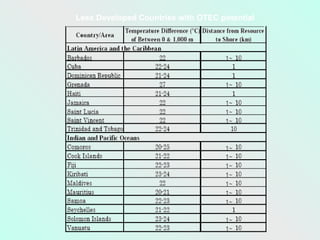
Less Developed Countries with OTEC potential
Potential in India
• Estimated overall potential – 180000 MW
• 2.56 million sq.km EEZ
• Ongoing projects: The 1 MW barge research
and demonstration facility being developed by the
National Institute of Ocean Technology, India
(NIOT) with technical support from Institute of
Ocean Energy, Saga University (IOES)
• Identified sites:
– Kavaratti
– Kulasekarapattinam
– Andaman & Nicobar Islands
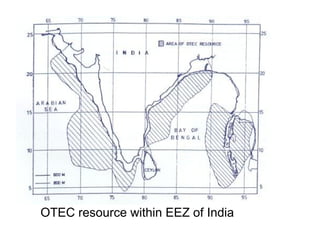
OTEC resource within EEZ of India
OTEC R&D history in India
1980 - Conceptual studies on OTEC plants initiated.
1984 - preliminary design for a 1 MW (gross) closed Rankine Cycle
floating plant was prepared by IITM
1993 – NIOT formed
1997 – Government proposed the establishment of the 1 MW plant
NIOT signed a memorandum of understanding with Saga
University in Japan for the joint development of the plant near
the port of Tuticorin
Goals:
The objective is to demonstrate the OTEC plant for one year, after
which it could be moved to the Andaman & Nicobar Islands for power
generation. NIOT’s plan is to build 10-25 MW shore-mounted power
plants in due course by scaling-up the 1 MW test plant, and possibly a
100 MW range of commercial plants thereafter.
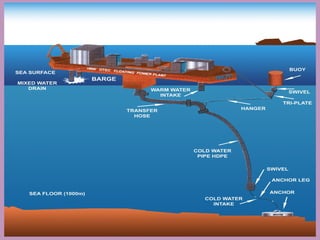
Floating OTEC plant constructed in India in
2000
India piloted a 1 MW floating OTEC plant
near Tamil Nadu. Its government continues
to sponsor various research in developing
floating OTEC facilities.
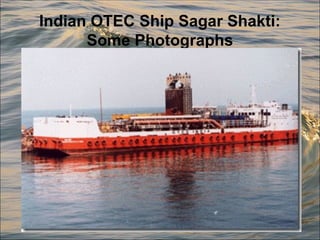
Indian OTEC Ship Sagar Shakti:
Some Photographs
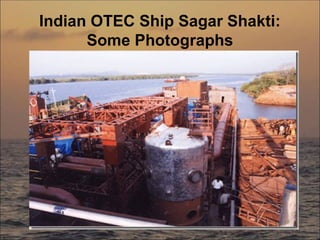
Indian OTEC Ship Sagar Shakti:
Some Photographs
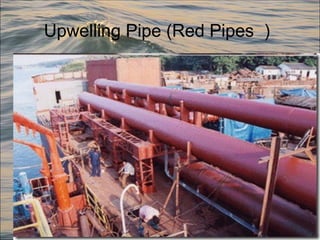
Upwelling Pipe (Red Pipes )
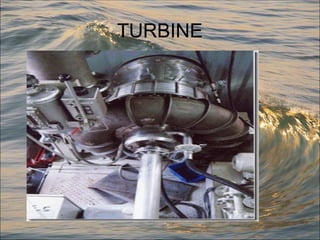
TURBINE
Environmental Aspects
Positives:
• Environmentally benign - no toxic products are
released
• Carbon di oxide emission - less than 1% of fossil fuel
plant
• Nutrient rich cold water promotes mariculture
• Chilled soil agriculture – promotes growth of temperate
crops in tropical regions.
• Cold water for air conditioning
• Fish will be attracted to the plant, increases fishing in
the area
• Fresh water production (1 MW plant -> 4500 m3
)
Environmental Aspects
Negatives:
• Fish eggs and larvae entrained, destroyed
• Sterilization of land by land based plants
• Floating plants – navigational hazard
• Entrainment and impingement of organisms.
• Chlorine used for preventing biofouling – hazardous
• Metal pieces entrained – affects marine orgs.
• Mixing of warm and cold sea water
• OTEC is yet untested on large scale over a long period
of time
Commercial benefits of OTEC
• Helps produce fuels such as hydrogen, ammonia, and
methanol
• Produces baseload electrical energy
• Produces desalinated water for industrial, agricultural,
and residential uses
• Provides air-conditioning for buildings
• Provides moderate-temperature refrigeration
• Has significant potential to provide clean, cost-effective
electricity for the future.
• Specially beneficial for small islands as they can become
self-sufficient
• Promotes competitiveness and international trade
• Enhances energy independence and energy security
• Promotes international sociopolitical stability
• Has potential to mitigate greenhouse gas emissions
resulting from burning fossil fuels.
Major accomplishments of the 210 kW open cycle OTEC project
include:
• First net power production from open-cycle process
• Largest OTEC plant yet operated, with largest net power output
• 10 ft diameter, 7.5 ton turbine rotated at 1800 rpm
• Developed use of magnetic bearings for high efficiency very high
speed (to 48,000 rpm) vacuum pumps
• Developed and utilized flexible PC-based monitoring and control
system
• Demonstrated very high condenser efficiency from structured-
packing
design
• Successfully demonstrated about 7000 gal/day fresh water
production with minimal power loss from an auxiliary vapor to liquid
surface condenser
• OTEC is technically feasible and economically
favorable
• Mature technology
• Benefits ecology
• More plants of capacity similar to experimental
plants can be constructed
• Promotes mariculture
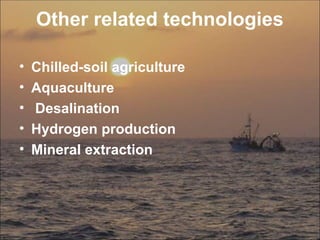
Other related technologies
• Chilled-soil agriculture
• Aquaculture
• Desalination
• Hydrogen production
• Mineral extraction

OTEC FINAL Presentation for undergraduate.ppt

  • 1.
    OCEAN THERMAL ENERGY OCEANTHERMAL ENERGY CONVERSION CONVERSION Presented by, Presented by, NAVANEETHA KRISHNAN .R NAVANEETHA KRISHNAN .R SABARIGIRISH.G SABARIGIRISH.G SAI LAVANYA.S SAI LAVANYA.S
  • 2.
    OCEAN THERMAL ENERGY OCEANTHERMAL ENERGY CONVERSION CONVERSION Presented by, Presented by, NAVANEETHA KRISHNAN .R NAVANEETHA KRISHNAN .R SABARIGIRISH.G SABARIGIRISH.G SAI LAVANYA.S SAI LAVANYA.S
  • 3.
    What is OTEC? •Manifestation of solar energy • Top layers of ocean receive solar heating • Bottom layers receive water from polar regions • Natural temperature gradient • Use in Thermodynamic cycle – Generate electricity
  • 4.
    INVENTION INVENTION 1. 1. Georges Claudewho actually built Georges Claude who actually built The first OTEC plant, in Cuba in 1930. The first OTEC plant, in Cuba in 1930. The system generated 22 kW of The system generated 22 kW of electricity with a low-pressure electricity with a low-pressure turbine. turbine. 2. 2. 1970 the Tokyo Electric Power 1970 the Tokyo Electric Power Company successfully built and Company successfully built and deployed a 100 kW closed-cycle OTEC deployed a 100 kW closed-cycle OTEC plant on the island of Nauru. plant on the island of Nauru.
  • 5.
    PRINCIPLE PRINCIPLE • OTEC utilizesthe temperature- OTEC utilizes the temperature- difference existing between warm difference existing between warm surface surface sea sea water of around water of around 27 27° ° C C to to 29 29° ° C and the cold deep sea water of C and the cold deep sea water of around around 5 5 ° C ° C to to 7 7° ° C, C, which is available which is available at a depth of 800m to-l000 m. at a depth of 800m to-l000 m.
  • 6.
    • Surface Surface Seawater Seawater around 25 around25 degrees degrees • Bottom Bottom seawater seawater around 4 around 4 degrees degrees Coral Sea
  • 12.
    PLANT LOCATION PLANT LOCATION 1. 1.Land based Land based - Favoured locations : narrow shelves - Favoured locations : narrow shelves (volcanic islands), steep (15-20 deg) offshore (volcanic islands), steep (15-20 deg) offshore slopes, and relatively smooth sea floors. slopes, and relatively smooth sea floors. 2. 2. Shelf mounted Shelf mounted - OTEC plants can be mounted to - OTEC plants can be mounted to the continental shelf at depths up to 100 meters. A the continental shelf at depths up to 100 meters. A shelf-mounted plant could be built in a shipyard, shelf-mounted plant could be built in a shipyard, towed to the site, and fixed to the sea bottom. towed to the site, and fixed to the sea bottom. 3. 3. Off shore Off shore floating floating plants plants
  • 14.
    Depending on thecycle used Depending on the cycle used • Open cycle Open cycle • Closed cycle Closed cycle • Hybrid cycle Hybrid cycle
  • 15.
    ELECTRICITY PRODUCTION 1. Closedcycle • Ammonia can be used as a working fluid
  • 16.
  • 19.
    • In 1979,the Natural Energy Laboratory In 1979, the Natural Energy Laboratory and several private-sector partners and several private-sector partners developed the mini OTEC experiment, developed the mini OTEC experiment, which achieved the first successful at- which achieved the first successful at- sea production of net electrical power sea production of net electrical power from closed-cycle OTEC. from closed-cycle OTEC.
  • 20.
    2. Open cycle •Water is the working fluid • Desalinated water can be produced
  • 21.
    Open cycle Open cycle •This method has the advantage of This method has the advantage of producing desalinized fresh water, producing desalinized fresh water, suitable for drinking water or irrigation. suitable for drinking water or irrigation.
  • 22.
    3. Hybrid cycle •Ammonia is the working fluid • Warm sea water is flashed and is then used to vaporize ammonia
  • 23.
    Classification Classification OTEC systems canbe classified as two OTEC systems can be classified as two types based on the thermodynamic types based on the thermodynamic cycle cycle • (1) Closed cycle and (1) Closed cycle and • (2) Open cycle. (2) Open cycle.
  • 24.
    Variation of ocean Variationof ocean temperature with depth temperature with depth • The total insolation received by the The total insolation received by the oceans = (5.457 × 10 oceans = (5.457 × 10¹⁸ 18 MJ/yr) × 0.7 = 1.9 MJ/yr) × 0.7 = 1.9 × 10 × 1018 18 MJ/yr. MJ/yr. (taking an average clearness index of 0.5) (taking an average clearness index of 0.5) Only 15% of this energy is retained as Only 15% of this energy is retained as thermal energy. thermal energy.
  • 25.
    Lambert's law toquantify the Lambert's law to quantify the solar energy absorption by water solar energy absorption by water • We can use Lambert's law to quantify We can use Lambert's law to quantify the solar energy absorption by water, the solar energy absorption by water, • Y Y the depth of water, the depth of water, • I I intensity and intensity and • μ μ the absorption coefficient the absorption coefficient
  • 26.
    Rankine Cycle Rankine Cycle Coolingrequired COLD WATER Heating Require d HOT WATER
  • 27.
    • Require a Requirea gas that gas that boils at boils at about 20 about 20 degrees degrees
  • 28.
  • 29.
    • H Hf f isenthalpy of liquid is enthalpy of liquid water at the inlet water at the inlet temperature, temperature, T T1 1 • H Hg g corresponds to corresponds to T T2 2. . For an ideal isentropic For an ideal isentropic (reversible adiabatic) (reversible adiabatic) turbine turbine • H H6 6= =H Hf f, at , at T T5 5. . • The adiabatic reversible The adiabatic reversible turbine work = turbine work = H H3 3- -H H5, 5, • W WT T = ( = (H H3 3- -H H5, 5,s s) × ) × polytropic polytropic efficiency efficiency
  • 30.
    • The coldwater flow rate The cold water flow rate per per unit turbine mass unit turbine mass flow rate, flow rate, • Turbine mass flow rate Turbine mass flow rate • Warm water mass flow rate Warm water mass flow rate • Cold water mass flow rate Cold water mass flow rate
  • 31.
    Closed/Anderson cycle Closed/Anderson cycle •condensate pump work, condensate pump work, W WC C • cold water pump work, cold water pump work, W WCT CT • warm water pump work, warm water pump work, W WHT HT • Denoting all other parasitic Denoting all other parasitic energy requirements by energy requirements by W WA A • energy balance for the energy balance for the working fluid as the system working fluid as the system
  • 32.
    MAIN COMPONENTS OFAN OTEC SYSTEM MAIN COMPONENTS OF AN OTEC SYSTEM • Evaporators Evaporators • Condensers Condensers • Cold-water pipe Cold-water pipe • Turbines Turbines
  • 33.
  • 34.
    • Shell andtube design can be enhanced by using fluted tubes: Shell and tube design can be enhanced by using fluted tubes: the working fluid flows into the grooves and over the crests, the working fluid flows into the grooves and over the crests, producing a thin film that evaporates more effectively producing a thin film that evaporates more effectively • In an advanced plate-and-fin design, working fluid and seawater In an advanced plate-and-fin design, working fluid and seawater flow through alternating parallel plates; fins between the plates flow through alternating parallel plates; fins between the plates enhance the heat transfer enhance the heat transfer • Original material chosen – Titanium - Expensive, so alternative Original material chosen – Titanium - Expensive, so alternative material – Aluminium. material – Aluminium. Selected Aluminium alloys may last 20 years in seawater. Selected Aluminium alloys may last 20 years in seawater.
  • 35.
    TURBINES TURBINES • Characterized bylow pressure ratios and high mass flow of Characterized by low pressure ratios and high mass flow of working fluids. working fluids. • The turbine is to be designed to have a good isentropic The turbine is to be designed to have a good isentropic expansion efficiency over a considerable range of pressure expansion efficiency over a considerable range of pressure ratio ratio For a 1 MW OTEC plant, a 4-stage axial flow reaction turbine For a 1 MW OTEC plant, a 4-stage axial flow reaction turbine coupled to a synchronous generator through 2 : 1 speed coupled to a synchronous generator through 2 : 1 speed reduction gear box is chosen. reduction gear box is chosen. For a considerable range of pressure ratios the turbine For a considerable range of pressure ratios the turbine efficiency remains above efficiency remains above 0.85 0.85. . For 100 MW – low speed 200 rpm unit around 45 m in dia. For 100 MW – low speed 200 rpm unit around 45 m in dia.
  • 36.
    ECONOMIC CONSIDERATIONS • OTECneeds high investment • Efficiency only 3% - low energy density – large heat transfer equipment therefore more cost
  • 37.
    Nominal Size, MW TYPE ScenarioPotential Sites 1 Land-Based OC- OTEC with 2nd Stage for Additional Water Production. Diesel: $45/barrel Water: $1.6/m3 Present Situation in Some Small Island States. 10 Same as Above. Fuel Oil: $30/barrel Water: $0.9/ m3 U.S. Pacific Insular Areas and other Island Nations. 50 Land-Based Hybrid CC-OTEC with 2nd Stage. Fuel Oil: $50/barrel Water: $0.4/ m3 Or Fuel Oil: $30/barrel Water: $0.8/ m3 Hawaii, Puerto Rico If fuel or water cost doubles. 50 Land-Based CC- OTEC Fuel Oil: $40/barrel Same as Above. 100 CC-OTEC Plantship Fuel Oil: $20/barrel Numerous sites fixed rate of 10%, 20 year loan, and OTEC plant availability of only 80%. Operation and maintenance costs corresponding to approximately 1.5% of the capital cost are used.
  • 38.
    Offshore Distance, km Capital Cost, $/kW COE,$/kWh 10 4200 0.07 50 5000 0.08 100 6000 0.10 200 8100 0.13 300 10200 0.17 400 12300 0.22 Cost Estimates for 100 MW CC-OTEC Plantship (COE for 10 % Fixed Rate, 20 years, Annual Operation & Maintenance 1% percent of Capital Cost).
  • 39.
    Factors to beconsidered while choosing a site: • Thermal gradient in the ocean • Topography of the ocean floor • Meteorological conditions – hurricanes • Seismic activity • Availability of personnel to operate the plant • Infrastructure – airports, harbors, etc. • Local electricity and desalinated water demand. • Political, ecological constraints • Cost and availability of shoreline sites
  • 40.
    Factors which increasethe viability of OTEC: • Rising price of crude oil, declining supplies • Ever-rising energy demand • Stringent regulations over emission of green house and toxic gases • Need for renewable source of baseload electricity • Energy security
  • 41.
    POTENTIAL • Equatorial, tropicaland sub-tropical regions i.e. 20 °N to 20 °S, have favorable temperature profile • Total estimated potential – 577000 MW • 99 nations and territories have access to the OTEC thermal resource: Americas—Mainland - 15 Americas—Island - 23 Africa—Mainland - 18 Africa—Island - 5 Indian/Pacific Ocean—Mainland - 11 Indian/Pacific Ocean—Island - 27
  • 43.
    Countries with accessto deep ocean water within 10Km of shore and favorable business climate: • Americas—Mainland - 1, Mexico • Americas—Island - 12 • Africa—Mainland - 1, Tanzania • Africa—Island - 1, Madagascar • Indian/Pacific Ocean—Mainland - 1, India • Indian/Pacific Ocean—Island – 13 OTEC has a high potential especially in small island nations
  • 44.
    Potential in SIDS •Islands have a large EEZ (SL’s EEZ = 27*area) • Favorable temperature gradient • SIDS have to import fuels and energy • OTEC provides cheaper energy and energy security • OTEC promotes agriculture – food self-sufficiency • Fresh water at cheaper cost • Provides transportation fuels • Refrigeration, air-conditioning • Full use of the benefits of OTEC  lower COE
  • 45.
    Less Developed Countrieswith OTEC potential
  • 46.
    Potential in India •Estimated overall potential – 180000 MW • 2.56 million sq.km EEZ • Ongoing projects: The 1 MW barge research and demonstration facility being developed by the National Institute of Ocean Technology, India (NIOT) with technical support from Institute of Ocean Energy, Saga University (IOES) • Identified sites: – Kavaratti – Kulasekarapattinam – Andaman & Nicobar Islands
  • 47.
  • 48.
    OTEC R&D historyin India 1980 - Conceptual studies on OTEC plants initiated. 1984 - preliminary design for a 1 MW (gross) closed Rankine Cycle floating plant was prepared by IITM 1993 – NIOT formed 1997 – Government proposed the establishment of the 1 MW plant NIOT signed a memorandum of understanding with Saga University in Japan for the joint development of the plant near the port of Tuticorin Goals: The objective is to demonstrate the OTEC plant for one year, after which it could be moved to the Andaman & Nicobar Islands for power generation. NIOT’s plan is to build 10-25 MW shore-mounted power plants in due course by scaling-up the 1 MW test plant, and possibly a 100 MW range of commercial plants thereafter.
  • 49.
    Floating OTEC plantconstructed in India in 2000 India piloted a 1 MW floating OTEC plant near Tamil Nadu. Its government continues to sponsor various research in developing floating OTEC facilities.
  • 51.
    Indian OTEC ShipSagar Shakti: Some Photographs
  • 52.
    Indian OTEC ShipSagar Shakti: Some Photographs
  • 53.
  • 54.
  • 55.
    Environmental Aspects Positives: • Environmentallybenign - no toxic products are released • Carbon di oxide emission - less than 1% of fossil fuel plant • Nutrient rich cold water promotes mariculture • Chilled soil agriculture – promotes growth of temperate crops in tropical regions. • Cold water for air conditioning • Fish will be attracted to the plant, increases fishing in the area • Fresh water production (1 MW plant -> 4500 m3 )
  • 56.
    Environmental Aspects Negatives: • Fisheggs and larvae entrained, destroyed • Sterilization of land by land based plants • Floating plants – navigational hazard • Entrainment and impingement of organisms. • Chlorine used for preventing biofouling – hazardous • Metal pieces entrained – affects marine orgs. • Mixing of warm and cold sea water • OTEC is yet untested on large scale over a long period of time
  • 57.
    Commercial benefits ofOTEC • Helps produce fuels such as hydrogen, ammonia, and methanol • Produces baseload electrical energy • Produces desalinated water for industrial, agricultural, and residential uses • Provides air-conditioning for buildings • Provides moderate-temperature refrigeration • Has significant potential to provide clean, cost-effective electricity for the future. • Specially beneficial for small islands as they can become self-sufficient
  • 58.
    • Promotes competitivenessand international trade • Enhances energy independence and energy security • Promotes international sociopolitical stability • Has potential to mitigate greenhouse gas emissions resulting from burning fossil fuels.
  • 59.
    Major accomplishments ofthe 210 kW open cycle OTEC project include: • First net power production from open-cycle process • Largest OTEC plant yet operated, with largest net power output • 10 ft diameter, 7.5 ton turbine rotated at 1800 rpm • Developed use of magnetic bearings for high efficiency very high speed (to 48,000 rpm) vacuum pumps • Developed and utilized flexible PC-based monitoring and control system • Demonstrated very high condenser efficiency from structured- packing design • Successfully demonstrated about 7000 gal/day fresh water production with minimal power loss from an auxiliary vapor to liquid surface condenser
  • 60.
    • OTEC istechnically feasible and economically favorable • Mature technology • Benefits ecology • More plants of capacity similar to experimental plants can be constructed
  • 61.
  • 62.
    Other related technologies •Chilled-soil agriculture • Aquaculture • Desalination • Hydrogen production • Mineral extraction