Ocean Thermal Energy
Conversion
Content
1. Introduction to OTEC
2. How OTEC Works
3. OTEC Plant Design & Location
4. OTEC Application
5. Benefit of OTEC
6. Potential and Market of OTEC
Introduction
• Ocean Thermal Energy Conversion (OTEC) is a process
which utilizes the heat energy stored in the tropical
ocean.
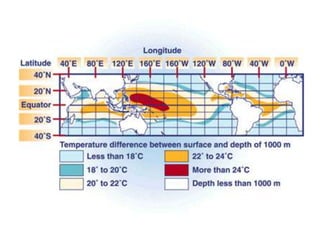
• OTEC utilizes the difference in temperature between
warm surface seawater and cold deep seawater to
produce electricity.
• Because the oceans are continually heated by the sun
and cover nearly 70% of the Earth's surface, this
temperature difference contains a vast amount of solar
energy which could potentially be tapped for human use.
Basic Principal
• OTEC is Manifestation of solar energy
• Top layers of ocean receive solar heating
• Bottom layers receive water from polar
regions
• OTEC Uses the vertical temperature gradient
in the ocean as a heat sink/source
• OTEC system is based on the Rankine Cycle
Main Component
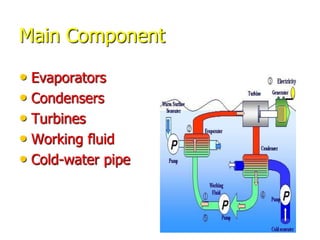
• Evaporators
• Condensers
• Turbines
• Working fluid
• Cold-water pipe
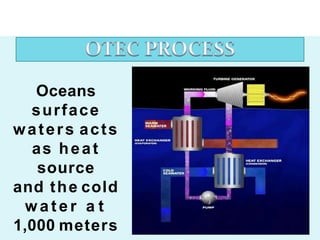
Oceans
surface
waters acts
as heat
source
and the cold
w a t e r a t
1,000 meters
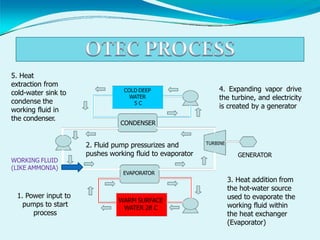
2. Fluid pump pressurizes and
pushes working fluid to evaporator
1. Power input to
pumps to start
process
3. Heat addition from
the hot-water source
used to evaporate the
working fluid within
the heat exchanger
(Evaporator)
EVAPORATOR
CONDENSER
WARM SURFACE
WATER 28 C
4. Expanding vapor drive
the turbine, and electricity
is created by a generator
5. Heat
extraction from
cold-water sink to
condense the
working fluid in
the condenser.
TURBINE
GENERATOR
COLD DEEP
WATER
5 C
WORKING FLUID
(LIKE AMMONIA)
How OTEC Works
• The warm surface ocean water is pumped to the
evaporator, which transfers heat to the working fluid
• Working fluid is turning into a high-pressure vapor.
• The turbine generator spins as the vapor rushes through
it.
• In the low-pressure condenser, the vapor is cooled by the
nearly freezing water brought up from the ocean depths.
• After condensing, the working fluid is sent back to the
boiler to be reused and to repeat the cycle.
Electricity production
• 3 basic OTEC system designs have been
demonstrated to generate electricity:
– Closed cycle
– Open cycle
– Hybrid Cycle
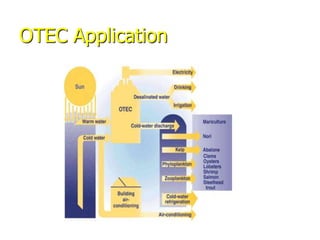
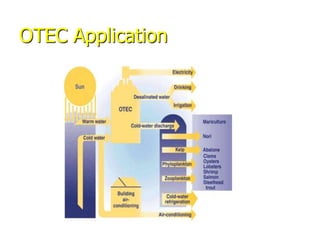
OTEC Application
• Ocean thermal energy conversion (OTEC) systems have many
applications or uses.
• OTEC can be used to :
– generate electricity,
– desalinate water,
– support deep-water mariculture,
– provide refrigeration and air-conditioning
– mineral extraction.
• These complementary products make OTEC systems attractive to
industry and island communities even if the price of oil remains low
• OTEC can also be used to produce methanol, ammonia, hydrogen,
aluminum, chlorine, and other chemicals.
OTEC Application
Deep-Water-Supported
Mariculture
• Deep-drawn seawater from an OTEC plant is cold, rich in nutrients,
relatively free of pathogens, and available in large quantity.
• It is an excellent medium for growing phytoplankton and
microalgae, which in turn support a variety of commercially valuable
fish and shellfish.
• The large, constant flow of water pumped from an OTEC plant will
reduce disease and contamination in the ponds; marine life,
therefore, can be grown in high densities.
• In addition, deep-drawn cold water can be mixed with warm surface
water, allowing local communities to culture a broad variety of
species.
Desalinated Water
• Desalinated water can be produced in open- or hybrid-
cycle plants using surface condensers.
• In a surface condenser, the spent steam is condensed by
indirect contact with the cold seawater.
• This condensate is relatively free of impurities and can
be collected and sold to local communities where natural
freshwater supplies for agriculture or drinking are
limited.
Refrigeration and Air-Conditioning
• The cold [5°C (41ºF)] seawater made available
by an OTEC system creates an opportunity to
provide large amounts of cooling to operations
that are related to or close to the plant.
• The cold seawater delivered to an OTEC plant
can be used in chilled-water coils to provide air-
conditioning for buildings.
Benefit of OTEC
• No fuel burned , carbon di oxide emission - less than 1%
of fossil fuel plant : has significant potential to provide
clean, cost-effective electricity for the future
• Nutrient rich cold water promotes mariculture
• Produces desalinated water for industrial, agricultural,
and residential uses.
• Cold water for air conditioning
• Fishing - Cold water, drawn from the depths, is nutrient-
rich and can significantly increase fishing yields
• Fresh water production (1 MW plant -> 4500 m3)
Disadvantage
• An OTEC facility requires a substantial initial capital outlay
• OTEC has not been demonstrated at full scale over a prolonged
period with integrated power, mariculture, fresh-water, and chill-
water production.
• OTEC is only feasible at relatively isolated sites (deep tropical
oceans); from such sites, the power and marine products must be
transported to market.
• OTEC is ecologically controversial--at least untested--in large scale
and over a long period.
OTEC Application
• Ocean thermal energy conversion (OTEC) systems have many
applications or uses.
• OTEC can be used to :
– generate electricity,
– desalinate water,
– support deep-water mariculture,
– provide refrigeration and air-conditioning
– mineral extraction.
• These complementary products make OTEC systems attractive to
industry and island communities even if the price of oil remains low
• OTEC can also be used to produce methanol, ammonia, hydrogen,
aluminum, chlorine, and other chemicals.
OTEC Application
Deep-Water-Supported
Mariculture
• Deep-drawn seawater from an OTEC plant is cold, rich in nutrients,
relatively free of pathogens, and available in large quantity.
• It is an excellent medium for growing phytoplankton and
microalgae, which in turn support a variety of commercially valuable
fish and shellfish.
• The large, constant flow of water pumped from an OTEC plant will
reduce disease and contamination in the ponds; marine life,
therefore, can be grown in high densities.
• In addition, deep-drawn cold water can be mixed with warm surface
water, allowing local communities to culture a broad variety of
species.
Desalinated Water
• Desalinated water can be produced in open- or hybrid-
cycle plants using surface condensers.
• In a surface condenser, the spent steam is condensed by
indirect contact with the cold seawater.
• This condensate is relatively free of impurities and can
be collected and sold to local communities where natural
freshwater supplies for agriculture or drinking are
limited.
Refrigeration and Air-Conditioning
• The cold [5°C (41ºF)] seawater made available
by an OTEC system creates an opportunity to
provide large amounts of cooling to operations
that are related to or close to the plant.
• The cold seawater delivered to an OTEC plant
can be used in chilled-water coils to provide air-
conditioning for buildings.
Benefit of OTEC
• No fuel burned , carbon di oxide emission - less than 1%
of fossil fuel plant : has significant potential to provide
clean, cost-effective electricity for the future
• Nutrient rich cold water promotes mariculture
• Produces desalinated water for industrial, agricultural,
and residential uses.
• Cold water for air conditioning
• Fishing - Cold water, drawn from the depths, is nutrient-
rich and can significantly increase fishing yields
• Fresh water production (1 MW plant -> 4500 m3)
Disadvantage
• An OTEC facility requires a substantial initial capital outlay
• OTEC has not been demonstrated at full scale over a prolonged
period with integrated power, mariculture, fresh-water, and chill-
water production.
• OTEC is only feasible at relatively isolated sites (deep tropical
oceans); from such sites, the power and marine products must be
transported to market.
• OTEC is ecologically controversial--at least untested--in large scale
and over a long period.
OTEC_OE_2023.pptx

OTEC_OE_2023.pptx

  • 1.
  • 2.
    Content 1. Introduction toOTEC 2. How OTEC Works 3. OTEC Plant Design & Location 4. OTEC Application 5. Benefit of OTEC 6. Potential and Market of OTEC
  • 3.
    Introduction • Ocean ThermalEnergy Conversion (OTEC) is a process which utilizes the heat energy stored in the tropical ocean. • OTEC utilizes the difference in temperature between warm surface seawater and cold deep seawater to produce electricity. • Because the oceans are continually heated by the sun and cover nearly 70% of the Earth's surface, this temperature difference contains a vast amount of solar energy which could potentially be tapped for human use.
  • 4.
    Basic Principal • OTECis Manifestation of solar energy • Top layers of ocean receive solar heating • Bottom layers receive water from polar regions • OTEC Uses the vertical temperature gradient in the ocean as a heat sink/source • OTEC system is based on the Rankine Cycle
  • 5.
    Main Component • Evaporators •Condensers • Turbines • Working fluid • Cold-water pipe
  • 6.
    Oceans surface waters acts as heat source andthe cold w a t e r a t 1,000 meters
  • 7.
    2. Fluid pumppressurizes and pushes working fluid to evaporator 1. Power input to pumps to start process 3. Heat addition from the hot-water source used to evaporate the working fluid within the heat exchanger (Evaporator) EVAPORATOR CONDENSER WARM SURFACE WATER 28 C 4. Expanding vapor drive the turbine, and electricity is created by a generator 5. Heat extraction from cold-water sink to condense the working fluid in the condenser. TURBINE GENERATOR COLD DEEP WATER 5 C WORKING FLUID (LIKE AMMONIA)
  • 8.
    How OTEC Works •The warm surface ocean water is pumped to the evaporator, which transfers heat to the working fluid • Working fluid is turning into a high-pressure vapor. • The turbine generator spins as the vapor rushes through it. • In the low-pressure condenser, the vapor is cooled by the nearly freezing water brought up from the ocean depths. • After condensing, the working fluid is sent back to the boiler to be reused and to repeat the cycle.
  • 9.
    Electricity production • 3basic OTEC system designs have been demonstrated to generate electricity: – Closed cycle – Open cycle – Hybrid Cycle
  • 10.
    OTEC Application • Oceanthermal energy conversion (OTEC) systems have many applications or uses. • OTEC can be used to : – generate electricity, – desalinate water, – support deep-water mariculture, – provide refrigeration and air-conditioning – mineral extraction. • These complementary products make OTEC systems attractive to industry and island communities even if the price of oil remains low • OTEC can also be used to produce methanol, ammonia, hydrogen, aluminum, chlorine, and other chemicals.
  • 11.
  • 12.
    Deep-Water-Supported Mariculture • Deep-drawn seawaterfrom an OTEC plant is cold, rich in nutrients, relatively free of pathogens, and available in large quantity. • It is an excellent medium for growing phytoplankton and microalgae, which in turn support a variety of commercially valuable fish and shellfish. • The large, constant flow of water pumped from an OTEC plant will reduce disease and contamination in the ponds; marine life, therefore, can be grown in high densities. • In addition, deep-drawn cold water can be mixed with warm surface water, allowing local communities to culture a broad variety of species.
  • 13.
    Desalinated Water • Desalinatedwater can be produced in open- or hybrid- cycle plants using surface condensers. • In a surface condenser, the spent steam is condensed by indirect contact with the cold seawater. • This condensate is relatively free of impurities and can be collected and sold to local communities where natural freshwater supplies for agriculture or drinking are limited.
  • 14.
    Refrigeration and Air-Conditioning •The cold [5°C (41ºF)] seawater made available by an OTEC system creates an opportunity to provide large amounts of cooling to operations that are related to or close to the plant. • The cold seawater delivered to an OTEC plant can be used in chilled-water coils to provide air- conditioning for buildings.
  • 15.
    Benefit of OTEC •No fuel burned , carbon di oxide emission - less than 1% of fossil fuel plant : has significant potential to provide clean, cost-effective electricity for the future • Nutrient rich cold water promotes mariculture • Produces desalinated water for industrial, agricultural, and residential uses. • Cold water for air conditioning • Fishing - Cold water, drawn from the depths, is nutrient- rich and can significantly increase fishing yields • Fresh water production (1 MW plant -> 4500 m3)
  • 16.
    Disadvantage • An OTECfacility requires a substantial initial capital outlay • OTEC has not been demonstrated at full scale over a prolonged period with integrated power, mariculture, fresh-water, and chill- water production. • OTEC is only feasible at relatively isolated sites (deep tropical oceans); from such sites, the power and marine products must be transported to market. • OTEC is ecologically controversial--at least untested--in large scale and over a long period.
  • 17.
    OTEC Application • Oceanthermal energy conversion (OTEC) systems have many applications or uses. • OTEC can be used to : – generate electricity, – desalinate water, – support deep-water mariculture, – provide refrigeration and air-conditioning – mineral extraction. • These complementary products make OTEC systems attractive to industry and island communities even if the price of oil remains low • OTEC can also be used to produce methanol, ammonia, hydrogen, aluminum, chlorine, and other chemicals.
  • 18.
  • 19.
    Deep-Water-Supported Mariculture • Deep-drawn seawaterfrom an OTEC plant is cold, rich in nutrients, relatively free of pathogens, and available in large quantity. • It is an excellent medium for growing phytoplankton and microalgae, which in turn support a variety of commercially valuable fish and shellfish. • The large, constant flow of water pumped from an OTEC plant will reduce disease and contamination in the ponds; marine life, therefore, can be grown in high densities. • In addition, deep-drawn cold water can be mixed with warm surface water, allowing local communities to culture a broad variety of species.
  • 20.
    Desalinated Water • Desalinatedwater can be produced in open- or hybrid- cycle plants using surface condensers. • In a surface condenser, the spent steam is condensed by indirect contact with the cold seawater. • This condensate is relatively free of impurities and can be collected and sold to local communities where natural freshwater supplies for agriculture or drinking are limited.
  • 21.
    Refrigeration and Air-Conditioning •The cold [5°C (41ºF)] seawater made available by an OTEC system creates an opportunity to provide large amounts of cooling to operations that are related to or close to the plant. • The cold seawater delivered to an OTEC plant can be used in chilled-water coils to provide air- conditioning for buildings.
  • 22.
    Benefit of OTEC •No fuel burned , carbon di oxide emission - less than 1% of fossil fuel plant : has significant potential to provide clean, cost-effective electricity for the future • Nutrient rich cold water promotes mariculture • Produces desalinated water for industrial, agricultural, and residential uses. • Cold water for air conditioning • Fishing - Cold water, drawn from the depths, is nutrient- rich and can significantly increase fishing yields • Fresh water production (1 MW plant -> 4500 m3)
  • 23.
    Disadvantage • An OTECfacility requires a substantial initial capital outlay • OTEC has not been demonstrated at full scale over a prolonged period with integrated power, mariculture, fresh-water, and chill- water production. • OTEC is only feasible at relatively isolated sites (deep tropical oceans); from such sites, the power and marine products must be transported to market. • OTEC is ecologically controversial--at least untested--in large scale and over a long period.