Weather
Weather- Conditionof atmosphere at a particular place over a short period
of time.
Day-to-day state of the atmosphere, and its short-term (minutes to weeks)
variation
includes sunshine, rain, cloud cover, winds, hail, snow, sleet, flooding, ice
storms, thunderstorms, excessive heat, heat waves etc.
Meteorology :
branch of science concerned with the processes and phenomena of the
atmosphere, especially as a means of forecasting the weather.
3.
Climate
Statistical weatherinformation that describes the
variation of weather at a given place for a specified interval
precipitation, temperature, humidity, sunshine, wind
velocity, phenomena such as fog, frost, and hail storms
over a long period of time.
Climatology :
the scientific study of climate.
4.
Climate change
Changein the statistical distribution of weather patterns when that change
last for a period of time (decades to millions of years )
Climate change may refer to a change in average weather conditions , or in
the time variation of weather around longer -term average conditions
(more or fewer extreme weather events )
Limited to a specific region or across the whole earth.
Water resources
Watersupply, water quality, competition for water
resources
Coastal areas
Beach erosion, inundation of coast wetlands
Species and natural areas
Loss of habitat and species
7.
Causes of climatechange
Human and natural causes.
Natural causes
Volcanic eruption
Ocean current
Earth’s orbital changes
Solar variations
8.
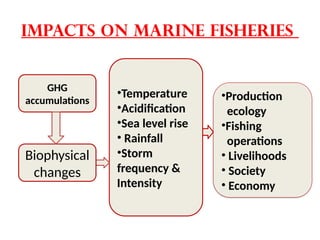
Natural causes
1.Volcanic eruption-
Throws SO2, water vapor, dust and ashes-influence
climatic pattern
Sulphurdioxide has the major effect (it get convert
to sulphuric acid and it condenses in the stratosphere
to form finite aerosol )
aerosol– reflect solar energy-space- cooling effect.
9.
2. Oceancurrent
Major component of climate system.
They transport & distribute heat & salt
Both play important role in driving the planetary climate engine
Fluctuation in the transport of current alter the distribution of
heat
10.
3. Earthorbital changes
Tilted at an angle of 23.5° to the perpendicular
plane of its orbital path.
changes in tilt- strength of season.
More tilt- warmer summers & cooler winters.
Less tilt- cooler summers & milder winters.
11.
4. solarvariation
Source of energy
Changes in sun’s energy output-climate change
both directly & indirectly
Directly by changing the rate of solar heating
of the earth & atmosphere & indirectly changing
cloud forming process
12.
Human causes
Manmade green house gases
Energy sector- 3/4 CO2 emission, 1/5 methane
CO2 – deforestation, land clearing, agriculture & other activities
Methane- dairy, cows, goat, pigs, buffaloes, camel, horse& sheep
– oil drilling, coal mining, leaking gas pipe lines, land fills & waste
dumps
Global warming- polar caps( Arctic ice caps) shrinking & Antarctic ice
shelf is melting
13.
Global warming &
Greenhouse effect
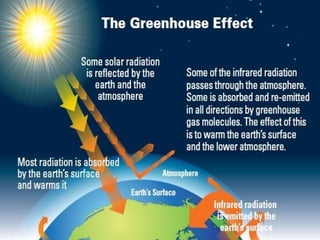
GREEN HOUSE EFFECT : The trapping of the sun's warmth
in a planet's lower atmosphere, due to the greater
transparency of the atmosphere to visible radiation from
the sun than to infrared radiation emitted from the
planet's surface.
GLOBAL WARMING : A gradual increase in the overall
temperature of the earth's atmosphere generally
attributed to the greenhouse effect caused by increased
levels of carbon dioxide, CFCs, and other pollutants.
16.
What is happening???
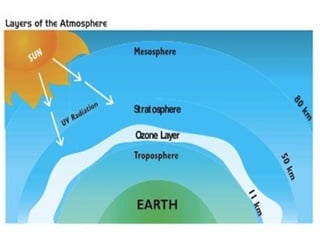
Heat is added to the stratosphere when strong ultraviolet-C (UV-C)
radiation from the sun is absorbed by oxygen molecules and causes
them to split.
One of the results of this process is the production of ozone and
the formation of the ozone layer in the stratosphere
More warming occurs when the ozone molecules intercept and are
destroyed by intense but slightly less powerful ultraviolet-B (UV-B)
radiation.
17.
A beneficialbyproduct of these processes is
that most of the UV that is harmful to plant
and animal life on earth is filtered out in the
stratosphere and does not reach the earth’s
surface.
Some additional heating of the stratosphere
also occurs because ozone absorbs infrared
radiation emitted by the earth’s surface
18.
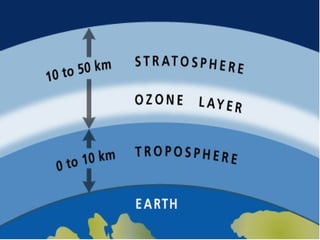
In thetroposphere, in contrast, very little of the incoming solar radiation is
absorbed directly by the atmosphere.
mostly the troposphere is warmed through the emission of long wave
infrared radiation, which is absorbed by water vapor and other greenhouse
gases in the air such as carbon dioxide, methane, nitrous oxide, and ozone
By re-emitting some of this long wave radiation back towards the earth’s
surface, these gases retain heat at the bottom of the atmosphere and of
this greenhouse effect, the earth’s average temperature is some help to
make it warmer.
As a result of this greenhouse effect, the earth’s average temperature is
some 33ºC warmer than it would otherwise be & the planet is able to
support life
19.
With fewerozone molecules available in the
stratosphere to absorb UV-B radiation, more of
that radiation reaches the ground.
That contributes to additional warming of the
earth’s surface and the lower troposphere
An increase in the abundance of greenhouse
gases produces similar results .
20.
Although allgreenhouse gases contribute to
warming in the troposphere, the effect of
individual green house gas on stratosphere
can vary considerably
Carbon dioxide has the greatest cooling
effect on the stratosphere, while CFCs actually
have a warming effect on it.
21.
Green house gases
Water vapor - naturally (36-70%)
Carbon dioxide - breath, volcanoes, fossil fuel, coal, oil and natural gases (9-
26%)
Methane - cattle, paddy field (4-9%)
Nitrous oxide - plant die and rot
Ozone - naturally (3-7%)
CFCs- used in Aerosols (hair spray cans, fridge, foam plastics)
Fluorinated industrial gases:- hydro fluorocarbons (HFCs), perfluorocarbons
(PFCs) and sulphur hexafluoride (SF6).
22.
Longevity of GreenHouse
Gases
Water vapor stays in the atmosphere for days
Other greenhouse gases take many years to leave the
atmosphere
CO 2 has an affective lifetime of tens of thousands of years
Methane has an atmospheric lifetime of 13½ years
Nitrous oxide has an atmospheric lifetime of 120 years
CFC-12 has an atmospheric lifetime of 100 years
23.
Rising sealevel
Changing of precipitation pattern
More frequent and more severe droughts
More frequent and more severe floods
Increase in tropical storm and hurricane intensity and
duration
Ice melting:
Coral bleaching
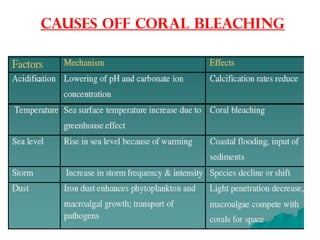
Acidification
RESULT OF GLOBAL WARMING
( CLIMATE CHANGE )
24.
Global sealevel is gradually rising and is projected to rise at
an even greater rate in the future.
Mean global rise of sea level during 20th
century - 2mm
/year
In the 4th
report of IPCC global annual sea water
temperature & sea level rise is by .8 to 2.5 degree Celsius & 8 to
25cm respectively by 2050
The rate of increase is accelerating and it is projected that
sea level may rise at the rate of 5mm/year in coming decades
1 .RISING OF SEA LEVEL
25.
In generalincrease in mean water depth will be
accompanied by an increase in mean wave height,
resulting in a more severe wave attack on the coast
The erosion due to sea level rise for the region is
estimated as 7,125 m3/year implying an erosion rate
of .3*10^6 m3/year
Main causes-
1. Thermal expansion of sea water at higher global temperature
2. Additional water from the melting of land-based ice.
26.
Global warmingresults in more frequent and more
severe rain .
The rise in average temperature in mountainous region
can alter the precipitation mix between rainfall & snow fall
, with substantial increases in precipitation coming down
as rain and a reduction in the amount coming as snow
This changes means more flooding & more run off
during rainy season & less water held as snow & ice in the
mountains for use in dry season
2. Changing of
precipitation
pattern
27.
Higher temperatureincreases the water vapour retention
power in the air, resulting in higher intensity when precipitations
do finally occur.
Increases the frequency and severity of droughts, as have
happened in many areas.
Cause large scale population displacement; resulting in socio
economic instability and resource insecurity.
3. More frequent and more
severe droughts
28.
This maycause large scale population
displacement; resulting in socio -economic
instability and resource insecurity
In AQ ponds fishes may escape due to frequent
floods
The turbid water affects the breeding of fishes
4. More frequent and
more severe floods.
29.
Storms areprojected to be more destructive.
Anthropogenic warming by the end of the 21st
century will likely cause hurricanes globally to be
more intense on average (by 2 to 11% according to
model projections of IPCC
5. Increase in tropical
storm and hurricane
intensity and duration
30.
Increasing temperature-glacier-melting and sea-ice
shrinking in the Arctic; diminished snow cover in the Northern
Hemisphere, decreasing frozen lakes and rivers.
This would result in increasing number of potentially
hazardous glacial lakes and enlarge glacial lakes
6. Ice melting:
31.
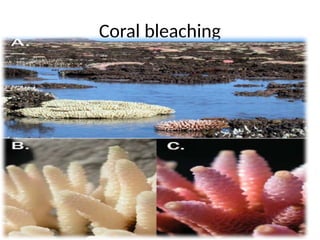
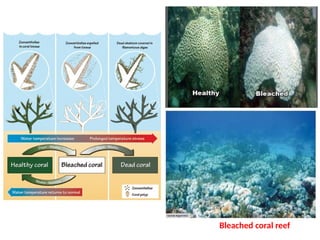
Coral Bleaching:
Symbioticzooxanthellae (single celled algae)
are expelled from the host coral organisms (21
degree celcius) due to stress; lead to mortality of
corals.
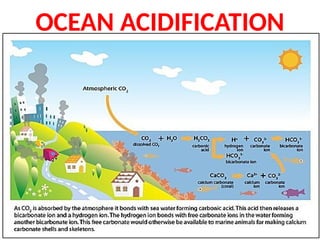
The oceanis becoming more acidic- absorbs
atmospheric CO2.
May impact the organisms such as corals,
plankton, shellfish and molluscs becoming less
able to produce calcareous parts- shells.
reased acidification
Inland water biodiversitynegatively affected by
climate change because
Freshwater species are experiencing declines in
biodiversity far greater than terrestrial ecosystems.
Changing rainfall and ice melt patterns will result in
changing flow regimes in rivers and lakes:- affecting
spawning and feeding habits .
Decreased flow in rivers and streams, causing a loss of ecosystem
services.
erability to climate change
38.
Cont…
These responses arelikely to lead to:
Changes in growth, reproduction, and distribution of lake and stream biodiversity
The pole ward movement of some organisms
Changes in the reproduction of migratory fishes that depend on lakes and streams for
their breeding cycle.
Draining and drying , these can release both carbon dioxide and methane, adding to
the level of greenhouse gases.
Fish in lowland streams and rivers that require cool water (e.g., trout and
salmon), are likely to be the most severely affected.
Affect species’ composition and distribution.
39.
Climate changeis predicted to have important
effects on parasitism and disease in freshwater
and marine ecosystems
Climate variability with
anthropogenic stressors can lead to increased
disease problems.
Effect of climate change on
the health
40.
Cont…
Transmission ratesof pathogens- increase with
increasing temperature
The study found that diseases and troublesome
invasive species are becoming more common, as
a result of warming conditions
PH lower than 5- most fish eggs will not hatch
and lower pH can kill adult fish
41.
Primary biologicalproductivity in the oceans -
the growth of phytoplankton that forms the basis
for the rest of the marine food chain - is tightly
linked to climate change & reduced by global
warming.
“on a global basis there is an inverse
relationship – increased temperatures cause
decreased marine phytoplankton production”
and Krill.
Effect of climate change on
productivity
42.
Cont…
There isevidence that the algal community composition
has shifted from large to small cells.
Krill are being replaced by salps –because salps
consume krill eggs and larvae.
Because krill form a critical link between primary
producers and upper-level consumers, the shift in
zooplankton community structure suggests that there
should be dramatic changes in the higher trophic levels
(fish, seals, whales, and penguins and other seabirds).
43.
Impacts on marinefisheries
GHG
accumulations
•Temperature
•Acidification
•Sea level rise
• Rainfall
•Storm
frequency &
Intensity
•Production
ecology
•Fishing
operations
• Livelihoods
• Society
• Economy
Biophysical
changes
44.
Effects of
Climate Change
onFisheries
While people tend to view any change from
the current status as negative, some changes
may have positive effects, such as faster
growth of fish and shellfish, and extension of
range into newly productive regions.
45.
Predicted fisheries effectsof
climate change fall into two
classes
( a )Those associated with the
biological health and viability of fish
stocks
(b ) those that are concerned with
the safety or the social, cultural, and
financial sustainability of fishermen
and fishing communities.
46.
Climate effects relatedto fish population biology
Changes in primary productivity, with increases
projected for some areas and decreases for
others
Changes in species composition within regions.
As the centre of abundance of some species
shifts, other species decrease in abundance and
new predator/prey relationships become
established.
Eg : bio geographical shifting of some warm
water species (Cirrhinus reba , Macrocanthus
aral) in the upper Ganga river stretch up to
Haridwar regions
RESULTS OF INCREASEDSST
Increase in dispersal of small pelagics (oil sardine &
mackeral )
reduction in size of the fishery ( mackeral &
nemipterus )
reduction in length at first maturity ( mackeral &
coastal prawns )
reduction in fecundity ( coastal prawns )
change in spawning season ( nemipterus )
Change in diet composition (sardine)
(CMFRI ANNUAL REPORT 2013-2014 )
49.
Climate effectson fishermen and
fishing communities can include:
Changes in fisheries productivity that
require expensive adaptations by
harvesters, processors, and dependent
communities.
For example, if target stocks change
location, fishermen may need bigger,
more sophisticated vessels and
processors may need better processing
facilities in new locations.
50.
Increased frequencyand severity of
storms or weather, and sea conditions
unsuitable to fishing as well as damaging
to communities on shore through
flooding, erosion, and storm damage.
Sea level rise that can flood
communities or valuable habitat.
51.
DEALING WITH GLOBALWARMING
Climate change is such a difficult problem to
deal with because:
The problem is global.
The effects will last a long time.
The harmful and beneficial impacts of climate change
are not spread evenly.
Many actions that might reduce the threat are
controversial because they can impact economies and
lifestyles.
52.
DEALING WITH GLOBALWARMING
Two ways to deal with global warming:
Mitigation that reduces greenhouse gas emissions.
Adaptation, where we recognize that some warming
is unavoidable and devise strategies to reduce its
harmful effects.
53.
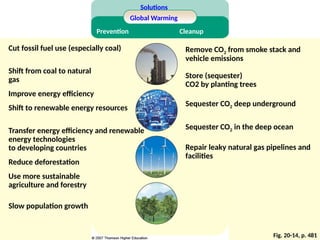
Fig. 20-14, p.481
Cut fossil fuel use (especially coal)
Shift from coal to natural
gas
Improve energy efficiency
Shift to renewable energy resources
Transfer energy efficiency and renewable
energy technologies
to developing countries
Reduce deforestation
Use more sustainable
agriculture and forestry
Slow population growth
Remove CO2 from smoke stack and
vehicle emissions
Store (sequester)
CO2 by planting trees
Sequester CO2 deep underground
Sequester CO2 in the deep ocean
Repair leaky natural gas pipelines and
facilities
Solutions
Global Warming
Prevention Cleanup
54.
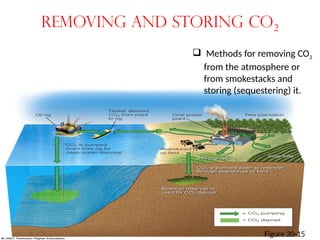
Removing and StoringCO2
Methods for removing CO2
from the atmosphere or
from smokestacks and
storing (sequestering) it.
Figure 20-15
55.
Solutions: Reducing the
Threat
Wecan improve energy efficiency, rely more
on carbon-free renewable energy resources,
and find ways to keep much of the CO2 we
produce out of the troposphere.
56.
International Climate
Negotiations: TheKyoto
Protocol
Treaty on global warming which extends the UNFCC that commit state parties to
reduce the emission of green house gases
first phase went into effect 16th
February , 2005 with 192 countries participating.
In the first commitment period It requires developed countries to cut their
emissions of CO2, CH4, and N2O to 5.2% below their 1990 levels by 2012.
Developing countries were excluded
Second commitment period is proposed in 2012 known as Doha Amendment
which would commit only Europe to further carbon dioxide reduction until 2020 ,
but has yet to be ratified
57.
Actions by SomeCountries,
States, and Businesses
In 2005, the EU proposed a plan to reduce CO2 levels
by 1/3rd
by 2020.
California has adopted a goal of reducing its
greenhouse gas emission 80% to 1990 level by 2050.
Global companies (BP, IBM, Toyota) have established
targets to reduce their greenhouse emissions 10-65%
to 1990 levels by 2010.
58.
KEY SOURCE OFINFORMATION
INTERGOVERNMENTAL PANEL ON CLIMATE CHANGE ( IPCC )
Produce reports that support the UNFCC (UNITED NATION FRAMEWORK
CONVENTION ON CLIMATE CHANGE ) which is the main International treaty on
climate change
ultimate aim of UNFCC is to stabilize the GHG concentration in atmosphere at a
level that would prevent dangerous anthropogenic interference with climate system
IPCC reports cover the scientific , technical, socioeconomic information relevant to
understand the basic risk of human induced climate change
NATIONAL INITIATIVE ON CLIMATE RESILIENT AGRICULTURE (NICRA) : Network
project of ICAR
Aim is to enhance resilience of Indian agriculture to climate change & climate
vulnerability through strategic research & technology demonstration .
STratospheric Ozone layer
depletion
Ozone layer- absorb 97-99% of UV light from the sun.
Lower portion of stratosphere- 20-30 km above the
earth-thickness varies
Act like giant sun shade-protection.
Depletion- increase UV radiation-affect human-
sunburn, snow blindness, other eye damage, early ageing
of skin, skin cancer.
OZONE HOLE
Ahuge concern is the creation of ozone hole
it can be defined as the extreme decrease in the amount of atmospheric
ozone measured in dobson unit ( db )
1 db is equivalent to .011 cm thickness pure ozone at standard conditions (1
atm & 0 degree celsius)
The most acute case of seasonal ozone depletion is called Antartic ozone hole
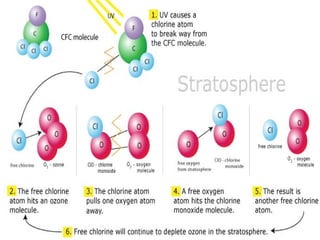
The hole occurs at the area where there is no oxygen atom in the stratosphere
The major destructive element is the chlorine atom
65.
in Antarcticathe increase of active chlorine is
enlarged by the existence of polar
stratospheric clouds
Due to extremely low temperature in the
Antarctica region , water & nitric acid
condense to materialize ice clouds called
polar stratospheric clouds
66.
these cloudsreduce the oxygen containing molecules & nitrogen
gas molecule
the size and ozone thickness of Antarctic ozone holes is fluctuating
through out the years
The amount of UV B radiation reaching the Antarctic grounds in the
spring , when the sun is highest in the sky with lowest ozone
concentration increases by a factor of 3 to 6
Spring time in Antarctica is the most dangerous in terms of UV
levels
67.
Ozone depleting gases
CFCs, Halons, Methyl chloroform, Methyl bromide,
CCL4
Halons- efficient-higher ODP
CFCs, Halons- released in to atmosphere-take 7 years to
reach stratosphere- UV light-chlorine released-react with
ozone-depletion.
Harmful radiation pass through earth surface.
68.
Types of UVradiation
UV-A radiation:- Emitted at wavelength of 315-
400 nm-unaffected by ozone reduction-not
harmful
UV-B radiation:- 280-315nm-decrease ozone-
damage to plant and animals.
UV-C radiation:- 200-280nm- Lethal-completely
absorbed-ozone and oxygen.
69.
Ecological effects
1.Impact on the oceans
UV-B- reduce food phytoplankton-so
zooplankton affected
Damage small fish, shrimp and crab larvae.
Decrease the fish yield.
70.
2. globalwarming
Increase green house warming-reduce the
effectiveness of CO2 sink in oceans.
Large amount of CO2 in atmosphere.
3. Impact on land plants
Rice production –drastically reduced-by UV-B on
the N2 assimilating activities of micro organism
Inhibit pollen germination.
71.
4.Damage tomaterial
UV- many material to degrade more rapidly
PVC sliding, window and door frame, pipes,
gutters-degrade faster.
72.
Measures on controlling
theproblems
set some laws to limit the amount of pollutants
produced by factories.
develop the skills of using renewable fuels , e.g.
solar energy, wind energy.
encourage the factories to replace fossil fuels
by renewable fuels, which would not cause
environmental pollution.
carry out energy saving scheme -> reduce the
pollution produced by burning fossil fuels
73.
build moreplants -> reduce the pollutants e.g. CO2
reduce the use of plastic bags -> as burning plastic
emit CH4
recycle the resources, e.g. plastic
reduce the use of sprays -> as CFCs would be
emitted out
reduce the use of air-conditioner, which will emit
CFCs
use public transportation instead of private cars ->
reduce the pollutants emitted by cars
74.
CONCLUSION
Anthropogenic activitiesare destroying our
atmosphere- all the resources that are
available in our environment are not only for
the present use and also for future- we have
to conserve & take effective measures to
control these activities- also create awareness
to public about adverse effect of these
phenomena's.
75.
REFERENCE
Hand bookof fisheries and Aquaculture ,
2011 ,Indian Council Of Agriculture , 40-47, 795-821.
Global warming and climate change ,
Velma.I.Grover , 12- 15
CMFRI annual report 2013-14 ,181 – 190
org/wiki/Kyoto_Protocol
org/wiki/Ipcc
ec.gc.ca/e/ozone/ClimateChange
Editor's Notes
#53 Figure 20.14
Solutions: methods for slowing atmospheric warming during this century. QUESTION: Which five of these mitigation solutions do you think are the most important?