MORAL AND MOTIVATION
THEORY
M. M. ZOSI
1/11/2023 1
M. M. ZOSI
Developmental dimensions
 Psychosexual
 Psychosocial
 Cognitive
 Learning and behavior
 Moral
 Motivation and emotion
1/11/2023 2
M. M. ZOSI
MORAL DEVELOPMENT
(Lawrence Kohlberg)
 -An American psychologist partly
influenced by Piaget.
 -He proposed three levels of moral
development, each having two
stages:
1/11/2023 3
M. M. ZOSI
1. Pre-Conventional level.
 Type of moral reasoning used by
children aged 4 and 10 years.
 Moral decisions tend to be
egocentric i.e. based on personal
interest.
 There are two stages in this level:
1/11/2023 4
M. M. ZOSI
a) Stage I: Punishment-Obedience
Orientation.
 Children assess for themselves how
good or bad they are on the basis of
rewards and punishments
administered by adults.
 Rules are perceived as being
absolute and ought to be observed,
irrespective of the circumstances.
1/11/2023 5
M. M. ZOSI
b) Stage II: Instrumental-Relativist
Orientation
 In the child’s view, what is right is
what makes one happy.
 The child refrains from being unfair
so that others will not be unfair to
him/her.
1/11/2023 6
M. M. ZOSI
2. Conventional level
 Moral reasoning is more socio-
centric as it takes into account the
interests of others in a given society.
 There is a strong desire to conform
to social norms, as well as to
support and justify them.
 Majority of adolescents and adults
operate at this stage.
1/11/2023 7
M. M. ZOSI
c) Stage III: Good boy – Nice girl
Orientation.
 The child does not engage in
unacceptable behavior in order to
impress upon his/her parents/adults
that he/she is a good child.
 Children behave well in order to win
others’ approval rather than
because they believe in a given
moral principle.
1/11/2023 8
M. M. ZOSI
They also tend to conform to the
opinion of the majority, and
when making judgments take
into account the motive for a
given behavior
1/11/2023 9
M. M. ZOSI
d) Stage IV: Law and Order Orientation.
 The law serves as a guiding principle so
that a person will refuse to engage in
certain behavior as long as the law
forbids such behavior.
 It is understood that the law is to be
maintained at all costs.
1/11/2023 10
M. M. ZOSI
 The operation of society and
institutions is governed by
regulations or rules. If these are not
observed and obeyed, chaos is
likely to ensue.
 A person’s acceptance by society
depends on his/her conforming to its
laws.
1/11/2023 11
M. M. ZOSI
3. Post – Conventional level
 Here one is neither egocentric nor
sociocentric, but autonomous in
his/her judgment.
 S/he maintains principles of justice
which transcend existing laws as
well as acceptable conventions if
these happen to be in conflict with
what is perceived to be man’s basic
rights and whatever is considered to
be in man’s best interests.
1/11/2023 12
M. M. ZOSI
e) Stage V: Social Contract
Orientation.
 Here, it is recognized that there are
situations in which laws may have to
be broken, and that where laws are
unfair, they must be altered.
 It is also held that rules should
involve mutual agreement and that
their purpose should be to protect
the rights of individuals.
1/11/2023 13
M. M. ZOSI
Society is viewed as the source
of law and a force that can
change the law if necessary.
A change in law is understood to
change the interpretation of
what is right and wrong.
At this stage, nothing is
considered absolute.
1/11/2023 14
M. M. ZOSI
f) Stage VI: Universal Ethical
Principle Orientation.
 Highest stage of moral development
proposed by Kohlberg and not many
people ever reach it.
 Here principles are based on human
life.
 It is held that the concept of justice
is beyond established order and
justice is universal.
1/11/2023 15
M. M. ZOSI
 Those operating at this stage have an
abiding interest in the equality of people,
the golden rule and human dignity, and
the universality of such principles.
 Life is held to take precedence over all
other human conventions.
 It is asserted that whatever situation a
person is faced with, s/he ought to
examine all the factors involved and
make a suitable decision.
1/11/2023 16
M. M. ZOSI
Theories of motivation
 Instinct theory
 Drive reduction theory
 Arousal theory
 Humanistic theory
 Psychoanalytic theory
1/11/2023 17
M. M. ZOSI
Theories of motivation
Instinct Theory
 Derived from our biological make-up.
 All creatures are born with specific
innate knowledge about how to survive
e.g reflexes (sucking, swallowing,
coughing, blinking. )
 Babies are born with a unique ability that
allows them to survive; they are born
with the ability to cry.
 Crying allows a human infant to survive.
1/11/2023 18
M. M. ZOSI
 Newborns can perform physical
movements to avoid pain; they will
turn their head if touched on their
cheek and search for a nipple
(rooting reflex); and they will grasp
an object that touches the palm of
their hands.
1/11/2023 19
M. M. ZOSI
Drive Reduction Theory
 According to Clark Hull (1943,
1952), humans have internal
biological needs which motivate us
to perform a certain way.
 These needs, or drives, are defined
by Hull as internal states of arousal
or tension which must be reduced.
1/11/2023 20
M. M. ZOSI
E.g. hunger or thirst, which
motivates us to eat.
According to this theory, we are
driven to reduce these drives so
that we may maintain a sense of
internal calmness.
1/11/2023 21
M. M. ZOSI
Arousal Theory
 It states that we are driven to maintain a
certain level of arousal in order to feel
comfortable.
 Arousal refers to a state of emotional,
intellectual, and physical activity.
 It is different from the drive reduction
theory,, because it doesn't rely on only a
reduction of tension, but a balanced
amount.
1/11/2023 22
M. M. ZOSI
Psychoanalytic Theory
 As part of this theory, he believed that
humans have only two basic drives: Eros
and Thanatos, or the Life and Death
drives.
 According to Psychoanalytic theory,
everything we do, every thought we
have, and every emotion we experience
has one of two goals: to help us survive
or to prevent our destruction.
1/11/2023 23
M. M. ZOSI
 This is similar to instinct theory, however,
Freud believed that the vast majority of
our knowledge about these drives is
buried in the unconscious part of the
mind.
 Psychoanalytic theory therefore argues
that we go to school because it will help
assure our survival in terms of improved
finances, more money for healthcare, or
even an improved ability to find a spouse
1/11/2023 24
M. M. ZOSI
Humanistic Theory
 According to this theory, humans
are driven to achieve their maximum
potential and will always do so
unless obstacles are placed in their
way.
 These obstacles include hunger,
thirst, financial problems, safety
issues, or anything else that takes
our focus away from maximum
psychological growth.
1/11/2023 25
M. M. ZOSI
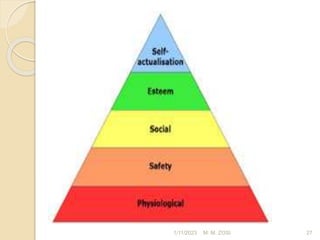
 The best way to describe this theory is to
utilize the famous pyramid developed by
Abraham Maslow (1970) called the
Hierarchy of Needs.
1/11/2023 26
M. M. ZOSI
1/11/2023 27
M. M. ZOSI
1. Biological and Physiological
needs - air, food, drink, shelter,
warmth, sex, sleep, etc.
2. Safety needs - protection from
elements, security, order, law,
stability, etc.
3. Love and belongingness needs -
friendship, intimacy, affection and
love, - from work group, family,
friends, romantic relationships
1/11/2023 28
M. M. ZOSI
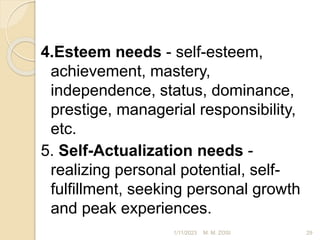
4.Esteem needs - self-esteem,
achievement, mastery,
independence, status, dominance,
prestige, managerial responsibility,
etc.
5. Self-Actualization needs -
realizing personal potential, self-
fulfillment, seeking personal growth
and peak experiences.
1/11/2023 29
M. M. ZOSI
STRESS AND COPING
1/11/2023 30
M. M. ZOSI
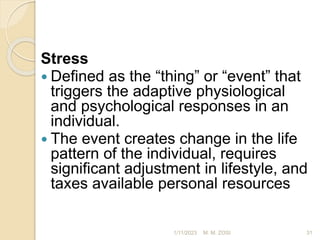
Stress
 Defined as the “thing” or “event” that
triggers the adaptive physiological
and psychological responses in an
individual.
 The event creates change in the life
pattern of the individual, requires
significant adjustment in lifestyle, and
taxes available personal resources
1/11/2023 31
M. M. ZOSI
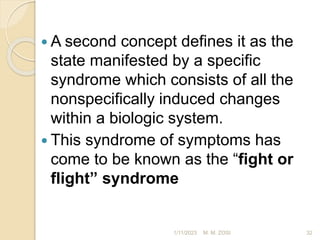
 A second concept defines it as the
state manifested by a specific
syndrome which consists of all the
nonspecifically induced changes
within a biologic system.
 This syndrome of symptoms has
come to be known as the “fight or
flight” syndrome
1/11/2023 32
M. M. ZOSI
 Selye called this general reaction of the
body to stress the general adaptation
syndrome.
 He described three distinct stages of the
reaction:
1/11/2023 33
M. M. ZOSI
 Alarm Reaction Stage. During this
stage, the physiological responses of the
“fight or flight” syndrome are initiated.
 Stage of Resistance. The individual
uses the physiological responses of the
first stage as a defense in the attempt to
adapt to the stressor. If adaptation
occurs, the third stage is prevented or
delayed. Physiological symptoms may
disappear.
1/11/2023 34
M. M. ZOSI
 Stage of Exhaustion. This stage occurs
when there is a prolonged exposure to
the stressor to which the body has
become adjusted. The adaptive energy
is depleted, and the individual can no
longer draw from the resources for
adaptation described in the first two
stages. Diseases of adaptation (e.g.,
headaches, mental disorders, coronary
artery disease, ulcers, colitis) may occur.
Without intervention in some cases
even death, ensues
1/11/2023 35
M. M. ZOSI
Stress management
 Involves the use of coping strategies in
response to stressful situations.
 Coping strategies are adaptive when
they protect the individual from harm (or
additional harm) or strengthen the
individual’s ability to meet challenging
situations ,
1/11/2023 36
M. M. ZOSI
Adaptive Coping Strategies
Awareness
The initial step in managing stress is
awareness—to become aware of the
factors that create stress and the
feelings associated with a stressful
response.
As one becomes aware of stressors, he or
she can omit, avoid, or accept them.
1/11/2023 37
M. M. ZOSI
 Relaxation
Individuals experience relaxation in
different ways.
Some individuals relax by engaging in
large motor activities, such as sports,
jogging, and physical exercise.
Still others use techniques such as
breathing exercises and progressive
relaxation to relieve stress
1/11/2023 38
M. M. ZOSI
 Meditation
Practiced 20 minutes once or twice
daily, meditation has been shown to
produce a lasting reduction in blood
pressure and other stress-related
symptoms
1/11/2023 39
M. M. ZOSI
 Interpersonal Communication
With Caring Other
Talking the problem out” with an
individual who is empathetic to
interrupt escalation of the stress
response. Writing about one’s
feelings in a journal or diary can
also be therapeutic.
1/11/2023 40
M. M. ZOSI
 Problem Solving
An extremely adaptive coping
strategy is to view the situation
objectively or to seek assistance
from another individual to
accomplish this if the anxiety level is
too high to concentrate. After an
objective assessment of the
situation, the problem-
solving/decision-making model can
be instituted as follows:
1/11/2023 41
M. M. ZOSI
 Assess the facts of the situation.
 Formulate goals for resolution of the
stressful situation.
 Study the alternatives for dealing with
the situation.
 Determine the risks and benefits of each
alternative.
1/11/2023 42
M. M. ZOSI
 Select an alternative.
 Implement the alternative selected.
 Evaluate the outcome of the alternative
implemented.
 If the first choice is ineffective, select and
implement a second option
1/11/2023 43
M. M. ZOSI
Music
 Creating and listening to music stimulate
motivation, enjoyment, and relaxation.
Music can reduce depression and bring
about measurable changes in mood
and general activity
1/11/2023 44
M. M. ZOSI
END: QUESTIONS?
1/11/2023 45
M. M. ZOSI

Occupational health community

  • 1.
    MORAL AND MOTIVATION THEORY M.M. ZOSI 1/11/2023 1 M. M. ZOSI
  • 2.
    Developmental dimensions  Psychosexual Psychosocial  Cognitive  Learning and behavior  Moral  Motivation and emotion 1/11/2023 2 M. M. ZOSI
  • 3.
    MORAL DEVELOPMENT (Lawrence Kohlberg) -An American psychologist partly influenced by Piaget.  -He proposed three levels of moral development, each having two stages: 1/11/2023 3 M. M. ZOSI
  • 4.
    1. Pre-Conventional level. Type of moral reasoning used by children aged 4 and 10 years.  Moral decisions tend to be egocentric i.e. based on personal interest.  There are two stages in this level: 1/11/2023 4 M. M. ZOSI
  • 5.
    a) Stage I:Punishment-Obedience Orientation.  Children assess for themselves how good or bad they are on the basis of rewards and punishments administered by adults.  Rules are perceived as being absolute and ought to be observed, irrespective of the circumstances. 1/11/2023 5 M. M. ZOSI
  • 6.
    b) Stage II:Instrumental-Relativist Orientation  In the child’s view, what is right is what makes one happy.  The child refrains from being unfair so that others will not be unfair to him/her. 1/11/2023 6 M. M. ZOSI
  • 7.
    2. Conventional level Moral reasoning is more socio- centric as it takes into account the interests of others in a given society.  There is a strong desire to conform to social norms, as well as to support and justify them.  Majority of adolescents and adults operate at this stage. 1/11/2023 7 M. M. ZOSI
  • 8.
    c) Stage III:Good boy – Nice girl Orientation.  The child does not engage in unacceptable behavior in order to impress upon his/her parents/adults that he/she is a good child.  Children behave well in order to win others’ approval rather than because they believe in a given moral principle. 1/11/2023 8 M. M. ZOSI
  • 9.
    They also tendto conform to the opinion of the majority, and when making judgments take into account the motive for a given behavior 1/11/2023 9 M. M. ZOSI
  • 10.
    d) Stage IV:Law and Order Orientation.  The law serves as a guiding principle so that a person will refuse to engage in certain behavior as long as the law forbids such behavior.  It is understood that the law is to be maintained at all costs. 1/11/2023 10 M. M. ZOSI
  • 11.
     The operationof society and institutions is governed by regulations or rules. If these are not observed and obeyed, chaos is likely to ensue.  A person’s acceptance by society depends on his/her conforming to its laws. 1/11/2023 11 M. M. ZOSI
  • 12.
    3. Post –Conventional level  Here one is neither egocentric nor sociocentric, but autonomous in his/her judgment.  S/he maintains principles of justice which transcend existing laws as well as acceptable conventions if these happen to be in conflict with what is perceived to be man’s basic rights and whatever is considered to be in man’s best interests. 1/11/2023 12 M. M. ZOSI
  • 13.
    e) Stage V:Social Contract Orientation.  Here, it is recognized that there are situations in which laws may have to be broken, and that where laws are unfair, they must be altered.  It is also held that rules should involve mutual agreement and that their purpose should be to protect the rights of individuals. 1/11/2023 13 M. M. ZOSI
  • 14.
    Society is viewedas the source of law and a force that can change the law if necessary. A change in law is understood to change the interpretation of what is right and wrong. At this stage, nothing is considered absolute. 1/11/2023 14 M. M. ZOSI
  • 15.
    f) Stage VI:Universal Ethical Principle Orientation.  Highest stage of moral development proposed by Kohlberg and not many people ever reach it.  Here principles are based on human life.  It is held that the concept of justice is beyond established order and justice is universal. 1/11/2023 15 M. M. ZOSI
  • 16.
     Those operatingat this stage have an abiding interest in the equality of people, the golden rule and human dignity, and the universality of such principles.  Life is held to take precedence over all other human conventions.  It is asserted that whatever situation a person is faced with, s/he ought to examine all the factors involved and make a suitable decision. 1/11/2023 16 M. M. ZOSI
  • 17.
    Theories of motivation Instinct theory  Drive reduction theory  Arousal theory  Humanistic theory  Psychoanalytic theory 1/11/2023 17 M. M. ZOSI
  • 18.
    Theories of motivation InstinctTheory  Derived from our biological make-up.  All creatures are born with specific innate knowledge about how to survive e.g reflexes (sucking, swallowing, coughing, blinking. )  Babies are born with a unique ability that allows them to survive; they are born with the ability to cry.  Crying allows a human infant to survive. 1/11/2023 18 M. M. ZOSI
  • 19.
     Newborns canperform physical movements to avoid pain; they will turn their head if touched on their cheek and search for a nipple (rooting reflex); and they will grasp an object that touches the palm of their hands. 1/11/2023 19 M. M. ZOSI
  • 20.
    Drive Reduction Theory According to Clark Hull (1943, 1952), humans have internal biological needs which motivate us to perform a certain way.  These needs, or drives, are defined by Hull as internal states of arousal or tension which must be reduced. 1/11/2023 20 M. M. ZOSI
  • 21.
    E.g. hunger orthirst, which motivates us to eat. According to this theory, we are driven to reduce these drives so that we may maintain a sense of internal calmness. 1/11/2023 21 M. M. ZOSI
  • 22.
    Arousal Theory  Itstates that we are driven to maintain a certain level of arousal in order to feel comfortable.  Arousal refers to a state of emotional, intellectual, and physical activity.  It is different from the drive reduction theory,, because it doesn't rely on only a reduction of tension, but a balanced amount. 1/11/2023 22 M. M. ZOSI
  • 23.
    Psychoanalytic Theory  Aspart of this theory, he believed that humans have only two basic drives: Eros and Thanatos, or the Life and Death drives.  According to Psychoanalytic theory, everything we do, every thought we have, and every emotion we experience has one of two goals: to help us survive or to prevent our destruction. 1/11/2023 23 M. M. ZOSI
  • 24.
     This issimilar to instinct theory, however, Freud believed that the vast majority of our knowledge about these drives is buried in the unconscious part of the mind.  Psychoanalytic theory therefore argues that we go to school because it will help assure our survival in terms of improved finances, more money for healthcare, or even an improved ability to find a spouse 1/11/2023 24 M. M. ZOSI
  • 25.
    Humanistic Theory  Accordingto this theory, humans are driven to achieve their maximum potential and will always do so unless obstacles are placed in their way.  These obstacles include hunger, thirst, financial problems, safety issues, or anything else that takes our focus away from maximum psychological growth. 1/11/2023 25 M. M. ZOSI
  • 26.
     The bestway to describe this theory is to utilize the famous pyramid developed by Abraham Maslow (1970) called the Hierarchy of Needs. 1/11/2023 26 M. M. ZOSI
  • 27.
  • 28.
    1. Biological andPhysiological needs - air, food, drink, shelter, warmth, sex, sleep, etc. 2. Safety needs - protection from elements, security, order, law, stability, etc. 3. Love and belongingness needs - friendship, intimacy, affection and love, - from work group, family, friends, romantic relationships 1/11/2023 28 M. M. ZOSI
  • 29.
    4.Esteem needs -self-esteem, achievement, mastery, independence, status, dominance, prestige, managerial responsibility, etc. 5. Self-Actualization needs - realizing personal potential, self- fulfillment, seeking personal growth and peak experiences. 1/11/2023 29 M. M. ZOSI
  • 30.
  • 31.
    Stress  Defined asthe “thing” or “event” that triggers the adaptive physiological and psychological responses in an individual.  The event creates change in the life pattern of the individual, requires significant adjustment in lifestyle, and taxes available personal resources 1/11/2023 31 M. M. ZOSI
  • 32.
     A secondconcept defines it as the state manifested by a specific syndrome which consists of all the nonspecifically induced changes within a biologic system.  This syndrome of symptoms has come to be known as the “fight or flight” syndrome 1/11/2023 32 M. M. ZOSI
  • 33.
     Selye calledthis general reaction of the body to stress the general adaptation syndrome.  He described three distinct stages of the reaction: 1/11/2023 33 M. M. ZOSI
  • 34.
     Alarm ReactionStage. During this stage, the physiological responses of the “fight or flight” syndrome are initiated.  Stage of Resistance. The individual uses the physiological responses of the first stage as a defense in the attempt to adapt to the stressor. If adaptation occurs, the third stage is prevented or delayed. Physiological symptoms may disappear. 1/11/2023 34 M. M. ZOSI
  • 35.
     Stage ofExhaustion. This stage occurs when there is a prolonged exposure to the stressor to which the body has become adjusted. The adaptive energy is depleted, and the individual can no longer draw from the resources for adaptation described in the first two stages. Diseases of adaptation (e.g., headaches, mental disorders, coronary artery disease, ulcers, colitis) may occur. Without intervention in some cases even death, ensues 1/11/2023 35 M. M. ZOSI
  • 36.
    Stress management  Involvesthe use of coping strategies in response to stressful situations.  Coping strategies are adaptive when they protect the individual from harm (or additional harm) or strengthen the individual’s ability to meet challenging situations , 1/11/2023 36 M. M. ZOSI
  • 37.
    Adaptive Coping Strategies Awareness Theinitial step in managing stress is awareness—to become aware of the factors that create stress and the feelings associated with a stressful response. As one becomes aware of stressors, he or she can omit, avoid, or accept them. 1/11/2023 37 M. M. ZOSI
  • 38.
     Relaxation Individuals experiencerelaxation in different ways. Some individuals relax by engaging in large motor activities, such as sports, jogging, and physical exercise. Still others use techniques such as breathing exercises and progressive relaxation to relieve stress 1/11/2023 38 M. M. ZOSI
  • 39.
     Meditation Practiced 20minutes once or twice daily, meditation has been shown to produce a lasting reduction in blood pressure and other stress-related symptoms 1/11/2023 39 M. M. ZOSI
  • 40.
     Interpersonal Communication WithCaring Other Talking the problem out” with an individual who is empathetic to interrupt escalation of the stress response. Writing about one’s feelings in a journal or diary can also be therapeutic. 1/11/2023 40 M. M. ZOSI
  • 41.
     Problem Solving Anextremely adaptive coping strategy is to view the situation objectively or to seek assistance from another individual to accomplish this if the anxiety level is too high to concentrate. After an objective assessment of the situation, the problem- solving/decision-making model can be instituted as follows: 1/11/2023 41 M. M. ZOSI
  • 42.
     Assess thefacts of the situation.  Formulate goals for resolution of the stressful situation.  Study the alternatives for dealing with the situation.  Determine the risks and benefits of each alternative. 1/11/2023 42 M. M. ZOSI
  • 43.
     Select analternative.  Implement the alternative selected.  Evaluate the outcome of the alternative implemented.  If the first choice is ineffective, select and implement a second option 1/11/2023 43 M. M. ZOSI
  • 44.
    Music  Creating andlistening to music stimulate motivation, enjoyment, and relaxation. Music can reduce depression and bring about measurable changes in mood and general activity 1/11/2023 44 M. M. ZOSI
  • 45.