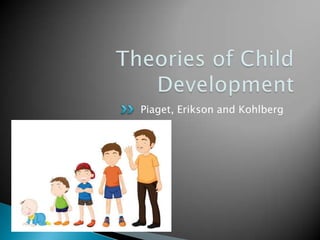
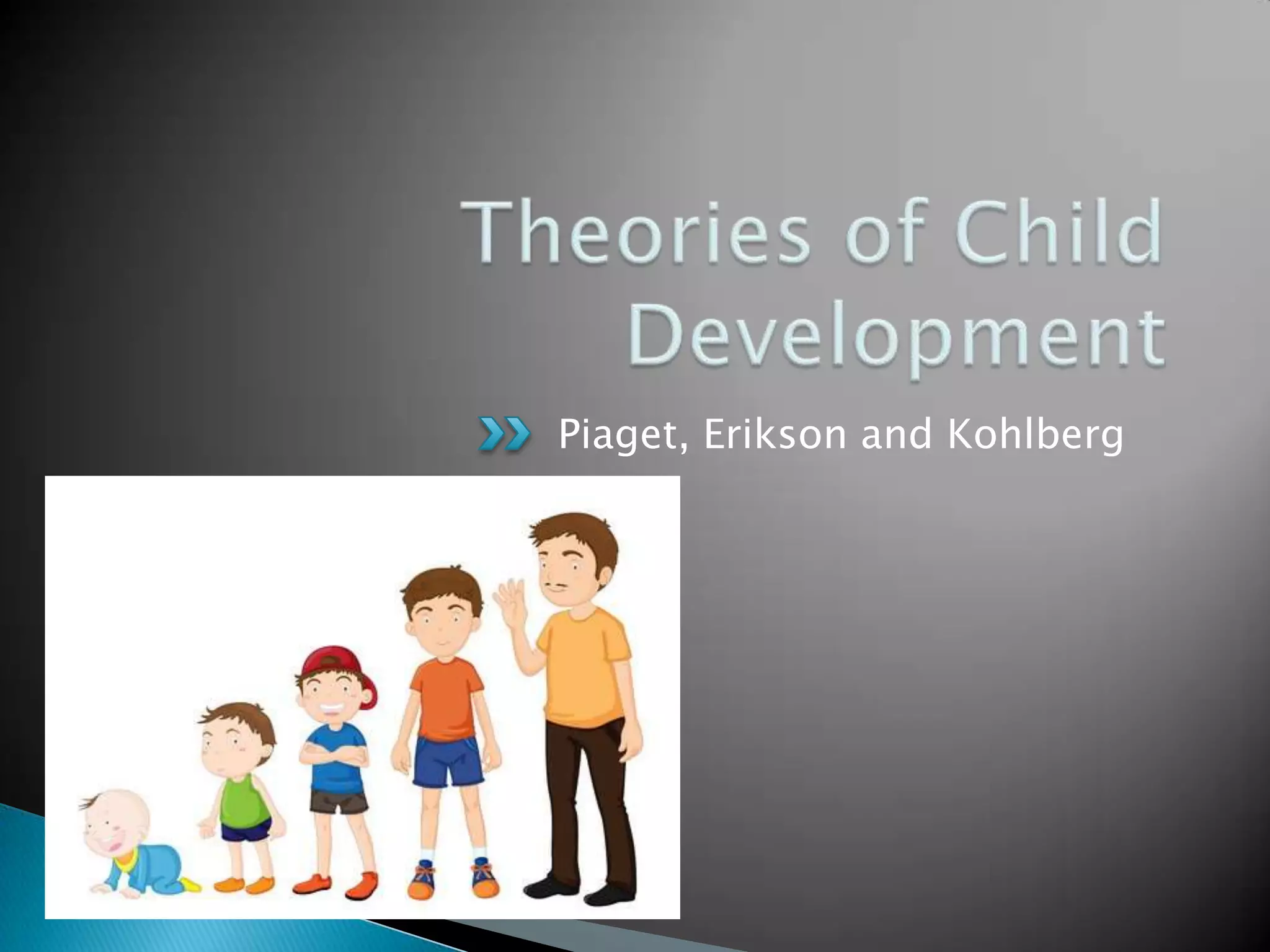
Piaget, Erikson and Kohlberg
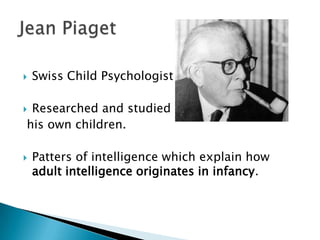
   Swiss Child Psychologist

Researched and studied his
his own children.

   Patters of intelligence which explain how
    adult intelligence originates in infancy.
   Appear in the same order for all children, but
    not always at the same age.

#1     Sensorimotor Period
#2     Preoperational Period
#3     Concrete Operations Period
#4     Formal Operations

*each have several sub-stages.

   Birth > Age 2
   Learn through senses and own actions

   Egocentric – thinking only about him or
    herself

   Object Permanence – the idea that an object
    exists even when it is not in view.

   Age 2 > Age 7

   Children think of everything in terms of:
    ◦ their own activities
    ◦ what they perceive at the moment

   Their unusual perspectives are often seen as
    “imaginative”
   Understand abstract language (love, beauty)
   Concentration is limited (one thing at a time)

   Often solve problems by pretending.

   Real and make believe are blurred.
   Age 7 > 11
   Children can think logically
   Still learn best from experience (senses)

   Need to see/experience a problem to solve it.

   Understand logical processes such as “the
    glasses experiment”
   Age 11 > adulthood
   Capable of symbolic learning – interpreting
    meaning from words, symbols, numbers.

   Do not need to experience something to
    understand it. (logical, critical, compassionate)

   Able to make plans, goals for the future.
   Detect subtle or hidden meaning.
The 8 Stages
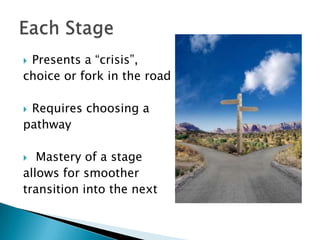
Presents a “crisis”,
choice or fork in the road

Requires choosing a
pathway

  Mastery of a stage
allows for smoother
transition into the next
   Successes and failures mould how we see the
    world, ourselves and others.

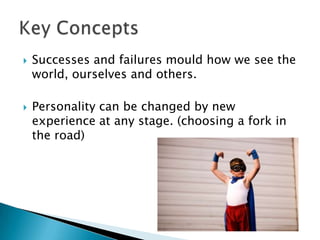
   Personality can be changed by new
    experience at any stage. (choosing a fork in
    the road)
   Development depends on whether or not
    needs are being met.

   Trust comes with predictability of care.

   Unpredictability and uncertainty of
    care/support creates mistrust.
   Autonomy = independence, ability to stand
    alone.

   Age 2-3
   Taking care of themselves

   Independence through learning and exploring

   Need for encouraging caregivers

   Shame comes from discouragement and over-
    protection
   Age 4-5

   Child is learning to feel purposeful and take
    initiative

   Freedom, exploration and questioning
    “Why??”

   Guilt comes from criticism, lack of
    recognition
   Age 6 to 11
   Industry = making an effort

   Inferiority = feeling less important, defeated
   Expanding beyond family –
    school, sports, activities

   Importance of family life in preparing for
    school.
   Adolescence (12-18)
   Focus on peers and social groups

   Modelling yourself after someone

   Influence of friends, teachers, media and less
    focus on family
   Young adulthood

   Seeking out a partner, “testing the waters” of
    relationships

   Good experiences leads to intimacy

   Rejection, disappointment leads to isolation
   Mid-life
   Generativity = full, productive life
   Stagnation = lack of development

   Productivity creates a sense of
    accomplishment (family, career, kids)

   Stagnation fosters lack of achievement, low
    self worth
   Old age

   Integrity = completeness, pride

   “Am I proud of what I have done?”.

   Facing
    regrets, dissatisfaction, mistakes, failures.
   As humans move through the stages they
    progress from parental and familial
    relationships, to peers, and finally romantic.

    Mastery of each stage is not required, but
    helps navigate later stages.

   The last stage is the only one that cannot be
    revisited.
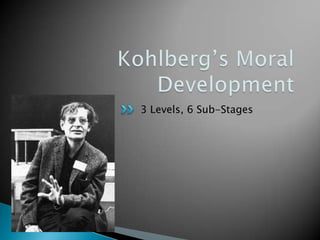
3 Levels, 6 Sub-Stages
   1920s-1980s

   American psychologist and university
    professor

   Expert in moral education and logic

   Interested in: How people respond to moral
    dilemmas!
   Level determined by the reasons a
    person gives for making a
    decision.
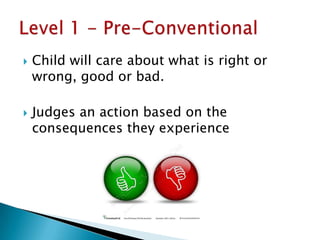
   Child will care about what is right or
    wrong, good or bad.

   Judges an action based on the
    consequences they experience
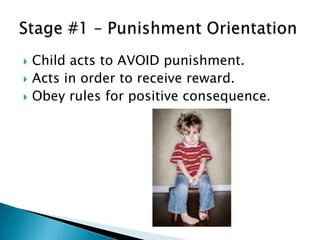
   Child acts to AVOID punishment.
   Acts in order to receive reward.
   Obey rules for positive consequence.
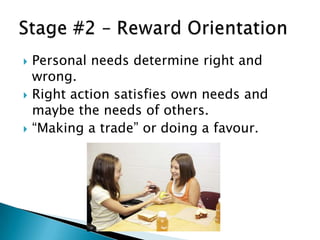
   Personal needs determine right and
    wrong.
   Right action satisfies own needs and
    maybe the needs of others.
   “Making a trade” or doing a favour.
   Make decisions to live up to the
    expectations of others.
   Family, Friends, Social Group, Nation, the
    Law
   Meeting these expectations is more
    important than consequences.
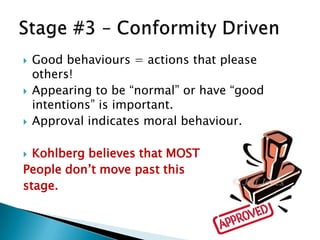
   Good behaviours = actions that please
    others!
   Appearing to be “normal” or have “good
    intentions” is important.
   Approval indicates moral behaviour.

 Kohlberg believes that MOST
People don’t move past this
stage.
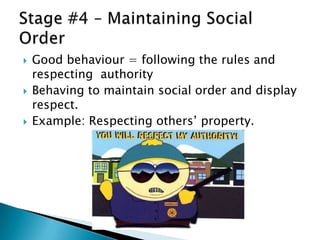
   Good behaviour = following the rules and
    respecting authority
   Behaving to maintain social order and display
    respect.
   Example: Respecting others’ property.
   A person identifies morality and values
    according to validity.
   Less influenced by authority and
    personal interest.
   Judgements based on abstract personal
    principles.
   Right actions determined by more “general
    rights”
   Agreed on by society as a whole
   Awareness of personal values and legal

   Not all cultures and societies have the same
    concepts of right and wrong.
   Right decision is a decision of personal
    conscience.

   Appeals to universal, consistent truths.

   Focus: Justice, Equality, Human Dignity.
   We have to go step by step – no skipping
    stages!

   Typically we don’t reach the higher stages.

   Having “role models” in the higher stages
    helps us grow. Learning by example.

   Stages progress from an individual to
    universal level.
   Pre-conventional
    ◦ consequences they see, meeting own needs.


   Conventional
    ◦ The expectations of others
    ◦ Rules and social order


   Post-conventional
    ◦ Abstract personal principles
    ◦ LESS on authority
   http://www.cbc.ca/news/canada/ottawa/stor
    y/2012/01/18/ottawa-odawa-
    fundraising.html

HHS 4M1 - Child Development

  • 1.
  • 2.
    Swiss Child Psychologist Researched and studied his his own children.  Patters of intelligence which explain how adult intelligence originates in infancy.
  • 3.
    Appear in the same order for all children, but not always at the same age. #1 Sensorimotor Period #2 Preoperational Period #3 Concrete Operations Period #4 Formal Operations *each have several sub-stages.
  • 4.
    Birth > Age 2  Learn through senses and own actions  Egocentric – thinking only about him or herself  Object Permanence – the idea that an object exists even when it is not in view.
  • 5.
    Age 2 > Age 7  Children think of everything in terms of: ◦ their own activities ◦ what they perceive at the moment  Their unusual perspectives are often seen as “imaginative”  Understand abstract language (love, beauty)
  • 6.
    Concentration is limited (one thing at a time)  Often solve problems by pretending.  Real and make believe are blurred.
  • 7.
    Age 7 > 11  Children can think logically  Still learn best from experience (senses)  Need to see/experience a problem to solve it.  Understand logical processes such as “the glasses experiment”
  • 8.
    Age 11 > adulthood  Capable of symbolic learning – interpreting meaning from words, symbols, numbers.  Do not need to experience something to understand it. (logical, critical, compassionate)  Able to make plans, goals for the future.  Detect subtle or hidden meaning.
  • 10.
  • 11.
    Presents a “crisis”, choiceor fork in the road Requires choosing a pathway  Mastery of a stage allows for smoother transition into the next
  • 12.
    Successes and failures mould how we see the world, ourselves and others.  Personality can be changed by new experience at any stage. (choosing a fork in the road)
  • 13.
    Development depends on whether or not needs are being met.  Trust comes with predictability of care.  Unpredictability and uncertainty of care/support creates mistrust.
  • 14.
    Autonomy = independence, ability to stand alone.  Age 2-3  Taking care of themselves  Independence through learning and exploring  Need for encouraging caregivers  Shame comes from discouragement and over- protection
  • 15.
    Age 4-5  Child is learning to feel purposeful and take initiative  Freedom, exploration and questioning “Why??”  Guilt comes from criticism, lack of recognition
  • 16.
    Age 6 to 11  Industry = making an effort  Inferiority = feeling less important, defeated  Expanding beyond family – school, sports, activities  Importance of family life in preparing for school.
  • 17.
    Adolescence (12-18)  Focus on peers and social groups  Modelling yourself after someone  Influence of friends, teachers, media and less focus on family
  • 18.
    Young adulthood  Seeking out a partner, “testing the waters” of relationships  Good experiences leads to intimacy  Rejection, disappointment leads to isolation
  • 19.
    Mid-life  Generativity = full, productive life  Stagnation = lack of development  Productivity creates a sense of accomplishment (family, career, kids)  Stagnation fosters lack of achievement, low self worth
  • 20.
    Old age  Integrity = completeness, pride  “Am I proud of what I have done?”.  Facing regrets, dissatisfaction, mistakes, failures.
  • 21.
    As humans move through the stages they progress from parental and familial relationships, to peers, and finally romantic.  Mastery of each stage is not required, but helps navigate later stages.  The last stage is the only one that cannot be revisited.
  • 22.
    3 Levels, 6Sub-Stages
  • 23.
    1920s-1980s  American psychologist and university professor  Expert in moral education and logic  Interested in: How people respond to moral dilemmas!
  • 24.
    Level determined by the reasons a person gives for making a decision.
  • 25.
    Child will care about what is right or wrong, good or bad.  Judges an action based on the consequences they experience
  • 26.
    Child acts to AVOID punishment.  Acts in order to receive reward.  Obey rules for positive consequence.
  • 27.
    Personal needs determine right and wrong.  Right action satisfies own needs and maybe the needs of others.  “Making a trade” or doing a favour.
  • 28.
    Make decisions to live up to the expectations of others.  Family, Friends, Social Group, Nation, the Law  Meeting these expectations is more important than consequences.
  • 29.
    Good behaviours = actions that please others!  Appearing to be “normal” or have “good intentions” is important.  Approval indicates moral behaviour.  Kohlberg believes that MOST People don’t move past this stage.
  • 30.
    Good behaviour = following the rules and respecting authority  Behaving to maintain social order and display respect.  Example: Respecting others’ property.
  • 31.
    A person identifies morality and values according to validity.  Less influenced by authority and personal interest.  Judgements based on abstract personal principles.
  • 32.
    Right actions determined by more “general rights”  Agreed on by society as a whole  Awareness of personal values and legal  Not all cultures and societies have the same concepts of right and wrong.
  • 33.
    Right decision is a decision of personal conscience.  Appeals to universal, consistent truths.  Focus: Justice, Equality, Human Dignity.
  • 34.
    We have to go step by step – no skipping stages!  Typically we don’t reach the higher stages.  Having “role models” in the higher stages helps us grow. Learning by example.  Stages progress from an individual to universal level.
  • 35.
    Pre-conventional ◦ consequences they see, meeting own needs.  Conventional ◦ The expectations of others ◦ Rules and social order  Post-conventional ◦ Abstract personal principles ◦ LESS on authority
  • 38.
    http://www.cbc.ca/news/canada/ottawa/stor y/2012/01/18/ottawa-odawa- fundraising.html