Presented by :
Rushikesh D Mendhe
Roll no - 511
M. Pharm Ist Year
(Department of Pharmaceutics)
1
Guided by :
Mrs. Neetu Khatri
Dr. D.Y Patil College of Pharmacy
Akurdi, Pune
CONTENT :
 INTRODUCTION.
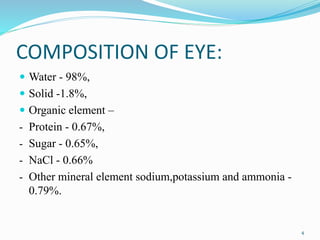
 COMPOSITION OF EYE
 ANATOMY OF EYE
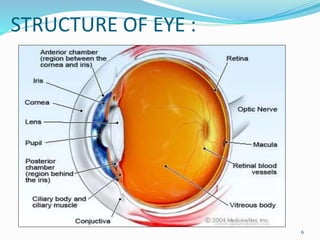
 STRUCTURE OF EYE
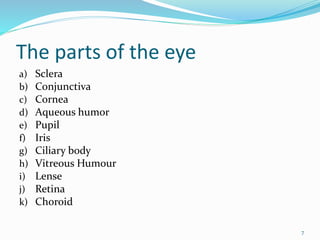
 THE PARTS OF THE EYE
 ROUTES OF OCULAR DRUG DELIVERY
 BARRIERS FOR OCULAR DELIVERY
 MECHANISM OF OCULAR DRUG DELIVERY
 OCULAR DRUG DELIVERY SYSTEMS
 EVALUATION OF OCDDS
 ACCELERATED STABILITY STUDIES
 MARKETED OPTHALMIC PREPARATIONS
 REFERENCES
2
INTRODUCTION :
 Eye is the most easily accessible site for topical
administration of a medication.
 In ocular drug delivery system the administration of a
drug through the eyes.
 It shows very poor bioavailability due to the drug flow
with the lacrimal fluid
 Ocular administration of drug is primarily associated
with the need to treat ophthalmic diseases.
 Ideal ophthalmic drug delivery must be able to sustain
the drug release and to remain in the vicinity of front
of the eye for prolong period of time.
3
COMPOSITION OF EYE:
 Water - 98%,
 Solid -1.8%,
 Organic element –
- Protein - 0.67%,
- Sugar - 0.65%,
- NaCl - 0.66%
- Other mineral element sodium,potassium and ammonia -
0.79%.
4
ANATOMY OF EYE :
 The eye is our organ of sight which is located in the
bony orbital cavity of the head.
 The combined weight of both spheres has been given
as 6.7-7.5gm, with a volume of approximately 6.5ml.
 The circumference of the eye is about 75mm.
 The eyeball is spherical in shape having diameter
about 1 inches. It houses many structures that work
together to facilitate sight.
5
STRUCTURE OF EYE :
6
The parts of the eye
a) Sclera
b) Conjunctiva
c) Cornea
d) Aqueous humor
e) Pupil
f) Iris
g) Ciliary body
h) Vitreous Humour
i) Lense
j) Retina
k) Choroid
7
ROUTES OF OCULAR DRUG DELIVERY:
There are several possible routes of drug delivery into the
ocular tissues. The selection of the route of administration
depends primarily on the target tissue.
a) Topical route :
- Dosage form given by topical route
- Mucoadhesive gels, gelifying formulations, ointments, and
inserts
b) Subconjunctival administration :
- Subconjunctival injections have been used to deliver drugs
at increased levels to the uvea
c) Intravitreal administration :
- Direct drug administration into the vitreous
8
BARRIERS FOR OCULAR DELIVERY:
a) Physiological barriers :
- After instillation, the flow of lacrimal fluid removes
instilled compounds from the surface of eye.
- Even though the lacrimal turnover rate is only about
1µl/min the excess volume of the instilled fluid is flown to
the nasolacrimal duct rapidly in a couple of minutes
b) Anatomical barriers :
- The corneal epithelial cells form tight junctions that limit
the paracellular drug permeation.
- Therefore, lipophilic drugs have typically at least an order
of magnitude higher permeability in the cornea than the
hydrophilic drugs.
9
c) Drug and dosage form related factors :
The rate of absorption from the administered site
depends highly on the physical properties of drug
molecule (solubility, lipophilicity, degree of ionization
and molecular weight) and ocular tissue structure.
- Solubility
- Lipophilicity
- Molecular weight and size
10
MECHANISM OF OCULAR DRUG
ABSORPTION
1. Corneal :
- Maximum absorption takes place through the cornea,
which leads the drug into aqueous humor.
- Trans cellular transport: transport between corneal
epithelium and stroma.
2. Non-corneal routes :
- The non-corneal route involves absorption across the
sclera and conjunctiva, this route is not productive as
it restrains the entry of drug into the intraocular
tissues.
11
OCULAR DELIVERY SYSTEMS :
A) CONVENTIONAL
- SOLUTIONS
- SUSPENSIONS
- EMULSIONS
- OINTMENT
- GELS
B) VESICULAR
- LIPOSOMES
- NIOSOMES
- PHARMACOSOMES
12
C) CONTROL RELEASE
- IMPLANTS
- INSERTS
- IONTOPORESIS
- COLLAGEN SHIELD
- CONTACT LENSES
- MICROONEEDLE
- MICROSUSPENSION
- NANOSUSPENSION
13
D) PARTICULATE
- MICROPARTICLES
- NANOPARTICLES
E) ADVANCED
- SCLERAL PLUGS
- GENE DELIVERY
- STEM CELL
14
Scleral Plugs :
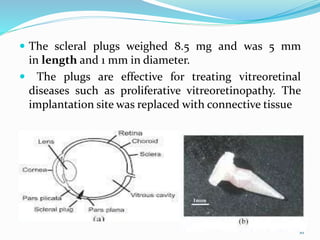
 Scleral plug can be implanted using a simple procedure at
the pars plana region of eye, made of biodegradable
polymers and drugs, and it gradually releases effective
doses of drugs for several months upon biodegradation.
 The release profiles vary with the kind of polymers used,
their molecular weights, and the amount of drug in the
plug.
 The plugs are effective for treating vitreoretinal diseases
such as proliferative vitreoretinopathy, cytomegalovirus
retinitis responds to repeated intravitreal injections and for
vitreoretinal disorders that require vitrectomy
15
 The scleral plugs weighed 8.5 mg and was 5 mm
in length and 1 mm in diameter.
 The plugs are effective for treating vitreoretinal
diseases such as proliferative vitreoretinopathy. The
implantation site was replaced with connective tissue
16
Gene Therapy :
 Along with tissue engineering, gene therapy
approaches stand on the front line of advanced
biomedical research to treat blindness arising from
corneal diseases, which are second only to cataract as
the leading cause of vision loss.
 Several kinds of viruses including adenovirus,
retrovirus, adeno-associated virus, and herpes simplex
140 virus, have been manipulated for use in gene
transfer and gene therapy applications
 Topical delivery to the eye is the most expedient way of
ocular gene delivery.
17
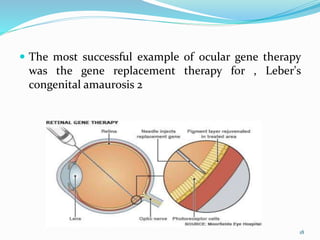
 The most successful example of ocular gene therapy
was the gene replacement therapy for , Leber's
congenital amaurosis 2
18
Stem Cell Therapy :
 Stem cell therapy, also known as regenerative medicine,
promotes the repair response of diseased, dysfunctional or
injured tissue using stem cells or their derivatives
 The most successful ocular application has been the use of
limbal stem cells, transplanted from a source other than
the patient for the renewal of corneal epithelium.
 The sources of limbal cells include donors, autografts,
cadaver eyes, and (recently) cells grown in culture.
 Stem-cell Therapy has demonstrated great success for
certain maladies of the anterior segment
19
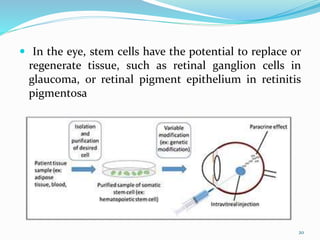
 In the eye, stem cells have the potential to replace or
regenerate tissue, such as retinal ganglion cells in
glaucoma, or retinal pigment epithelium in retinitis
pigmentosa
20
Evaluation test for Opthalmic
Products:
Occular Inserts :
1. Thickness of the film
2. Weight variation
3. Percent moisture content
4. Sterility test
5. Drug Content
6. Tensile Strength
7. Water Absorption test
21
Eye Drop :
1) Organoleptic characters :
- Colour
- Odour
2) pH
3) Viscosity
4) Isotonicity
5) Clearity test
6) Leakage test
7) Sterility test
- Membrane filtration technique
- Direct inoculation technique
8) Drug content uniformity
- Bottle method
- Diffusion method
- Modified rotating paddle apparatus
22
Eye Suspension :
1 ) Organoleptic characters :
- Colour
- Odour
2) pH
3) Viscosity
4) Isotonicity
5) Leakage test
6) Sterility test
- Membrane filtration technique
- Direct inoculation technique
7) Drug content uniformity
- Bottle method
- Diffusion method
- Modified rotating paddle apparatus
23
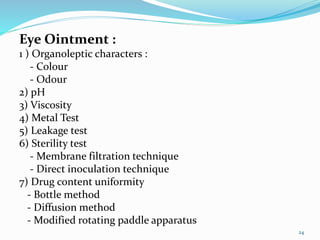
Eye Ointment :
1 ) Organoleptic characters :
- Colour
- Odour
2) pH
3) Viscosity
4) Metal Test
5) Leakage test
6) Sterility test
- Membrane filtration technique
- Direct inoculation technique
7) Drug content uniformity
- Bottle method
- Diffusion method
- Modified rotating paddle apparatus
24
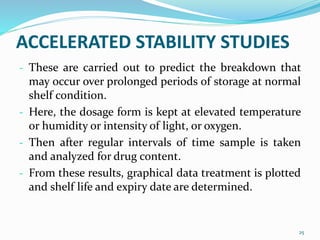
ACCELERATED STABILITY STUDIES
- These are carried out to predict the breakdown that
may occur over prolonged periods of storage at normal
shelf condition.
- Here, the dosage form is kept at elevated temperature
or humidity or intensity of light, or oxygen.
- Then after regular intervals of time sample is taken
and analyzed for drug content.
- From these results, graphical data treatment is plotted
and shelf life and expiry date are determined.
25
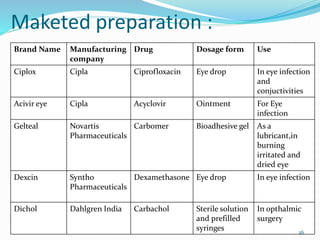
Maketed preparation :
Brand Name Manufacturing
company
Drug Dosage form Use
Ciplox Cipla Ciprofloxacin Eye drop In eye infection
and
conjuctivities
Acivir eye Cipla Acyclovir Ointment For Eye
infection
Gelteal Novartis
Pharmaceuticals
Carbomer Bioadhesive gel As a
lubricant,in
burning
irritated and
dried eye
Dexcin Syntho
Pharmaceuticals
Dexamethasone Eye drop In eye infection
Dichol Dahlgren India Carbachol Sterile solution
and prefilled
syringes
In opthalmic
surgery
26
REFERENCES :
 Sikandar K. , Sharma P. K. and Visht S. , ’Ocular drug
delivery systems: An overview’ , International Journal
Of Pharmaceutical Sciences And Research,Volume III,
2017 ; 7-28
 Zahra Jafariazar, Nasim Jamalinia, Fatemeh Ghorbani-
Bidkorbeh, and Seyed Alireza Mortazavib,’ Design and
Evaluation of Ocular Controlled Delivery System’
Iranian1 Journal of Pharmaceutical Research,Vol-14,
2015, 21-33
 Klausner EA, Peer D, Chapman RL, Multack RF,
Andurkar SV, ‘Review Corneal gene therapy’, Journal of
Controlled Release, 124, 2007, 107–133.
27
 Pellegrinia G, Lucaa MD, Arsenijevicc Y, Review
towards therapeutic application of ocular stem cells,
Seminars in Cell & Developmental Biology, 18, 2007,
805–818
28
29

Occular Drug Delivery System

  • 1.
    Presented by : RushikeshD Mendhe Roll no - 511 M. Pharm Ist Year (Department of Pharmaceutics) 1 Guided by : Mrs. Neetu Khatri Dr. D.Y Patil College of Pharmacy Akurdi, Pune
  • 2.
    CONTENT :  INTRODUCTION. COMPOSITION OF EYE  ANATOMY OF EYE  STRUCTURE OF EYE  THE PARTS OF THE EYE  ROUTES OF OCULAR DRUG DELIVERY  BARRIERS FOR OCULAR DELIVERY  MECHANISM OF OCULAR DRUG DELIVERY  OCULAR DRUG DELIVERY SYSTEMS  EVALUATION OF OCDDS  ACCELERATED STABILITY STUDIES  MARKETED OPTHALMIC PREPARATIONS  REFERENCES 2
  • 3.
    INTRODUCTION :  Eyeis the most easily accessible site for topical administration of a medication.  In ocular drug delivery system the administration of a drug through the eyes.  It shows very poor bioavailability due to the drug flow with the lacrimal fluid  Ocular administration of drug is primarily associated with the need to treat ophthalmic diseases.  Ideal ophthalmic drug delivery must be able to sustain the drug release and to remain in the vicinity of front of the eye for prolong period of time. 3
  • 4.
    COMPOSITION OF EYE: Water - 98%,  Solid -1.8%,  Organic element – - Protein - 0.67%, - Sugar - 0.65%, - NaCl - 0.66% - Other mineral element sodium,potassium and ammonia - 0.79%. 4
  • 5.
    ANATOMY OF EYE:  The eye is our organ of sight which is located in the bony orbital cavity of the head.  The combined weight of both spheres has been given as 6.7-7.5gm, with a volume of approximately 6.5ml.  The circumference of the eye is about 75mm.  The eyeball is spherical in shape having diameter about 1 inches. It houses many structures that work together to facilitate sight. 5
  • 6.
  • 7.
    The parts ofthe eye a) Sclera b) Conjunctiva c) Cornea d) Aqueous humor e) Pupil f) Iris g) Ciliary body h) Vitreous Humour i) Lense j) Retina k) Choroid 7
  • 8.
    ROUTES OF OCULARDRUG DELIVERY: There are several possible routes of drug delivery into the ocular tissues. The selection of the route of administration depends primarily on the target tissue. a) Topical route : - Dosage form given by topical route - Mucoadhesive gels, gelifying formulations, ointments, and inserts b) Subconjunctival administration : - Subconjunctival injections have been used to deliver drugs at increased levels to the uvea c) Intravitreal administration : - Direct drug administration into the vitreous 8
  • 9.
    BARRIERS FOR OCULARDELIVERY: a) Physiological barriers : - After instillation, the flow of lacrimal fluid removes instilled compounds from the surface of eye. - Even though the lacrimal turnover rate is only about 1µl/min the excess volume of the instilled fluid is flown to the nasolacrimal duct rapidly in a couple of minutes b) Anatomical barriers : - The corneal epithelial cells form tight junctions that limit the paracellular drug permeation. - Therefore, lipophilic drugs have typically at least an order of magnitude higher permeability in the cornea than the hydrophilic drugs. 9
  • 10.
    c) Drug anddosage form related factors : The rate of absorption from the administered site depends highly on the physical properties of drug molecule (solubility, lipophilicity, degree of ionization and molecular weight) and ocular tissue structure. - Solubility - Lipophilicity - Molecular weight and size 10
  • 11.
    MECHANISM OF OCULARDRUG ABSORPTION 1. Corneal : - Maximum absorption takes place through the cornea, which leads the drug into aqueous humor. - Trans cellular transport: transport between corneal epithelium and stroma. 2. Non-corneal routes : - The non-corneal route involves absorption across the sclera and conjunctiva, this route is not productive as it restrains the entry of drug into the intraocular tissues. 11
  • 12.
    OCULAR DELIVERY SYSTEMS: A) CONVENTIONAL - SOLUTIONS - SUSPENSIONS - EMULSIONS - OINTMENT - GELS B) VESICULAR - LIPOSOMES - NIOSOMES - PHARMACOSOMES 12
  • 13.
    C) CONTROL RELEASE -IMPLANTS - INSERTS - IONTOPORESIS - COLLAGEN SHIELD - CONTACT LENSES - MICROONEEDLE - MICROSUSPENSION - NANOSUSPENSION 13
  • 14.
    D) PARTICULATE - MICROPARTICLES -NANOPARTICLES E) ADVANCED - SCLERAL PLUGS - GENE DELIVERY - STEM CELL 14
  • 15.
    Scleral Plugs : Scleral plug can be implanted using a simple procedure at the pars plana region of eye, made of biodegradable polymers and drugs, and it gradually releases effective doses of drugs for several months upon biodegradation.  The release profiles vary with the kind of polymers used, their molecular weights, and the amount of drug in the plug.  The plugs are effective for treating vitreoretinal diseases such as proliferative vitreoretinopathy, cytomegalovirus retinitis responds to repeated intravitreal injections and for vitreoretinal disorders that require vitrectomy 15
  • 16.
     The scleralplugs weighed 8.5 mg and was 5 mm in length and 1 mm in diameter.  The plugs are effective for treating vitreoretinal diseases such as proliferative vitreoretinopathy. The implantation site was replaced with connective tissue 16
  • 17.
    Gene Therapy : Along with tissue engineering, gene therapy approaches stand on the front line of advanced biomedical research to treat blindness arising from corneal diseases, which are second only to cataract as the leading cause of vision loss.  Several kinds of viruses including adenovirus, retrovirus, adeno-associated virus, and herpes simplex 140 virus, have been manipulated for use in gene transfer and gene therapy applications  Topical delivery to the eye is the most expedient way of ocular gene delivery. 17
  • 18.
     The mostsuccessful example of ocular gene therapy was the gene replacement therapy for , Leber's congenital amaurosis 2 18
  • 19.
    Stem Cell Therapy:  Stem cell therapy, also known as regenerative medicine, promotes the repair response of diseased, dysfunctional or injured tissue using stem cells or their derivatives  The most successful ocular application has been the use of limbal stem cells, transplanted from a source other than the patient for the renewal of corneal epithelium.  The sources of limbal cells include donors, autografts, cadaver eyes, and (recently) cells grown in culture.  Stem-cell Therapy has demonstrated great success for certain maladies of the anterior segment 19
  • 20.
     In theeye, stem cells have the potential to replace or regenerate tissue, such as retinal ganglion cells in glaucoma, or retinal pigment epithelium in retinitis pigmentosa 20
  • 21.
    Evaluation test forOpthalmic Products: Occular Inserts : 1. Thickness of the film 2. Weight variation 3. Percent moisture content 4. Sterility test 5. Drug Content 6. Tensile Strength 7. Water Absorption test 21
  • 22.
    Eye Drop : 1)Organoleptic characters : - Colour - Odour 2) pH 3) Viscosity 4) Isotonicity 5) Clearity test 6) Leakage test 7) Sterility test - Membrane filtration technique - Direct inoculation technique 8) Drug content uniformity - Bottle method - Diffusion method - Modified rotating paddle apparatus 22
  • 23.
    Eye Suspension : 1) Organoleptic characters : - Colour - Odour 2) pH 3) Viscosity 4) Isotonicity 5) Leakage test 6) Sterility test - Membrane filtration technique - Direct inoculation technique 7) Drug content uniformity - Bottle method - Diffusion method - Modified rotating paddle apparatus 23
  • 24.
    Eye Ointment : 1) Organoleptic characters : - Colour - Odour 2) pH 3) Viscosity 4) Metal Test 5) Leakage test 6) Sterility test - Membrane filtration technique - Direct inoculation technique 7) Drug content uniformity - Bottle method - Diffusion method - Modified rotating paddle apparatus 24
  • 25.
    ACCELERATED STABILITY STUDIES -These are carried out to predict the breakdown that may occur over prolonged periods of storage at normal shelf condition. - Here, the dosage form is kept at elevated temperature or humidity or intensity of light, or oxygen. - Then after regular intervals of time sample is taken and analyzed for drug content. - From these results, graphical data treatment is plotted and shelf life and expiry date are determined. 25
  • 26.
    Maketed preparation : BrandName Manufacturing company Drug Dosage form Use Ciplox Cipla Ciprofloxacin Eye drop In eye infection and conjuctivities Acivir eye Cipla Acyclovir Ointment For Eye infection Gelteal Novartis Pharmaceuticals Carbomer Bioadhesive gel As a lubricant,in burning irritated and dried eye Dexcin Syntho Pharmaceuticals Dexamethasone Eye drop In eye infection Dichol Dahlgren India Carbachol Sterile solution and prefilled syringes In opthalmic surgery 26
  • 27.
    REFERENCES :  SikandarK. , Sharma P. K. and Visht S. , ’Ocular drug delivery systems: An overview’ , International Journal Of Pharmaceutical Sciences And Research,Volume III, 2017 ; 7-28  Zahra Jafariazar, Nasim Jamalinia, Fatemeh Ghorbani- Bidkorbeh, and Seyed Alireza Mortazavib,’ Design and Evaluation of Ocular Controlled Delivery System’ Iranian1 Journal of Pharmaceutical Research,Vol-14, 2015, 21-33  Klausner EA, Peer D, Chapman RL, Multack RF, Andurkar SV, ‘Review Corneal gene therapy’, Journal of Controlled Release, 124, 2007, 107–133. 27
  • 28.
     Pellegrinia G,Lucaa MD, Arsenijevicc Y, Review towards therapeutic application of ocular stem cells, Seminars in Cell & Developmental Biology, 18, 2007, 805–818 28
  • 29.