Civil-Military Occasional Papers 
The Links Between 
Security Sector Reform 
and Development 
2/2014 
Prepared by Edward Rees, Gordon Peake, Federico Davila and Richard Hughes 
> WWW.ACMC.GOV.AU
Disclaimer: 
The views expressed in this Civil-Military Occasional Paper are those of 
the authors and do not necessarily reflect the position of the Australian 
Civil- Military Centre or of any government agency. Authors enjoy the 
academic freedom to offer new and sometimes controversial perspectives 
in the interest of furthering debate on key issues. 
The content is published under a Creative Commons by Attribution 
3.0 Australia (http://creativecommons.org/licenses/by/3.0/au/) licence. 
All parts of this publication may be reproduced, stored in retrieval 
systems, and transmitted by any means without the written permission 
of the publisher. 
ISBN: 978-1-921933-05-9 
Published in 2014
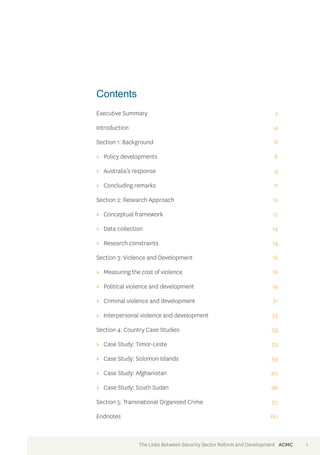
Contents 
Executive Summary 2 
Introduction 4 
Section 1: Background 6 
>> Policy developments 6 
>> Australia’s response 9 
>> Concluding remarks 11 
Section 2: Research Approach 12 
>> Conceptual framework 12 
>> Data collection 14 
>> Research constraints 14 
Section 3: Violence and Development 16 
>> Measuring the cost of violence 16 
>> Political violence and development 19 
>> Criminal violence and development 21 
>> Interpersonal violence and development 23 
Section 4: Country Case Studies 29 
>> Case Study: Timor-Leste 29 
>> Case Study: Solomon Islands 34 
>> Case Study: Afghanistan 40 
>> Case Study: South Sudan 46 
Section 5: Transnational Organised Crime 55 
Endnotes 60 
The Links Between Security Sector Reform and Development ACMC 1
Executive Summary 
This paper explores the relationship between security and development, with a focus on how different 
types of violence inhibit development in fragile and conflict-affected states. 
This paper is based upon a comprehensive literature review of separate pieces of research including 
academic studies, datasets and policy analysis. It explores statistics and figures that illustrate the 
barriers that insecurity poses to achieving development outcomes in fragile and conflict-afflicted 
states. It also examines these dynamics in detail in four countries: Afghanistan, Solomon Islands, 
South Sudan and Timor-Leste. 
The assignment was not to come up with policy recommendations per se; rather it was to present a 
comprehensive synopsis of how different types of violence shackles and inhibits development in fragile 
and conflict-affected states. The research team believes that the material presented will be of use to 
inform policy debate and development, including in the field of security sector reform. 
The analysis is contextualised by focusing on three types of violence: political, criminal and 
interpersonal. The barriers these different types of violence pose to development is presented 
throughout the report, and embedded in the country case studies. 
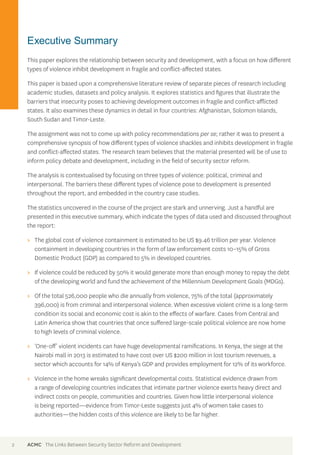
The statistics uncovered in the course of the project are stark and unnerving. Just a handful are 
presented in this executive summary, which indicate the types of data used and discussed throughout 
the report: 
>> The global cost of violence containment is estimated to be US $9.46 trillion per year. Violence 
containment in developing countries in the form of law enforcement costs 10–15% of Gross 
Domestic Product (GDP) as compared to 5% in developed countries. 
>> If violence could be reduced by 50% it would generate more than enough money to repay the debt 
of the developing world and fund the achievement of the Millennium Development Goals (MDGs). 
>> Of the total 526,000 people who die annually from violence, 75% of the total (approximately 
396,000) is from criminal and interpersonal violence. When excessive violent crime is a long-term 
condition its social and economic cost is akin to the effects of warfare. Cases from Central and 
Latin America show that countries that once suffered large-scale political violence are now home 
to high levels of criminal violence. 
>> ‘One-off’ violent incidents can have huge developmental ramifications. In Kenya, the siege at the 
Nairobi mall in 2013 is estimated to have cost over US $200 million in lost tourism revenues, a 
sector which accounts for 14% of Kenya’s GDP and provides employment for 12% of its workforce. 
>> Violence in the home wreaks significant developmental costs. Statistical evidence drawn from 
a range of developing countries indicates that intimate partner violence exerts heavy direct and 
indirect costs on people, communities and countries. Given how little interpersonal violence 
is being reported—evidence from Timor-Leste suggests just 4% of women take cases to 
authorities—the hidden costs of this violence are likely to be far higher. 
2 ACMC The Links Between Security Sector Reform and Development
>> Solomon Islands’ HDI value for 2012 is 0.530—in the low human development category— 
positioning the country at 143 out of 187 countries and territories. Between 2000 and 2012, 
Solomon Islands’ HDI value increased from 0.486 to 0.530, an increase of 9 percent or average 
annual increase of about 0.7 percent. 
>> The ‘blow-back’ effects of heroin production in Afghanistan, some of which directly leads to 
addiction here in Australia, costs the State of Victoria $845 million per year if crime, health care, 
social services, imprisonment and lost tax revenue are included. 
>> Statistics emerging from South Sudan are unremittingly bleak. The economic burden of real and 
perceived insecurity in the world’s newest country means that the government is spending more 
than double its budget on security than it does for health and education. State security forces are 
a major cause of insecurity. 
>> Transnational crime costs Australia a minimum AU $15 billion a year, a statistic that is negligible in 
comparison to its costs in terms of economic development in fragile and conflict-afflicted states. 
>> In Afghanistan, corruption costs nearly 20% of the country’s GDP. There is a strong correlation 
between high levels of corruption and failing to meet the MDGs. 
These statistics, among others, are used to highlight the barriers that different types of violence pose 
to development. It is not only the financial cost, but also the broader institutional and social costs that 
generate a series of barriers for meaningful development. Through synthesising these statistics, this 
paper contributes to the understandings of the links between security and development, paving way 
for policy recommendations and lines of action for Australia and development practitioners. 
The Links Between Security Sector Reform and Development ACMC 3
Introduction 
State fragility, ongoing conflict, instability, political violence, organised criminal violence and 
interpersonal violence inhibit progress and retard development.1 The figures on the costs of violence 
are staggering. Data from 2012 suggests that violence costs the global economy almost $9.5 trillion 
in 2012,2 or 11% of global Gross World Product (GWP)—the combined gross national product of every 
country—and over six times Australia’s entire GDP. The global impact of violence at 11% of GWP is 
startling when compared with the global financial crisis, which caused a drop in worldwide GWP by 
only 0.6%. Global violence costs 75 times the amount of all overseas development assistance (at 
$126.5 billion), or nearly double the value of global agricultural production and 13 times the annual 
output of the global airline industry.3 Nearly 5% of the GWP is spent on mitigating the negative impacts 
of violence and controlling violent activity.4 
There are a range of direct and indirect costs associated with ongoing insecurity and violence. The 
direct costs of violence placed on governments and development agencies—such as medical care, 
policing and security enforcement—slows down opportunities for economic growth. Indirectly, 
the human costs associated with the loss of human capital, loss of wages and productivity, and 
psychological costs on victims further slows the opportunity for genuine productivity and social 
progress.5 Furthermore, an environment where conflict is likely to arise can have a profound negative 
effect on investments, trade and economic growth.6 This complex range of costs caused by insecurity 
and violence indicates that they act as a barrier for genuine socio-economic development. 
Purpose 
The purpose of this research project is to set out the impacts and costs of violence (political, criminal, 
and interpersonal) upon socio-economic development. The research complements work already 
ongoing at the Australian Civil-Military Centre (ACMC), which focuses on Australian government and 
non-government organisation approaches to security sector reform. 
The diverse role Australia plays in the international security and development field, along with the 
fragmented nature of the literature and data sets on the costs and impacts of violence and how 
it impedes development, provides the context for this research paper. This paper explores the 
relationship between security and development, with a focus on how different types of violence inhibit 
development in fragile and conflict-affected states. The paper provides a demand side overview of the 
changing nature of insecurity and violence, and their links to underdevelopment, to inform supply side 
responses such as security sector reform initiatives. 
Through the use of a conceptual framework informed by a rigorous and comprehensive literature 
review, we explore statistics and figures that illustrate the barriers that insecurity poses to 
development. Additionally, we use four country case studies—Timor-Leste, Solomon Islands, 
Afghanistan and South Sudan—to highlight how violence and insecurity inhibit development. 
This review is being undertaken as the Australian Government, under the auspices of the ACMC, 
seeks to better understand the link between security sector reform and development to provide 
4 ACMC The Links Between Security Sector Reform and Development
for improved ways and means to operationalise international interventions in fragile and post conflict 
states. The paper provides a comprehensive synthesis of available information on the costs of different 
types of violence and how resulting insecurity constrains political and socio-economic development in 
fragile and conflict-affected states. 
Outline 
This review comprises five sections. Section 1 provides a brief historical overview of how security 
sector reform came to be an issue of global importance. Section 2 identifies the different forms of 
violence—political, criminal and interpersonal—which will be the focus of the analysis. Section 3 
provides a summary of the range of data generated that points to the profound impact of insecurity 
upon development. Section 4 uses four country case studies to provide concrete examples of the 
costs of insecurity. Section 5 uses an additional discrete case study to highlight how insecurity is 
exacerbated by transnational criminal activities. 
The Links Between Security Sector Reform and Development ACMC 5
Section 1: Background 
This section provides the international context of the relevance of the link between security and 
development. Having this global understanding provides a basis for gauging why and how Australia 
approaches these issues. Firstly, the origins of the security and development debate are traced. 
Secondly, the response from multilateral institutions and bi-lateral donors is given to provide an 
insight of where the global interests in the issues are at present. Finally, Australia’s response to the 
growing interest in security and development is examined. 
Policy developments 
In the last 20 years intrastate conflicts became more prominent in the international security agenda. 
Unlike previous interstate conflicts, where mass insecurity existed between states, conflict within 
states rapidly emerged as an issue of concern. These internal conflicts eroded social cohesion, 
undermined legitimacy in state institutions, reduced government capacity to provide basic services 
to citizens, and created a hostile environment for economic growth to take place. 
This changing nature of insecurity presented the international community with new challenges in 
seeking the prevention of conflict within and between states.7 Among these are the concerns over rule 
of law, good governance, security and justice reform, small arms control and the protection of human 
rights. Embedded into all these security specific issues is the normative underpinning that these 
reforms are necessary precursors for socio-economic development. 
In 1994 the United Nations Development Programme (UNDP) outlined the ‘new concept of human 
security, which equated security with people rather than territories, with development rather than 
arms.’8 This concept argued that the main threats to human security were economic, food, health, 
environmental, personal, community and political in nature.9 
Over the last decade there has been increasing recognition that violence presents a major obstacle 
to development. 
In 2002, UNDP articulated the challenge as being: 
Without safety and security, human development cannot be achieved. Unfortunately, war 
has killed more than 3.6 million since 1989. In 2000, approximately 500,000 people lost 
their lives in violent conflict. Aside from the considerable death toll, violent conflict impedes 
future development and reverses decades of socio-economic gains in terms of the loss of 
social and physical infrastructure and missed opportunities for individuals, families, and 
their communities.10 
Other international cooperation organisations have highlighted the linkages between security and 
development. In 2008 the Organisation for Economic Co-operation and Development’s Development 
Assistance Committee (OECD-DAC) established the ‘Principles for Good International Engagement in 
6 ACMC The Links Between Security Sector Reform and Development
Fragile States’. Within these, they acknowledged the linkages that exist between the political, security, 
economic and social aspects of fragile states. 
The impact of violence and insecurity was the key theme of the World Bank’s annual World 
Development Report in 2011. Throughout this report, the World Bank argues that the nature of 
insecurity is moving towards new threats, especially in fragile and conflict-affected states. The key 
message of the World Bank’s position is that ‘strengthening legitimate institutions and governance to 
provide citizen security, justice, and jobs is crucial to break cycles of violence’.11 Furthermore, it argues 
that the violence, in particular criminality, and the insecurity that it creates has high costs in terms of 
political, social and economic development. 
Along with multilateral responses to the linkages between development and security, bilateral 
donors have focused their foreign policy and development efforts in security sector reform and 
violence reduction. As part of this approach, many of the world’s largest development donors have 
acknowledged the interlinked relationship between security and development issues in fragile and 
conflict-affected states. 
For example, the United Kingdom’s Department for International Development (DFID) have long been 
champions of linking security with development in its overseas development assistance programs.12 
Most recently, the United Kingdom’s ‘National Security Strategy’13 and its ‘Building Stability Overseas 
Strategy’14 both reiterated that addressing security and development linkages is critical to conflict 
resolution and promoting development.15 In the United States, the US Agency for International 
Development (USAID), the US Department of Defense and the US State Department issued guidance 
in 2009 on security sector reform, which incorporates security and development linkages. This 
guidance, and earlier iterations, argues that a whole-of-government approach16 is necessary to 
address the ‘increasingly complex threats facing our partners and … that we address the linkages 
among security, governance, development, and conflict in more comprehensive and sustainable 
ways’.17 In April 2013 the United States Government issued the Security Sector Assistance Policy, 
further emphasising the linkages between security and development.18 
The evolving development and security agenda has allowed for different ways of conceptualising the 
approach of dealing with security both on the ground and at policy level dialogues. One such way 
of conceptualising security has been through the use of the term Security Sector Reform, which has 
become prevalent in the United Nations.19 This terminology, however, is not commonly shared across 
other actors, with an array of different terms being used. For example, some actors use security and 
justice development,20 meanwhile Australia often uses the term law and justice development.21 Despite 
the diversity in terminology, the global community is responding to the security and development 
linkages. For the purposes of this paper the term security and development will be used to describe 
the linkages between them, and different typologies of violence are used as a means of drawing out 
these linkages (see Section 2 for further information). 
Importantly, it is not only traditional donor countries that have focused their attention to the linkages 
between security and development. Fragile and conflict-affected states—whose citizens are the prime 
victims of insecurity—have also begun to establish their own positions on the centrality of insecurity 
The Links Between Security Sector Reform and Development ACMC 7
and its negative impact on development. The g7+, founded in Dili in 2010, is a collective of 18 fragile 
states.22 The g7+’s New Deal proclamation states that in order to achieve development, greater action 
on reducing insecurity and improving justice and governance systems is needed. Indeed, the first 
operationalisation of the New Deal via the Somalia Compact in 2013 notes that ‘security is the essential 
prerequisite for further progress in all other spheres’.23 
This increasing focus on security development linkages is emerging clearly in the discussion on the 
United Nations’ Post-2015 Millennium Development Goals (MDGs). It is now development orthodoxy 
that insecurity has significantly hindered the ability of fragile and conflict states to be on track to meet 
the MDGs.24 The current MDGs were developed in 2000 with the goal of mobilising communities and 
governments to address internal factors inhibiting development. Yet the goals were not designed to 
address the specific challenges of conflict, violence and instability, and their retarding effects. As a result, 
while progress has been made in achieving the MDGs, fragile and conflict-affected states lag behind. 
The UN High Level Panel, convened to advise on a post-2015 development agenda, recognised how 
violence impedes development and accordingly put forward a number of security and anti-violence 
related goals for consideration by member states. There is a marked emphasis on the implications 
of conflict and violence for the potential post-2015 development framework. The High Level Panel 
recommended that the post-2015 MDGs be supplemented with security and governance centric goals. 
These are summarised in Table 1. 
Overarching Goal Specific Goals 
Goal 10: Ensure Good 
Governance and Effective 
Institutions 
10a. Provide free and universal legal identity, such as birth registrations. 
10b. Ensure people enjoy freedom of speech, association, peaceful protest 
and access to independent media and information. 
10c. Increase public participation in political processes and civic 
engagement at all levels. 
10d. Guarantee the public’s right to information and access to government 
data. 
10e. Reduce bribery and corruption and ensure officials can be held 
accountable. 
Goal 11: Ensure Stable and 
Peaceful Societies 
11a. Reduce violent deaths per 100,000 by x and eliminate all forms of 
violence against children. 
11b. Ensure justice institutions are accessible, independent, well-resourced 
and respect due-process rights. 
11c. Stem the external stressors that lead to conflict, including those related 
to organised crime. 
11d. Enhance the capacity, professionalism and accountability of the 
security forces, police and judiciary. 
Table 1: Recommendations from the Report of the Secretary-General’s High-level Panel of Eminent Persons on the 
Post-2015 Development Agenda25 
8 ACMC The Links Between Security Sector Reform and Development
These global bilateral and multilateral responses have clearly outlined the important relationship 
between security and development. This global action towards conceptualising and acting on insecurity 
throughout the world has also informed Australia’s position on security, violence and development. It is 
thus imperative for the country to pursue efforts in both foreign policy and international development 
that seek to improve governance and reduce the likelihood of violent activity. 
Australia’s response 
Australian foreign policy has followed and reinforced this normative shift towards viewing basic 
security as the entry point for development. For example, in a seminal policy paper that would later 
prove influential in shaping the scope of the Regional Assistance Mission to Solomon Islands (RAMSI), 
the Australian Strategic Policy Institute (ASPI) noted the failure of state institutions that rendered the 
government unable to enforce legal order and provide justice.26 Analysts pointed to the lack of a well 
developed rule of law as the trigger of violent conflict in the wider region, often conceptualising it as 
the ‘arc of instability’. 
The shift was not just a rhetorical one. In the wake of the AFP’s deployment to Solomon Islands the 
government created an International Deployment Group, drawn from the ranks of the AFP and state 
police forces, trained and available for deployment for peacekeeping and police capacity development 
missions overseas. Law and justice assistance now accounts for 15% of Australia’s bilateral aid 
program.27 Similarly, the Australian Defence Force (ADF) has been involved in a number of activities in 
fragile and conflict-affected states, from natural disaster response to military intervention, defence 
cooperation and peacekeeping. 
An example of this whole-of-government approach was the 2013 partnership agreement between 
AusAID28 and the AFP. Through this partnership, both agencies had a strong focus on enhancing 
security and promoting development at the same time, noting that ‘a safe environment is 
a fundamental prerequisite for development and poverty reduction to occur and that access to justice 
is vital for promoting human rights’.29 
Within this context, Australia has played an important role in dealing with security and development 
linkages in fragile and conflict-affected states, which ranges from direct, on the ground interventions 
to high level policy dialogue. 
In parallel to this report the ACMC conducted an extensive overview and analysis of Australia’s 
contribution to security sector reform and its role in addressing security and development linkages 
in 2013.30 As part of that project, the ACMC has summarised the following: 
>> A 2005 Minister of Defence press release mentioning the deployment of an Army lieutenant colonel 
to the Middle East noted he would join the international team (with US, British and Canadian 
counterparts) working on security sector reform. 
>> In 2008, ACFID called for the government to use the same security sector reform lens adopted in 
the OECD in order to rectify weaknesses in Australia’s security policy framework. 
The Links Between Security Sector Reform and Development ACMC 9
>> The 2009 Defence White Paper referred to Afghanistan’s ‘security sector’ when describing the 
need to build Afghan institutions and mentor the Afghan National Army. 
>> In 2007, when Australia requested to participate in the Security Council’s first security sector 
reform debate, the Australian Ambassador emphasised two examples: the Papua New Guinea 
request to support its armed forces restructuring and the Solomon Islands request to assist in 
law and order and executive policing. 
>> In the 2011 AusAID publication Framework for working in fragile and conflict-affected states: 
Guidance for staff, and the 2012 ACMC publication Partnering for Peace there are references to and 
definitions of security sector reform. The 2011 AusAID guidance for staff includes descriptions of the 
tensions between security and development approaches in settings such as Afghanistan, and how 
security sector reform can be one element of technical support for peace settlements, and how it 
can support Australian troop or police deployments for peacekeeping and peace monitoring. 
>> In the 2013 General Assembly Special Committee on Peacekeeping Operations, the current 
Australian Ambassador spoke on behalf of Canada, Australia, New Zealand (the CANZ group), 
and linked professional and accountable security sectors with trust and confidence in judicial 
and security institutions. He also noted CANZ support to Defence Sector Reform. 
>> Australia’s 2013 National Security Strategy noted that there is an ‘intrinsic connection between 
security and development’, and that Australia will focus its development efforts in reducing conflict 
and working towards peacebuilding. 
Current Australian policy on security and development linkages have been the result of historical 
experience and driven by the fact that in the past insecurity has primarily come from political violence. 
This has been the driver behind many of Australia’s overseas security interventions in recent years. 
However, over the past 15 years there has been increasing focus on insecurity from criminal and 
interpersonal violence. 
While political instability, and the prospects for political violence, remains an issue Australia’s policy 
response has been evolving due to the rising requirements to address criminal and interpersonal 
violence as sources of insecurity in its immediate region. This is particularly the case in fragile and 
conflict-affected states such as Timor-Leste, Solomon Islands and Papua New Guinea. This has 
generated a growing policy debate on how to reorient Australian responses to insecurity moving 
from less of a security-centric approach to one that joins up with developmental solutions.31 
Australia recognises the linkages between insecurity and poor development outcomes. Political 
violence remains an issue in some cases, but it is generally declining. The primary threats posed to 
fragile states involved in long-term political, social and economic development trajectories are now 
viewed as being criminal and interpersonal violence. If left unchecked these forms of violence can 
provide the possible foundations for future political violence; this is especially the case with criminal 
violence. 
On the international stage Australia supports the International Dialogue on Peacebuilding and 
Statebuilding, as well as the development of the g7+. It also backs the New Deal Declaration of the g7+ 
10 ACMC The Links Between Security Sector Reform and Development
and the International Dialogue on Peacebuilding and Statebuilding, which prioritises the development 
of the security and justice sectors as being necessary steps to achieving the MDGs. Elements of these 
initiatives are being woven into country assistance agreements with numerous states in the region. 
Concluding remarks 
This overview provides the context for this paper. It is clear that multilateral organisations, bilateral 
donors and fragile states themselves have focused their attention on the important linkages between 
security and development. Around the world, and in the Asia-Pacific region, where there is ongoing 
insecurity coupled with significant underdevelopment, Australia has remained as a development and 
international dialogue leader in promoting peace and carrying out security related activities. As a way 
of exploring the links between security and development, it was important for the research team to 
design an approach that allows for the filtering of available data. This approach is discussed next. 
The Links Between Security Sector Reform and Development ACMC 11
Section 2: Research Approach 
This section provides the theoretical grounding for our approach. Through using three different 
types of violence, we provide a conceptual framework for situating the data and analysis we provide 
throughout the report. 
Conceptual framework 
Violence is complex, fluid and often difficult to qualify as well as quantify. The 2011 World Development 
Report examined conflict through the lenses of political and organised criminal violence, which 
encompass high-level governance, countrywide and subnational types of violence. This analysis, while 
crucial to understanding the impacts of violence, chose not to examine the impact of interpersonal 
violence. In addition to the World Development Report, the World Health Organization (WHO) defines 
violence using the following typology, with a strong focus on interpersonal violence: 
>> Collective violence—refers to violence committed by larger groups of individuals and can be 
subdivided into social, political and economic violence. 
>> Interpersonal violence—refers to violence between individuals, and is subdivided into family 
and intimate partner violence and community violence. The former category includes child 
maltreatment, intimate partner violence and elder abuse; while the latter is broken down into 
acquaintance and stranger violence and includes youth violence, assault by strangers, violence 
related to property crimes, and violence in workplaces and other institutions. 
>> Self-directed violence—refers to violence in which the perpetrator and the victim are the same 
individual and is subdivided into self-abuse and suicide.32 
As this paper aims to explore the relationship between security and development, with a focus on how 
different types of violence inhibit development in conflict and fragile states, it is important to develop 
an adequate way of analysing these issues. Furthermore, the wide and fragmented nature of the 
literature and data available required the research team to set a logical boundary of analysis for the 
project. 
Following from the work of the WHO and the World Bank, this paper focuses on three different types 
of violence that will guide the analysis of the material collected. These types of violence are often 
inter-related, and the boundaries between them can be blurred and often converge, thus exacerbating 
each other. It is for this reason that this paper uses the following violence typology as a framework to 
present some of the available data that explain security and its relationship to development. 
The conceptual framework, based on three types of violence, is provided in Table 2. 
12 ACMC The Links Between Security Sector Reform and Development
Type of Violence Elements 
Political Violence Political violence is characterised by force being used by state and/or non-state actors 
in the pursuit of political aims. 
The causes of political violence are diverse and are often influenced by other types 
of violence, notably criminal activity. Many forms of political violence can be criminal 
in nature and thus blur the line between political and criminal violence. Criminal 
acts, such as police brutality or unjust incarceration, may be carried out for political 
purposes, but also generate a cycle of political and/or criminal violence in return. 
Graft and corruption, especially if rife, can also generate levels of grievance, which 
can create political violence in turn. This is especially the case in fragile and conflict-affected 
states.33 
Criminal Violence Criminal violence challenges legal systems, and has an impact on individuals in society 
as well as negative influences on communities, institutions and governance systems. 
Criminal violence can create lucrative illegal markets of a range of products and 
services, and distorts unofficial financial flows in highly vulnerable countries. 
Criminal violence is of high concern for fragile and conflict states, where state 
institutions are weak, social cohesion is fragmented and economies underdeveloped. 
Organised criminal activities include but are not limited to trafficking in illicit small 
arms, human beings and narcotics; people smuggling; piracy; money laundering; the 
illegal exploitation of natural resources and wildlife; and counterfeiting. The conduct 
of these activities often requires the use of violence in and of themselves, but can also 
generate wider violence both directly and indirectly. 
Organised criminal networks can compete with state and non-state actors for 
resources. This competition will in many cases generate violent crime. 
The spread of criminal networks into the political sphere can undermine the capacity 
of institutions to provide services to citizens, which in turn can lead to further criminal 
and/or or interpersonal violence. 
Interpersonal 
Violence 
Interpersonal violence exists amongst societies, and includes partner and gender 
violence, child violence, elder abuse and community violence. 
Interpersonal violence often blends with criminal violence, for example, in the case 
of homicide or sexual assault. 
In fragile states, corrupt and poorly governed systems will further prevent society 
from addressing the impact of interpersonal violence. 
Unlike criminal and political violence, which can have high-level direct impacts, 
interpersonal violence has impacts on development that, while diffuse, are long-term 
and with very significant human impact—such as long-term physical disability, loss of 
life which inhibits productivity, or psychological trauma. 
Table 2: Conceptual Framework 
The Links Between Security Sector Reform and Development ACMC 13
Data collection 
This paper is based upon a comprehensive desk-based literature review of a wide range of documents, 
data-sets and policy papers. Literature reviewed included material generated by a number of sources, 
including reports, position papers and other material produced by the leading applied research 
organisations in the sector since 2011. Other sources included the ‘grey literature’ emanating from 
leading donors and international organisations, such as AusAID, USAID, DFID, OECD, the World Bank 
and the UNDP. These documents are important to consider in order for tracking policy shifts, as they 
portray an up to date picture of how multilateral and bilateral agencies are dealing with security and 
development linkages. 
The team also examined reports that have focused on Australian assistance in this field. For example 
it included the Australian Office for Development Effectiveness (ODE) Review on Law and Justice 
Development, as well as an examination of the research literature on Australia’s endeavours in security 
sector reform. 
Furthermore, global datasets relating to security and development indicators from organisations 
have been reviewed, including: the World Bank Development Indicators,34 the United Nations Human 
Development Indicators,35 the UN MDGs, the United Nations Office for Drugs and Crime (UNODC) 
data-sets on global homicide rates and other issue, as well as the WHO’s research into violence. 
The structure and content of the paper corresponds closely to a writing guide agreed to by the ACMC. 
Research constraints 
The team faced constraints when reviewing the available data. Qualitative and quantitative data on 
the impact of insecurity on development in fragile and conflict-affected states is highly fragmented 
and incomplete, thus presenting a barrier for meaningful analysis. 
The availability of quantitative data on violent incidents is often diffuse and of limited quality. Low 
capacity, a difficult logistic environment, and insecurity itself in fragile countries makes the gathering 
of reliable data very onerous. While top-level data with regard to basic development indicators is often 
in place—although not always so—this is less so when insecurity indicators are considered. 
While data regarding fatalities from political violence in the form of interstate conflict is relatively 
robust, it is less so when considering intrastate conflict. The data-sets, and thus the supporting 
research, when reviewing political, criminal and especially interpersonal violence in fragile states is 
difficult to grapple with. For example the United Nations, World Bank and OECD all gather data on 
development indicators and, while similar, are not necessarily in perfect alignment. In the case of 
the UNODC Global Homicide Survey 2011 it used data from a disparate of sources including national 
governments, other UN agencies, non-government organisations and Interpol.36 
While information regarding political and criminal violence in these fragile states is increasingly 
available, it is often collected in a variety of ways by multiple organisations using different methods. 
This creates difficulty in generating a comprehensive understanding of the security and development 
14 ACMC The Links Between Security Sector Reform and Development
linkages. For example, in the case of Solomon Islands, violence and security data is gathered and 
analysed by RAMSI, national and international non-government organisations, the United Nations 
and the Royal Solomon Islands Police Force. The result is that the available information is highly 
fragmented. 
For interpersonal violence the situation regarding available data is more uncertain. While information 
relating to homicide rates is available in some cases, it is not always the case. For example the most 
recent homicide rates according to the UNODC for Timor-Leste, Afghanistan and Sudan (without 
differentiating South Sudan) are dated 2008. This problem is even more acute when reviewing 
interpersonal violence such as assault, sexual assault, child abuse and gender-based violence. 
However, numerous efforts at gathering and understanding data in these areas have occurred in 
recent years, but it is still very disjointed and disparate in nature. For example, in Solomon Islands 
the World Bank uses national police criminal violence data from 2010 to 2013 but also data from 
non-government organisations on interpersonal violence dated 2009. Additionally, there exists no 
comprehensive quantitative information on the economic costs of interpersonal violence in any of 
the countries examined in this paper’s case studies (Afghanistan, Solomon Islands, South Sudan and 
Timor-Leste). 
Despite the growing international interest, the evidence pointing towards the linkages between 
violence, security sector reform and development is scattered. The field of study of ‘security 
economics’ of fragile and conflict-affected states remains largely untapped, and specific literature 
on the different types of violence is rarely combined in a manner that paints a holistic picture of the 
linkages between security and development.37 There is, for example, little in the literature that links 
a focus on security sector reform with economic development outcomes. Despite this disconnect, 
the complexities and importance of the issues have been identified as core elements of a future 
development agenda, notably through the United Nations’ Post-2015 High Level Panel. 
The Links Between Security Sector Reform and Development ACMC 15
Section 3: Violence and Development 
In this section of the paper, we present data to show that higher levels of insecurity have a negative 
influence on development. The literature and data indicates that political, criminal and interpersonal 
violence in fragile and conflict-affected states creates insecurity that is both costly in human and 
economic terms, and that it has a profoundly negative effect on development outcomes.38 
Violence has direct and indirect costs on societies and economies (see Table 3).39 Understanding the 
wide-ranging impacts of violence allows for a more detailed examination of how political, criminal and 
interpersonal violence affects societies. 
Direct Costs of Violence Indirect Costs of Violence 
>> destroyed public infrastructure 
>> destroyed factories and machinery 
>> destroyed housing, autos and other personal 
property 
>> budgetary appropriations for cost of war and 
cost of lost equipment 
>> deaths 
>> physical and mental injuries 
>> future costs of disability 
>> future costs of physical and mental health care 
>> population displacement reduced production 
due to violence or its threat 
>> reduced trade due to violence or its threat 
>> lower current and future physical investment 
>> reduction in educational opportunities 
>> brain drain (emigration of educated work force) 
>> reduced tourism from abroad 
>> other macroeconomic effects (inflation, further 
unemployment, reduced economic growth) 
>> overall welfare costs 
Table 3: The Direct and Indirect Costs of Violence 
Measuring the cost of violence 
The cost of dealing with violence in highly industrialised countries has been the subject of detailed 
analysis. For example, in Australia, the costs of violence and associated security activities have been 
recently documented: 
>> Crime costs Australia nearly AU $36 billion a year, equating to 4.1% of Australia’s GDP 40 
>> Fraud costs approximately AU $8.5 billion 
>> Justice services cost AU $10.7 billion, of which 66.7% included policing services. 
Identifying similar figures for fragile and conflict-affected states is a much more arduous task, given 
the complex nature of governance and security systems, and uneven data collection. However, there is 
a growing body of work in this field41 that is shedding light on how insecurity is exceedingly costly and 
drives poor development outcomes, creating what some have described as ‘development in reverse’.42 
16 ACMC The Links Between Security Sector Reform and Development
Analysis conducted in 2004 estimated the costs of civil wars at $50 billion per event, and that 
‘more than half of the total economic cost is borne by neighbouring countries’.43 Along with this, 
the historical prevalence of insecure environments often creates fertile ground for violence to recur 
(see Table 4).44 
Decade Violence onsets in 
countries with no 
previous conflict (%) 
Violence onsets in 
countries with a previous 
conflict (%) 
Number of onsets 
1960s 57 43 35 
1970s 43 57 44 
1980s 38 62 39 
1990s 33 67 81 
2000s 10 90 39 
Table 4: Violence Reoccurrence 
The prevalence of different types of violence throughout the developing world, and especially in 
fragile and conflict-affected states, indicates that a focus on security and violence is crucial for 
effective development interventions and peacekeeping operations to take place. In recent years the 
international community has begun to assess the socio-economic impact of these forms of violence. 
Although the efforts have been fruitful in providing a good global understanding of the issues, the 
complexity of the problems, and the contexts in which they exist, continue to create barriers for data 
collection, analysis, planning and implementation of programs. Complexity is driven by the fact that 
political, criminal and interpersonal violence often overlap with each other dynamically and take 
place in countries where the international community is oft beset with its own problems trying to 
comprehend social and political context. 
Global Peace Index 
In an attempt to quantify the global state of insecurity, the 2013 Global Peace Index (GPI) undertook 
a detailed analysis of insecurity throughout the world. This report provides an authoritative overview 
of the nature of insecurity and violence, and serves as a good indicator of the linkages between 
insecurity and development. The global cost of violence containment is estimated to be US $9.46 
trillion. As noted in Figure 1, global military expenditure on violence containment accounts for 51% 
of this cost. Homicides account for 15% of the total impact. The third largest category is spending 
on internal security, accounting for 14% of the total.45 
Further to this, the GPI notes that the economic impact of violence is so large that if violence could 
be reduced by 50% it would generate enough money: 
>> to repay the debt of the developing world ($4.1 trillion) 
>> for the European Stability Mechanism ($900 billion) 
>> to fund the Millennium Development Goals ($60 billion).46 
The Links Between Security Sector Reform and Development ACMC 17
Figure 1: The Global Economic Direct Costs of Violence 
From the figures presented here, it is clear that the economic cost of violence and its containment 
is high. Further to these costs, there are a range of non-economic long-term costs that are likely to 
reduce the capacity of countries to develop, such as stresses on the health system, disabilities, lack 
of willingness to study due to fear, amongst many others. Highlighting the chronic and interrelated 
nature of global insecurity allows the portrayal of a more concrete picture of how this issue remains 
crucial for the global development agenda. 
Insecurity in Africa 
The cost of violence 
With 67 people killed, including 18 foreigners, the September 2013 terrorist attack on Westgate 
Mall in Nairobi has had significant costs. The mall, virtually destroyed during the Kenyan military’s 
response, was reportedly insured at Lloyds for $70 million, not to mention the value of goods 
destroyed or stolen by the military.47 The Barclays’ Bank and Millionaire’s Casino both reported 
losses due to Kenyan Defence Force looters. While the total value of goods destroyed or stolen is 
unknown, the Kenyan Defence Force has returned approximately US $3 million in goods and cash 
that its soldiers looted from the site.48 Further to this, insurance premiums in Kenya are expected to 
rise.49 
The violence is estimated to have cost a further $215 million in lost tourism revenues, a sector which 
accounts for 14% of Kenya’s GDP and provides employment for 12% of its workforce.50 
‘Moody’s predicts the attack will cost Kenya’s economy $US200 to $US250 million ($215 
million to $268 million) in lost tourism revenue, estimating it will slow growth of Kenya’s 
GDP by 0.5%. Kenya’s 2012 GDP was $US41 billion.’51 
18 ACMC The Links Between Security Sector Reform and Development
Other examples of insecurity and mixed political/criminal violence exist in the Horn of Africa. In 2011 
the World Bank estimated a minimum cost of $2 billion per year to police and insure against piracy 
off the coast of Somalia.52 However, in 2013 the World Bank upwardly revised this figure to $18 billion 
per year. It notes that cooperation between pirates and Somali officials over ransoms and rents 
undermines the state and non-state institutions alike.53 
Insecurity causes communities to flee their homes, and these people not only suffer physical harm, 
trauma and lost productivity, but other costs are also incurred. The global population of refugees and 
internally displaced persons has increased by 300% in the last 30 years, and 75% of these are hosted 
by neighbours.54 For example, between 2006 and 2012 the Dadaab refugee camp in Kenya housing 
Somalis fleeing political and criminal violence in Somalia grew to a population of over 500,000. The 
place has become rampant with violence, where ‘sexual violence has become endemic, and police 
abuse and inaction commonplace and resented by the refugees’.55 Having experienced this level of 
violence for decades, Dadaab is described as ‘a hotbed of crime, disease and increasingly, radicalism’.56 
Such a situation highlights the impact population movements can have on neighbouring states 
in terms of the violence and instability that can spread across borders. The complex dynamics of 
insecurity and political, criminal and interpersonal violence illustrated above serve to expose the 
complexity of the challenges in restoring security and putting people on a positive development path. 
Given these global costs, the following section will further examine how the three identified types of 
violence are acting as a barrier to development. Exploring costs associated with political, criminal 
and interpersonal violence allows for the linkages between security and development to be further 
highlighted. 
Political violence and development 
Despite the significant decrease of interstate wars since the end of the Cold War, a wide range of 
countries remain subject to intrastate conflict. It is estimated that over 1.5 billion people live in fragile 
and conflict-afflicted states where there is a strong propensity for recurring political violence (see 
Table 4). Furthermore, in these states there is a mix of political, criminal and interpersonal violence 
that is the most pronounced in the world.57 
The prevalence and likelihood of violence in fragile and conflict states has had significant impact 
on the capacity of those states to achieve the MDGs. Within these states, the repeated occurrence 
of violence has acted as a barrier towards achieving these development targets. The prevalence of 
violence in fragile and conflict states creates a situation where their citizens are: 
>> twice as likely to be poor 
>> twice as likely to be undernourished as compared to other developing states 
>> more than three times as likely to be unable to send their children to school 
>> twice as likely to see their children die before five years of age 
>> more than twice as likely to lack access to clean water.58 
The Links Between Security Sector Reform and Development ACMC 19
Furthermore, development is also inhibited by subnational conflicts.59 For example, according to a 
recent study of subnational conflicts, Asia is the region that has had the greatest prevalence of long-term 
subnational conflict globally.60 These conflicts last for an average of 33 years, twice the global 
average.61 Subnational conflicts have killed 1.35 million people in Asia since 1946, but in the 1999 to 
2008 period they killed more people in Asia than every other form of conflict combined (a total of 
94,907 battle-related deaths). Subnational conflicts directly affect 131 million people in Asia.62 
While many of these subnational conflicts occur in states that are low to middle income economies 
with modest to strong economic growth, the study focused on areas that suffer from subnational 
conflict generally witness a decline in their proportional share of national income.63 However, in regard 
to other key development indicators the security development linkages are less clear. For example, 
income, poverty and access to clean water in subnational conflict areas score average to poorly, 
while doing much better with regard to infant mortality and literacy rates.64 This suggests that while 
insecurity limits development in some areas it may not be wholesale in its impact. 
Partially driven by historical and politically opposing movements, combined with violent groups and 
a lack of well governed security and legal systems, parts of the Asia region remain among the most 
dangerous in the world.65 Despite significant increases in productivity and economic growth, there 
are still serious issues concerning violence in the region. In the context of an interconnected world 
in which political and criminal violence are often transnational in nature, Australia, as a stable and 
safe state, has a national interest in playing an important role in the region through development 
and security related activities. 
There are significant financial costs associated with violence, which inhibit states’ ability to promote 
development. For example, the World Bank estimates the average cost of civil war is equivalent to 30 
years of GDP growth, reducing GDP growth by 2% per year, with an average total cost of $65 billion.66 
Similarly, violence containment in developing countries, in the form of law enforcement, costs 10–15% 
of GDP as compared to just 5% in developed countries.67 
The severe human cost of civil war has a profound impact on the availability of human capital to 
meaningfully contribute to economic growth and productivity, and social development. Although 
political unrest and civil war remains a global issue, the total human life cost of these has significantly 
reduced since the end of the Cold War. In 1988, there were 200,000 deaths as a result of civil war, 
whereas the number decreased to 50,000 deaths in 2008.68 Although this is a positive improvement, 
what has changed is the likelihood for civil unrest to remerge, driven by highly unstable political 
systems in fragile states. For example, 90% of civil conflicts in the 2000s occurred in countries with 
a history of previous events (see Table 4).69 While global poverty levels are receding, countries that 
suffer from violence lag by up to 2.7% for every three years of excessive violence. 
As fragile and conflict-affected states suffer repeated episodes or recurring political violence they fail 
to develop robust state and non-state institutions to provide security and development to citizens. 
This, in part, creates the conditions for an increase in criminality. In the form of organised criminal 
violence it can create further political violence, but also set the ground for increases in criminal 
interpersonal violence. 
20 ACMC The Links Between Security Sector Reform and Development
Criminal violence and development 
The nature of fragile states and their weak institutions create an opportunity for criminal activity, 
often as part of the political elites and associated movements that govern those states. Of the 
total 526,000 people that die annually from violence, 75% of the total (approximately 396,000) 
is from homicidal criminal violence (see Figure 2).70 This indicates that these types of violence are 
becoming the core area of violent activity in developing states, and are thus adding to the barriers of 
development. The large majority of victimised communities live in low and middle income countries 
with disproportionate numbers in fragile and conflict-affected states. This poses profound challenges 
for security and development programs targeted in states in which violence is an endemic. 
Figure 2: Breakdown of deaths stemming from violence 
Violence is not the sole preserve of countries experiencing intrastate armed conflict or in a post 
conflict transition, but often occurs at excessive levels in countries at peace. This is especially the case 
when countries lack robust, credible or legitimate institutions and where corruption71 and organised 
crime merge to create in some countries what can only be described as a maelstrom of violence. A 
number of central and South American countries and the West African region illustrate the point. 
Examples of merging political and criminal violence in Africa and Latin America 
Liberia constitutes a compelling example of how political violence can become enveloped in organised 
criminal violence and corruption. ‘The human cost of Liberia’s two civil wars and the related conflict 
in Sierra Leone was staggering. 200,000 people were killed, 2 million displaced, and half of Sierra 
Leone’s female population subjected to sexual violence including rape, torture and sexual slavery.’72 
Liberian President Charles Taylor pillaged natural resources at home and in neighbouring Sierra Leone 
The Links Between Security Sector Reform and Development ACMC 21
in order to finance war spending, but in due course funding political violence through criminality 
became simple criminal enterprise. In 2011 he stood accused of pocketing $105–450 million.73 
Further up the coast in Guinea Bissau, South American organised crime networks have, via corrupting 
government and security officials, captured a country turning it into a narco-state as a transit point 
for narcotics destined for Europe. The result has been cyclical political violence with coups and 
assassinations. This has in turn increased wider violence and insecurity and caused development 
efforts to fail. 
In a new development in another part of West Africa, a UNODC threat assessment for the region 
reports, 
the emergence of drug production in the region. Two methamphetamine labs were detected in 
Nigeria in 2011–2012, and an estimated 3000 methamphetamine couriers travelled from West 
Africa (including Benin, Côte d’Ivoire, Ghana, Guinea, Nigeria and Senegal) to Asia (primarily 
Japan, the Republic of Korea, Malaysia and Thailand) in 2010. The drugs carried by these 
couriers sold for about US $360 million, a sizeable income for such a young flow. Unlike the 
cocaine flow, the bulk of the profits accrued to West African traffickers, and may ultimately 
find its way back to West Africa.74 
The advent of local production and associated revenue flows allow crime networks to use new 
income to consolidate and expand. Such revenues are used for a number of purposes such as 
further undermining government via corruption, the purchase of weapons for protection and power 
projection, and to reward foot soldiers, making criminal life more attractive than legitimate pursuits. 
Cases from Latin America show that countries, while successfully resolving major political violence in 
the past, are now home to high levels of criminal violence. Through working with government officials, 
alternately through coercion and cooperation, violent organised criminal networks running narcotics, 
weapons and human trafficking operations have turned the tables on the state. 
Honduras, El Salvador and Guatemala have the world´s highest violent death rates in the world. 
Honduras is by far the worst. After registering 170 homicides per 100,000 residents last year, 
San Pedro Sula, the country’s second largest city, is considered the most dangerous on the 
planet, based on murders per capita.75 
Despite these countries having overcome political violence in the form of civil wars in the 1980s 
and 1990s they have descended into a new phase of violence. Working with government officials, 
alternately through coercion and cooperation, violent organised criminal networks running narcotics, 
weapons and human trafficking operations have turned the tables on the state. Homicidal death 
rates can approach levels found in civil wars, the people are displaced, human trauma spreads, 
and significant economic costs are incurred. Furthermore, the state’s credibility is undermined 
via corruption and as its ability to deliver public goods is weakened thus negatively affecting 
development.76 In the case of Guatemala it is estimated that criminal violence cost $2.4 billion 
22 ACMC The Links Between Security Sector Reform and Development
or 7.3% of GDP in 2005, and $1.7 billion or 11.5% of GDP in El Salvador in 2003.77 When excessive violent 
crime is a long-term condition its social and economic cost is comparable to warfare. The World 
Development Report (2011) estimates ‘the economic impact of organised crime in Central America and 
the Caribbean as being on a similar scale to the impact of civil war and suggests that violence is the 
main constraint to the achievement of the Millennium Development Goals.78 
The lack of capacity of states to deal with criminal activity creates high level human costs. Similar to the 
impacts of political violence and civil wars, criminal activity can lead to homicidal death rates that are 
similar to the ones found in civil wars, displace individuals, generate long-term psychological impacts, 
and cause a slowdown in economic growth. Furthermore, the state’s credibility is undermined via 
corruption and its ability to deliver public goods is weakened thus negatively affecting development.79 
Interpersonal violence and development 
Interpersonal violence takes form in child abuse and neglect, intimate partner violence, elder abuse, 
sexual violence, workplace violence, youth violence, and other violent crime directed at members 
of communities.80 Similar to other crimes, there are a range of indirect costs associated with 
interpersonal violence. These costs rapidly build up and inhibit a fragile state’s capacity to develop 
as resources are allocated to the immediate containment and alleviation of these costs. 
One of the more reliable ways of measuring interpersonal violence is through homicide rates. This is 
largely due to the fact that in fragile and conflict-afflicted states murders are more likely to come to 
the attention of law enforcement and other authorities than other forms of violence, and especially 
so for interpersonal violence such as gender-based violence and child abuse. The available data on 
homicide rates and the impact this has on development clearly indicate that violence remains a barrier 
to development. 
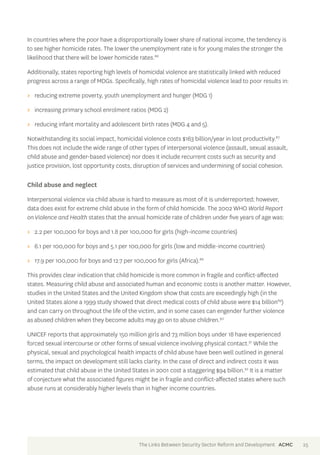
States with low homicide rates develop more rapidly than those that do not, and have an 11% greater 
chance of making improvements against the United Nations Human Development Index (HDI) than 
states with higher homicide rates.81 Further to this, countries with a high homicide rate of 14.6 per 
100,000 people portray a lower HDI to countries with lower homicide rates of approximately 2.1 
homicides per 100,000 people. Along with the loss of life and the associated costs, the overall 
global cost of homicidal violence is between $95 and $160 billion per year.82 At the individual level, 
it is estimated that the loss of human life costs between $3.1 and $6.8 million.83 
Countries that report lower levels of development report higher levels of violence set against the 
annual average of 7.25 homicides per 100,000. Higher homicide rates drag countries toward lower 
HDI ratings.84 
The Links Between Security Sector Reform and Development ACMC 23
Figure 3: HDI and Homicide Rate Influence 
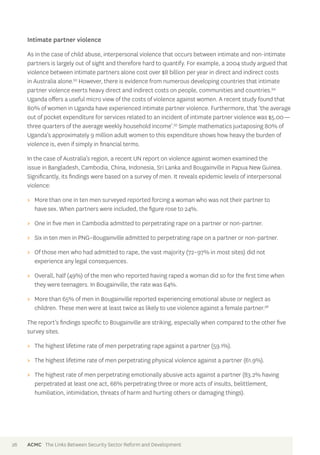
The relationship between criminal and interpersonal violence and associated negative development 
outcomes is further strengthened when correlating homicide with a state’s income level. Lower 
income states experience higher rates of homicide, indicating a general relationship between 
insecurity and poverty levels.85 
Figure 4: Comparison of country income and homicidal violence 
(Source: Geneva Declaration 2010) 
24 ACMC The Links Between Security Sector Reform and Development
In countries where the poor have a disproportionally lower share of national income, the tendency is 
to see higher homicide rates. The lower the unemployment rate is for young males the stronger the 
likelihood that there will be lower homicide rates.86 
Additionally, states reporting high levels of homicidal violence are statistically linked with reduced 
progress across a range of MDGs. Specifically, high rates of homicidal violence lead to poor results in: 
>> reducing extreme poverty, youth unemployment and hunger (MDG 1) 
>> increasing primary school enrolment ratios (MDG 2) 
>> reducing infant mortality and adolescent birth rates (MDG 4 and 5). 
Notwithstanding its social impact, homicidal violence costs $163 billion/year in lost productivity.87 
This does not include the wide range of other types of interpersonal violence (assault, sexual assault, 
child abuse and gender-based violence) nor does it include recurrent costs such as security and 
justice provision, lost opportunity costs, disruption of services and undermining of social cohesion. 
Child abuse and neglect 
Interpersonal violence via child abuse is hard to measure as most of it is underreported; however, 
data does exist for extreme child abuse in the form of child homicide. The 2002 WHO World Report 
on Violence and Health states that the annual homicide rate of children under five years of age was: 
>> 2.2 per 100,000 for boys and 1.8 per 100,000 for girls (high-income countries) 
>> 6.1 per 100,000 for boys and 5.1 per 100,000 for girls (low and middle-income countries) 
>> 17.9 per 100,000 for boys and 12.7 per 100,000 for girls (Africa).88 
This provides clear indication that child homicide is more common in fragile and conflict-affected 
states. Measuring child abuse and associated human and economic costs is another matter. However, 
studies in the United States and the United Kingdom show that costs are exceedingly high (in the 
United States alone a 1999 study showed that direct medical costs of child abuse were $14 billion89) 
and can carry on throughout the life of the victim, and in some cases can engender further violence 
as abused children when they become adults may go on to abuse children.90 
UNICEF reports that approximately 150 million girls and 73 million boys under 18 have experienced 
forced sexual intercourse or other forms of sexual violence involving physical contact.91 While the 
physical, sexual and psychological health impacts of child abuse have been well outlined in general 
terms, the impact on development still lacks clarity. In the case of direct and indirect costs it was 
estimated that child abuse in the United States in 2001 cost a staggering $94 billion.92 It is a matter 
of conjecture what the associated figures might be in fragile and conflict-affected states where such 
abuse runs at considerably higher levels than in higher income countries. 
The Links Between Security Sector Reform and Development ACMC 25
Intimate partner violence 
As in the case of child abuse, interpersonal violence that occurs between intimate and non-intimate 
partners is largely out of sight and therefore hard to quantify. For example, a 2004 study argued that 
violence between intimate partners alone cost over $8 billion per year in direct and indirect costs 
in Australia alone.93 However, there is evidence from numerous developing countries that intimate 
partner violence exerts heavy direct and indirect costs on people, communities and countries.94 
Uganda offers a useful micro view of the costs of violence against women. A recent study found that 
80% of women in Uganda have experienced intimate partner violence. Furthermore, that ‘the average 
out of pocket expenditure for services related to an incident of intimate partner violence was $5.00— 
three quarters of the average weekly household income’.95 Simple mathematics juxtaposing 80% of 
Uganda’s approximately 9 million adult women to this expenditure shows how heavy the burden of 
violence is, even if simply in financial terms. 
In the case of Australia’s region, a recent UN report on violence against women examined the 
issue in Bangladesh, Cambodia, China, Indonesia, Sri Lanka and Bougainville in Papua New Guinea. 
Significantly, its findings were based on a survey of men. It reveals epidemic levels of interpersonal 
violence: 
>> More than one in ten men surveyed reported forcing a woman who was not their partner to 
have sex. When partners were included, the figure rose to 24%. 
>> One in five men in Cambodia admitted to perpetrating rape on a partner or non-partner. 
>> Six in ten men in PNG–Bougainville admitted to perpetrating rape on a partner or non-partner. 
>> Of those men who had admitted to rape, the vast majority (72–97% in most sites) did not 
experience any legal consequences. 
>> Overall, half (49%) of the men who reported having raped a woman did so for the first time when 
they were teenagers. In Bougainville, the rate was 64%. 
>> More than 65% of men in Bougainville reported experiencing emotional abuse or neglect as 
children. These men were at least twice as likely to use violence against a female partner.96 
The report’s findings specific to Bougainville are striking, especially when compared to the other five 
survey sites. 
>> The highest lifetime rate of men perpetrating rape against a partner (59.1%). 
>> The highest lifetime rate of men perpetrating physical violence against a partner (61.9%). 
>> The highest rate of men perpetrating emotionally abusive acts against a partner (83.2% having 
perpetrated at least one act, 66% perpetrating three or more acts of insults, belittlement, 
humiliation, intimidation, threats of harm and hurting others or damaging things). 
26 ACMC The Links Between Security Sector Reform and Development
>> The highest rate (closely followed by Cambodia) of men perpetrating economically abusive 
acts against a partner (56.9%). This includes acts such as denial of funds, refusal to contribute 
financially, denial of food and basic needs, and controlling access to health care and employment. 
>> The highest rate of men reporting perpetration of gang rape (14%). 
>> The highest rate of men reporting perpetration of non-partner rape (40.7%). Only the Papua site 
in Indonesia came close to this figure (23.4%). 
>> The highest rate of men reporting raping other men (7.6%).97 
As in the case of child abuse and intimate partner violence, sexual violence is hard to quantify. In 2010 
it was reported by the WHO ‘that only around 5% of adult victims of sexual violence [in Latin America] 
reported the incident to the police’.98 This suggests the nature of interpersonal and sexual violence 
is hugely underestimated. In 2013 the WHO estimates that ‘1 in 3 women throughout the world will 
experience physical and/or sexual violence by a partner or sexual violence by a non-partner’. The 
WHO further estimates that physical and/or sexual violence will occur according to the following rates: 
>> 28.9% the Americas 
>> 23.2% high income countries 
>> 25.4% European region 
>> 36.6% African region 
>> 37% Eastern Mediterranean region 
>> 37.7% South East Asia region 
>> 24.6% West Pacific Region.99 
Women exposed to intimate partner violence are twice as likely to experience depression, nearly 
twice as likely to develop alcohol use disorders, 16% more likely to have low birth weight babies, and 
1.5 times more likely to acquire HIV. About 42% are likely to be injured as a result of intimate partner 
violence, and intimate partners cause 38% of all homicides of women.100 
While rape and sexual violence are well known occurrences in times of conflict, either as a 
direct instrument of the warring parties or via the breakdown in law and order, its impact on the 
development of women and girls is clear. However, it is hard to quantify the nature of this impact given 
systematic information gaps due to low reporting levels as a result of poor capacity and sometimes 
disinterest by local authorities. However, evidence from the United States suggests that rape and 
sexual violence is among the most costly forms of violence.101 
The Links Between Security Sector Reform and Development ACMC 27
Impact on development 
Injury from violence further multiplies the impact of insecurity on development. Indirect costs, such as 
stress, trauma, disability, lost employment and lower productivity are all consequences of injury from 
violence. In 2011 the World Bank reported that: 
In Brazil in 2004, the direct medical costs of all interpersonal violence were estimated 
at US $235 million and the indirect medical costs at US $9.2 billion. Comparable figures, 
respectively, for Jamaica are US $29.5 million and US $385 million, and for Thailand US $40.3 
million and US $432 million. Emerging findings from Kenya estimate total costs of violence at 
1.2 % of GDP. In the United Kingdom, the direct costs of domestic violence are estimated at 
£5.7 billion annually.102 
In 2007, the UNODC and World Bank reported that in Jamaica direct medical costs for injuries 
resulting from violence were found to cost 0.1% of GDP in 2001. Meanwhile lost time, wages, private 
costs and lost productivity cost another 0.1% of GDP.103 Other sources reported in 2006 that: 
Interpersonal violence (in Jamaica) accounted for J$2.1 billion in direct medical costs, with the 
average direct medical cost per incident in 2006 being J$72,000 for fatal injuries, J$418,000 
for serious injuries and J$256,000 for slight injuries. Indirect medical costs for injuries due to 
interpersonal violence in 2006 totalled J$27.5 billion And during 2006, the direct medical cost 
of injuries due to interpersonal violence accounted for about 12% of Jamaica’s total health 
expenditure (J$16.8 billion) while loss of productivity due to interpersonal violence-related 
injuries accounted for approximately 160% of total health expenditure or 4% of GDP.104 
From these examples, it is clear that the various data sources show a very strong association with 
and in some cases direct causality between insecurity and poor development outcomes. However, as 
violence morphs back and forth between political, criminal and interpersonal the picture is unclear, 
but is very likely one in which the relationship is more negative than may be properly understood. This 
is especially the case when one considers how little scholars, aid workers, development organisations, 
diplomats and police officers know about criminal and interpersonal violence in fragile and conflict-affected 
states. 
With a view to further examining how insecurity constrains development, the following case studies 
illustrate security and development linkages. The following cases studies will present the extent to 
which political, criminal and interpersonal violence has inhibited development in Afghanistan, 
Timor-Leste, Solomon Islands and South Sudan. 
28 ACMC The Links Between Security Sector Reform and Development
Section 4: Country Case Studies 
This section presents four country case studies to which the conceptual framework from Section 2 
is being applied. Throughout these case studies, we highlight how different types of violence have 
created a barrier for meaningful development to take place. Furthermore, the case studies highlight 
how instances of violence act as a catalyst for extended instability and a lack of social and economic 
development. 
Case Study: Timor-Leste 
Timor-Leste105 is a leading member of the g7+ grouping and signatory to the New Deal,106 which 
prioritises security and justice in achieving development outcomes in fragile and conflict-affected 
states. The Timor-Leste government’s Strategic Development Plan 2011–2030107 states that ‘stability 
and security are necessary preconditions to social and economic development’.108 Similarly, the 
Strategic Planning Agreement for Development between the Government of Timor-Leste and the 
Government of Australia prioritises security as part of the pathway to securing eventual achievement 
of the MDGs.109 
The nature of insecurity has evolved in Timor-Leste, with severe political violence from 1975 to 1999, 
moving towards less well understood trends in criminal and interpersonal violence in the late 2000s. 
On average, it takes a fragile state 30 years to move successfully towards long-term stability. Given 
the unstable nature of security in Timor-Leste since independence from Indonesia in 1999, it is clear 
that the transition to stable governance and more secure societies is a difficult one. 
In the last century Timor-Leste has experienced at least six major conflicts110 with numerous periods 
of instability and insecurity in the interim periods. However, this case study will only review the 
relationship between insecurity and poor development outcomes since the Indonesian occupation 
when insecurity reached genocidal levels, and during Timor-Leste’s bumpy 11 years of independence 
since 2002. 
Political violence 
Notwithstanding its founding act of political violence by invading Timor-Leste in December 1975, 
Indonesia expended considerable resources during the occupation as part of a strategy ‘based on 
a combination of tight internal security and efforts to promote economic and social development 
effort’.111 By 1999, persistent political violence primarily perpetrated by the Indonesian military and its 
proxies had left Timor-Leste with among the lowest levels of development in Indonesia. Analysis so 
far indicates that, in a context of violence, Indonesian administration of Timor-Leste resulted in poor 
development outcomes, despite substantial capital flow and high economic growth rates.112 
Despite considerable pacification efforts, as well as numerous development programs, by 1996 
Timor-Leste’s per capita GDP was at $429, less than half of the Indonesian average ($1,153). Pervasive 
insecurity born from political violence undermined the ability of Indonesia to be able to deliver 
The Links Between Security Sector Reform and Development ACMC 29
development. Poverty rates were twice as high as the national average, with 32% of households living 
in poverty. Social indicators were much worse than the rest of Indonesia, with life expectancy at 
54 years—ten years below the national average—and the infant mortality rate of 100 per thousand 
live births—among the highest in the world.113 
During 1999, political violence associated with the Timorese vote to regain their independence 
resulted in half the population being displaced, over 1,500 killed and many more injured, along with 
the majority of property being damaged or destroyed. GDP fell by 33% and an impoverished society 
hit the bottom of the development rankings. For a population largely consisting of subsistence 
farmers, the loss of half of the national livestock holdings was especially crushing (58% of goats, 
48% of cattle and 47% of pigs).114 
It is hard to comprehensively quantify the cost of political violence in Timor-Leste during the 
Indonesian occupation, but the impact on general political, social and economic development is clear. 
Upon independence Timor-Leste was one of the poorest countries in the world and the poorest in 
Asia.115 Using the lower end of the WHO’s valuation spectrum of the cost of human life multiplied by 
conservative estimates of the Timorese death toll between 1975–99, the cost is a staggering $316.2 
billion.116 This is roughly 2,500 times Australia’s current development assistance to Timor-Leste,117 
and over 200 times Timor-Leste’s current national budget. 
Between 2002 and 2005 Timor-Leste was characterised by being generally stable but with underlying 
security and political issues that ultimately caused an outbreak of political violence in 2006. Insecurity 
was further exacerbated by criminal and interpersonal violence due to a range of factors including but 
not limited to poor rule of law, a dysfunctional security sector, land conflict, youth gangs and growing 
urbanisation to name a few.118 
In 2002 Dili experienced a major riot after a series of politicised confrontations between the police, 
veterans of the anti-Indonesian resistance movement, and disparate youth in martial arts groups and 
other gangs.119 Criminal violence with political overtones was ongoing, with cross-border attacks by 
former pro-Indonesian militias in early 2003 further adding to general insecurity. Political tensions 
between the defence force and police service were highlighted by a clash between rival members 
in the eastern district of Lautem in January 2004. In 2005 Dili was the scene of a prolonged anti-government 
protest led by the Catholic Church.120 Additionally, the leaders of the main opposition 
parties had left the Parliament in protest of exclusivist politics between 2002 and 2005. 
Tensions eventually exploded in 2006 when factionalism and internal administration problems 
caused a significant portion of the defence force to quit the barracks in early 2006. These soldiers 
were dismissed in March 2006 and the issue became highly politicised, resulting in a major protest 
in April 2006 turning violent. With portions of the police breaking away from the chain of command 
the Minister of Interior armed civilian militias, and public disorder and political violence ensued. 
This resulted in the necessity for an Australian intervention in May 2006 and a new United Nations 
peacekeeping operation in August. Political violence in and around Dili resulted in dozens of civilians 
being killed, 10% of the population being displaced and thousands of homes being destroyed. With 
the breakdown in law and order came a wave of criminal violence in Dili, which caused significant 
30 ACMC The Links Between Security Sector Reform and Development
further fatalities, injuries and destruction of property.121 General elections in 2007 saw the political 
equation being redrawn and stability being largely restored. Political violence has been more or less 
absent from Timor-Leste since 2008 after failed attempts on the lives of the prime minister and the 
president. 
There is a strong association between the political violence and insecurity experienced by Timor-Leste 
between 1999 and 2008 and poor development outcomes. Progress towards meeting the MDGs is 
slow, and the goals will not be met by 2015. In 2006, the economy contracted by an estimated 5.4%.122 
In 2008 the Timor-Leste government and the World Bank reported that: 
… the proportion of the population below the upper poverty line increased from 36% to about 
50%, and that below the lower line increased from 25% to 33%. Poverty increased in both 
rural and urban areas. However, the increase in urban poverty was larger (from 25% to 45%) 
than the increase in rural poverty (from 40% to 52%).123 
Violence containment measures as a result of insecurity should be recognised when assessing 
development programs, as these measures detract from potential development efforts. Australia’s 
military presence (Operation ASTUTE) in Timor-Leste cost AU $1.06 billion between 2007–13,124 
or 8.5 times Australia’s 2013 development assistance to Timor-Leste, and 16 times Timor-Leste’s 
2013 national health budget.125 Of course other violence containment measures such as the UN 
peacekeeping operation and bilateral assistance from other countries boost the cost of preserving 
stability even further. This is not to mention measures pursued by the Timor-Leste government to 
proverbially ‘buy the peace’ in the wake of the 2006–08 crisis. These included major increases in 
defence, security expenditures, civil service-wide salary increases, pensions for veterans, and a 
wave of largesse via public works and supply contracts. 
With increased stability came the foundations for improved development. For example, the 
percentage of the population living in poverty is estimated to have fallen from 49.9% in 2007 to 41% 
in 2009.126 However, development is multifaceted and while poverty may be decreasing, Timor-Leste 
consistently ranks as the world’s third worst performer after Afghanistan and Yemen in terms of its 
number of malnourished children.127 In 2011 Timor-Leste sat at 147 in the low income bracket of the 
UN human development rankings; however, in 2013 Timor-Leste moved to middle income levels in 
UN human development rankings and now sits at 134 on the UN HDI in between Guatemala (133) 
and Ghana (135).128 In 2004 Timor-Leste was first introduced to the HDI at 158. 
Criminal violence 
It is worth noting that political and criminal violence are difficult concepts to separate in many 
situations in fragile and conflict-affected states, including Timor-Leste. For example during the 2006 
crisis at least two leaders of anti-government groups were former soldiers that ended up being 
disciplined in 2004 and 2005 for their involvement in fuel and timber smuggling operations. Resulting 
grievance contributed to their assuming leadership roles in the ensuing political violence the next year. 
Additionally, the Minister of Interior from 2002–06 ran the national police service in a manner that 
The Links Between Security Sector Reform and Development ACMC 31
verged on being a criminal enterprise and was himself directly implicated in a number criminal actions 
during his tenure in office. 
While insecurity has been greatly reduced with the end of major organised political violence in Timor- 
Leste, its development efforts continue to be constrained by criminal and interpersonal forms of 
violence. In 2013 the UNODC reported that Timor-Leste’s homicide rate in 2008 was 7.5 individuals 
per 100,000, placing it slightly above the global average.129 According to UNODC the UN peacekeeping 
operation reported a homicide rate of 11.2 individuals per 100,000 in Dili in 2010, significantly over 
the global average. There are no homicide statistics prior to or after 2008, although somewhat 
confusingly, the Timorese police report that the rate has dropped to just 2.9 individuals per 100,000 
in the first eight months of 2013.130 
Interpersonal violence 
Interpersonal violence and especially violence against women (and girls), often between intimate 
partners, exists in alarmingly high rates in Timor-Leste and acts as significant drag on women and 
girls’ development, and thus has impact on broader societal development. The Strategic Development 
Plan 2011–30 states: 
Nearly 40% of women in Timor-Leste over the age of 15 have experienced physical violence. 
Of women who have been married, 34% have experienced physical violence from their 
husbands and many have not been able to obtain justice and redress for their grievances.131 
Other sources argue that the prevalence of violence against women is actually at a minimum of 50%.132 
These figures grow even more alarming when considering that most interpersonal violence in Timor- 
Leste is largely unreported and especially so in the category of violence against women. In 2008 an 
AusAID study reported that: 
>> 25% of married women are afraid of their partners 
>> 25% of women had been physically assaulted by their partners during the previous 12 months 
>> 10% of women had been beaten while pregnant and half of these experienced negative 
pregnancy outcomes 
>> 16% of married women reported sexual coercion by their husbands during the previous 
12 months.133 
Hospital records, if available, provide a useful insight into violence against women in Timor-Leste. 
In a review of emergency rooms visits in Dili and Baucau hospitals in 2006–08, approximately 25% 
of all women visitors were victims of gender-based violence, rising to 33% in the 20–39 year old 
demographic.134 
The Timor-Leste government makes a strong connection between the insecurity of women and 
girls and lack of development outcomes.135 Its Strategic Development Plan 2011–30 states that: 
32 ACMC The Links Between Security Sector Reform and Development
>> adult female illiteracy rates are 32% as opposed to 21% for men 
>> for every 100 men in higher education there are only 83 women 
>> fertility rates are still among the highest in the world and, while health statistics are improving, 
too many Timorese women still die in childbirth. 
>> maternal mortality rate remains one of the highest in the world, with 42% of all deaths of women 
aged 15 to 49 related to pregnancy.136 
According to AusAID, ‘only 4 per cent of women who experience violence seek help from the police’,137 
thus suggesting that the scale of the problem is much larger than what is documented. There are no 
reliable statistics on what the myriad of medical, legal, lost productivity and psychological costs are 
to the women and girls involved. While some acts of violence may be solitary events, many others 
will be recurrent. In both cases there are strong probabilities that they will have recurrent effects on 
the victim. The socio-economic cost of such interpersonal violence in Timor-Leste is unknown due 
to the fact that no data exists. However, it almost certainly has very significant negative effects on 
development outcomes not just on the women directly involved but also on their children, families 
and communities. 
Concluding remarks 
Timor-Leste remains a conflict-affected and fragile state, despite rapid economic growth and 
extensive international development assistance and security related efforts in the country. The 
combination of political, criminal and interpersonal violence has acted as a significant barrier for the 
people and government of Timor-Leste to contribute to the country’s development. Australia, as the 
largest development donor in Timor-Leste, has played a significant role in both security enhancement 
and governance improvements in the country. Although some progress has been made, the fragile 
nature of the country indicates that Timor-Leste will remain susceptible to future violent activity and 
thus face barriers in achieving necessary development outcomes. 
The Links Between Security Sector Reform and Development ACMC 33
Case Study: Solomon Islands 
The prevalence of instability and insecurity has had profound impact on development in Solomon 
Islands. In mid-2013, marking the tenth anniversary of the Regional Assistance Mission to Solomon 
Islands (RAMSI), its Development Coordinator summed up the impact: 
The cost of the tensions on Solomon Islands has been massive. Decades of development have 
been lost. Solomon Islands has still not returned to mid-1990 levels of average per capita 
wealth after losing more than 25% of its economic base (GDP) during the tensions.138 
In the 2012 UNDP HDI the Solomon Islands was ranked 143rd of 187 and has shown gradual but 
continuous improvement in this index since 2000. The Asia Development Bank puts Solomon Islands 
as the least developed Pacific country, and states that ‘most of the 10,000 or so young Solomon 
Islanders who enter the workforce each year won’t be able to find employment’.139 
At the policy level both the Solomon Islands government and its regional partners recognise 
the relationship between insecurity and poor development outcomes. The conflict (1998–2003) 
necessitated the government’s request for the RAMSI intervention in mid-2003, for which the 
restoration of security was the first and foremost task.140 For Australia, Solomon Islands was a turning 
point, as it was the first time Australia took a comprehensive whole-of-government approach towards 
security and development in a fragile state. 
Throughout the RAMSI mandate, the links between insecurity and underdevelopment were a core 
issue. Throughout the mandate, it is stated that RAMSI is to: 
>> ensure the safety and security of Solomon Islands 
>> repair and reform the machinery of government, improve government accountability and improve 
the delivery of services in urban and provincial areas 
>> improve economic governance and strengthen the government’s financial systems 
>> help rebuild the economy and encourage sustainable broad-based growth 
>> build strong and peaceful communities.141 
An Office of Development Effectiveness review of law and justice programs in Solomon Islands 
noted, ‘Effectively, RAMSI has a dual mandate—to ensure safety and security and to support 
development—a duality that is particularly acute for the Participating Police Force.142 This review also 
highlights how RAMSI’s history can be viewed as having three stages with a security to development 
trajectory: 1) a stabilisation period between 2003–04; 2) an initial development period 2004–09; and 
3) a full development stage from 2009 to present.143 
In 2009 the combined priorities of the Solomon Islands government and RAMSI were outlined via the 
signing of the Partnership Framework between Solomon Islands and RAMSI. This agreement rests 
upon three pillars of work which includes: 
34 ACMC The Links Between Security Sector Reform and Development
>> law and justice 
>> economic governance and growth 
>> machinery of government 
>> and cross-cutting issues: capacity development, anti-corruption and gender equality.144 
Echoing the above policy linkages between security and development Solomon Islands’ National 
Development Strategy 2011–2020 sets out three broad goals: 
1. Increasing social and economic opportunities 
2. Securing sustainable growth 
3. Maintaining stability and peace.145 
These priorities have thus influenced the allocation of budget in the country on an annual basis. 
Solomon Islands has been the largest recipient of Australian law and justice assistance between 
2008 and 2012, with 40% of total expenditure.146 
In 2010 Solomon Islands was a founding member of the g7+ grouping of fragile conflict-affected 
states. The grouping has a ‘shared recognition that without security there can be no development’. 
In its 2010 Dili Declaration, the g7+ members called for ‘the need to strengthen linkages between 
development, security, justice and good governance’.147 This position was reiterated by both Solomon 
Islands and Australia endorsing the New Deal. The New Deal’s Peacebuilding and Statebuilding Goals 
posit security and justice as necessary building blocks for achieving the MDGs.148 In recognition 
of improved security in Solomon Islands, RAMSI’s military component was withdrawn in 2013, but 
considerable policing and development assistance remains in place. While criminal violence is 
relatively low, unresolved political and land issues, corruption149 and interpersonal violence remain 
serious challenges to long-term development and sustainable political stability. The following sections 
present some of the impacts on development from political and criminal violence in Solomon Islands. 
Political violence 
Political violence, mixed with criminality, played a role in generating and sustaining the conflict. While 
political violence has generally receded since RAMSI’s initial deployment in 2003, it briefly re-emerged 
during riots after the 2006 elections. The World Bank recently stated that: 
There have been real improvements in development outcomes in Solomon Islands, 
particularly during the past decade; yet partly because of the tensions, progress toward most 
MDGs remains off track, and has been more limited than in some neighbouring countries.150 
The conflict lasted between 1998 and 2003 but found its antecedents in the period since 
independence in 1978. Riots in Honiara in 1989 and 1996 were precursors of how violence was used 
for political purposes in Solomon Islands.151 Its small but highly diverse population of 550,000 people 
The Links Between Security Sector Reform and Development ACMC 35
is spread across a large archipelago and is characterised by a weak state undermined by corruption 
centred on the exploitation of natural resources, particularly the fisheries and logging sectors.152 
Uneven economic development provided the backdrop for inter-island migration as people sought 
economic opportunity. This led to conflict over land, particularly between people from Malaita 
migrating to the main island Guadalcanal. Land disputes between Malaitans and Guales, the 
indigenous people of Guadalcanal, led to violent evictions of Malaitans in Guadalacanal in 1998. The 
subsequent establishment of a number of armed paramilitary groups, notably the Malaitan Eagle 
Force (MEF) and the Isababu Freedom Movement (IFM), accelerated and expanded violence. The 
national police force was compromised by its relations with various armed groups, and rather than 
being a stabilising influence it was source of insecurity.153 Furthermore, corrupt political interests 
aligned with either side, with an interest in controlling the natural resource sector, participated in 
instigating and directing the violence. 
There were numerous attempts by national actors, as well as the Multinational Police Peace 
Monitoring Group, to resolve the conflict during 1999 and 2000, but it reached a head with the 
MEF launching a coup on 5 June 2000 deposing Prime Minister Bart Ulafa’alu. Opposition leader 
Manasseh Sogavare was installed as Prime Minister on 30 June. However, insecurity persisted with 
uncontrolled arms stocks continuing to be in the hands of the ethnically based armed groups. 
Despite the Townsville Peace Agreement being signed between the MEF and IFM on 15 October 2000, 
political violence mixed with criminal opportunism plagued Solomon Islands until the arrival of 
RAMSI in July 2003. 
The human costs of political violence in Solomon Islands were high. Between 100 and 200 people 
were killed during the fighting between 1998 and 2000 and approximately 35,000 people were 
displaced. While the Townsville Peace Agreement ended most of the fighting approximately 50 people 
were killed and thousands more were displaced between late 2000 and the deployment of RAMSI.154 
Along with this human cost, the prevalence of violence derailed the country’s economy. Most foreign 
owned and/or managed businesses reduced operations or closed down altogether. For example, the 
Gold Ridge Mine, Solomon Taiyo fish cannery, and Solomon Islands Plantations Ltd ceased operations 
at a cost of between 4,000–5,500 jobs.155 The economic cost of insecurity born from political violence 
is difficult to assess accurately. Some sources assert that between 1998 and 2000 the conflict had 
a dramatic burden on subsequent years; while GDP dropped 14% in 2000, it fell another 9% in 2001 
and by 2003 had halved over the course of the previous six years.156 Other sources contend that the 
economy contracted by 25% between 1998 and 2002 and caused significant reductions in health and 
education service delivery.157 Most recently, it has been stated that ‘incomes of Solomon Islanders 
today are around 40% less than they otherwise would have been’ in the absence of conflict.158 It is thus 
clear that the outbreak and prevalence of political violence in the country had profound impacts on 
economic development in the country. 
The RAMSI whole-of-government approach, focusing on the restoration of law and order, had 
almost immediate and positive results. By 2004, 3,700 weapons and over 300,000 rounds of 
ammunition comprising up to 95% of the total had been recovered.159 Improvements in public 
36 ACMC The Links Between Security Sector Reform and Development
financial management assisted the government in collecting revenues and its intake increased by 
170% between 2003 and 2006,160 providing for the partial or whole restoration of services. Despite 
questions about the sustainability of Solomon Islands’ economic development,161 many businesses 
have resumed or started new operations in Solomon Islands and annual GDP growth has averaged 
7% since 2004.162 
Despite advances made in restoring security between 2003 and 2006, lingering issues relating to 
governance, corruption and the blurring of the lines between criminality and politics led to a spike in 
political violence in 2006. After national elections in April 2006 Snyder Rini was elected prime minister 
but there was an almost immediate breakdown in law and order resulting in widespread rioting in 
Honiara and considerable destruction of private property, especially in the city’s Chinatown quarter. 
Despite RAMSI being able to restore order quickly, political instability caused Rini to resign and 
Manasseh Sogavare became Prime Minister. 
Overall, the increase in security has had some positive impact on development outcomes. Solomon 
Islands’ per capita GNI has increased from US $800 in 2003 at the end of the tension to slightly 
over US $1,100 in 2012,163 but has yet to recover to the level of US $1,450 reached in the late 1990s.164 
However, it has come at significant and perhaps unsustainable cost. As of 2012, ‘approximately 
60–62% of the entire operational and development budget of Solomon Islands law and justice 
institutions and agencies has been and is currently funded by Australia’. 
It has been estimated that the cost of policing was at SBD 210 million in 2009 (approximately US 
$26.04 million), with SBD 131 million (approximately US 16.24 million), or 62%, being paid by donors.165 
Although high, the costs that would have generated from greater violence and insecurity would have 
been much higher. These are estimated to be ‘SBD 8.14 billion [or US $1.35 billion] (in constant 2011 
prices) or 134% of GDP based on the total loss of economic output relative to trend that occurred 
during the six years of the tensions (1998–2003)’.166 
Criminal violence 
In Solomon Islands the relationship between corruption, criminal and political violence is an entangled 
one. Determining where political violence stops and where criminal violence starts is often hard to 
determine. Control of the state is closely linked to the lucrative power to award fisheries, logging and 
other concessions. Election victory or defeat is thereby tantamount to winning or losing the spoils of 
conflict, and so the lines between the two forms of violence often merge. The corruption that flows 
from the abuse of state authority is both a consequence and a cause of violence in Solomon Islands. 
In 2005, two auditor general reports exposed rampant corruption in the Department of Forestry, 
Environment and the Department of Marine Resources167 and in 2008 a leading scholarly publication 
on statebuilding in Solomon Island argued that: 
the lucrative logging deals ... have been the key driver of the politics of disorder in Solomon 
Islands for the past 20 years or so. There is no reason or evidence to suggest that the situation 
today is any different than it was 10 years ago.168 
The Links Between Security Sector Reform and Development ACMC 37
The unrest in 2006 was part of a wider pattern of corruption linking political to criminal violence. 
Despite the causes for the 2006 riots being unclear, two Members of Parliament, Nelson Ne’e and 
Charles Dausabea (political associates of Manasseh Sogavare) were arrested for their role in provoking 
the disorder. This was not the first time that politicians had been involved in stoking violence in an 
effort to leverage themselves into positions where they could potentially capture state positions so 
as to control and corruptly abuse state revenues and resources.169 
Other underlying causes for the 2006 riots include social jealousy directed towards the affluent 
Chinese community, and the MEF memberships’ claims that it had not been properly compensated 
for their role in the 1998–2003 conflict. Recent corruption allegations involving Solomon Islands’ 
Ministry of Health suggest that criminality lingers and continues to undermine the government’s 
ability to deliver services to its citizens.170 While this has direct implications for improving development 
outcomes it can also provide pathways towards renewed political violence. 
Serious crime in the form of homicide is generally low in Solomon Islands, with some of the latest data 
putting the rate of intentional homicide at 3.7 per 100,000,171 which is well below the international 
median at 6.9 per 100,000.172 
Interpersonal violence 
Interpersonal violence remains a major barrier to achieving positive development outcomes in 
Solomon Islands. This is especially the case with regard to gender-based violence. Reported rape has 
fluctuated in the last ten years, with 20 cases being reported in 2000, rising to 170 cases in 2004, and 
33 cases in 2012. However, despite rape being used as a weapon during conflict, no cases have ever 
been prosecuted.173 
More generally, gender-based violence is deemed to be endemic. The most authoritative study on 
the subject found that: 
>> 64% of women between 15–49 reported physical and/or sexual violence from intimate partners, 
and 30% of these women report being injured at least once (injuries including cuts, punctures, 
bites, abrasion, bruises, sprains, dislocations , burns, deep cuts, gashes, eardrum or eye injuries, 
fractures/broken bones, broken teeth, and internal injuries) 
>> 42% of women between 15–49 reported experiencing physical and/or sexual partner violence in 
the previous 12 months 
>> 18% of women between 15–49 reported experiencing physical violence by someone other than 
an intimate partner 
>> 18% of women between 15–49 reported experiencing non-partner sexual violence.174 
The study also found that childhood sexual abuse was common in Solomon Islands; 37% of women 
between 15–49 had been sexually abused before the age of 15, and perpetrators were often male 
acquaintances and male family members.175 
38 ACMC The Links Between Security Sector Reform and Development
The impact of interpersonal violence on women has a range of direct and indirect ramifications such 
as medical and legal costs, lost productivity, as well as a range of long-term trauma and behavioural 
impacts. Not only is there a strong association between violence against women limiting their own 
prospects for development but also that of their children. While development in the education sector 
has seen recent progress, Solomon Islands will likely fail to meet the MDG target of achieving universal 
primary education by 2015. While enrolment rates have increased from approximately 75% to 90% in 
the last ten years, only about 30% of students completing primary school are functionally literate.176 
There have been improvements in the health sector in Solomon Islands but it will also likely fail to 
meet MDG targets. While child mortality has fallen from 42 to 22 per 1,000 births, it is still below the 
average for all lower middle-income countries. Likewise, maternal mortality rates are still higher than 
most other Pacific Island countries.177 
General perceptions of insecurity in Solomon Islands illustrated by a leading annual survey in 2013 
suggest that drugs, alcohol, land disputes and interpersonal violence are main causes of conflict in 
Solomon Islands. 
>> 91% of respondents said alcohol, drugs and/or kwaso were the primary causes of insecurity 
>> 49% of respondents said it was arguments and domestic disputes 
>> 33% of respondents said it was land disputes 
>> 13% of respondents said it was crime, violence and murder.178 
The survey exposed stark differences in perceptions of insecurity between rural and urban areas 
in Solomon Islands. Overall 87% of respondents feel safe in their household and 12% said they 
sometimes felt safe, with less than 1% hardly ever feeling safe in their household. Meanwhile in 
Honiara only 14% said they always feel safe, 45% said they sometimes feel safe there, and 38% 
said they hardly ever feel safe.179 
Concluding remarks 
This brief case study indicates that while political and criminal violence, especially that which is 
spurred by competition to control natural resources, cannot be ignored, it is generally on the decline. 
However, if ignored, the costs of the insecurity it can generate may place a heavy burden on achieving 
socio-economic development for the population of Solomon Islands. Concurrently, interpersonal 
violence is an issue, which constrains development, and at current levels will continue to hinder 
progress in achieving the MDGs. 
The Links Between Security Sector Reform and Development ACMC 39
Case Study: Afghanistan 
Insecurity has plagued Afghanistan since the Soviet invasion in 1979, having devastating consequences 
for the country’s development. There has been a tumultuous history of violence and insecurity in 
Afghanistan in the last 40 years. There was Soviet occupation from 1979 to 1989, a period of civil war 
in which the Taliban came to prominence by taking control over Kandahar in 1994 followed by their 
capture of Kabul in 1996. By 1998, the Taliban had established control over much of Afghanistan, and 
conflict remained scattered in parts of the country. 
Australia’s government estimates that at least one million Afghans died as a result of the Soviet 
occupation between 1979 and 1989.180 A further 400,000 people are estimated to have died as a result 
of the civil war and the Taliban regime’s rise.181 Furthermore, millions of Afghans were displaced and 
most of the country’s infrastructure was destroyed. The Taliban imposed order and control over the 
country, excluding socio-economic and political development from their priorities. The Taliban also 
joined forces with al-Qaeda and provided space for the export of international terrorism. 
The al-Qaeda attack on the World Trade Center in New York in 2001 spurred the United States, NATO 
and its allies to topple the Taliban in 2001. Australia played a leading role in this effort, fighting its 
longest war in the process. Australia’s combat role in Afghanistan came to an end in 2013, and it took 
a heavy toll incurring 40 fatalities, 260 serious injuries, and costs in the range of AU $7.5 billion.182 
Despite its military withdrawal Australia has signalled that it intends to remain engaged for some time. 
Future assistance is focused very squarely on the linkages between security and development. In 2012 
Australia and Afghanistan concluded agreement on a ‘Comprehensive Long-term Partnership between 
Australia and the Islamic Republic of Afghanistan’.183 In this agreement both Australia and Afghanistan 
prioritise linking security to Afghanistan’s development. Both parties pledge to remain committed to 
resolving security issues with a focus on ‘transnational threats, including terrorism, narcotics, people 
smuggling and organised crime’.184 
This vision builds from the Afghanistan Government’s 2008 position that: 
Insecurity, poverty, corruption and the expanding narcotics industry signify that while the 
challenges facing Afghanistan have changed in nature, they have not necessarily changed 
in magnitude. Yet, the price of securing peace and freedom at this pivotal moment in history 
will be nothing compared to the long term costs of failure both for Afghanistan and the 
international community.185 
These sentiments emanate from the Afghanistan Government’s National Development Strategy 
2008–2013, in which it further reflects the emphasis on security-development linkages by focusing 
on three pillars of work: 
Security: Achieve nationwide stabilization, strengthen law enforcement, and improve personal 
security for every Afghan. 
40 ACMC The Links Between Security Sector Reform and Development
Governance, Rule of Law and Human Rights: Strengthen democratic processes and 
institutions, human rights, the rule of law, delivery of public services and government 
accountability. 
Economic and Social Development: Reduce poverty, ensure sustainable development through 
a private-sector-led market economy, improve human development indicators, and make 
significant progress towards the Millennium Development Goals (MDGs).186 
Significantly the strategy emphasised a ‘further vital and cross-cutting area of work is eliminating 
the narcotics industry, which remains a formidable threat to the people and state of Afghanistan, 
the region and beyond’.187 
State of development 
Afghanistan faces profound development challenges. In 1992 Afghanistan ranked 158 out of 160 on the 
United Nations HDI. Some 31 years later in 2013 it remains towards the bottom of global rankings at 175 
out of 186. The ranking remains very low, but some improvements have been made over the years. For 
example, the measure of security and stability has been restored and life expectancy has improved 
from 42.5 to 49.1 years in the intervening period between 1992 and 2013.188 
The threat of insecurity is such a barrier for development in Afghanistan that an additional MDG was 
added in its 2005 development strategy: ‘Enhance Security’. The addition of this further emphasised 
the central role security has in achieving the other MDGs. Within this unique MDG, the following 
targets were incorporated: 
>> Reform and professionalise the Afghan National Army by 2010. 
>> Reform, restructure and professionalise the Afghan National Police by 2010. 
>> All emplaced anti-personnel land mines destroyed by 2013. All other explosive contaminants 
destroyed by 2015. 
>> All stockpiled anti-personnel mines destroyed by 2007. All other abandoned or unwanted explosive 
stocks destroyed by 2020. 
>> Reduce the contribution of opium to the total (licit and illicit) GDP to less than 5% by 2015, and to 
less than 1% by 2020.189 
Despite some progress having been made to achieve some MDGs, it has been slow and the country 
will not achieve the targets by 2015. Furthermore, the security MDG above has seen little progress 
and as such will be unachievable. 
Security and development in Afghanistan are inherently political issues. A recent survey found that 
‘Public optimism about the overall direction of Afghanistan is currently at its highest point since 
2006’;190 however, critics suggest this is not entirely accurate seeing as the survey was not conducted 
in insecure areas.191 Given the complex and sensitive nature of the international intervention in 
The Links Between Security Sector Reform and Development ACMC 41
Afghanistan this case study will focus on the opium trade and how it facilitates political-criminal 
violence, and even further exacerbates violence against women as well. 
Australia used a whole-of-government approach linking defence, diplomacy and development 
together in its Afghanistan field operations, and its engagement grew nearly a hundredfold between 
2001 and 2011. Australian aid to Afghanistan increased from just a few million dollars in 2000–01 
to $200 million in 2012, and has a target of $250 million by 2015–16.192 In 2012–13 Afghanistan was 
Australia’s fourth largest aid program, after Indonesia, Papua New Guinea and Solomon Islands. 
Political and Criminal Violence 
Afghanistan is on track to become the world’s largest narco-state, as opium trade plays a much bigger 
part in the economy than narcotics in Bolivia or Colombia.193 UNODC estimated in 2011 that the export 
value of Afghanistan’s opium was $2.4 billion, equating to 15% of GDP. Income from opium farming is 
as much as 1100% more than that gained from wheat, which is the usual alternative crop.194 
As the world’s leading producer of opium,195 political and criminal violence are interwoven in 
Afghanistan. Groups from all levels of society are involved in all stages of the opium trade including 
impoverished farmers and their families, traffickers, warlords and politicians who often occupy 
the same social niche, and the Taliban who often impose a tax on the crop. The narcotics trade 
creates the conditions whereby violence is used to establish and maintain control over supply areas, 
transport routes and distribution networks. The government is undermined, if not outright captured, 
by the corruption that the profits engender and often fails to deliver public services as a result. This 
is especially the case with regard to the provision of security and justice services, the weakness 
or absence of which are necessary prerequisites for criminal networks to successfully engage in 
narcotics cultivation, production and trafficking.196 
As noted above, narcotics are a threat to the security of both Afghan citizens as well as the state 
itself. The profits have both sustained poor people and have attracted and sustained criminality in 
Afghanistan for decades. Opium creates a ‘Catch 22’ situation in Afghanistan. While its proceeds fall 
outside legal state control and enables non-state actors to violently exert control over communities 
and state institutions, the cultivation of the crop provides income for the rural poor, where other 
sources of income is otherwise available. The opium poppy is a labour-intensive crop (350 person 
days/hectare annually) compared with the staple wheat crop (40 person days/ hectare annually). 
As a result, while opium provides for citizens’ livelihoods, it creates a market that exists outside state 
laws and control, and reduces the state’s ability to protect and provide services to its citizens. Overall, 
production may involve as many as two million people, around 9% of the total population.197 
The corrupting influence of massive profits from the narcotics trade is both a cause and a symptom of 
state weakness and insecurity in Afghanistan. There are blurred lines between political and criminal 
elites, some of whom are warlords holding political office both in support of, and in opposition to, 
the Taliban insurgency. In such an environment citizen’s development is not a priority, and is often 
undermined through a lack of concern over safety and security. The Afghanistan Research and 
42 ACMC The Links Between Security Sector Reform and Development
Evaluation Unit has detailed how in some areas members of the police not only benefit from poppy 
cultivation but also in some cases grow it themselves.198 
In 2013 the United Nations Office for Drugs and Crime (UNODC) reported alarming increases in the 
cultivation and production of opium in Afghanistan, stating that: 
If the drug problem is not taken more seriously by aid, development and security actors, the virus 
of opium will further reduce the resistance of its host, already suffering from dangerously low 
immune levels due to fragmentation, conflict, patronage, corruption and impunity.199 
Between 2012 and 2013 opium cultivation has increased from 154,000 hectare to 209,000 hectare, 
which sets an all-time record and is part of dramatic yearly increases since 2010. The increase in 
cultivation has led to an increase in production from 3,700 metric tonnes to 5,500 metric tonnes 
between 2012 and 2013. The value of this crop represents 4% of GDP, although in 2011 it was 
estimated to be as much as 15% of GDP.200 It is estimated that gross income from opium per hectare is 
approximately US $4,500, a considerable income for the rural poor. The crop has a total value at ‘farm-sale’ 
of US $0.95 billion.201 Insecure environments are linked to opium production, as the vast majority of 
cultivation occurs in areas which are dominated by insurgency and organised criminal networks.202 
The Taliban receives significant income from the opium industry through the levy of taxes, the provision 
of protection and other services. One report suggests that the Taliban have made a minimum US $400 
million from its association with the trade.203 Like a criminal network, taxes are gathered at the base 
and these funds (usually in the form of raw or partially refined opium) are funnelled upwards through 
the chain of command to the Taliban Central Finance Committee.204 There are reports that the Taliban 
will ‘attack security checkpoints to allow drug convoys to pass, and on occasion have even launched 
diversionary strikes to draw Western troops away from an area where a major consignment was 
passing’. The corrupting influence of drug revenues even affects the Taliban internally, with cases of 
violent clashes occurring between Taliban battlefield commanders over opium. 
In Uruzgan province, where Australia has been extensively involved for years, the opium trade is a 
source of considerable insecurity. In Uruzgan there was a 45% increase in opium poppy cultivation 
from 2010 to 2011 (from 7,337 to 10,620 hectares). In some districts in Uruzgan, 50–80% of the 
population is involved in opium poppy cultivation.205 An investigative report from 2012 details how 
the Taliban, local authorities, traffickers and farmers are involved in the growing opium trade with 
pernicious effects on the region’s development. In the report it details how just one small farmer in 
Tarin Kowt earns as much as $24,000, which is by local standards a very significant earning.216 The 
economic benefits attributed to opium production provide incentives to low-income farmers. 
While Afghanistan has become the world’s leading source of opiates reaching millions of users 
worldwide, it has negative development impacts both at home and abroad. According to a 2004 
World Bank study, some 10,000 people die each year from opiates produced in Afghanistan.207 
In Afghanistan’s third largest city Herat, there are an estimated 60,000 to 70,000 heroin addicts (15% 
of the population).208 It also has costly and detrimental effects in Australia. In 2012, it was reported that: 
The Links Between Security Sector Reform and Development ACMC 43
Heroin seizures from southwest Asia, including Afghanistan and Pakistan, between January and 
June last year [2011] increased more than 50 per cent over 2010, according to figures provided 
by the Australian Federal Police, and that ‘increased shipments from Afghanistan had been 
detected’.209 
In Australia Crime Commission reported in 2011 that: 
>> the weight of heroin detections at the Australian border increased by 241%, and is the highest 
weight recorded since 2001–02 
>> profiling data for January–June 2011 indicates an increase in the proportion of heroin seized at the 
Australian border originating from Southwest Asia (including Afghanistan) compared to 2010 figures 
>> the weight of national heroin seizures increased by 402.6%, from 74.7 kilograms in 2009–10 to 
375.7 kilograms in 2010–11, the highest weight recorded since 2002–03.210 
This has direct and indirect ramifications in Australia due to the potential crime, medical, legal, police 
and incarceration costs associated with the narcotics trade. 
In a 2003 survey in the State of Victoria it was found that the costs per heroin-dependent individual 
ranges from $20,776 per year for a recovering heroin addict to $46,400 per year for imprisonment 
for heroin related charges. The total cost of heroin use was found to be $845 million per year if crime, 
health care, social services, imprisonment and lost tax revenue are included. Of these, crime costs 
is the single largest group, at $312 million, with lost tax revenue accounting for $160 million, health 
care and social services at $105 million, and prison costs at $24 million. Costs for long-term health 
costs due to hepatitis and HIV, and long-term productivity losses due to premature death were not 
accounted for.211 A 2010 survey found that 263 people died from heroin overdoses in Australia in 2003, 
resulting in the loss of 16,758 disability-adjusted-life-years (DALYS, or lost years of healthy life).212 
More generally, in the context of the pending withdrawal of NATO and US combat forces in 2014, 
Afghanistan has witnessed an increase in political violence and the deterioration of security in recent 
years. This is evidenced by the increase in civilian fatalities between 2007 and the present, as outlined 
below: 
>> In 2007 there were 1,523 civilian fatalities 
>> In 2008—2,118 
>> In 2009—2,412 
>> In 2010—2,790 
>> In 2011—3,021213 
According to the United Nations, 2012 witnessed a drop in civilian causalities with 2,754 deaths and 
4,805 injuries. However, there has been a marked increase in the number of targeted killings: 698 in 
44 ACMC The Links Between Security Sector Reform and Development
2012, up 62% from 2011. These have included high-level female officials.214 As recently as 11 November 
2013 the United Nations has reported a 60% increase in civilian deaths in the western zone.215 
With regard to those who are particularly vulnerable, the United Nations reports that in 2012 
there were 1,302 casualties of boys and girls (488 deaths and 814 injured)—a slight decrease from 
2011’s figures. Meanwhile there were 864 women and girl casualties in 2012 (301 deaths and 563 
injuries)—a 20% increase compared to 2011. Women and girls are also increasingly the subjects of 
targeted killings with a 300% increase in 2012 as compared to 2011.216 
Given the nature of the situation in Afghanistan, reliable and comprehensive data regarding insecurity 
and violence is often difficult to obtain; as a result there is a paucity of accessible data on overall 
homicide rates in Afghanistan. Although, and perplexingly so, the UNODC puts the known rate at a 
mere 2.4/100,000 per year, well below the international average. 
Despite the precarious security situation, there have been some gains in development over the past 
decade. School enrolments have jumped from one million in 2002 to nearly seven million in 2010, of 
which almost 37% are girls. However, the vast majority of women are still illiterate.217 Meanwhile, child 
mortality rates are among the highest in the world and poverty rates remain high with 36% of the 
population being under the poverty line.218 Although this data shows improvements, other indicators 
show that meaningful development is not taking place. For example, while the situation with regard 
to girls’ education appears to be improving, gender-based violence remains high. This will remain a 
crucial development concern, as it has deeply negative effects for the over 50% of the population 
that are female, and their offspring. 
Interpersonal violence 
Violence against women is pandemic in Afghanistan, and as such is a very serious constraint not only 
to the affected women (and girls) but also to their families as a whole. A widely sourced 2008 review 
of this form of interpersonal violence found that: 
>> 87.2% of women experienced at least one form of physical, sexual or psychological violence or 
forced marriage 
>> 62.0% of women experienced multiple forms of violence 
>> 17.2% of women reported sexual violence, with 11.2% experiencing rape 
>> 52.4 % of women reported physical violence, with 39.3% saying they had been hit by their 
husband in the last year 
>> 58.8% of women were in forced marriages, which is distinct from arranged marriages.219 
In 2009 Human Rights Watch detailed how ‘57% of all marriages that take place in Afghanistan 
are classified as child marriages by UNIFEM (under the legal age of 16) and 70 to 80% as forced 
marriages’.220 There are links between the opium trade and violence against women. Farmers that 
have had their crops destroyed by eradication efforts sometimes fall into debt, and these debts are 
The Links Between Security Sector Reform and Development ACMC 45
in some cases paid off by selling their daughters in forced marriages.221 Comprehensive gathering of 
data on interpersonal violence in Afghanistan is limited for several reasons. The intimate nature of 
the violence in a traditional society inhibits close examination of the subject. Additionally, insecurity 
in much of the country provides another serious obstacle to gathering systematic information on 
interpersonal violence in rural areas either under Taliban/insurgent control or where serious fighting 
is taking place. However, what information does exist, either anecdotal or comprehensive in nature, 
points towards the fact that Afghan women and children suffer from extreme interpersonal violence, 
placing a massive burden on their development and thus the development of Afghanistan as a whole. 
Concluding remarks 
A recent survey found that there are strong linkages between security and development. People 
surveyed identified insecurity (28%), unemployment (27%) and corruption (25%) as the three biggest 
problems facing Afghanistan as a whole. Although the survey found that ‘overall, fewer Afghans say 
they experienced violence or crime over the past year than in 2011’. Although it did find that ‘the most 
common form of crime experienced was physical attacks or beatings, occurring mostly between 
neighbours or within the family’.222 
Afghanistan is undergoing a transition period in which insecurity continues to dominate the public 
debate and the lives of its population. As a result its future development is potentially jeopardised. 
Reliable and systematic information and data about security and development metrics are difficult 
to obtain in Afghanistan; this may be a result of the fact that the Afghan state is still weak in many 
respects. If effective, efficient and accountable state and non-state institutions are a necessary 
precursor to securing development, it is likely that insecurity will continue to damage development 
efforts in Afghanistan for some time to come. 
Case Study: South Sudan 
In January 2005 the Government of Sudan and the Sudan People’s Liberation Army (SPLA) of South 
Sudan signed the Comprehensive Peace Agreement (CPA) bringing to an end the second Sudanese 
civil war (1982–2005). Following a referendum 98% of South Sudanese voted for secession from Sudan 
and gained independence on 9 July 2011. Since these developments, South Sudan has become the 
world’s youngest country, along with one of the most underdeveloped and least secure. 
Since independence South Sudan has struggled to normalise relations with Sudan, and political 
violence between the two states has caused serious border clashes with considerable physical 
destruction, displaced communities and loss of life. Furthermore, independent South Sudan has 
witnessed the rise of political and criminal violence in rural areas as non-state armed groups have 
proliferated and become more active, causing localised violence as well as threatening the central 
government. The capital city Juba is reportedly also the scene of rising criminality, while interpersonal 
violence is endemic and largely unchecked throughout South Sudan. 
46 ACMC The Links Between Security Sector Reform and Development
Recognising that the relationship between security and development is central to South Sudan’s 
future, the United Nations Security Council mandate that established the United Nations Mission 
in the Republic of South Sudan (UNMISS) stated there is a: 
need for a comprehensive and integrated approach to peace consolidation that strengthens 
coherence between political, security, development, human rights, and rule of law activities, 
and addresses the underlying causes of conflict, and underlining that security and development 
are closely interlinked and mutually reinforcing and key to attaining sustainable peace.223 
In its August 2011–2013 national development plan the Government of the Republic of South Sudan 
reinforced the importance of security and development linkages with its national priorities being: 
>> governance 
>> economic development 
>> social and human development 
>> conflict prevention and security.224 
Despite being a member of the g7+ fragile states grouping, and a signatory to the New Deal with 
its focus on linking security and development, South Sudan’s security challenges are so enormous 
that the development of its people is almost an afterthought. The two-year timeframe of the above 
national development plan is perhaps indicative of the gap between rhetoric and reality, and the 
very tentative nature of development in South Sudan. 
In October 2012, the African Development Bank remarked that: 
The political and security situation in South Sudan has remained fluid. The recent heightened 
military tensions with Sudan, internal conflicts and population displacements make it 
challenging for the GRSS [Government of the Republic of South Sudan] and Donors to make the 
full transition from addressing humanitarian needs to medium and long-term state-building 
and development needs.225 
At present violence continues to plague South Sudan and thus places serious constraints on the 
country’s prospects for improving development outcomes. Such is the scale of the problem that 
the 2013 United Nations Human Development Report does not provide development indicators for 
South Sudan. 
Political violence 
South Sudan witnessed severe political violence long before independence in 2011. During two 
civil wars (1955–72 and 1983–2005) an estimated 2.5 million people lost their lives due to conflict, 
displacement, disease and famine.226 As in the case of other fragile states political violence does 
not just end with independence, its persists and takes on new forms. In the run up to 2011, political 
The Links Between Security Sector Reform and Development ACMC 47
violence flared up as South Sudan and Sudan became embroiled in a costly border conflict about 
sovereignty over the oil-rich Abyei State. Some observers estimated the potential economic costs 
of a return to open war as being between US $105–589 billion. 
A ‘medium conflict scenario’ over ten years could cost: 
>> US $50 billion to Sudan (both north and south) in lost GDP 
>> US $25 billion to neighbours (especially Kenya, Uganda and Ethiopia) in lost GDP due to negative 
spill-over effects, ie. IDPs, loss of trade, etc 
>> US $30 billion in humanitarian and peacekeeping costs to the international community.227 
Meanwhile, the costs of a ‘high conflict scenario’ over 25 years was calculated as being: 
>> US $363 billion to Sudan (both north and south) in lost GDP 
>> US $164 billion to neighbours (especially Kenya, Uganda and Ethiopia) in lost GDP due to negative 
spill-over effects, ie. IDPs, loss of trade, etc 
>> US $62 billion in humanitarian and peacekeeping costs to the international community.228 
The Abyei dispute, while inherently complex on the ground, is ultimately about how the two states 
share and manage petroleum resources. Oil fields in disputed areas, along with the fact that pipelines 
for South Sudanese oil run to seaports on Sudan’s Red Sea coast, were a major cause of the outbreak 
in violence over Abyei. The conflict resulted in hundreds of deaths, and at least 100,000 people being 
displaced. The violence was so severe that it threatened to lead to outright war between Khartoum 
and Juba. Subsequent to a tenuous ceasefire, the United Nations Security Council mandated a new 
peacekeeping operation, the United Nations Interim Security Force for Abyei (UNISFA) on 27 June 
2011, which remains in place to the present day.229 The war with South Sudan between 1983 and 2005, 
resulting in the South’s independence, cost Sudan the loss of 75% of its known oil reserves.230 As a 
result, after Juba’s secession, Khartoum sought to impose high transit fees on South Sudan for the use 
of pipelines to the coast. South Sudan has a single sectored economy, with over 95% of state revenues 
emanating from petroleum resources. For both countries, the loss of oil fields, and/or the inability 
to pipe oil to the coast are a matter of their very economic viability. This is especially acute for South 
Sudan whose reliance on petroleum is almost total. 
Commencing in January 2012 South Sudan ceased oil production in protest of Khartoum’s imposition 
of what it claimed to be exorbitant pipeline transit fees. While production restarted in mid-2013 the 
issue remains a serious point of contention. In October 2013 the pro South Sudan ethnic group in Abyei 
voted in an unofficial referendum to join South Sudan.231 These facts suggest that ‘unresolved issues 
remain and production may be curtailed again in the future’,232 thus threatening South Sudan’s national 
development. The tenuous nature of South Sudan’s revenue stream caused the loss of over 95% of the 
state’s revenues as a result of the cessation of oil production, and spurred a 2012–13 austerity budget, 
which has in turn created internal political instability. 
48 ACMC The Links Between Security Sector Reform and Development
The austerity budget prompted Salva Kiir, the President of South Sudan, to write to 75 former and 
current senior government officials asking them to return $4 billion in missing public funds,233 an 
average of over $53 million each. In an ongoing power struggle President Kiir sacked his Finance 
Minister and Cabinet Affairs Minister in June 2013 over an allegedly unlawful transfer of US $8 million 
to a firm called ‘Daffy Investments Group’.234 The power struggle reached a head when he fired Vice 
President Riek Machar, the entire Cabinet and 17 police brigadiers in July 2013.235 Kiir is a Dinka, and 
Machar is a Nuer, and their political struggle symbolises the political competition between South 
Sudan’s dominant Dinka and Nuer ethnic groups vying for control of the country and its oil wealth. 
This struggle presents the threat of wider political violence if not appropriately managed. It is also one 
in which political violence during the war of independence intersects with the present day. Notably, 
former Vice President Machar was involved in ordering a massacre of 2,000 Dinka by his Nuer troops 
in 1991 as part of an internal conflict.236 Instability, at the apex of political power in South Sudan means 
that the threat of extensive political violence thwarts substantive planning for, and execution of, 
national development initiatives. 
Since 2011 new forms of intrastate political violence have appeared, with different ethnic groups and 
marginalised leaders taking up arms against each other as well as against the central government. 
The Lord’s Resistance Army’s (LRA) from Uganda has also been pushed across the border in recent 
years and is destabilising parts of western South Sudan. The United Nations has estimated that some 
350,000 people were newly displaced in 2011 alone as a result of post-independence insecurity.237 
Violence in South Sudan since independence has exceeded levels that were seen between 2005 and 
2011. This alarming media report from January 2012 just months after independence illustrates the 
scale of internal conflict: 
United Nations aircraft had been tracking an unusually large column of 6,000 to 8,000 
heavily armed fighters from the Lou Nuer ethnic group as it advanced toward the town 
of Pibor [Jonglei State], cutting a swath of destruction across the savanna. Pibor is the 
hometown of the Lou Nuer’s traditional rival, the Murle, and the two groups have been 
locked in a tit-for-tat cattle rustling feud for years ...238 
The violence is particularly severe in Jonglei, South Sudan’s most populous state.239 Attacks associated 
with inter-communal violence and state versus non-state groups account for 43% of all incidents, 57% 
of all displaced persons, and 57% of fatalities in South Sudan.240 
In June 2013 the United Nations Secretary General reported to the UN Security Council that there has 
been: 
A significant deterioration in the security situation in Jonglei State, owing to increased 
activity of armed groups and military operations by South Sudanese security forces, had 
spillover effects on neighbouring Eastern Equatoria, Central Equatoria and Upper Nile States. 
Meanwhile, the tri-State area of Lakes, Unity and Warrap States continued to experience 
incidents of cattle raids that resulted in fatalities. On some occasions, the United Nations 
itself was the target of violence.241 
The Links Between Security Sector Reform and Development ACMC 49
The violence in Jonglei is an example of how political and criminal violence merge in the context of a 
fragile state where national institutions are either challenged for political purposes, or are too weak to 
provide law and order in the context of criminal activity. In Jonglei, the three ethnic groups (the Dinka, 
Nuer and Murle) have been engaged in violent cattle-rustling attacks against each other for decades. 
This long-standing problem has been inflamed by an insurrection against Juba by ethnic Murle rebels 
under the command of David Yau Yau. This rebellion is closely tied to historical grievances emanating 
from the 1983–2005 civil war. Indicative of ongoing problems with Sudan, Juba accuses Khartoum 
of supporting Yau Yau so as to block plans for a pipeline through Ethiopia to the Port of Djibouti and 
hinder oil exploration in Jonglei. 
In 2011 and 2012 there were numerous inter-communal attacks between the above ethnic groups. 
Medecin San Frontieres (MSF) catalogued the impact of several of the larger clashes as being: 
>> 18–23 April 2011: Attacks in Pibor and Pochalla counties—an estimated 200–300 deaths, 
91 children abducted and over 4,400 people displaced 
>> 15–23 June 2011: Attack on Pibor county—an estimated 430 deaths and 7,000–10,000 people 
displaced 
>> 18 August 2011: Attack on Pieri (Uror county)—an estimated 340 deaths and 26,800 people 
displaced 
>> 23 December 2011 – 3 January 2012: Attack on Pibor county—an estimated 612 deaths and 
140,000 displaced.242 
The attack against Pibor in January 2012 was so large and organised that it took on warlike 
characteristics as opposed to a simple cattle rustling operation, blurring the lines between what is 
political and criminal violence. According to the commissioner of Pibor County, ‘2,182 women and 
children and 959 men were killed, 1,293 children were abducted and 375,186 cows were stolen’.243 
Independent sources have quantified the violence in Jonglei between 2009 and 2012 as causing 
3,800 fatalities and 770,000 stolen cattle.244 
MSF also chronicled other impacts on affected communities, noting that the fighting results in an 
increase in sexual violence, vulnerability to malaria (over 200% spike), increased rates of acute 
malnutrition, and lost crops. In a country where the state has limited ability to deliver health services 
to its people there is often reliance on non-state organisations to provide them. However, violence 
limits the ability of national/international non-government organisations and UN agencies to operate 
in the affected areas. In some cases health care providers and their facilities have purposely been 
targeted so as to punish or coerce communities for their political allegiances.245 The fighting is not 
limited to combatants; MSF reports that in the case of at least one attack more than 50% of the 
victims of gunshot wounds were women and children.246 
Insecurity persists to the present day as non-state armed groups,247 alternately opposed or supported 
by central government, continue to use violence resulting in hundreds of deaths and over 100,000 
displaced people in 2013.248 Of particular concern is the fact that the government is itself increasingly 
being viewed as the source of insecurity. Throughout 2013 there have been reports that South Sudan’s 
50 ACMC The Links Between Security Sector Reform and Development
army (the SPLA) has been responsible for major human rights violations and civilian fatalities in 
Jonglei.249 Human Rights Watch asserts that since December 2012, the SPLA has committed serious 
violations human rights violations including the killing of civilians.250 
In the context of continuing violence, positive development outcomes are exceedingly difficult to 
obtain. Progress in education, public health, and social and economic development are undermined 
by circumstances in which physical survival trumps all other concerns. 
In May 2012, AusAID painted a dramatically poor picture of South Sudan’s development situation, 
stating that: 
>> South Sudan is one of the poorest countries in the world, with half the population (50.6%) living 
on less than US $1 per day, and most in rural areas (92.5%). 
>> South Sudan’s population (estimated at 8,260,490) has some of the worst health status indicators 
in the world, with preventable, vector-borne diseases being the most important causes of morbidity 
and mortality. South Sudan experiences regular outbreaks of communicable diseases such as 
measles, Kalaazar, meningitis, cholera, cutaneous anthrax and malaria. Malaria is endemic across 
almost all of South Sudan, accounting for almost a quarter (24.7%) of all diagnoses reported by 
health facilities. 
>> Only 44% of the population live within a 5-kilometre radius of a functional health facility. 
>> South Sudan has the highest rate of maternal mortality in the world, at 2,054 per 100,000 
live births. 
>> Teenage pregnancy is common, with 40.8% of girls married before their 18th birthday. 
>> There is estimated to be only two nurses/midwives for every 100,000 citizens. 
>> South Sudan is significantly off-track in achieving the MDGs.251 
While political and criminal violence have clear and present negative impacts on development in 
South Sudan, the opportunity costs associated with having to contain violence are very considerable. 
The 2013 Global Peace Index found that the economic burden of real and perceived insecurity in 
South Sudan results in very high expenditures on security. It found that in 2012 South Sudan spent 
approximately $2.8 billion, or 17% of its GDP on violence containment.252 The Government of the 
Republic of South Sudan reports that the largest portion of government expenditure is on security 
at 26% of the state budget in 2010. Meanwhile health and education were only allocated 4% and 7% 
respectively.253 
Criminal violence 
It is difficult to quantify and thus understand the nature of ordinary criminal violence in South Sudan. 
Firstly, lack of state presence in most of the rural areas means that there is a significant information 
deficit with regards to criminality, although anecdotal evidence suggests that crime is rife. Secondly, 
The Links Between Security Sector Reform and Development ACMC 51
the capacity of state authorities is nascent or very low, resulting in minimal data being gathered, 
and even when it is available its quality is variable. 
South Sudan’s national police and army are often viewed as a major source of criminality and 
insecurity, but reliable statistics about security institutions’ abusive actions toward citizens are 
limited. However, they are more obvious when abuse is directed at the United Nations. In 2012 South 
Sudan expelled a UN human rights investigator for reporting on army abuses and the SPLA shot down 
a UN helicopter not long afterwards. In November 2013 the Government of the Republic of South 
Sudan was forced to apologise for chronic and flagrant criminal abuse of UN staff by South Sudan’s 
security sector. 
UN leader Ban Ki-moon complained in a report last week of 67 cases of ‘harassment, threats, 
physical assault, arrest and detention of United Nations staff’ and seizure of UN vehicles 
between May 7 and November 5. In one case on October 19, a female UN staff member was 
‘severely beaten’ in the capital, Juba, and then detained following ‘a traffic encounter with a 
military pickup carrying armed uniformed men,’ said Ban’s report. Diplomats said the case 
involved a convoy of South Sudan’s president, Salva Kiir.254 
With regard to general criminal violence in the population, the South Sudan National Police Service 
(SSNPS) only started collecting crime statistics in December 2011. In 2012 the SSNPS reported that 
its analysis of reported crime yielded several themes: 
1. Crime has a disproportionate impact on women. 
2. In the six-month reporting period there had been a general overall decline in the number of major 
crimes (murder, grievous hurt, theft, home invasions and rape). 
3. Rates of misappropriate, trespassing and kidnapping have increased over 100% in the six-month 
reporting period, while murder and theft have declined. 
4. Both murder and offences to property are higher in states with low economic growth (Central 
Equatoria, Jonglei, Lakes and Western Equatoria).255 
Other sources suggest that general crime is a growing threat in South Sudan both in Juba as well as 
rural areas.256 A survey of crime rates in Jonglei found that homicide rates were at wartime levels with 
as much as 1,218 murders per 100,000 inhabitants. When compared with the United Nations Office 
on Drugs and Crime (UNODC) claim that the Honduran city of San Pedro Sula had the world’s highest 
murder rate; with 159 murders per 100,000 inhabitants in 2011, Jonglei is seven times worse.257 Using 
WHO figures from 2008 the UNODC put the national homicide rate for Sudan at 24.2/100,000 per 
year, making it one of the highest murder rates globally.258 
Urbanisation, and a massive youth population,259 has placed considerable stress on Juba in particular 
and is partially responsible for increasing criminal violence. Estimates vary but the capital city is 
exploding in size. Lower end estimates suggest the city’s population has grown from 250,000 to 
500,000 between 2005 and 2010,260 or at the higher end from 300,000 to 1.2 million between 2005 
52 ACMC The Links Between Security Sector Reform and Development
and 2012.261 Either presents a startling rate of urban expansion. During the war Juba was known to be 
relatively peaceful; but now it’s a city where police presence is rare in most areas, organised criminal 
gangs operate under the protection of senior members of the police and army,262 and targeted daylight 
killings and kidnappings, once rare, are now increasingly common. One South Sudanese research 
institute catalogued a number of killings in Juba in 2012, which detail only a small portion of the overall 
numbers: 
>> The Eritrean Embassy Juba reported to the GRSS that 45 Eritreans has been victims of robbery-related 
murders in Juba between in 2012. 
>> A prominent Somali businessperson’s house, neighbouring that of a senior government official, 
was attacked and three residents blindfolded and executed in November 2012.263 
While ordinary crime is a matter of concern and limits development in the capital, rural areas also 
suffer in this regard as well. In a 2010 survey of insecurity and underdevelopment in Eastern Equatoria 
State respondents cited cattle rustling and instability arising from armed groups as being leading 
concerns, with killings and gun ownership commonplace. In addition, it was noted that: 
>> Killings including spontaneous, intentional and revenge killings accounted for 40% of all crimes 
reported in the previous year, with an estimated 5,587 households in the survey area experiencing 
one killing. 
>> The most frequently reported weapon used to commit a crime, including killings, was the AK-47 or 
other semi-automatic assault weapon. However, an equal percentage of crimes, including killings, 
were committed with no weapon at all. 
>> Almost 40% (38%) of all surveyed households reported firearm ownership.264 
Interpersonal violence 
Present and reliable data is weak, but set against the backdrop of major and ongoing political and 
criminal violence, interpersonal violence is almost certainly wholesale and unchecked in South Sudan. 
Anecdotal reports suggest that women and girls suffer from endemic gender-based violence and 
have some of the lowest development indicators in the world.265 However, there is some quantitative 
evidence based on small-scale surveys that support this assertion. A 2009 survey found that during 
the second civil war: 
>> 41.9% of respondents knew of women who had been raped 
>> 36.7% of respondents knew of women who had been gang raped 
>> 31.1% of respondents knew of women who had been forced into marriage 
>> 28.5% of respondents knew of women who had been abducted and subjected to sexual abuse. 
High percentages of the respondents interviewed reported physical and psychological torture 
during the war and long-term health consequences.266 
The Links Between Security Sector Reform and Development ACMC 53
Moreover, despite the civil war now being over, violence between intimate partners is still 
commonplace. In 2013 a survey of men and women in South Sudan further revealed very high 
rates of interpersonal violence: 
>> 82% of females and 81% of males agreed that ‘a woman should tolerate violence in order to keep 
her family together’. 
>> The majority, 68% of females and 63% of males, also agreed that ‘there are times when a woman 
deserves to be beaten’. Women (47%) were more likely than men (37%) to agree that ‘it is okay for 
a man to hit his wife if she won’t have sex with him’. 
>> 69% of respondents knew at least one woman who was beaten by her husband in the past month 
and 42% of respondents knew at least one man who forced his wife or partner to have sex. 
>> 68% of females and 63% of males agreed that ‘there are times when a woman deserves to be 
beaten’.267 
Experience of violence is not limited to females when they are adults, but begins when they are 
girls. Forced child marriage is common in South Sudan, which is considered one of the world’s child 
marriage hotspots. It is reported that 48% of girls between 15 and 19 years of age are married, 
and some girls as young as 12 are forced into marriage.268 These facts along with the wide range of 
domestic and sexual violence that women and girls experience constrains development. This is not 
only the case for the women and girls involved but also affects the development of their families 
and children. In South Sudan it is not surprising that development indicators are as low as they are. 
According to government statistics: 
>> 27% of the adult population is literate; the literacy rate for males is 40% compared to 16% for 
females 
>> 51% of the population live below the poverty line 
>> 80% of the population does not have access to any toilet facility 
>> Infant mortality rate is 102 (per 1000 live births) 
>> Under-5 mortality rate is 135 (per 1000 live births) 
>> Maternal mortality rate is 2,054 (per 100,000 live births) 
>> 83% of children are not immunised.269 
Concluding remarks 
South Sudan’s history of past and present political violence, current levels of insecurity, and the 
recent injection of petro dollars has created conditions in which criminal and interpersonal violence 
is a significant threat to development. Furthermore, the widespread presence of illicit small arms, 
the growth in urbanised youth gangs and rural militias, and access to alcohol means interpersonal 
violence is everywhere. 
54 ACMC The Links Between Security Sector Reform and Development
Section 5: Transnational Organised Crime 
This section presents an overview of some elements of transnational organised crime (TOC), namely: 
trafficking, corruption and money laundering. Throughout this, we highlight how crime traverses 
borders, and can undermine meaningful development. Furthermore, the case study highlights how 
a range of factors associated with these issues can exacerbate insecurity. 
Transnational organised crime 
The previous case studies have illustrated how different countries are faced with varying levels of 
violence and insecurity. A higher order of crime exists in the form of TOC, which occurs across borders 
and between states. Corruption and money laundering are issues that inter-relate in ways that contribute 
to creating and/or exacerbating insecurity in fragile and conflict-affected states. This insecurity not 
only undermines development outcomes in the host countries themselves, but can also have negative 
effects on neighbours and countries around the world. This case study provides a brief overview of TOC, 
corruption and money laundering, and how they relate to security and development linkages. 
The manner in which TOC and corruption intersect often blurs the boundaries between the political 
and criminal spheres, and their corrosive effects on the relationship between states and their citizens 
is often a source of instability. Global connectivity through e-technologies and greater accessibility 
to transport has allowed TOC to spread. This has created international crime networks, which are 
not state specific yet have highly negative impacts on the states in which they operate. As such, 
TOC disrupts the provision of state services designed to develop the lives of citizens and can even 
criminalise the state altogether, thus negating development as a national objective. 
TOC is a significant economy player, generating an estimated $870 billion/annum, an amount equal 
to 1.5% of GWP,270 or over six times total overseas development assistance globally. TOC evolves 
and operates in ever-changing illicit markets, and is not bound by legal jurisdictions and borders. 
The economic value of different types of TOC demonstrate the relevance that these activities have in 
global markets: 
>> drug trafficking—US $320 billion 
>> human trafficking—approximately 2.4 million people with profits at over US $30 billion 
>> people smuggling—55,000 people from Africa to Europe for US $150 million 
>> illicit weapons trade—between US $170–320 million per year 
>> trafficking in natural resources—South East Asia timber at US $3.5 billion 
>> illegal trade in wildlife—African and South East Asian markets create profits of US $75 million 
>> Fraudulent pharmaceuticals—African and South East Asian markets valued at US $1.6 billion 
>> Cybercrime—identity theft alone is valued at US $1 billion.271 
The Links Between Security Sector Reform and Development ACMC 55
In East Asia and the Pacific, the UNODC estimates that TOC has generated a combined annual income 
of nearly US $90 billion or twice the GDP of Myanmar, eight times that of Cambodia, and 13 times that 
of Lao PDR.272 Counterfeit goods, illegal timber, heroin and methamphetamines are the biggest earners 
in the region. Almost 50% of illicit transactions in the world occur in countries that have a range 
of ‘weak law enforcement mechanisms, low levels of economic wellbeing, insufficient government 
capacity and significant societal divisions’.273 Illicit markets have a logic of their own and for poverty 
stricken people that live in conflict-affected countries the profits derived from organised crime are 
often too hard to resist, or in some cases it is simply irrational to not participate. The lives of Afghan 
poppy farmers and their families, discussed earlier, illustrate how it can be an economically irrational 
decision not to participate in the narcotics industry. 
The negative effect of TOC operations in fragile and conflict-affected states has a long reach. In 
2013 the Australian Crime Commission asserted that the cost of organised crime to Australia was 
a minimum AU $15 billion.274 The trafficking of people and narcotics from fragile states such as 
Afghanistan to Australia is an obvious link between crime in a fragile state and crime in Australia. 
With vast profits creating incentives both at the supply and demand ends of illicit markets TOC 
seeks out fragile states where supply of illicit goods can be grown, acquired and/or recruited and 
then organised for national and transnational distribution. The problems of poor governance, weak 
law enforcement, and corrupt officials that exist in fragile states attract criminal networks, and are 
prerequisites for their operational success and profitability. As a result, these networks seek to 
propagate these problems as part of their business plan. By doing so they threaten the state in a 
number of ways that can either cause political and criminal violence or multiply the effects of existing 
violence dynamics. Environments in which corruption is endemic and whereby illicit profits can be 
used to corrupt key persons and institutions are part of any successful TOC’s business plan. 
Criminal networks use different strategies to ensure that the state cannot thwart or even participate 
in their business operations. These strategies ultimately undermine or challenge the state in ways that 
limit the state’s ability to provide socio-economic development for citizens. Furthermore, TOC uses 
bribery and corruption to purchase officials’ consent or acquiescence to their illegal activities. For 
example, the use of bribery with police, customs and immigration officials is a common practice to 
allow the movement of people, drugs and weapons between borders. If simple bribery is inadequate 
for access to, and control of, illicit markets criminal networks will often seek to capture or infiltrate 
governments. This involves state officials and institutions actually becoming part of the criminal 
enterprise itself in exchange for payment. In case of severe corruption, officials will initiate the criminal 
activity. The close relationship between narcotics traffickers and political elites in Afghanistan and 
Guinea Bissau, as discussed earlier, illustrates how this dynamic can occur and operate. 
If state capture is impossible criminal networks will sometimes directly challenge and compete with 
the state in order to retain control over illicit markets. This results in violence that can escalate and 
lead to loss of life. Examples of this sort of activity are seen in the actions of drug cartels mixed with 
insurgent groups in places such as Mexico and Colombia.275 In Mexico alone over 47,000 people were 
killed between 2006 and 2011 in the war against the cartels.276 There is also evidence to suggest that 
TOC and associated violence dynamics create conditions whereby ordinary people adopt attitudes 
56 ACMC The Links Between Security Sector Reform and Development
that indicate the entrenchment of violence in daily life. For example, in Medellin, Colombia, 38% 
of people believe that it is acceptable to use violence to eliminate people that are a threat to the 
community.277 These levels of violence, and the acceptance of it as a reasonable form of human 
activity, present a clear obstacle to development. 
Meanwhile, surveys have shown that corruption can create grievances that are viewed by citizens 
as being a major driver of conflict and political/criminal violence.278 This is a multifaceted issue. 
Grievance and associated violence may derive from citizens’ feelings of injustice, or it may emanate 
from competitive political elites seeking greater access to the profits of crime. In either case, conflict 
between citizens and state institutions or between elites competing over the spoils can result in both 
low level as well as major political and criminal violence. 
Because TOC thrives in places in which governments are weak, it plays a role in perpetuating cycles 
of institutional failure and weakness. This institutional weakness not only ensures compliance or 
indifference to TOC activities, but also limits the host government’s capacity to provide basic services 
to citizens in sectors such as health and education. The presence of criminal networks also generates 
real and perceived institutional instability, as well as a lack of predictability that are obstacles to 
attracting investment.279 The ensuing lack of economic development disables governments and 
communities from being able to achieve wider development goals such as the MDGs. In some fragile 
states criminal networks overlap with political elites in ways that make them parties to the conflict. In 
these cases the criminal networks often derive commercial benefit from ongoing conflict and will not 
participate in peace processes, or will actively work to derail them. 
Material/financial losses from organised crime are varied but include the loss of resources, such as in 
the case of the Democratic Republic of the Congo where it is estimated that ‘forty tons of gold, worth 
$1.24 billion, are smuggled out every year, constituting about 5% of the DRC’s annual GDP’.280 In the 
case of Solomon Islands illegal logging, or corrupted licence agreements reducing asset value, have 
resulted in the loss of significant amounts of the state’s timber resources.281 Other financial losses 
include lost tax revenues, and the need for greater expenditure on law enforcement and other means 
to contain criminal networks. Human impacts include loss of life, injury, effects of drug addiction, 
trauma from sexual abuse, and the associated loss of productivity. 
Ordinary corruption 
In addition to the corruption that is present due to the activities of criminal networks many fragile 
states suffer from chronic ordinary corruption independent of organised crime. In this case corruption 
is usually focused on how government officials either seek financial benefit for the provision of services 
or how private individuals or businesses will engage in bribery of government officials for commercial 
benefit or preferential service delivery. In the first case, it may be low-level corruption in the form of 
police officers or hospital staff refusing to provide basic services to citizens if a bribe is not paid. At 
the higher end of the scale it may entail government ministers making preferential award of contracts 
in exchange for a bribe. Alternately it may involve domestic or foreign businesses engaged in legal 
activities using bribery of government officials for commercial gain. 
The Links Between Security Sector Reform and Development ACMC 57
Variations on these forms of corruption are endlessly diverse but the resulting effects on the state 
and its relationship with citizens is highly problematic for development. While the forms of corruption 
are diverse, so are the negative impacts on development. Examples include expensive and inefficient 
public expenditure, poor public works construction, degraded service delivery, and a loss of state 
legitimacy. The scale of corruption in some fragile states is staggering. In 2013 the UNODC reported 
that corruption in Afghanistan cost nearly $4 billion in 2012, or nearly 20% of GDP.282 As noted above, 
this can be a significant contributing factor to violence and conflict. 
In 2013 a leading anti-corruption organisation reported that there is a strong correlation between 
high levels of corruption and failure to meet MDGs. In Ghana nearly two out of five people interacting 
with the education sector had to pay a bribe in the previous year, ‘leading to distorted educational 
outcomes and increasing the obstacles facing the poorest in society’.283 It also found: 
>> in countries that report high rates of bribery, more women die at childbirth and fewer children 
attend school 
>> a 1% increase in the rate of bribery correlates with a half percentage point drop in access to 
public sewers and basic latrines 
>> high rates of bribery also correlate to lower rates in access to clean water.284 
Bribery Hurts Development 
In countries where bribery is common, progress on the MDGs is slower depriving people of even the 
most basic services.285 
% of population that paid a bribe in 
the last year 
Less than 30% 30–60% More than 60% 
Women dying in childbirth 
(Average maternal mortality rate 
per 100,000 live births in 2010) 
57 women 220 women 482 women 
Young people who cannot read 
(illiteracy rate of 15–24 year olds 
(%) in 2010–11) 
3% 8% 11% 
People without toilets (proportion 
of the population who did not have 
access to sanitation in 2011) 
11% 44% 61% 
Money laundering 
The total estimated amount of money laundered globally in one year is 2–5% of global GDP, or $800 
billion—$2 trillion in current US dollars.286 Of this amount the financial gains made from corruption 
and organised crime account for nearly $1 trillion globally every year. In either case, profits are the 
raison d’etre of the activities in question and the ability to use them requires that monies be hidden, 
58 ACMC The Links Between Security Sector Reform and Development
transferred, and/or be provided legitimate ‘heritage’ so as to be made available for later use. This 
requires that money laundering systems be in place. As a result, TOC and corruption create a market 
for money laundering, and money laundering systems attract criminal networks and their profits, thus 
further enhancing the spread of TOC. 
The UNODC estimates that 70% of illicit profits from TOC are laundered through the financial system 
and that less 1% of it is intercepted. Money laundering systems are critical to TOC and actors involved 
in major corruption as they provide the ways and means to use funds from criminal activity. However, 
in order for a money laundering system to function properly it requires the criminalisation of critical 
sectors of the economy, professional services sector, and law and justice providers. These include 
employees and management of financial institutions, lawyers and accountants, the legislature, 
enforcement agencies, supervisory authorities, police authorities, prosecutors and the courts. As 
such, if the establishment of money laundering systems is successful, organised criminality further 
spreads into sectors that are critical for political, social and economic development. If undermined 
by becoming part of the wider ecology of transnational organised crime and corruption then the 
actors needed to effectively launder criminal proceeds become part of the problem as opposed to 
the solution. 
Concluding remarks 
The existence of transnational organised crime, including corruption and money laundering, has the 
effect of exacerbating insecurity and undermining efforts to improve social, political and economic 
development. Transnational organised crime and its related elements are intertwined with the use 
of violence in the regions where it takes place, further perpetuating the presence of violence and 
inhibiting opportunities for meaningful development to take place. 
The Links Between Security Sector Reform and Development ACMC 59
Endnotes 
1 Collier, P 2004, Development and Conflict, Oxford University: Centre for the Study of African 
Economies, Department of Economics. 
2 Institute for Economics & Peace 2013, Global Peace Index 2013: Measuring the state of global 
peace, Institute for Economic & Peace: Sydney and New York, p. 56. 
3 Ibid. 
4 Stockholm International Peace Research Institute 2008, SIPRI Yearbook 2008: Armaments, 
Disarmament and International Security, New York: Oxford University Press. 
5 Ibid. 
6 Garfinkel, M and Skaperdas, S 2007, ‘Economics of Conflict: An Overview’ in Sandler, T and 
Hartley, K (eds), Handbook of Defense Economics, New York: North-Holland, pp. 649–709. 
7 Schnabel, A and Farr, V (eds) 2012, Back to the Roots: Security Sector Reform and Development, 
Centre for the Democratic Control of Armed Forces (DCAF). 
8 United Nations Development Programme 1994, New Dimensions of Human Security, Human 
Development Report, United Nations Development Programme. 
9 Ibid. 
10 United Nations Development Programme 2002, Justice and Security Sector Reform, p. 3, 
citing United Nations Development Programme 2002, Human Development Report 2002, New 
York: Oxford University Press, p. 85. See also Organisation for Economic Co-Operation and 
Development’s Development Assistance Committee 2001, The DAC Guidelines: Helping Prevent 
Violent Conflict, Policy Statement and Executive Summary. 
11 World Bank 2011, Conflict, Security and Development, World Development Report. 
12 DFID’s 2005 ‘Security and Development Strategy’ outlined how ‘security and justice should be 
seen as a basic service and a necessary part of an enabling environment for poverty reduction’. 
In 2007 the Stabilisation Unit was formed as an interdepartmental agency of the UK government. 
It brings together the Foreign and Commonwealth Office, the DFID and the Ministry of Defence 
in a whole-of-government body, with responsibility for supporting international assistance in 
fragile states and conflict-affected states. 
13 HM Government 2010, A Strong Britain in an Age of Uncertainty: The National Security Strategy, 
London: Her Majesty’s Stationery Office. 
14 UK Government 2011, Building Stability Overseas Strategy, London: Department for International 
Development, the Foreign and Commonwealth Office and the Ministry of Defence. 
60 ACMC The Links Between Security Sector Reform and Development
15 HM Government 2010, A Strong Britain in an Age of Uncertainty. 
16 In 2011 the US State Department, under the aegis of the Under Secretary for Civilian Security, 
Democracy and Human Rights, established the Bureau of Conflict and Stabilization Operations 
within which sits the Office of the Coordinator for Reconstruction and Stabilization (S/CRS) 
whose role it is to coordinate US government efforts to stabilise fragile and conflict-affected 
states. 
17 US Department for International Aid, US Department of Defense and US Department of State 
2009, Security Sector Reform, p. 1. 
18 Office of the Press Secretary 2013, ‘US Security Sector Assistance Policy’, Fact sheet, The White 
House, 5 April 2013 <http://www.whitehouse.gov/the-press-office/2013/04/05/fact-sheet-us-security- 
sector-assistance-policy> 
19 United Nations 2008, Securing peace and development: the role of the United Nations in 
supporting security sector reform, Report of the Secretary General, S/2008/39, 29 January 
2008; United Nations 2013, Securing States and societies: strengthening the United Nations 
comprehensive support to security sector reform, Report of the Secretary-General, S/2013/480, 
13 August 2013. 
20 Organisation for Economic Co-Operation and Development 2007, Enhancing the Delivery of 
Justice and Security: Governance, Peace and Security, Development Assistance Committee, 
Paris: OECD Publishing. 
21 Scheye, E 2011, Some thoughts on law and justice: what to do about the ‘crisis of confidence’?, 
Canberra: Office of Development Effectiveness. 
22 Afghanistan, Burundi, Central African Republic, Chad, Comoros, Côte d’Ivoire, The Democratic 
Republic of the Congo, Guinea Bissau, Guinea, Haiti, Liberia, Papua New Guinea, Sierra Leone, 
Solomon Islands, Somalia, South Sudan, Timor-Leste, Togo <http://www.g7plus.org/members/> 
23 Final Communique International Somalia Conference May 2013 <https://www.gov.uk/ 
government/news/somalia-conference-2013-communique> 
24 World Bank 2011, Conflict, Security and Development, World Development Report. 
25 United Nations 2013, A New Global Partnership: Eradicate Poverty and Transform Economies 
through Sustainable Development. The Report of the High-Level Panel of Eminent Persons on 
the Post-2015 Development Agenda, New York: United Nations Publications, p. 31. 
26 ASPI Policy Report 2003, Our Failing Neighbour: Australia and the Future of Solomon Islands, 
Canberra: Australian Strategic Policy Institute. 
27 Office of Development Effectiveness 2012, Building on Local Strengths, Evaluation of Australian 
Law and Justice Assistance, Canberra: Office of Development Effectiveness. 
The Links Between Security Sector Reform and Development ACMC 61
28 On 1 November 2013, AusAID was integrated into the Department of Foreign Affairs and Trade 
(DFAT) and ceased to exist as an Executive Agency. DFAT now administers the Australian aid 
program. The name AusAID will be used for the purposes of this paper. 
29 AusAID 2013, ‘Strategic Partnership Agreement between the Australian Federal Police and 
the Australian Agency for International Development’, March 2013 <http://aid.dfat.gov.au/ 
Publications/Documents/spa-afp.pdf> 
30 Morrice, A 2013, ‘Security Sector Reform Trends: Conflict-Affected States and International 
Responses’, unpublished paper for the Australian Civil-Military Centre, 10 April 2013. 
31 A special issue of Security Challenges (vol 8. no. 4, Summer 2012) looks at this issue in depth— 
see Baledrokadroka, J, ‘The Unintended Consequences of Fiji’s International Peacekeeping’; 
Dinnen, S, ‘The Solomon Islands—RAMSI, Transition and Future Prospects’; Dobell, G, ‘From 
“Arc of Instability” to “Arc of Responsibility”’; Lal, B, ‘Fiji: Fishing in Troubled Waters’; Maebuta, 
J, ‘Peace Education and Peace-building in the Solomon Islands: Disconnected Layers’; May, R, 
‘Papua New Guinea: Issues of External and Internal Security’; Peake, G, ‘An Increased Spotlight: 
Australia in Timor-Leste’; Wallis, J, ‘The Pacific: from “Arc of Instability” to “Arc of Responsibility” 
and then to “Arc of Opportunity”?’. 
32 Violence Prevention Alliance, ‘Definition and typology of violence‘, World Health Organization 
<http://www.who.int/violenceprevention/approach/definition/en/> 
33 World Bank 2011, Conflict, Security and Development, World Development Report. 
34 World Bank Development Indicators <http://data.world bank.org/indicator> 
35 United Nations Human Development Indicators <http://hdr.undp.org/en/content/human-development- 
indicators-and-thematic-tables> 
36 The full range of data sources for the UNODC Global Homicide Survey 2011 include CTS, Eurostat, 
GBI, Interpol, NGO (a-d), NSO, OAS, OCAVI, PAHO, SES, Transmonee, UN-OCHA, UN-PKO, WHO. 
See dataset for details: <http://www.unodc.org/documents/data-and-analysis/statistics/crime/ 
Homicide_statistics2013.xls> 
37 Brauer, J and Marlin, T 2009, ‘Nonkilling Economics: Calculating the size of a Peace Gross World 
Product’ in Evans Pim, J (ed) 2009, Toward a Nonkilling Paradigm, Honolulu, Center for Global 
Nonkilling. 
38 Ibid. 
49 Skaperdas, S 2011, ‘The costs of organized violence: a review of the evidence’, Economic 
Governance, vol. 12, no. 1, pp. 1–23. 
40 For example, in 2008 the Australian Institute of Criminology determined that ‘crime costs 
Australia nearly $36 billion a year—some 4.1 per cent of the nation’s gross domestic product. 
Forty per cent of this is the result of fraud, which costs some $8.5 billion, and which has 
62 ACMC The Links Between Security Sector Reform and Development
increased significantly in recent years. Burglary is next at 10 per cent, followed by drug offences 
(9 per cent), arson (8 per cent) and assault (7 per cent). The Productivity Commission recently 
found that justice services in 2009 alone cost Australian governments more than $10.7 billion, 
with police services accounting for some 66.7 per cent, followed by corrective services 
(22.7 per cent), criminal court administration (5.7 per cent) and civil court administration 
(4.9 per cent).’ <http://www.aic.gov.au/crime_community/communitycrime/costs.html> 
<http://www.pc.gov.au/gsp/reports/rogs/2009> 
41 Organisations leading the development of an approach linking insecurity and poor development 
outcomes are the World Bank, the OECD, the Geneva Declaration Secretariat, the World Health 
Organization (WHO), the UNODC and the Institute of Economics and Peace. 
42 Development in reverse is a concept first articulated by conflict economist Paul Collier, its basic 
premise is that conflict not only retards socio-economic development but reverses it. Collier, P, 
Development and Conflict, Centre for the Study of African Economies, Department of Economics, 
Oxford University, 1 October 2004. 
43 Ibid. 
44 World Bank 2011, Conflict, Security and Development, World Development Report, p. 58. 
45 Institute for Economics and Peace 2013, Global Peace Index, Sydney and New York. 
46 Ibid. 
47 Nairobi Exposed 2013, ‘Revealed: How KDF stole millions from the Westgate mall’, 29 September 
2013 <http://www.nairobiexposed.com/2013/09/29/revealed-kdf-stole-millions-westgate-mall> 
48 ‘KDF returns goods worth Sh 300 million to Westgate after AL SHABAAB attack’, The Kenyan 
Daily Post, 4 October 2013. 
49 Charles Mwaniki 2013, ‘Westgate attack to raise cost of terror insurance’, Business Daily Africa, 
23 October 2013. 
50 AFP 2013, ‘Kenya Westgate Mall attack to cost $215m in tourism’, 2 October 2013. 
51 Ibid. 
52 World Bank 2011, Conflict, Security and Development, World Development Report, p. 5. 
53 World Bank 2013, Pirates of Somalia: Ending the Threat, Rebuilding a Nation, New York. 
54 World Bank 2011, Conflict, Security and Development, World Development Report. 
55 Garvelink, William J and Farha Tahir 2012, ‘The Dadaab Refugee Complex: A Powder Keg and It’s 
Giving Off Sparks’, Washington DC: Center for Strategic and International Studies. 
56 Payne, Thymaya 2013, ‘Dadaab: The clock is ticking’, Creative Time Reports, 4 November 2013. 
The Links Between Security Sector Reform and Development ACMC 63
57 Due to data limitations the World Development Report 2011 does not include interpersonal 
violence in its assessment of security development linkages. 
58 World Bank 2011, Conflict, Security and Development, World Development Report. 
59 Subnational conflict definition: Armed conflict over control of a subnational territory within 
a sovereign state, where an opposition movement uses violence to contest for local political 
authority, and ostensibly, greater self-rule for the local population. Armed violence may take 
many forms, as competition between local elites and inter-communal violence may be closely 
linked to the vertical state-minority conflict. Parks, T, Colletta, N and Oppenheim, B 2013, The 
contested corners of Asia: Subnational Conflict and International Development Assistance, San 
Franciso: The Asia Foundation, p. 12. 
60 Bangladesh (1 subnational conflict), Myanmar (7), India (8), Indonesia (3 includes East Timor to 
1999), Nepal, (2), Pakistan (1), Papua New Guinea (1), Philippines (1), Sri Lanka (1), and Thailand (1). 
61 Parks, et al 2013, The contested corners of Asia. 
62 Ibid. 
63 Ibid. Countries of focus were Bangladesh, Myanmar, India, Indonesia, Nepal, Pakistan, Papua 
New Guinea, Philippines, Sri Lanka, and Thailand. 
64 Ibid. 
65 Institute for Economics and Peace 2013, Global Peace Index, Sydney and New York. 
66 World Bank 2011, Conflict, Security and Development, World Development Report, p. 5. 
67 De Martino, Luigi 2012, ‘Reducing Armed Violence, Enabling Development’, Small Arms Survey, 
no. 19, p. 1. 
68 World Bank 2011, Conflict, Security and Development, World Development Report. 
69 Ibid. 
70 De Martino, Luigi 2012, ‘Reducing Armed Violence, Enabling Development’. This data is based 
on the Global Burden of Armed Violence covering the period between 2004–09. These deaths 
included 396,000 intentional homicides, 55,000 direct conflict deaths, 54,000 unintentional 
homicides, and 21,000 killings during legal interventions. 
71 See: UNODC ‘We Can End Poverty 2015’ Initiative for Corruption Case study. Corruption is 
the single greatest obstacle to economic and social development around the world. Every 
year $1 trillion is paid in bribes while an estimated $2.6 trillion is stolen annually through 
corruption—a sum equivalent to more than 5% of the global GDP. Fact sheet 2012, ‘Corruption 
and Development’ <http://www.actagainstcorruption.org/documents/actagainstcorruption/ 
print/materials2012/corr12_fs_DEVELOPMENT_en.pdf> 
64 ACMC The Links Between Security Sector Reform and Development
72 ‘History of the conflict’, Global Witness <http://www.globalwitness.org/campaigns/conflict/post-conflict/ 
liberia/liberia-sierra-leone-and-charles-taylor> 
73 World Bank 2011, Conflict, Security and Development, World Development Report, p. 5. 
74 UNODC Regional Office for West and Central Africa 2013, Transnational Organized Crime in West 
Africa: A Threat Assessment, Vienna: United Nations Office on Drugs and Crime. 
75 United Nations Office of Drugs and Crime, ‘UNODC Homicide Statistics 2013’ <http://www.unodc. 
org/unodc/en/data-and-analysis/homicide.html> 
76 Miraglia, P, Ochoa, R and Briscoe, I 2012, Transnational organised crime and fragile states, 
WP 3/2012, Paris: Organisation for Economic Co-operation and Development, p. 13. 
77 World Bank 2011, Conflict, Security and Development, World Development Report, p. 5. 
78 Cockayne, J 2011, State fragility, organised crime and peacebuilding: Towards a more strategic 
approach, Oslo: Norwegian Peacebuilding Resource Centre, p. 3. 
79 Miraglia, et al 2012, Transnational organised crime and fragile states. 
80 Krug, E G, Dahlberg, L L, Mercy, J A, Zwi A B and Lozano, R (eds) 2002, World Report on Violence 
and Health, Geneva: World Health Organization. 
81 Geneva Declaration 2010, More Violence, Less Development: examining the relationship between 
armed violence and MDG achievement <http://www.genevadeclaration.org/fileadmin/docs/ 
MDG_Process/MoreViolenceLessDevelopment.pdf> 
82 De Martino, Luigi 2012, ‘Reducing Armed Violence, Enabling Development’. 
83 Waters H, Hyder A, Rajkotia Y, Basu S, Rehwinkel J A, Butchart A 2004, The Economic 
Dimensions of Interpersonal Violence, Department of Injuries and Violence Prevention, 
Geneva: World Health Organization. 
84 Geneva Declaration 2010, More Violence, Less Development. 
85 Ibid. 
86 Ibid. 
87 Ibid. 
88 Krug, et al 2002, World Report on Violence and Health. 
89 Waters, et al 2004, The Economic Dimensions of Interpersonal Violence. 
90 Ibid. 
91 Paulo Sérgio Pinheiro 2006, World Report on Violence Against Children, Geneva: United Nations 
Secretary-General’s Study on Violence Against Children. 
The Links Between Security Sector Reform and Development ACMC 65
92 Ibid. 
93 A recent study in the United Kingdom estimates the aggregate costs of intimate partner violence, 
including service-related costs, the value of economic output lost, and human and emotional 
costs, is close to £23 billion ($34.5 billion) annually (Walby, 2004). In Australia, the same set of 
costs is estimated to be $8.1 billion a year (Access Economics 2004). In the United States, the 
estimated costs of intimate partner violence range from $3.5 billion (Womankind Worldwide, 
2002) to $5.8 billion (Center for Disease Control, 2003) to $12.6 billion (Women’s Advocates, 
2002). See: ICRW 2007, Estimating the Costs and Impacts of Intimate Partner Violence in 
Developing Countries: A Methodological Resource Guide, International Center for Research 
on Women, <http://www.icrw.org/files/publications/Estimating-the-Costs-and-Impacts-of- 
Intimate-Partner-Violence-in-Developing-Countries-A-Methodological-Resource-Guide.pdf> 
94 Ibid. 
95 ICGBV 2009, Keeping Gender on the Agenda: Gender Based Violence, Poverty and Development, 
Dublin: Irish Joint Consortium on Gender Based Violence <http://www.realizingrights.org/pdf/ 
Keeping_Gender_on_the_Agenda.pdf> pp. 1–2. 
96 Fulu, E, Warner, X, Miedema, S, Jewkes, R, Roselli T and Lang, J 2013, Why Do Some Men Use 
Violence Against Women and How Can We Prevent It? Quantitative Findings from the UN Multi-country 
Study on Men and Violence in Asia and the Pacific, Bangkok: UNDP, UNFPA, UN Women 
and UNV. 
97 Betteridge, A 2013, ‘Why do some men rape? Looking for reasons behind gender-based 
violence in Asia and the Pacific’, Dev Policy Blog, 18 September 2013 <http://devpolicy.org/ 
why-do-some-men-rape-looking-for-reasons-behind-gender-based-violence-in-asia-and-the-pacific- 
20130918/> 
98 Garcia-Moreno, C, Guedes, A and Knerr, W 2012, Understanding and addressing violence against 
women, Geneva: World Health Organization <http://apps.who.int/iris/bitstream/10665/77434/1/ 
WHO_RHR_12.37_eng.pdf> 
99 Infographic 2013, ‘Responding to intimate partner violence and sexual violence against women’, 
Geneva: World Health Organization <http://www.who.int/reproductivehealth/publications/ 
violence/VAW_infographic.pdf> 
100 Ibid. 
101 The best available research tells us that crime victimisation costs the United States $450 billion 
annually (National Institute of Justice, 1996). Rape is the most costly of all crimes to its victims, 
with total estimated costs at $127 billion a year (excluding the cost of child sexual abuse). In 
2008, researchers estimated that each rape cost approximately $151,423 (DeLisi, 2010). Sexual 
abuse has a negative impact on children’s educational attainment (MacMillan, 2000), later job 
performance (Anda et al, 2004), and earnings (MacMillan, 2000). Sexual violence survivors 
experience reduced income in adulthood as a result of victimisation in adolescence, with a 
66 ACMC The Links Between Security Sector Reform and Development
lifetime income loss estimated at $241,600 (MacMillan, 2000). Sexual abuse interferes with 
women’s ability to work (Lyon, 2002). Fifty per cent of sexual violence victims had to quit or were 
forced to leave their jobs in the year following their assaults due to the severity of their reactions 
(Ellis, Atkeson and Calhoun 1981). In 2008, violence and abuse constituted up to 37.5 of total 
health care costs, or up to $750 billion (Dolezal, McCollum, & Callahan, 2009). See: ‘Costs, 
Consequences and Solutions’, National Alliance to End Sexual Violence, 
<http://endsexualviolence.org/where-we-stand/costs-consequences-and-solutions> 
102 World Bank 2011, Conflict, Security and Development, World Development Report. 
103 World Bank 2007, Crime, Violence, and Development: Trends, Costs, and Policy Options in the 
Caribbean, Report No. 37820, A Joint Report by the United Nations Office on Drugs and Crime 
and the Latin America and the Caribbean Region of the World Bank. 
104 Butchart, A, Brown, D, Khanh-Huynh, A, Corso, P, Florquin, N and Muggah, R 2008, Manual 
for estimating the economic costs of injuries due to interpersonal and self-directed violence, 
Geneva: World Health Organization and the Centers for Disease Control and Prevention. 
105 Despite high levels of international assistance since independence in 2002 Timor-Leste 
remains on the World Bank’s list of fragile and conflicted affected states index along 
with 36 other states and territories. See: <http://siteresources.worldbank.org/EXTLICUS/ 
Resources/511777-1269623894864/HarmonizedlistoffragilestatesFY14.pdf> 
106 The New Deal’s five Peacebuilding and Statebuilding Goals are described ‘as a crucial 
foundation to enable progress towards the MDGs’. The five goals are: (1) Legitimate politics: 
Foster inclusive political settlements and conflict resolution. (2) Security: Establish and 
strengthen people’s security. (3) Justice: Address injustices and increase people’s access to 
justice. (4) Economic Foundations: Generate employment and improve livelihoods. (5) Revenues 
& Services: Manage revenue and build capacity for accountable and fair service delivery. See: 
<http://www.newdeal4peace.org/peacebuilding-and-statebuilding-goals/> 
107 For full text see: Government of Timor-Leste 2011, Timor-Leste Strategic Development Plan 2011- 
2030, Dili: Government of Timor-Leste <http://timor-leste.gov.tl/wp-content/uploads/2012/02/ 
Strategic-Development-Plan_EN.pdf> 
108 Ibid, p. 159. 
109 AusAID 2011, Strategic Planning Agreement for Development between the Government of Timor- 
Leste and the Government of Australia <http://www.ausaid.gov.au/countries/eastasia/timor-leste/ 
Documents/strategic-planning-agreement-english.pdf> 
110 The War of Manufahi (1908–12) resulted in 15,000–25,000 Timorese fatalies, and during WWII 
some 40,000–70,000 Timorese died. In 1959 the Viqueque rebellion caused 1,000 casualties. 
During the 1975 civil war 3,000 people were killed and in the subsequent 1975–99 invasion and 
occupation by Indonesia between 100,000–200,000 Timorese died. During 2006–08 Timor- 
Leste experienced considerable violence and disorder with between 40–250 people being killed. 
The Links Between Security Sector Reform and Development ACMC 67
Muggah, R (ed) 2010, Urban Violence in an Urban Village A Case Study of Dili, Timor-Leste, 
Geneva: Geneva Declaration Secretariat, pp. 21–25. 
111 Nixon, R 2008, ‘Integrating Indigenous Approaches into a “New Subsistence State”: The Case 
of Justice and Conflict Resolution in East Timor’, unpublished PhD thesis, Melbourne: Royal 
Melbourne Institute of Technology. 
112 Ibid. 
113 East Timor Human Development Report 2002, Ukun Rasik A’an: The Way Ahead, Dili: United 
Nations Development Programme <http://www.timoragri.fhost.com.au/ta200/TA208.pdf> 
114 Ibid. 
115 BBC News 2002, ‘East Timor “Asia’s poorest nation”’, BBC News, 13 May 2002 <http://news.bbc. 
co.uk/2/hi/asia-pacific/1984864.stm> 
116 The WHO estimates the cost of a human life is a minimum $3.1 million. If 102,000 people died as 
a result of Indonesia’s invasion the cost of lives lost would equal $316.2 billion. See: Waters, et al 
2004, The Economic Dimensions of Interpersonal Violence, p. 9. 
117 Australia’s development assistance budget for Timor-Leste in 2013/14 is $115.6 million. DFAT, 
‘Timor-Leste’ <http://aid.dfat.gov.au/countries/eastasia/timor-leste/Pages/default.aspx> 
118 Between 1975 and 2010 the population of Dili grew from 28,000 to over 220,000 people. 
119 Muggah, R (ed) 2010, Urban Violence in an Urban Village A Case Study of Dili, Timor-Leste. 
120 Report of the United Nations Independent Special Commission of Inquiry for Timor-Leste, Geneva, 
2 October 2006, p. 20 <http://www.ohchr.org/Documents/Countries/COITimorLeste.pdf>. 
121 Ibid. 
122 World Bank, ‘Timor-Leste overview’ <http://www.worldbank.org/en/country/timor-leste/overview> 
123 World Bank and Directorate of National Statistics, Dili 2008, Timor-Leste: Poverty in a Young 
Nation, November 2008 <http://aid.dfat.gov.au/Publications/Documents/et-timorleste-poverty-young- 
nation.pdf> 
124 See ADF defence expenditure reports for OP ASTUTE 2007 <http://www.defence.gov.au/ 
budget/07-08/pbs/2007-2008_Defence_PBS_03_s1_ch2.pdf>; 2008 <http://www.defence. 
gov.au/budget/09-10/pbs/2009-2010_Defence_PBS_03_department.pdf>; 2009 <http:// 
www.defence.gov.au/budget/09-10/pbs/2009-2010_Defence_PBS_03_department.pdf>; 
2011 <http://www.defence.gov.au/minister/90tpl.cfm?CurrentId=10273>; 2012 <http://www. 
aph.gov.au/About_Parliament/Parliamentary_Departments/Parliamentary_Library/pubs/rp/ 
BudgetReview201112/ADF>; 2013 <http://www.minister.defence.gov.au/2012/05/08/minister-for-defence- 
budget-2012-13-defence-operations-funding/> 
68 ACMC The Links Between Security Sector Reform and Development
125 For full details on Timor-Leste FY2013 national budget, see: <http://www.laohamutuk.org/econ/ 
OGE13/12OGE13.htm> 
126 Timor-Leste Human Development Report 2011, Managing Natural Resources for Human 
Development: Developing the non-oil economy to achieve the MDGs, New York: United Nations 
Development Programme, p. 40. 
127 IRIN 2011, ‘Timor-Leste: Chronic malnutrition among world’s highest’ <http://www.irinnews.org/ 
report/92039/timor-leste-chronic-malnutrition-among-world-s-highest> 
128 Human Development Report 2013, The Rise of the South Human Progress in a Diverse World, 
New York: United Nations Development Programme, <http://hdr.undp.org/en/media/HDR2013_ 
EN_Statistics.pdf> 
129 See UNODC 2011, Global Study on Homicide, Vienna: United Nations Office on Drugs and Crime, 
p. 94 <http://www.unodc.org/documents/data-and-analysis/statistics/Homicide/Globa_study_ 
on_homicide_2011_web.pdf> 
130 ‘Relatorio Annual Husi 13 Distrito 2013’. Husi Commandante Servico Investigasaun Kriminal, 
Manuel Alves, 18 September 2013. On file with author. 
131 Government of Timor-Leste 2011, Timor-Leste Strategic Development Plan 2011–2030, p. 49. 
132 Peake, G, Pearce, B, Perry, R and Scheye, E (Team Leader) 2012, Independent Evaluation of the 
East Timor Justice Sector Support Facility: Management Response, AusAID Timor-Leste Justice 
Sector Support Facility, p. 9. 
133 Office of Development Effectiveness 2008, Violence Against Women in Melanesia and East 
Timor: Building on Global and Regional Promising Approaches, Canberra: Department of Foreign 
Affairs and Trade, p. 10. 
134 LeBrun, E, Muggah R, Paoloni C and Wan, L 2009, Tracking Violence in Timor-Leste: A Sample of 
Emergency Room Data, 2006–08, Timor-Leste Armed Violence Assessment, p. 1 <http://www. 
timor-leste-violence.org/pdfs/Timor-Leste-Violence-IB4-ENGLISH.pdf> 
135 Government of Timor-Leste 2011, Timor-Leste Strategic Development Plan 2011–2030, p. 49. 
136 Ibid. 
137 AusAID, 2010, AusAID Timor-Leste Cooperation Development Report. 
138 Lake, Jane, 2013, ‘Solomon Islands: A decade on, transition and the Regional Assistance Mission 
to Solomon Islands (RAMSI)’ <http://ausaid.govspace.gov.au/2013/07/01/solomon-islands-a-decade- 
on-transition-and-the-regional-assistance-mission-to-solomon-islands-ramsi/> 
139 Cox, M, Duituturaga, E and Scheye, E 2012, Solomon Islands Case Study, Evaluation of Australian 
Law and Justice Assistance, Canberra: Office of Development Effectiveness, p. 14. 
The Links Between Security Sector Reform and Development ACMC 69
140 RAMSI initial deployment consisted of contributions from Australia, Fiji, New Zealand, Papua 
New Guinea, Cook Islands, Federated States of Micronesia, Kiribati, Marshall Islands, Nauru, 
Niue, Palau, Samoa, Tonga, Tuvalu and Vanuatu. The mission was led by Australia and it also 
has born the majority of the financial burden. 
141 ‘What is RAMSI’, Regional Assistance Mission to Solomon Islands (RAMSI) website 
<http://www.ramsi.org/about/what-is-ramsi.html> 
142 Peake, G, Pearce, B, Perry, R and Scheye, E 2012, Independent Evaluation of the East Timor 
Justice Sector Support Facility: Management Response. 
143 Ibid. 
144 ‘Australia–Solomon Islands Partnership for Development’, April 2009 <http://aid.dfat.gov.au/ 
HotTopics/Documents/Australia_Solomon_Islands_Partnership_for_Development.pdf> 
145 The International Finance Corporation 2013, Country Partnership Strategy for Solomon Islands 
for the period FY2013–2017, Report No. 76349 SB, World Bank. 
146 Cox, M, Duituturaga, E and Scheye, E 2012, Building on Local Strengths, Evaluation of Australian 
Law and Justice Assistance, Canberra: Office of Development Effectiveness. PNG and East 
Timor are next with 11.6 and 9.3 per cent respectively, while Indonesia, Cambodia, Vanuatu and 
Afghanistan all have substantial country allocations. 
147 International Dialogue on Peacebuilding and Statebuilding 2010, Dili Declaration: A new vision for 
peacebuilding and statebuilding <http://www.pbsbdialogue.org/documentupload/44927821.pdf> 
148 International Dialogue on Peacebuilding and Statebuilding, A new deal for engagement in fragile 
states <http://www.pbsbdialogue.org/documentupload/49151944.pdf> 
149 As recently as August 2013, former New Zealand Foreign Minister Phil Goff warned that despite 
progress made, unresolved land issues between ethnic groups, poor economic development 
and corruption threaten political stability in the Solomon Islands. Bruce Hill 2013, ‘Solomons 
conflict could break out again warns Phil Goff’, Radio Australia, 26 August 2013 <http://www. 
radioaustralia.net.au/international/radio/program/pacific-beat/solomons-conflict-could-break-out- 
again-warns-phil-goff/1181438> 
150 The International Finance Corporation 2013, Country Partnership Strategy for Solomon Islands 
for the period FY2013–2017. 
151 Dinnen, S and Firth, S (eds) 2008, Politics and State Building in Solomon Islands, Canberra: ANU 
E Press and Asia Pacific Press. 
152 Ibid. 
153 ‘At the time of the coup, some 75 per cent of the police were Malaitan and only 3 per cent were 
from Guadalcanal (with most of the latter assigned to other provinces at the time of the coup) 
(Amnesty International 2000: 7–8)’ quoted in Braithwaite, J, Dinnen, S, Allen, M, Braithwaite, 
70 ACMC The Links Between Security Sector Reform and Development
V and Charlesworth, H 2010, Pillars and Shadows: Statebuilding as peacebuilding in Solomon 
Islands, Canberra: Australian National University, 2010 <http://epress.anu.edu.au/apps/ 
bookworm/view/Pillars+and+Shadows%3A+Statebuilding+as+peacebuilding+in+Solomon 
+Islands/5221/ch03.xhtml#toc-anchor> 
154 The International Finance Corporation 2013, Country Partnership Strategy for Solomon Islands 
for the period FY2013–2017. 
155 Braithwaite, J, Dinnen, S, Allen, M, Braithwaite, V and Charlesworth, H, 2010, ‘Pillars and 
Shadows: Statebuilding as peacebuilding in Solomon Islands’, Canberra: ANU E Press 
<http://press.anu.edu.au/apps/bookworm/view/Pillars+and+Shadows%3A+Statebuilding+ 
as+peacebuilding+in+Solomon+Islands/5221/upfront.xhtml> 
156 Ibid. 
157 Australian Civil-Military Centre 2012, Partnering for Peace: Australia’s peacekeeping and 
peacebuilding experiences in the Autonomous Region of Bougainville in Papua New Guinea, 
and in Solomon Islands and Timor-Leste, Queanbeyan: Australian Civil-Military Centre. 
158 Haque, T 2011, Evaluation of Community Officers Program Economic and Financial Analysis 
(Solomon Islands), Economist Pacific Division, The World Bank. 
159 Australian Civil-Military Centre 2012, Partnering for Peace; Haque, T 2011, Evaluation of 
Community Officers Program Economic and Financial Analysis. 
160 Dinnen, S 2012, ‘The Solomon Islands – RAMSI, Transition and Future Prospects’, Security 
Challenges, vol. 8, no. 4. 
161 The World Bank asserts that an aid dependent economy mixed with unsustainable levels of 
logging in the timber industry have been the basis for economic development to date, but that 
prospects for a collapse in timber stocks in 2015 poses a risk of economic collapse. Dinnen, S 
2012, ‘The Solomon Islands – RAMSI, Transition and Future Prospects’, p. 70. 
162 Ibid. 
163 Gross National Income (GNI) is Gross National Product (plus) net income from abroad. 
164 The International Finance Corporation 2013, Country Partnership Strategy for Solomon Islands 
for the period FY2013–2017. 
165 Haque, T 2011, Evaluation of Community Officers Program Economic and Financial Analysis. 
166 Ibid. 
167 Dinnen, S and Firth, S 2008, Politics and State Building in Solomon Islands. 
168 Ibid. 
The Links Between Security Sector Reform and Development ACMC 71
169 Other examples being the actions of politicians in 1998, and earlier in the 1980s, in stirring up 
unrest for political purposes ‘to reassert control over the state, which had provided them with 
the lucrative proceeds of corruption in the logging industry’. Ibid, p. 55. 
170 Betteridge, A 2013, ‘Corruption scandal rocks Solomons health ministry’, Dev Policy Blog 
<http://devpolicy.org/in-brief/corruption-scandal-rocks-solomons-health-ministry-20130925-1/> 
171 United Nations Office of Drugs and Crime (UNODC) 2011, Global Study on Homicide, p. 96. 
172 Ibid. 
173 Allen, M, Dinnen, S, Evans, D and Monson, R 2013, Justice Delivered Locally: Systems, Challenges, 
and Innovations in Solomon Islands, Washington DC: World Bank, p. 59 <http://documents. 
worldbank.org/curated/en/2013/09/18310356/justice-delivered-locally-systems-challenges-innovations- 
solomon-islands> 
174 Secretariat of the Pacific Community for the Ministry of Women, Youth & Children’s Affairs 2009, 
Solomon Islands Family Health and Safety Study: A Study on Violence Against Women and 
Children, Honiara: Ministry of Finance and Treasury, National Reform and Planning, p. 7. 
175 Ibid. 
176 The International Finance Corporation 2013, Country Partnership Strategy for Solomon Islands 
for the period FY2013–2017. 
177 Ibid. 
178 ANU Edge 2013, People’s Survey 2013: Solomon Islands, p. 9 <http://www.ramsi.org/Media/docs/ 
People-Survey-2013-summary-FINAL-with-cover-f3e7b4b6-3d60-4a76-986f-368fc4bcfe09-0.pdf> 
179 Ibid. 
180 ‘Afghanistan country brief’, Canberra: Department of Foreign Affairs and Trade 
<http://www.dfat.gov.au/geo/afghanistan/afghanistan_country_brief.html> 
181 Baldauf, S 2001, ‘Life under Taliban cuts two ways’, The Christian Science Monitor 
<http://www.csmonitor.com/layout/set/print/2001/0920/p1s3-wosc.html> 
182 Masters, C 2013, ‘Australia in Afghanistan: Longest war draws to a “bittersweet” end after 12 
years’, ABC News, 11 November 2013 <http://www.abc.net.au/news/2013-11-11/australias-war-in- 
afghanistan-draws-to-an-end/5082976> 
183 ‘Comprehensive Long-term Partnership Between Australia and the Islamic Republic of 
Afghanistan’, signed 20 May 2012 in Chicago <http://www.dfat.gov.au/geo/afghanistan/ 
comprehensive-long-term-partnership.pdf> 
184 Ibid. 
72 ACMC The Links Between Security Sector Reform and Development
185 Islamic Republic of Afghanistan 2008, Afghanistan National Development Strategy 2008–2013, 
Kabul, 2008, p. 1 <http://www.embassyofafghanistan.org/sites/default/files/publications/ 
Afghanistan_National_Development_Strategy_eng.pdf> 
186 Ibid. 
187 Ibid. 
188 Human Development Report 1992, Global Dimensions of Human Development, United Nations 
Development Programme, p. 131 <http://hdr.undp.org/en/reports/global/hdr1992> 
189 Ibid. 
190 Hopkins, N (ed) 2012, Afghanistan in 2012: A Survey of the Afghan People, Kabul: The Asia 
Foundation. 
191 These include the Carnegie Endowment for International Peace, see: Chayes, S 2012, ‘In 
Afghanistan, It’s Not All in the Numbers’, <http://carnegieendowment.org/2012/12/03/in-afghanistan- 
it-s-not-all-in-numbers/epjw> and Mashal, M 2011, ‘Doubt cast over glowing Afghan 
survey’, AlJazeera.com, <http://www.aljazeera.com/news/asia/2011/11/20111114192847114331. 
html> 
192 Howes, S, Pyke, J 2012, ‘Australian aid to Afghanistan: submission to the Foreign Affairs, Defence 
and Trade Reference Committee’, Development Policy Centre, Canberra: Australian National 
University <http://devpolicy.anu.edu.au/pdf/2012/australian-aid-to-afghanistan.pdf> 
193 Nordland, R 2013, ‘Production of Opium by Afghans Is Up Again’, New York Times, 15 April 2013. 
194 Khan, A 2012, ‘Afghanistan’s Opium Profits Soared in 2011’, PBS, 17 January 2012 <http://www. 
pbs.org/wgbh/pages/frontline/afghanistan-pakistan/opium-brides/afghanistans-opium-profits-soared- 
in-2011/> 
195 Norland, R 2013, ‘Afghan Opium Cultivation and Production Seen Rising’, New York Times, 
13 November 2013. 
196 ‘It is widely alleged that corrupt officials within the Kabul government, the Afghan National 
Police (ANP), and various provincial administrations are also in the pay of opium traffickers, 
and recent media reports have suggested that some senior officials themselves engage in drug 
trafficking. As a 2008 British study reported, many Afghans in the country’s south believe that 
state actors earn greater profits from the drug trade than the insurgents’ quoted in Peters, G 
2009, How Opium Profits the Taliban, Washington DC: United States Institute of Peace, p. 3 
<http://www.usip.org/sites/default/files/resources/taliban_opium_1.pdf> 
197 Ward, C and Byrd, W 2004, Afghanistan’s Opium Drug Economy, Washington DC: World Bank, p. 1. 
198 Mansfield, D and Fishstein, P 2013, Eyes Wide Shut: Counter-Narcotics in Transition, Kabul: 
Afghan Research and Evaluation Unit, p. 1. 
The Links Between Security Sector Reform and Development ACMC 73
199 United Nations Office for Drugs and Crime (UNODC) 2013, Afghanistan Opium Survey 2013, p. 3. 
200 United Nations Office for Drugs and Crime (UNODC) 2011, Afghanistan Opium Survey 2011, p. 7. 
201 United Nations Office for Drugs and Crime (UNODC) 2013, Afghanistan Opium Survey 2013, p. 3. 
202 Ibid. 
203 Reuters 2012, ‘Insurgent Taliban Rake in $400m from Different Sources: UN Report’, Express 
Tribune, 11 September 2012. 
204 United States Institute of Peace 2009, How Opium Profits the Taliban, Washington DC: United 
States Institute of Peace, pp. 19–20. 
205 Howes, S and Pyke, J 2012, Australian Aid to Afghanistan: Submission to the Foreign Affairs, 
Defence and Trade Reference Committee, Development Policy Centre, Canberra: Australian 
National University. 
206 Latifi, E 2012, ‘Afghanistan: Unchecked Opium Production in Uruzgan’, 14 November 2012. 
207 Ward and Byrd 2004, Afghanistan’s Opium Drug Economy, p. 1. 
208 Druzin, H 2013, ‘Options limited for broke, addled and hopeless on Afghanistan’s heroin highway’, 
Stars and Stripes, 30 October 2013. 
209 Shand, A 2012, ‘Afghan drug lords feeding new appetite for heroin’, The Australian, 4 June 2012. 
210 The Australian Crime Commission, ‘Heroin’ in Illicit Drug Data Report 2010–11 
<https://www.crimecommission.gov.au/sites/default/files/iddr-2010-11-heroin.pdf> 
211 Premier’s Drug Prevention Council 2003, What’s the Deal? The cost of heroin use in Victoria, 
State of Victoria: Department of Human Services, p. 3. 
212 Australian Institute for Health and Welfare, 2011, Drugs in Australia 2010: Tobacco, alcohol and 
other drugs, Drug Statistics Series Number 27, Canberra: Australian Institute of Health and 
Welfare. 
213 Brangwin, N, Harris, M and Watt, D 2012, Australia at war in Afghanistan: evised facts and 
figures, Canberra: Parliamentary Library. 
214 ‘Afghanistan Civilian Casualties’, The Guardian, August 2010 <http://www.theguardian.com/ 
news/datablog/2010/aug/10/afghanistan-civilian-casualties-statistics> 
215 United Nations Assistance Mission to Afghanistan (UNAMA) website: <http://unama.unmissions. 
org/Default.aspx?tabid=12329&ctl=Details&mid=15870&Itemid=37434&language=en-US> 
216 United Nations Assistance Mission in Afghanistan 2014, Afghanistan Annual Report 2013 
Protection of Civilians in Armed Conflict, Kabul: United Nations Assistance Mission in Afghanistan 
p. 56. 
74 ACMC The Links Between Security Sector Reform and Development
217 UNDP, MDG 2 report, Kabul: United Nations Development Programme. 
218 UNDP, MDG 1 report, Kabul: United Nations Development Programme. 
219 Nijhowne, D and Oates, L 2008, Living with Violence: A National Report on Domestic Abuse in 
Afghanistan, Washington DC: Global Rights, Partners for Justice. 
220 Human Rights Watch 2009, We have the promises of the world: Women’s Rights in Afghanistan, 
New York: Human Rights Watch. 
221 ‘Opium Brides’, PBS, 3 January 2012 <http://www.pbs.org/wgbh/pages/frontline/opium-brides/> 
222 Hopkins, N (ed) 2012, Afghanistan in 2012: A Survey of the Afghan People, Kabul: The Asia 
Foundation. 
223 United Nations Security Council 2011, Resolution 1996, 8 July 2011. 
224 South Sudan Development Plan 2011–2013: Realising freedom, equality, justice, peace and 
prosperity for all, Juba: Government of the Republic of South Sudan, August 2011 <http://www. 
jdt-juba.org/wp-content/uploads/2012/02/South-Sudan-Development-Plan-2011-13.pdf> 
225 Kone, S, et al 2012, South Sudan 2012: Interim Country Strategy Paper 2012–2014, African 
Development Bank Group. 
226 New Sudan Centre for Statistics and Evaluation 2004, Millennium Development Goals: Interim 
MDG Report for South Sudan 2004 <http://ssnbs.org/storage/MDGs Interim Report for Southern 
Sudan 2004.pdf> 
227 Frontier Economics 2010, The cost of future conflict in Sudan, Frontier Economics. 
228 Frontier Economics 2011, War and peace: The economic costs of a return to conflict in Sudan, 
Frontier Economics. 
229 United Nations Interim Security Force for Abyei (UNISFA). 
230 ‘Return to North-South Sudan war will cost over $100bn: activists’, Sudan Tribune, 30 March 
2012. 
231 ‘Abyei opts to join South Sudan in unofficial referendum’, BBC News Africa, 31 October 2013. 
232 ‘Sudan and South Sudan’, US Energy Information Administration, 5 September 2013, 
<http://www.eia.gov/countries/cab.cfm?fips=SU> 
233 ‘Juba: corruption investigation committee determined to “establish facts”’, Sudan Tribune, 
19 July 2013. 
234 ‘South Sudan’s Salva Kiir sacks Kosti Manibe and Deng Alor’, BBC News Africa, 19 June 2013. 
235 Ibid. 
The Links Between Security Sector Reform and Development ACMC 75
236 Green, A 2013, ‘South Sudan’s Machar sets sights on presidency, challenges Kiir’, Reuters, 
26 July 2013. 
237 Internal displacement in Africa 2011, Internal Displacement Monitoring Centre 
<http://www.internal-displacement.org/8025708F004BE3B1/%28httpInfoFiles%29/ 
4670ACB0F6276351C12579E4003668A6/$file/global-overview-africa-2011.pdf> 
238 Gettleman, J 2012, ‘Accounts Emerge in South Sudan of 3,000 Deaths in Ethnic Violence’, 
New York Times, 5 January 2012. 
239 SSCCSE 2010, Key Indicators for South Sudan, Juba: Southern Sudan Centre for Census, 
Statistics and Evaluation <http://www.southsudanmedicaljournal.com/assets/files/misc/ 
Key%20Indicators%20Final%2014%2012%2010.pdf> 
240 Medecin Sans Frontieres 2012, South Sudan’s hidden crisis: How violence against civilians is 
devastating communities and preventing access to life-saving healthcare in Jonglei, Medecin 
San Fronteires, p. 2. 
241 United Nations Security Council 2013, Report of the Secretary General on South Sudan, 
S/2013/366, 20 June 2013. 
242 Medecin Sans Frontieres 2012, South Sudan’s hidden crisis. 
243 Gettleman, ‘Accounts Emerge in South Sudan of 3,000 Deaths in Ethnic Violence’. 
244 HSBA Issue Brief 2012, My Neighbour, My Enemy: Inter-tribal violence in Jonglei, Small Arms 
Survey <http://www.smallarmssurveysudan.org/fileadmin/docs/issue-briefs/HSBA-IB21-Inter-tribal_ 
violence_in_Jonglei.pdf> 
245 Medecin Sans Frontieres 2012, South Sudan’s hidden crisis, p. 1. 
246 Ibid. 
247 The Small Arms Survey estimated that at least five major non-state armed groups are active 
in South Sudan and that they have a combined force of approximately 10,000 personnel with 
slightly over 9,000 small arms in their possession. HSBA Issue Brief 2012, Reaching for the 
gun: Arms flows and holdings in South Sudan, Small Arms Survey, April 2012, p. 9 <http://www. 
smallarmssurveysudan.org/fileadmin/docs/issue-briefs/HSBA-IB-19-Arms-flows-and-holdings- 
South-Sudan.pdf> 
248 United Nations Security Council 2013, Report of the Secretary General on South Sudan, 
S/2013/366, 20 June 2013, p. 5. 
249 Kulish, N 2013, ‘South Sudan’s Army Faces Accusations of Civilian Abuse’, New York Times, 
28 September 2013. 
250 Human Rights Watch, 2013, ‘They Are Killing Us’: Abuses Against Civilians in South Sudan’s Pibor 
County, Human Rights Watch. 
76 ACMC The Links Between Security Sector Reform and Development
251 AusAID 2012, ‘Improving health outcomes in South Sudan: Support to Health Pooled Fund’, 
Design Summary and Implementation Document, p. 8. 
252 Institute for Economics & Peace 2013, Global Peace Index 2013, p. 59. 
253 SSCCSE 2010, Key Indicators for South Sudan. 
254 AFP 2013, ‘South Sudan ‘deeply regrets’ UN harassment’, The Daily Nation, 18 November 2013. 
255 United Nations Development Programme 2012, ‘South Sudan launches Crime Statistics Reports’, 
Press release, 8 October 2012. 
256 Overseas Security Advisory Council 2013, ‘South Sudan 2013 Crime and Safety Report’, US State 
Department. 
257 Deng, D K 2013, ‘South Sudan: Murder Rates At Wartime Levels in Jonglei’, The New Sudan 
Vision, 21 September 2013. 
258 United Nations Office for Drugs and Crime, 2011, Global Study on Homicide, p. 92. 
259 More than half (51%) of the population is below the age of 18. 72% of the population is below the 
age of 30. See: SSCCSE 2010, Key Indicators for South Sudan. 
260 Martin, E and Mosel, I 2011, City limits: urbanisation and vulnerability in Sudan – Juba case 
study, London: Overseas Development Institute, p. 3. 
261 Jok Madut Jok, 2013, Mapping the Sources of Conflict and Insecurity in South Sudan, The Sudd 
Institute, Special Report No. 1, p. 10. 
262 Martin and Mosel 2011, City limits: urbanisation and vulnerability in Sudan. 
263 Jok Madut Jok, 2013, Mapping the Sources of Conflict and Insecurity in South Sudan. 
264 Sudan Issue Brief 2010, ‘Symptoms and causes, Insecurity and underdevelopment’, Small Arms 
Survey, no. 16, April 2010, pp. 1–2, <http://www.smallarmssurveysudan.org/fileadmin/docs/ 
issue-briefs/HSBA-IB-16-symptoms-causes.pdf> 
265 ‘Women’s Security in South Sudan: Threats in the Home’, Human Security Baseline Assessment 
(HSBA) for Sudan and South Sudan, January 2012 <http://www.smallarmssurveysudan.org/facts-figures/ 
south-sudan/womens-security.html> 
266 Lowenstein, A 2010, Gender Based Violence in Southern Sudan: Justice for Women Long 
overdue: A Study for the Enough Project, International Human Rights Clinic at Yale Law School 
<http://www.enoughproject.org/files/Lowenstein%20Study%20-%20Sudan.pdf> 
267 Scott, J, et al 2013, ‘An assessment of gender inequitable norms and gender-based violence in 
South Sudan: a community-based participatory research approach’, Conflict and Health, vol. 7. 
268 ‘South Sudan: End Widespread Child Marriage’, Human Rights Watch, 7 March 2013. 
The Links Between Security Sector Reform and Development ACMC 77
269 SSCCSE 2010, Key Indicators for South Sudan. 
270 ‘Transnational Organized Crime: The Globalized Illegal Economy’, Fact sheet, United Nations 
Office for Drugs and Crime <https://www.unodc.org/toc/en/crimes/organized-crime.html> 
271 Ibid. 
272 Harris, M, et al 2013, Transnational Organized Crime in East Asia and the Pacific: A Threat 
Assessment, Bangkok: United Nations Office for Drugs and Crime, April 2013, p. 1. 
273 Locke, R 2012, Organized Crime, Conflict, and Fragility: A New Approach, International Peace 
Institute, p. 1. 
274 Organised Crime in Australia 2013, Canberra: Australian Crime Commission. 
275 This section borrows heavily from analysis undertaken by the International Peace Institute, 
which was in turn informed by USAID. Locke, Organized Crime, Conflict, and Fragility. 
276 ‘Mexico drug war deaths over five years now total 47,515’, BBC News, 12 January 2012. 
277 Miraglia, P, Ochoa, R and Briscoe, I 2012, Transnational organised crime and fragile states, 
Organisation for Economic Co-operation and Development, WP 5/2012, p. 12. 
278 World Bank 2011, Conflict, Security and Development, World Development Report. 
279 Miraglia, Ochoa and Briscoe 2012, Transnational organised crime and fragile states. 
280 Locke 2012, Organized Crime, Conflict, and Fragility, p. 3. 
281 Wilson, C 2013, ‘Solomon Islanders battle illegal logging’, Thomson Reuters, 17 October 2013 
<http://sustainability.thomsonreuters.com/2013/10/17/solomon-islanders-battle-illegal-logging/> 
282 UN News Centre 2013, ‘Cost of corruption in Afghanistan nearly $4 billion—UN survey’, UN News 
Centre, 7 February 2013. 
283 Fagan, C and Srinivasan, S 2013, 2015 and Beyond: The Governance Solution for Development, 
Working Paper 1/2013, Berlin: Transparency International, p. 3 <http://files.transparency.org/ 
content/download/690/2964/file/2013_WorkingPaper1_MDGsGovernance_EN.pdf> 
284 Ibid. 
285 See: 2015 and Beyond: The Governance Solution for Development, p. 4. 
286 ‘Money-Laundering and Globalization’, United Nations Office for Drugs and Crime 
<http://www.unodc.org/unodc/en/money-laundering/globalization.html> 
78 ACMC The Links Between Security Sector Reform and Development

Civil-Military Occasional Paper 2-2014 - The Links Between Security Sectory Reform and Development

  • 1.
    Civil-Military Occasional Papers The Links Between Security Sector Reform and Development 2/2014 Prepared by Edward Rees, Gordon Peake, Federico Davila and Richard Hughes > WWW.ACMC.GOV.AU
  • 2.
    Disclaimer: The viewsexpressed in this Civil-Military Occasional Paper are those of the authors and do not necessarily reflect the position of the Australian Civil- Military Centre or of any government agency. Authors enjoy the academic freedom to offer new and sometimes controversial perspectives in the interest of furthering debate on key issues. The content is published under a Creative Commons by Attribution 3.0 Australia (http://creativecommons.org/licenses/by/3.0/au/) licence. All parts of this publication may be reproduced, stored in retrieval systems, and transmitted by any means without the written permission of the publisher. ISBN: 978-1-921933-05-9 Published in 2014
  • 3.
    Contents Executive Summary2 Introduction 4 Section 1: Background 6 >> Policy developments 6 >> Australia’s response 9 >> Concluding remarks 11 Section 2: Research Approach 12 >> Conceptual framework 12 >> Data collection 14 >> Research constraints 14 Section 3: Violence and Development 16 >> Measuring the cost of violence 16 >> Political violence and development 19 >> Criminal violence and development 21 >> Interpersonal violence and development 23 Section 4: Country Case Studies 29 >> Case Study: Timor-Leste 29 >> Case Study: Solomon Islands 34 >> Case Study: Afghanistan 40 >> Case Study: South Sudan 46 Section 5: Transnational Organised Crime 55 Endnotes 60 The Links Between Security Sector Reform and Development ACMC 1
  • 4.
    Executive Summary Thispaper explores the relationship between security and development, with a focus on how different types of violence inhibit development in fragile and conflict-affected states. This paper is based upon a comprehensive literature review of separate pieces of research including academic studies, datasets and policy analysis. It explores statistics and figures that illustrate the barriers that insecurity poses to achieving development outcomes in fragile and conflict-afflicted states. It also examines these dynamics in detail in four countries: Afghanistan, Solomon Islands, South Sudan and Timor-Leste. The assignment was not to come up with policy recommendations per se; rather it was to present a comprehensive synopsis of how different types of violence shackles and inhibits development in fragile and conflict-affected states. The research team believes that the material presented will be of use to inform policy debate and development, including in the field of security sector reform. The analysis is contextualised by focusing on three types of violence: political, criminal and interpersonal. The barriers these different types of violence pose to development is presented throughout the report, and embedded in the country case studies. The statistics uncovered in the course of the project are stark and unnerving. Just a handful are presented in this executive summary, which indicate the types of data used and discussed throughout the report: >> The global cost of violence containment is estimated to be US $9.46 trillion per year. Violence containment in developing countries in the form of law enforcement costs 10–15% of Gross Domestic Product (GDP) as compared to 5% in developed countries. >> If violence could be reduced by 50% it would generate more than enough money to repay the debt of the developing world and fund the achievement of the Millennium Development Goals (MDGs). >> Of the total 526,000 people who die annually from violence, 75% of the total (approximately 396,000) is from criminal and interpersonal violence. When excessive violent crime is a long-term condition its social and economic cost is akin to the effects of warfare. Cases from Central and Latin America show that countries that once suffered large-scale political violence are now home to high levels of criminal violence. >> ‘One-off’ violent incidents can have huge developmental ramifications. In Kenya, the siege at the Nairobi mall in 2013 is estimated to have cost over US $200 million in lost tourism revenues, a sector which accounts for 14% of Kenya’s GDP and provides employment for 12% of its workforce. >> Violence in the home wreaks significant developmental costs. Statistical evidence drawn from a range of developing countries indicates that intimate partner violence exerts heavy direct and indirect costs on people, communities and countries. Given how little interpersonal violence is being reported—evidence from Timor-Leste suggests just 4% of women take cases to authorities—the hidden costs of this violence are likely to be far higher. 2 ACMC The Links Between Security Sector Reform and Development
  • 5.
    >> Solomon Islands’HDI value for 2012 is 0.530—in the low human development category— positioning the country at 143 out of 187 countries and territories. Between 2000 and 2012, Solomon Islands’ HDI value increased from 0.486 to 0.530, an increase of 9 percent or average annual increase of about 0.7 percent. >> The ‘blow-back’ effects of heroin production in Afghanistan, some of which directly leads to addiction here in Australia, costs the State of Victoria $845 million per year if crime, health care, social services, imprisonment and lost tax revenue are included. >> Statistics emerging from South Sudan are unremittingly bleak. The economic burden of real and perceived insecurity in the world’s newest country means that the government is spending more than double its budget on security than it does for health and education. State security forces are a major cause of insecurity. >> Transnational crime costs Australia a minimum AU $15 billion a year, a statistic that is negligible in comparison to its costs in terms of economic development in fragile and conflict-afflicted states. >> In Afghanistan, corruption costs nearly 20% of the country’s GDP. There is a strong correlation between high levels of corruption and failing to meet the MDGs. These statistics, among others, are used to highlight the barriers that different types of violence pose to development. It is not only the financial cost, but also the broader institutional and social costs that generate a series of barriers for meaningful development. Through synthesising these statistics, this paper contributes to the understandings of the links between security and development, paving way for policy recommendations and lines of action for Australia and development practitioners. The Links Between Security Sector Reform and Development ACMC 3
  • 6.
    Introduction State fragility,ongoing conflict, instability, political violence, organised criminal violence and interpersonal violence inhibit progress and retard development.1 The figures on the costs of violence are staggering. Data from 2012 suggests that violence costs the global economy almost $9.5 trillion in 2012,2 or 11% of global Gross World Product (GWP)—the combined gross national product of every country—and over six times Australia’s entire GDP. The global impact of violence at 11% of GWP is startling when compared with the global financial crisis, which caused a drop in worldwide GWP by only 0.6%. Global violence costs 75 times the amount of all overseas development assistance (at $126.5 billion), or nearly double the value of global agricultural production and 13 times the annual output of the global airline industry.3 Nearly 5% of the GWP is spent on mitigating the negative impacts of violence and controlling violent activity.4 There are a range of direct and indirect costs associated with ongoing insecurity and violence. The direct costs of violence placed on governments and development agencies—such as medical care, policing and security enforcement—slows down opportunities for economic growth. Indirectly, the human costs associated with the loss of human capital, loss of wages and productivity, and psychological costs on victims further slows the opportunity for genuine productivity and social progress.5 Furthermore, an environment where conflict is likely to arise can have a profound negative effect on investments, trade and economic growth.6 This complex range of costs caused by insecurity and violence indicates that they act as a barrier for genuine socio-economic development. Purpose The purpose of this research project is to set out the impacts and costs of violence (political, criminal, and interpersonal) upon socio-economic development. The research complements work already ongoing at the Australian Civil-Military Centre (ACMC), which focuses on Australian government and non-government organisation approaches to security sector reform. The diverse role Australia plays in the international security and development field, along with the fragmented nature of the literature and data sets on the costs and impacts of violence and how it impedes development, provides the context for this research paper. This paper explores the relationship between security and development, with a focus on how different types of violence inhibit development in fragile and conflict-affected states. The paper provides a demand side overview of the changing nature of insecurity and violence, and their links to underdevelopment, to inform supply side responses such as security sector reform initiatives. Through the use of a conceptual framework informed by a rigorous and comprehensive literature review, we explore statistics and figures that illustrate the barriers that insecurity poses to development. Additionally, we use four country case studies—Timor-Leste, Solomon Islands, Afghanistan and South Sudan—to highlight how violence and insecurity inhibit development. This review is being undertaken as the Australian Government, under the auspices of the ACMC, seeks to better understand the link between security sector reform and development to provide 4 ACMC The Links Between Security Sector Reform and Development
  • 7.
    for improved waysand means to operationalise international interventions in fragile and post conflict states. The paper provides a comprehensive synthesis of available information on the costs of different types of violence and how resulting insecurity constrains political and socio-economic development in fragile and conflict-affected states. Outline This review comprises five sections. Section 1 provides a brief historical overview of how security sector reform came to be an issue of global importance. Section 2 identifies the different forms of violence—political, criminal and interpersonal—which will be the focus of the analysis. Section 3 provides a summary of the range of data generated that points to the profound impact of insecurity upon development. Section 4 uses four country case studies to provide concrete examples of the costs of insecurity. Section 5 uses an additional discrete case study to highlight how insecurity is exacerbated by transnational criminal activities. The Links Between Security Sector Reform and Development ACMC 5
  • 8.
    Section 1: Background This section provides the international context of the relevance of the link between security and development. Having this global understanding provides a basis for gauging why and how Australia approaches these issues. Firstly, the origins of the security and development debate are traced. Secondly, the response from multilateral institutions and bi-lateral donors is given to provide an insight of where the global interests in the issues are at present. Finally, Australia’s response to the growing interest in security and development is examined. Policy developments In the last 20 years intrastate conflicts became more prominent in the international security agenda. Unlike previous interstate conflicts, where mass insecurity existed between states, conflict within states rapidly emerged as an issue of concern. These internal conflicts eroded social cohesion, undermined legitimacy in state institutions, reduced government capacity to provide basic services to citizens, and created a hostile environment for economic growth to take place. This changing nature of insecurity presented the international community with new challenges in seeking the prevention of conflict within and between states.7 Among these are the concerns over rule of law, good governance, security and justice reform, small arms control and the protection of human rights. Embedded into all these security specific issues is the normative underpinning that these reforms are necessary precursors for socio-economic development. In 1994 the United Nations Development Programme (UNDP) outlined the ‘new concept of human security, which equated security with people rather than territories, with development rather than arms.’8 This concept argued that the main threats to human security were economic, food, health, environmental, personal, community and political in nature.9 Over the last decade there has been increasing recognition that violence presents a major obstacle to development. In 2002, UNDP articulated the challenge as being: Without safety and security, human development cannot be achieved. Unfortunately, war has killed more than 3.6 million since 1989. In 2000, approximately 500,000 people lost their lives in violent conflict. Aside from the considerable death toll, violent conflict impedes future development and reverses decades of socio-economic gains in terms of the loss of social and physical infrastructure and missed opportunities for individuals, families, and their communities.10 Other international cooperation organisations have highlighted the linkages between security and development. In 2008 the Organisation for Economic Co-operation and Development’s Development Assistance Committee (OECD-DAC) established the ‘Principles for Good International Engagement in 6 ACMC The Links Between Security Sector Reform and Development
  • 9.
    Fragile States’. Withinthese, they acknowledged the linkages that exist between the political, security, economic and social aspects of fragile states. The impact of violence and insecurity was the key theme of the World Bank’s annual World Development Report in 2011. Throughout this report, the World Bank argues that the nature of insecurity is moving towards new threats, especially in fragile and conflict-affected states. The key message of the World Bank’s position is that ‘strengthening legitimate institutions and governance to provide citizen security, justice, and jobs is crucial to break cycles of violence’.11 Furthermore, it argues that the violence, in particular criminality, and the insecurity that it creates has high costs in terms of political, social and economic development. Along with multilateral responses to the linkages between development and security, bilateral donors have focused their foreign policy and development efforts in security sector reform and violence reduction. As part of this approach, many of the world’s largest development donors have acknowledged the interlinked relationship between security and development issues in fragile and conflict-affected states. For example, the United Kingdom’s Department for International Development (DFID) have long been champions of linking security with development in its overseas development assistance programs.12 Most recently, the United Kingdom’s ‘National Security Strategy’13 and its ‘Building Stability Overseas Strategy’14 both reiterated that addressing security and development linkages is critical to conflict resolution and promoting development.15 In the United States, the US Agency for International Development (USAID), the US Department of Defense and the US State Department issued guidance in 2009 on security sector reform, which incorporates security and development linkages. This guidance, and earlier iterations, argues that a whole-of-government approach16 is necessary to address the ‘increasingly complex threats facing our partners and … that we address the linkages among security, governance, development, and conflict in more comprehensive and sustainable ways’.17 In April 2013 the United States Government issued the Security Sector Assistance Policy, further emphasising the linkages between security and development.18 The evolving development and security agenda has allowed for different ways of conceptualising the approach of dealing with security both on the ground and at policy level dialogues. One such way of conceptualising security has been through the use of the term Security Sector Reform, which has become prevalent in the United Nations.19 This terminology, however, is not commonly shared across other actors, with an array of different terms being used. For example, some actors use security and justice development,20 meanwhile Australia often uses the term law and justice development.21 Despite the diversity in terminology, the global community is responding to the security and development linkages. For the purposes of this paper the term security and development will be used to describe the linkages between them, and different typologies of violence are used as a means of drawing out these linkages (see Section 2 for further information). Importantly, it is not only traditional donor countries that have focused their attention to the linkages between security and development. Fragile and conflict-affected states—whose citizens are the prime victims of insecurity—have also begun to establish their own positions on the centrality of insecurity The Links Between Security Sector Reform and Development ACMC 7
  • 10.
    and its negativeimpact on development. The g7+, founded in Dili in 2010, is a collective of 18 fragile states.22 The g7+’s New Deal proclamation states that in order to achieve development, greater action on reducing insecurity and improving justice and governance systems is needed. Indeed, the first operationalisation of the New Deal via the Somalia Compact in 2013 notes that ‘security is the essential prerequisite for further progress in all other spheres’.23 This increasing focus on security development linkages is emerging clearly in the discussion on the United Nations’ Post-2015 Millennium Development Goals (MDGs). It is now development orthodoxy that insecurity has significantly hindered the ability of fragile and conflict states to be on track to meet the MDGs.24 The current MDGs were developed in 2000 with the goal of mobilising communities and governments to address internal factors inhibiting development. Yet the goals were not designed to address the specific challenges of conflict, violence and instability, and their retarding effects. As a result, while progress has been made in achieving the MDGs, fragile and conflict-affected states lag behind. The UN High Level Panel, convened to advise on a post-2015 development agenda, recognised how violence impedes development and accordingly put forward a number of security and anti-violence related goals for consideration by member states. There is a marked emphasis on the implications of conflict and violence for the potential post-2015 development framework. The High Level Panel recommended that the post-2015 MDGs be supplemented with security and governance centric goals. These are summarised in Table 1. Overarching Goal Specific Goals Goal 10: Ensure Good Governance and Effective Institutions 10a. Provide free and universal legal identity, such as birth registrations. 10b. Ensure people enjoy freedom of speech, association, peaceful protest and access to independent media and information. 10c. Increase public participation in political processes and civic engagement at all levels. 10d. Guarantee the public’s right to information and access to government data. 10e. Reduce bribery and corruption and ensure officials can be held accountable. Goal 11: Ensure Stable and Peaceful Societies 11a. Reduce violent deaths per 100,000 by x and eliminate all forms of violence against children. 11b. Ensure justice institutions are accessible, independent, well-resourced and respect due-process rights. 11c. Stem the external stressors that lead to conflict, including those related to organised crime. 11d. Enhance the capacity, professionalism and accountability of the security forces, police and judiciary. Table 1: Recommendations from the Report of the Secretary-General’s High-level Panel of Eminent Persons on the Post-2015 Development Agenda25 8 ACMC The Links Between Security Sector Reform and Development
  • 11.
    These global bilateraland multilateral responses have clearly outlined the important relationship between security and development. This global action towards conceptualising and acting on insecurity throughout the world has also informed Australia’s position on security, violence and development. It is thus imperative for the country to pursue efforts in both foreign policy and international development that seek to improve governance and reduce the likelihood of violent activity. Australia’s response Australian foreign policy has followed and reinforced this normative shift towards viewing basic security as the entry point for development. For example, in a seminal policy paper that would later prove influential in shaping the scope of the Regional Assistance Mission to Solomon Islands (RAMSI), the Australian Strategic Policy Institute (ASPI) noted the failure of state institutions that rendered the government unable to enforce legal order and provide justice.26 Analysts pointed to the lack of a well developed rule of law as the trigger of violent conflict in the wider region, often conceptualising it as the ‘arc of instability’. The shift was not just a rhetorical one. In the wake of the AFP’s deployment to Solomon Islands the government created an International Deployment Group, drawn from the ranks of the AFP and state police forces, trained and available for deployment for peacekeeping and police capacity development missions overseas. Law and justice assistance now accounts for 15% of Australia’s bilateral aid program.27 Similarly, the Australian Defence Force (ADF) has been involved in a number of activities in fragile and conflict-affected states, from natural disaster response to military intervention, defence cooperation and peacekeeping. An example of this whole-of-government approach was the 2013 partnership agreement between AusAID28 and the AFP. Through this partnership, both agencies had a strong focus on enhancing security and promoting development at the same time, noting that ‘a safe environment is a fundamental prerequisite for development and poverty reduction to occur and that access to justice is vital for promoting human rights’.29 Within this context, Australia has played an important role in dealing with security and development linkages in fragile and conflict-affected states, which ranges from direct, on the ground interventions to high level policy dialogue. In parallel to this report the ACMC conducted an extensive overview and analysis of Australia’s contribution to security sector reform and its role in addressing security and development linkages in 2013.30 As part of that project, the ACMC has summarised the following: >> A 2005 Minister of Defence press release mentioning the deployment of an Army lieutenant colonel to the Middle East noted he would join the international team (with US, British and Canadian counterparts) working on security sector reform. >> In 2008, ACFID called for the government to use the same security sector reform lens adopted in the OECD in order to rectify weaknesses in Australia’s security policy framework. The Links Between Security Sector Reform and Development ACMC 9
  • 12.
    >> The 2009Defence White Paper referred to Afghanistan’s ‘security sector’ when describing the need to build Afghan institutions and mentor the Afghan National Army. >> In 2007, when Australia requested to participate in the Security Council’s first security sector reform debate, the Australian Ambassador emphasised two examples: the Papua New Guinea request to support its armed forces restructuring and the Solomon Islands request to assist in law and order and executive policing. >> In the 2011 AusAID publication Framework for working in fragile and conflict-affected states: Guidance for staff, and the 2012 ACMC publication Partnering for Peace there are references to and definitions of security sector reform. The 2011 AusAID guidance for staff includes descriptions of the tensions between security and development approaches in settings such as Afghanistan, and how security sector reform can be one element of technical support for peace settlements, and how it can support Australian troop or police deployments for peacekeeping and peace monitoring. >> In the 2013 General Assembly Special Committee on Peacekeeping Operations, the current Australian Ambassador spoke on behalf of Canada, Australia, New Zealand (the CANZ group), and linked professional and accountable security sectors with trust and confidence in judicial and security institutions. He also noted CANZ support to Defence Sector Reform. >> Australia’s 2013 National Security Strategy noted that there is an ‘intrinsic connection between security and development’, and that Australia will focus its development efforts in reducing conflict and working towards peacebuilding. Current Australian policy on security and development linkages have been the result of historical experience and driven by the fact that in the past insecurity has primarily come from political violence. This has been the driver behind many of Australia’s overseas security interventions in recent years. However, over the past 15 years there has been increasing focus on insecurity from criminal and interpersonal violence. While political instability, and the prospects for political violence, remains an issue Australia’s policy response has been evolving due to the rising requirements to address criminal and interpersonal violence as sources of insecurity in its immediate region. This is particularly the case in fragile and conflict-affected states such as Timor-Leste, Solomon Islands and Papua New Guinea. This has generated a growing policy debate on how to reorient Australian responses to insecurity moving from less of a security-centric approach to one that joins up with developmental solutions.31 Australia recognises the linkages between insecurity and poor development outcomes. Political violence remains an issue in some cases, but it is generally declining. The primary threats posed to fragile states involved in long-term political, social and economic development trajectories are now viewed as being criminal and interpersonal violence. If left unchecked these forms of violence can provide the possible foundations for future political violence; this is especially the case with criminal violence. On the international stage Australia supports the International Dialogue on Peacebuilding and Statebuilding, as well as the development of the g7+. It also backs the New Deal Declaration of the g7+ 10 ACMC The Links Between Security Sector Reform and Development
  • 13.
    and the InternationalDialogue on Peacebuilding and Statebuilding, which prioritises the development of the security and justice sectors as being necessary steps to achieving the MDGs. Elements of these initiatives are being woven into country assistance agreements with numerous states in the region. Concluding remarks This overview provides the context for this paper. It is clear that multilateral organisations, bilateral donors and fragile states themselves have focused their attention on the important linkages between security and development. Around the world, and in the Asia-Pacific region, where there is ongoing insecurity coupled with significant underdevelopment, Australia has remained as a development and international dialogue leader in promoting peace and carrying out security related activities. As a way of exploring the links between security and development, it was important for the research team to design an approach that allows for the filtering of available data. This approach is discussed next. The Links Between Security Sector Reform and Development ACMC 11
  • 14.
    Section 2: ResearchApproach This section provides the theoretical grounding for our approach. Through using three different types of violence, we provide a conceptual framework for situating the data and analysis we provide throughout the report. Conceptual framework Violence is complex, fluid and often difficult to qualify as well as quantify. The 2011 World Development Report examined conflict through the lenses of political and organised criminal violence, which encompass high-level governance, countrywide and subnational types of violence. This analysis, while crucial to understanding the impacts of violence, chose not to examine the impact of interpersonal violence. In addition to the World Development Report, the World Health Organization (WHO) defines violence using the following typology, with a strong focus on interpersonal violence: >> Collective violence—refers to violence committed by larger groups of individuals and can be subdivided into social, political and economic violence. >> Interpersonal violence—refers to violence between individuals, and is subdivided into family and intimate partner violence and community violence. The former category includes child maltreatment, intimate partner violence and elder abuse; while the latter is broken down into acquaintance and stranger violence and includes youth violence, assault by strangers, violence related to property crimes, and violence in workplaces and other institutions. >> Self-directed violence—refers to violence in which the perpetrator and the victim are the same individual and is subdivided into self-abuse and suicide.32 As this paper aims to explore the relationship between security and development, with a focus on how different types of violence inhibit development in conflict and fragile states, it is important to develop an adequate way of analysing these issues. Furthermore, the wide and fragmented nature of the literature and data available required the research team to set a logical boundary of analysis for the project. Following from the work of the WHO and the World Bank, this paper focuses on three different types of violence that will guide the analysis of the material collected. These types of violence are often inter-related, and the boundaries between them can be blurred and often converge, thus exacerbating each other. It is for this reason that this paper uses the following violence typology as a framework to present some of the available data that explain security and its relationship to development. The conceptual framework, based on three types of violence, is provided in Table 2. 12 ACMC The Links Between Security Sector Reform and Development
  • 15.
    Type of ViolenceElements Political Violence Political violence is characterised by force being used by state and/or non-state actors in the pursuit of political aims. The causes of political violence are diverse and are often influenced by other types of violence, notably criminal activity. Many forms of political violence can be criminal in nature and thus blur the line between political and criminal violence. Criminal acts, such as police brutality or unjust incarceration, may be carried out for political purposes, but also generate a cycle of political and/or criminal violence in return. Graft and corruption, especially if rife, can also generate levels of grievance, which can create political violence in turn. This is especially the case in fragile and conflict-affected states.33 Criminal Violence Criminal violence challenges legal systems, and has an impact on individuals in society as well as negative influences on communities, institutions and governance systems. Criminal violence can create lucrative illegal markets of a range of products and services, and distorts unofficial financial flows in highly vulnerable countries. Criminal violence is of high concern for fragile and conflict states, where state institutions are weak, social cohesion is fragmented and economies underdeveloped. Organised criminal activities include but are not limited to trafficking in illicit small arms, human beings and narcotics; people smuggling; piracy; money laundering; the illegal exploitation of natural resources and wildlife; and counterfeiting. The conduct of these activities often requires the use of violence in and of themselves, but can also generate wider violence both directly and indirectly. Organised criminal networks can compete with state and non-state actors for resources. This competition will in many cases generate violent crime. The spread of criminal networks into the political sphere can undermine the capacity of institutions to provide services to citizens, which in turn can lead to further criminal and/or or interpersonal violence. Interpersonal Violence Interpersonal violence exists amongst societies, and includes partner and gender violence, child violence, elder abuse and community violence. Interpersonal violence often blends with criminal violence, for example, in the case of homicide or sexual assault. In fragile states, corrupt and poorly governed systems will further prevent society from addressing the impact of interpersonal violence. Unlike criminal and political violence, which can have high-level direct impacts, interpersonal violence has impacts on development that, while diffuse, are long-term and with very significant human impact—such as long-term physical disability, loss of life which inhibits productivity, or psychological trauma. Table 2: Conceptual Framework The Links Between Security Sector Reform and Development ACMC 13
  • 16.
    Data collection Thispaper is based upon a comprehensive desk-based literature review of a wide range of documents, data-sets and policy papers. Literature reviewed included material generated by a number of sources, including reports, position papers and other material produced by the leading applied research organisations in the sector since 2011. Other sources included the ‘grey literature’ emanating from leading donors and international organisations, such as AusAID, USAID, DFID, OECD, the World Bank and the UNDP. These documents are important to consider in order for tracking policy shifts, as they portray an up to date picture of how multilateral and bilateral agencies are dealing with security and development linkages. The team also examined reports that have focused on Australian assistance in this field. For example it included the Australian Office for Development Effectiveness (ODE) Review on Law and Justice Development, as well as an examination of the research literature on Australia’s endeavours in security sector reform. Furthermore, global datasets relating to security and development indicators from organisations have been reviewed, including: the World Bank Development Indicators,34 the United Nations Human Development Indicators,35 the UN MDGs, the United Nations Office for Drugs and Crime (UNODC) data-sets on global homicide rates and other issue, as well as the WHO’s research into violence. The structure and content of the paper corresponds closely to a writing guide agreed to by the ACMC. Research constraints The team faced constraints when reviewing the available data. Qualitative and quantitative data on the impact of insecurity on development in fragile and conflict-affected states is highly fragmented and incomplete, thus presenting a barrier for meaningful analysis. The availability of quantitative data on violent incidents is often diffuse and of limited quality. Low capacity, a difficult logistic environment, and insecurity itself in fragile countries makes the gathering of reliable data very onerous. While top-level data with regard to basic development indicators is often in place—although not always so—this is less so when insecurity indicators are considered. While data regarding fatalities from political violence in the form of interstate conflict is relatively robust, it is less so when considering intrastate conflict. The data-sets, and thus the supporting research, when reviewing political, criminal and especially interpersonal violence in fragile states is difficult to grapple with. For example the United Nations, World Bank and OECD all gather data on development indicators and, while similar, are not necessarily in perfect alignment. In the case of the UNODC Global Homicide Survey 2011 it used data from a disparate of sources including national governments, other UN agencies, non-government organisations and Interpol.36 While information regarding political and criminal violence in these fragile states is increasingly available, it is often collected in a variety of ways by multiple organisations using different methods. This creates difficulty in generating a comprehensive understanding of the security and development 14 ACMC The Links Between Security Sector Reform and Development
  • 17.
    linkages. For example,in the case of Solomon Islands, violence and security data is gathered and analysed by RAMSI, national and international non-government organisations, the United Nations and the Royal Solomon Islands Police Force. The result is that the available information is highly fragmented. For interpersonal violence the situation regarding available data is more uncertain. While information relating to homicide rates is available in some cases, it is not always the case. For example the most recent homicide rates according to the UNODC for Timor-Leste, Afghanistan and Sudan (without differentiating South Sudan) are dated 2008. This problem is even more acute when reviewing interpersonal violence such as assault, sexual assault, child abuse and gender-based violence. However, numerous efforts at gathering and understanding data in these areas have occurred in recent years, but it is still very disjointed and disparate in nature. For example, in Solomon Islands the World Bank uses national police criminal violence data from 2010 to 2013 but also data from non-government organisations on interpersonal violence dated 2009. Additionally, there exists no comprehensive quantitative information on the economic costs of interpersonal violence in any of the countries examined in this paper’s case studies (Afghanistan, Solomon Islands, South Sudan and Timor-Leste). Despite the growing international interest, the evidence pointing towards the linkages between violence, security sector reform and development is scattered. The field of study of ‘security economics’ of fragile and conflict-affected states remains largely untapped, and specific literature on the different types of violence is rarely combined in a manner that paints a holistic picture of the linkages between security and development.37 There is, for example, little in the literature that links a focus on security sector reform with economic development outcomes. Despite this disconnect, the complexities and importance of the issues have been identified as core elements of a future development agenda, notably through the United Nations’ Post-2015 High Level Panel. The Links Between Security Sector Reform and Development ACMC 15
  • 18.
    Section 3: Violenceand Development In this section of the paper, we present data to show that higher levels of insecurity have a negative influence on development. The literature and data indicates that political, criminal and interpersonal violence in fragile and conflict-affected states creates insecurity that is both costly in human and economic terms, and that it has a profoundly negative effect on development outcomes.38 Violence has direct and indirect costs on societies and economies (see Table 3).39 Understanding the wide-ranging impacts of violence allows for a more detailed examination of how political, criminal and interpersonal violence affects societies. Direct Costs of Violence Indirect Costs of Violence >> destroyed public infrastructure >> destroyed factories and machinery >> destroyed housing, autos and other personal property >> budgetary appropriations for cost of war and cost of lost equipment >> deaths >> physical and mental injuries >> future costs of disability >> future costs of physical and mental health care >> population displacement reduced production due to violence or its threat >> reduced trade due to violence or its threat >> lower current and future physical investment >> reduction in educational opportunities >> brain drain (emigration of educated work force) >> reduced tourism from abroad >> other macroeconomic effects (inflation, further unemployment, reduced economic growth) >> overall welfare costs Table 3: The Direct and Indirect Costs of Violence Measuring the cost of violence The cost of dealing with violence in highly industrialised countries has been the subject of detailed analysis. For example, in Australia, the costs of violence and associated security activities have been recently documented: >> Crime costs Australia nearly AU $36 billion a year, equating to 4.1% of Australia’s GDP 40 >> Fraud costs approximately AU $8.5 billion >> Justice services cost AU $10.7 billion, of which 66.7% included policing services. Identifying similar figures for fragile and conflict-affected states is a much more arduous task, given the complex nature of governance and security systems, and uneven data collection. However, there is a growing body of work in this field41 that is shedding light on how insecurity is exceedingly costly and drives poor development outcomes, creating what some have described as ‘development in reverse’.42 16 ACMC The Links Between Security Sector Reform and Development
  • 19.
    Analysis conducted in2004 estimated the costs of civil wars at $50 billion per event, and that ‘more than half of the total economic cost is borne by neighbouring countries’.43 Along with this, the historical prevalence of insecure environments often creates fertile ground for violence to recur (see Table 4).44 Decade Violence onsets in countries with no previous conflict (%) Violence onsets in countries with a previous conflict (%) Number of onsets 1960s 57 43 35 1970s 43 57 44 1980s 38 62 39 1990s 33 67 81 2000s 10 90 39 Table 4: Violence Reoccurrence The prevalence of different types of violence throughout the developing world, and especially in fragile and conflict-affected states, indicates that a focus on security and violence is crucial for effective development interventions and peacekeeping operations to take place. In recent years the international community has begun to assess the socio-economic impact of these forms of violence. Although the efforts have been fruitful in providing a good global understanding of the issues, the complexity of the problems, and the contexts in which they exist, continue to create barriers for data collection, analysis, planning and implementation of programs. Complexity is driven by the fact that political, criminal and interpersonal violence often overlap with each other dynamically and take place in countries where the international community is oft beset with its own problems trying to comprehend social and political context. Global Peace Index In an attempt to quantify the global state of insecurity, the 2013 Global Peace Index (GPI) undertook a detailed analysis of insecurity throughout the world. This report provides an authoritative overview of the nature of insecurity and violence, and serves as a good indicator of the linkages between insecurity and development. The global cost of violence containment is estimated to be US $9.46 trillion. As noted in Figure 1, global military expenditure on violence containment accounts for 51% of this cost. Homicides account for 15% of the total impact. The third largest category is spending on internal security, accounting for 14% of the total.45 Further to this, the GPI notes that the economic impact of violence is so large that if violence could be reduced by 50% it would generate enough money: >> to repay the debt of the developing world ($4.1 trillion) >> for the European Stability Mechanism ($900 billion) >> to fund the Millennium Development Goals ($60 billion).46 The Links Between Security Sector Reform and Development ACMC 17
  • 20.
    Figure 1: TheGlobal Economic Direct Costs of Violence From the figures presented here, it is clear that the economic cost of violence and its containment is high. Further to these costs, there are a range of non-economic long-term costs that are likely to reduce the capacity of countries to develop, such as stresses on the health system, disabilities, lack of willingness to study due to fear, amongst many others. Highlighting the chronic and interrelated nature of global insecurity allows the portrayal of a more concrete picture of how this issue remains crucial for the global development agenda. Insecurity in Africa The cost of violence With 67 people killed, including 18 foreigners, the September 2013 terrorist attack on Westgate Mall in Nairobi has had significant costs. The mall, virtually destroyed during the Kenyan military’s response, was reportedly insured at Lloyds for $70 million, not to mention the value of goods destroyed or stolen by the military.47 The Barclays’ Bank and Millionaire’s Casino both reported losses due to Kenyan Defence Force looters. While the total value of goods destroyed or stolen is unknown, the Kenyan Defence Force has returned approximately US $3 million in goods and cash that its soldiers looted from the site.48 Further to this, insurance premiums in Kenya are expected to rise.49 The violence is estimated to have cost a further $215 million in lost tourism revenues, a sector which accounts for 14% of Kenya’s GDP and provides employment for 12% of its workforce.50 ‘Moody’s predicts the attack will cost Kenya’s economy $US200 to $US250 million ($215 million to $268 million) in lost tourism revenue, estimating it will slow growth of Kenya’s GDP by 0.5%. Kenya’s 2012 GDP was $US41 billion.’51 18 ACMC The Links Between Security Sector Reform and Development
  • 21.
    Other examples ofinsecurity and mixed political/criminal violence exist in the Horn of Africa. In 2011 the World Bank estimated a minimum cost of $2 billion per year to police and insure against piracy off the coast of Somalia.52 However, in 2013 the World Bank upwardly revised this figure to $18 billion per year. It notes that cooperation between pirates and Somali officials over ransoms and rents undermines the state and non-state institutions alike.53 Insecurity causes communities to flee their homes, and these people not only suffer physical harm, trauma and lost productivity, but other costs are also incurred. The global population of refugees and internally displaced persons has increased by 300% in the last 30 years, and 75% of these are hosted by neighbours.54 For example, between 2006 and 2012 the Dadaab refugee camp in Kenya housing Somalis fleeing political and criminal violence in Somalia grew to a population of over 500,000. The place has become rampant with violence, where ‘sexual violence has become endemic, and police abuse and inaction commonplace and resented by the refugees’.55 Having experienced this level of violence for decades, Dadaab is described as ‘a hotbed of crime, disease and increasingly, radicalism’.56 Such a situation highlights the impact population movements can have on neighbouring states in terms of the violence and instability that can spread across borders. The complex dynamics of insecurity and political, criminal and interpersonal violence illustrated above serve to expose the complexity of the challenges in restoring security and putting people on a positive development path. Given these global costs, the following section will further examine how the three identified types of violence are acting as a barrier to development. Exploring costs associated with political, criminal and interpersonal violence allows for the linkages between security and development to be further highlighted. Political violence and development Despite the significant decrease of interstate wars since the end of the Cold War, a wide range of countries remain subject to intrastate conflict. It is estimated that over 1.5 billion people live in fragile and conflict-afflicted states where there is a strong propensity for recurring political violence (see Table 4). Furthermore, in these states there is a mix of political, criminal and interpersonal violence that is the most pronounced in the world.57 The prevalence and likelihood of violence in fragile and conflict states has had significant impact on the capacity of those states to achieve the MDGs. Within these states, the repeated occurrence of violence has acted as a barrier towards achieving these development targets. The prevalence of violence in fragile and conflict states creates a situation where their citizens are: >> twice as likely to be poor >> twice as likely to be undernourished as compared to other developing states >> more than three times as likely to be unable to send their children to school >> twice as likely to see their children die before five years of age >> more than twice as likely to lack access to clean water.58 The Links Between Security Sector Reform and Development ACMC 19
  • 22.
    Furthermore, development isalso inhibited by subnational conflicts.59 For example, according to a recent study of subnational conflicts, Asia is the region that has had the greatest prevalence of long-term subnational conflict globally.60 These conflicts last for an average of 33 years, twice the global average.61 Subnational conflicts have killed 1.35 million people in Asia since 1946, but in the 1999 to 2008 period they killed more people in Asia than every other form of conflict combined (a total of 94,907 battle-related deaths). Subnational conflicts directly affect 131 million people in Asia.62 While many of these subnational conflicts occur in states that are low to middle income economies with modest to strong economic growth, the study focused on areas that suffer from subnational conflict generally witness a decline in their proportional share of national income.63 However, in regard to other key development indicators the security development linkages are less clear. For example, income, poverty and access to clean water in subnational conflict areas score average to poorly, while doing much better with regard to infant mortality and literacy rates.64 This suggests that while insecurity limits development in some areas it may not be wholesale in its impact. Partially driven by historical and politically opposing movements, combined with violent groups and a lack of well governed security and legal systems, parts of the Asia region remain among the most dangerous in the world.65 Despite significant increases in productivity and economic growth, there are still serious issues concerning violence in the region. In the context of an interconnected world in which political and criminal violence are often transnational in nature, Australia, as a stable and safe state, has a national interest in playing an important role in the region through development and security related activities. There are significant financial costs associated with violence, which inhibit states’ ability to promote development. For example, the World Bank estimates the average cost of civil war is equivalent to 30 years of GDP growth, reducing GDP growth by 2% per year, with an average total cost of $65 billion.66 Similarly, violence containment in developing countries, in the form of law enforcement, costs 10–15% of GDP as compared to just 5% in developed countries.67 The severe human cost of civil war has a profound impact on the availability of human capital to meaningfully contribute to economic growth and productivity, and social development. Although political unrest and civil war remains a global issue, the total human life cost of these has significantly reduced since the end of the Cold War. In 1988, there were 200,000 deaths as a result of civil war, whereas the number decreased to 50,000 deaths in 2008.68 Although this is a positive improvement, what has changed is the likelihood for civil unrest to remerge, driven by highly unstable political systems in fragile states. For example, 90% of civil conflicts in the 2000s occurred in countries with a history of previous events (see Table 4).69 While global poverty levels are receding, countries that suffer from violence lag by up to 2.7% for every three years of excessive violence. As fragile and conflict-affected states suffer repeated episodes or recurring political violence they fail to develop robust state and non-state institutions to provide security and development to citizens. This, in part, creates the conditions for an increase in criminality. In the form of organised criminal violence it can create further political violence, but also set the ground for increases in criminal interpersonal violence. 20 ACMC The Links Between Security Sector Reform and Development
  • 23.
    Criminal violence anddevelopment The nature of fragile states and their weak institutions create an opportunity for criminal activity, often as part of the political elites and associated movements that govern those states. Of the total 526,000 people that die annually from violence, 75% of the total (approximately 396,000) is from homicidal criminal violence (see Figure 2).70 This indicates that these types of violence are becoming the core area of violent activity in developing states, and are thus adding to the barriers of development. The large majority of victimised communities live in low and middle income countries with disproportionate numbers in fragile and conflict-affected states. This poses profound challenges for security and development programs targeted in states in which violence is an endemic. Figure 2: Breakdown of deaths stemming from violence Violence is not the sole preserve of countries experiencing intrastate armed conflict or in a post conflict transition, but often occurs at excessive levels in countries at peace. This is especially the case when countries lack robust, credible or legitimate institutions and where corruption71 and organised crime merge to create in some countries what can only be described as a maelstrom of violence. A number of central and South American countries and the West African region illustrate the point. Examples of merging political and criminal violence in Africa and Latin America Liberia constitutes a compelling example of how political violence can become enveloped in organised criminal violence and corruption. ‘The human cost of Liberia’s two civil wars and the related conflict in Sierra Leone was staggering. 200,000 people were killed, 2 million displaced, and half of Sierra Leone’s female population subjected to sexual violence including rape, torture and sexual slavery.’72 Liberian President Charles Taylor pillaged natural resources at home and in neighbouring Sierra Leone The Links Between Security Sector Reform and Development ACMC 21
  • 24.
    in order tofinance war spending, but in due course funding political violence through criminality became simple criminal enterprise. In 2011 he stood accused of pocketing $105–450 million.73 Further up the coast in Guinea Bissau, South American organised crime networks have, via corrupting government and security officials, captured a country turning it into a narco-state as a transit point for narcotics destined for Europe. The result has been cyclical political violence with coups and assassinations. This has in turn increased wider violence and insecurity and caused development efforts to fail. In a new development in another part of West Africa, a UNODC threat assessment for the region reports, the emergence of drug production in the region. Two methamphetamine labs were detected in Nigeria in 2011–2012, and an estimated 3000 methamphetamine couriers travelled from West Africa (including Benin, Côte d’Ivoire, Ghana, Guinea, Nigeria and Senegal) to Asia (primarily Japan, the Republic of Korea, Malaysia and Thailand) in 2010. The drugs carried by these couriers sold for about US $360 million, a sizeable income for such a young flow. Unlike the cocaine flow, the bulk of the profits accrued to West African traffickers, and may ultimately find its way back to West Africa.74 The advent of local production and associated revenue flows allow crime networks to use new income to consolidate and expand. Such revenues are used for a number of purposes such as further undermining government via corruption, the purchase of weapons for protection and power projection, and to reward foot soldiers, making criminal life more attractive than legitimate pursuits. Cases from Latin America show that countries, while successfully resolving major political violence in the past, are now home to high levels of criminal violence. Through working with government officials, alternately through coercion and cooperation, violent organised criminal networks running narcotics, weapons and human trafficking operations have turned the tables on the state. Honduras, El Salvador and Guatemala have the world´s highest violent death rates in the world. Honduras is by far the worst. After registering 170 homicides per 100,000 residents last year, San Pedro Sula, the country’s second largest city, is considered the most dangerous on the planet, based on murders per capita.75 Despite these countries having overcome political violence in the form of civil wars in the 1980s and 1990s they have descended into a new phase of violence. Working with government officials, alternately through coercion and cooperation, violent organised criminal networks running narcotics, weapons and human trafficking operations have turned the tables on the state. Homicidal death rates can approach levels found in civil wars, the people are displaced, human trauma spreads, and significant economic costs are incurred. Furthermore, the state’s credibility is undermined via corruption and as its ability to deliver public goods is weakened thus negatively affecting development.76 In the case of Guatemala it is estimated that criminal violence cost $2.4 billion 22 ACMC The Links Between Security Sector Reform and Development
  • 25.
    or 7.3% ofGDP in 2005, and $1.7 billion or 11.5% of GDP in El Salvador in 2003.77 When excessive violent crime is a long-term condition its social and economic cost is comparable to warfare. The World Development Report (2011) estimates ‘the economic impact of organised crime in Central America and the Caribbean as being on a similar scale to the impact of civil war and suggests that violence is the main constraint to the achievement of the Millennium Development Goals.78 The lack of capacity of states to deal with criminal activity creates high level human costs. Similar to the impacts of political violence and civil wars, criminal activity can lead to homicidal death rates that are similar to the ones found in civil wars, displace individuals, generate long-term psychological impacts, and cause a slowdown in economic growth. Furthermore, the state’s credibility is undermined via corruption and its ability to deliver public goods is weakened thus negatively affecting development.79 Interpersonal violence and development Interpersonal violence takes form in child abuse and neglect, intimate partner violence, elder abuse, sexual violence, workplace violence, youth violence, and other violent crime directed at members of communities.80 Similar to other crimes, there are a range of indirect costs associated with interpersonal violence. These costs rapidly build up and inhibit a fragile state’s capacity to develop as resources are allocated to the immediate containment and alleviation of these costs. One of the more reliable ways of measuring interpersonal violence is through homicide rates. This is largely due to the fact that in fragile and conflict-afflicted states murders are more likely to come to the attention of law enforcement and other authorities than other forms of violence, and especially so for interpersonal violence such as gender-based violence and child abuse. The available data on homicide rates and the impact this has on development clearly indicate that violence remains a barrier to development. States with low homicide rates develop more rapidly than those that do not, and have an 11% greater chance of making improvements against the United Nations Human Development Index (HDI) than states with higher homicide rates.81 Further to this, countries with a high homicide rate of 14.6 per 100,000 people portray a lower HDI to countries with lower homicide rates of approximately 2.1 homicides per 100,000 people. Along with the loss of life and the associated costs, the overall global cost of homicidal violence is between $95 and $160 billion per year.82 At the individual level, it is estimated that the loss of human life costs between $3.1 and $6.8 million.83 Countries that report lower levels of development report higher levels of violence set against the annual average of 7.25 homicides per 100,000. Higher homicide rates drag countries toward lower HDI ratings.84 The Links Between Security Sector Reform and Development ACMC 23
  • 26.
    Figure 3: HDIand Homicide Rate Influence The relationship between criminal and interpersonal violence and associated negative development outcomes is further strengthened when correlating homicide with a state’s income level. Lower income states experience higher rates of homicide, indicating a general relationship between insecurity and poverty levels.85 Figure 4: Comparison of country income and homicidal violence (Source: Geneva Declaration 2010) 24 ACMC The Links Between Security Sector Reform and Development
  • 27.
    In countries wherethe poor have a disproportionally lower share of national income, the tendency is to see higher homicide rates. The lower the unemployment rate is for young males the stronger the likelihood that there will be lower homicide rates.86 Additionally, states reporting high levels of homicidal violence are statistically linked with reduced progress across a range of MDGs. Specifically, high rates of homicidal violence lead to poor results in: >> reducing extreme poverty, youth unemployment and hunger (MDG 1) >> increasing primary school enrolment ratios (MDG 2) >> reducing infant mortality and adolescent birth rates (MDG 4 and 5). Notwithstanding its social impact, homicidal violence costs $163 billion/year in lost productivity.87 This does not include the wide range of other types of interpersonal violence (assault, sexual assault, child abuse and gender-based violence) nor does it include recurrent costs such as security and justice provision, lost opportunity costs, disruption of services and undermining of social cohesion. Child abuse and neglect Interpersonal violence via child abuse is hard to measure as most of it is underreported; however, data does exist for extreme child abuse in the form of child homicide. The 2002 WHO World Report on Violence and Health states that the annual homicide rate of children under five years of age was: >> 2.2 per 100,000 for boys and 1.8 per 100,000 for girls (high-income countries) >> 6.1 per 100,000 for boys and 5.1 per 100,000 for girls (low and middle-income countries) >> 17.9 per 100,000 for boys and 12.7 per 100,000 for girls (Africa).88 This provides clear indication that child homicide is more common in fragile and conflict-affected states. Measuring child abuse and associated human and economic costs is another matter. However, studies in the United States and the United Kingdom show that costs are exceedingly high (in the United States alone a 1999 study showed that direct medical costs of child abuse were $14 billion89) and can carry on throughout the life of the victim, and in some cases can engender further violence as abused children when they become adults may go on to abuse children.90 UNICEF reports that approximately 150 million girls and 73 million boys under 18 have experienced forced sexual intercourse or other forms of sexual violence involving physical contact.91 While the physical, sexual and psychological health impacts of child abuse have been well outlined in general terms, the impact on development still lacks clarity. In the case of direct and indirect costs it was estimated that child abuse in the United States in 2001 cost a staggering $94 billion.92 It is a matter of conjecture what the associated figures might be in fragile and conflict-affected states where such abuse runs at considerably higher levels than in higher income countries. The Links Between Security Sector Reform and Development ACMC 25
  • 28.
    Intimate partner violence As in the case of child abuse, interpersonal violence that occurs between intimate and non-intimate partners is largely out of sight and therefore hard to quantify. For example, a 2004 study argued that violence between intimate partners alone cost over $8 billion per year in direct and indirect costs in Australia alone.93 However, there is evidence from numerous developing countries that intimate partner violence exerts heavy direct and indirect costs on people, communities and countries.94 Uganda offers a useful micro view of the costs of violence against women. A recent study found that 80% of women in Uganda have experienced intimate partner violence. Furthermore, that ‘the average out of pocket expenditure for services related to an incident of intimate partner violence was $5.00— three quarters of the average weekly household income’.95 Simple mathematics juxtaposing 80% of Uganda’s approximately 9 million adult women to this expenditure shows how heavy the burden of violence is, even if simply in financial terms. In the case of Australia’s region, a recent UN report on violence against women examined the issue in Bangladesh, Cambodia, China, Indonesia, Sri Lanka and Bougainville in Papua New Guinea. Significantly, its findings were based on a survey of men. It reveals epidemic levels of interpersonal violence: >> More than one in ten men surveyed reported forcing a woman who was not their partner to have sex. When partners were included, the figure rose to 24%. >> One in five men in Cambodia admitted to perpetrating rape on a partner or non-partner. >> Six in ten men in PNG–Bougainville admitted to perpetrating rape on a partner or non-partner. >> Of those men who had admitted to rape, the vast majority (72–97% in most sites) did not experience any legal consequences. >> Overall, half (49%) of the men who reported having raped a woman did so for the first time when they were teenagers. In Bougainville, the rate was 64%. >> More than 65% of men in Bougainville reported experiencing emotional abuse or neglect as children. These men were at least twice as likely to use violence against a female partner.96 The report’s findings specific to Bougainville are striking, especially when compared to the other five survey sites. >> The highest lifetime rate of men perpetrating rape against a partner (59.1%). >> The highest lifetime rate of men perpetrating physical violence against a partner (61.9%). >> The highest rate of men perpetrating emotionally abusive acts against a partner (83.2% having perpetrated at least one act, 66% perpetrating three or more acts of insults, belittlement, humiliation, intimidation, threats of harm and hurting others or damaging things). 26 ACMC The Links Between Security Sector Reform and Development
  • 29.
    >> The highestrate (closely followed by Cambodia) of men perpetrating economically abusive acts against a partner (56.9%). This includes acts such as denial of funds, refusal to contribute financially, denial of food and basic needs, and controlling access to health care and employment. >> The highest rate of men reporting perpetration of gang rape (14%). >> The highest rate of men reporting perpetration of non-partner rape (40.7%). Only the Papua site in Indonesia came close to this figure (23.4%). >> The highest rate of men reporting raping other men (7.6%).97 As in the case of child abuse and intimate partner violence, sexual violence is hard to quantify. In 2010 it was reported by the WHO ‘that only around 5% of adult victims of sexual violence [in Latin America] reported the incident to the police’.98 This suggests the nature of interpersonal and sexual violence is hugely underestimated. In 2013 the WHO estimates that ‘1 in 3 women throughout the world will experience physical and/or sexual violence by a partner or sexual violence by a non-partner’. The WHO further estimates that physical and/or sexual violence will occur according to the following rates: >> 28.9% the Americas >> 23.2% high income countries >> 25.4% European region >> 36.6% African region >> 37% Eastern Mediterranean region >> 37.7% South East Asia region >> 24.6% West Pacific Region.99 Women exposed to intimate partner violence are twice as likely to experience depression, nearly twice as likely to develop alcohol use disorders, 16% more likely to have low birth weight babies, and 1.5 times more likely to acquire HIV. About 42% are likely to be injured as a result of intimate partner violence, and intimate partners cause 38% of all homicides of women.100 While rape and sexual violence are well known occurrences in times of conflict, either as a direct instrument of the warring parties or via the breakdown in law and order, its impact on the development of women and girls is clear. However, it is hard to quantify the nature of this impact given systematic information gaps due to low reporting levels as a result of poor capacity and sometimes disinterest by local authorities. However, evidence from the United States suggests that rape and sexual violence is among the most costly forms of violence.101 The Links Between Security Sector Reform and Development ACMC 27
  • 30.
    Impact on development Injury from violence further multiplies the impact of insecurity on development. Indirect costs, such as stress, trauma, disability, lost employment and lower productivity are all consequences of injury from violence. In 2011 the World Bank reported that: In Brazil in 2004, the direct medical costs of all interpersonal violence were estimated at US $235 million and the indirect medical costs at US $9.2 billion. Comparable figures, respectively, for Jamaica are US $29.5 million and US $385 million, and for Thailand US $40.3 million and US $432 million. Emerging findings from Kenya estimate total costs of violence at 1.2 % of GDP. In the United Kingdom, the direct costs of domestic violence are estimated at £5.7 billion annually.102 In 2007, the UNODC and World Bank reported that in Jamaica direct medical costs for injuries resulting from violence were found to cost 0.1% of GDP in 2001. Meanwhile lost time, wages, private costs and lost productivity cost another 0.1% of GDP.103 Other sources reported in 2006 that: Interpersonal violence (in Jamaica) accounted for J$2.1 billion in direct medical costs, with the average direct medical cost per incident in 2006 being J$72,000 for fatal injuries, J$418,000 for serious injuries and J$256,000 for slight injuries. Indirect medical costs for injuries due to interpersonal violence in 2006 totalled J$27.5 billion And during 2006, the direct medical cost of injuries due to interpersonal violence accounted for about 12% of Jamaica’s total health expenditure (J$16.8 billion) while loss of productivity due to interpersonal violence-related injuries accounted for approximately 160% of total health expenditure or 4% of GDP.104 From these examples, it is clear that the various data sources show a very strong association with and in some cases direct causality between insecurity and poor development outcomes. However, as violence morphs back and forth between political, criminal and interpersonal the picture is unclear, but is very likely one in which the relationship is more negative than may be properly understood. This is especially the case when one considers how little scholars, aid workers, development organisations, diplomats and police officers know about criminal and interpersonal violence in fragile and conflict-affected states. With a view to further examining how insecurity constrains development, the following case studies illustrate security and development linkages. The following cases studies will present the extent to which political, criminal and interpersonal violence has inhibited development in Afghanistan, Timor-Leste, Solomon Islands and South Sudan. 28 ACMC The Links Between Security Sector Reform and Development
  • 31.
    Section 4: CountryCase Studies This section presents four country case studies to which the conceptual framework from Section 2 is being applied. Throughout these case studies, we highlight how different types of violence have created a barrier for meaningful development to take place. Furthermore, the case studies highlight how instances of violence act as a catalyst for extended instability and a lack of social and economic development. Case Study: Timor-Leste Timor-Leste105 is a leading member of the g7+ grouping and signatory to the New Deal,106 which prioritises security and justice in achieving development outcomes in fragile and conflict-affected states. The Timor-Leste government’s Strategic Development Plan 2011–2030107 states that ‘stability and security are necessary preconditions to social and economic development’.108 Similarly, the Strategic Planning Agreement for Development between the Government of Timor-Leste and the Government of Australia prioritises security as part of the pathway to securing eventual achievement of the MDGs.109 The nature of insecurity has evolved in Timor-Leste, with severe political violence from 1975 to 1999, moving towards less well understood trends in criminal and interpersonal violence in the late 2000s. On average, it takes a fragile state 30 years to move successfully towards long-term stability. Given the unstable nature of security in Timor-Leste since independence from Indonesia in 1999, it is clear that the transition to stable governance and more secure societies is a difficult one. In the last century Timor-Leste has experienced at least six major conflicts110 with numerous periods of instability and insecurity in the interim periods. However, this case study will only review the relationship between insecurity and poor development outcomes since the Indonesian occupation when insecurity reached genocidal levels, and during Timor-Leste’s bumpy 11 years of independence since 2002. Political violence Notwithstanding its founding act of political violence by invading Timor-Leste in December 1975, Indonesia expended considerable resources during the occupation as part of a strategy ‘based on a combination of tight internal security and efforts to promote economic and social development effort’.111 By 1999, persistent political violence primarily perpetrated by the Indonesian military and its proxies had left Timor-Leste with among the lowest levels of development in Indonesia. Analysis so far indicates that, in a context of violence, Indonesian administration of Timor-Leste resulted in poor development outcomes, despite substantial capital flow and high economic growth rates.112 Despite considerable pacification efforts, as well as numerous development programs, by 1996 Timor-Leste’s per capita GDP was at $429, less than half of the Indonesian average ($1,153). Pervasive insecurity born from political violence undermined the ability of Indonesia to be able to deliver The Links Between Security Sector Reform and Development ACMC 29
  • 32.
    development. Poverty rateswere twice as high as the national average, with 32% of households living in poverty. Social indicators were much worse than the rest of Indonesia, with life expectancy at 54 years—ten years below the national average—and the infant mortality rate of 100 per thousand live births—among the highest in the world.113 During 1999, political violence associated with the Timorese vote to regain their independence resulted in half the population being displaced, over 1,500 killed and many more injured, along with the majority of property being damaged or destroyed. GDP fell by 33% and an impoverished society hit the bottom of the development rankings. For a population largely consisting of subsistence farmers, the loss of half of the national livestock holdings was especially crushing (58% of goats, 48% of cattle and 47% of pigs).114 It is hard to comprehensively quantify the cost of political violence in Timor-Leste during the Indonesian occupation, but the impact on general political, social and economic development is clear. Upon independence Timor-Leste was one of the poorest countries in the world and the poorest in Asia.115 Using the lower end of the WHO’s valuation spectrum of the cost of human life multiplied by conservative estimates of the Timorese death toll between 1975–99, the cost is a staggering $316.2 billion.116 This is roughly 2,500 times Australia’s current development assistance to Timor-Leste,117 and over 200 times Timor-Leste’s current national budget. Between 2002 and 2005 Timor-Leste was characterised by being generally stable but with underlying security and political issues that ultimately caused an outbreak of political violence in 2006. Insecurity was further exacerbated by criminal and interpersonal violence due to a range of factors including but not limited to poor rule of law, a dysfunctional security sector, land conflict, youth gangs and growing urbanisation to name a few.118 In 2002 Dili experienced a major riot after a series of politicised confrontations between the police, veterans of the anti-Indonesian resistance movement, and disparate youth in martial arts groups and other gangs.119 Criminal violence with political overtones was ongoing, with cross-border attacks by former pro-Indonesian militias in early 2003 further adding to general insecurity. Political tensions between the defence force and police service were highlighted by a clash between rival members in the eastern district of Lautem in January 2004. In 2005 Dili was the scene of a prolonged anti-government protest led by the Catholic Church.120 Additionally, the leaders of the main opposition parties had left the Parliament in protest of exclusivist politics between 2002 and 2005. Tensions eventually exploded in 2006 when factionalism and internal administration problems caused a significant portion of the defence force to quit the barracks in early 2006. These soldiers were dismissed in March 2006 and the issue became highly politicised, resulting in a major protest in April 2006 turning violent. With portions of the police breaking away from the chain of command the Minister of Interior armed civilian militias, and public disorder and political violence ensued. This resulted in the necessity for an Australian intervention in May 2006 and a new United Nations peacekeeping operation in August. Political violence in and around Dili resulted in dozens of civilians being killed, 10% of the population being displaced and thousands of homes being destroyed. With the breakdown in law and order came a wave of criminal violence in Dili, which caused significant 30 ACMC The Links Between Security Sector Reform and Development
  • 33.
    further fatalities, injuriesand destruction of property.121 General elections in 2007 saw the political equation being redrawn and stability being largely restored. Political violence has been more or less absent from Timor-Leste since 2008 after failed attempts on the lives of the prime minister and the president. There is a strong association between the political violence and insecurity experienced by Timor-Leste between 1999 and 2008 and poor development outcomes. Progress towards meeting the MDGs is slow, and the goals will not be met by 2015. In 2006, the economy contracted by an estimated 5.4%.122 In 2008 the Timor-Leste government and the World Bank reported that: … the proportion of the population below the upper poverty line increased from 36% to about 50%, and that below the lower line increased from 25% to 33%. Poverty increased in both rural and urban areas. However, the increase in urban poverty was larger (from 25% to 45%) than the increase in rural poverty (from 40% to 52%).123 Violence containment measures as a result of insecurity should be recognised when assessing development programs, as these measures detract from potential development efforts. Australia’s military presence (Operation ASTUTE) in Timor-Leste cost AU $1.06 billion between 2007–13,124 or 8.5 times Australia’s 2013 development assistance to Timor-Leste, and 16 times Timor-Leste’s 2013 national health budget.125 Of course other violence containment measures such as the UN peacekeeping operation and bilateral assistance from other countries boost the cost of preserving stability even further. This is not to mention measures pursued by the Timor-Leste government to proverbially ‘buy the peace’ in the wake of the 2006–08 crisis. These included major increases in defence, security expenditures, civil service-wide salary increases, pensions for veterans, and a wave of largesse via public works and supply contracts. With increased stability came the foundations for improved development. For example, the percentage of the population living in poverty is estimated to have fallen from 49.9% in 2007 to 41% in 2009.126 However, development is multifaceted and while poverty may be decreasing, Timor-Leste consistently ranks as the world’s third worst performer after Afghanistan and Yemen in terms of its number of malnourished children.127 In 2011 Timor-Leste sat at 147 in the low income bracket of the UN human development rankings; however, in 2013 Timor-Leste moved to middle income levels in UN human development rankings and now sits at 134 on the UN HDI in between Guatemala (133) and Ghana (135).128 In 2004 Timor-Leste was first introduced to the HDI at 158. Criminal violence It is worth noting that political and criminal violence are difficult concepts to separate in many situations in fragile and conflict-affected states, including Timor-Leste. For example during the 2006 crisis at least two leaders of anti-government groups were former soldiers that ended up being disciplined in 2004 and 2005 for their involvement in fuel and timber smuggling operations. Resulting grievance contributed to their assuming leadership roles in the ensuing political violence the next year. Additionally, the Minister of Interior from 2002–06 ran the national police service in a manner that The Links Between Security Sector Reform and Development ACMC 31
  • 34.
    verged on beinga criminal enterprise and was himself directly implicated in a number criminal actions during his tenure in office. While insecurity has been greatly reduced with the end of major organised political violence in Timor- Leste, its development efforts continue to be constrained by criminal and interpersonal forms of violence. In 2013 the UNODC reported that Timor-Leste’s homicide rate in 2008 was 7.5 individuals per 100,000, placing it slightly above the global average.129 According to UNODC the UN peacekeeping operation reported a homicide rate of 11.2 individuals per 100,000 in Dili in 2010, significantly over the global average. There are no homicide statistics prior to or after 2008, although somewhat confusingly, the Timorese police report that the rate has dropped to just 2.9 individuals per 100,000 in the first eight months of 2013.130 Interpersonal violence Interpersonal violence and especially violence against women (and girls), often between intimate partners, exists in alarmingly high rates in Timor-Leste and acts as significant drag on women and girls’ development, and thus has impact on broader societal development. The Strategic Development Plan 2011–30 states: Nearly 40% of women in Timor-Leste over the age of 15 have experienced physical violence. Of women who have been married, 34% have experienced physical violence from their husbands and many have not been able to obtain justice and redress for their grievances.131 Other sources argue that the prevalence of violence against women is actually at a minimum of 50%.132 These figures grow even more alarming when considering that most interpersonal violence in Timor- Leste is largely unreported and especially so in the category of violence against women. In 2008 an AusAID study reported that: >> 25% of married women are afraid of their partners >> 25% of women had been physically assaulted by their partners during the previous 12 months >> 10% of women had been beaten while pregnant and half of these experienced negative pregnancy outcomes >> 16% of married women reported sexual coercion by their husbands during the previous 12 months.133 Hospital records, if available, provide a useful insight into violence against women in Timor-Leste. In a review of emergency rooms visits in Dili and Baucau hospitals in 2006–08, approximately 25% of all women visitors were victims of gender-based violence, rising to 33% in the 20–39 year old demographic.134 The Timor-Leste government makes a strong connection between the insecurity of women and girls and lack of development outcomes.135 Its Strategic Development Plan 2011–30 states that: 32 ACMC The Links Between Security Sector Reform and Development
  • 35.
    >> adult femaleilliteracy rates are 32% as opposed to 21% for men >> for every 100 men in higher education there are only 83 women >> fertility rates are still among the highest in the world and, while health statistics are improving, too many Timorese women still die in childbirth. >> maternal mortality rate remains one of the highest in the world, with 42% of all deaths of women aged 15 to 49 related to pregnancy.136 According to AusAID, ‘only 4 per cent of women who experience violence seek help from the police’,137 thus suggesting that the scale of the problem is much larger than what is documented. There are no reliable statistics on what the myriad of medical, legal, lost productivity and psychological costs are to the women and girls involved. While some acts of violence may be solitary events, many others will be recurrent. In both cases there are strong probabilities that they will have recurrent effects on the victim. The socio-economic cost of such interpersonal violence in Timor-Leste is unknown due to the fact that no data exists. However, it almost certainly has very significant negative effects on development outcomes not just on the women directly involved but also on their children, families and communities. Concluding remarks Timor-Leste remains a conflict-affected and fragile state, despite rapid economic growth and extensive international development assistance and security related efforts in the country. The combination of political, criminal and interpersonal violence has acted as a significant barrier for the people and government of Timor-Leste to contribute to the country’s development. Australia, as the largest development donor in Timor-Leste, has played a significant role in both security enhancement and governance improvements in the country. Although some progress has been made, the fragile nature of the country indicates that Timor-Leste will remain susceptible to future violent activity and thus face barriers in achieving necessary development outcomes. The Links Between Security Sector Reform and Development ACMC 33
  • 36.
    Case Study: SolomonIslands The prevalence of instability and insecurity has had profound impact on development in Solomon Islands. In mid-2013, marking the tenth anniversary of the Regional Assistance Mission to Solomon Islands (RAMSI), its Development Coordinator summed up the impact: The cost of the tensions on Solomon Islands has been massive. Decades of development have been lost. Solomon Islands has still not returned to mid-1990 levels of average per capita wealth after losing more than 25% of its economic base (GDP) during the tensions.138 In the 2012 UNDP HDI the Solomon Islands was ranked 143rd of 187 and has shown gradual but continuous improvement in this index since 2000. The Asia Development Bank puts Solomon Islands as the least developed Pacific country, and states that ‘most of the 10,000 or so young Solomon Islanders who enter the workforce each year won’t be able to find employment’.139 At the policy level both the Solomon Islands government and its regional partners recognise the relationship between insecurity and poor development outcomes. The conflict (1998–2003) necessitated the government’s request for the RAMSI intervention in mid-2003, for which the restoration of security was the first and foremost task.140 For Australia, Solomon Islands was a turning point, as it was the first time Australia took a comprehensive whole-of-government approach towards security and development in a fragile state. Throughout the RAMSI mandate, the links between insecurity and underdevelopment were a core issue. Throughout the mandate, it is stated that RAMSI is to: >> ensure the safety and security of Solomon Islands >> repair and reform the machinery of government, improve government accountability and improve the delivery of services in urban and provincial areas >> improve economic governance and strengthen the government’s financial systems >> help rebuild the economy and encourage sustainable broad-based growth >> build strong and peaceful communities.141 An Office of Development Effectiveness review of law and justice programs in Solomon Islands noted, ‘Effectively, RAMSI has a dual mandate—to ensure safety and security and to support development—a duality that is particularly acute for the Participating Police Force.142 This review also highlights how RAMSI’s history can be viewed as having three stages with a security to development trajectory: 1) a stabilisation period between 2003–04; 2) an initial development period 2004–09; and 3) a full development stage from 2009 to present.143 In 2009 the combined priorities of the Solomon Islands government and RAMSI were outlined via the signing of the Partnership Framework between Solomon Islands and RAMSI. This agreement rests upon three pillars of work which includes: 34 ACMC The Links Between Security Sector Reform and Development
  • 37.
    >> law andjustice >> economic governance and growth >> machinery of government >> and cross-cutting issues: capacity development, anti-corruption and gender equality.144 Echoing the above policy linkages between security and development Solomon Islands’ National Development Strategy 2011–2020 sets out three broad goals: 1. Increasing social and economic opportunities 2. Securing sustainable growth 3. Maintaining stability and peace.145 These priorities have thus influenced the allocation of budget in the country on an annual basis. Solomon Islands has been the largest recipient of Australian law and justice assistance between 2008 and 2012, with 40% of total expenditure.146 In 2010 Solomon Islands was a founding member of the g7+ grouping of fragile conflict-affected states. The grouping has a ‘shared recognition that without security there can be no development’. In its 2010 Dili Declaration, the g7+ members called for ‘the need to strengthen linkages between development, security, justice and good governance’.147 This position was reiterated by both Solomon Islands and Australia endorsing the New Deal. The New Deal’s Peacebuilding and Statebuilding Goals posit security and justice as necessary building blocks for achieving the MDGs.148 In recognition of improved security in Solomon Islands, RAMSI’s military component was withdrawn in 2013, but considerable policing and development assistance remains in place. While criminal violence is relatively low, unresolved political and land issues, corruption149 and interpersonal violence remain serious challenges to long-term development and sustainable political stability. The following sections present some of the impacts on development from political and criminal violence in Solomon Islands. Political violence Political violence, mixed with criminality, played a role in generating and sustaining the conflict. While political violence has generally receded since RAMSI’s initial deployment in 2003, it briefly re-emerged during riots after the 2006 elections. The World Bank recently stated that: There have been real improvements in development outcomes in Solomon Islands, particularly during the past decade; yet partly because of the tensions, progress toward most MDGs remains off track, and has been more limited than in some neighbouring countries.150 The conflict lasted between 1998 and 2003 but found its antecedents in the period since independence in 1978. Riots in Honiara in 1989 and 1996 were precursors of how violence was used for political purposes in Solomon Islands.151 Its small but highly diverse population of 550,000 people The Links Between Security Sector Reform and Development ACMC 35
  • 38.
    is spread acrossa large archipelago and is characterised by a weak state undermined by corruption centred on the exploitation of natural resources, particularly the fisheries and logging sectors.152 Uneven economic development provided the backdrop for inter-island migration as people sought economic opportunity. This led to conflict over land, particularly between people from Malaita migrating to the main island Guadalcanal. Land disputes between Malaitans and Guales, the indigenous people of Guadalcanal, led to violent evictions of Malaitans in Guadalacanal in 1998. The subsequent establishment of a number of armed paramilitary groups, notably the Malaitan Eagle Force (MEF) and the Isababu Freedom Movement (IFM), accelerated and expanded violence. The national police force was compromised by its relations with various armed groups, and rather than being a stabilising influence it was source of insecurity.153 Furthermore, corrupt political interests aligned with either side, with an interest in controlling the natural resource sector, participated in instigating and directing the violence. There were numerous attempts by national actors, as well as the Multinational Police Peace Monitoring Group, to resolve the conflict during 1999 and 2000, but it reached a head with the MEF launching a coup on 5 June 2000 deposing Prime Minister Bart Ulafa’alu. Opposition leader Manasseh Sogavare was installed as Prime Minister on 30 June. However, insecurity persisted with uncontrolled arms stocks continuing to be in the hands of the ethnically based armed groups. Despite the Townsville Peace Agreement being signed between the MEF and IFM on 15 October 2000, political violence mixed with criminal opportunism plagued Solomon Islands until the arrival of RAMSI in July 2003. The human costs of political violence in Solomon Islands were high. Between 100 and 200 people were killed during the fighting between 1998 and 2000 and approximately 35,000 people were displaced. While the Townsville Peace Agreement ended most of the fighting approximately 50 people were killed and thousands more were displaced between late 2000 and the deployment of RAMSI.154 Along with this human cost, the prevalence of violence derailed the country’s economy. Most foreign owned and/or managed businesses reduced operations or closed down altogether. For example, the Gold Ridge Mine, Solomon Taiyo fish cannery, and Solomon Islands Plantations Ltd ceased operations at a cost of between 4,000–5,500 jobs.155 The economic cost of insecurity born from political violence is difficult to assess accurately. Some sources assert that between 1998 and 2000 the conflict had a dramatic burden on subsequent years; while GDP dropped 14% in 2000, it fell another 9% in 2001 and by 2003 had halved over the course of the previous six years.156 Other sources contend that the economy contracted by 25% between 1998 and 2002 and caused significant reductions in health and education service delivery.157 Most recently, it has been stated that ‘incomes of Solomon Islanders today are around 40% less than they otherwise would have been’ in the absence of conflict.158 It is thus clear that the outbreak and prevalence of political violence in the country had profound impacts on economic development in the country. The RAMSI whole-of-government approach, focusing on the restoration of law and order, had almost immediate and positive results. By 2004, 3,700 weapons and over 300,000 rounds of ammunition comprising up to 95% of the total had been recovered.159 Improvements in public 36 ACMC The Links Between Security Sector Reform and Development
  • 39.
    financial management assistedthe government in collecting revenues and its intake increased by 170% between 2003 and 2006,160 providing for the partial or whole restoration of services. Despite questions about the sustainability of Solomon Islands’ economic development,161 many businesses have resumed or started new operations in Solomon Islands and annual GDP growth has averaged 7% since 2004.162 Despite advances made in restoring security between 2003 and 2006, lingering issues relating to governance, corruption and the blurring of the lines between criminality and politics led to a spike in political violence in 2006. After national elections in April 2006 Snyder Rini was elected prime minister but there was an almost immediate breakdown in law and order resulting in widespread rioting in Honiara and considerable destruction of private property, especially in the city’s Chinatown quarter. Despite RAMSI being able to restore order quickly, political instability caused Rini to resign and Manasseh Sogavare became Prime Minister. Overall, the increase in security has had some positive impact on development outcomes. Solomon Islands’ per capita GNI has increased from US $800 in 2003 at the end of the tension to slightly over US $1,100 in 2012,163 but has yet to recover to the level of US $1,450 reached in the late 1990s.164 However, it has come at significant and perhaps unsustainable cost. As of 2012, ‘approximately 60–62% of the entire operational and development budget of Solomon Islands law and justice institutions and agencies has been and is currently funded by Australia’. It has been estimated that the cost of policing was at SBD 210 million in 2009 (approximately US $26.04 million), with SBD 131 million (approximately US 16.24 million), or 62%, being paid by donors.165 Although high, the costs that would have generated from greater violence and insecurity would have been much higher. These are estimated to be ‘SBD 8.14 billion [or US $1.35 billion] (in constant 2011 prices) or 134% of GDP based on the total loss of economic output relative to trend that occurred during the six years of the tensions (1998–2003)’.166 Criminal violence In Solomon Islands the relationship between corruption, criminal and political violence is an entangled one. Determining where political violence stops and where criminal violence starts is often hard to determine. Control of the state is closely linked to the lucrative power to award fisheries, logging and other concessions. Election victory or defeat is thereby tantamount to winning or losing the spoils of conflict, and so the lines between the two forms of violence often merge. The corruption that flows from the abuse of state authority is both a consequence and a cause of violence in Solomon Islands. In 2005, two auditor general reports exposed rampant corruption in the Department of Forestry, Environment and the Department of Marine Resources167 and in 2008 a leading scholarly publication on statebuilding in Solomon Island argued that: the lucrative logging deals ... have been the key driver of the politics of disorder in Solomon Islands for the past 20 years or so. There is no reason or evidence to suggest that the situation today is any different than it was 10 years ago.168 The Links Between Security Sector Reform and Development ACMC 37
  • 40.
    The unrest in2006 was part of a wider pattern of corruption linking political to criminal violence. Despite the causes for the 2006 riots being unclear, two Members of Parliament, Nelson Ne’e and Charles Dausabea (political associates of Manasseh Sogavare) were arrested for their role in provoking the disorder. This was not the first time that politicians had been involved in stoking violence in an effort to leverage themselves into positions where they could potentially capture state positions so as to control and corruptly abuse state revenues and resources.169 Other underlying causes for the 2006 riots include social jealousy directed towards the affluent Chinese community, and the MEF memberships’ claims that it had not been properly compensated for their role in the 1998–2003 conflict. Recent corruption allegations involving Solomon Islands’ Ministry of Health suggest that criminality lingers and continues to undermine the government’s ability to deliver services to its citizens.170 While this has direct implications for improving development outcomes it can also provide pathways towards renewed political violence. Serious crime in the form of homicide is generally low in Solomon Islands, with some of the latest data putting the rate of intentional homicide at 3.7 per 100,000,171 which is well below the international median at 6.9 per 100,000.172 Interpersonal violence Interpersonal violence remains a major barrier to achieving positive development outcomes in Solomon Islands. This is especially the case with regard to gender-based violence. Reported rape has fluctuated in the last ten years, with 20 cases being reported in 2000, rising to 170 cases in 2004, and 33 cases in 2012. However, despite rape being used as a weapon during conflict, no cases have ever been prosecuted.173 More generally, gender-based violence is deemed to be endemic. The most authoritative study on the subject found that: >> 64% of women between 15–49 reported physical and/or sexual violence from intimate partners, and 30% of these women report being injured at least once (injuries including cuts, punctures, bites, abrasion, bruises, sprains, dislocations , burns, deep cuts, gashes, eardrum or eye injuries, fractures/broken bones, broken teeth, and internal injuries) >> 42% of women between 15–49 reported experiencing physical and/or sexual partner violence in the previous 12 months >> 18% of women between 15–49 reported experiencing physical violence by someone other than an intimate partner >> 18% of women between 15–49 reported experiencing non-partner sexual violence.174 The study also found that childhood sexual abuse was common in Solomon Islands; 37% of women between 15–49 had been sexually abused before the age of 15, and perpetrators were often male acquaintances and male family members.175 38 ACMC The Links Between Security Sector Reform and Development
  • 41.
    The impact ofinterpersonal violence on women has a range of direct and indirect ramifications such as medical and legal costs, lost productivity, as well as a range of long-term trauma and behavioural impacts. Not only is there a strong association between violence against women limiting their own prospects for development but also that of their children. While development in the education sector has seen recent progress, Solomon Islands will likely fail to meet the MDG target of achieving universal primary education by 2015. While enrolment rates have increased from approximately 75% to 90% in the last ten years, only about 30% of students completing primary school are functionally literate.176 There have been improvements in the health sector in Solomon Islands but it will also likely fail to meet MDG targets. While child mortality has fallen from 42 to 22 per 1,000 births, it is still below the average for all lower middle-income countries. Likewise, maternal mortality rates are still higher than most other Pacific Island countries.177 General perceptions of insecurity in Solomon Islands illustrated by a leading annual survey in 2013 suggest that drugs, alcohol, land disputes and interpersonal violence are main causes of conflict in Solomon Islands. >> 91% of respondents said alcohol, drugs and/or kwaso were the primary causes of insecurity >> 49% of respondents said it was arguments and domestic disputes >> 33% of respondents said it was land disputes >> 13% of respondents said it was crime, violence and murder.178 The survey exposed stark differences in perceptions of insecurity between rural and urban areas in Solomon Islands. Overall 87% of respondents feel safe in their household and 12% said they sometimes felt safe, with less than 1% hardly ever feeling safe in their household. Meanwhile in Honiara only 14% said they always feel safe, 45% said they sometimes feel safe there, and 38% said they hardly ever feel safe.179 Concluding remarks This brief case study indicates that while political and criminal violence, especially that which is spurred by competition to control natural resources, cannot be ignored, it is generally on the decline. However, if ignored, the costs of the insecurity it can generate may place a heavy burden on achieving socio-economic development for the population of Solomon Islands. Concurrently, interpersonal violence is an issue, which constrains development, and at current levels will continue to hinder progress in achieving the MDGs. The Links Between Security Sector Reform and Development ACMC 39
  • 42.
    Case Study: Afghanistan Insecurity has plagued Afghanistan since the Soviet invasion in 1979, having devastating consequences for the country’s development. There has been a tumultuous history of violence and insecurity in Afghanistan in the last 40 years. There was Soviet occupation from 1979 to 1989, a period of civil war in which the Taliban came to prominence by taking control over Kandahar in 1994 followed by their capture of Kabul in 1996. By 1998, the Taliban had established control over much of Afghanistan, and conflict remained scattered in parts of the country. Australia’s government estimates that at least one million Afghans died as a result of the Soviet occupation between 1979 and 1989.180 A further 400,000 people are estimated to have died as a result of the civil war and the Taliban regime’s rise.181 Furthermore, millions of Afghans were displaced and most of the country’s infrastructure was destroyed. The Taliban imposed order and control over the country, excluding socio-economic and political development from their priorities. The Taliban also joined forces with al-Qaeda and provided space for the export of international terrorism. The al-Qaeda attack on the World Trade Center in New York in 2001 spurred the United States, NATO and its allies to topple the Taliban in 2001. Australia played a leading role in this effort, fighting its longest war in the process. Australia’s combat role in Afghanistan came to an end in 2013, and it took a heavy toll incurring 40 fatalities, 260 serious injuries, and costs in the range of AU $7.5 billion.182 Despite its military withdrawal Australia has signalled that it intends to remain engaged for some time. Future assistance is focused very squarely on the linkages between security and development. In 2012 Australia and Afghanistan concluded agreement on a ‘Comprehensive Long-term Partnership between Australia and the Islamic Republic of Afghanistan’.183 In this agreement both Australia and Afghanistan prioritise linking security to Afghanistan’s development. Both parties pledge to remain committed to resolving security issues with a focus on ‘transnational threats, including terrorism, narcotics, people smuggling and organised crime’.184 This vision builds from the Afghanistan Government’s 2008 position that: Insecurity, poverty, corruption and the expanding narcotics industry signify that while the challenges facing Afghanistan have changed in nature, they have not necessarily changed in magnitude. Yet, the price of securing peace and freedom at this pivotal moment in history will be nothing compared to the long term costs of failure both for Afghanistan and the international community.185 These sentiments emanate from the Afghanistan Government’s National Development Strategy 2008–2013, in which it further reflects the emphasis on security-development linkages by focusing on three pillars of work: Security: Achieve nationwide stabilization, strengthen law enforcement, and improve personal security for every Afghan. 40 ACMC The Links Between Security Sector Reform and Development
  • 43.
    Governance, Rule ofLaw and Human Rights: Strengthen democratic processes and institutions, human rights, the rule of law, delivery of public services and government accountability. Economic and Social Development: Reduce poverty, ensure sustainable development through a private-sector-led market economy, improve human development indicators, and make significant progress towards the Millennium Development Goals (MDGs).186 Significantly the strategy emphasised a ‘further vital and cross-cutting area of work is eliminating the narcotics industry, which remains a formidable threat to the people and state of Afghanistan, the region and beyond’.187 State of development Afghanistan faces profound development challenges. In 1992 Afghanistan ranked 158 out of 160 on the United Nations HDI. Some 31 years later in 2013 it remains towards the bottom of global rankings at 175 out of 186. The ranking remains very low, but some improvements have been made over the years. For example, the measure of security and stability has been restored and life expectancy has improved from 42.5 to 49.1 years in the intervening period between 1992 and 2013.188 The threat of insecurity is such a barrier for development in Afghanistan that an additional MDG was added in its 2005 development strategy: ‘Enhance Security’. The addition of this further emphasised the central role security has in achieving the other MDGs. Within this unique MDG, the following targets were incorporated: >> Reform and professionalise the Afghan National Army by 2010. >> Reform, restructure and professionalise the Afghan National Police by 2010. >> All emplaced anti-personnel land mines destroyed by 2013. All other explosive contaminants destroyed by 2015. >> All stockpiled anti-personnel mines destroyed by 2007. All other abandoned or unwanted explosive stocks destroyed by 2020. >> Reduce the contribution of opium to the total (licit and illicit) GDP to less than 5% by 2015, and to less than 1% by 2020.189 Despite some progress having been made to achieve some MDGs, it has been slow and the country will not achieve the targets by 2015. Furthermore, the security MDG above has seen little progress and as such will be unachievable. Security and development in Afghanistan are inherently political issues. A recent survey found that ‘Public optimism about the overall direction of Afghanistan is currently at its highest point since 2006’;190 however, critics suggest this is not entirely accurate seeing as the survey was not conducted in insecure areas.191 Given the complex and sensitive nature of the international intervention in The Links Between Security Sector Reform and Development ACMC 41
  • 44.
    Afghanistan this casestudy will focus on the opium trade and how it facilitates political-criminal violence, and even further exacerbates violence against women as well. Australia used a whole-of-government approach linking defence, diplomacy and development together in its Afghanistan field operations, and its engagement grew nearly a hundredfold between 2001 and 2011. Australian aid to Afghanistan increased from just a few million dollars in 2000–01 to $200 million in 2012, and has a target of $250 million by 2015–16.192 In 2012–13 Afghanistan was Australia’s fourth largest aid program, after Indonesia, Papua New Guinea and Solomon Islands. Political and Criminal Violence Afghanistan is on track to become the world’s largest narco-state, as opium trade plays a much bigger part in the economy than narcotics in Bolivia or Colombia.193 UNODC estimated in 2011 that the export value of Afghanistan’s opium was $2.4 billion, equating to 15% of GDP. Income from opium farming is as much as 1100% more than that gained from wheat, which is the usual alternative crop.194 As the world’s leading producer of opium,195 political and criminal violence are interwoven in Afghanistan. Groups from all levels of society are involved in all stages of the opium trade including impoverished farmers and their families, traffickers, warlords and politicians who often occupy the same social niche, and the Taliban who often impose a tax on the crop. The narcotics trade creates the conditions whereby violence is used to establish and maintain control over supply areas, transport routes and distribution networks. The government is undermined, if not outright captured, by the corruption that the profits engender and often fails to deliver public services as a result. This is especially the case with regard to the provision of security and justice services, the weakness or absence of which are necessary prerequisites for criminal networks to successfully engage in narcotics cultivation, production and trafficking.196 As noted above, narcotics are a threat to the security of both Afghan citizens as well as the state itself. The profits have both sustained poor people and have attracted and sustained criminality in Afghanistan for decades. Opium creates a ‘Catch 22’ situation in Afghanistan. While its proceeds fall outside legal state control and enables non-state actors to violently exert control over communities and state institutions, the cultivation of the crop provides income for the rural poor, where other sources of income is otherwise available. The opium poppy is a labour-intensive crop (350 person days/hectare annually) compared with the staple wheat crop (40 person days/ hectare annually). As a result, while opium provides for citizens’ livelihoods, it creates a market that exists outside state laws and control, and reduces the state’s ability to protect and provide services to its citizens. Overall, production may involve as many as two million people, around 9% of the total population.197 The corrupting influence of massive profits from the narcotics trade is both a cause and a symptom of state weakness and insecurity in Afghanistan. There are blurred lines between political and criminal elites, some of whom are warlords holding political office both in support of, and in opposition to, the Taliban insurgency. In such an environment citizen’s development is not a priority, and is often undermined through a lack of concern over safety and security. The Afghanistan Research and 42 ACMC The Links Between Security Sector Reform and Development
  • 45.
    Evaluation Unit hasdetailed how in some areas members of the police not only benefit from poppy cultivation but also in some cases grow it themselves.198 In 2013 the United Nations Office for Drugs and Crime (UNODC) reported alarming increases in the cultivation and production of opium in Afghanistan, stating that: If the drug problem is not taken more seriously by aid, development and security actors, the virus of opium will further reduce the resistance of its host, already suffering from dangerously low immune levels due to fragmentation, conflict, patronage, corruption and impunity.199 Between 2012 and 2013 opium cultivation has increased from 154,000 hectare to 209,000 hectare, which sets an all-time record and is part of dramatic yearly increases since 2010. The increase in cultivation has led to an increase in production from 3,700 metric tonnes to 5,500 metric tonnes between 2012 and 2013. The value of this crop represents 4% of GDP, although in 2011 it was estimated to be as much as 15% of GDP.200 It is estimated that gross income from opium per hectare is approximately US $4,500, a considerable income for the rural poor. The crop has a total value at ‘farm-sale’ of US $0.95 billion.201 Insecure environments are linked to opium production, as the vast majority of cultivation occurs in areas which are dominated by insurgency and organised criminal networks.202 The Taliban receives significant income from the opium industry through the levy of taxes, the provision of protection and other services. One report suggests that the Taliban have made a minimum US $400 million from its association with the trade.203 Like a criminal network, taxes are gathered at the base and these funds (usually in the form of raw or partially refined opium) are funnelled upwards through the chain of command to the Taliban Central Finance Committee.204 There are reports that the Taliban will ‘attack security checkpoints to allow drug convoys to pass, and on occasion have even launched diversionary strikes to draw Western troops away from an area where a major consignment was passing’. The corrupting influence of drug revenues even affects the Taliban internally, with cases of violent clashes occurring between Taliban battlefield commanders over opium. In Uruzgan province, where Australia has been extensively involved for years, the opium trade is a source of considerable insecurity. In Uruzgan there was a 45% increase in opium poppy cultivation from 2010 to 2011 (from 7,337 to 10,620 hectares). In some districts in Uruzgan, 50–80% of the population is involved in opium poppy cultivation.205 An investigative report from 2012 details how the Taliban, local authorities, traffickers and farmers are involved in the growing opium trade with pernicious effects on the region’s development. In the report it details how just one small farmer in Tarin Kowt earns as much as $24,000, which is by local standards a very significant earning.216 The economic benefits attributed to opium production provide incentives to low-income farmers. While Afghanistan has become the world’s leading source of opiates reaching millions of users worldwide, it has negative development impacts both at home and abroad. According to a 2004 World Bank study, some 10,000 people die each year from opiates produced in Afghanistan.207 In Afghanistan’s third largest city Herat, there are an estimated 60,000 to 70,000 heroin addicts (15% of the population).208 It also has costly and detrimental effects in Australia. In 2012, it was reported that: The Links Between Security Sector Reform and Development ACMC 43
  • 46.
    Heroin seizures fromsouthwest Asia, including Afghanistan and Pakistan, between January and June last year [2011] increased more than 50 per cent over 2010, according to figures provided by the Australian Federal Police, and that ‘increased shipments from Afghanistan had been detected’.209 In Australia Crime Commission reported in 2011 that: >> the weight of heroin detections at the Australian border increased by 241%, and is the highest weight recorded since 2001–02 >> profiling data for January–June 2011 indicates an increase in the proportion of heroin seized at the Australian border originating from Southwest Asia (including Afghanistan) compared to 2010 figures >> the weight of national heroin seizures increased by 402.6%, from 74.7 kilograms in 2009–10 to 375.7 kilograms in 2010–11, the highest weight recorded since 2002–03.210 This has direct and indirect ramifications in Australia due to the potential crime, medical, legal, police and incarceration costs associated with the narcotics trade. In a 2003 survey in the State of Victoria it was found that the costs per heroin-dependent individual ranges from $20,776 per year for a recovering heroin addict to $46,400 per year for imprisonment for heroin related charges. The total cost of heroin use was found to be $845 million per year if crime, health care, social services, imprisonment and lost tax revenue are included. Of these, crime costs is the single largest group, at $312 million, with lost tax revenue accounting for $160 million, health care and social services at $105 million, and prison costs at $24 million. Costs for long-term health costs due to hepatitis and HIV, and long-term productivity losses due to premature death were not accounted for.211 A 2010 survey found that 263 people died from heroin overdoses in Australia in 2003, resulting in the loss of 16,758 disability-adjusted-life-years (DALYS, or lost years of healthy life).212 More generally, in the context of the pending withdrawal of NATO and US combat forces in 2014, Afghanistan has witnessed an increase in political violence and the deterioration of security in recent years. This is evidenced by the increase in civilian fatalities between 2007 and the present, as outlined below: >> In 2007 there were 1,523 civilian fatalities >> In 2008—2,118 >> In 2009—2,412 >> In 2010—2,790 >> In 2011—3,021213 According to the United Nations, 2012 witnessed a drop in civilian causalities with 2,754 deaths and 4,805 injuries. However, there has been a marked increase in the number of targeted killings: 698 in 44 ACMC The Links Between Security Sector Reform and Development
  • 47.
    2012, up 62%from 2011. These have included high-level female officials.214 As recently as 11 November 2013 the United Nations has reported a 60% increase in civilian deaths in the western zone.215 With regard to those who are particularly vulnerable, the United Nations reports that in 2012 there were 1,302 casualties of boys and girls (488 deaths and 814 injured)—a slight decrease from 2011’s figures. Meanwhile there were 864 women and girl casualties in 2012 (301 deaths and 563 injuries)—a 20% increase compared to 2011. Women and girls are also increasingly the subjects of targeted killings with a 300% increase in 2012 as compared to 2011.216 Given the nature of the situation in Afghanistan, reliable and comprehensive data regarding insecurity and violence is often difficult to obtain; as a result there is a paucity of accessible data on overall homicide rates in Afghanistan. Although, and perplexingly so, the UNODC puts the known rate at a mere 2.4/100,000 per year, well below the international average. Despite the precarious security situation, there have been some gains in development over the past decade. School enrolments have jumped from one million in 2002 to nearly seven million in 2010, of which almost 37% are girls. However, the vast majority of women are still illiterate.217 Meanwhile, child mortality rates are among the highest in the world and poverty rates remain high with 36% of the population being under the poverty line.218 Although this data shows improvements, other indicators show that meaningful development is not taking place. For example, while the situation with regard to girls’ education appears to be improving, gender-based violence remains high. This will remain a crucial development concern, as it has deeply negative effects for the over 50% of the population that are female, and their offspring. Interpersonal violence Violence against women is pandemic in Afghanistan, and as such is a very serious constraint not only to the affected women (and girls) but also to their families as a whole. A widely sourced 2008 review of this form of interpersonal violence found that: >> 87.2% of women experienced at least one form of physical, sexual or psychological violence or forced marriage >> 62.0% of women experienced multiple forms of violence >> 17.2% of women reported sexual violence, with 11.2% experiencing rape >> 52.4 % of women reported physical violence, with 39.3% saying they had been hit by their husband in the last year >> 58.8% of women were in forced marriages, which is distinct from arranged marriages.219 In 2009 Human Rights Watch detailed how ‘57% of all marriages that take place in Afghanistan are classified as child marriages by UNIFEM (under the legal age of 16) and 70 to 80% as forced marriages’.220 There are links between the opium trade and violence against women. Farmers that have had their crops destroyed by eradication efforts sometimes fall into debt, and these debts are The Links Between Security Sector Reform and Development ACMC 45
  • 48.
    in some casespaid off by selling their daughters in forced marriages.221 Comprehensive gathering of data on interpersonal violence in Afghanistan is limited for several reasons. The intimate nature of the violence in a traditional society inhibits close examination of the subject. Additionally, insecurity in much of the country provides another serious obstacle to gathering systematic information on interpersonal violence in rural areas either under Taliban/insurgent control or where serious fighting is taking place. However, what information does exist, either anecdotal or comprehensive in nature, points towards the fact that Afghan women and children suffer from extreme interpersonal violence, placing a massive burden on their development and thus the development of Afghanistan as a whole. Concluding remarks A recent survey found that there are strong linkages between security and development. People surveyed identified insecurity (28%), unemployment (27%) and corruption (25%) as the three biggest problems facing Afghanistan as a whole. Although the survey found that ‘overall, fewer Afghans say they experienced violence or crime over the past year than in 2011’. Although it did find that ‘the most common form of crime experienced was physical attacks or beatings, occurring mostly between neighbours or within the family’.222 Afghanistan is undergoing a transition period in which insecurity continues to dominate the public debate and the lives of its population. As a result its future development is potentially jeopardised. Reliable and systematic information and data about security and development metrics are difficult to obtain in Afghanistan; this may be a result of the fact that the Afghan state is still weak in many respects. If effective, efficient and accountable state and non-state institutions are a necessary precursor to securing development, it is likely that insecurity will continue to damage development efforts in Afghanistan for some time to come. Case Study: South Sudan In January 2005 the Government of Sudan and the Sudan People’s Liberation Army (SPLA) of South Sudan signed the Comprehensive Peace Agreement (CPA) bringing to an end the second Sudanese civil war (1982–2005). Following a referendum 98% of South Sudanese voted for secession from Sudan and gained independence on 9 July 2011. Since these developments, South Sudan has become the world’s youngest country, along with one of the most underdeveloped and least secure. Since independence South Sudan has struggled to normalise relations with Sudan, and political violence between the two states has caused serious border clashes with considerable physical destruction, displaced communities and loss of life. Furthermore, independent South Sudan has witnessed the rise of political and criminal violence in rural areas as non-state armed groups have proliferated and become more active, causing localised violence as well as threatening the central government. The capital city Juba is reportedly also the scene of rising criminality, while interpersonal violence is endemic and largely unchecked throughout South Sudan. 46 ACMC The Links Between Security Sector Reform and Development
  • 49.
    Recognising that therelationship between security and development is central to South Sudan’s future, the United Nations Security Council mandate that established the United Nations Mission in the Republic of South Sudan (UNMISS) stated there is a: need for a comprehensive and integrated approach to peace consolidation that strengthens coherence between political, security, development, human rights, and rule of law activities, and addresses the underlying causes of conflict, and underlining that security and development are closely interlinked and mutually reinforcing and key to attaining sustainable peace.223 In its August 2011–2013 national development plan the Government of the Republic of South Sudan reinforced the importance of security and development linkages with its national priorities being: >> governance >> economic development >> social and human development >> conflict prevention and security.224 Despite being a member of the g7+ fragile states grouping, and a signatory to the New Deal with its focus on linking security and development, South Sudan’s security challenges are so enormous that the development of its people is almost an afterthought. The two-year timeframe of the above national development plan is perhaps indicative of the gap between rhetoric and reality, and the very tentative nature of development in South Sudan. In October 2012, the African Development Bank remarked that: The political and security situation in South Sudan has remained fluid. The recent heightened military tensions with Sudan, internal conflicts and population displacements make it challenging for the GRSS [Government of the Republic of South Sudan] and Donors to make the full transition from addressing humanitarian needs to medium and long-term state-building and development needs.225 At present violence continues to plague South Sudan and thus places serious constraints on the country’s prospects for improving development outcomes. Such is the scale of the problem that the 2013 United Nations Human Development Report does not provide development indicators for South Sudan. Political violence South Sudan witnessed severe political violence long before independence in 2011. During two civil wars (1955–72 and 1983–2005) an estimated 2.5 million people lost their lives due to conflict, displacement, disease and famine.226 As in the case of other fragile states political violence does not just end with independence, its persists and takes on new forms. In the run up to 2011, political The Links Between Security Sector Reform and Development ACMC 47
  • 50.
    violence flared upas South Sudan and Sudan became embroiled in a costly border conflict about sovereignty over the oil-rich Abyei State. Some observers estimated the potential economic costs of a return to open war as being between US $105–589 billion. A ‘medium conflict scenario’ over ten years could cost: >> US $50 billion to Sudan (both north and south) in lost GDP >> US $25 billion to neighbours (especially Kenya, Uganda and Ethiopia) in lost GDP due to negative spill-over effects, ie. IDPs, loss of trade, etc >> US $30 billion in humanitarian and peacekeeping costs to the international community.227 Meanwhile, the costs of a ‘high conflict scenario’ over 25 years was calculated as being: >> US $363 billion to Sudan (both north and south) in lost GDP >> US $164 billion to neighbours (especially Kenya, Uganda and Ethiopia) in lost GDP due to negative spill-over effects, ie. IDPs, loss of trade, etc >> US $62 billion in humanitarian and peacekeeping costs to the international community.228 The Abyei dispute, while inherently complex on the ground, is ultimately about how the two states share and manage petroleum resources. Oil fields in disputed areas, along with the fact that pipelines for South Sudanese oil run to seaports on Sudan’s Red Sea coast, were a major cause of the outbreak in violence over Abyei. The conflict resulted in hundreds of deaths, and at least 100,000 people being displaced. The violence was so severe that it threatened to lead to outright war between Khartoum and Juba. Subsequent to a tenuous ceasefire, the United Nations Security Council mandated a new peacekeeping operation, the United Nations Interim Security Force for Abyei (UNISFA) on 27 June 2011, which remains in place to the present day.229 The war with South Sudan between 1983 and 2005, resulting in the South’s independence, cost Sudan the loss of 75% of its known oil reserves.230 As a result, after Juba’s secession, Khartoum sought to impose high transit fees on South Sudan for the use of pipelines to the coast. South Sudan has a single sectored economy, with over 95% of state revenues emanating from petroleum resources. For both countries, the loss of oil fields, and/or the inability to pipe oil to the coast are a matter of their very economic viability. This is especially acute for South Sudan whose reliance on petroleum is almost total. Commencing in January 2012 South Sudan ceased oil production in protest of Khartoum’s imposition of what it claimed to be exorbitant pipeline transit fees. While production restarted in mid-2013 the issue remains a serious point of contention. In October 2013 the pro South Sudan ethnic group in Abyei voted in an unofficial referendum to join South Sudan.231 These facts suggest that ‘unresolved issues remain and production may be curtailed again in the future’,232 thus threatening South Sudan’s national development. The tenuous nature of South Sudan’s revenue stream caused the loss of over 95% of the state’s revenues as a result of the cessation of oil production, and spurred a 2012–13 austerity budget, which has in turn created internal political instability. 48 ACMC The Links Between Security Sector Reform and Development
  • 51.
    The austerity budgetprompted Salva Kiir, the President of South Sudan, to write to 75 former and current senior government officials asking them to return $4 billion in missing public funds,233 an average of over $53 million each. In an ongoing power struggle President Kiir sacked his Finance Minister and Cabinet Affairs Minister in June 2013 over an allegedly unlawful transfer of US $8 million to a firm called ‘Daffy Investments Group’.234 The power struggle reached a head when he fired Vice President Riek Machar, the entire Cabinet and 17 police brigadiers in July 2013.235 Kiir is a Dinka, and Machar is a Nuer, and their political struggle symbolises the political competition between South Sudan’s dominant Dinka and Nuer ethnic groups vying for control of the country and its oil wealth. This struggle presents the threat of wider political violence if not appropriately managed. It is also one in which political violence during the war of independence intersects with the present day. Notably, former Vice President Machar was involved in ordering a massacre of 2,000 Dinka by his Nuer troops in 1991 as part of an internal conflict.236 Instability, at the apex of political power in South Sudan means that the threat of extensive political violence thwarts substantive planning for, and execution of, national development initiatives. Since 2011 new forms of intrastate political violence have appeared, with different ethnic groups and marginalised leaders taking up arms against each other as well as against the central government. The Lord’s Resistance Army’s (LRA) from Uganda has also been pushed across the border in recent years and is destabilising parts of western South Sudan. The United Nations has estimated that some 350,000 people were newly displaced in 2011 alone as a result of post-independence insecurity.237 Violence in South Sudan since independence has exceeded levels that were seen between 2005 and 2011. This alarming media report from January 2012 just months after independence illustrates the scale of internal conflict: United Nations aircraft had been tracking an unusually large column of 6,000 to 8,000 heavily armed fighters from the Lou Nuer ethnic group as it advanced toward the town of Pibor [Jonglei State], cutting a swath of destruction across the savanna. Pibor is the hometown of the Lou Nuer’s traditional rival, the Murle, and the two groups have been locked in a tit-for-tat cattle rustling feud for years ...238 The violence is particularly severe in Jonglei, South Sudan’s most populous state.239 Attacks associated with inter-communal violence and state versus non-state groups account for 43% of all incidents, 57% of all displaced persons, and 57% of fatalities in South Sudan.240 In June 2013 the United Nations Secretary General reported to the UN Security Council that there has been: A significant deterioration in the security situation in Jonglei State, owing to increased activity of armed groups and military operations by South Sudanese security forces, had spillover effects on neighbouring Eastern Equatoria, Central Equatoria and Upper Nile States. Meanwhile, the tri-State area of Lakes, Unity and Warrap States continued to experience incidents of cattle raids that resulted in fatalities. On some occasions, the United Nations itself was the target of violence.241 The Links Between Security Sector Reform and Development ACMC 49
  • 52.
    The violence inJonglei is an example of how political and criminal violence merge in the context of a fragile state where national institutions are either challenged for political purposes, or are too weak to provide law and order in the context of criminal activity. In Jonglei, the three ethnic groups (the Dinka, Nuer and Murle) have been engaged in violent cattle-rustling attacks against each other for decades. This long-standing problem has been inflamed by an insurrection against Juba by ethnic Murle rebels under the command of David Yau Yau. This rebellion is closely tied to historical grievances emanating from the 1983–2005 civil war. Indicative of ongoing problems with Sudan, Juba accuses Khartoum of supporting Yau Yau so as to block plans for a pipeline through Ethiopia to the Port of Djibouti and hinder oil exploration in Jonglei. In 2011 and 2012 there were numerous inter-communal attacks between the above ethnic groups. Medecin San Frontieres (MSF) catalogued the impact of several of the larger clashes as being: >> 18–23 April 2011: Attacks in Pibor and Pochalla counties—an estimated 200–300 deaths, 91 children abducted and over 4,400 people displaced >> 15–23 June 2011: Attack on Pibor county—an estimated 430 deaths and 7,000–10,000 people displaced >> 18 August 2011: Attack on Pieri (Uror county)—an estimated 340 deaths and 26,800 people displaced >> 23 December 2011 – 3 January 2012: Attack on Pibor county—an estimated 612 deaths and 140,000 displaced.242 The attack against Pibor in January 2012 was so large and organised that it took on warlike characteristics as opposed to a simple cattle rustling operation, blurring the lines between what is political and criminal violence. According to the commissioner of Pibor County, ‘2,182 women and children and 959 men were killed, 1,293 children were abducted and 375,186 cows were stolen’.243 Independent sources have quantified the violence in Jonglei between 2009 and 2012 as causing 3,800 fatalities and 770,000 stolen cattle.244 MSF also chronicled other impacts on affected communities, noting that the fighting results in an increase in sexual violence, vulnerability to malaria (over 200% spike), increased rates of acute malnutrition, and lost crops. In a country where the state has limited ability to deliver health services to its people there is often reliance on non-state organisations to provide them. However, violence limits the ability of national/international non-government organisations and UN agencies to operate in the affected areas. In some cases health care providers and their facilities have purposely been targeted so as to punish or coerce communities for their political allegiances.245 The fighting is not limited to combatants; MSF reports that in the case of at least one attack more than 50% of the victims of gunshot wounds were women and children.246 Insecurity persists to the present day as non-state armed groups,247 alternately opposed or supported by central government, continue to use violence resulting in hundreds of deaths and over 100,000 displaced people in 2013.248 Of particular concern is the fact that the government is itself increasingly being viewed as the source of insecurity. Throughout 2013 there have been reports that South Sudan’s 50 ACMC The Links Between Security Sector Reform and Development
  • 53.
    army (the SPLA)has been responsible for major human rights violations and civilian fatalities in Jonglei.249 Human Rights Watch asserts that since December 2012, the SPLA has committed serious violations human rights violations including the killing of civilians.250 In the context of continuing violence, positive development outcomes are exceedingly difficult to obtain. Progress in education, public health, and social and economic development are undermined by circumstances in which physical survival trumps all other concerns. In May 2012, AusAID painted a dramatically poor picture of South Sudan’s development situation, stating that: >> South Sudan is one of the poorest countries in the world, with half the population (50.6%) living on less than US $1 per day, and most in rural areas (92.5%). >> South Sudan’s population (estimated at 8,260,490) has some of the worst health status indicators in the world, with preventable, vector-borne diseases being the most important causes of morbidity and mortality. South Sudan experiences regular outbreaks of communicable diseases such as measles, Kalaazar, meningitis, cholera, cutaneous anthrax and malaria. Malaria is endemic across almost all of South Sudan, accounting for almost a quarter (24.7%) of all diagnoses reported by health facilities. >> Only 44% of the population live within a 5-kilometre radius of a functional health facility. >> South Sudan has the highest rate of maternal mortality in the world, at 2,054 per 100,000 live births. >> Teenage pregnancy is common, with 40.8% of girls married before their 18th birthday. >> There is estimated to be only two nurses/midwives for every 100,000 citizens. >> South Sudan is significantly off-track in achieving the MDGs.251 While political and criminal violence have clear and present negative impacts on development in South Sudan, the opportunity costs associated with having to contain violence are very considerable. The 2013 Global Peace Index found that the economic burden of real and perceived insecurity in South Sudan results in very high expenditures on security. It found that in 2012 South Sudan spent approximately $2.8 billion, or 17% of its GDP on violence containment.252 The Government of the Republic of South Sudan reports that the largest portion of government expenditure is on security at 26% of the state budget in 2010. Meanwhile health and education were only allocated 4% and 7% respectively.253 Criminal violence It is difficult to quantify and thus understand the nature of ordinary criminal violence in South Sudan. Firstly, lack of state presence in most of the rural areas means that there is a significant information deficit with regards to criminality, although anecdotal evidence suggests that crime is rife. Secondly, The Links Between Security Sector Reform and Development ACMC 51
  • 54.
    the capacity ofstate authorities is nascent or very low, resulting in minimal data being gathered, and even when it is available its quality is variable. South Sudan’s national police and army are often viewed as a major source of criminality and insecurity, but reliable statistics about security institutions’ abusive actions toward citizens are limited. However, they are more obvious when abuse is directed at the United Nations. In 2012 South Sudan expelled a UN human rights investigator for reporting on army abuses and the SPLA shot down a UN helicopter not long afterwards. In November 2013 the Government of the Republic of South Sudan was forced to apologise for chronic and flagrant criminal abuse of UN staff by South Sudan’s security sector. UN leader Ban Ki-moon complained in a report last week of 67 cases of ‘harassment, threats, physical assault, arrest and detention of United Nations staff’ and seizure of UN vehicles between May 7 and November 5. In one case on October 19, a female UN staff member was ‘severely beaten’ in the capital, Juba, and then detained following ‘a traffic encounter with a military pickup carrying armed uniformed men,’ said Ban’s report. Diplomats said the case involved a convoy of South Sudan’s president, Salva Kiir.254 With regard to general criminal violence in the population, the South Sudan National Police Service (SSNPS) only started collecting crime statistics in December 2011. In 2012 the SSNPS reported that its analysis of reported crime yielded several themes: 1. Crime has a disproportionate impact on women. 2. In the six-month reporting period there had been a general overall decline in the number of major crimes (murder, grievous hurt, theft, home invasions and rape). 3. Rates of misappropriate, trespassing and kidnapping have increased over 100% in the six-month reporting period, while murder and theft have declined. 4. Both murder and offences to property are higher in states with low economic growth (Central Equatoria, Jonglei, Lakes and Western Equatoria).255 Other sources suggest that general crime is a growing threat in South Sudan both in Juba as well as rural areas.256 A survey of crime rates in Jonglei found that homicide rates were at wartime levels with as much as 1,218 murders per 100,000 inhabitants. When compared with the United Nations Office on Drugs and Crime (UNODC) claim that the Honduran city of San Pedro Sula had the world’s highest murder rate; with 159 murders per 100,000 inhabitants in 2011, Jonglei is seven times worse.257 Using WHO figures from 2008 the UNODC put the national homicide rate for Sudan at 24.2/100,000 per year, making it one of the highest murder rates globally.258 Urbanisation, and a massive youth population,259 has placed considerable stress on Juba in particular and is partially responsible for increasing criminal violence. Estimates vary but the capital city is exploding in size. Lower end estimates suggest the city’s population has grown from 250,000 to 500,000 between 2005 and 2010,260 or at the higher end from 300,000 to 1.2 million between 2005 52 ACMC The Links Between Security Sector Reform and Development
  • 55.
    and 2012.261 Eitherpresents a startling rate of urban expansion. During the war Juba was known to be relatively peaceful; but now it’s a city where police presence is rare in most areas, organised criminal gangs operate under the protection of senior members of the police and army,262 and targeted daylight killings and kidnappings, once rare, are now increasingly common. One South Sudanese research institute catalogued a number of killings in Juba in 2012, which detail only a small portion of the overall numbers: >> The Eritrean Embassy Juba reported to the GRSS that 45 Eritreans has been victims of robbery-related murders in Juba between in 2012. >> A prominent Somali businessperson’s house, neighbouring that of a senior government official, was attacked and three residents blindfolded and executed in November 2012.263 While ordinary crime is a matter of concern and limits development in the capital, rural areas also suffer in this regard as well. In a 2010 survey of insecurity and underdevelopment in Eastern Equatoria State respondents cited cattle rustling and instability arising from armed groups as being leading concerns, with killings and gun ownership commonplace. In addition, it was noted that: >> Killings including spontaneous, intentional and revenge killings accounted for 40% of all crimes reported in the previous year, with an estimated 5,587 households in the survey area experiencing one killing. >> The most frequently reported weapon used to commit a crime, including killings, was the AK-47 or other semi-automatic assault weapon. However, an equal percentage of crimes, including killings, were committed with no weapon at all. >> Almost 40% (38%) of all surveyed households reported firearm ownership.264 Interpersonal violence Present and reliable data is weak, but set against the backdrop of major and ongoing political and criminal violence, interpersonal violence is almost certainly wholesale and unchecked in South Sudan. Anecdotal reports suggest that women and girls suffer from endemic gender-based violence and have some of the lowest development indicators in the world.265 However, there is some quantitative evidence based on small-scale surveys that support this assertion. A 2009 survey found that during the second civil war: >> 41.9% of respondents knew of women who had been raped >> 36.7% of respondents knew of women who had been gang raped >> 31.1% of respondents knew of women who had been forced into marriage >> 28.5% of respondents knew of women who had been abducted and subjected to sexual abuse. High percentages of the respondents interviewed reported physical and psychological torture during the war and long-term health consequences.266 The Links Between Security Sector Reform and Development ACMC 53
  • 56.
    Moreover, despite thecivil war now being over, violence between intimate partners is still commonplace. In 2013 a survey of men and women in South Sudan further revealed very high rates of interpersonal violence: >> 82% of females and 81% of males agreed that ‘a woman should tolerate violence in order to keep her family together’. >> The majority, 68% of females and 63% of males, also agreed that ‘there are times when a woman deserves to be beaten’. Women (47%) were more likely than men (37%) to agree that ‘it is okay for a man to hit his wife if she won’t have sex with him’. >> 69% of respondents knew at least one woman who was beaten by her husband in the past month and 42% of respondents knew at least one man who forced his wife or partner to have sex. >> 68% of females and 63% of males agreed that ‘there are times when a woman deserves to be beaten’.267 Experience of violence is not limited to females when they are adults, but begins when they are girls. Forced child marriage is common in South Sudan, which is considered one of the world’s child marriage hotspots. It is reported that 48% of girls between 15 and 19 years of age are married, and some girls as young as 12 are forced into marriage.268 These facts along with the wide range of domestic and sexual violence that women and girls experience constrains development. This is not only the case for the women and girls involved but also affects the development of their families and children. In South Sudan it is not surprising that development indicators are as low as they are. According to government statistics: >> 27% of the adult population is literate; the literacy rate for males is 40% compared to 16% for females >> 51% of the population live below the poverty line >> 80% of the population does not have access to any toilet facility >> Infant mortality rate is 102 (per 1000 live births) >> Under-5 mortality rate is 135 (per 1000 live births) >> Maternal mortality rate is 2,054 (per 100,000 live births) >> 83% of children are not immunised.269 Concluding remarks South Sudan’s history of past and present political violence, current levels of insecurity, and the recent injection of petro dollars has created conditions in which criminal and interpersonal violence is a significant threat to development. Furthermore, the widespread presence of illicit small arms, the growth in urbanised youth gangs and rural militias, and access to alcohol means interpersonal violence is everywhere. 54 ACMC The Links Between Security Sector Reform and Development
  • 57.
    Section 5: TransnationalOrganised Crime This section presents an overview of some elements of transnational organised crime (TOC), namely: trafficking, corruption and money laundering. Throughout this, we highlight how crime traverses borders, and can undermine meaningful development. Furthermore, the case study highlights how a range of factors associated with these issues can exacerbate insecurity. Transnational organised crime The previous case studies have illustrated how different countries are faced with varying levels of violence and insecurity. A higher order of crime exists in the form of TOC, which occurs across borders and between states. Corruption and money laundering are issues that inter-relate in ways that contribute to creating and/or exacerbating insecurity in fragile and conflict-affected states. This insecurity not only undermines development outcomes in the host countries themselves, but can also have negative effects on neighbours and countries around the world. This case study provides a brief overview of TOC, corruption and money laundering, and how they relate to security and development linkages. The manner in which TOC and corruption intersect often blurs the boundaries between the political and criminal spheres, and their corrosive effects on the relationship between states and their citizens is often a source of instability. Global connectivity through e-technologies and greater accessibility to transport has allowed TOC to spread. This has created international crime networks, which are not state specific yet have highly negative impacts on the states in which they operate. As such, TOC disrupts the provision of state services designed to develop the lives of citizens and can even criminalise the state altogether, thus negating development as a national objective. TOC is a significant economy player, generating an estimated $870 billion/annum, an amount equal to 1.5% of GWP,270 or over six times total overseas development assistance globally. TOC evolves and operates in ever-changing illicit markets, and is not bound by legal jurisdictions and borders. The economic value of different types of TOC demonstrate the relevance that these activities have in global markets: >> drug trafficking—US $320 billion >> human trafficking—approximately 2.4 million people with profits at over US $30 billion >> people smuggling—55,000 people from Africa to Europe for US $150 million >> illicit weapons trade—between US $170–320 million per year >> trafficking in natural resources—South East Asia timber at US $3.5 billion >> illegal trade in wildlife—African and South East Asian markets create profits of US $75 million >> Fraudulent pharmaceuticals—African and South East Asian markets valued at US $1.6 billion >> Cybercrime—identity theft alone is valued at US $1 billion.271 The Links Between Security Sector Reform and Development ACMC 55
  • 58.
    In East Asiaand the Pacific, the UNODC estimates that TOC has generated a combined annual income of nearly US $90 billion or twice the GDP of Myanmar, eight times that of Cambodia, and 13 times that of Lao PDR.272 Counterfeit goods, illegal timber, heroin and methamphetamines are the biggest earners in the region. Almost 50% of illicit transactions in the world occur in countries that have a range of ‘weak law enforcement mechanisms, low levels of economic wellbeing, insufficient government capacity and significant societal divisions’.273 Illicit markets have a logic of their own and for poverty stricken people that live in conflict-affected countries the profits derived from organised crime are often too hard to resist, or in some cases it is simply irrational to not participate. The lives of Afghan poppy farmers and their families, discussed earlier, illustrate how it can be an economically irrational decision not to participate in the narcotics industry. The negative effect of TOC operations in fragile and conflict-affected states has a long reach. In 2013 the Australian Crime Commission asserted that the cost of organised crime to Australia was a minimum AU $15 billion.274 The trafficking of people and narcotics from fragile states such as Afghanistan to Australia is an obvious link between crime in a fragile state and crime in Australia. With vast profits creating incentives both at the supply and demand ends of illicit markets TOC seeks out fragile states where supply of illicit goods can be grown, acquired and/or recruited and then organised for national and transnational distribution. The problems of poor governance, weak law enforcement, and corrupt officials that exist in fragile states attract criminal networks, and are prerequisites for their operational success and profitability. As a result, these networks seek to propagate these problems as part of their business plan. By doing so they threaten the state in a number of ways that can either cause political and criminal violence or multiply the effects of existing violence dynamics. Environments in which corruption is endemic and whereby illicit profits can be used to corrupt key persons and institutions are part of any successful TOC’s business plan. Criminal networks use different strategies to ensure that the state cannot thwart or even participate in their business operations. These strategies ultimately undermine or challenge the state in ways that limit the state’s ability to provide socio-economic development for citizens. Furthermore, TOC uses bribery and corruption to purchase officials’ consent or acquiescence to their illegal activities. For example, the use of bribery with police, customs and immigration officials is a common practice to allow the movement of people, drugs and weapons between borders. If simple bribery is inadequate for access to, and control of, illicit markets criminal networks will often seek to capture or infiltrate governments. This involves state officials and institutions actually becoming part of the criminal enterprise itself in exchange for payment. In case of severe corruption, officials will initiate the criminal activity. The close relationship between narcotics traffickers and political elites in Afghanistan and Guinea Bissau, as discussed earlier, illustrates how this dynamic can occur and operate. If state capture is impossible criminal networks will sometimes directly challenge and compete with the state in order to retain control over illicit markets. This results in violence that can escalate and lead to loss of life. Examples of this sort of activity are seen in the actions of drug cartels mixed with insurgent groups in places such as Mexico and Colombia.275 In Mexico alone over 47,000 people were killed between 2006 and 2011 in the war against the cartels.276 There is also evidence to suggest that TOC and associated violence dynamics create conditions whereby ordinary people adopt attitudes 56 ACMC The Links Between Security Sector Reform and Development
  • 59.
    that indicate theentrenchment of violence in daily life. For example, in Medellin, Colombia, 38% of people believe that it is acceptable to use violence to eliminate people that are a threat to the community.277 These levels of violence, and the acceptance of it as a reasonable form of human activity, present a clear obstacle to development. Meanwhile, surveys have shown that corruption can create grievances that are viewed by citizens as being a major driver of conflict and political/criminal violence.278 This is a multifaceted issue. Grievance and associated violence may derive from citizens’ feelings of injustice, or it may emanate from competitive political elites seeking greater access to the profits of crime. In either case, conflict between citizens and state institutions or between elites competing over the spoils can result in both low level as well as major political and criminal violence. Because TOC thrives in places in which governments are weak, it plays a role in perpetuating cycles of institutional failure and weakness. This institutional weakness not only ensures compliance or indifference to TOC activities, but also limits the host government’s capacity to provide basic services to citizens in sectors such as health and education. The presence of criminal networks also generates real and perceived institutional instability, as well as a lack of predictability that are obstacles to attracting investment.279 The ensuing lack of economic development disables governments and communities from being able to achieve wider development goals such as the MDGs. In some fragile states criminal networks overlap with political elites in ways that make them parties to the conflict. In these cases the criminal networks often derive commercial benefit from ongoing conflict and will not participate in peace processes, or will actively work to derail them. Material/financial losses from organised crime are varied but include the loss of resources, such as in the case of the Democratic Republic of the Congo where it is estimated that ‘forty tons of gold, worth $1.24 billion, are smuggled out every year, constituting about 5% of the DRC’s annual GDP’.280 In the case of Solomon Islands illegal logging, or corrupted licence agreements reducing asset value, have resulted in the loss of significant amounts of the state’s timber resources.281 Other financial losses include lost tax revenues, and the need for greater expenditure on law enforcement and other means to contain criminal networks. Human impacts include loss of life, injury, effects of drug addiction, trauma from sexual abuse, and the associated loss of productivity. Ordinary corruption In addition to the corruption that is present due to the activities of criminal networks many fragile states suffer from chronic ordinary corruption independent of organised crime. In this case corruption is usually focused on how government officials either seek financial benefit for the provision of services or how private individuals or businesses will engage in bribery of government officials for commercial benefit or preferential service delivery. In the first case, it may be low-level corruption in the form of police officers or hospital staff refusing to provide basic services to citizens if a bribe is not paid. At the higher end of the scale it may entail government ministers making preferential award of contracts in exchange for a bribe. Alternately it may involve domestic or foreign businesses engaged in legal activities using bribery of government officials for commercial gain. The Links Between Security Sector Reform and Development ACMC 57
  • 60.
    Variations on theseforms of corruption are endlessly diverse but the resulting effects on the state and its relationship with citizens is highly problematic for development. While the forms of corruption are diverse, so are the negative impacts on development. Examples include expensive and inefficient public expenditure, poor public works construction, degraded service delivery, and a loss of state legitimacy. The scale of corruption in some fragile states is staggering. In 2013 the UNODC reported that corruption in Afghanistan cost nearly $4 billion in 2012, or nearly 20% of GDP.282 As noted above, this can be a significant contributing factor to violence and conflict. In 2013 a leading anti-corruption organisation reported that there is a strong correlation between high levels of corruption and failure to meet MDGs. In Ghana nearly two out of five people interacting with the education sector had to pay a bribe in the previous year, ‘leading to distorted educational outcomes and increasing the obstacles facing the poorest in society’.283 It also found: >> in countries that report high rates of bribery, more women die at childbirth and fewer children attend school >> a 1% increase in the rate of bribery correlates with a half percentage point drop in access to public sewers and basic latrines >> high rates of bribery also correlate to lower rates in access to clean water.284 Bribery Hurts Development In countries where bribery is common, progress on the MDGs is slower depriving people of even the most basic services.285 % of population that paid a bribe in the last year Less than 30% 30–60% More than 60% Women dying in childbirth (Average maternal mortality rate per 100,000 live births in 2010) 57 women 220 women 482 women Young people who cannot read (illiteracy rate of 15–24 year olds (%) in 2010–11) 3% 8% 11% People without toilets (proportion of the population who did not have access to sanitation in 2011) 11% 44% 61% Money laundering The total estimated amount of money laundered globally in one year is 2–5% of global GDP, or $800 billion—$2 trillion in current US dollars.286 Of this amount the financial gains made from corruption and organised crime account for nearly $1 trillion globally every year. In either case, profits are the raison d’etre of the activities in question and the ability to use them requires that monies be hidden, 58 ACMC The Links Between Security Sector Reform and Development
  • 61.
    transferred, and/or beprovided legitimate ‘heritage’ so as to be made available for later use. This requires that money laundering systems be in place. As a result, TOC and corruption create a market for money laundering, and money laundering systems attract criminal networks and their profits, thus further enhancing the spread of TOC. The UNODC estimates that 70% of illicit profits from TOC are laundered through the financial system and that less 1% of it is intercepted. Money laundering systems are critical to TOC and actors involved in major corruption as they provide the ways and means to use funds from criminal activity. However, in order for a money laundering system to function properly it requires the criminalisation of critical sectors of the economy, professional services sector, and law and justice providers. These include employees and management of financial institutions, lawyers and accountants, the legislature, enforcement agencies, supervisory authorities, police authorities, prosecutors and the courts. As such, if the establishment of money laundering systems is successful, organised criminality further spreads into sectors that are critical for political, social and economic development. If undermined by becoming part of the wider ecology of transnational organised crime and corruption then the actors needed to effectively launder criminal proceeds become part of the problem as opposed to the solution. Concluding remarks The existence of transnational organised crime, including corruption and money laundering, has the effect of exacerbating insecurity and undermining efforts to improve social, political and economic development. Transnational organised crime and its related elements are intertwined with the use of violence in the regions where it takes place, further perpetuating the presence of violence and inhibiting opportunities for meaningful development to take place. The Links Between Security Sector Reform and Development ACMC 59
  • 62.
    Endnotes 1 Collier,P 2004, Development and Conflict, Oxford University: Centre for the Study of African Economies, Department of Economics. 2 Institute for Economics & Peace 2013, Global Peace Index 2013: Measuring the state of global peace, Institute for Economic & Peace: Sydney and New York, p. 56. 3 Ibid. 4 Stockholm International Peace Research Institute 2008, SIPRI Yearbook 2008: Armaments, Disarmament and International Security, New York: Oxford University Press. 5 Ibid. 6 Garfinkel, M and Skaperdas, S 2007, ‘Economics of Conflict: An Overview’ in Sandler, T and Hartley, K (eds), Handbook of Defense Economics, New York: North-Holland, pp. 649–709. 7 Schnabel, A and Farr, V (eds) 2012, Back to the Roots: Security Sector Reform and Development, Centre for the Democratic Control of Armed Forces (DCAF). 8 United Nations Development Programme 1994, New Dimensions of Human Security, Human Development Report, United Nations Development Programme. 9 Ibid. 10 United Nations Development Programme 2002, Justice and Security Sector Reform, p. 3, citing United Nations Development Programme 2002, Human Development Report 2002, New York: Oxford University Press, p. 85. See also Organisation for Economic Co-Operation and Development’s Development Assistance Committee 2001, The DAC Guidelines: Helping Prevent Violent Conflict, Policy Statement and Executive Summary. 11 World Bank 2011, Conflict, Security and Development, World Development Report. 12 DFID’s 2005 ‘Security and Development Strategy’ outlined how ‘security and justice should be seen as a basic service and a necessary part of an enabling environment for poverty reduction’. In 2007 the Stabilisation Unit was formed as an interdepartmental agency of the UK government. It brings together the Foreign and Commonwealth Office, the DFID and the Ministry of Defence in a whole-of-government body, with responsibility for supporting international assistance in fragile states and conflict-affected states. 13 HM Government 2010, A Strong Britain in an Age of Uncertainty: The National Security Strategy, London: Her Majesty’s Stationery Office. 14 UK Government 2011, Building Stability Overseas Strategy, London: Department for International Development, the Foreign and Commonwealth Office and the Ministry of Defence. 60 ACMC The Links Between Security Sector Reform and Development
  • 63.
    15 HM Government2010, A Strong Britain in an Age of Uncertainty. 16 In 2011 the US State Department, under the aegis of the Under Secretary for Civilian Security, Democracy and Human Rights, established the Bureau of Conflict and Stabilization Operations within which sits the Office of the Coordinator for Reconstruction and Stabilization (S/CRS) whose role it is to coordinate US government efforts to stabilise fragile and conflict-affected states. 17 US Department for International Aid, US Department of Defense and US Department of State 2009, Security Sector Reform, p. 1. 18 Office of the Press Secretary 2013, ‘US Security Sector Assistance Policy’, Fact sheet, The White House, 5 April 2013 <http://www.whitehouse.gov/the-press-office/2013/04/05/fact-sheet-us-security- sector-assistance-policy> 19 United Nations 2008, Securing peace and development: the role of the United Nations in supporting security sector reform, Report of the Secretary General, S/2008/39, 29 January 2008; United Nations 2013, Securing States and societies: strengthening the United Nations comprehensive support to security sector reform, Report of the Secretary-General, S/2013/480, 13 August 2013. 20 Organisation for Economic Co-Operation and Development 2007, Enhancing the Delivery of Justice and Security: Governance, Peace and Security, Development Assistance Committee, Paris: OECD Publishing. 21 Scheye, E 2011, Some thoughts on law and justice: what to do about the ‘crisis of confidence’?, Canberra: Office of Development Effectiveness. 22 Afghanistan, Burundi, Central African Republic, Chad, Comoros, Côte d’Ivoire, The Democratic Republic of the Congo, Guinea Bissau, Guinea, Haiti, Liberia, Papua New Guinea, Sierra Leone, Solomon Islands, Somalia, South Sudan, Timor-Leste, Togo <http://www.g7plus.org/members/> 23 Final Communique International Somalia Conference May 2013 <https://www.gov.uk/ government/news/somalia-conference-2013-communique> 24 World Bank 2011, Conflict, Security and Development, World Development Report. 25 United Nations 2013, A New Global Partnership: Eradicate Poverty and Transform Economies through Sustainable Development. The Report of the High-Level Panel of Eminent Persons on the Post-2015 Development Agenda, New York: United Nations Publications, p. 31. 26 ASPI Policy Report 2003, Our Failing Neighbour: Australia and the Future of Solomon Islands, Canberra: Australian Strategic Policy Institute. 27 Office of Development Effectiveness 2012, Building on Local Strengths, Evaluation of Australian Law and Justice Assistance, Canberra: Office of Development Effectiveness. The Links Between Security Sector Reform and Development ACMC 61
  • 64.
    28 On 1November 2013, AusAID was integrated into the Department of Foreign Affairs and Trade (DFAT) and ceased to exist as an Executive Agency. DFAT now administers the Australian aid program. The name AusAID will be used for the purposes of this paper. 29 AusAID 2013, ‘Strategic Partnership Agreement between the Australian Federal Police and the Australian Agency for International Development’, March 2013 <http://aid.dfat.gov.au/ Publications/Documents/spa-afp.pdf> 30 Morrice, A 2013, ‘Security Sector Reform Trends: Conflict-Affected States and International Responses’, unpublished paper for the Australian Civil-Military Centre, 10 April 2013. 31 A special issue of Security Challenges (vol 8. no. 4, Summer 2012) looks at this issue in depth— see Baledrokadroka, J, ‘The Unintended Consequences of Fiji’s International Peacekeeping’; Dinnen, S, ‘The Solomon Islands—RAMSI, Transition and Future Prospects’; Dobell, G, ‘From “Arc of Instability” to “Arc of Responsibility”’; Lal, B, ‘Fiji: Fishing in Troubled Waters’; Maebuta, J, ‘Peace Education and Peace-building in the Solomon Islands: Disconnected Layers’; May, R, ‘Papua New Guinea: Issues of External and Internal Security’; Peake, G, ‘An Increased Spotlight: Australia in Timor-Leste’; Wallis, J, ‘The Pacific: from “Arc of Instability” to “Arc of Responsibility” and then to “Arc of Opportunity”?’. 32 Violence Prevention Alliance, ‘Definition and typology of violence‘, World Health Organization <http://www.who.int/violenceprevention/approach/definition/en/> 33 World Bank 2011, Conflict, Security and Development, World Development Report. 34 World Bank Development Indicators <http://data.world bank.org/indicator> 35 United Nations Human Development Indicators <http://hdr.undp.org/en/content/human-development- indicators-and-thematic-tables> 36 The full range of data sources for the UNODC Global Homicide Survey 2011 include CTS, Eurostat, GBI, Interpol, NGO (a-d), NSO, OAS, OCAVI, PAHO, SES, Transmonee, UN-OCHA, UN-PKO, WHO. See dataset for details: <http://www.unodc.org/documents/data-and-analysis/statistics/crime/ Homicide_statistics2013.xls> 37 Brauer, J and Marlin, T 2009, ‘Nonkilling Economics: Calculating the size of a Peace Gross World Product’ in Evans Pim, J (ed) 2009, Toward a Nonkilling Paradigm, Honolulu, Center for Global Nonkilling. 38 Ibid. 49 Skaperdas, S 2011, ‘The costs of organized violence: a review of the evidence’, Economic Governance, vol. 12, no. 1, pp. 1–23. 40 For example, in 2008 the Australian Institute of Criminology determined that ‘crime costs Australia nearly $36 billion a year—some 4.1 per cent of the nation’s gross domestic product. Forty per cent of this is the result of fraud, which costs some $8.5 billion, and which has 62 ACMC The Links Between Security Sector Reform and Development
  • 65.
    increased significantly inrecent years. Burglary is next at 10 per cent, followed by drug offences (9 per cent), arson (8 per cent) and assault (7 per cent). The Productivity Commission recently found that justice services in 2009 alone cost Australian governments more than $10.7 billion, with police services accounting for some 66.7 per cent, followed by corrective services (22.7 per cent), criminal court administration (5.7 per cent) and civil court administration (4.9 per cent).’ <http://www.aic.gov.au/crime_community/communitycrime/costs.html> <http://www.pc.gov.au/gsp/reports/rogs/2009> 41 Organisations leading the development of an approach linking insecurity and poor development outcomes are the World Bank, the OECD, the Geneva Declaration Secretariat, the World Health Organization (WHO), the UNODC and the Institute of Economics and Peace. 42 Development in reverse is a concept first articulated by conflict economist Paul Collier, its basic premise is that conflict not only retards socio-economic development but reverses it. Collier, P, Development and Conflict, Centre for the Study of African Economies, Department of Economics, Oxford University, 1 October 2004. 43 Ibid. 44 World Bank 2011, Conflict, Security and Development, World Development Report, p. 58. 45 Institute for Economics and Peace 2013, Global Peace Index, Sydney and New York. 46 Ibid. 47 Nairobi Exposed 2013, ‘Revealed: How KDF stole millions from the Westgate mall’, 29 September 2013 <http://www.nairobiexposed.com/2013/09/29/revealed-kdf-stole-millions-westgate-mall> 48 ‘KDF returns goods worth Sh 300 million to Westgate after AL SHABAAB attack’, The Kenyan Daily Post, 4 October 2013. 49 Charles Mwaniki 2013, ‘Westgate attack to raise cost of terror insurance’, Business Daily Africa, 23 October 2013. 50 AFP 2013, ‘Kenya Westgate Mall attack to cost $215m in tourism’, 2 October 2013. 51 Ibid. 52 World Bank 2011, Conflict, Security and Development, World Development Report, p. 5. 53 World Bank 2013, Pirates of Somalia: Ending the Threat, Rebuilding a Nation, New York. 54 World Bank 2011, Conflict, Security and Development, World Development Report. 55 Garvelink, William J and Farha Tahir 2012, ‘The Dadaab Refugee Complex: A Powder Keg and It’s Giving Off Sparks’, Washington DC: Center for Strategic and International Studies. 56 Payne, Thymaya 2013, ‘Dadaab: The clock is ticking’, Creative Time Reports, 4 November 2013. The Links Between Security Sector Reform and Development ACMC 63
  • 66.
    57 Due todata limitations the World Development Report 2011 does not include interpersonal violence in its assessment of security development linkages. 58 World Bank 2011, Conflict, Security and Development, World Development Report. 59 Subnational conflict definition: Armed conflict over control of a subnational territory within a sovereign state, where an opposition movement uses violence to contest for local political authority, and ostensibly, greater self-rule for the local population. Armed violence may take many forms, as competition between local elites and inter-communal violence may be closely linked to the vertical state-minority conflict. Parks, T, Colletta, N and Oppenheim, B 2013, The contested corners of Asia: Subnational Conflict and International Development Assistance, San Franciso: The Asia Foundation, p. 12. 60 Bangladesh (1 subnational conflict), Myanmar (7), India (8), Indonesia (3 includes East Timor to 1999), Nepal, (2), Pakistan (1), Papua New Guinea (1), Philippines (1), Sri Lanka (1), and Thailand (1). 61 Parks, et al 2013, The contested corners of Asia. 62 Ibid. 63 Ibid. Countries of focus were Bangladesh, Myanmar, India, Indonesia, Nepal, Pakistan, Papua New Guinea, Philippines, Sri Lanka, and Thailand. 64 Ibid. 65 Institute for Economics and Peace 2013, Global Peace Index, Sydney and New York. 66 World Bank 2011, Conflict, Security and Development, World Development Report, p. 5. 67 De Martino, Luigi 2012, ‘Reducing Armed Violence, Enabling Development’, Small Arms Survey, no. 19, p. 1. 68 World Bank 2011, Conflict, Security and Development, World Development Report. 69 Ibid. 70 De Martino, Luigi 2012, ‘Reducing Armed Violence, Enabling Development’. This data is based on the Global Burden of Armed Violence covering the period between 2004–09. These deaths included 396,000 intentional homicides, 55,000 direct conflict deaths, 54,000 unintentional homicides, and 21,000 killings during legal interventions. 71 See: UNODC ‘We Can End Poverty 2015’ Initiative for Corruption Case study. Corruption is the single greatest obstacle to economic and social development around the world. Every year $1 trillion is paid in bribes while an estimated $2.6 trillion is stolen annually through corruption—a sum equivalent to more than 5% of the global GDP. Fact sheet 2012, ‘Corruption and Development’ <http://www.actagainstcorruption.org/documents/actagainstcorruption/ print/materials2012/corr12_fs_DEVELOPMENT_en.pdf> 64 ACMC The Links Between Security Sector Reform and Development
  • 67.
    72 ‘History ofthe conflict’, Global Witness <http://www.globalwitness.org/campaigns/conflict/post-conflict/ liberia/liberia-sierra-leone-and-charles-taylor> 73 World Bank 2011, Conflict, Security and Development, World Development Report, p. 5. 74 UNODC Regional Office for West and Central Africa 2013, Transnational Organized Crime in West Africa: A Threat Assessment, Vienna: United Nations Office on Drugs and Crime. 75 United Nations Office of Drugs and Crime, ‘UNODC Homicide Statistics 2013’ <http://www.unodc. org/unodc/en/data-and-analysis/homicide.html> 76 Miraglia, P, Ochoa, R and Briscoe, I 2012, Transnational organised crime and fragile states, WP 3/2012, Paris: Organisation for Economic Co-operation and Development, p. 13. 77 World Bank 2011, Conflict, Security and Development, World Development Report, p. 5. 78 Cockayne, J 2011, State fragility, organised crime and peacebuilding: Towards a more strategic approach, Oslo: Norwegian Peacebuilding Resource Centre, p. 3. 79 Miraglia, et al 2012, Transnational organised crime and fragile states. 80 Krug, E G, Dahlberg, L L, Mercy, J A, Zwi A B and Lozano, R (eds) 2002, World Report on Violence and Health, Geneva: World Health Organization. 81 Geneva Declaration 2010, More Violence, Less Development: examining the relationship between armed violence and MDG achievement <http://www.genevadeclaration.org/fileadmin/docs/ MDG_Process/MoreViolenceLessDevelopment.pdf> 82 De Martino, Luigi 2012, ‘Reducing Armed Violence, Enabling Development’. 83 Waters H, Hyder A, Rajkotia Y, Basu S, Rehwinkel J A, Butchart A 2004, The Economic Dimensions of Interpersonal Violence, Department of Injuries and Violence Prevention, Geneva: World Health Organization. 84 Geneva Declaration 2010, More Violence, Less Development. 85 Ibid. 86 Ibid. 87 Ibid. 88 Krug, et al 2002, World Report on Violence and Health. 89 Waters, et al 2004, The Economic Dimensions of Interpersonal Violence. 90 Ibid. 91 Paulo Sérgio Pinheiro 2006, World Report on Violence Against Children, Geneva: United Nations Secretary-General’s Study on Violence Against Children. The Links Between Security Sector Reform and Development ACMC 65
  • 68.
    92 Ibid. 93A recent study in the United Kingdom estimates the aggregate costs of intimate partner violence, including service-related costs, the value of economic output lost, and human and emotional costs, is close to £23 billion ($34.5 billion) annually (Walby, 2004). In Australia, the same set of costs is estimated to be $8.1 billion a year (Access Economics 2004). In the United States, the estimated costs of intimate partner violence range from $3.5 billion (Womankind Worldwide, 2002) to $5.8 billion (Center for Disease Control, 2003) to $12.6 billion (Women’s Advocates, 2002). See: ICRW 2007, Estimating the Costs and Impacts of Intimate Partner Violence in Developing Countries: A Methodological Resource Guide, International Center for Research on Women, <http://www.icrw.org/files/publications/Estimating-the-Costs-and-Impacts-of- Intimate-Partner-Violence-in-Developing-Countries-A-Methodological-Resource-Guide.pdf> 94 Ibid. 95 ICGBV 2009, Keeping Gender on the Agenda: Gender Based Violence, Poverty and Development, Dublin: Irish Joint Consortium on Gender Based Violence <http://www.realizingrights.org/pdf/ Keeping_Gender_on_the_Agenda.pdf> pp. 1–2. 96 Fulu, E, Warner, X, Miedema, S, Jewkes, R, Roselli T and Lang, J 2013, Why Do Some Men Use Violence Against Women and How Can We Prevent It? Quantitative Findings from the UN Multi-country Study on Men and Violence in Asia and the Pacific, Bangkok: UNDP, UNFPA, UN Women and UNV. 97 Betteridge, A 2013, ‘Why do some men rape? Looking for reasons behind gender-based violence in Asia and the Pacific’, Dev Policy Blog, 18 September 2013 <http://devpolicy.org/ why-do-some-men-rape-looking-for-reasons-behind-gender-based-violence-in-asia-and-the-pacific- 20130918/> 98 Garcia-Moreno, C, Guedes, A and Knerr, W 2012, Understanding and addressing violence against women, Geneva: World Health Organization <http://apps.who.int/iris/bitstream/10665/77434/1/ WHO_RHR_12.37_eng.pdf> 99 Infographic 2013, ‘Responding to intimate partner violence and sexual violence against women’, Geneva: World Health Organization <http://www.who.int/reproductivehealth/publications/ violence/VAW_infographic.pdf> 100 Ibid. 101 The best available research tells us that crime victimisation costs the United States $450 billion annually (National Institute of Justice, 1996). Rape is the most costly of all crimes to its victims, with total estimated costs at $127 billion a year (excluding the cost of child sexual abuse). In 2008, researchers estimated that each rape cost approximately $151,423 (DeLisi, 2010). Sexual abuse has a negative impact on children’s educational attainment (MacMillan, 2000), later job performance (Anda et al, 2004), and earnings (MacMillan, 2000). Sexual violence survivors experience reduced income in adulthood as a result of victimisation in adolescence, with a 66 ACMC The Links Between Security Sector Reform and Development
  • 69.
    lifetime income lossestimated at $241,600 (MacMillan, 2000). Sexual abuse interferes with women’s ability to work (Lyon, 2002). Fifty per cent of sexual violence victims had to quit or were forced to leave their jobs in the year following their assaults due to the severity of their reactions (Ellis, Atkeson and Calhoun 1981). In 2008, violence and abuse constituted up to 37.5 of total health care costs, or up to $750 billion (Dolezal, McCollum, & Callahan, 2009). See: ‘Costs, Consequences and Solutions’, National Alliance to End Sexual Violence, <http://endsexualviolence.org/where-we-stand/costs-consequences-and-solutions> 102 World Bank 2011, Conflict, Security and Development, World Development Report. 103 World Bank 2007, Crime, Violence, and Development: Trends, Costs, and Policy Options in the Caribbean, Report No. 37820, A Joint Report by the United Nations Office on Drugs and Crime and the Latin America and the Caribbean Region of the World Bank. 104 Butchart, A, Brown, D, Khanh-Huynh, A, Corso, P, Florquin, N and Muggah, R 2008, Manual for estimating the economic costs of injuries due to interpersonal and self-directed violence, Geneva: World Health Organization and the Centers for Disease Control and Prevention. 105 Despite high levels of international assistance since independence in 2002 Timor-Leste remains on the World Bank’s list of fragile and conflicted affected states index along with 36 other states and territories. See: <http://siteresources.worldbank.org/EXTLICUS/ Resources/511777-1269623894864/HarmonizedlistoffragilestatesFY14.pdf> 106 The New Deal’s five Peacebuilding and Statebuilding Goals are described ‘as a crucial foundation to enable progress towards the MDGs’. The five goals are: (1) Legitimate politics: Foster inclusive political settlements and conflict resolution. (2) Security: Establish and strengthen people’s security. (3) Justice: Address injustices and increase people’s access to justice. (4) Economic Foundations: Generate employment and improve livelihoods. (5) Revenues & Services: Manage revenue and build capacity for accountable and fair service delivery. See: <http://www.newdeal4peace.org/peacebuilding-and-statebuilding-goals/> 107 For full text see: Government of Timor-Leste 2011, Timor-Leste Strategic Development Plan 2011- 2030, Dili: Government of Timor-Leste <http://timor-leste.gov.tl/wp-content/uploads/2012/02/ Strategic-Development-Plan_EN.pdf> 108 Ibid, p. 159. 109 AusAID 2011, Strategic Planning Agreement for Development between the Government of Timor- Leste and the Government of Australia <http://www.ausaid.gov.au/countries/eastasia/timor-leste/ Documents/strategic-planning-agreement-english.pdf> 110 The War of Manufahi (1908–12) resulted in 15,000–25,000 Timorese fatalies, and during WWII some 40,000–70,000 Timorese died. In 1959 the Viqueque rebellion caused 1,000 casualties. During the 1975 civil war 3,000 people were killed and in the subsequent 1975–99 invasion and occupation by Indonesia between 100,000–200,000 Timorese died. During 2006–08 Timor- Leste experienced considerable violence and disorder with between 40–250 people being killed. The Links Between Security Sector Reform and Development ACMC 67
  • 70.
    Muggah, R (ed)2010, Urban Violence in an Urban Village A Case Study of Dili, Timor-Leste, Geneva: Geneva Declaration Secretariat, pp. 21–25. 111 Nixon, R 2008, ‘Integrating Indigenous Approaches into a “New Subsistence State”: The Case of Justice and Conflict Resolution in East Timor’, unpublished PhD thesis, Melbourne: Royal Melbourne Institute of Technology. 112 Ibid. 113 East Timor Human Development Report 2002, Ukun Rasik A’an: The Way Ahead, Dili: United Nations Development Programme <http://www.timoragri.fhost.com.au/ta200/TA208.pdf> 114 Ibid. 115 BBC News 2002, ‘East Timor “Asia’s poorest nation”’, BBC News, 13 May 2002 <http://news.bbc. co.uk/2/hi/asia-pacific/1984864.stm> 116 The WHO estimates the cost of a human life is a minimum $3.1 million. If 102,000 people died as a result of Indonesia’s invasion the cost of lives lost would equal $316.2 billion. See: Waters, et al 2004, The Economic Dimensions of Interpersonal Violence, p. 9. 117 Australia’s development assistance budget for Timor-Leste in 2013/14 is $115.6 million. DFAT, ‘Timor-Leste’ <http://aid.dfat.gov.au/countries/eastasia/timor-leste/Pages/default.aspx> 118 Between 1975 and 2010 the population of Dili grew from 28,000 to over 220,000 people. 119 Muggah, R (ed) 2010, Urban Violence in an Urban Village A Case Study of Dili, Timor-Leste. 120 Report of the United Nations Independent Special Commission of Inquiry for Timor-Leste, Geneva, 2 October 2006, p. 20 <http://www.ohchr.org/Documents/Countries/COITimorLeste.pdf>. 121 Ibid. 122 World Bank, ‘Timor-Leste overview’ <http://www.worldbank.org/en/country/timor-leste/overview> 123 World Bank and Directorate of National Statistics, Dili 2008, Timor-Leste: Poverty in a Young Nation, November 2008 <http://aid.dfat.gov.au/Publications/Documents/et-timorleste-poverty-young- nation.pdf> 124 See ADF defence expenditure reports for OP ASTUTE 2007 <http://www.defence.gov.au/ budget/07-08/pbs/2007-2008_Defence_PBS_03_s1_ch2.pdf>; 2008 <http://www.defence. gov.au/budget/09-10/pbs/2009-2010_Defence_PBS_03_department.pdf>; 2009 <http:// www.defence.gov.au/budget/09-10/pbs/2009-2010_Defence_PBS_03_department.pdf>; 2011 <http://www.defence.gov.au/minister/90tpl.cfm?CurrentId=10273>; 2012 <http://www. aph.gov.au/About_Parliament/Parliamentary_Departments/Parliamentary_Library/pubs/rp/ BudgetReview201112/ADF>; 2013 <http://www.minister.defence.gov.au/2012/05/08/minister-for-defence- budget-2012-13-defence-operations-funding/> 68 ACMC The Links Between Security Sector Reform and Development
  • 71.
    125 For fulldetails on Timor-Leste FY2013 national budget, see: <http://www.laohamutuk.org/econ/ OGE13/12OGE13.htm> 126 Timor-Leste Human Development Report 2011, Managing Natural Resources for Human Development: Developing the non-oil economy to achieve the MDGs, New York: United Nations Development Programme, p. 40. 127 IRIN 2011, ‘Timor-Leste: Chronic malnutrition among world’s highest’ <http://www.irinnews.org/ report/92039/timor-leste-chronic-malnutrition-among-world-s-highest> 128 Human Development Report 2013, The Rise of the South Human Progress in a Diverse World, New York: United Nations Development Programme, <http://hdr.undp.org/en/media/HDR2013_ EN_Statistics.pdf> 129 See UNODC 2011, Global Study on Homicide, Vienna: United Nations Office on Drugs and Crime, p. 94 <http://www.unodc.org/documents/data-and-analysis/statistics/Homicide/Globa_study_ on_homicide_2011_web.pdf> 130 ‘Relatorio Annual Husi 13 Distrito 2013’. Husi Commandante Servico Investigasaun Kriminal, Manuel Alves, 18 September 2013. On file with author. 131 Government of Timor-Leste 2011, Timor-Leste Strategic Development Plan 2011–2030, p. 49. 132 Peake, G, Pearce, B, Perry, R and Scheye, E (Team Leader) 2012, Independent Evaluation of the East Timor Justice Sector Support Facility: Management Response, AusAID Timor-Leste Justice Sector Support Facility, p. 9. 133 Office of Development Effectiveness 2008, Violence Against Women in Melanesia and East Timor: Building on Global and Regional Promising Approaches, Canberra: Department of Foreign Affairs and Trade, p. 10. 134 LeBrun, E, Muggah R, Paoloni C and Wan, L 2009, Tracking Violence in Timor-Leste: A Sample of Emergency Room Data, 2006–08, Timor-Leste Armed Violence Assessment, p. 1 <http://www. timor-leste-violence.org/pdfs/Timor-Leste-Violence-IB4-ENGLISH.pdf> 135 Government of Timor-Leste 2011, Timor-Leste Strategic Development Plan 2011–2030, p. 49. 136 Ibid. 137 AusAID, 2010, AusAID Timor-Leste Cooperation Development Report. 138 Lake, Jane, 2013, ‘Solomon Islands: A decade on, transition and the Regional Assistance Mission to Solomon Islands (RAMSI)’ <http://ausaid.govspace.gov.au/2013/07/01/solomon-islands-a-decade- on-transition-and-the-regional-assistance-mission-to-solomon-islands-ramsi/> 139 Cox, M, Duituturaga, E and Scheye, E 2012, Solomon Islands Case Study, Evaluation of Australian Law and Justice Assistance, Canberra: Office of Development Effectiveness, p. 14. The Links Between Security Sector Reform and Development ACMC 69
  • 72.
    140 RAMSI initialdeployment consisted of contributions from Australia, Fiji, New Zealand, Papua New Guinea, Cook Islands, Federated States of Micronesia, Kiribati, Marshall Islands, Nauru, Niue, Palau, Samoa, Tonga, Tuvalu and Vanuatu. The mission was led by Australia and it also has born the majority of the financial burden. 141 ‘What is RAMSI’, Regional Assistance Mission to Solomon Islands (RAMSI) website <http://www.ramsi.org/about/what-is-ramsi.html> 142 Peake, G, Pearce, B, Perry, R and Scheye, E 2012, Independent Evaluation of the East Timor Justice Sector Support Facility: Management Response. 143 Ibid. 144 ‘Australia–Solomon Islands Partnership for Development’, April 2009 <http://aid.dfat.gov.au/ HotTopics/Documents/Australia_Solomon_Islands_Partnership_for_Development.pdf> 145 The International Finance Corporation 2013, Country Partnership Strategy for Solomon Islands for the period FY2013–2017, Report No. 76349 SB, World Bank. 146 Cox, M, Duituturaga, E and Scheye, E 2012, Building on Local Strengths, Evaluation of Australian Law and Justice Assistance, Canberra: Office of Development Effectiveness. PNG and East Timor are next with 11.6 and 9.3 per cent respectively, while Indonesia, Cambodia, Vanuatu and Afghanistan all have substantial country allocations. 147 International Dialogue on Peacebuilding and Statebuilding 2010, Dili Declaration: A new vision for peacebuilding and statebuilding <http://www.pbsbdialogue.org/documentupload/44927821.pdf> 148 International Dialogue on Peacebuilding and Statebuilding, A new deal for engagement in fragile states <http://www.pbsbdialogue.org/documentupload/49151944.pdf> 149 As recently as August 2013, former New Zealand Foreign Minister Phil Goff warned that despite progress made, unresolved land issues between ethnic groups, poor economic development and corruption threaten political stability in the Solomon Islands. Bruce Hill 2013, ‘Solomons conflict could break out again warns Phil Goff’, Radio Australia, 26 August 2013 <http://www. radioaustralia.net.au/international/radio/program/pacific-beat/solomons-conflict-could-break-out- again-warns-phil-goff/1181438> 150 The International Finance Corporation 2013, Country Partnership Strategy for Solomon Islands for the period FY2013–2017. 151 Dinnen, S and Firth, S (eds) 2008, Politics and State Building in Solomon Islands, Canberra: ANU E Press and Asia Pacific Press. 152 Ibid. 153 ‘At the time of the coup, some 75 per cent of the police were Malaitan and only 3 per cent were from Guadalcanal (with most of the latter assigned to other provinces at the time of the coup) (Amnesty International 2000: 7–8)’ quoted in Braithwaite, J, Dinnen, S, Allen, M, Braithwaite, 70 ACMC The Links Between Security Sector Reform and Development
  • 73.
    V and Charlesworth,H 2010, Pillars and Shadows: Statebuilding as peacebuilding in Solomon Islands, Canberra: Australian National University, 2010 <http://epress.anu.edu.au/apps/ bookworm/view/Pillars+and+Shadows%3A+Statebuilding+as+peacebuilding+in+Solomon +Islands/5221/ch03.xhtml#toc-anchor> 154 The International Finance Corporation 2013, Country Partnership Strategy for Solomon Islands for the period FY2013–2017. 155 Braithwaite, J, Dinnen, S, Allen, M, Braithwaite, V and Charlesworth, H, 2010, ‘Pillars and Shadows: Statebuilding as peacebuilding in Solomon Islands’, Canberra: ANU E Press <http://press.anu.edu.au/apps/bookworm/view/Pillars+and+Shadows%3A+Statebuilding+ as+peacebuilding+in+Solomon+Islands/5221/upfront.xhtml> 156 Ibid. 157 Australian Civil-Military Centre 2012, Partnering for Peace: Australia’s peacekeeping and peacebuilding experiences in the Autonomous Region of Bougainville in Papua New Guinea, and in Solomon Islands and Timor-Leste, Queanbeyan: Australian Civil-Military Centre. 158 Haque, T 2011, Evaluation of Community Officers Program Economic and Financial Analysis (Solomon Islands), Economist Pacific Division, The World Bank. 159 Australian Civil-Military Centre 2012, Partnering for Peace; Haque, T 2011, Evaluation of Community Officers Program Economic and Financial Analysis. 160 Dinnen, S 2012, ‘The Solomon Islands – RAMSI, Transition and Future Prospects’, Security Challenges, vol. 8, no. 4. 161 The World Bank asserts that an aid dependent economy mixed with unsustainable levels of logging in the timber industry have been the basis for economic development to date, but that prospects for a collapse in timber stocks in 2015 poses a risk of economic collapse. Dinnen, S 2012, ‘The Solomon Islands – RAMSI, Transition and Future Prospects’, p. 70. 162 Ibid. 163 Gross National Income (GNI) is Gross National Product (plus) net income from abroad. 164 The International Finance Corporation 2013, Country Partnership Strategy for Solomon Islands for the period FY2013–2017. 165 Haque, T 2011, Evaluation of Community Officers Program Economic and Financial Analysis. 166 Ibid. 167 Dinnen, S and Firth, S 2008, Politics and State Building in Solomon Islands. 168 Ibid. The Links Between Security Sector Reform and Development ACMC 71
  • 74.
    169 Other examplesbeing the actions of politicians in 1998, and earlier in the 1980s, in stirring up unrest for political purposes ‘to reassert control over the state, which had provided them with the lucrative proceeds of corruption in the logging industry’. Ibid, p. 55. 170 Betteridge, A 2013, ‘Corruption scandal rocks Solomons health ministry’, Dev Policy Blog <http://devpolicy.org/in-brief/corruption-scandal-rocks-solomons-health-ministry-20130925-1/> 171 United Nations Office of Drugs and Crime (UNODC) 2011, Global Study on Homicide, p. 96. 172 Ibid. 173 Allen, M, Dinnen, S, Evans, D and Monson, R 2013, Justice Delivered Locally: Systems, Challenges, and Innovations in Solomon Islands, Washington DC: World Bank, p. 59 <http://documents. worldbank.org/curated/en/2013/09/18310356/justice-delivered-locally-systems-challenges-innovations- solomon-islands> 174 Secretariat of the Pacific Community for the Ministry of Women, Youth & Children’s Affairs 2009, Solomon Islands Family Health and Safety Study: A Study on Violence Against Women and Children, Honiara: Ministry of Finance and Treasury, National Reform and Planning, p. 7. 175 Ibid. 176 The International Finance Corporation 2013, Country Partnership Strategy for Solomon Islands for the period FY2013–2017. 177 Ibid. 178 ANU Edge 2013, People’s Survey 2013: Solomon Islands, p. 9 <http://www.ramsi.org/Media/docs/ People-Survey-2013-summary-FINAL-with-cover-f3e7b4b6-3d60-4a76-986f-368fc4bcfe09-0.pdf> 179 Ibid. 180 ‘Afghanistan country brief’, Canberra: Department of Foreign Affairs and Trade <http://www.dfat.gov.au/geo/afghanistan/afghanistan_country_brief.html> 181 Baldauf, S 2001, ‘Life under Taliban cuts two ways’, The Christian Science Monitor <http://www.csmonitor.com/layout/set/print/2001/0920/p1s3-wosc.html> 182 Masters, C 2013, ‘Australia in Afghanistan: Longest war draws to a “bittersweet” end after 12 years’, ABC News, 11 November 2013 <http://www.abc.net.au/news/2013-11-11/australias-war-in- afghanistan-draws-to-an-end/5082976> 183 ‘Comprehensive Long-term Partnership Between Australia and the Islamic Republic of Afghanistan’, signed 20 May 2012 in Chicago <http://www.dfat.gov.au/geo/afghanistan/ comprehensive-long-term-partnership.pdf> 184 Ibid. 72 ACMC The Links Between Security Sector Reform and Development
  • 75.
    185 Islamic Republicof Afghanistan 2008, Afghanistan National Development Strategy 2008–2013, Kabul, 2008, p. 1 <http://www.embassyofafghanistan.org/sites/default/files/publications/ Afghanistan_National_Development_Strategy_eng.pdf> 186 Ibid. 187 Ibid. 188 Human Development Report 1992, Global Dimensions of Human Development, United Nations Development Programme, p. 131 <http://hdr.undp.org/en/reports/global/hdr1992> 189 Ibid. 190 Hopkins, N (ed) 2012, Afghanistan in 2012: A Survey of the Afghan People, Kabul: The Asia Foundation. 191 These include the Carnegie Endowment for International Peace, see: Chayes, S 2012, ‘In Afghanistan, It’s Not All in the Numbers’, <http://carnegieendowment.org/2012/12/03/in-afghanistan- it-s-not-all-in-numbers/epjw> and Mashal, M 2011, ‘Doubt cast over glowing Afghan survey’, AlJazeera.com, <http://www.aljazeera.com/news/asia/2011/11/20111114192847114331. html> 192 Howes, S, Pyke, J 2012, ‘Australian aid to Afghanistan: submission to the Foreign Affairs, Defence and Trade Reference Committee’, Development Policy Centre, Canberra: Australian National University <http://devpolicy.anu.edu.au/pdf/2012/australian-aid-to-afghanistan.pdf> 193 Nordland, R 2013, ‘Production of Opium by Afghans Is Up Again’, New York Times, 15 April 2013. 194 Khan, A 2012, ‘Afghanistan’s Opium Profits Soared in 2011’, PBS, 17 January 2012 <http://www. pbs.org/wgbh/pages/frontline/afghanistan-pakistan/opium-brides/afghanistans-opium-profits-soared- in-2011/> 195 Norland, R 2013, ‘Afghan Opium Cultivation and Production Seen Rising’, New York Times, 13 November 2013. 196 ‘It is widely alleged that corrupt officials within the Kabul government, the Afghan National Police (ANP), and various provincial administrations are also in the pay of opium traffickers, and recent media reports have suggested that some senior officials themselves engage in drug trafficking. As a 2008 British study reported, many Afghans in the country’s south believe that state actors earn greater profits from the drug trade than the insurgents’ quoted in Peters, G 2009, How Opium Profits the Taliban, Washington DC: United States Institute of Peace, p. 3 <http://www.usip.org/sites/default/files/resources/taliban_opium_1.pdf> 197 Ward, C and Byrd, W 2004, Afghanistan’s Opium Drug Economy, Washington DC: World Bank, p. 1. 198 Mansfield, D and Fishstein, P 2013, Eyes Wide Shut: Counter-Narcotics in Transition, Kabul: Afghan Research and Evaluation Unit, p. 1. The Links Between Security Sector Reform and Development ACMC 73
  • 76.
    199 United NationsOffice for Drugs and Crime (UNODC) 2013, Afghanistan Opium Survey 2013, p. 3. 200 United Nations Office for Drugs and Crime (UNODC) 2011, Afghanistan Opium Survey 2011, p. 7. 201 United Nations Office for Drugs and Crime (UNODC) 2013, Afghanistan Opium Survey 2013, p. 3. 202 Ibid. 203 Reuters 2012, ‘Insurgent Taliban Rake in $400m from Different Sources: UN Report’, Express Tribune, 11 September 2012. 204 United States Institute of Peace 2009, How Opium Profits the Taliban, Washington DC: United States Institute of Peace, pp. 19–20. 205 Howes, S and Pyke, J 2012, Australian Aid to Afghanistan: Submission to the Foreign Affairs, Defence and Trade Reference Committee, Development Policy Centre, Canberra: Australian National University. 206 Latifi, E 2012, ‘Afghanistan: Unchecked Opium Production in Uruzgan’, 14 November 2012. 207 Ward and Byrd 2004, Afghanistan’s Opium Drug Economy, p. 1. 208 Druzin, H 2013, ‘Options limited for broke, addled and hopeless on Afghanistan’s heroin highway’, Stars and Stripes, 30 October 2013. 209 Shand, A 2012, ‘Afghan drug lords feeding new appetite for heroin’, The Australian, 4 June 2012. 210 The Australian Crime Commission, ‘Heroin’ in Illicit Drug Data Report 2010–11 <https://www.crimecommission.gov.au/sites/default/files/iddr-2010-11-heroin.pdf> 211 Premier’s Drug Prevention Council 2003, What’s the Deal? The cost of heroin use in Victoria, State of Victoria: Department of Human Services, p. 3. 212 Australian Institute for Health and Welfare, 2011, Drugs in Australia 2010: Tobacco, alcohol and other drugs, Drug Statistics Series Number 27, Canberra: Australian Institute of Health and Welfare. 213 Brangwin, N, Harris, M and Watt, D 2012, Australia at war in Afghanistan: evised facts and figures, Canberra: Parliamentary Library. 214 ‘Afghanistan Civilian Casualties’, The Guardian, August 2010 <http://www.theguardian.com/ news/datablog/2010/aug/10/afghanistan-civilian-casualties-statistics> 215 United Nations Assistance Mission to Afghanistan (UNAMA) website: <http://unama.unmissions. org/Default.aspx?tabid=12329&ctl=Details&mid=15870&Itemid=37434&language=en-US> 216 United Nations Assistance Mission in Afghanistan 2014, Afghanistan Annual Report 2013 Protection of Civilians in Armed Conflict, Kabul: United Nations Assistance Mission in Afghanistan p. 56. 74 ACMC The Links Between Security Sector Reform and Development
  • 77.
    217 UNDP, MDG2 report, Kabul: United Nations Development Programme. 218 UNDP, MDG 1 report, Kabul: United Nations Development Programme. 219 Nijhowne, D and Oates, L 2008, Living with Violence: A National Report on Domestic Abuse in Afghanistan, Washington DC: Global Rights, Partners for Justice. 220 Human Rights Watch 2009, We have the promises of the world: Women’s Rights in Afghanistan, New York: Human Rights Watch. 221 ‘Opium Brides’, PBS, 3 January 2012 <http://www.pbs.org/wgbh/pages/frontline/opium-brides/> 222 Hopkins, N (ed) 2012, Afghanistan in 2012: A Survey of the Afghan People, Kabul: The Asia Foundation. 223 United Nations Security Council 2011, Resolution 1996, 8 July 2011. 224 South Sudan Development Plan 2011–2013: Realising freedom, equality, justice, peace and prosperity for all, Juba: Government of the Republic of South Sudan, August 2011 <http://www. jdt-juba.org/wp-content/uploads/2012/02/South-Sudan-Development-Plan-2011-13.pdf> 225 Kone, S, et al 2012, South Sudan 2012: Interim Country Strategy Paper 2012–2014, African Development Bank Group. 226 New Sudan Centre for Statistics and Evaluation 2004, Millennium Development Goals: Interim MDG Report for South Sudan 2004 <http://ssnbs.org/storage/MDGs Interim Report for Southern Sudan 2004.pdf> 227 Frontier Economics 2010, The cost of future conflict in Sudan, Frontier Economics. 228 Frontier Economics 2011, War and peace: The economic costs of a return to conflict in Sudan, Frontier Economics. 229 United Nations Interim Security Force for Abyei (UNISFA). 230 ‘Return to North-South Sudan war will cost over $100bn: activists’, Sudan Tribune, 30 March 2012. 231 ‘Abyei opts to join South Sudan in unofficial referendum’, BBC News Africa, 31 October 2013. 232 ‘Sudan and South Sudan’, US Energy Information Administration, 5 September 2013, <http://www.eia.gov/countries/cab.cfm?fips=SU> 233 ‘Juba: corruption investigation committee determined to “establish facts”’, Sudan Tribune, 19 July 2013. 234 ‘South Sudan’s Salva Kiir sacks Kosti Manibe and Deng Alor’, BBC News Africa, 19 June 2013. 235 Ibid. The Links Between Security Sector Reform and Development ACMC 75
  • 78.
    236 Green, A2013, ‘South Sudan’s Machar sets sights on presidency, challenges Kiir’, Reuters, 26 July 2013. 237 Internal displacement in Africa 2011, Internal Displacement Monitoring Centre <http://www.internal-displacement.org/8025708F004BE3B1/%28httpInfoFiles%29/ 4670ACB0F6276351C12579E4003668A6/$file/global-overview-africa-2011.pdf> 238 Gettleman, J 2012, ‘Accounts Emerge in South Sudan of 3,000 Deaths in Ethnic Violence’, New York Times, 5 January 2012. 239 SSCCSE 2010, Key Indicators for South Sudan, Juba: Southern Sudan Centre for Census, Statistics and Evaluation <http://www.southsudanmedicaljournal.com/assets/files/misc/ Key%20Indicators%20Final%2014%2012%2010.pdf> 240 Medecin Sans Frontieres 2012, South Sudan’s hidden crisis: How violence against civilians is devastating communities and preventing access to life-saving healthcare in Jonglei, Medecin San Fronteires, p. 2. 241 United Nations Security Council 2013, Report of the Secretary General on South Sudan, S/2013/366, 20 June 2013. 242 Medecin Sans Frontieres 2012, South Sudan’s hidden crisis. 243 Gettleman, ‘Accounts Emerge in South Sudan of 3,000 Deaths in Ethnic Violence’. 244 HSBA Issue Brief 2012, My Neighbour, My Enemy: Inter-tribal violence in Jonglei, Small Arms Survey <http://www.smallarmssurveysudan.org/fileadmin/docs/issue-briefs/HSBA-IB21-Inter-tribal_ violence_in_Jonglei.pdf> 245 Medecin Sans Frontieres 2012, South Sudan’s hidden crisis, p. 1. 246 Ibid. 247 The Small Arms Survey estimated that at least five major non-state armed groups are active in South Sudan and that they have a combined force of approximately 10,000 personnel with slightly over 9,000 small arms in their possession. HSBA Issue Brief 2012, Reaching for the gun: Arms flows and holdings in South Sudan, Small Arms Survey, April 2012, p. 9 <http://www. smallarmssurveysudan.org/fileadmin/docs/issue-briefs/HSBA-IB-19-Arms-flows-and-holdings- South-Sudan.pdf> 248 United Nations Security Council 2013, Report of the Secretary General on South Sudan, S/2013/366, 20 June 2013, p. 5. 249 Kulish, N 2013, ‘South Sudan’s Army Faces Accusations of Civilian Abuse’, New York Times, 28 September 2013. 250 Human Rights Watch, 2013, ‘They Are Killing Us’: Abuses Against Civilians in South Sudan’s Pibor County, Human Rights Watch. 76 ACMC The Links Between Security Sector Reform and Development
  • 79.
    251 AusAID 2012,‘Improving health outcomes in South Sudan: Support to Health Pooled Fund’, Design Summary and Implementation Document, p. 8. 252 Institute for Economics & Peace 2013, Global Peace Index 2013, p. 59. 253 SSCCSE 2010, Key Indicators for South Sudan. 254 AFP 2013, ‘South Sudan ‘deeply regrets’ UN harassment’, The Daily Nation, 18 November 2013. 255 United Nations Development Programme 2012, ‘South Sudan launches Crime Statistics Reports’, Press release, 8 October 2012. 256 Overseas Security Advisory Council 2013, ‘South Sudan 2013 Crime and Safety Report’, US State Department. 257 Deng, D K 2013, ‘South Sudan: Murder Rates At Wartime Levels in Jonglei’, The New Sudan Vision, 21 September 2013. 258 United Nations Office for Drugs and Crime, 2011, Global Study on Homicide, p. 92. 259 More than half (51%) of the population is below the age of 18. 72% of the population is below the age of 30. See: SSCCSE 2010, Key Indicators for South Sudan. 260 Martin, E and Mosel, I 2011, City limits: urbanisation and vulnerability in Sudan – Juba case study, London: Overseas Development Institute, p. 3. 261 Jok Madut Jok, 2013, Mapping the Sources of Conflict and Insecurity in South Sudan, The Sudd Institute, Special Report No. 1, p. 10. 262 Martin and Mosel 2011, City limits: urbanisation and vulnerability in Sudan. 263 Jok Madut Jok, 2013, Mapping the Sources of Conflict and Insecurity in South Sudan. 264 Sudan Issue Brief 2010, ‘Symptoms and causes, Insecurity and underdevelopment’, Small Arms Survey, no. 16, April 2010, pp. 1–2, <http://www.smallarmssurveysudan.org/fileadmin/docs/ issue-briefs/HSBA-IB-16-symptoms-causes.pdf> 265 ‘Women’s Security in South Sudan: Threats in the Home’, Human Security Baseline Assessment (HSBA) for Sudan and South Sudan, January 2012 <http://www.smallarmssurveysudan.org/facts-figures/ south-sudan/womens-security.html> 266 Lowenstein, A 2010, Gender Based Violence in Southern Sudan: Justice for Women Long overdue: A Study for the Enough Project, International Human Rights Clinic at Yale Law School <http://www.enoughproject.org/files/Lowenstein%20Study%20-%20Sudan.pdf> 267 Scott, J, et al 2013, ‘An assessment of gender inequitable norms and gender-based violence in South Sudan: a community-based participatory research approach’, Conflict and Health, vol. 7. 268 ‘South Sudan: End Widespread Child Marriage’, Human Rights Watch, 7 March 2013. The Links Between Security Sector Reform and Development ACMC 77
  • 80.
    269 SSCCSE 2010,Key Indicators for South Sudan. 270 ‘Transnational Organized Crime: The Globalized Illegal Economy’, Fact sheet, United Nations Office for Drugs and Crime <https://www.unodc.org/toc/en/crimes/organized-crime.html> 271 Ibid. 272 Harris, M, et al 2013, Transnational Organized Crime in East Asia and the Pacific: A Threat Assessment, Bangkok: United Nations Office for Drugs and Crime, April 2013, p. 1. 273 Locke, R 2012, Organized Crime, Conflict, and Fragility: A New Approach, International Peace Institute, p. 1. 274 Organised Crime in Australia 2013, Canberra: Australian Crime Commission. 275 This section borrows heavily from analysis undertaken by the International Peace Institute, which was in turn informed by USAID. Locke, Organized Crime, Conflict, and Fragility. 276 ‘Mexico drug war deaths over five years now total 47,515’, BBC News, 12 January 2012. 277 Miraglia, P, Ochoa, R and Briscoe, I 2012, Transnational organised crime and fragile states, Organisation for Economic Co-operation and Development, WP 5/2012, p. 12. 278 World Bank 2011, Conflict, Security and Development, World Development Report. 279 Miraglia, Ochoa and Briscoe 2012, Transnational organised crime and fragile states. 280 Locke 2012, Organized Crime, Conflict, and Fragility, p. 3. 281 Wilson, C 2013, ‘Solomon Islanders battle illegal logging’, Thomson Reuters, 17 October 2013 <http://sustainability.thomsonreuters.com/2013/10/17/solomon-islanders-battle-illegal-logging/> 282 UN News Centre 2013, ‘Cost of corruption in Afghanistan nearly $4 billion—UN survey’, UN News Centre, 7 February 2013. 283 Fagan, C and Srinivasan, S 2013, 2015 and Beyond: The Governance Solution for Development, Working Paper 1/2013, Berlin: Transparency International, p. 3 <http://files.transparency.org/ content/download/690/2964/file/2013_WorkingPaper1_MDGsGovernance_EN.pdf> 284 Ibid. 285 See: 2015 and Beyond: The Governance Solution for Development, p. 4. 286 ‘Money-Laundering and Globalization’, United Nations Office for Drugs and Crime <http://www.unodc.org/unodc/en/money-laundering/globalization.html> 78 ACMC The Links Between Security Sector Reform and Development