What is obstructive sleep apnea
(OSA)?
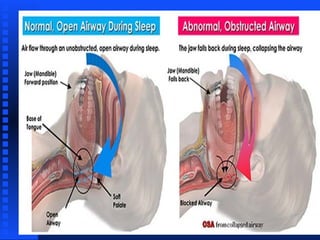
Disorder of obstructedDisorder of obstructed
breathing occurringbreathing occurring
during sleepduring sleep
Apnea: cessation ofApnea: cessation of
breathing withbreathing with
respiratory effortrespiratory effort
lasting greater thanlasting greater than
10s10s
Total apneas andTotal apneas and
hypopneas per hour =hypopneas per hour =
AHI or RDIAHI or RDI
History
Charles Dickens – the Pickwick PaperCharles Dickens – the Pickwick Paper
William Osler - Pickwickian SyndromeWilliam Osler - Pickwickian Syndrome
19181918
Guilleminault - OSAS - 1973Guilleminault - OSAS - 1973
Fujita - UPPP - 1981Fujita - UPPP - 1981
Sullivan - CPAP - 1981Sullivan - CPAP - 1981
Risk factors for OSA
Obesity & BMI greater than 25kg/m2Obesity & BMI greater than 25kg/m2
Cranial facial structureCranial facial structure
Alcohol consumptionAlcohol consumption
High and narrow hard palateHigh and narrow hard palate
Male gender ,Familial associationMale gender ,Familial association
Enlargement of tonsilsEnlargement of tonsils
Lesions of ANSLesions of ANS
Pathophysiology
snoringsnoring
tissue laxity andtissue laxity and
redundant mucosaredundant mucosa
anatomicanatomic
abnormalitiesabnormalities
decreased muscle tonedecreased muscle tone
with REM sleepwith REM sleep
airway collapseairway collapse
Pathophysiology
desaturationdesaturation
arousal with restoration of airwayarousal with restoration of airway
sleep fragmentation leading tosleep fragmentation leading to
hypersomnolencehypersomnolence
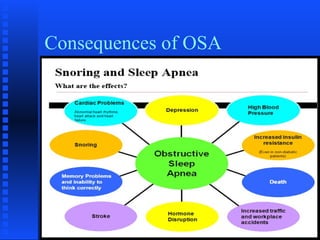
Consequences of OSA
Why is it so Important?
OSA causes HypertensionOSA causes Hypertension
25% of hypertensives have OSA (AI>5)25% of hypertensives have OSA (AI>5)
during the night, the apneas and hypopneas ofduring the night, the apneas and hypopneas of
OSA cause a transient rise in bloodOSA cause a transient rise in blood
pressure( 30 mm hg or more) and increasedpressure( 30 mm hg or more) and increased
activity of sympathetic nervous systemactivity of sympathetic nervous system
OSA causes Hypertension
Over time, the transient changes becomeOver time, the transient changes become
more sustained and are detectable duringmore sustained and are detectable during
the daytime, including evidence ofthe daytime, including evidence of
sympathetic overactivity ( Narkiewicz andsympathetic overactivity ( Narkiewicz and
Somers, 2003)Somers, 2003)
Studies have found that people with OSAStudies have found that people with OSA
(versus those with similar BP, but no OSA)(versus those with similar BP, but no OSA)
have faster HR, blunted heart ratehave faster HR, blunted heart rate
variabilityvariability
OSA causes Hypertension
,and increased blood pressure variability- all,and increased blood pressure variability- all
of which are markers of heightenedof which are markers of heightened
cardiovascular risk ( Caples et al., 2005)cardiovascular risk ( Caples et al., 2005)
OSA is associated with
cardiovascular disease and stroke
Epidemiological studies reveal anEpidemiological studies reveal an
association between OSA andassociation between OSA and
cardiovascular disease, includingcardiovascular disease, including
arrhythmias( Guilleminault et al.,1983);arrhythmias( Guilleminault et al.,1983);
CAD (Andreas et al.,1996) and specifically,CAD (Andreas et al.,1996) and specifically,
MI(Hung et al.,1990; Mooe et al.,1996;MI(Hung et al.,1990; Mooe et al.,1996;
Marin et al.,2005) and congestive heartMarin et al.,2005) and congestive heart
failure ( Javaheri et al.,1998).failure ( Javaheri et al.,1998).
OSA is associated with Impaired
glucose tolerance and Diabetes
 OSA contributes to the onset of diabetesOSA contributes to the onset of diabetes
through the development of glucosethrough the development of glucose
intolerance and insulin resistance, which areintolerance and insulin resistance, which are
established pathophysiological processes inestablished pathophysiological processes in
diabetes ( Martin et al.,1992)diabetes ( Martin et al.,1992)
 Recent data also indicate that diabetics withRecent data also indicate that diabetics with
OSA have poorer control of glucose levels,OSA have poorer control of glucose levels,
with improvement following treatment ofwith improvement following treatment of
OSA with CPAP(Babu et al.,2005)OSA with CPAP(Babu et al.,2005)
OSA is associated with Obesity
Data from the WisconsinData from the Wisconsin
Sleep Cohort also showSleep Cohort also show
that individuals with OSAthat individuals with OSA
have reduced level ofhave reduced level of
physical activity; OSAphysical activity; OSA
related sleepiness mayrelated sleepiness may
contribute to change incontribute to change in
activity and energyactivity and energy
expenditure, and thusexpenditure, and thus
contribute to weight gain.contribute to weight gain.
Societal Impact
Fragmentation of sleepFragmentation of sleep
occurring with SDBoccurring with SDB
increased daytimeincreased daytime
sleepiness, decreasedsleepiness, decreased
intellect, behavioral andintellect, behavioral and
personality changes,personality changes,
enuresis, sexual dysfunctionenuresis, sexual dysfunction
Increased traffic accidentsIncreased traffic accidents
How’s it Diagnosed?
SymptomsSymptoms
Physical examinationPhysical examination
AHIAHI
Sleep study- polysomnography (PSG)Sleep study- polysomnography (PSG)
Physical Exam
Height and Weight (BMI)Height and Weight (BMI)
BMI=[703.1 x weight(pounds)] / [Height (in)BMI=[703.1 x weight(pounds)] / [Height (in)22
]]
neck sizeneck size
Face-retrognathiaFace-retrognathia
NoseNose
Oral cavity- palate, uvula, tonsils/pillars,Oral cavity- palate, uvula, tonsils/pillars,
tongue, occlusiontongue, occlusion
What is Significant OSA?
Uh, I don’t knowUh, I don’t know
Most considerMost consider
significant sleepsignificant sleep
apnea to be presentapnea to be present
with an AHI > 15with an AHI > 15
15-25: Mild Apnea15-25: Mild Apnea
26-40: Moderate26-40: Moderate
ApneaApnea
>40: Severe Apnea>40: Severe Apnea
Fiberoptic
Nasopharyngolaryngoscopy
Determines level ofDetermines level of
obstructionobstruction
Provides estimate of degreeProvides estimate of degree
of obstructionof obstruction
TechniqueTechnique
supine (i.e., in a sleepingsupine (i.e., in a sleeping
position)position)
at FRC-point of maximalat FRC-point of maximal
relaxationrelaxation
snore maneuversnore maneuver
Mueller maneuver- inspireMueller maneuver- inspire
against a closed airwayagainst a closed airway
TREATMENT
NON SURGICALNON SURGICAL
• CPAPCPAP
• APAPAPAP
• ORAL PRESSUREORAL PRESSURE
THERAPYTHERAPY
• BPAPBPAP
• ORAL APPLIANCESORAL APPLIANCES
SURGICALSURGICAL
• UPPPUPPP
• LAUPLAUP
• Palatal somnoplastyPalatal somnoplasty
• Laser midlineLaser midline
glossectomyglossectomy
CPAP
The “Gold Standard” in the treatment ofThe “Gold Standard” in the treatment of
OSAOSA
Works the best in the most peopleWorks the best in the most people
Positive pressure ventilation functions as aPositive pressure ventilation functions as a
pneumatic splint for the collapsing upperpneumatic splint for the collapsing upper
airwayairway
But... compliance is very poorBut... compliance is very poor
Oral Appliances
 Mandibular repositioning appliancesMandibular repositioning appliances
(MRAs)(MRAs)
Lower the tongue position , reduce theLower the tongue position , reduce the
mandibular plane-to- hyoid distance,mandibular plane-to- hyoid distance,
advance the mandible and widen the upperadvance the mandible and widen the upper
oropharynx (retropalatal & retroglossal) inoropharynx (retropalatal & retroglossal) in
some patients.some patients.
Oral Appliances
Contraindication : TMJ disorder, bruxismContraindication : TMJ disorder, bruxism
 Tongue – retaining devices (TRD)Tongue – retaining devices (TRD)
used in pts. Contraindicated to MRAsused in pts. Contraindicated to MRAs
hold the tongue forward and affecthold the tongue forward and affect
genioglossus muscle activitygenioglossus muscle activity
Surgery
TracheotomyTracheotomy
An incision in the tracheaAn incision in the trachea
Cures OSA nearly 100% of the timeCures OSA nearly 100% of the time
Prior to 1980, it’s all we had; still useful forPrior to 1980, it’s all we had; still useful for
severe apneicssevere apneics
Remove Tissue-
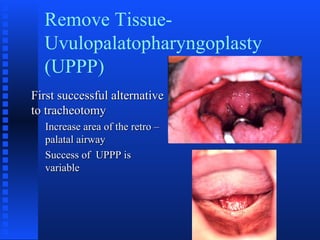
Uvulopalatopharyngoplasty
(UPPP)
First successful alternativeFirst successful alternative
to tracheotomyto tracheotomy
Increase area of the retro –Increase area of the retro –
palatal airwaypalatal airway
Success of UPPP isSuccess of UPPP is
variablevariable
Remove Tissue-Other Surgeries
Laser MidlineLaser Midline
GlossectomyGlossectomy
Palatal SomnoplastyPalatal Somnoplasty
LAUPLAUP
Radiofrequency tongueRadiofrequency tongue
base reductionbase reduction
Enlarge the Bony Space-
Other Surgeries
Genioglossus Advancement/Genioglossus Advancement/
Hyoid RepositioningHyoid Repositioning
Success ~80% (11-18mm)Success ~80% (11-18mm)
Less effective with RDI >60Less effective with RDI >60
Maxillo-mandibularMaxillo-mandibular
AdvancementAdvancement
Particularly useful in theParticularly useful in the
setting of hypopharyngealsetting of hypopharyngeal
obstructionobstruction
CONCLUSION
OSA is a potentially life-threateningOSA is a potentially life-threatening
disorder that demands proper evaluation.disorder that demands proper evaluation.
Components of that proper evaluationComponents of that proper evaluation
include detailed sleep history, PSG, andinclude detailed sleep history, PSG, and
endoscopic evaluation. Most cases are notendoscopic evaluation. Most cases are not
recorded as peoples are not aware of it, andrecorded as peoples are not aware of it, and
they suffer some serious consequences. Sothey suffer some serious consequences. So
it is better to prevent the disease than curingit is better to prevent the disease than curing
it.it.
THANK YOU

Obstructive sleep apnea

  • 2.
    What is obstructivesleep apnea (OSA)? Disorder of obstructedDisorder of obstructed breathing occurringbreathing occurring during sleepduring sleep Apnea: cessation ofApnea: cessation of breathing withbreathing with respiratory effortrespiratory effort lasting greater thanlasting greater than 10s10s Total apneas andTotal apneas and hypopneas per hour =hypopneas per hour = AHI or RDIAHI or RDI
  • 4.
    History Charles Dickens –the Pickwick PaperCharles Dickens – the Pickwick Paper William Osler - Pickwickian SyndromeWilliam Osler - Pickwickian Syndrome 19181918 Guilleminault - OSAS - 1973Guilleminault - OSAS - 1973 Fujita - UPPP - 1981Fujita - UPPP - 1981 Sullivan - CPAP - 1981Sullivan - CPAP - 1981
  • 5.
    Risk factors forOSA Obesity & BMI greater than 25kg/m2Obesity & BMI greater than 25kg/m2 Cranial facial structureCranial facial structure Alcohol consumptionAlcohol consumption High and narrow hard palateHigh and narrow hard palate Male gender ,Familial associationMale gender ,Familial association Enlargement of tonsilsEnlargement of tonsils Lesions of ANSLesions of ANS
  • 6.
    Pathophysiology snoringsnoring tissue laxity andtissuelaxity and redundant mucosaredundant mucosa anatomicanatomic abnormalitiesabnormalities decreased muscle tonedecreased muscle tone with REM sleepwith REM sleep airway collapseairway collapse
  • 7.
    Pathophysiology desaturationdesaturation arousal with restorationof airwayarousal with restoration of airway sleep fragmentation leading tosleep fragmentation leading to hypersomnolencehypersomnolence
  • 8.
  • 9.
    Why is itso Important? OSA causes HypertensionOSA causes Hypertension 25% of hypertensives have OSA (AI>5)25% of hypertensives have OSA (AI>5) during the night, the apneas and hypopneas ofduring the night, the apneas and hypopneas of OSA cause a transient rise in bloodOSA cause a transient rise in blood pressure( 30 mm hg or more) and increasedpressure( 30 mm hg or more) and increased activity of sympathetic nervous systemactivity of sympathetic nervous system
  • 10.
    OSA causes Hypertension Overtime, the transient changes becomeOver time, the transient changes become more sustained and are detectable duringmore sustained and are detectable during the daytime, including evidence ofthe daytime, including evidence of sympathetic overactivity ( Narkiewicz andsympathetic overactivity ( Narkiewicz and Somers, 2003)Somers, 2003) Studies have found that people with OSAStudies have found that people with OSA (versus those with similar BP, but no OSA)(versus those with similar BP, but no OSA) have faster HR, blunted heart ratehave faster HR, blunted heart rate variabilityvariability
  • 11.
    OSA causes Hypertension ,andincreased blood pressure variability- all,and increased blood pressure variability- all of which are markers of heightenedof which are markers of heightened cardiovascular risk ( Caples et al., 2005)cardiovascular risk ( Caples et al., 2005)
  • 12.
    OSA is associatedwith cardiovascular disease and stroke Epidemiological studies reveal anEpidemiological studies reveal an association between OSA andassociation between OSA and cardiovascular disease, includingcardiovascular disease, including arrhythmias( Guilleminault et al.,1983);arrhythmias( Guilleminault et al.,1983); CAD (Andreas et al.,1996) and specifically,CAD (Andreas et al.,1996) and specifically, MI(Hung et al.,1990; Mooe et al.,1996;MI(Hung et al.,1990; Mooe et al.,1996; Marin et al.,2005) and congestive heartMarin et al.,2005) and congestive heart failure ( Javaheri et al.,1998).failure ( Javaheri et al.,1998).
  • 13.
    OSA is associatedwith Impaired glucose tolerance and Diabetes  OSA contributes to the onset of diabetesOSA contributes to the onset of diabetes through the development of glucosethrough the development of glucose intolerance and insulin resistance, which areintolerance and insulin resistance, which are established pathophysiological processes inestablished pathophysiological processes in diabetes ( Martin et al.,1992)diabetes ( Martin et al.,1992)  Recent data also indicate that diabetics withRecent data also indicate that diabetics with OSA have poorer control of glucose levels,OSA have poorer control of glucose levels, with improvement following treatment ofwith improvement following treatment of OSA with CPAP(Babu et al.,2005)OSA with CPAP(Babu et al.,2005)
  • 14.
    OSA is associatedwith Obesity Data from the WisconsinData from the Wisconsin Sleep Cohort also showSleep Cohort also show that individuals with OSAthat individuals with OSA have reduced level ofhave reduced level of physical activity; OSAphysical activity; OSA related sleepiness mayrelated sleepiness may contribute to change incontribute to change in activity and energyactivity and energy expenditure, and thusexpenditure, and thus contribute to weight gain.contribute to weight gain.
  • 15.
    Societal Impact Fragmentation ofsleepFragmentation of sleep occurring with SDBoccurring with SDB increased daytimeincreased daytime sleepiness, decreasedsleepiness, decreased intellect, behavioral andintellect, behavioral and personality changes,personality changes, enuresis, sexual dysfunctionenuresis, sexual dysfunction Increased traffic accidentsIncreased traffic accidents
  • 16.
    How’s it Diagnosed? SymptomsSymptoms PhysicalexaminationPhysical examination AHIAHI Sleep study- polysomnography (PSG)Sleep study- polysomnography (PSG)
  • 18.
    Physical Exam Height andWeight (BMI)Height and Weight (BMI) BMI=[703.1 x weight(pounds)] / [Height (in)BMI=[703.1 x weight(pounds)] / [Height (in)22 ]] neck sizeneck size Face-retrognathiaFace-retrognathia NoseNose Oral cavity- palate, uvula, tonsils/pillars,Oral cavity- palate, uvula, tonsils/pillars, tongue, occlusiontongue, occlusion
  • 19.
    What is SignificantOSA? Uh, I don’t knowUh, I don’t know Most considerMost consider significant sleepsignificant sleep apnea to be presentapnea to be present with an AHI > 15with an AHI > 15 15-25: Mild Apnea15-25: Mild Apnea 26-40: Moderate26-40: Moderate ApneaApnea >40: Severe Apnea>40: Severe Apnea
  • 20.
    Fiberoptic Nasopharyngolaryngoscopy Determines level ofDetermineslevel of obstructionobstruction Provides estimate of degreeProvides estimate of degree of obstructionof obstruction TechniqueTechnique supine (i.e., in a sleepingsupine (i.e., in a sleeping position)position) at FRC-point of maximalat FRC-point of maximal relaxationrelaxation snore maneuversnore maneuver Mueller maneuver- inspireMueller maneuver- inspire against a closed airwayagainst a closed airway
  • 21.
    TREATMENT NON SURGICALNON SURGICAL •CPAPCPAP • APAPAPAP • ORAL PRESSUREORAL PRESSURE THERAPYTHERAPY • BPAPBPAP • ORAL APPLIANCESORAL APPLIANCES SURGICALSURGICAL • UPPPUPPP • LAUPLAUP • Palatal somnoplastyPalatal somnoplasty • Laser midlineLaser midline glossectomyglossectomy
  • 22.
    CPAP The “Gold Standard”in the treatment ofThe “Gold Standard” in the treatment of OSAOSA Works the best in the most peopleWorks the best in the most people Positive pressure ventilation functions as aPositive pressure ventilation functions as a pneumatic splint for the collapsing upperpneumatic splint for the collapsing upper airwayairway But... compliance is very poorBut... compliance is very poor
  • 24.
    Oral Appliances  Mandibularrepositioning appliancesMandibular repositioning appliances (MRAs)(MRAs) Lower the tongue position , reduce theLower the tongue position , reduce the mandibular plane-to- hyoid distance,mandibular plane-to- hyoid distance, advance the mandible and widen the upperadvance the mandible and widen the upper oropharynx (retropalatal & retroglossal) inoropharynx (retropalatal & retroglossal) in some patients.some patients.
  • 25.
    Oral Appliances Contraindication :TMJ disorder, bruxismContraindication : TMJ disorder, bruxism  Tongue – retaining devices (TRD)Tongue – retaining devices (TRD) used in pts. Contraindicated to MRAsused in pts. Contraindicated to MRAs hold the tongue forward and affecthold the tongue forward and affect genioglossus muscle activitygenioglossus muscle activity
  • 28.
    Surgery TracheotomyTracheotomy An incision inthe tracheaAn incision in the trachea Cures OSA nearly 100% of the timeCures OSA nearly 100% of the time Prior to 1980, it’s all we had; still useful forPrior to 1980, it’s all we had; still useful for severe apneicssevere apneics
  • 29.
    Remove Tissue- Uvulopalatopharyngoplasty (UPPP) First successfulalternativeFirst successful alternative to tracheotomyto tracheotomy Increase area of the retro –Increase area of the retro – palatal airwaypalatal airway Success of UPPP isSuccess of UPPP is variablevariable
  • 31.
    Remove Tissue-Other Surgeries LaserMidlineLaser Midline GlossectomyGlossectomy Palatal SomnoplastyPalatal Somnoplasty LAUPLAUP Radiofrequency tongueRadiofrequency tongue base reductionbase reduction
  • 32.
    Enlarge the BonySpace- Other Surgeries Genioglossus Advancement/Genioglossus Advancement/ Hyoid RepositioningHyoid Repositioning Success ~80% (11-18mm)Success ~80% (11-18mm) Less effective with RDI >60Less effective with RDI >60 Maxillo-mandibularMaxillo-mandibular AdvancementAdvancement Particularly useful in theParticularly useful in the setting of hypopharyngealsetting of hypopharyngeal obstructionobstruction
  • 33.
    CONCLUSION OSA is apotentially life-threateningOSA is a potentially life-threatening disorder that demands proper evaluation.disorder that demands proper evaluation. Components of that proper evaluationComponents of that proper evaluation include detailed sleep history, PSG, andinclude detailed sleep history, PSG, and endoscopic evaluation. Most cases are notendoscopic evaluation. Most cases are not recorded as peoples are not aware of it, andrecorded as peoples are not aware of it, and they suffer some serious consequences. Sothey suffer some serious consequences. So it is better to prevent the disease than curingit is better to prevent the disease than curing it.it.
  • 34.