AMBO University School/college health science
• Module Name: Obstetrics II
YEAR IV
INSTITUTION:
AMBO UNIVERSITY
COLLEGE OF
HEALTH SCIENCE
DEPARTMENT OF
MIDWIFERY.
• BY: Rebuma M. (MSc.)
09/02/2024 Rebuma M. 1
AMBO University School/college health science
ANALGESIA AND
ANESTHESI
A
AMBO University School/college health science
AMBO University School/college name here
9/2/24
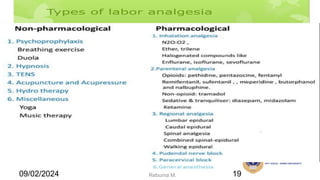
What is the difference
between analgesia and
anesthesia
AMBO University School/college name here
Introduction
Relief of pain during labor and delivery is an essential
part in good obstetric care.
Choice of anesthesia depends upon the patient’s
conditions and the associate disorders.
Anesthesia following full meal may cause maternal
death due to vomiting and aspiration of gastric contents.
09/02/2024 Rebuma M. 5
AMBO University School/college name here
-Analgesia is pain relief without loss of consciousness
and without total loss of feeling or movement
-anesthesia is defined as the loss of physical sensation
with or without loss of consciousness.
09/02/2024 Rebuma M. 6
AMBO University School/college name here
09/02/2024 Rebuma M. 7
AMBO University School/college name here
09/02/2024 Rebuma M. 8
AMBO University School/college name here
09/02/2024 Rebuma M. 9
AMBO University School/college name here
09/02/2024 Rebuma M. 10
AMBO University School/college name here
09/02/2024 Rebuma M. 11
AMBO University School/college name here
NERVE SUPPLY OF THE GENITAL
TRACT:-
•Uterus is under both nervous and hormonal control.
• Hypothalamus controls the uterine activity through the
reticular formation which balances the effects of
the two autonomic divisions.
MOTOR NERVE SUPPLY:-
The uterus receives both sympathetic and
parasympathetic nerve fibers.
09/02/2024 Rebuma M. 12
AMBO University School/college name here
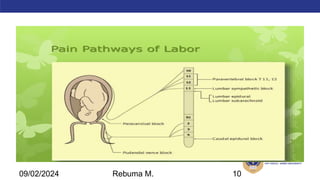
 The sympathetic nerve fibers arise from lower
thoracic and upper lumbar segments of the spinal
cord.
 The parasympathetic fibers arise from sacral 2, 3
and 4 segments of the spinal cord.
 Sensory stimuli from the uterine body: are
transmitted through the pelvic, superior
hypogastric and aorticorenal plexus to the10th
,
11th
and 12th
dorsal and the first lumbar segments
of the spinal cord.
 Sensory stimuli from cervix pass through the pelvic
plexus along the pelvic parasympathetic nerves to
sacral segments 2, 3 and 4 of the spinal cord.
09/02/2024 Rebuma M. 13
AMBO University School/college name here
Sensory stimuli from upper vagina pass to 2, 3 and 4
sacral parasympathetic segments and from lower vagina pass
through the pudendal nerve.
The perineum receives both motor and sensory
innervation from sacral roots 2, 3 and 4 through the pudendal
nerve.
The branches of ilioinguinal and genital branch of
genitofemoral nerves supply the labia majora and also carry
the impulses from the perineum.
09/02/2024 Rebuma M. 14
AMBO University School/college name here
HORMONAL CONTROL:-
 It is generally agreed that intact nerve supply is not essential for the initiation and
progress of labor. Oxytocin, a hormone derived from posterior pituitary maintains the
uterine activity during labor.
 Progesterone is the pregnancy–stabilizing hormone.
 Labor commences when it is withdrawn.
 Adrenalin with its beta activity inhibits the contraction of uterus, while its
alpha activity excites it.
09/02/2024 Rebuma M. 15
AMBO University School/college name here
09/02/2024 Rebuma M. 16
AMBO University School/college name here
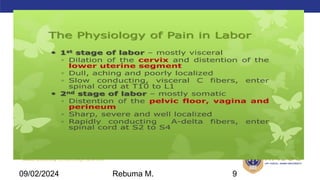
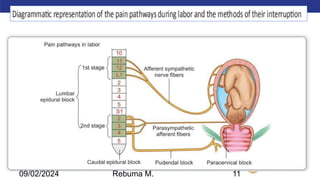
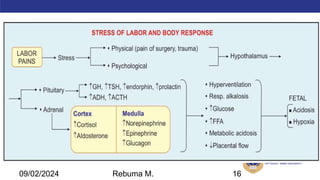
 Pain during labor results from a combination of
uterine contractions and cervical dilatation.
 The intensity of labor pain depends on the intensity
and duration of uterine contractions, degree of dilatation of
cervix, distension of perineal tissue, parity and the pain
threshold of the woman.
09/02/2024 Rebuma M. 17
AMBO University School/college name here
09/02/2024 Rebuma M. 18
AMBO University School/college name here
09/02/2024 19
Rebuma M.
AMBO University School/college name here
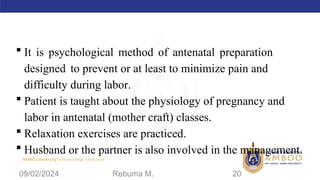
 It is psychological method of antenatal preparation
designed to prevent or at least to minimize pain and
difficulty during labor.
 Patient is taught about the physiology of pregnancy and
labor in antenatal (mother craft) classes.
 Relaxation exercises are practiced.
 Husband or the partner is also involved in the management.
09/02/2024 Rebuma M. 20
AMBO University School/college name here
09/02/2024 Rebuma M. 21
AMBO University School/college name here
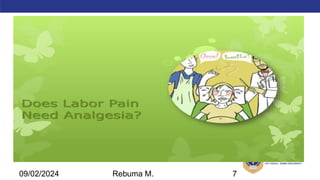
• Every case of labor does not require
analgesia and only sympathetic explanation may be
all that is required.
09/02/2024 Rebuma M. 22
AMBO University School/college name here
COMMONLY USED LOCAL
ANESTHESIA IN OBSTETRICS
09/02/2024 Rebuma M. 23
AMBO University School/college name here
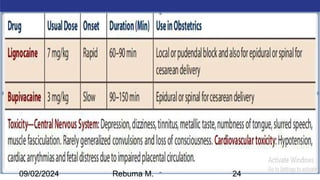
09/02/2024 Rebuma M. 24
AMBO University School/college name here
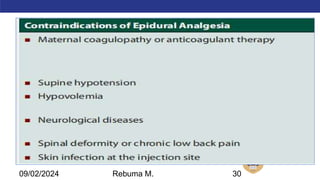
When complete relief of pain is needed
throughout labor, epidural analgesia is the
safest and simplest method for procuring it.
It provides sensory and motor blocked of the
regions.
A lumbar puncture is made between L2 and L3
with the epidural needle (Tuohy needle).
I .REGIONAL (NEURAXIAL) ANESTHESI
09/02/2024 Rebuma M. 25
AMBO University School/college name here
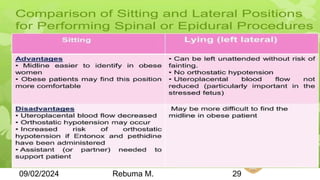
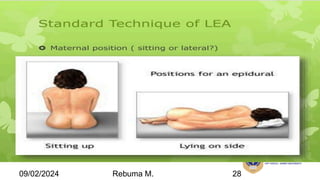
• With the patient on her left side, the back of the patient
is cleansed with antiseptics before injection.
• When the epidural space is ensured, a plastic catheter is passed
through the epidural needle for continuous epidural analgesia.
• A local anesthetic agent (0.5% bupivacaine) is injected into
the epidural space.
• Full dose is given after a test dose when there is no toxicity.
• For cesarean delivery a block from T4 to S1 is needed.
09/02/2024 Rebuma M. 26
AMBO University School/college name here
Advantages of regional Anesthesia
 The patient is awake and can enjoy the birth time
 Newborn APGAR score generally good
Lower risk of maternal aspiration
Postoperative pain control is better
09/02/2024 Rebuma M. 27
AMBO University School/college name here
09/02/2024 Rebuma M. 28
AMBO University School/college name here
09/02/2024 Rebuma M. 29
AMBO University School/college name here
09/02/2024 Rebuma M. 30
AMBO University School/college name here
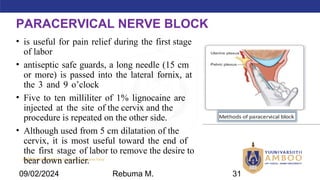
PARACERVICAL NERVE BLOCK
• is useful for pain relief during the first stage
of labor
• antiseptic safe guards, a long needle (15 cm
or more) is passed into the lateral fornix, at
the 3 and 9 o’clock
• Five to ten milliliter of 1% lignocaine are
injected at the site of the cervix and the
procedure is repeated on the other side.
• Although used from 5 cm dilatation of the
cervix, it is most useful toward the end of
the first stage of labor to remove the desire to
bear down earlier.
09/02/2024 Rebuma M. 31
AMBO University School/college name here
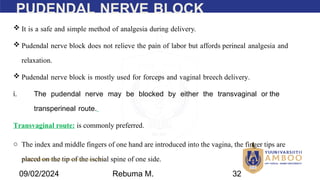
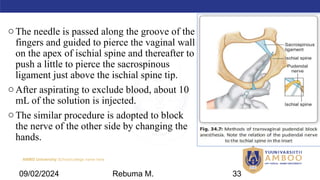
PUDENDAL NERVE BLOCK
 It is a safe and simple method of analgesia during delivery.
 Pudendal nerve block does not relieve the pain of labor but affords perineal analgesia and
relaxation.
 Pudendal nerve block is mostly used for forceps and vaginal breech delivery.
i. The pudendal nerve may be blocked by either the transvaginal or the
transperineal route.
Transvaginal route: is commonly preferred.
o The index and middle fingers of one hand are introduced into the vagina, the finger tips are
placed on the tip of the ischial spine of one side.
09/02/2024 Rebuma M. 32
AMBO University School/college name here
oThe needle is passed along the groove of the
fingers and guided to pierce the vaginal wall
on the apex of ischial spine and thereafter to
push a little to pierce the sacrospinous
ligament just above the ischial spine tip.
oAfter aspirating to exclude blood, about 10
mL of the solution is injected.
oThe similar procedure is adopted to block
the nerve of the other side by changing the
hands.
09/02/2024 Rebuma M. 33
AMBO University School/college name here
SPINAL ANESTHESIA
obtained by injection of local anesthetic agent into the subarachnoid space
of the L3 or L4 lumbar interspace
It has less procedure time and high success rate.
For normal delivery or for outlet forceps with episiotomy, ventouse
delivery, block should extend from T10 (umbilicus) to S1.
Hyperbaric bupivacaine (5–10 mg) or lignocaine (25–50 mg) is used.
09/02/2024 Rebuma M. 34
AMBO University School/college name here
The blood pressure and respiratory rate should be recorded every
3 minutes for the first 10 minutes and every 5 minutes thereafter.
Oxygen should be given for respiratory depression and
hypotension.
Sometimes vasopressor drugs may be required if a marked fall in
blood pressure occurs.
09/02/2024 Rebuma M. 35
AMBO University School/college name here
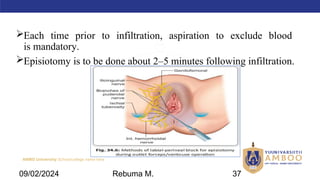
Perineal infiltration:
 For episiotomy: Perineal infiltration anesthesia is
extensively used prior to episiotomy.
 A 10 mL syringe, with a fine needle and about 8–
10 mL 1% lignocaine hydrochloride (Xylocaine) are
required.
 The perineum on the proposed episiotomy site is
infiltrated in a fanwise manner starting from the middle of
the fourchette.
09/02/2024 Rebuma M. 36
AMBO University School/college name here
Each time prior to infiltration, aspiration to exclude blood
is mandatory.
Episiotomy is to be done about 2–5 minutes following infiltration.
09/02/2024 Rebuma M. 37
AMBO University School/college name here
Cesarean section may have to be done either as
an elective or emergency procedure.
Ryel’s tube aspiration of gastric contents is to be
done, especially when the stomach contains food.
Induction of anesthesia is done with the injection of
thiopentone sodium 200–250 mg (4 mg/kg) as a
2.5% solution intravenously.
09/02/2024 Rebuma M. 38
AMBO University School/college name here
Uterine contractility may be diminished by volatile anesthetic agents
like ether, halothane.
Halothane, isoflurane cause cardiac depression, hepatic necrosis and
hypotension.
Uterine incision-Delivery (U-D) interval is more predictive
of neonatal status (Apgar score).
Prolonged U-D interval of more than 3 minutes results in lower
Apgar scores and neonatal acidosis.
09/02/2024 Rebuma M. 39
AMBO University School/college name here
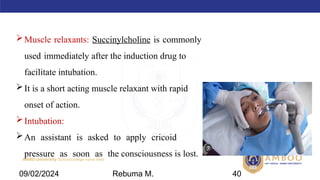
Muscle relaxants: Succinylcholine is commonly
used immediately after the induction drug to
facilitate intubation.
It is a short acting muscle relaxant with rapid
onset of action.
Intubation:
An assistant is asked to apply cricoid
pressure as soon as the consciousness is lost.
09/02/2024 Rebuma M. 40
AMBO University School/college name here
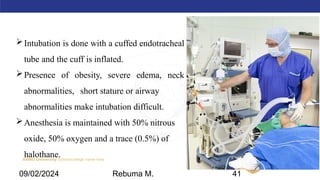
Intubation is done with a cuffed endotracheal
tube and the cuff is inflated.
Presence of obesity, severe edema, neck
abnormalities, short stature or airway
abnormalities make intubation difficult.
Anesthesia is maintained with 50% nitrous
oxide, 50% oxygen and a trace (0.5%) of
halothane.
09/02/2024 Rebuma M. 41
AMBO University School/college name here
Complications of general anesthesia:
Aspiration of gastric contents (Mendelson’s syndrome) is a
serious and life threatening one.
Delayed gastric emptying due to high level of serum
progesterone, decreased motility and maternal
apprehension during labor is the predisposing factor.
is due to aspiration of gastric acid contents (pH < 2.5)
with the development of chemical pneumonitis, lung
damage, atelectasis and bronchopneumonia.
09/02/2024 Rebuma M. 42
AMBO University School/college name here
Management:
Immediate suctioning of oropharynx and nasopharynx is done to
remove the inhaled fluid.
Bronchoscopy may be needed if there is any large
particulate matter.
Continuous positive pressure ventilation to maintain arterial
oxygen saturation of 95% is done.
09/02/2024 Rebuma M. 43
AMBO University School/college name here
Abnormal labor
Objectives
At the end of the session the learners will be able to:
• Define abnormal labor or dystocia
• Identify etiologies of abnormal labor
• Discuss on classification of abnormal labor
• Describe the diagnosis and management options
09/02/2024 Rebuma M. 44
AMBO University School/college name here
Physiology of normal labor
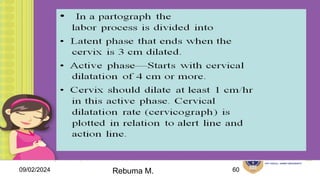
• Labor -is a clinical diagnosis defined as uterine
contractions resulting in progressive cervical
effacement and dilatation, which results in birth
of the baby
-often accompanied by a bloody discharge,
bloody show.
• Stages- first stage -latent
-active
-second stage
-third stage
-fourth stage
09/02/2024 Rebuma M. 45
AMBO University School/college name here
Definition:
Dystocia(abnormal labor)
 literally means difficult labor (child birth)and is
characterized by abnormally slow progress of labor.
 Most common cause of primary c/s.
 More common for primi (25-30 %) multipara (10-15
%).
46
09/02/2024
Abnormal labor( Dystocia)
Rebuma M.
AMBO University School/college name here
09/02/2024 47
Induced labor.
Multiple gestation.
Malpresentation.
Pre/Post term.
Assisted delivery.
Precipitous labor.
Poor progress or arrest.
Abnormal labor
Rebuma M.
AMBO University School/college name here
09/02/2024 48
Classifications of abnormal labor patterns
– Four major groups
• Prolongation disorders
• Protraction disorders
• Arrest Disorders
• Precipitate labor
Rebuma M.
AMBO University School/college name here
09/02/2024 49
Prolongation Disorders
• Only one prolongation disorder
• Prolonged latent phase of labor
• A latent phase lasting longer than 20 hrs. for nulliparous and 14 hrs. for
multiparas.
– Challenge in diagnosis is often due to the problem in diagnosing the
exact time of onset of labor
Causes:
1- Power (Inefficient uterine contraction)
a) Hypertonic uterine dysfunction
b) Hypotonic uterine dysfunction
2- Excessive use of sedative or analgesia.
Rebuma M.
AMBO University School/college name here
Hypertonic:-
contractions are:
-painful
-ineffective and
-associated with increased uterine tone.
There is a high resting basal tone between contractions. Therefore,
uterine circulation does not return to normal between contractions and
consequently fetal distress is more common.
Hypotonic :-
- contractions are less painful and characterized by easily indentable
uterus during the contractions and occur more frequently during the active
phase.
They are considered as the most common cause of poor progress in
labor.
50
09/02/2024 Rebuma M.
AMBO University School/college name here
Risk factors:
-Extreme reproductive age (too young or too old).
-Primigravida.
-Unusually anxious women.
-Uterine over distention, e.g. multiple gestation,
polyhydraminos.
-Minor degrees of cephalo-pelvic disproportion.
-Malposition of the fetal head.
51
09/02/2024 Rebuma M.
AMBO University School/college name here
Cont….
Management
depend on the cause :
* hypertonic activity respond erratically to oxytocin but
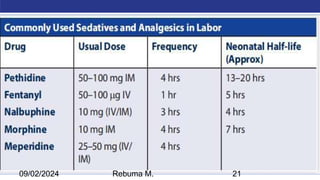
usually respond to therapeutic rest with 15-20mg morphine
sulphate or pethidine
* hypotonic activity respond well to IV(infusion)
oxytocin.
* excessive sedation or analgesia resolved spontaneously after
their effect have disappeared.
* ARM .
52
09/02/2024 Rebuma M.
AMBO University School/college name here
09/02/2024 53
Protraction Disorders
Two protraction disorders
• Protracted cervical dilatation
– A dilatation< 1.2 cms per hour in the primigravida and <1.5
cms per hour in the multigravida during active labor
• Protracted descent
– Descent < 1 cms per hour in the primigravida and <2 cms per
hour in the multigravida
Rebuma M.
AMBO University School/college name here
Management
 generally these disorders don’t respond to oxytocin
stimulation or therapeutic rest or ARM , they should be
treated expectantly as long as the fetal HR is satisfactory
and labor continues to progress.
 If due to hypotonic activity it will respond to oxytocin.
 over sedation , normal labor will resume if the effect of
drug is allowed to wear off.
54
09/02/2024 Rebuma M.
AMBO University School/college name here
09/02/2024 55
Arrest Disorders
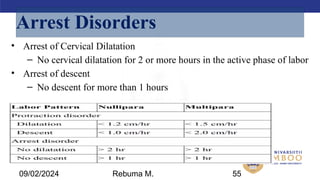
• Arrest of Cervical Dilatation
– No cervical dilatation for 2 or more hours in the active phase of labor
• Arrest of descent
– No descent for more than 1 hours
Rebuma M.
AMBO University School/college name here
Management of labor abnormalities
- Expectant management — Most women with
prolonged second stage ultimately deliver
vaginally
- Treatment of hypo contractile uterine activity
- Assisted vaginal delivery
- Cesarean delivery
09/02/2024 Rebuma M. 56
AMBO University School/college name here
• Definition: Strong and frequent contractions causing
abnormally rapid progress of delivery within 1 hr in multipara
and 3 hrs in primipara.
• Over-efficient contractions in the absence of obstruction.
• Risk factors:
• Strong uterine contractions.
• Small sized fetus.
• Minimal soft tissue resistance.
• Previous history of precipitate labor.
Precipitate labor
09/02/2024 Rebuma M. 57
AMBO University School/college name here
Precipitate labor
• Complications:
• Maternal:
• Laceration: Cervix, vagina, and perineum.
• Uterine inversion – postpartum hemorrhage
• Uterine atony – postpartum hemorrhage
• Amniotic fluid embolism
• Fetal:
• Intracranial hemorrhage
• Fetal distress
• Delivery in inappropriate place
09/02/2024 Rebuma M. 58
AMBO University School/college name here
Precipitate labor
• Management:
1. Stop oxytocin infusion (if used).
2. Tocolytics (Mg sulfate, terbutaline).
3. Episiotomy to avoid fetal and birth canal injuries.
4. Observe for PPH.
5. Observe fetus for injuries.
09/02/2024 Rebuma M. 59
AMBO University School/college name here
09/02/2024 60
Rebuma M.
AMBO University School/college name here
Partograph and Criteria
for Active Labor
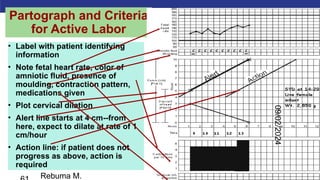
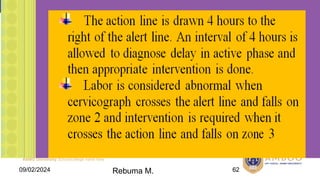
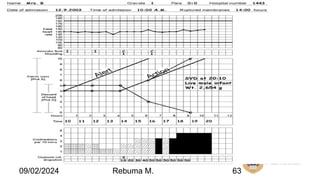
• Label with patient identifying
information
• Note fetal heart rate, color of
amniotic fluid, presence of
moulding, contraction pattern,
medications given
• Plot cervical dilation
• Alert line starts at 4 cm--from
here, expect to dilate at rate of 1
cm/hour
• Action line: if patient does not
progress as above, action is
required
09/02/2024
Rebuma M.
AMBO University School/college name here
09/02/2024 62
Rebuma M.
AMBO University School/college name here
09/02/2024 Rebuma M. 63
AMBO University School/college name here
Quiz
1.case≠1: A 32 yo G1P0 36 wks presented
with contractions. Looks uncomfortable and is
contracting every 3minutes but cervix is 2cm
dilated and 50 % effaced. was seen the
previous day with similar complaints and
findings.
a. What is the diagnosis? (1%)
b.Management option: (1%)
09/02/2024 Rebuma M. 64
AMBO University School/college name here
b.Management: (1%)
a.Diagnosis: (1%)
2.Case≠2:28 yo P0111 at 42 weeks presented in labor. She has
history of previous MVA and pelvic fracture. contracting every
2-3 minutes.6cm dilation x4hrs.confirmed adequate labor with
intrauterine pressure catheter. membranes ruptured, EFW
3200gm.constricted pelvic inlet with non engaged fetal head.
presentation vertex
09/02/2024 Rebuma M. 65
AMBO University School/college name here
09/02/2024 66
Rebuma M.
AMBO University School/college name here
09/02/2024 67
Obstructed Labor Cont…
Outline
• Define obstructed labor
• Discuss the etiology of obstructed labor
• Describe the diagnosis of obstructed labor
• Outline complications of obstructed labor
• Outline steps in the management of obstructed
labor Rebuma M.
AMBO University School/college name here
09/02/2024 68
 Obstructed labor – a neglected case of labor in which
there is failure of descent of fetal presenting part through
the birth canal for mechanical reasons in the presence of
adequate uterine contractions.
 Major cause of maternal and perinatal mortality and
morbidity in low-resource settings with inadequate or
inaccessible intrapartum care.
Definitions – Obstructed labor
Rebuma M.
AMBO University School/college name here
09/02/2024 69
Etiology of Obstructed Labor
• (I) Maternal causes:
1-Bony obstruction : e.g.
- Contracted pelvis.
- Tumours of pelvic bones.
2-Soft tissue obstruction:
i) Uterus: - Impacted subserous pedunculated fibroid.
ii) Cervix: cervical dystocia.
iii) Vagina: − Septa. − Stenosis. − Tumours.
iv) Ovaries : Impacted ovarian tumours.
Rebuma M.
AMBO University School/college name here
09/02/2024 70
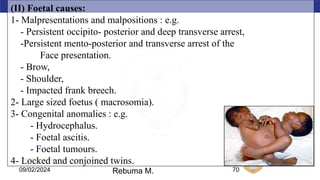
(II) Foetal causes:
1- Malpresentations and malpositions : e.g.
- Persistent occipito- posterior and deep transverse arrest,
-Persistent mento-posterior and transverse arrest of the
Face presentation.
- Brow,
- Shoulder,
- Impacted frank breech.
2- Large sized foetus ( macrosomia).
3- Congenital anomalies : e.g.
- Hydrocephalus.
- Foetal ascitis.
- Foetal tumours.
4- Locked and conjoined twins.
Rebuma M.
AMBO University School/college name here
09/02/2024 71
(A) History: of
- prolonged labour,
- frequent and strong uterine contractions,
- rupture membranes.
(B) General examination :
shows signs of maternal distress as:
- exhaustion,
- high temperature (≥ 38 o
C),
- rapid pulse,
- signs of dehydration : dry tongue and cracked lips.
Diagnosis of Obstructed Labor
Rebuma M.
AMBO University School/college name here
09/02/2024 72
(C) Abdominal examination:
1- The uterus :
- is hard and tender,
- frequent strong uterine contractions with no relaxation
in between (tetanic contractions).
- rising retraction ring is seen and felt as an oblique
groove across the abdomen.
2- The foetus :
- foetal parts cannot be felt easily.
- FHS are absent or show foetal distress due to
interference with the utero-placental blood flow.
Diagnosis cont…
Rebuma M.
AMBO University School/college name here
09/02/2024 73
(D) Vaginal examination:
1- Vulva: is oedematous.
2- Vagina : is dry and hot.
3- Cervix: is fully or partially dilated, oedematous and
hanging.
4- The membranes : are ruptured and offensive liquor
5- The presenting part: is high and not engaged or
impacted in the pelvis. If it is the head it shows
excessive moulding and large caput.
6-High station
7- The cause of obstruction can be detected.
Diagnosis cont…
Rebuma M.
AMBO University School/college name here
09/02/2024 74
(E) Differential diagnosis:
1- Full bladder.
2- Fundal myoma.
Diagnosis cont…
Rebuma M.
AMBO University School/college name here
09/02/2024 75
Obstructed labor versus Parity
Primigravid labor
 Uterine inertia following
obstruction
 Labor can continue for days
 Sepsis and shock are causes
of death
 Fistula is a major
complications
Multiparous labor
 Increased uterine
contractions
 Uterine rupture within
hours
 Death often faster
compared to the
primigravida
Rebuma M.
AMBO University School/college name here
09/02/2024 76
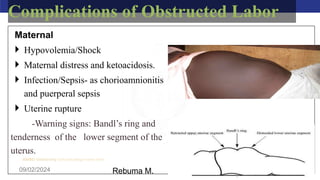
Complications of Obstructed Labor
Maternal
 Hypovolemia/Shock
 Maternal distress and ketoacidosis.
 Infection/Sepsis- as chorioamnionitis
and puerperal sepsis
 Uterine rupture
-Warning signs: Bandl’s ring and
tenderness of the lower segment of the
uterus.
Rebuma M.
AMBO University School/college name here
09/02/2024 77
 Genital trauma
 Neurologic injury
 Death
 Psychological injury
 Postpartum hemorrhage-due to injuries or uterine atony.
Fetus/Neonate
 Asphyxia
 Infection/Sepsis
 Trauma
 Death
 Intracranial haemorrhage from excessive moulding.
Complications of Obstructed Labor
Rebuma M.
AMBO University School/college name here
09/02/2024 78
Management of Obstructed Labor
(A)Preventive measures:
General
 Resuscitation
 Correct dehydration, electrolyte deficit, and acidosis.
 Oxygen
 Antibiotics
 Catheterization
 Pain relief
 NG tube drainage of gastric contents
Rebuma M.
AMBO University School/college name here
09/02/2024 79
 Cross match and prepare blood
Careful observation , proper assessment, early detection and
management of the causes of obstruction.
(B) Curative measures:
Caesarean section is the safest method even if the baby is dead as
labor must be immediately terminated and any manipulations may
lead to rupture uterus.
Management cont…
Rebuma M.
AMBO University School/college name here
Non-reassuring fetal heart rate pattern
Objective
The learner will be able to:
• Describe non-reassuring fetal heart rate
• Identify categories of non-reassuring fetal heart rate
• Categorize Preventive and management options
09/02/2024 Rebuma M. 80
AMBO University School/college name here
Fetal heart rate tracings
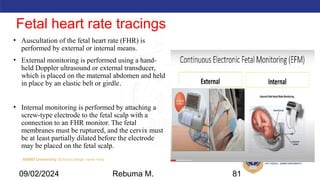
• Auscultation of the fetal heart rate (FHR) is
performed by external or internal means.
• External monitoring is performed using a hand-
held Doppler ultrasound or external transducer,
which is placed on the maternal abdomen and held
in place by an elastic belt or girdle.
• Internal monitoring is performed by attaching a
screw-type electrode to the fetal scalp with a
connection to an FHR monitor. The fetal
membranes must be ruptured, and the cervix must
be at least partially dilated before the electrode
may be placed on the fetal scalp.
09/02/2024 Rebuma M. 81
AMBO University School/college name here
Cont…
I. Reassuring fetal heart rate:
Indicates there is minimal likelihood of acidemia at that
point/normal/.
• A baseline fetal heart rate of 110 to 160 bpm
• Absence of FHR variability (6 to 25 bpm)
• Age appropriate FHR acceleration
• late or variable FHR deceleration.
• Moderate
AMBO University School/college name here
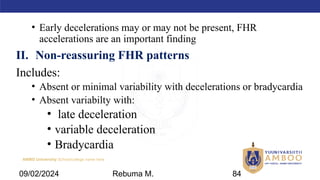
• Early decelerations may or may not be present, FHR
accelerations are an important finding
II. Non-reassuring FHR patterns
Includes:
• Absent or minimal variability with decelerations or bradycardia
• Absent variabilty with:
• late deceleration
• variable deceleration
• Bradycardia
09/02/2024 Rebuma M. 84
AMBO University School/college name here
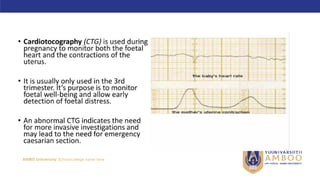
• Tracing the fetal heart beat with a cardiotocograph (CTG)
monitor can be used to assess fetal well being and fetal heart
rate response to uterine activity, during labor and delivery
Interpretation: A) Baseline FHR changes
The pattern between uterine contractions
09/02/2024 Rebuma M. 85
AMBO University School/college name here
i. Tachycardia:
• Mild:160-180 beats/min
• Severe:>180 b/min
Causes
-Maternal fever
-Fetal hypoxia
-Fetal anemia
-Amnionitis
ii. Bradycardia:
• Mild:100-110 beats/min
• Severe:<100 beats/min
Causes
-Heart block (little or no variability)
-Occiput posterior or transverse position
-Serious fetal compromise.
09/02/2024 Rebuma M. 86
AMBO University School/college name here
iii. Loss of beat – to – beat variation:
normally there is a change of 6-25 beats/min every minute in
FHR. Absence of this beat-to-beat variation indicates fetal
compromise.
09/02/2024 Rebuma M. 87
AMBO University School/college name here
B) Periodic FHR changes :The pattern with uterine contractions.
Types of decelerations:
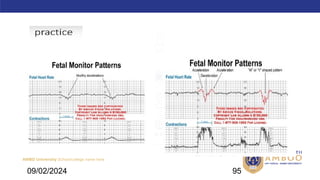
i. Early Decelerations:
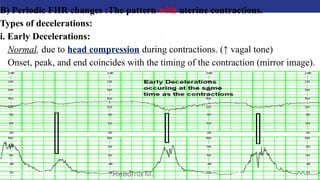
Normal, due to head compression during contractions. (↑ vagal tone)
Onset, peak, and end coincides with the timing of the contraction (mirror image).
09/02/2024 Rebuma M. 88
AMBO University School/college name here
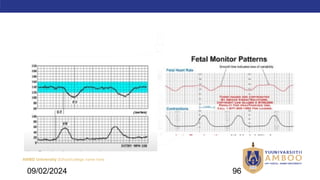
ii. Late deceleration
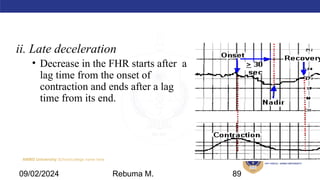
• Decrease in the FHR starts after a
lag time from the onset of
contraction and ends after a lag
time from its end.
09/02/2024 Rebuma M. 89
AMBO University School/college name here
• It denotes utero-placental insufficiency—due to:excessive
uterine contraction, maternal hypoxemia, hypotension,
IUGR,diabetes,abruption.
• hypoxemia leads to hypoxia and metabolic acidosis the delayed return
to baseline worsens due to myocardial depression.
09/02/2024 Rebuma M. 90
AMBO University School/college name here
iii. Variable Decelerations
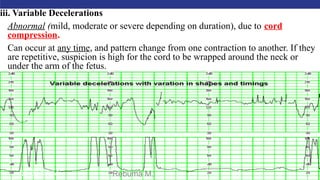
Abnormal (mild, moderate or severe depending on duration), due to cord
compression.
Can occur at any time, and pattern change from one contraction to another. If they
are repetitive, suspicion is high for the cord to be wrapped around the neck or
under the arm of the fetus.
09/02/2024 Rebuma M. 91
AMBO University School/college name here
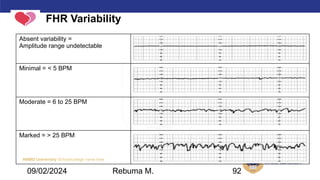
FHR Variability
Absent variability =
Amplitude range undetectable
Minimal = < 5 BPM
Moderate = 6 to 25 BPM
Marked = > 25 BPM
09/02/2024 Rebuma M. 92
AMBO University School/college name here
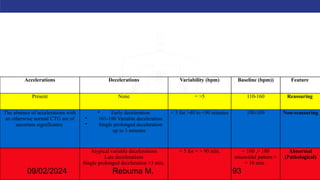
Accelerations Decelerations Variability (bpm) Baseline (bpm)) Feature
Present None = >5 110-160 Reassuring
The absence of accelerations with
an otherwise normal CTG are of
uncertain significance
• Early deceleration
• 161-180 Variable deceleration
• Single prolonged deceleration
up to 3 minutes
< 5 for >40 to <90 minutes 100-109 Non-reassuring
Atypical variable decelerations
Late decelerations
Single prolonged deceleration >3 min.
< 5 for = > 90 min. < 100 ,> 180
sinusoidal pattern >
= 10 min.
Abnormal
(Pathological)
09/02/2024 Rebuma M. 93
AMBO University School/college name here
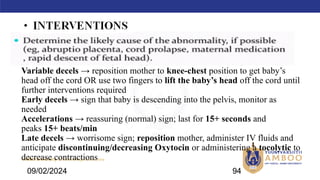
• INTERVENTIONS
Variable decels → reposition mother to knee-chest position to get baby’s
head off the cord OR use two fingers to lift the baby’s head off the cord until
further interventions required
Early decels → sign that baby is descending into the pelvis, monitor as
needed
Accelerations → reassuring (normal) sign; last for 15+ seconds and
peaks 15+ beats/min
Late decels → worrisome sign; reposition mother, administer IV fluids and
anticipate discontinuing/decreasing Oxytocin or administering a tocolytic to
decrease contractions
09/02/2024 94
AMBO University School/college name here
09/02/2024 95
AMBO University School/college name here
09/02/2024 96
AMBO University School/college name here
09/02/2024 97
Induction and Augmentation of Labour
Objectives
At the end of this session, the students will be able to:
-Define induction and Augmentation
- Identify indications of induction and
augmentationof labour
- Mention standard protocols
Induction Of Labour
Definition:
It is artificial initiation of labour using d/f methods after viability of the
foetus i.e. after 28 weeks on appropriate time & favorable condition.
Rebuma M.
AMBO University School/college name here
09/02/2024 98
Indications: Labour maybe induced for medical or obstetrical
reasons.
(I) Maternal:
1. Hypertensive disorders with pregnancy:
i- Severe pre-eclampsia.
ii- Eclampsia.
iii- Essential hypertension.
v- Chronic nephritis.
2. Antepartum haemorrhage:
i- Placenta praevia type I&II.
ii- Accidental haemorrhage.
Rebuma M.
AMBO University School/college name here
09/02/2024 99
- Diabetes mellitus:
To avoid intrauterine foetal death and dystocia due to macrosomia
- Spontaneous / premature rupture of membrane
Elderly primigravida
- Poor obstetric history
(II) Foetal:
1.Post-term pregnancy.
2.Intrauterine growth retardation.
3.Intrauterine foetal death
Indication cont…
Rebuma M.
AMBO University School/college name here
09/02/2024 100
4.Rh- isoimmunization.
5.Gross congenital anomalies
Contraindication
- Unreliable EDD -Repaired fistula
- Malpresentation -Active genital herpes
- CPD -PP totalis
- Fetal distress
- Psychological distress
Relative CI: -twin pregnancy -previous c/s
-grand multipara > 6 -abnormal FHB pattern
Rebuma M.
AMBO University School/college name here
09/02/2024 101
Precondition for Induction
A .Fetal maturity and viability
B .Favorability of cervix
Favorability of cervix is assessed by a score system called
‘’Bishop”score.It has to be done before induction. The total score is in the
range of 0-13
There are five factors considered, each accounts a score of 0-3.
The components are: -Cervical dilatation
- >> effacement
- >> consistency
- >> Position
- Fetal station
Rebuma M.
AMBO University School/college name here
09/02/2024 102
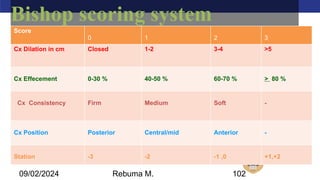
Bishop scoring system
Score
0 1 2 3
Cx Dilation in cm Closed 1-2 3-4 >5
Cx Effecement 0-30 % 40-50 % 60-70 % > 80 %
Cx Consistency Firm Medium Soft -
Cx Position Posterior Central/mid Anterior -
Station -3 -2 -1 ,0 +1,+2
Rebuma M.
AMBO University School/college name here
09/02/2024
103
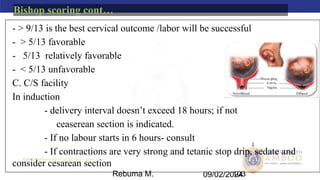
- > 9/13 is the best cervical outcome /labor will be successful
- > 5/13 favorable
- 5/13 relatively favorable
- < 5/13 unfavorable
C. C/S facility
In induction
- delivery interval doesn’t exceed 18 hours; if not
ceaserean section is indicated.
- If no labour starts in 6 hours- consult
- If contractions are very strong and tetanic stop drip, sedate and
consider cesarean section
Bishop scoring cont…
Rebuma M.
AMBO University School/college name here
09/02/2024 104
Observation of mother and fetus
- The fetal heart rate
- Uterine contractions
- Fluid balance chart
- Urine test for ketoses
Progress in labour
- Abdominal & cervical examination every 2-4 hours After
delivery continue oxytocin drops for one hour to prevent PPH.
Rebuma M.
AMBO University School/college name here
Methods of Induction:
I-Natural-Non Medical methods (Cont.)
1-Relaxation techniques: advise patient to relieve tension and try to relax then
use some visual aids to show how labor starts.
2-Visualization: The patient is advised to imagine her uterus contracting and
she is laboring. Hypnosis/self-hypnosis helps.
3-Walking: The force of gravity pulls the weight of the baby towards the birth
canal leading to dilatation and effacement of the cervix.
09/02/2024 Rebuma M. 105
AMBO University School/college name here
Cont…
4-Sex: Having sex is known to induce labor. This is related to prostaglandin
content of the seminal fluid and the occurrence of orgasm which stimulate
uterine contractions
5-Nipple stimulation: The lady moves her palm and applies some pressure
in a circular fashion over her areola and massaging nipple between thumb
and forefingers for a period of 2 minutes alternating with 3 minutes of
rest. The procedure is performed for 20 minutes.
09/02/2024 Rebuma M. 106
AMBO University School/college name here
Cont…
6-Bath/Castor oil/Enemas: - take a warm bath
- have 3 teaspoons of castor oil mixed with some juice and an
enema thereafter. This method could stimulate the uterus to contract.
7-Foods: Eating lots of pineapple is known to stimulate labor and ripen the
cervix. This is possibly related to its enzyme content. Other foods with
similar action include Pizza, spicy food like Mexican, and tropical fruits
09/02/2024 Rebuma M. 107
AMBO University School/college name here
II-Surgical Methods
-Amniotomy - Technique:
-The FHR is recorded before the procedure.
-A pelvic examination is performed to evaluate the cervix & station of the presenting
part. The presenting part should be well fitted to the cervix.
-The membranes are identified and a kocher is inserted through the cervical os by
sliding it along the hand & fingers & membranes are ruptured.
-The nature of the amniotic fluid is recorded (clear, bloody, thick or thin, meconium).
-The FHR is recorded after the procedure.
09/02/2024 Rebuma M. 108
AMBO University School/college name here
III-Surgical Methods (Cont.)
Risks of amniotomy:
1- Prolapse of the umbilical cord (0.5%)
2- Chorioamnionitis: Risk increases with prolonged induction delivery interval
3- Postpartum hemorrhage: Risk is doubled compared with women with
spontaneous onset of labor
4- Rupture of vasa previa
5- Neonatal hyperbilirubinemia
09/02/2024 Rebuma M. 109
AMBO University School/college name here
IV-Pharmacologic Induction of Labor
1-Prostaglandin E2: (dinoprostone): It is inserted vaginally as a gel
(Prepidil), as a removable tampon (Cervidil) or as a vaginal pessary.
2-Misoprostol:
Route of administration: Oral, vaginal and sublingual route for induction.
-Misoprostol (Cytotec) is a synthetic PGE1 analog
-Clinical trials indicate that the safe optimal dose and dosing interval is 25
mcg intravaginally every 4-6 hours. A maximum of 6 doses was
suggested. Higher doses or shorter dosing intervals are associated with a
higher incidence of side effects, especially hyperstimulation syndrome.
09/02/2024 Rebuma M. 110
AMBO University School/college name here
IV-Pharmacologic Induction of Labor
3-Mifepristone:
• Mifepristone (Mifeprex) is an antiprogesterone, couteract the
progesterone activity.
4-Oxytocin:
It is given by IV infusion using an automated pump. Oxytocin has many
advantages: it is potent and easy to titrate, has a short half-life (one to five
minutes) and is well tolerated.
09/02/2024 Rebuma M. 111
AMBO University School/college name here
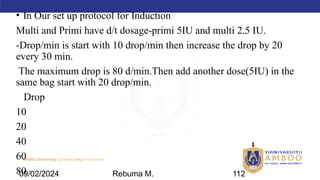
• In Our set up protocol for Induction
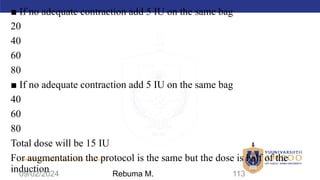
Multi and Primi have d/t dosage-primi 5IU and multi 2.5 IU.
-Drop/min is start with 10 drop/min then increase the drop by 20
every 30 min.
The maximum drop is 80 d/min.Then add another dose(5IU) in the
same bag start with 20 drop/min.
Drop
10
20
40
60
80
09/02/2024 Rebuma M. 112
AMBO University School/college name here
■ If no adequate contraction add 5 IU on the same bag
20
40
60
80
■ If no adequate contraction add 5 IU on the same bag
40
60
80
Total dose will be 15 IU
For augmentation the protocol is the same but the dose is half of the
induction
09/02/2024 113
Rebuma M.
AMBO University School/college name here
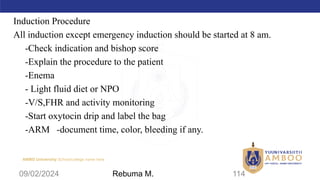
Induction Procedure
All induction except emergency induction should be started at 8 am.
-Check indication and bishop score
-Explain the procedure to the patient
-Enema
- Light fluid diet or NPO
-V/S,FHR and activity monitoring
-Start oxytocin drip and label the bag
-ARM -document time, color, bleeding if any.
09/02/2024 114
Rebuma M.
AMBO University School/college name here
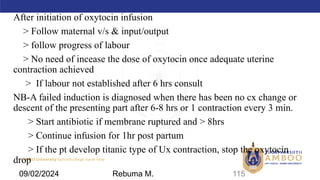
After initiation of oxytocin infusion
> Follow maternal v/s & input/output
> follow progress of labour
> No need of incease the dose of oxytocin once adequate uterine
contraction achieved
> If labour not established after 6 hrs consult
NB-A failed induction is diagnosed when there has been no cx change or
descent of the presenting part after 6-8 hrs or 1 contraction every 3 min.
> Start antibiotic if membrane ruptured and > 8hrs
> Continue infusion for 1hr post partum
> If the pt develop titanic type of Ux contraction, stop the oxytocin
drop
115
09/02/2024 Rebuma M.
AMBO University School/college name here
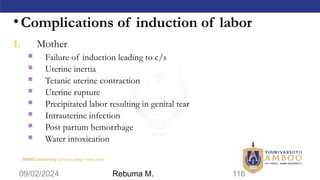
•Complications of induction of labor
1. Mother
 Failure of induction leading to c/s
 Uterine inertia
 Tetanic uterine contraction
 Uterine rupture
 Precipitated labor resulting in genital tear
 Intrauterine infection
 Post partum hemorrhage
 Water intoxication
09/02/2024 116
Rebuma M.
AMBO University School/college name here
2. Fetus
 Prematurity
 Birth injuries
 Cord prolapse
 Fetal distress
 IUFD
09/02/2024 117
Rebuma M.
AMBO University School/college name here
09/02/2024 118
Defn:Acceleration of already started labour.
Indication:
♦ Prolonged labor due to
-Cx arrest
- Descent disorder-all are b/c of –poor Ux cont.
The aim :
 To increase intensity of Ux contraction
 To clear the possibility of uncoordinated Ux contraction
Augmentation of labour
Rebuma M.
AMBO University School/college name here
09/02/2024 119
Precondition For Augmentation
 Rule out passage of meconium
 Rule out CPD,malposition,malpresentation
 There should be C/S facility
Contraindication:
♣ Maposition and malpresentation
♣ CPD
♣ Active genital herpes infection
♣ Pelvic contractor
♣ NRFHR
♣ Fetal macrosomia
Augmentation cont…
Rebuma M.
AMBO University School/college name here
Thank you!
09/02/2024
By Rebuma M.
120
AMBO University School/college name here
I. Interactive presentation, case scenario [6hr]
1. Anesthesia and Analgesics (2hrs)
• Review mechanism of pain
• Introduction
• Type
• Complications /side effects
2. Abnormal labor [4hrs]
 Prolonged latent phase
 Protraction and arrest disorders
 Precipitate labor
Skill Development Lab [3hrs]
 Prepare and administer medications (Demonstration)
 Abnormal progress of labor (video, interpreting partograph)
PBL [4hrs]
 Abnormal labor
09/02/2024 Rebuma M. 121
AMBO University School/college name here
II. Interactive presentation, case scenario [6hrs.]
3. Non-reassuring fetal heart rate pattern [2hr]
 Introduction
 Pathophysiology
 Cause
 Care and management
4. Obstructed labor [2hr]
 Introduction
 Risk factors and causes
 Care and management
Skill Development Lab [2hrs]
 Cephalopelvic disproportion & obstructed labor
PBL [4hrs]
 Obstructed labor
 Non-reassuring fetal heart rate pattern
09/02/2024 Rebuma M. 122
AMBO University School/college name here
5. Induction and Augmentation of labor [2hrs]
 Indications for induction and augmentation
 Contraindications for induction and augmentation
AMBO University School/college name here
References:
• Burkman RT. Williams obstetrics. JAMA. 2010 Jul 28;304(4):474-5.
• El-Mowafi DM. Obstetrics Simplified. El-Happy Land Square, El-
Mansoura, Egypt: Burg Abu-Samr. 1997.
• Marshall JE, Raynor MD. Myles' Textbook for Midwives E-Book.
Elsevier Health Sciences; 2022 Sep 5.
• Jacob A. A comprehensive textbook of midwifery & gynecological
nursing. Jaypee Brothers Medical Publishers; 2018 Nov 10.
• Beckmann CR, Herbert W, Laube D, Ling F, Smith R. Obstetrics and
gynecology. Lippincott Williams & Wilkins; 2013 Jan 21.
09/02/2024 Rebuma M. 124

obstetrics II class handout.pptx

  • 1.
    AMBO University School/collegehealth science • Module Name: Obstetrics II YEAR IV INSTITUTION: AMBO UNIVERSITY COLLEGE OF HEALTH SCIENCE DEPARTMENT OF MIDWIFERY. • BY: Rebuma M. (MSc.) 09/02/2024 Rebuma M. 1
  • 2.
    AMBO University School/collegehealth science ANALGESIA AND ANESTHESI A
  • 3.
  • 4.
    AMBO University School/collegename here 9/2/24 What is the difference between analgesia and anesthesia
  • 5.
    AMBO University School/collegename here Introduction Relief of pain during labor and delivery is an essential part in good obstetric care. Choice of anesthesia depends upon the patient’s conditions and the associate disorders. Anesthesia following full meal may cause maternal death due to vomiting and aspiration of gastric contents. 09/02/2024 Rebuma M. 5
  • 6.
    AMBO University School/collegename here -Analgesia is pain relief without loss of consciousness and without total loss of feeling or movement -anesthesia is defined as the loss of physical sensation with or without loss of consciousness. 09/02/2024 Rebuma M. 6
  • 7.
    AMBO University School/collegename here 09/02/2024 Rebuma M. 7
  • 8.
    AMBO University School/collegename here 09/02/2024 Rebuma M. 8
  • 9.
    AMBO University School/collegename here 09/02/2024 Rebuma M. 9
  • 10.
    AMBO University School/collegename here 09/02/2024 Rebuma M. 10
  • 11.
    AMBO University School/collegename here 09/02/2024 Rebuma M. 11
  • 12.
    AMBO University School/collegename here NERVE SUPPLY OF THE GENITAL TRACT:- •Uterus is under both nervous and hormonal control. • Hypothalamus controls the uterine activity through the reticular formation which balances the effects of the two autonomic divisions. MOTOR NERVE SUPPLY:- The uterus receives both sympathetic and parasympathetic nerve fibers. 09/02/2024 Rebuma M. 12
  • 13.
    AMBO University School/collegename here  The sympathetic nerve fibers arise from lower thoracic and upper lumbar segments of the spinal cord.  The parasympathetic fibers arise from sacral 2, 3 and 4 segments of the spinal cord.  Sensory stimuli from the uterine body: are transmitted through the pelvic, superior hypogastric and aorticorenal plexus to the10th , 11th and 12th dorsal and the first lumbar segments of the spinal cord.  Sensory stimuli from cervix pass through the pelvic plexus along the pelvic parasympathetic nerves to sacral segments 2, 3 and 4 of the spinal cord. 09/02/2024 Rebuma M. 13
  • 14.
    AMBO University School/collegename here Sensory stimuli from upper vagina pass to 2, 3 and 4 sacral parasympathetic segments and from lower vagina pass through the pudendal nerve. The perineum receives both motor and sensory innervation from sacral roots 2, 3 and 4 through the pudendal nerve. The branches of ilioinguinal and genital branch of genitofemoral nerves supply the labia majora and also carry the impulses from the perineum. 09/02/2024 Rebuma M. 14
  • 15.
    AMBO University School/collegename here HORMONAL CONTROL:-  It is generally agreed that intact nerve supply is not essential for the initiation and progress of labor. Oxytocin, a hormone derived from posterior pituitary maintains the uterine activity during labor.  Progesterone is the pregnancy–stabilizing hormone.  Labor commences when it is withdrawn.  Adrenalin with its beta activity inhibits the contraction of uterus, while its alpha activity excites it. 09/02/2024 Rebuma M. 15
  • 16.
    AMBO University School/collegename here 09/02/2024 Rebuma M. 16
  • 17.
    AMBO University School/collegename here  Pain during labor results from a combination of uterine contractions and cervical dilatation.  The intensity of labor pain depends on the intensity and duration of uterine contractions, degree of dilatation of cervix, distension of perineal tissue, parity and the pain threshold of the woman. 09/02/2024 Rebuma M. 17
  • 18.
    AMBO University School/collegename here 09/02/2024 Rebuma M. 18
  • 19.
    AMBO University School/collegename here 09/02/2024 19 Rebuma M.
  • 20.
    AMBO University School/collegename here  It is psychological method of antenatal preparation designed to prevent or at least to minimize pain and difficulty during labor.  Patient is taught about the physiology of pregnancy and labor in antenatal (mother craft) classes.  Relaxation exercises are practiced.  Husband or the partner is also involved in the management. 09/02/2024 Rebuma M. 20
  • 21.
    AMBO University School/collegename here 09/02/2024 Rebuma M. 21
  • 22.
    AMBO University School/collegename here • Every case of labor does not require analgesia and only sympathetic explanation may be all that is required. 09/02/2024 Rebuma M. 22
  • 23.
    AMBO University School/collegename here COMMONLY USED LOCAL ANESTHESIA IN OBSTETRICS 09/02/2024 Rebuma M. 23
  • 24.
    AMBO University School/collegename here 09/02/2024 Rebuma M. 24
  • 25.
    AMBO University School/collegename here When complete relief of pain is needed throughout labor, epidural analgesia is the safest and simplest method for procuring it. It provides sensory and motor blocked of the regions. A lumbar puncture is made between L2 and L3 with the epidural needle (Tuohy needle). I .REGIONAL (NEURAXIAL) ANESTHESI 09/02/2024 Rebuma M. 25
  • 26.
    AMBO University School/collegename here • With the patient on her left side, the back of the patient is cleansed with antiseptics before injection. • When the epidural space is ensured, a plastic catheter is passed through the epidural needle for continuous epidural analgesia. • A local anesthetic agent (0.5% bupivacaine) is injected into the epidural space. • Full dose is given after a test dose when there is no toxicity. • For cesarean delivery a block from T4 to S1 is needed. 09/02/2024 Rebuma M. 26
  • 27.
    AMBO University School/collegename here Advantages of regional Anesthesia  The patient is awake and can enjoy the birth time  Newborn APGAR score generally good Lower risk of maternal aspiration Postoperative pain control is better 09/02/2024 Rebuma M. 27
  • 28.
    AMBO University School/collegename here 09/02/2024 Rebuma M. 28
  • 29.
    AMBO University School/collegename here 09/02/2024 Rebuma M. 29
  • 30.
    AMBO University School/collegename here 09/02/2024 Rebuma M. 30
  • 31.
    AMBO University School/collegename here PARACERVICAL NERVE BLOCK • is useful for pain relief during the first stage of labor • antiseptic safe guards, a long needle (15 cm or more) is passed into the lateral fornix, at the 3 and 9 o’clock • Five to ten milliliter of 1% lignocaine are injected at the site of the cervix and the procedure is repeated on the other side. • Although used from 5 cm dilatation of the cervix, it is most useful toward the end of the first stage of labor to remove the desire to bear down earlier. 09/02/2024 Rebuma M. 31
  • 32.
    AMBO University School/collegename here PUDENDAL NERVE BLOCK  It is a safe and simple method of analgesia during delivery.  Pudendal nerve block does not relieve the pain of labor but affords perineal analgesia and relaxation.  Pudendal nerve block is mostly used for forceps and vaginal breech delivery. i. The pudendal nerve may be blocked by either the transvaginal or the transperineal route. Transvaginal route: is commonly preferred. o The index and middle fingers of one hand are introduced into the vagina, the finger tips are placed on the tip of the ischial spine of one side. 09/02/2024 Rebuma M. 32
  • 33.
    AMBO University School/collegename here oThe needle is passed along the groove of the fingers and guided to pierce the vaginal wall on the apex of ischial spine and thereafter to push a little to pierce the sacrospinous ligament just above the ischial spine tip. oAfter aspirating to exclude blood, about 10 mL of the solution is injected. oThe similar procedure is adopted to block the nerve of the other side by changing the hands. 09/02/2024 Rebuma M. 33
  • 34.
    AMBO University School/collegename here SPINAL ANESTHESIA obtained by injection of local anesthetic agent into the subarachnoid space of the L3 or L4 lumbar interspace It has less procedure time and high success rate. For normal delivery or for outlet forceps with episiotomy, ventouse delivery, block should extend from T10 (umbilicus) to S1. Hyperbaric bupivacaine (5–10 mg) or lignocaine (25–50 mg) is used. 09/02/2024 Rebuma M. 34
  • 35.
    AMBO University School/collegename here The blood pressure and respiratory rate should be recorded every 3 minutes for the first 10 minutes and every 5 minutes thereafter. Oxygen should be given for respiratory depression and hypotension. Sometimes vasopressor drugs may be required if a marked fall in blood pressure occurs. 09/02/2024 Rebuma M. 35
  • 36.
    AMBO University School/collegename here Perineal infiltration:  For episiotomy: Perineal infiltration anesthesia is extensively used prior to episiotomy.  A 10 mL syringe, with a fine needle and about 8– 10 mL 1% lignocaine hydrochloride (Xylocaine) are required.  The perineum on the proposed episiotomy site is infiltrated in a fanwise manner starting from the middle of the fourchette. 09/02/2024 Rebuma M. 36
  • 37.
    AMBO University School/collegename here Each time prior to infiltration, aspiration to exclude blood is mandatory. Episiotomy is to be done about 2–5 minutes following infiltration. 09/02/2024 Rebuma M. 37
  • 38.
    AMBO University School/collegename here Cesarean section may have to be done either as an elective or emergency procedure. Ryel’s tube aspiration of gastric contents is to be done, especially when the stomach contains food. Induction of anesthesia is done with the injection of thiopentone sodium 200–250 mg (4 mg/kg) as a 2.5% solution intravenously. 09/02/2024 Rebuma M. 38
  • 39.
    AMBO University School/collegename here Uterine contractility may be diminished by volatile anesthetic agents like ether, halothane. Halothane, isoflurane cause cardiac depression, hepatic necrosis and hypotension. Uterine incision-Delivery (U-D) interval is more predictive of neonatal status (Apgar score). Prolonged U-D interval of more than 3 minutes results in lower Apgar scores and neonatal acidosis. 09/02/2024 Rebuma M. 39
  • 40.
    AMBO University School/collegename here Muscle relaxants: Succinylcholine is commonly used immediately after the induction drug to facilitate intubation. It is a short acting muscle relaxant with rapid onset of action. Intubation: An assistant is asked to apply cricoid pressure as soon as the consciousness is lost. 09/02/2024 Rebuma M. 40
  • 41.
    AMBO University School/collegename here Intubation is done with a cuffed endotracheal tube and the cuff is inflated. Presence of obesity, severe edema, neck abnormalities, short stature or airway abnormalities make intubation difficult. Anesthesia is maintained with 50% nitrous oxide, 50% oxygen and a trace (0.5%) of halothane. 09/02/2024 Rebuma M. 41
  • 42.
    AMBO University School/collegename here Complications of general anesthesia: Aspiration of gastric contents (Mendelson’s syndrome) is a serious and life threatening one. Delayed gastric emptying due to high level of serum progesterone, decreased motility and maternal apprehension during labor is the predisposing factor. is due to aspiration of gastric acid contents (pH < 2.5) with the development of chemical pneumonitis, lung damage, atelectasis and bronchopneumonia. 09/02/2024 Rebuma M. 42
  • 43.
    AMBO University School/collegename here Management: Immediate suctioning of oropharynx and nasopharynx is done to remove the inhaled fluid. Bronchoscopy may be needed if there is any large particulate matter. Continuous positive pressure ventilation to maintain arterial oxygen saturation of 95% is done. 09/02/2024 Rebuma M. 43
  • 44.
    AMBO University School/collegename here Abnormal labor Objectives At the end of the session the learners will be able to: • Define abnormal labor or dystocia • Identify etiologies of abnormal labor • Discuss on classification of abnormal labor • Describe the diagnosis and management options 09/02/2024 Rebuma M. 44
  • 45.
    AMBO University School/collegename here Physiology of normal labor • Labor -is a clinical diagnosis defined as uterine contractions resulting in progressive cervical effacement and dilatation, which results in birth of the baby -often accompanied by a bloody discharge, bloody show. • Stages- first stage -latent -active -second stage -third stage -fourth stage 09/02/2024 Rebuma M. 45
  • 46.
    AMBO University School/collegename here Definition: Dystocia(abnormal labor)  literally means difficult labor (child birth)and is characterized by abnormally slow progress of labor.  Most common cause of primary c/s.  More common for primi (25-30 %) multipara (10-15 %). 46 09/02/2024 Abnormal labor( Dystocia) Rebuma M.
  • 47.
    AMBO University School/collegename here 09/02/2024 47 Induced labor. Multiple gestation. Malpresentation. Pre/Post term. Assisted delivery. Precipitous labor. Poor progress or arrest. Abnormal labor Rebuma M.
  • 48.
    AMBO University School/collegename here 09/02/2024 48 Classifications of abnormal labor patterns – Four major groups • Prolongation disorders • Protraction disorders • Arrest Disorders • Precipitate labor Rebuma M.
  • 49.
    AMBO University School/collegename here 09/02/2024 49 Prolongation Disorders • Only one prolongation disorder • Prolonged latent phase of labor • A latent phase lasting longer than 20 hrs. for nulliparous and 14 hrs. for multiparas. – Challenge in diagnosis is often due to the problem in diagnosing the exact time of onset of labor Causes: 1- Power (Inefficient uterine contraction) a) Hypertonic uterine dysfunction b) Hypotonic uterine dysfunction 2- Excessive use of sedative or analgesia. Rebuma M.
  • 50.
    AMBO University School/collegename here Hypertonic:- contractions are: -painful -ineffective and -associated with increased uterine tone. There is a high resting basal tone between contractions. Therefore, uterine circulation does not return to normal between contractions and consequently fetal distress is more common. Hypotonic :- - contractions are less painful and characterized by easily indentable uterus during the contractions and occur more frequently during the active phase. They are considered as the most common cause of poor progress in labor. 50 09/02/2024 Rebuma M.
  • 51.
    AMBO University School/collegename here Risk factors: -Extreme reproductive age (too young or too old). -Primigravida. -Unusually anxious women. -Uterine over distention, e.g. multiple gestation, polyhydraminos. -Minor degrees of cephalo-pelvic disproportion. -Malposition of the fetal head. 51 09/02/2024 Rebuma M.
  • 52.
    AMBO University School/collegename here Cont…. Management depend on the cause : * hypertonic activity respond erratically to oxytocin but usually respond to therapeutic rest with 15-20mg morphine sulphate or pethidine * hypotonic activity respond well to IV(infusion) oxytocin. * excessive sedation or analgesia resolved spontaneously after their effect have disappeared. * ARM . 52 09/02/2024 Rebuma M.
  • 53.
    AMBO University School/collegename here 09/02/2024 53 Protraction Disorders Two protraction disorders • Protracted cervical dilatation – A dilatation< 1.2 cms per hour in the primigravida and <1.5 cms per hour in the multigravida during active labor • Protracted descent – Descent < 1 cms per hour in the primigravida and <2 cms per hour in the multigravida Rebuma M.
  • 54.
    AMBO University School/collegename here Management  generally these disorders don’t respond to oxytocin stimulation or therapeutic rest or ARM , they should be treated expectantly as long as the fetal HR is satisfactory and labor continues to progress.  If due to hypotonic activity it will respond to oxytocin.  over sedation , normal labor will resume if the effect of drug is allowed to wear off. 54 09/02/2024 Rebuma M.
  • 55.
    AMBO University School/collegename here 09/02/2024 55 Arrest Disorders • Arrest of Cervical Dilatation – No cervical dilatation for 2 or more hours in the active phase of labor • Arrest of descent – No descent for more than 1 hours Rebuma M.
  • 56.
    AMBO University School/collegename here Management of labor abnormalities - Expectant management — Most women with prolonged second stage ultimately deliver vaginally - Treatment of hypo contractile uterine activity - Assisted vaginal delivery - Cesarean delivery 09/02/2024 Rebuma M. 56
  • 57.
    AMBO University School/collegename here • Definition: Strong and frequent contractions causing abnormally rapid progress of delivery within 1 hr in multipara and 3 hrs in primipara. • Over-efficient contractions in the absence of obstruction. • Risk factors: • Strong uterine contractions. • Small sized fetus. • Minimal soft tissue resistance. • Previous history of precipitate labor. Precipitate labor 09/02/2024 Rebuma M. 57
  • 58.
    AMBO University School/collegename here Precipitate labor • Complications: • Maternal: • Laceration: Cervix, vagina, and perineum. • Uterine inversion – postpartum hemorrhage • Uterine atony – postpartum hemorrhage • Amniotic fluid embolism • Fetal: • Intracranial hemorrhage • Fetal distress • Delivery in inappropriate place 09/02/2024 Rebuma M. 58
  • 59.
    AMBO University School/collegename here Precipitate labor • Management: 1. Stop oxytocin infusion (if used). 2. Tocolytics (Mg sulfate, terbutaline). 3. Episiotomy to avoid fetal and birth canal injuries. 4. Observe for PPH. 5. Observe fetus for injuries. 09/02/2024 Rebuma M. 59
  • 60.
    AMBO University School/collegename here 09/02/2024 60 Rebuma M.
  • 61.
    AMBO University School/collegename here Partograph and Criteria for Active Labor • Label with patient identifying information • Note fetal heart rate, color of amniotic fluid, presence of moulding, contraction pattern, medications given • Plot cervical dilation • Alert line starts at 4 cm--from here, expect to dilate at rate of 1 cm/hour • Action line: if patient does not progress as above, action is required 09/02/2024 Rebuma M.
  • 62.
    AMBO University School/collegename here 09/02/2024 62 Rebuma M.
  • 63.
    AMBO University School/collegename here 09/02/2024 Rebuma M. 63
  • 64.
    AMBO University School/collegename here Quiz 1.case≠1: A 32 yo G1P0 36 wks presented with contractions. Looks uncomfortable and is contracting every 3minutes but cervix is 2cm dilated and 50 % effaced. was seen the previous day with similar complaints and findings. a. What is the diagnosis? (1%) b.Management option: (1%) 09/02/2024 Rebuma M. 64
  • 65.
    AMBO University School/collegename here b.Management: (1%) a.Diagnosis: (1%) 2.Case≠2:28 yo P0111 at 42 weeks presented in labor. She has history of previous MVA and pelvic fracture. contracting every 2-3 minutes.6cm dilation x4hrs.confirmed adequate labor with intrauterine pressure catheter. membranes ruptured, EFW 3200gm.constricted pelvic inlet with non engaged fetal head. presentation vertex 09/02/2024 Rebuma M. 65
  • 66.
    AMBO University School/collegename here 09/02/2024 66 Rebuma M.
  • 67.
    AMBO University School/collegename here 09/02/2024 67 Obstructed Labor Cont… Outline • Define obstructed labor • Discuss the etiology of obstructed labor • Describe the diagnosis of obstructed labor • Outline complications of obstructed labor • Outline steps in the management of obstructed labor Rebuma M.
  • 68.
    AMBO University School/collegename here 09/02/2024 68  Obstructed labor – a neglected case of labor in which there is failure of descent of fetal presenting part through the birth canal for mechanical reasons in the presence of adequate uterine contractions.  Major cause of maternal and perinatal mortality and morbidity in low-resource settings with inadequate or inaccessible intrapartum care. Definitions – Obstructed labor Rebuma M.
  • 69.
    AMBO University School/collegename here 09/02/2024 69 Etiology of Obstructed Labor • (I) Maternal causes: 1-Bony obstruction : e.g. - Contracted pelvis. - Tumours of pelvic bones. 2-Soft tissue obstruction: i) Uterus: - Impacted subserous pedunculated fibroid. ii) Cervix: cervical dystocia. iii) Vagina: − Septa. − Stenosis. − Tumours. iv) Ovaries : Impacted ovarian tumours. Rebuma M.
  • 70.
    AMBO University School/collegename here 09/02/2024 70 (II) Foetal causes: 1- Malpresentations and malpositions : e.g. - Persistent occipito- posterior and deep transverse arrest, -Persistent mento-posterior and transverse arrest of the Face presentation. - Brow, - Shoulder, - Impacted frank breech. 2- Large sized foetus ( macrosomia). 3- Congenital anomalies : e.g. - Hydrocephalus. - Foetal ascitis. - Foetal tumours. 4- Locked and conjoined twins. Rebuma M.
  • 71.
    AMBO University School/collegename here 09/02/2024 71 (A) History: of - prolonged labour, - frequent and strong uterine contractions, - rupture membranes. (B) General examination : shows signs of maternal distress as: - exhaustion, - high temperature (≥ 38 o C), - rapid pulse, - signs of dehydration : dry tongue and cracked lips. Diagnosis of Obstructed Labor Rebuma M.
  • 72.
    AMBO University School/collegename here 09/02/2024 72 (C) Abdominal examination: 1- The uterus : - is hard and tender, - frequent strong uterine contractions with no relaxation in between (tetanic contractions). - rising retraction ring is seen and felt as an oblique groove across the abdomen. 2- The foetus : - foetal parts cannot be felt easily. - FHS are absent or show foetal distress due to interference with the utero-placental blood flow. Diagnosis cont… Rebuma M.
  • 73.
    AMBO University School/collegename here 09/02/2024 73 (D) Vaginal examination: 1- Vulva: is oedematous. 2- Vagina : is dry and hot. 3- Cervix: is fully or partially dilated, oedematous and hanging. 4- The membranes : are ruptured and offensive liquor 5- The presenting part: is high and not engaged or impacted in the pelvis. If it is the head it shows excessive moulding and large caput. 6-High station 7- The cause of obstruction can be detected. Diagnosis cont… Rebuma M.
  • 74.
    AMBO University School/collegename here 09/02/2024 74 (E) Differential diagnosis: 1- Full bladder. 2- Fundal myoma. Diagnosis cont… Rebuma M.
  • 75.
    AMBO University School/collegename here 09/02/2024 75 Obstructed labor versus Parity Primigravid labor  Uterine inertia following obstruction  Labor can continue for days  Sepsis and shock are causes of death  Fistula is a major complications Multiparous labor  Increased uterine contractions  Uterine rupture within hours  Death often faster compared to the primigravida Rebuma M.
  • 76.
    AMBO University School/collegename here 09/02/2024 76 Complications of Obstructed Labor Maternal  Hypovolemia/Shock  Maternal distress and ketoacidosis.  Infection/Sepsis- as chorioamnionitis and puerperal sepsis  Uterine rupture -Warning signs: Bandl’s ring and tenderness of the lower segment of the uterus. Rebuma M.
  • 77.
    AMBO University School/collegename here 09/02/2024 77  Genital trauma  Neurologic injury  Death  Psychological injury  Postpartum hemorrhage-due to injuries or uterine atony. Fetus/Neonate  Asphyxia  Infection/Sepsis  Trauma  Death  Intracranial haemorrhage from excessive moulding. Complications of Obstructed Labor Rebuma M.
  • 78.
    AMBO University School/collegename here 09/02/2024 78 Management of Obstructed Labor (A)Preventive measures: General  Resuscitation  Correct dehydration, electrolyte deficit, and acidosis.  Oxygen  Antibiotics  Catheterization  Pain relief  NG tube drainage of gastric contents Rebuma M.
  • 79.
    AMBO University School/collegename here 09/02/2024 79  Cross match and prepare blood Careful observation , proper assessment, early detection and management of the causes of obstruction. (B) Curative measures: Caesarean section is the safest method even if the baby is dead as labor must be immediately terminated and any manipulations may lead to rupture uterus. Management cont… Rebuma M.
  • 80.
    AMBO University School/collegename here Non-reassuring fetal heart rate pattern Objective The learner will be able to: • Describe non-reassuring fetal heart rate • Identify categories of non-reassuring fetal heart rate • Categorize Preventive and management options 09/02/2024 Rebuma M. 80
  • 81.
    AMBO University School/collegename here Fetal heart rate tracings • Auscultation of the fetal heart rate (FHR) is performed by external or internal means. • External monitoring is performed using a hand- held Doppler ultrasound or external transducer, which is placed on the maternal abdomen and held in place by an elastic belt or girdle. • Internal monitoring is performed by attaching a screw-type electrode to the fetal scalp with a connection to an FHR monitor. The fetal membranes must be ruptured, and the cervix must be at least partially dilated before the electrode may be placed on the fetal scalp. 09/02/2024 Rebuma M. 81
  • 82.
  • 83.
    AMBO University School/collegename here Cont… I. Reassuring fetal heart rate: Indicates there is minimal likelihood of acidemia at that point/normal/. • A baseline fetal heart rate of 110 to 160 bpm • Absence of FHR variability (6 to 25 bpm) • Age appropriate FHR acceleration • late or variable FHR deceleration. • Moderate
  • 84.
    AMBO University School/collegename here • Early decelerations may or may not be present, FHR accelerations are an important finding II. Non-reassuring FHR patterns Includes: • Absent or minimal variability with decelerations or bradycardia • Absent variabilty with: • late deceleration • variable deceleration • Bradycardia 09/02/2024 Rebuma M. 84
  • 85.
    AMBO University School/collegename here • Tracing the fetal heart beat with a cardiotocograph (CTG) monitor can be used to assess fetal well being and fetal heart rate response to uterine activity, during labor and delivery Interpretation: A) Baseline FHR changes The pattern between uterine contractions 09/02/2024 Rebuma M. 85
  • 86.
    AMBO University School/collegename here i. Tachycardia: • Mild:160-180 beats/min • Severe:>180 b/min Causes -Maternal fever -Fetal hypoxia -Fetal anemia -Amnionitis ii. Bradycardia: • Mild:100-110 beats/min • Severe:<100 beats/min Causes -Heart block (little or no variability) -Occiput posterior or transverse position -Serious fetal compromise. 09/02/2024 Rebuma M. 86
  • 87.
    AMBO University School/collegename here iii. Loss of beat – to – beat variation: normally there is a change of 6-25 beats/min every minute in FHR. Absence of this beat-to-beat variation indicates fetal compromise. 09/02/2024 Rebuma M. 87
  • 88.
    AMBO University School/collegename here B) Periodic FHR changes :The pattern with uterine contractions. Types of decelerations: i. Early Decelerations: Normal, due to head compression during contractions. (↑ vagal tone) Onset, peak, and end coincides with the timing of the contraction (mirror image). 09/02/2024 Rebuma M. 88
  • 89.
    AMBO University School/collegename here ii. Late deceleration • Decrease in the FHR starts after a lag time from the onset of contraction and ends after a lag time from its end. 09/02/2024 Rebuma M. 89
  • 90.
    AMBO University School/collegename here • It denotes utero-placental insufficiency—due to:excessive uterine contraction, maternal hypoxemia, hypotension, IUGR,diabetes,abruption. • hypoxemia leads to hypoxia and metabolic acidosis the delayed return to baseline worsens due to myocardial depression. 09/02/2024 Rebuma M. 90
  • 91.
    AMBO University School/collegename here iii. Variable Decelerations Abnormal (mild, moderate or severe depending on duration), due to cord compression. Can occur at any time, and pattern change from one contraction to another. If they are repetitive, suspicion is high for the cord to be wrapped around the neck or under the arm of the fetus. 09/02/2024 Rebuma M. 91
  • 92.
    AMBO University School/collegename here FHR Variability Absent variability = Amplitude range undetectable Minimal = < 5 BPM Moderate = 6 to 25 BPM Marked = > 25 BPM 09/02/2024 Rebuma M. 92
  • 93.
    AMBO University School/collegename here Accelerations Decelerations Variability (bpm) Baseline (bpm)) Feature Present None = >5 110-160 Reassuring The absence of accelerations with an otherwise normal CTG are of uncertain significance • Early deceleration • 161-180 Variable deceleration • Single prolonged deceleration up to 3 minutes < 5 for >40 to <90 minutes 100-109 Non-reassuring Atypical variable decelerations Late decelerations Single prolonged deceleration >3 min. < 5 for = > 90 min. < 100 ,> 180 sinusoidal pattern > = 10 min. Abnormal (Pathological) 09/02/2024 Rebuma M. 93
  • 94.
    AMBO University School/collegename here • INTERVENTIONS Variable decels → reposition mother to knee-chest position to get baby’s head off the cord OR use two fingers to lift the baby’s head off the cord until further interventions required Early decels → sign that baby is descending into the pelvis, monitor as needed Accelerations → reassuring (normal) sign; last for 15+ seconds and peaks 15+ beats/min Late decels → worrisome sign; reposition mother, administer IV fluids and anticipate discontinuing/decreasing Oxytocin or administering a tocolytic to decrease contractions 09/02/2024 94
  • 95.
    AMBO University School/collegename here 09/02/2024 95
  • 96.
    AMBO University School/collegename here 09/02/2024 96
  • 97.
    AMBO University School/collegename here 09/02/2024 97 Induction and Augmentation of Labour Objectives At the end of this session, the students will be able to: -Define induction and Augmentation - Identify indications of induction and augmentationof labour - Mention standard protocols Induction Of Labour Definition: It is artificial initiation of labour using d/f methods after viability of the foetus i.e. after 28 weeks on appropriate time & favorable condition. Rebuma M.
  • 98.
    AMBO University School/collegename here 09/02/2024 98 Indications: Labour maybe induced for medical or obstetrical reasons. (I) Maternal: 1. Hypertensive disorders with pregnancy: i- Severe pre-eclampsia. ii- Eclampsia. iii- Essential hypertension. v- Chronic nephritis. 2. Antepartum haemorrhage: i- Placenta praevia type I&II. ii- Accidental haemorrhage. Rebuma M.
  • 99.
    AMBO University School/collegename here 09/02/2024 99 - Diabetes mellitus: To avoid intrauterine foetal death and dystocia due to macrosomia - Spontaneous / premature rupture of membrane Elderly primigravida - Poor obstetric history (II) Foetal: 1.Post-term pregnancy. 2.Intrauterine growth retardation. 3.Intrauterine foetal death Indication cont… Rebuma M.
  • 100.
    AMBO University School/collegename here 09/02/2024 100 4.Rh- isoimmunization. 5.Gross congenital anomalies Contraindication - Unreliable EDD -Repaired fistula - Malpresentation -Active genital herpes - CPD -PP totalis - Fetal distress - Psychological distress Relative CI: -twin pregnancy -previous c/s -grand multipara > 6 -abnormal FHB pattern Rebuma M.
  • 101.
    AMBO University School/collegename here 09/02/2024 101 Precondition for Induction A .Fetal maturity and viability B .Favorability of cervix Favorability of cervix is assessed by a score system called ‘’Bishop”score.It has to be done before induction. The total score is in the range of 0-13 There are five factors considered, each accounts a score of 0-3. The components are: -Cervical dilatation - >> effacement - >> consistency - >> Position - Fetal station Rebuma M.
  • 102.
    AMBO University School/collegename here 09/02/2024 102 Bishop scoring system Score 0 1 2 3 Cx Dilation in cm Closed 1-2 3-4 >5 Cx Effecement 0-30 % 40-50 % 60-70 % > 80 % Cx Consistency Firm Medium Soft - Cx Position Posterior Central/mid Anterior - Station -3 -2 -1 ,0 +1,+2 Rebuma M.
  • 103.
    AMBO University School/collegename here 09/02/2024 103 - > 9/13 is the best cervical outcome /labor will be successful - > 5/13 favorable - 5/13 relatively favorable - < 5/13 unfavorable C. C/S facility In induction - delivery interval doesn’t exceed 18 hours; if not ceaserean section is indicated. - If no labour starts in 6 hours- consult - If contractions are very strong and tetanic stop drip, sedate and consider cesarean section Bishop scoring cont… Rebuma M.
  • 104.
    AMBO University School/collegename here 09/02/2024 104 Observation of mother and fetus - The fetal heart rate - Uterine contractions - Fluid balance chart - Urine test for ketoses Progress in labour - Abdominal & cervical examination every 2-4 hours After delivery continue oxytocin drops for one hour to prevent PPH. Rebuma M.
  • 105.
    AMBO University School/collegename here Methods of Induction: I-Natural-Non Medical methods (Cont.) 1-Relaxation techniques: advise patient to relieve tension and try to relax then use some visual aids to show how labor starts. 2-Visualization: The patient is advised to imagine her uterus contracting and she is laboring. Hypnosis/self-hypnosis helps. 3-Walking: The force of gravity pulls the weight of the baby towards the birth canal leading to dilatation and effacement of the cervix. 09/02/2024 Rebuma M. 105
  • 106.
    AMBO University School/collegename here Cont… 4-Sex: Having sex is known to induce labor. This is related to prostaglandin content of the seminal fluid and the occurrence of orgasm which stimulate uterine contractions 5-Nipple stimulation: The lady moves her palm and applies some pressure in a circular fashion over her areola and massaging nipple between thumb and forefingers for a period of 2 minutes alternating with 3 minutes of rest. The procedure is performed for 20 minutes. 09/02/2024 Rebuma M. 106
  • 107.
    AMBO University School/collegename here Cont… 6-Bath/Castor oil/Enemas: - take a warm bath - have 3 teaspoons of castor oil mixed with some juice and an enema thereafter. This method could stimulate the uterus to contract. 7-Foods: Eating lots of pineapple is known to stimulate labor and ripen the cervix. This is possibly related to its enzyme content. Other foods with similar action include Pizza, spicy food like Mexican, and tropical fruits 09/02/2024 Rebuma M. 107
  • 108.
    AMBO University School/collegename here II-Surgical Methods -Amniotomy - Technique: -The FHR is recorded before the procedure. -A pelvic examination is performed to evaluate the cervix & station of the presenting part. The presenting part should be well fitted to the cervix. -The membranes are identified and a kocher is inserted through the cervical os by sliding it along the hand & fingers & membranes are ruptured. -The nature of the amniotic fluid is recorded (clear, bloody, thick or thin, meconium). -The FHR is recorded after the procedure. 09/02/2024 Rebuma M. 108
  • 109.
    AMBO University School/collegename here III-Surgical Methods (Cont.) Risks of amniotomy: 1- Prolapse of the umbilical cord (0.5%) 2- Chorioamnionitis: Risk increases with prolonged induction delivery interval 3- Postpartum hemorrhage: Risk is doubled compared with women with spontaneous onset of labor 4- Rupture of vasa previa 5- Neonatal hyperbilirubinemia 09/02/2024 Rebuma M. 109
  • 110.
    AMBO University School/collegename here IV-Pharmacologic Induction of Labor 1-Prostaglandin E2: (dinoprostone): It is inserted vaginally as a gel (Prepidil), as a removable tampon (Cervidil) or as a vaginal pessary. 2-Misoprostol: Route of administration: Oral, vaginal and sublingual route for induction. -Misoprostol (Cytotec) is a synthetic PGE1 analog -Clinical trials indicate that the safe optimal dose and dosing interval is 25 mcg intravaginally every 4-6 hours. A maximum of 6 doses was suggested. Higher doses or shorter dosing intervals are associated with a higher incidence of side effects, especially hyperstimulation syndrome. 09/02/2024 Rebuma M. 110
  • 111.
    AMBO University School/collegename here IV-Pharmacologic Induction of Labor 3-Mifepristone: • Mifepristone (Mifeprex) is an antiprogesterone, couteract the progesterone activity. 4-Oxytocin: It is given by IV infusion using an automated pump. Oxytocin has many advantages: it is potent and easy to titrate, has a short half-life (one to five minutes) and is well tolerated. 09/02/2024 Rebuma M. 111
  • 112.
    AMBO University School/collegename here • In Our set up protocol for Induction Multi and Primi have d/t dosage-primi 5IU and multi 2.5 IU. -Drop/min is start with 10 drop/min then increase the drop by 20 every 30 min. The maximum drop is 80 d/min.Then add another dose(5IU) in the same bag start with 20 drop/min. Drop 10 20 40 60 80 09/02/2024 Rebuma M. 112
  • 113.
    AMBO University School/collegename here ■ If no adequate contraction add 5 IU on the same bag 20 40 60 80 ■ If no adequate contraction add 5 IU on the same bag 40 60 80 Total dose will be 15 IU For augmentation the protocol is the same but the dose is half of the induction 09/02/2024 113 Rebuma M.
  • 114.
    AMBO University School/collegename here Induction Procedure All induction except emergency induction should be started at 8 am. -Check indication and bishop score -Explain the procedure to the patient -Enema - Light fluid diet or NPO -V/S,FHR and activity monitoring -Start oxytocin drip and label the bag -ARM -document time, color, bleeding if any. 09/02/2024 114 Rebuma M.
  • 115.
    AMBO University School/collegename here After initiation of oxytocin infusion > Follow maternal v/s & input/output > follow progress of labour > No need of incease the dose of oxytocin once adequate uterine contraction achieved > If labour not established after 6 hrs consult NB-A failed induction is diagnosed when there has been no cx change or descent of the presenting part after 6-8 hrs or 1 contraction every 3 min. > Start antibiotic if membrane ruptured and > 8hrs > Continue infusion for 1hr post partum > If the pt develop titanic type of Ux contraction, stop the oxytocin drop 115 09/02/2024 Rebuma M.
  • 116.
    AMBO University School/collegename here •Complications of induction of labor 1. Mother  Failure of induction leading to c/s  Uterine inertia  Tetanic uterine contraction  Uterine rupture  Precipitated labor resulting in genital tear  Intrauterine infection  Post partum hemorrhage  Water intoxication 09/02/2024 116 Rebuma M.
  • 117.
    AMBO University School/collegename here 2. Fetus  Prematurity  Birth injuries  Cord prolapse  Fetal distress  IUFD 09/02/2024 117 Rebuma M.
  • 118.
    AMBO University School/collegename here 09/02/2024 118 Defn:Acceleration of already started labour. Indication: ♦ Prolonged labor due to -Cx arrest - Descent disorder-all are b/c of –poor Ux cont. The aim :  To increase intensity of Ux contraction  To clear the possibility of uncoordinated Ux contraction Augmentation of labour Rebuma M.
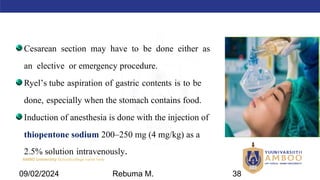
  • 119.
    AMBO University School/collegename here 09/02/2024 119 Precondition For Augmentation  Rule out passage of meconium  Rule out CPD,malposition,malpresentation  There should be C/S facility Contraindication: ♣ Maposition and malpresentation ♣ CPD ♣ Active genital herpes infection ♣ Pelvic contractor ♣ NRFHR ♣ Fetal macrosomia Augmentation cont… Rebuma M.
  • 120.
    AMBO University School/collegename here Thank you! 09/02/2024 By Rebuma M. 120
  • 121.
    AMBO University School/collegename here I. Interactive presentation, case scenario [6hr] 1. Anesthesia and Analgesics (2hrs) • Review mechanism of pain • Introduction • Type • Complications /side effects 2. Abnormal labor [4hrs]  Prolonged latent phase  Protraction and arrest disorders  Precipitate labor Skill Development Lab [3hrs]  Prepare and administer medications (Demonstration)  Abnormal progress of labor (video, interpreting partograph) PBL [4hrs]  Abnormal labor 09/02/2024 Rebuma M. 121
  • 122.
    AMBO University School/collegename here II. Interactive presentation, case scenario [6hrs.] 3. Non-reassuring fetal heart rate pattern [2hr]  Introduction  Pathophysiology  Cause  Care and management 4. Obstructed labor [2hr]  Introduction  Risk factors and causes  Care and management Skill Development Lab [2hrs]  Cephalopelvic disproportion & obstructed labor PBL [4hrs]  Obstructed labor  Non-reassuring fetal heart rate pattern 09/02/2024 Rebuma M. 122
  • 123.
    AMBO University School/collegename here 5. Induction and Augmentation of labor [2hrs]  Indications for induction and augmentation  Contraindications for induction and augmentation
  • 124.
    AMBO University School/collegename here References: • Burkman RT. Williams obstetrics. JAMA. 2010 Jul 28;304(4):474-5. • El-Mowafi DM. Obstetrics Simplified. El-Happy Land Square, El- Mansoura, Egypt: Burg Abu-Samr. 1997. • Marshall JE, Raynor MD. Myles' Textbook for Midwives E-Book. Elsevier Health Sciences; 2022 Sep 5. • Jacob A. A comprehensive textbook of midwifery & gynecological nursing. Jaypee Brothers Medical Publishers; 2018 Nov 10. • Beckmann CR, Herbert W, Laube D, Ling F, Smith R. Obstetrics and gynecology. Lippincott Williams & Wilkins; 2013 Jan 21. 09/02/2024 Rebuma M. 124

Editor's Notes

  • #61 The partograph is a useful tool for monitoring the progress of labor. Use it to avoid unnecessary interventions so maternal and neonatal morbidity are not needlessly increased, to intervene in a timely manner to avoid maternal and neonatal morbidity or mortality and to ensure close monitoring of the woman in labor. At the alert line, the onset of the active phase of labor (4 cm), the patient is expected to reach full dilation at the rate of 1 cm/hour. At the action line, which is 4 hours to the risk of the alert line, the practitioner is signaled to take action if the patient is not following the expected course of labor.