Topic: Observation Methods
Presented By: Gagana K S
Guide: Tanjua Maam
Exploring
Methodologies: An
Overview of Various
Observation
Techniques
Exploring
Methodologies: An
Overview of Various
Observation
Techniques
Data
Data
Research data is any
information that has been
collected, observed,
generated or created to
validate original research
findings. Data comes in
many formats, both digital
and physical.
Research data is any
information that has been
collected, observed,
generated or created to
validate original research
findings. Data comes in
many formats, both digital
and physical.
Data Collection
Data Collection
Data collection is the
process of gathering and
measuring information on
variables of interest, in an
established systematic
fashion that enables one
to answer stated research
questions, test
hypotheses, and evaluate
outcomes.
Data collection is the
process of gathering and
measuring information on
variables of interest, in an
established systematic
fashion that enables one
to answer stated research
questions, test
hypotheses, and evaluate
outcomes.
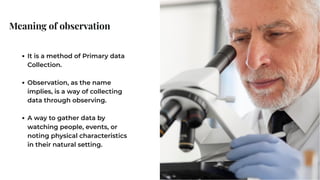
Meaning of observation
It is a method of Primary data
Collection.
Observation, as the name
implies, is a way of collecting
data through observing.
A way to gather data by
watching people, events, or
noting physical characteristics
in their natural setting.
It is a method of Primary data
Collection.
Observation, as the name
implies, is a way of collecting
data through observing.
A way to gather data by
watching people, events, or
noting physical characteristics
in their natural setting.
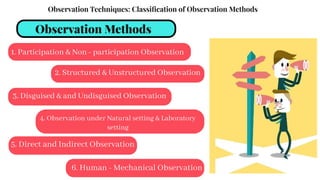
Observation Techniques: Classification of Observation Methods
Observation Methods
1. Participation & Non - participation Observation
2. Structured & Unstructured Observation
3. Disguised & and Undisguised Observation
4. Observation under Natural setting & Laboratory
setting
5. Direct and Indirect Observation
6. Human - Mechanical Observation
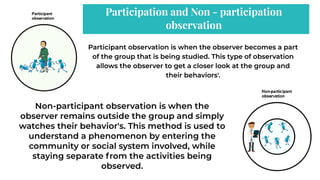
Participation and Non - participation
observation
Participation and Non - participation
observation
Participant observation is when the observer becomes a part
of the group that is being studied. This type of observation
allows the observer to get a closer look at the group and
their behaviors'.
Participant observation is when the observer becomes a part
of the group that is being studied. This type of observation
allows the observer to get a closer look at the group and
their behaviors'.
Non-participant observation is when the
observer remains outside the group and simply
watches their behavior's. This method is used to
understand a phenomenon by entering the
community or social system involved, while
staying separate from the activities being
observed.
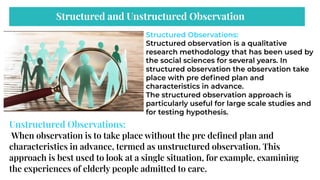
Structured and Unstructured Observation
Unstructured Observations:
When observation is to take place without the pre defined plan and
characteristics in advance, termed as unstructured observation. This
approach is best used to look at a single situation, for example, examining
the experiences of elderly people admitted to care.
Structured Observations:
Structured observation is a qualitative
research methodology that has been used by
the social sciences for several years. In
structured observation the observation take
place with pre defined plan and
characteristics in advance.
The structured observation approach is
particularly useful for large scale studies and
for testing hypothesis.
Disguised and Undisguised Observation
Disguised Observation:
A marketing research technique in which the behaviour
of unaware respondents is observed in marketing
situations. The 'mystery shopper' technique is an example
of disguised observation. Subjects in disguised
observations tend to act more naturally and the data
collected tends to reflect their true reactions.
Non-disguised Observation:
When subjects know they are being observed, this is
called a non-disguised observation. The observer does
not attempt to manipulate the phenomenon being
observed but merely records what takes place. For
example, a researcher might record traffic counts and
observe traffic flows in a department store.
Disguised Observation:
A marketing research technique in which the behaviour
of unaware respondents is observed in marketing
situations. The 'mystery shopper' technique is an example
of disguised observation. Subjects in disguised
observations tend to act more naturally and the data
collected tends to reflect their true reactions.
Non-disguised Observation:
When subjects know they are being observed, this is
called a non-disguised observation. The observer does
not attempt to manipulate the phenomenon being
observed but merely records what takes place. For
example, a researcher might record traffic counts and
observe traffic flows in a department store.
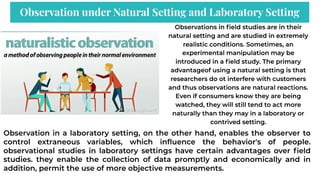
Observation under Natural Setting and Laboratory Setting
Observations in field studies are in their
natural setting and are studied in extremely
realistic conditions. Sometimes, an
experimental manipulation may be
introduced in a field study. The primary
advantageof using a natural setting is that
researchers do ot interfere with customers
and thus observations are natural reactions.
Even if consumers know they are being
watched, they will still tend to act more
naturally than they may in a laboratory or
contrived setting.
Observations in field studies are in their
natural setting and are studied in extremely
realistic conditions. Sometimes, an
experimental manipulation may be
introduced in a field study. The primary
advantageof using a natural setting is that
researchers do ot interfere with customers
and thus observations are natural reactions.
Even if consumers know they are being
watched, they will still tend to act more
naturally than they may in a laboratory or
contrived setting.
Observation in a laboratory setting, on the other hand, enables the observer to
control extraneous variables, which influence the behavior's of people.
observational studies in laboratory settings have certain advantages over field
studies. they enable the collection of data promptly and economically and in
addition, permit the use of more objective measurements.
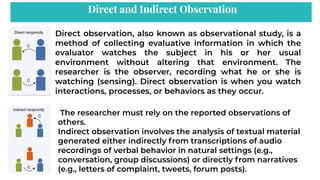
Direct and Indirect Observation
The researcher must rely on the reported observations of
others.
Indirect observation involves the analysis of textual material
generated either indirectly from transcriptions of audio
recordings of verbal behavior in natural settings (e.g.,
conversation, group discussions) or directly from narratives
(e.g., letters of complaint, tweets, forum posts).
Direct observation, also known as observational study, is a
method of collecting evaluative information in which the
evaluator watches the subject in his or her usual
environment without altering that environment. The
researcher is the observer, recording what he or she is
watching (sensing). Direct observation is when you watch
interactions, processes, or behaviors as they occur.
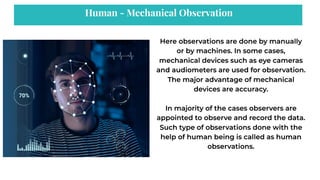
Human - Mechanical Observation
Here observations are done by manually
or by machines. In some cases,
mechanical devices such as eye cameras
and audiometers are used for observation.
The major advantage of mechanical
devices are accuracy.
In majority of the cases observers are
appointed to observe and record the data.
Such type of observations done with the
help of human being is called as human
observations.
Here observations are done by manually
or by machines. In some cases,
mechanical devices such as eye cameras
and audiometers are used for observation.
The major advantage of mechanical
devices are accuracy.
In majority of the cases observers are
appointed to observe and record the data.
Such type of observations done with the
help of human being is called as human
observations.
Conclusion
Conclusion
In conclusion, observation is a critical part of research
methodologies. By using different observation techniques,
researchers can gain a deeper understanding of behavior and
culture. However, it is important to choose the right technique for
the research question and to ensure that the data is collected
and analyzed accurately. We hope that this presentation has
provided you with a better understanding of the different
observation techniques and how to use them effectively.
In conclusion, observation is a critical part of research
methodologies. By using different observation techniques,
researchers can gain a deeper understanding of behavior and
culture. However, it is important to choose the right technique for
the research question and to ensure that the data is collected
and analyzed accurately. We hope that this presentation has
provided you with a better understanding of the different
observation techniques and how to use them effectively.
PPT on Observation Methods [BRM}.pdf

PPT on Observation Methods [BRM}.pdf

  • 1.
    Topic: Observation Methods Topic:Observation Methods Presented By: Gagana K S Guide: Tanjua Maam
  • 2.
    Exploring Methodologies: An Overview ofVarious Observation Techniques Exploring Methodologies: An Overview of Various Observation Techniques
  • 3.
    Data Data Research data isany information that has been collected, observed, generated or created to validate original research findings. Data comes in many formats, both digital and physical. Research data is any information that has been collected, observed, generated or created to validate original research findings. Data comes in many formats, both digital and physical.
  • 4.
    Data Collection Data Collection Datacollection is the process of gathering and measuring information on variables of interest, in an established systematic fashion that enables one to answer stated research questions, test hypotheses, and evaluate outcomes. Data collection is the process of gathering and measuring information on variables of interest, in an established systematic fashion that enables one to answer stated research questions, test hypotheses, and evaluate outcomes.
  • 6.
    Meaning of observation Meaningof observation It is a method of Primary data Collection. Observation, as the name implies, is a way of collecting data through observing. A way to gather data by watching people, events, or noting physical characteristics in their natural setting. It is a method of Primary data Collection. Observation, as the name implies, is a way of collecting data through observing. A way to gather data by watching people, events, or noting physical characteristics in their natural setting.
  • 7.
    Observation Techniques: Classificationof Observation Methods Observation Techniques: Classification of Observation Methods Observation Methods 1. Participation & Non - participation Observation 2. Structured & Unstructured Observation 3. Disguised & and Undisguised Observation 4. Observation under Natural setting & Laboratory setting 5. Direct and Indirect Observation 6. Human - Mechanical Observation
  • 8.
    Participation and Non- participation observation Participation and Non - participation observation Participant observation is when the observer becomes a part of the group that is being studied. This type of observation allows the observer to get a closer look at the group and their behaviors'. Participant observation is when the observer becomes a part of the group that is being studied. This type of observation allows the observer to get a closer look at the group and their behaviors'. Non-participant observation is when the observer remains outside the group and simply watches their behavior's. This method is used to understand a phenomenon by entering the community or social system involved, while staying separate from the activities being observed.
  • 9.
    Structured and UnstructuredObservation Structured and Unstructured Observation Unstructured Observations: When observation is to take place without the pre defined plan and characteristics in advance, termed as unstructured observation. This approach is best used to look at a single situation, for example, examining the experiences of elderly people admitted to care. Structured Observations: Structured observation is a qualitative research methodology that has been used by the social sciences for several years. In structured observation the observation take place with pre defined plan and characteristics in advance. The structured observation approach is particularly useful for large scale studies and for testing hypothesis.
  • 10.
    Disguised and UndisguisedObservation Disguised and Undisguised Observation Disguised Observation: A marketing research technique in which the behaviour of unaware respondents is observed in marketing situations. The 'mystery shopper' technique is an example of disguised observation. Subjects in disguised observations tend to act more naturally and the data collected tends to reflect their true reactions. Non-disguised Observation: When subjects know they are being observed, this is called a non-disguised observation. The observer does not attempt to manipulate the phenomenon being observed but merely records what takes place. For example, a researcher might record traffic counts and observe traffic flows in a department store. Disguised Observation: A marketing research technique in which the behaviour of unaware respondents is observed in marketing situations. The 'mystery shopper' technique is an example of disguised observation. Subjects in disguised observations tend to act more naturally and the data collected tends to reflect their true reactions. Non-disguised Observation: When subjects know they are being observed, this is called a non-disguised observation. The observer does not attempt to manipulate the phenomenon being observed but merely records what takes place. For example, a researcher might record traffic counts and observe traffic flows in a department store.
  • 11.
    Observation under NaturalSetting and Laboratory Setting Observation under Natural Setting and Laboratory Setting Observations in field studies are in their natural setting and are studied in extremely realistic conditions. Sometimes, an experimental manipulation may be introduced in a field study. The primary advantageof using a natural setting is that researchers do ot interfere with customers and thus observations are natural reactions. Even if consumers know they are being watched, they will still tend to act more naturally than they may in a laboratory or contrived setting. Observations in field studies are in their natural setting and are studied in extremely realistic conditions. Sometimes, an experimental manipulation may be introduced in a field study. The primary advantageof using a natural setting is that researchers do ot interfere with customers and thus observations are natural reactions. Even if consumers know they are being watched, they will still tend to act more naturally than they may in a laboratory or contrived setting. Observation in a laboratory setting, on the other hand, enables the observer to control extraneous variables, which influence the behavior's of people. observational studies in laboratory settings have certain advantages over field studies. they enable the collection of data promptly and economically and in addition, permit the use of more objective measurements.
  • 12.
    Direct and IndirectObservation Direct and Indirect Observation The researcher must rely on the reported observations of others. Indirect observation involves the analysis of textual material generated either indirectly from transcriptions of audio recordings of verbal behavior in natural settings (e.g., conversation, group discussions) or directly from narratives (e.g., letters of complaint, tweets, forum posts). Direct observation, also known as observational study, is a method of collecting evaluative information in which the evaluator watches the subject in his or her usual environment without altering that environment. The researcher is the observer, recording what he or she is watching (sensing). Direct observation is when you watch interactions, processes, or behaviors as they occur.
  • 13.
    Human - MechanicalObservation Human - Mechanical Observation Here observations are done by manually or by machines. In some cases, mechanical devices such as eye cameras and audiometers are used for observation. The major advantage of mechanical devices are accuracy. In majority of the cases observers are appointed to observe and record the data. Such type of observations done with the help of human being is called as human observations. Here observations are done by manually or by machines. In some cases, mechanical devices such as eye cameras and audiometers are used for observation. The major advantage of mechanical devices are accuracy. In majority of the cases observers are appointed to observe and record the data. Such type of observations done with the help of human being is called as human observations.
  • 14.
    Conclusion Conclusion In conclusion, observationis a critical part of research methodologies. By using different observation techniques, researchers can gain a deeper understanding of behavior and culture. However, it is important to choose the right technique for the research question and to ensure that the data is collected and analyzed accurately. We hope that this presentation has provided you with a better understanding of the different observation techniques and how to use them effectively. In conclusion, observation is a critical part of research methodologies. By using different observation techniques, researchers can gain a deeper understanding of behavior and culture. However, it is important to choose the right technique for the research question and to ensure that the data is collected and analyzed accurately. We hope that this presentation has provided you with a better understanding of the different observation techniques and how to use them effectively.