OBJECTIVES OF
ECONOMIC
DEVELOPMENT
MEANING OF OBJECTIVE
Objective is something which we plan to do or
achieve. It is an aim or purpose. Every country or
economy in the world would strive hard to achieve
the path of development.
OBJECTIVE IS NECESSARY FOR AN ECONOMY:
 To increase and raise standard of living
 To expand range of economic and social choice
 To meet basic needs
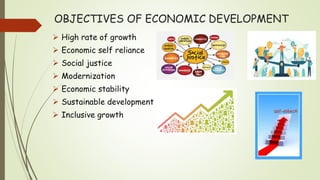
OBJECTIVES OF ECONOMIC DEVELOPMENT
 High rate of growth
 Economic self reliance
 Social justice
 Modernization
 Economic stability
 Sustainable development
 Inclusive growth
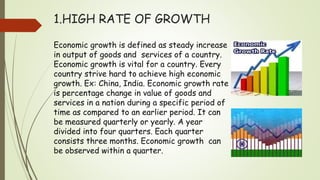
1.HIGH RATE OF GROWTH
Economic growth is defined as steady increase
in output of goods and services of a country.
Economic growth is vital for a country. Every
country strive hard to achieve high economic
growth. Ex: China, India. Economic growth rate
is percentage change in value of goods and
services in a nation during a specific period of
time as compared to an earlier period. It can
be measured quarterly or yearly. A year
divided into four quarters. Each quarter
consists three months. Economic growth can
be observed within a quarter.
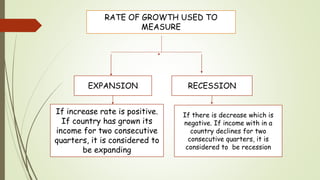
RATE OF GROWTH USED TO
MEASURE
EXPANSION RECESSION
If increase rate is positive.
If country has grown its
income for two consecutive
quarters, it is considered to
be expanding
If there is decrease which is
negative. If income with in a
country declines for two
consecutive quarters, it is
considered to be recession
A healthy rate of growth is 2% to 3%. Economic
growth provides financial stability. It increases
productive capacity. There are huge benefits of
economic growth.
Developing economies or countries were in a view
that high rate of growth can be achieved by giving
importance to primary sector. For instance, after
achieving independence, India’s first five year plan
has focussed on primary sector for growth of real
national income. Initially, rate of economic growth is
not encouraging in economy.
First five year plan [1951-56]
Second five year plan [1956-61]
Third five year plan [1961-66]
THREE FIVE YEAR
PLANNING
Growth was not so encouraging
Till 1980,
 Average annual rate of GDP is 3.73%
 Average annual rate of population 2.5%
Per capita income is 1%
6th plan -considerable change in economy
7th plan –growth rate is 5.4%
8th plan -growth rate is 6.8%
9th plan –growth rate is 7%[targeted growth]
growth rate is 5.35%[real growth]
Economy achieved high rate of growth of 9%. China
achieved 10% rate in 21st century.
12th plan –Targeted growth[7.9%]
Actual growth[8.2%]
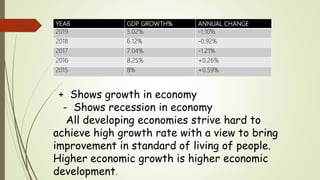
GDP grown at 7.5% during 2014-15 and 2018-19
YEAR GDP GROWTH% ANNUAL CHANGE
2019 5.02% -1.10%
2018 6.12% -0.92%
2017 7.04% -1.21%
2016 8.25% +0.26%
2015 8% +0.59%
+ Shows growth in economy
- Shows recession in economy
All developing economies strive hard to
achieve high growth rate with a view to bring
improvement in standard of living of people.
Higher economic growth is higher economic
development.
2.ECONOMIC SELF RELIANCE
Self-reliance is to rely on one’s own powers and resources rather than other. In
simple terms, it is ability to do our things ourselves. Economic self reliance is a
situation where a country has attained a level of autonomy economically that it
can take certain important decisions. Self reliance means to stand on one's own
legs. Self sufficiency is the fulfillment of an individual without outside aid. Self
Reliance has become an important objective.
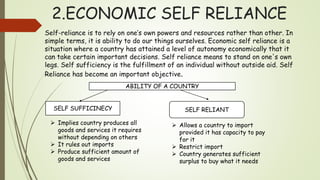
ABILITY OF A COUNTRY
SELF SUFFICINECY SELF RELIANT
 Implies country produces all
goods and services it requires
without depending on others
 It rules out imports
 Produce sufficient amount of
goods and services
 Allows a country to import
provided it has capacity to pay
for it
 Restrict import
 Country generates sufficient
surplus to buy what it needs
No country is self sufficient, but a country can try become self reliant by paying for
everything that imports. A self reliant country doesn't depend on other counties for
resources of needed to acquire them. It implies that dependence on foreign aid
should be minimum as possible. Excessive dependence on foreign sector may lead to
economic colonialism. Economic colonialism refers to powerful nation extending its
influence on less developed economies to exploit one's nation resources.
3rd plan –Objective of self reliance
4th plan –Importance given on self reliance[production of food grains]
5th plan –Earn sufficient foreign exchange[export promotion and import
substitution]
India’s dependence on foreign aid for
Import food grains
from USA
Process of
industrialisation
Infrastructural
facilities
Meet our domestic
demand
Capital goods in
form of machinery
Roads, Railways,
Power etc
India has made remarkable progress in achieving self –reliance.
However, it has to depend on aid to raise rate of investment. China,
Brazil, South Africa, South Korea, Vietnam and Latin American
countries are aiming to achieve self-reliance.
SELF RELIANT SCHEME IN INDIA:
Atmanirbhar Bharat scheme was launched on
12th May 2020, by the Prime Minister of India -
Narendra Modi to make India self Reliant India
to minimize import of atleast small things.
The Atmanirbhar Bharat Abhiyan is a
chance for Indian start-ups to take charge of
innovations for which we are usually dependent
an global suppliers. It is the time to become
vocal for local products & make them global.
FIVE PILLARS
OF SELF-
RELIANT INDIA
Economy
Demography
Demand
System
Infrastructure
ATMANIRBHAR BHARAT[THE
ROAD AHEAD]
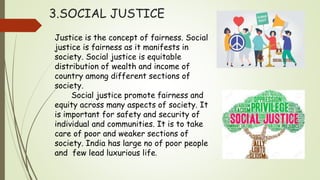
3.SOCIAL JUSTICE
Justice is the concept of fairness. Social
justice is fairness as it manifests in
society. Social justice is equitable
distribution of wealth and income of
country among different sections of
society.
Social justice promote fairness and
equity across many aspects of society. It
is important for safety and security of
individual and communities. It is to take
care of poor and weaker sections of
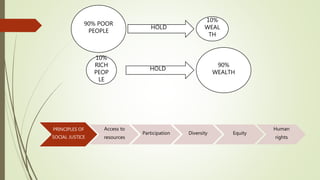
society. India has large no of poor people
and few lead luxurious life.
90% POOR
PEOPLE
HOLD
10%
WEAL
TH
10%
RICH
PEOP
LE
HOLD
90%
WEALTH
PRINCIPLES OF
SOCIAL JUSTICE
Access to
resources
Participation Diversity Equity
Human
rights
ASPECTS OF SOCIAL JUSTICE
 Adherence to democratic principles in political structure of
country. (adherence-commitment)
 Establishment of social and economic equity and removal of
regional disparities. (focus on imbalanced areas)
 Putting an end to process of centralization of economic power
and simultaneously attaining decentralized power
[Decentralization is a good sign of development, Centralization
refers to assets in hand of only few people. Rich becomes richer
and poor becomes poorer]
 Efforts to raise conditions of backward and depressed classes
9th five year plan focused on social justice and
equity
OBJECTIVES OF FIVE YEAR PLAN
 Uplift economic conditions of socio-economically weaker sections
like SC and ST through no of targeted oriented programmes
 To reduce inequality in distribution of land and assets, land
reforms have been adopted
 Specific programmes have been adopted
4.MODERNIZATION
Modernization refers to model of transition from ‘pre-modern’
or ‘traditional' to modem society. Modernization is transforming
from traditional methods to modem methods. Modernization is a
revolutionary change leading to transformation of traditional society
into technological and civilized society. It is opposite view to
traditionalism. It is replacement of traditional to scientific methods.
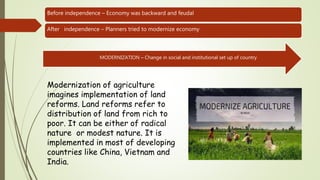
Before independence – Economy was backward and feudal
After independence – Planners tried to modernize economy
MODERNIZATION – Change in social and institutional set up of country
Modernization of agriculture
imagines implementation of land
reforms. Land reforms refer to
distribution of land from rich to
poor. It can be either of radical
nature or modest nature. It is
implemented in most of developing
countries like China, Vietnam and
India.
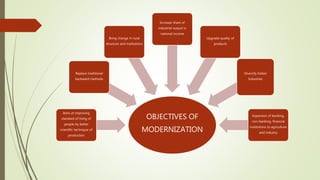
OBJECTIVES OF
MODERNIZATION
Aims at improving
standard of living of
people by better
scientific technique of
production
Replace traditional
backward methods
Bring change in rural
structure and institutions
Increase share of
industrial output in
national income
Upgrade quality of
products
Diversify Indian
Industries
Expansion of banking,
non-banking, financial
institutions to agriculture
and industry
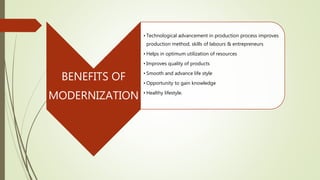
BENEFITS OF
MODERNIZATION
• Technological advancement in production process improves
production method, skills of labours & entrepreneurs
• Helps in optimum utilization of resources
• Improves quality of products
• Smooth and advance life style
• Opportunity to gain knowledge
• Healthy lifestyle.
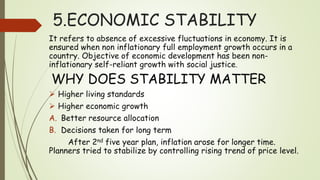
5.ECONOMIC STABILITY
It refers to absence of excessive fluctuations in economy. It is
ensured when non inflationary full employment growth occurs in a
country. Objective of economic development has been non-
inflationary self-reliant growth with social justice.
WHY DOES STABILITY MATTER
 Higher living standards
 Higher economic growth
A. Better resource allocation
B. Decisions taken for long term
After 2nd five year plan, inflation arose for longer time.
Planners tried to stabilize by controlling rising trend of price level.
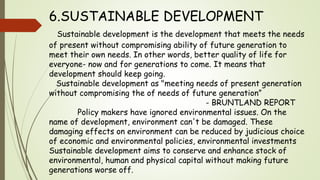
6.SUSTAINABLE DEVELOPMENT
Sustainable development is the development that meets the needs
of present without compromising ability of future generation to
meet their own needs. In other words, better quality of life for
everyone- now and for generations to come. It means that
development should keep going.
Sustainable development as "meeting needs of present generation
without compromising the of needs of future generation”
- BRUNTLAND REPORT
Policy makers have ignored environmental issues. On the
name of development, environment can't be damaged. These
damaging effects on environment can be reduced by judicious choice
of economic and environmental policies, environmental investments
Sustainable development aims to conserve and enhance stock of
environmental, human and physical capital without making future
generations worse off.
7.INCLUSIVE GROWTH
Inclusive growth means economic growth that creates
employment opportunities and helps in reducing poverty. It means
having access essential services in health and education by poor.
It includes providing equality of opportunity and skill
development. It also encompasses growth process is environment
friendly growth.
It refers to pace and pattern of growth. It was referred by
world Bank. It benefits marginalized sections of population. It
stresses the inclusiveness of the hitherto excluded population in
growth process, expected to bring benefits to economy.
Inclusive growth is equality of opportunity.
20% of population – share 2% to 3% of national income
BY ADOPTING INCLUSIVE GROWTH STRATEGY
20% of population – share 5% to 10% of national income
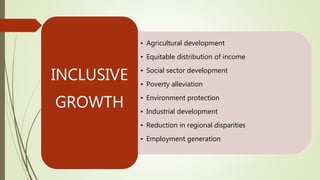
• Agricultural development
• Equitable distribution of income
• Social sector development
• Poverty alleviation
• Environment protection
• Industrial development
• Reduction in regional disparities
• Employment generation
INCLUSIVE
GROWTH
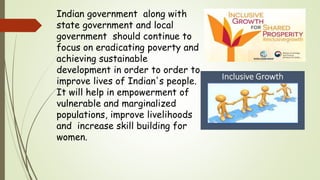
Indian government along with
state government and local
government should continue to
focus on eradicating poverty and
achieving sustainable
development in order to order to
improve lives of Indian's people.
It will help in empowerment of
vulnerable and marginalized
populations, improve livelihoods
and increase skill building for
women.
THANK YOU

OBJECTIVES OF ECONOMIC DEVELOPMENT.pptx

  • 1.
  • 2.
    MEANING OF OBJECTIVE Objectiveis something which we plan to do or achieve. It is an aim or purpose. Every country or economy in the world would strive hard to achieve the path of development. OBJECTIVE IS NECESSARY FOR AN ECONOMY:  To increase and raise standard of living  To expand range of economic and social choice  To meet basic needs
  • 3.
    OBJECTIVES OF ECONOMICDEVELOPMENT  High rate of growth  Economic self reliance  Social justice  Modernization  Economic stability  Sustainable development  Inclusive growth
  • 4.
    1.HIGH RATE OFGROWTH Economic growth is defined as steady increase in output of goods and services of a country. Economic growth is vital for a country. Every country strive hard to achieve high economic growth. Ex: China, India. Economic growth rate is percentage change in value of goods and services in a nation during a specific period of time as compared to an earlier period. It can be measured quarterly or yearly. A year divided into four quarters. Each quarter consists three months. Economic growth can be observed within a quarter.
  • 5.
    RATE OF GROWTHUSED TO MEASURE EXPANSION RECESSION If increase rate is positive. If country has grown its income for two consecutive quarters, it is considered to be expanding If there is decrease which is negative. If income with in a country declines for two consecutive quarters, it is considered to be recession
  • 6.
    A healthy rateof growth is 2% to 3%. Economic growth provides financial stability. It increases productive capacity. There are huge benefits of economic growth. Developing economies or countries were in a view that high rate of growth can be achieved by giving importance to primary sector. For instance, after achieving independence, India’s first five year plan has focussed on primary sector for growth of real national income. Initially, rate of economic growth is not encouraging in economy. First five year plan [1951-56] Second five year plan [1956-61] Third five year plan [1961-66] THREE FIVE YEAR PLANNING Growth was not so encouraging
  • 7.
    Till 1980,  Averageannual rate of GDP is 3.73%  Average annual rate of population 2.5% Per capita income is 1% 6th plan -considerable change in economy 7th plan –growth rate is 5.4% 8th plan -growth rate is 6.8% 9th plan –growth rate is 7%[targeted growth] growth rate is 5.35%[real growth] Economy achieved high rate of growth of 9%. China achieved 10% rate in 21st century. 12th plan –Targeted growth[7.9%] Actual growth[8.2%] GDP grown at 7.5% during 2014-15 and 2018-19
  • 8.
    YEAR GDP GROWTH%ANNUAL CHANGE 2019 5.02% -1.10% 2018 6.12% -0.92% 2017 7.04% -1.21% 2016 8.25% +0.26% 2015 8% +0.59% + Shows growth in economy - Shows recession in economy All developing economies strive hard to achieve high growth rate with a view to bring improvement in standard of living of people. Higher economic growth is higher economic development.
  • 9.
    2.ECONOMIC SELF RELIANCE Self-relianceis to rely on one’s own powers and resources rather than other. In simple terms, it is ability to do our things ourselves. Economic self reliance is a situation where a country has attained a level of autonomy economically that it can take certain important decisions. Self reliance means to stand on one's own legs. Self sufficiency is the fulfillment of an individual without outside aid. Self Reliance has become an important objective. ABILITY OF A COUNTRY SELF SUFFICINECY SELF RELIANT  Implies country produces all goods and services it requires without depending on others  It rules out imports  Produce sufficient amount of goods and services  Allows a country to import provided it has capacity to pay for it  Restrict import  Country generates sufficient surplus to buy what it needs
  • 10.
    No country isself sufficient, but a country can try become self reliant by paying for everything that imports. A self reliant country doesn't depend on other counties for resources of needed to acquire them. It implies that dependence on foreign aid should be minimum as possible. Excessive dependence on foreign sector may lead to economic colonialism. Economic colonialism refers to powerful nation extending its influence on less developed economies to exploit one's nation resources. 3rd plan –Objective of self reliance 4th plan –Importance given on self reliance[production of food grains] 5th plan –Earn sufficient foreign exchange[export promotion and import substitution] India’s dependence on foreign aid for Import food grains from USA Process of industrialisation Infrastructural facilities Meet our domestic demand Capital goods in form of machinery Roads, Railways, Power etc
  • 11.
    India has maderemarkable progress in achieving self –reliance. However, it has to depend on aid to raise rate of investment. China, Brazil, South Africa, South Korea, Vietnam and Latin American countries are aiming to achieve self-reliance. SELF RELIANT SCHEME IN INDIA: Atmanirbhar Bharat scheme was launched on 12th May 2020, by the Prime Minister of India - Narendra Modi to make India self Reliant India to minimize import of atleast small things. The Atmanirbhar Bharat Abhiyan is a chance for Indian start-ups to take charge of innovations for which we are usually dependent an global suppliers. It is the time to become vocal for local products & make them global.
  • 12.
    FIVE PILLARS OF SELF- RELIANTINDIA Economy Demography Demand System Infrastructure ATMANIRBHAR BHARAT[THE ROAD AHEAD]
  • 13.
    3.SOCIAL JUSTICE Justice isthe concept of fairness. Social justice is fairness as it manifests in society. Social justice is equitable distribution of wealth and income of country among different sections of society. Social justice promote fairness and equity across many aspects of society. It is important for safety and security of individual and communities. It is to take care of poor and weaker sections of society. India has large no of poor people and few lead luxurious life.
  • 14.
    90% POOR PEOPLE HOLD 10% WEAL TH 10% RICH PEOP LE HOLD 90% WEALTH PRINCIPLES OF SOCIALJUSTICE Access to resources Participation Diversity Equity Human rights
  • 15.
    ASPECTS OF SOCIALJUSTICE  Adherence to democratic principles in political structure of country. (adherence-commitment)  Establishment of social and economic equity and removal of regional disparities. (focus on imbalanced areas)  Putting an end to process of centralization of economic power and simultaneously attaining decentralized power [Decentralization is a good sign of development, Centralization refers to assets in hand of only few people. Rich becomes richer and poor becomes poorer]  Efforts to raise conditions of backward and depressed classes 9th five year plan focused on social justice and equity
  • 16.
    OBJECTIVES OF FIVEYEAR PLAN  Uplift economic conditions of socio-economically weaker sections like SC and ST through no of targeted oriented programmes  To reduce inequality in distribution of land and assets, land reforms have been adopted  Specific programmes have been adopted 4.MODERNIZATION Modernization refers to model of transition from ‘pre-modern’ or ‘traditional' to modem society. Modernization is transforming from traditional methods to modem methods. Modernization is a revolutionary change leading to transformation of traditional society into technological and civilized society. It is opposite view to traditionalism. It is replacement of traditional to scientific methods.
  • 17.
    Before independence –Economy was backward and feudal After independence – Planners tried to modernize economy MODERNIZATION – Change in social and institutional set up of country Modernization of agriculture imagines implementation of land reforms. Land reforms refer to distribution of land from rich to poor. It can be either of radical nature or modest nature. It is implemented in most of developing countries like China, Vietnam and India.
  • 18.
    OBJECTIVES OF MODERNIZATION Aims atimproving standard of living of people by better scientific technique of production Replace traditional backward methods Bring change in rural structure and institutions Increase share of industrial output in national income Upgrade quality of products Diversify Indian Industries Expansion of banking, non-banking, financial institutions to agriculture and industry
  • 19.
    BENEFITS OF MODERNIZATION • Technologicaladvancement in production process improves production method, skills of labours & entrepreneurs • Helps in optimum utilization of resources • Improves quality of products • Smooth and advance life style • Opportunity to gain knowledge • Healthy lifestyle.
  • 20.
    5.ECONOMIC STABILITY It refersto absence of excessive fluctuations in economy. It is ensured when non inflationary full employment growth occurs in a country. Objective of economic development has been non- inflationary self-reliant growth with social justice. WHY DOES STABILITY MATTER  Higher living standards  Higher economic growth A. Better resource allocation B. Decisions taken for long term After 2nd five year plan, inflation arose for longer time. Planners tried to stabilize by controlling rising trend of price level.
  • 21.
    6.SUSTAINABLE DEVELOPMENT Sustainable developmentis the development that meets the needs of present without compromising ability of future generation to meet their own needs. In other words, better quality of life for everyone- now and for generations to come. It means that development should keep going. Sustainable development as "meeting needs of present generation without compromising the of needs of future generation” - BRUNTLAND REPORT Policy makers have ignored environmental issues. On the name of development, environment can't be damaged. These damaging effects on environment can be reduced by judicious choice of economic and environmental policies, environmental investments Sustainable development aims to conserve and enhance stock of environmental, human and physical capital without making future generations worse off.
  • 22.
    7.INCLUSIVE GROWTH Inclusive growthmeans economic growth that creates employment opportunities and helps in reducing poverty. It means having access essential services in health and education by poor. It includes providing equality of opportunity and skill development. It also encompasses growth process is environment friendly growth. It refers to pace and pattern of growth. It was referred by world Bank. It benefits marginalized sections of population. It stresses the inclusiveness of the hitherto excluded population in growth process, expected to bring benefits to economy. Inclusive growth is equality of opportunity. 20% of population – share 2% to 3% of national income BY ADOPTING INCLUSIVE GROWTH STRATEGY 20% of population – share 5% to 10% of national income
  • 23.
    • Agricultural development •Equitable distribution of income • Social sector development • Poverty alleviation • Environment protection • Industrial development • Reduction in regional disparities • Employment generation INCLUSIVE GROWTH
  • 24.
    Indian government alongwith state government and local government should continue to focus on eradicating poverty and achieving sustainable development in order to order to improve lives of Indian's people. It will help in empowerment of vulnerable and marginalized populations, improve livelihoods and increase skill building for women.
  • 25.