KEY RESULT AREA 3
DIVERSITY OF LEARNERS,
CURRICULUM AND PLANNING, &
ASSESSMENT AND REPORTING
OBJECTIVE 10
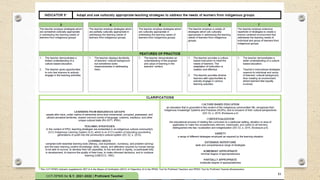
•Adapted and used culturally appropriate
teaching strategies to address the
needs of learners from indigenous
groups
SET A
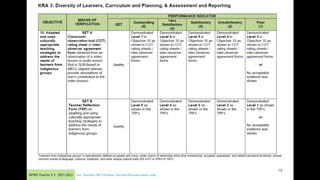
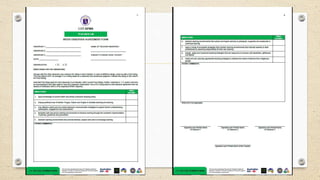
• Classroom observation tool (COT) rating
sheet or inter-observer agreement form
obtained from an observation of a video lesson
or audio lesson that is SLM-based or MELC-
aligned (please provide annotations of one’s
contribution to the video lesson)
SET B
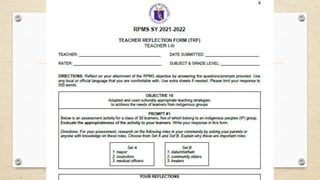
• Teacher Reflection Form (TRF) on adapting
and using culturally appropriate teaching
strategies to address the needs of learners
from indigenous groups
• “Learners from indigenous groups” is
operationally defined as people who have,
under claims of ownership since time
immemorial, occupied, possessed, and
utilized ancestral territories, shared common
bonds of language, customs, traditions, and
other unique cultural traits (RA 8371 or IPRA
of 1997).
Indigenous Peoples Rights Act 1997
• “Learners from indigenous groups” is
operationally defined as people who have,
under claims of ownership since time
immemorial, occupied, possessed, and
utilized ancestral territories, shared common
bonds of language, customs, traditions, and
other unique cultural traits (RA 8371 or IPRA
of 1997).
E N D

OBJECTIVE 10.pptx

  • 1.
    KEY RESULT AREA3 DIVERSITY OF LEARNERS, CURRICULUM AND PLANNING, & ASSESSMENT AND REPORTING
  • 2.
    OBJECTIVE 10 •Adapted andused culturally appropriate teaching strategies to address the needs of learners from indigenous groups
  • 4.
    SET A • Classroomobservation tool (COT) rating sheet or inter-observer agreement form obtained from an observation of a video lesson or audio lesson that is SLM-based or MELC- aligned (please provide annotations of one’s contribution to the video lesson)
  • 5.
    SET B • TeacherReflection Form (TRF) on adapting and using culturally appropriate teaching strategies to address the needs of learners from indigenous groups
  • 6.
    • “Learners fromindigenous groups” is operationally defined as people who have, under claims of ownership since time immemorial, occupied, possessed, and utilized ancestral territories, shared common bonds of language, customs, traditions, and other unique cultural traits (RA 8371 or IPRA of 1997). Indigenous Peoples Rights Act 1997
  • 9.
    • “Learners fromindigenous groups” is operationally defined as people who have, under claims of ownership since time immemorial, occupied, possessed, and utilized ancestral territories, shared common bonds of language, customs, traditions, and other unique cultural traits (RA 8371 or IPRA of 1997).
  • 15.