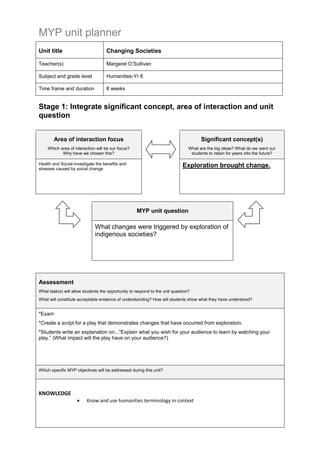
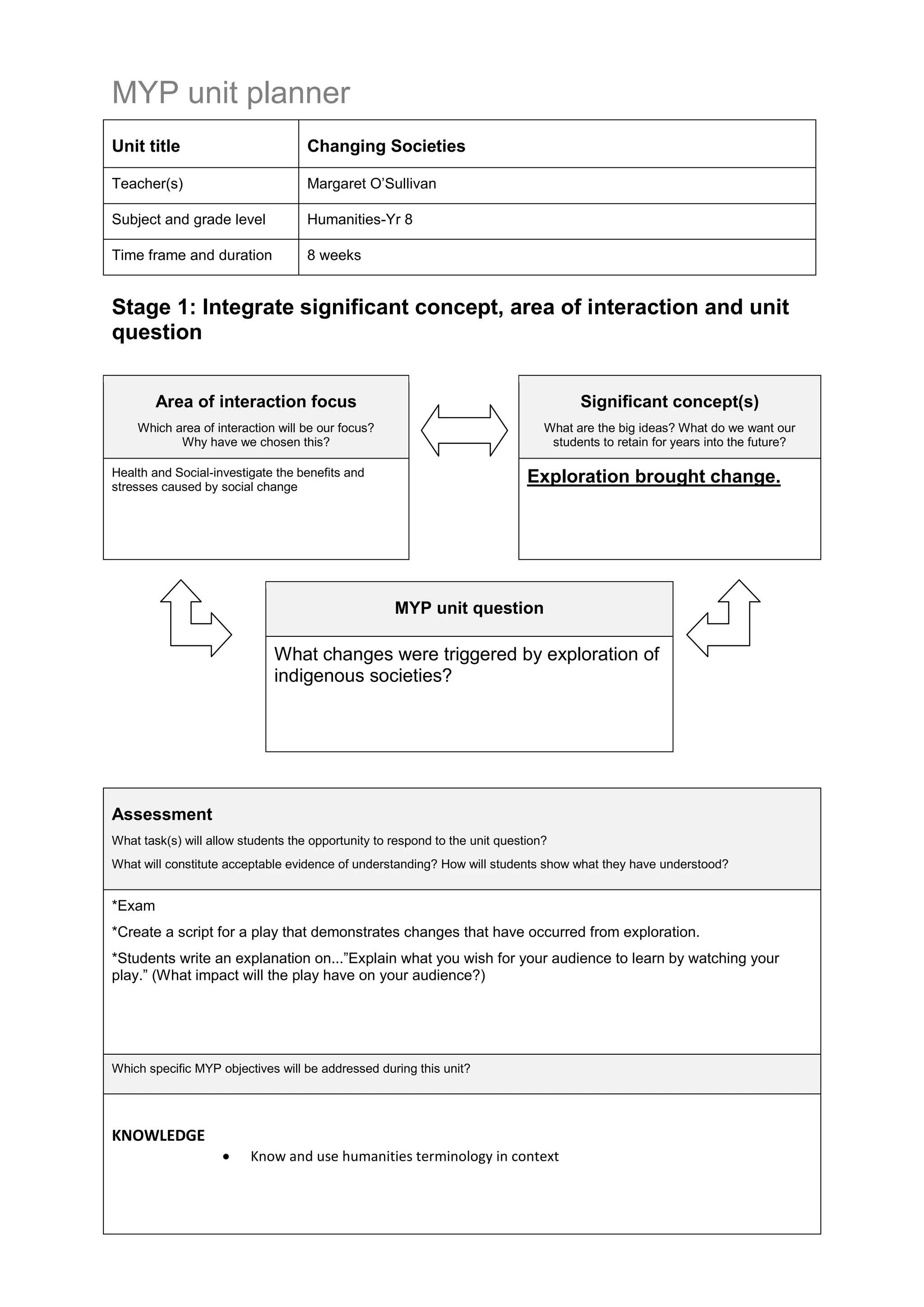
MYP unit planner<br />Unit titleChanging SocietiesTeacher(s)Margaret O’SullivanSubject and grade levelHumanities-Yr 8Time frame and duration8 weeks<br />Stage 1: Integrate significant concept, area of interaction and unit question<br />Area of interaction focusWhich area of interaction will be our focus?Why have we chosen this?Significant concept(s)What are the big ideas? What do we want our students to retain for years into the future?Health and Social-investigate the benefits and stresses caused by social changeExploration brought change.<br />MYP unit questionWhat changes were triggered by exploration of indigenous societies?<br />AssessmentWhat task(s) will allow students the opportunity to respond to the unit question?What will constitute acceptable evidence of understanding? How will students show what they have understood?*Exam*Create a script for a play that demonstrates changes that have occurred from exploration.*Students write an explanation on...”Explain what you wish for your audience to learn by watching your play.” (What impact will the play have on your audience?) Which specific MYP objectives will be addressed during this unit?KNOWLEDGEKnow and use humanities terminology in contextCONCEPTSPlace & SpaceRecognize and explain similarities and differences between placesUnderstand constraints and opportunities afforded by locationUnderstand issues related to place/space on a local, national and global scale.TechnicalUse a variety of media and technologies to research, select, interpret and communicate dataUse sources such as maps, graphs, tables, atlases, photographs and statistics, in a critical manner Represent information using maps, graphs and tables.AnalyticalAnalyze and interpret information from a wide range of sourcesIdentify key questions, problems and issuesDecision-MakingFormulate clear, valid and sound arguments, make balanced judgments on events, and draw conclusions, including implications ORGANIZATION AND PRESENTATIONCommunicate information that is relevant to the topicOrganize information in a logically sequenced manner, appropriate to the format usedPresent and express information and ideas in a clear and concise manner, using appropriate language, style and visual representationUse referencing to clearly document sources of information, using appropriate conventionsWhich MYP assessment criteria will be used?A – Knowledge and SkillsB-Understanding ConceptsC-Application of SkillsD-Presentation and Organisation of InformationStage 2: Backward planning: from the assessment to the learning activities through inquiry<br />ContentWhat knowledge and/or skills (from the course overview) are going to be used to enable the student to respond to the unit question?What (if any) state, provincial, district, or local standards/skills are to be addressed? How can they be unpacked to develop the significant concept(s) for stage 1?Students will be able to: Introduction –  understanding  and defining what exploration is and why it may have been necessaryAn understanding of terminology -       A study and analysis of Indigenous societies after contact.- Indigenous Australians and Indigenous North Americans-       Comparisons-       Keep referring to Vietnam and its exploration.Approaches to learningHow will this unit contribute to the overall development of subject-specific and general approaches to learning skills?Use organisational skills- working to deadlines, organising information into tables and graphsUse thinking skills- draw conclusionsHealth and Social Education- exploring concepts of identity, culture and community.  Producing a product that will reflect an awareness campaign.Learning experiencesHow will students know what is expected of them? Will they see examples, rubrics, templates?How will students acquire the knowledge and practise the skills required? How will they practise applying these?Do the students have enough prior knowledge? How will we know?Teaching strategiesHow will we use formative assessment to give students feedback during the unit?What different teaching methodologies will we employ?How are we differentiating teaching and learning for all? How have we made provision for those learning in a language other than their mother tongue? How have we considered those with special educational needs?Pretest knowledge on Australian Aborigines (AA). All words, connotations, and impressions.Pair/group creation of a Photostory on Impact of Colonisation- stresses and benefits.Create timeline of events after contact for AA.Look at map of changes that took place.Group work- Each group will be given a topic from the following. Research and deliver facts to the class to record:-Shelter; Lifestyle; Difference in Tribes and their features; Religion; Social Structure; Government; Warfare; Everyday life.For INA- Use of Buffalo; Government;  Missionaries; Extension :- Isolate Conflicts eg broken treaties/deals and honoured  treaties/deals.         Watch “10 Canoes”- ReviewRepeat all of the above for Indigenous North Americans.Watch “Dances With Wolves”-reviewVENN DIAGRAM- Compare 2 INA tribes…Sioux and Plains IndiansCompare Australia to North America and colonization between them.STUDENT EVALUATION OF UNIT…DO PMI Chart.ICT-Skills-see Andrew Gill for assistanceGuided web search and website evaluation of Australian Aboriginal and Native American sites to explore terms effect & legacy.  Using hyperlinked worksheet students will answer questions on reliability as well as analyzing the anatomy of the website.  Class to discuss analysis of websitesIndividually students will compose structured paragraphs on a topic and format their work and then email as an attachment to teacher. Students demonstrate research skill; ability to explain the aspects of culture/liestyle; skills of communication in their chosen presentation format and delivery; negotiation and research skills in working as part of a group.Exercises completed in folder.Individual notes on documentaryIndividual answers to film questionsIndividual film reportClass discussionStudent mind maps and discussion demonstrate the level of knowledge and understanding of pre-contact culture.Student notemaking indicates their ability to comprehend and extract relevant information from sources and their understanding of different cultural perspectives of AA and INA.ResourcesWhat resources are available to us?How will our classroom environment, local environment and/or the community be used to facilitate students’ experiences during the unit?Indigenous North Americans“Discovering the Americas” worksheetFilm: ‘Dances with Wolves’Aboriginal Australians-Blackline Masters Series 1.Land 2. Invasion and 3 Colonisation by Cathie Burgess and Julie Myers-“Ten Canoes”-Websites:www.frogandtoad.com.au/aborigines/land.html (Aboriginal history)-Video Series:Women of the Sun, Episode 1 ‘Alinta the Flame’ and Episode 2 ‘Maydina’, RETROACTIVE 1- Bliss <br />Ongoing reflections and evaluation<br />In keeping an ongoing record, consider the following questions. There are further stimulus questions at the end of the “Planning for teaching and learning” section of MYP: From principles into practice.Students and teachersWhat did we find compelling? Were our disciplinary knowledge/skills challenged in any way?What inquiries arose during the learning? What, if any, extension activities arose?How did we reflect—both on the unit and on our own learning?Which attributes of the learner profile were encouraged through this unit? What opportunities were there for student-initiated action?Possible connections How successful was the collaboration with other teachers within my subject group and from other subject groups?What interdisciplinary understandings were or could be forged through collaboration with other subjects?AssessmentWere students able to demonstrate their learning?How did the assessment tasks allow students to demonstrate the learning objectives identified for this unit? How did I make sure students were invited to achieve at all levels of the criteria descriptors?Are we prepared for the next stage?Data collection How did we decide on the data to collect? Was it useful?Unit cut short due to Term 1’s unit but this will need to spill over to Term 3 where scripts need to be presented. This is mainly due to time lost in exams, although the extended response was lead into the assessment task. Data collection was very useful, however a mammoth task, and some of the poorer EAL English users were baffled by the 2 studies of the indigenous people going on at the one time. It would be better to deal with 1 society at a time and do the comparison after. To most students the North American indigenous people were more tangible. The scripts are developing and this unit could not be done without the infusion with Drama. In fact, due to the Drama teachers extended absence, the topic would have had more depth had she been around. The plays will be presented in Week 2. It was hard to get the students to adhere to the historical perspective. <br />Figure 12<br />MYP unit planner<br />

MYP Unit Plan Yr 8-Changing societies exploration

  • 1.
    MYP unit planner<br/>Unit titleChanging SocietiesTeacher(s)Margaret O’SullivanSubject and grade levelHumanities-Yr 8Time frame and duration8 weeks<br />Stage 1: Integrate significant concept, area of interaction and unit question<br />Area of interaction focusWhich area of interaction will be our focus?Why have we chosen this?Significant concept(s)What are the big ideas? What do we want our students to retain for years into the future?Health and Social-investigate the benefits and stresses caused by social changeExploration brought change.<br />MYP unit questionWhat changes were triggered by exploration of indigenous societies?<br />AssessmentWhat task(s) will allow students the opportunity to respond to the unit question?What will constitute acceptable evidence of understanding? How will students show what they have understood?*Exam*Create a script for a play that demonstrates changes that have occurred from exploration.*Students write an explanation on...”Explain what you wish for your audience to learn by watching your play.” (What impact will the play have on your audience?) Which specific MYP objectives will be addressed during this unit?KNOWLEDGEKnow and use humanities terminology in contextCONCEPTSPlace & SpaceRecognize and explain similarities and differences between placesUnderstand constraints and opportunities afforded by locationUnderstand issues related to place/space on a local, national and global scale.TechnicalUse a variety of media and technologies to research, select, interpret and communicate dataUse sources such as maps, graphs, tables, atlases, photographs and statistics, in a critical manner Represent information using maps, graphs and tables.AnalyticalAnalyze and interpret information from a wide range of sourcesIdentify key questions, problems and issuesDecision-MakingFormulate clear, valid and sound arguments, make balanced judgments on events, and draw conclusions, including implications ORGANIZATION AND PRESENTATIONCommunicate information that is relevant to the topicOrganize information in a logically sequenced manner, appropriate to the format usedPresent and express information and ideas in a clear and concise manner, using appropriate language, style and visual representationUse referencing to clearly document sources of information, using appropriate conventionsWhich MYP assessment criteria will be used?A – Knowledge and SkillsB-Understanding ConceptsC-Application of SkillsD-Presentation and Organisation of InformationStage 2: Backward planning: from the assessment to the learning activities through inquiry<br />ContentWhat knowledge and/or skills (from the course overview) are going to be used to enable the student to respond to the unit question?What (if any) state, provincial, district, or local standards/skills are to be addressed? How can they be unpacked to develop the significant concept(s) for stage 1?Students will be able to: Introduction – understanding and defining what exploration is and why it may have been necessaryAn understanding of terminology - A study and analysis of Indigenous societies after contact.- Indigenous Australians and Indigenous North Americans- Comparisons- Keep referring to Vietnam and its exploration.Approaches to learningHow will this unit contribute to the overall development of subject-specific and general approaches to learning skills?Use organisational skills- working to deadlines, organising information into tables and graphsUse thinking skills- draw conclusionsHealth and Social Education- exploring concepts of identity, culture and community. Producing a product that will reflect an awareness campaign.Learning experiencesHow will students know what is expected of them? Will they see examples, rubrics, templates?How will students acquire the knowledge and practise the skills required? How will they practise applying these?Do the students have enough prior knowledge? How will we know?Teaching strategiesHow will we use formative assessment to give students feedback during the unit?What different teaching methodologies will we employ?How are we differentiating teaching and learning for all? How have we made provision for those learning in a language other than their mother tongue? How have we considered those with special educational needs?Pretest knowledge on Australian Aborigines (AA). All words, connotations, and impressions.Pair/group creation of a Photostory on Impact of Colonisation- stresses and benefits.Create timeline of events after contact for AA.Look at map of changes that took place.Group work- Each group will be given a topic from the following. Research and deliver facts to the class to record:-Shelter; Lifestyle; Difference in Tribes and their features; Religion; Social Structure; Government; Warfare; Everyday life.For INA- Use of Buffalo; Government; Missionaries; Extension :- Isolate Conflicts eg broken treaties/deals and honoured treaties/deals. Watch “10 Canoes”- ReviewRepeat all of the above for Indigenous North Americans.Watch “Dances With Wolves”-reviewVENN DIAGRAM- Compare 2 INA tribes…Sioux and Plains IndiansCompare Australia to North America and colonization between them.STUDENT EVALUATION OF UNIT…DO PMI Chart.ICT-Skills-see Andrew Gill for assistanceGuided web search and website evaluation of Australian Aboriginal and Native American sites to explore terms effect & legacy. Using hyperlinked worksheet students will answer questions on reliability as well as analyzing the anatomy of the website. Class to discuss analysis of websitesIndividually students will compose structured paragraphs on a topic and format their work and then email as an attachment to teacher. Students demonstrate research skill; ability to explain the aspects of culture/liestyle; skills of communication in their chosen presentation format and delivery; negotiation and research skills in working as part of a group.Exercises completed in folder.Individual notes on documentaryIndividual answers to film questionsIndividual film reportClass discussionStudent mind maps and discussion demonstrate the level of knowledge and understanding of pre-contact culture.Student notemaking indicates their ability to comprehend and extract relevant information from sources and their understanding of different cultural perspectives of AA and INA.ResourcesWhat resources are available to us?How will our classroom environment, local environment and/or the community be used to facilitate students’ experiences during the unit?Indigenous North Americans“Discovering the Americas” worksheetFilm: ‘Dances with Wolves’Aboriginal Australians-Blackline Masters Series 1.Land 2. Invasion and 3 Colonisation by Cathie Burgess and Julie Myers-“Ten Canoes”-Websites:www.frogandtoad.com.au/aborigines/land.html (Aboriginal history)-Video Series:Women of the Sun, Episode 1 ‘Alinta the Flame’ and Episode 2 ‘Maydina’, RETROACTIVE 1- Bliss <br />Ongoing reflections and evaluation<br />In keeping an ongoing record, consider the following questions. There are further stimulus questions at the end of the “Planning for teaching and learning” section of MYP: From principles into practice.Students and teachersWhat did we find compelling? Were our disciplinary knowledge/skills challenged in any way?What inquiries arose during the learning? What, if any, extension activities arose?How did we reflect—both on the unit and on our own learning?Which attributes of the learner profile were encouraged through this unit? What opportunities were there for student-initiated action?Possible connections How successful was the collaboration with other teachers within my subject group and from other subject groups?What interdisciplinary understandings were or could be forged through collaboration with other subjects?AssessmentWere students able to demonstrate their learning?How did the assessment tasks allow students to demonstrate the learning objectives identified for this unit? How did I make sure students were invited to achieve at all levels of the criteria descriptors?Are we prepared for the next stage?Data collection How did we decide on the data to collect? Was it useful?Unit cut short due to Term 1’s unit but this will need to spill over to Term 3 where scripts need to be presented. This is mainly due to time lost in exams, although the extended response was lead into the assessment task. Data collection was very useful, however a mammoth task, and some of the poorer EAL English users were baffled by the 2 studies of the indigenous people going on at the one time. It would be better to deal with 1 society at a time and do the comparison after. To most students the North American indigenous people were more tangible. The scripts are developing and this unit could not be done without the infusion with Drama. In fact, due to the Drama teachers extended absence, the topic would have had more depth had she been around. The plays will be presented in Week 2. It was hard to get the students to adhere to the historical perspective. <br />Figure 12<br />MYP unit planner<br />