Training on HOTS-PLP for English, Science, and Mathematics Teachers
Session 2A – SOLO and HOTS in the Classroom (1/3)
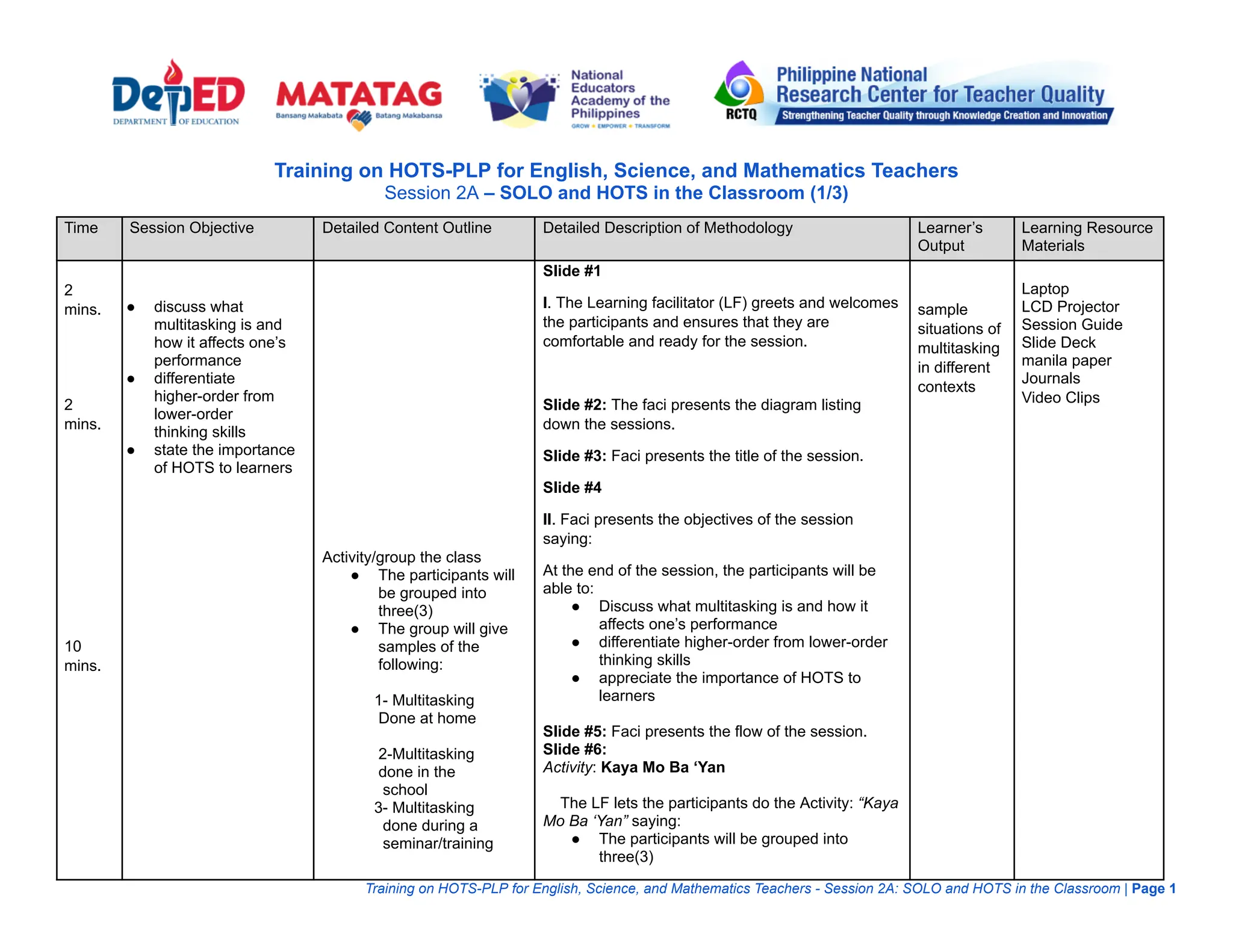
Time Session Objective Detailed Content Outline Detailed Description of Methodology Learner’s
Output
Learning Resource
Materials
2
mins.
2
mins.
10
mins.
● discuss what
multitasking is and
how it affects one’s
performance
● differentiate
higher-order from
lower-order
thinking skills
● state the importance
of HOTS to learners
Activity/group the class
● The participants will
be grouped into
three(3)
● The group will give
samples of the
following:
1- Multitasking
Done at home
2-Multitasking
done in the
school
3- Multitasking
done during a
seminar/training
Slide #1
I. The Learning facilitator (LF) greets and welcomes
the participants and ensures that they are
comfortable and ready for the session.
Slide #2: The faci presents the diagram listing
down the sessions.
Slide #3: Faci presents the title of the session.
Slide #4
II. Faci presents the objectives of the session
saying:
At the end of the session, the participants will be
able to:
● Discuss what multitasking is and how it
affects one’s performance
● differentiate higher-order from lower-order
thinking skills
● appreciate the importance of HOTS to
learners
Slide #5: Faci presents the flow of the session.
Slide #6:
Activity: Kaya Mo Ba ‘Yan
The LF lets the participants do the Activity: “Kaya
Mo Ba ‘Yan” saying:
● The participants will be grouped into
three(3)
sample
situations of
multitasking
in different
contexts
Laptop
LCD Projector
Session Guide
Slide Deck
manila paper
Journals
Video Clips
Training on HOTS-PLP for English, Science, and Mathematics Teachers - Session 2A: SOLO and HOTS in the Classroom | Page 1
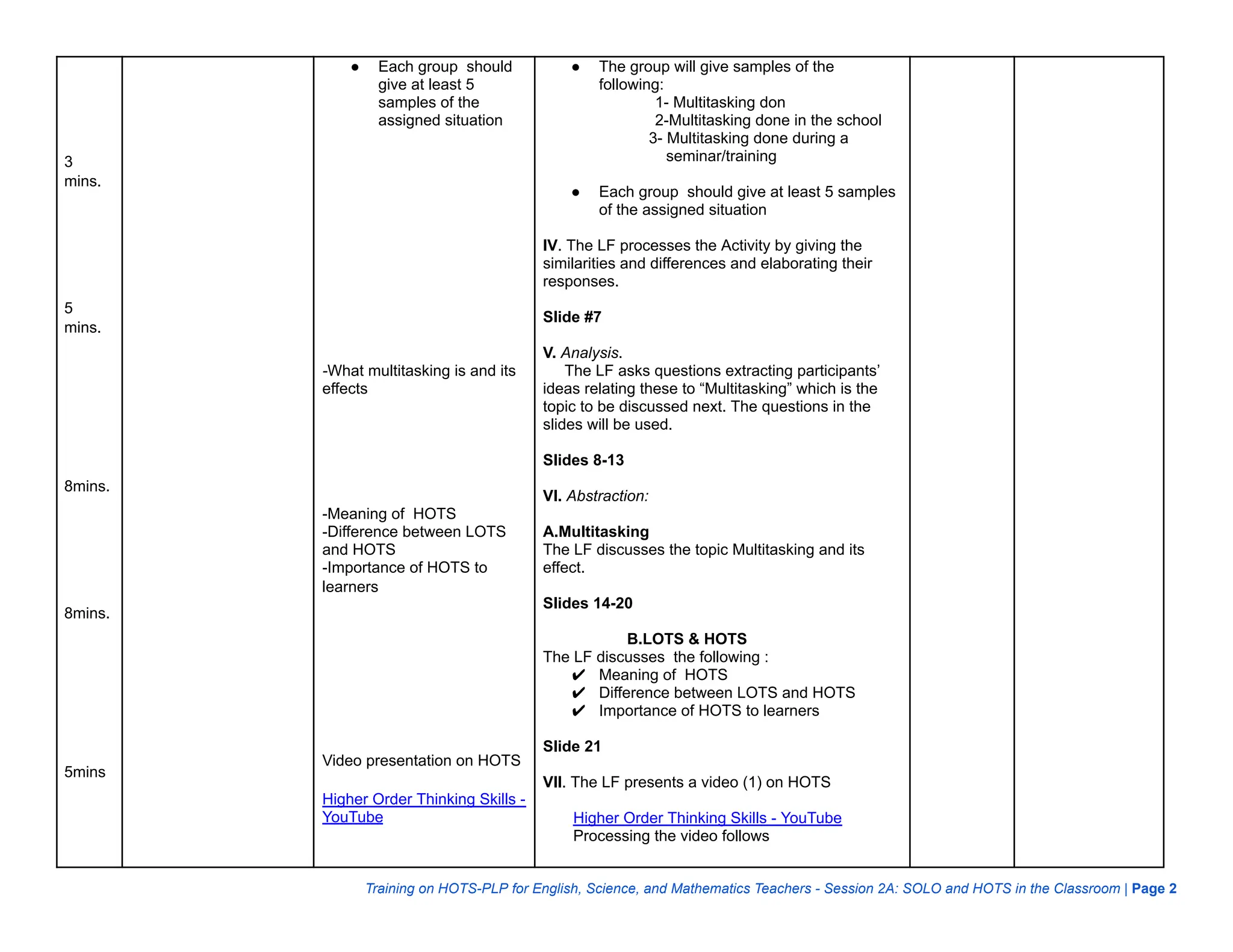
3
mins.
5
mins.
8mins.
8mins.
5mins
● Each group should
give at least 5
samples of the
assigned situation
-What multitasking is and its
effects
-Meaning of HOTS
-Difference between LOTS
and HOTS
-Importance of HOTS to
learners
Video presentation on HOTS
Higher Order Thinking Skills -
YouTube
● The group will give samples of the
following:
1- Multitasking don
2-Multitasking done in the school
3- Multitasking done during a
seminar/training
● Each group should give at least 5 samples
of the assigned situation
IV. The LF processes the Activity by giving the
similarities and differences and elaborating their
responses.
Slide #7
V. Analysis.
The LF asks questions extracting participants’
ideas relating these to “Multitasking” which is the
topic to be discussed next. The questions in the
slides will be used.
Slides 8-13
VI. Abstraction:
A.Multitasking
The LF discusses the topic Multitasking and its
effect.
Slides 14-20
B.LOTS & HOTS
The LF discusses the following :
✔ Meaning of HOTS
✔ Difference between LOTS and HOTS
✔ Importance of HOTS to learners
Slide 21
VII. The LF presents a video (1) on HOTS
Higher Order Thinking Skills - YouTube
Processing the video follows
Training on HOTS-PLP for English, Science, and Mathematics Teachers - Session 2A: SOLO and HOTS in the Classroom | Page 2
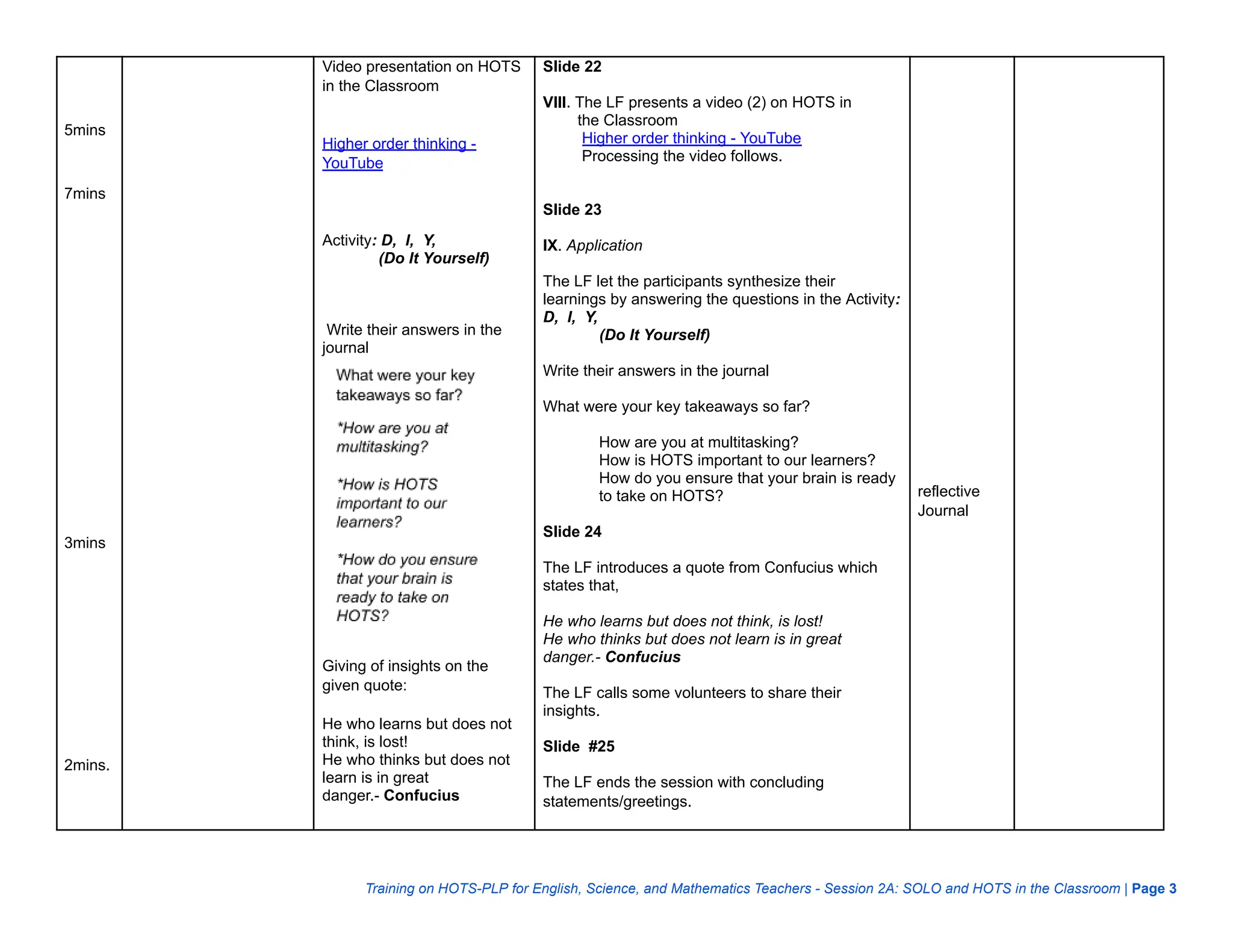
5mins
7mins
3mins
2mins.
Video presentation on HOTS
in the Classroom
Higher order thinking -
YouTube
Activity: D, I, Y,
(Do It Yourself)
Write their answers in the
journal
Giving of insights on the
given quote:
He who learns but does not
think, is lost!
He who thinks but does not
learn is in great
danger.- Confucius
Slide 22
VIII. The LF presents a video (2) on HOTS in
the Classroom
Higher order thinking - YouTube
Processing the video follows.
Slide 23
IX. Application
The LF let the participants synthesize their
learnings by answering the questions in the Activity:
D, I, Y,
(Do It Yourself)
Write their answers in the journal
What were your key takeaways so far?
How are you at multitasking?
How is HOTS important to our learners?
How do you ensure that your brain is ready
to take on HOTS?
Slide 24
The LF introduces a quote from Confucius which
states that,
He who learns but does not think, is lost!
He who thinks but does not learn is in great
danger.- Confucius
The LF calls some volunteers to share their
insights.
Slide #25
The LF ends the session with concluding
statements/greetings.
reflective
Journal
Training on HOTS-PLP for English, Science, and Mathematics Teachers - Session 2A: SOLO and HOTS in the Classroom | Page 3

S2A_SG_SOLO and HOTS in the Classroom.pdf

  • 1.
    Training on HOTS-PLPfor English, Science, and Mathematics Teachers Session 2A – SOLO and HOTS in the Classroom (1/3) Time Session Objective Detailed Content Outline Detailed Description of Methodology Learner’s Output Learning Resource Materials 2 mins. 2 mins. 10 mins. ● discuss what multitasking is and how it affects one’s performance ● differentiate higher-order from lower-order thinking skills ● state the importance of HOTS to learners Activity/group the class ● The participants will be grouped into three(3) ● The group will give samples of the following: 1- Multitasking Done at home 2-Multitasking done in the school 3- Multitasking done during a seminar/training Slide #1 I. The Learning facilitator (LF) greets and welcomes the participants and ensures that they are comfortable and ready for the session. Slide #2: The faci presents the diagram listing down the sessions. Slide #3: Faci presents the title of the session. Slide #4 II. Faci presents the objectives of the session saying: At the end of the session, the participants will be able to: ● Discuss what multitasking is and how it affects one’s performance ● differentiate higher-order from lower-order thinking skills ● appreciate the importance of HOTS to learners Slide #5: Faci presents the flow of the session. Slide #6: Activity: Kaya Mo Ba ‘Yan The LF lets the participants do the Activity: “Kaya Mo Ba ‘Yan” saying: ● The participants will be grouped into three(3) sample situations of multitasking in different contexts Laptop LCD Projector Session Guide Slide Deck manila paper Journals Video Clips Training on HOTS-PLP for English, Science, and Mathematics Teachers - Session 2A: SOLO and HOTS in the Classroom | Page 1
  • 2.
    3 mins. 5 mins. 8mins. 8mins. 5mins ● Each groupshould give at least 5 samples of the assigned situation -What multitasking is and its effects -Meaning of HOTS -Difference between LOTS and HOTS -Importance of HOTS to learners Video presentation on HOTS Higher Order Thinking Skills - YouTube ● The group will give samples of the following: 1- Multitasking don 2-Multitasking done in the school 3- Multitasking done during a seminar/training ● Each group should give at least 5 samples of the assigned situation IV. The LF processes the Activity by giving the similarities and differences and elaborating their responses. Slide #7 V. Analysis. The LF asks questions extracting participants’ ideas relating these to “Multitasking” which is the topic to be discussed next. The questions in the slides will be used. Slides 8-13 VI. Abstraction: A.Multitasking The LF discusses the topic Multitasking and its effect. Slides 14-20 B.LOTS & HOTS The LF discusses the following : ✔ Meaning of HOTS ✔ Difference between LOTS and HOTS ✔ Importance of HOTS to learners Slide 21 VII. The LF presents a video (1) on HOTS Higher Order Thinking Skills - YouTube Processing the video follows Training on HOTS-PLP for English, Science, and Mathematics Teachers - Session 2A: SOLO and HOTS in the Classroom | Page 2
  • 3.
    5mins 7mins 3mins 2mins. Video presentation onHOTS in the Classroom Higher order thinking - YouTube Activity: D, I, Y, (Do It Yourself) Write their answers in the journal Giving of insights on the given quote: He who learns but does not think, is lost! He who thinks but does not learn is in great danger.- Confucius Slide 22 VIII. The LF presents a video (2) on HOTS in the Classroom Higher order thinking - YouTube Processing the video follows. Slide 23 IX. Application The LF let the participants synthesize their learnings by answering the questions in the Activity: D, I, Y, (Do It Yourself) Write their answers in the journal What were your key takeaways so far? How are you at multitasking? How is HOTS important to our learners? How do you ensure that your brain is ready to take on HOTS? Slide 24 The LF introduces a quote from Confucius which states that, He who learns but does not think, is lost! He who thinks but does not learn is in great danger.- Confucius The LF calls some volunteers to share their insights. Slide #25 The LF ends the session with concluding statements/greetings. reflective Journal Training on HOTS-PLP for English, Science, and Mathematics Teachers - Session 2A: SOLO and HOTS in the Classroom | Page 3