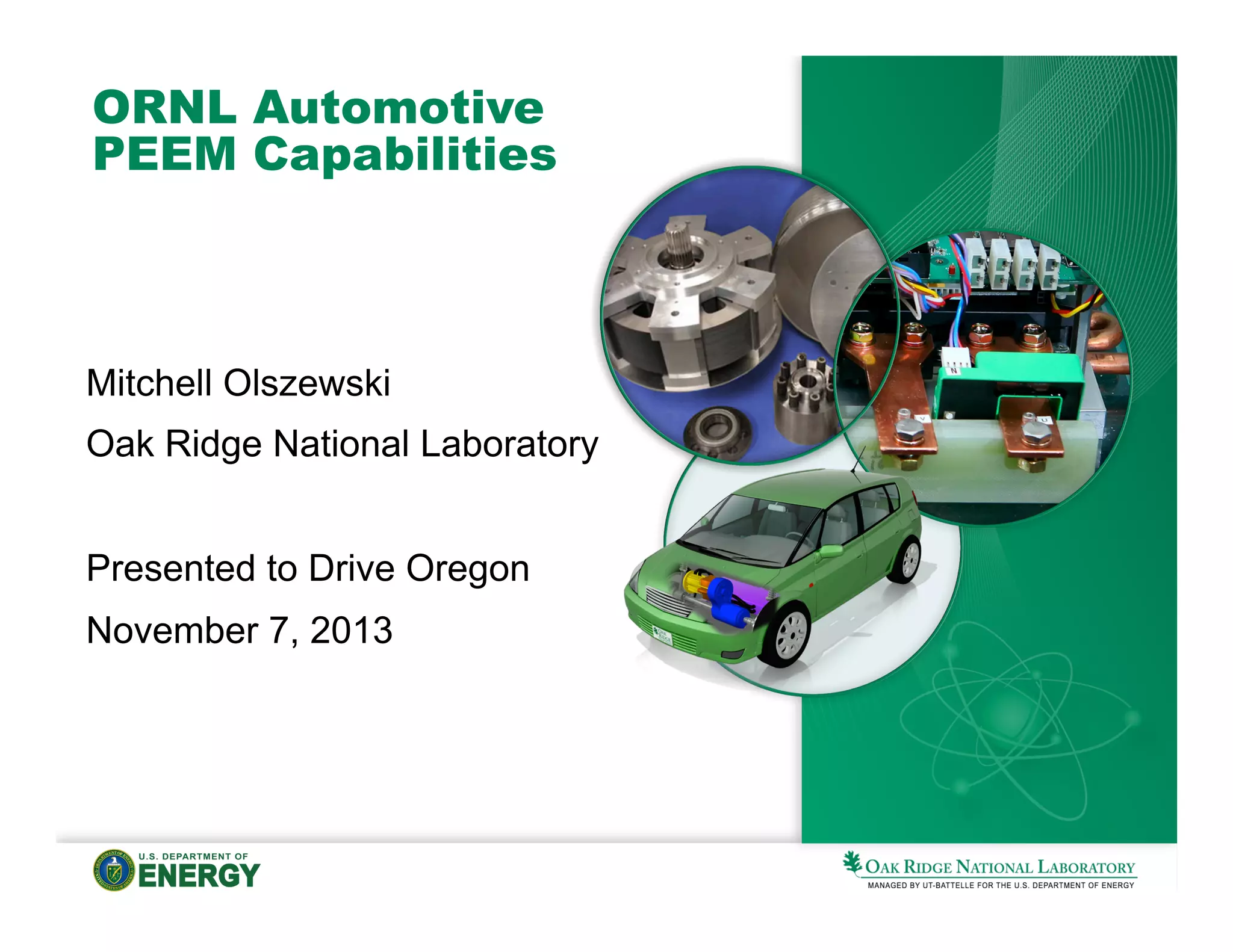
ORNL Automotive
PEEM Capabilities

Mitchell Olszewski
Oak Ridge National Laboratory
Presented to Drive Oregon
November 7, 2013
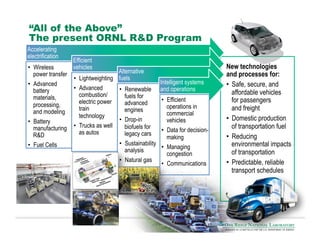
“All of the Above”
The present ORNL R&D Program
Accelerating
electrification
•  Wireless
power transfer
•  Advanced
battery
materials,
processing,
and modeling
•  Battery
manufacturing
R&D
•  Fuel Cells

Efficient
vehicles

Alternative
•  Lightweighting fuels
•  Advanced
•  Renewable
combustion/
fuels for
electric power
advanced
train
engines
technology
•  Drop-in
•  Trucks as well
biofuels for
as autos
legacy cars
•  Sustainability
analysis
•  Natural gas

Intelligent systems
and operations
•  Efficient
operations in
commercial
vehicles
•  Data for decisionmaking
•  Managing
congestion
•  Communications

New technologies
and processes for:
•  Safe, secure, and
affordable vehicles
for passengers
and freight
•  Domestic production
of transportation fuel
•  Reducing
environmental impacts
of transportation
•  Predictable, reliable
transport schedules
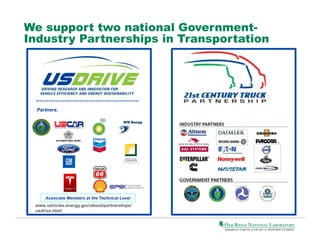
We support two national GovernmentIndustry Partnerships in Transportation

Partners:

Associate Members at the Technical Level

www.vehicles.energy.gov/about/partnerships/
usdrive.html
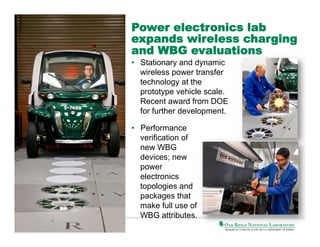
Power electronics lab
expands wireless charging
and WBG evaluations
•  Stationary and dynamic
wireless power transfer
technology at the
prototype vehicle scale.
Recent award from DOE
for further development.
•  Performance
verification of
new WBG
devices; new
power
electronics
topologies and
packages that
make full use of
WBG attributes.
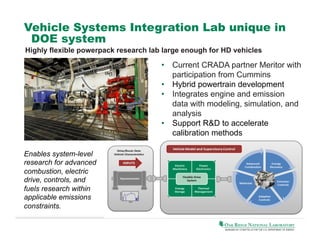
Vehicle Systems Integration Lab unique in
DOE system
Highly flexible powerpack research lab large enough for HD vehicles

•  Current CRADA partner Meritor with
participation from Cummins
•  Hybrid powertrain development
•  Integrates engine and emission
data with modeling, simulation, and
analysis
•  Support R&D to accelerate
calibration methods
Enables system-level
research for advanced
combustion, electric
drive, controls, and
fuels research within
applicable emissions
constraints.
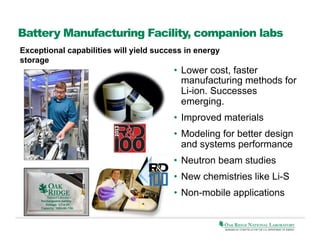
Battery Manufacturing Facility, companion labs
Exceptional capabilities will yield success in energy
storage

•  Lower cost, faster
manufacturing methods for
Li-ion. Successes
emerging.
•  Improved materials
•  Modeling for better design
and systems performance
•  Neutron beam studies
•  New chemistries like Li-S
•  Non-mobile applications
Rechargeable battery
Voltage: 3.7-4.5V
Capacity: 100mAh-7Ah
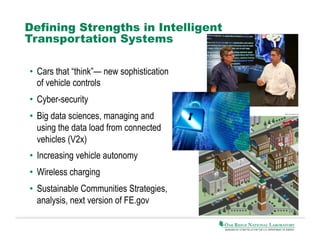
Defining Strengths in Intelligent
Transportation Systems
•  Cars that “think”— new sophistication
of vehicle controls
•  Cyber-security
•  Big data sciences, managing and
using the data load from connected
vehicles (V2x)
•  Increasing vehicle autonomy
•  Wireless charging
•  Sustainable Communities Strategies,
analysis, next version of FE.gov
Manufacturing Demonstration Facility (MDF)
A great resource and partner to Transportation
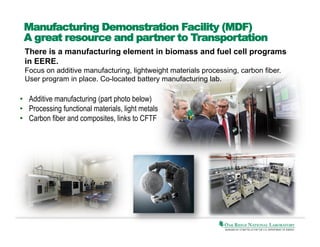
There is a manufacturing element in biomass and fuel cell programs
in EERE.
Focus on additive manufacturing, lightweight materials processing, carbon fiber.
User program in place. Co-located battery manufacturing lab.

•  Additive manufacturing (part photo below)
•  Processing functional materials, light metals
•  Carbon fiber and composites, links to CFTF	
  
Initial success with HFIR imaging beam
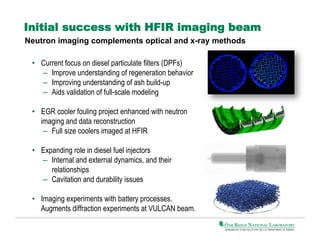
Neutron imaging complements optical and x-ray methods
•  Current focus on diesel particulate filters (DPFs)
–  Improve understanding of regeneration behavior
–  Improving understanding of ash build-up
–  Aids validation of full-scale modeling
•  EGR cooler fouling project enhanced with neutron
imaging and data reconstruction
–  Full size coolers imaged at HFIR
•  Expanding role in diesel fuel injectors
–  Internal and external dynamics, and their
relationships
–  Cavitation and durability issues
•  Imaging experiments with battery processes.
Augments diffraction experiments at VULCAN beam.
Engaging high-performance computing
to accelerate design and deployment
New user project business model offers advantages to industry for
proprietary work
•  Collaboration with Ford examines stochastic and
deterministic processes that drive cycle-to-cycle instabilities.
•  Collaborations with GM to improve the understanding and
design optimization of gasoline fuel injector hole patterns.
•  Open architecture software for computer aided engineering
for batteries to facilitate rapid battery design and prototyping
by integrating battery modeling components.

T
312.6
301.6
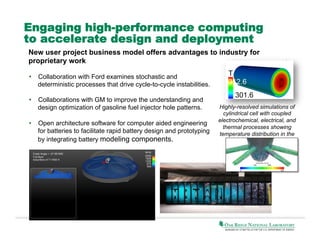
Highly-resolved simulations of
cylindrical cell with coupled
electrochemical, electrical, and
thermal processes showing
temperature distribution in the
cell.
PEEM R&D Capabilities

Power
Electronics

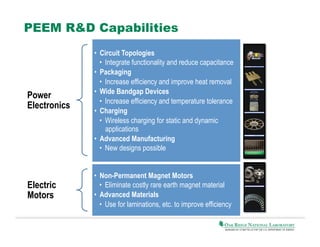
•  Circuit Topologies
•  Integrate functionality and reduce capacitance
•  Packaging
•  Increase efficiency and improve heat removal
•  Wide Bandgap Devices
•  Increase efficiency and temperature tolerance
•  Charging
•  Wireless charging for static and dynamic
applications
•  Advanced Manufacturing
•  New designs possible

Electric
Motors

•  Non-Permanent Magnet Motors
•  Eliminate costly rare earth magnet material
•  Advanced Materials
•  Use for laminations, etc. to improve efficiency
Inverter Development Addresses Near
Term Application Leading to
Transformational
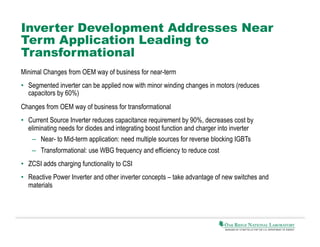
Minimal Changes from OEM way of business for near-term
•  Segmented inverter can be applied now with minor winding changes in motors (reduces
capacitors by 60%)
Changes from OEM way of business for transformational
•  Current Source Inverter reduces capacitance requirement by 90%, decreases cost by
eliminating needs for diodes and integrating boost function and charger into inverter
–  Near- to Mid-term application: need multiple sources for reverse blocking IGBTs
–  Transformational: use WBG frequency and efficiency to reduce cost
•  ZCSI adds charging functionality to CSI
•  Reactive Power Inverter and other inverter concepts – take advantage of new switches and
materials
Planar_Bond_All Power Module
Characterization
PBA Module

200

500
450

ΔVce(PB)=72V

160

400

140

350

120

Ice

100

Vce

300
250

80

200

60

150

40

100

20

Voltage (V)

Current (A)

Wire Bond Module

ΔVce(WB)=156V

180

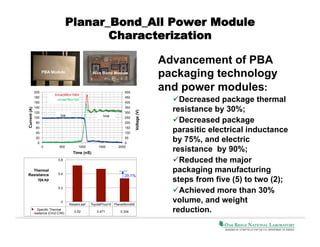
Advancement of PBA
packaging technology
and power modules:

50

0
0

500

1000

1500

0
2000

Time (nS)
0.6

Thermal
Resistance
θja,sp

0.4

29.1%

0.2

0
Specific Thermal
resitance (Cm2.C/W)

NissanLeaf
0.52

ToyotaPrius10 PlanarBondAll
0.471

0.334

ü Decreased package thermal
resistance by 30%;
ü Decreased package
parasitic electrical inductance
by 75%, and electric
resistance by 90%;
ü Reduced the major
packaging manufacturing
steps from five (5) to two (2);
ü Achieved more than 30%
volume, and weight
reduction.
Novel Flux Coupling Motor Without
Permanent Magnets
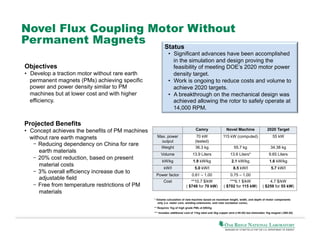
Status
Objectives
•  Develop a traction motor without rare earth
permanent magnets (PMs) achieving specific
power and power density similar to PM
machines but at lower cost and with higher
efficiency.

•  Significant advances have been accomplished
in the simulation and design proving the
feasibility of meeting DOE’s 2020 motor power
density target.
•  Work is ongoing to reduce costs and volume to
achieve 2020 targets.
•  A breakthrough on the mechanical design was
achieved allowing the rotor to safely operate at
14,000 RPM.

Projected Benefits
•  Concept achieves the benefits of PM machines
without rare earth magnets
-  Reducing dependency on China for rare
earth materials
-  20% cost reduction, based on present
material costs
-  3% overall efficiency increase due to
adjustable field
-  Free from temperature restrictions of PM
materials

Camry

Novel Machine

2020 Target

Max. power
output

70 kW
(tested)

115 kW (computed)

55 kW

Weight

36.3 kg

55.7 kg

34.38 kg

Volume

13.9 Liters

13.6 Liters*

9.65 Liters

kW/kg

1.9 kW/kg

2.1 kW/kg

1.6 kW/kg

kW/l

5.0 kW/l

8.5 kW/l

5.7 kW/l

Power factor

0.61 – 1.00

0.75 – 1.00

Cost

**10.7 $/kW
( $749 for 70 kW)

***6.1 $/kW
( $702 for 115 kW)

4.7 $/kW
( $259 for 55 kW)
Thank You

Oak Ridge National Labs - Automotive / Electric Vehicle Capabilities

  • 1.
    ORNL Automotive PEEM Capabilities MitchellOlszewski Oak Ridge National Laboratory Presented to Drive Oregon November 7, 2013
  • 2.
    “All of theAbove” The present ORNL R&D Program Accelerating electrification •  Wireless power transfer •  Advanced battery materials, processing, and modeling •  Battery manufacturing R&D •  Fuel Cells Efficient vehicles Alternative •  Lightweighting fuels •  Advanced •  Renewable combustion/ fuels for electric power advanced train engines technology •  Drop-in •  Trucks as well biofuels for as autos legacy cars •  Sustainability analysis •  Natural gas Intelligent systems and operations •  Efficient operations in commercial vehicles •  Data for decisionmaking •  Managing congestion •  Communications New technologies and processes for: •  Safe, secure, and affordable vehicles for passengers and freight •  Domestic production of transportation fuel •  Reducing environmental impacts of transportation •  Predictable, reliable transport schedules
  • 3.
    We support twonational GovernmentIndustry Partnerships in Transportation Partners: Associate Members at the Technical Level www.vehicles.energy.gov/about/partnerships/ usdrive.html
  • 4.
    Power electronics lab expandswireless charging and WBG evaluations •  Stationary and dynamic wireless power transfer technology at the prototype vehicle scale. Recent award from DOE for further development. •  Performance verification of new WBG devices; new power electronics topologies and packages that make full use of WBG attributes.
  • 5.
    Vehicle Systems IntegrationLab unique in DOE system Highly flexible powerpack research lab large enough for HD vehicles •  Current CRADA partner Meritor with participation from Cummins •  Hybrid powertrain development •  Integrates engine and emission data with modeling, simulation, and analysis •  Support R&D to accelerate calibration methods Enables system-level research for advanced combustion, electric drive, controls, and fuels research within applicable emissions constraints.
  • 6.
    Battery Manufacturing Facility,companion labs Exceptional capabilities will yield success in energy storage •  Lower cost, faster manufacturing methods for Li-ion. Successes emerging. •  Improved materials •  Modeling for better design and systems performance •  Neutron beam studies •  New chemistries like Li-S •  Non-mobile applications Rechargeable battery Voltage: 3.7-4.5V Capacity: 100mAh-7Ah
  • 7.
    Defining Strengths inIntelligent Transportation Systems •  Cars that “think”— new sophistication of vehicle controls •  Cyber-security •  Big data sciences, managing and using the data load from connected vehicles (V2x) •  Increasing vehicle autonomy •  Wireless charging •  Sustainable Communities Strategies, analysis, next version of FE.gov
  • 8.
    Manufacturing Demonstration Facility(MDF) A great resource and partner to Transportation There is a manufacturing element in biomass and fuel cell programs in EERE. Focus on additive manufacturing, lightweight materials processing, carbon fiber. User program in place. Co-located battery manufacturing lab. •  Additive manufacturing (part photo below) •  Processing functional materials, light metals •  Carbon fiber and composites, links to CFTF  
  • 9.
    Initial success withHFIR imaging beam Neutron imaging complements optical and x-ray methods •  Current focus on diesel particulate filters (DPFs) –  Improve understanding of regeneration behavior –  Improving understanding of ash build-up –  Aids validation of full-scale modeling •  EGR cooler fouling project enhanced with neutron imaging and data reconstruction –  Full size coolers imaged at HFIR •  Expanding role in diesel fuel injectors –  Internal and external dynamics, and their relationships –  Cavitation and durability issues •  Imaging experiments with battery processes. Augments diffraction experiments at VULCAN beam.
  • 10.
    Engaging high-performance computing toaccelerate design and deployment New user project business model offers advantages to industry for proprietary work •  Collaboration with Ford examines stochastic and deterministic processes that drive cycle-to-cycle instabilities. •  Collaborations with GM to improve the understanding and design optimization of gasoline fuel injector hole patterns. •  Open architecture software for computer aided engineering for batteries to facilitate rapid battery design and prototyping by integrating battery modeling components. T 312.6 301.6 Highly-resolved simulations of cylindrical cell with coupled electrochemical, electrical, and thermal processes showing temperature distribution in the cell.
  • 11.
    PEEM R&D Capabilities Power Electronics • Circuit Topologies •  Integrate functionality and reduce capacitance •  Packaging •  Increase efficiency and improve heat removal •  Wide Bandgap Devices •  Increase efficiency and temperature tolerance •  Charging •  Wireless charging for static and dynamic applications •  Advanced Manufacturing •  New designs possible Electric Motors •  Non-Permanent Magnet Motors •  Eliminate costly rare earth magnet material •  Advanced Materials •  Use for laminations, etc. to improve efficiency
  • 12.
    Inverter Development AddressesNear Term Application Leading to Transformational Minimal Changes from OEM way of business for near-term •  Segmented inverter can be applied now with minor winding changes in motors (reduces capacitors by 60%) Changes from OEM way of business for transformational •  Current Source Inverter reduces capacitance requirement by 90%, decreases cost by eliminating needs for diodes and integrating boost function and charger into inverter –  Near- to Mid-term application: need multiple sources for reverse blocking IGBTs –  Transformational: use WBG frequency and efficiency to reduce cost •  ZCSI adds charging functionality to CSI •  Reactive Power Inverter and other inverter concepts – take advantage of new switches and materials
  • 13.
    Planar_Bond_All Power Module Characterization PBAModule 200 500 450 ΔVce(PB)=72V 160 400 140 350 120 Ice 100 Vce 300 250 80 200 60 150 40 100 20 Voltage (V) Current (A) Wire Bond Module ΔVce(WB)=156V 180 Advancement of PBA packaging technology and power modules: 50 0 0 500 1000 1500 0 2000 Time (nS) 0.6 Thermal Resistance θja,sp 0.4 29.1% 0.2 0 Specific Thermal resitance (Cm2.C/W) NissanLeaf 0.52 ToyotaPrius10 PlanarBondAll 0.471 0.334 ü Decreased package thermal resistance by 30%; ü Decreased package parasitic electrical inductance by 75%, and electric resistance by 90%; ü Reduced the major packaging manufacturing steps from five (5) to two (2); ü Achieved more than 30% volume, and weight reduction.
  • 14.
    Novel Flux CouplingMotor Without Permanent Magnets Status Objectives •  Develop a traction motor without rare earth permanent magnets (PMs) achieving specific power and power density similar to PM machines but at lower cost and with higher efficiency. •  Significant advances have been accomplished in the simulation and design proving the feasibility of meeting DOE’s 2020 motor power density target. •  Work is ongoing to reduce costs and volume to achieve 2020 targets. •  A breakthrough on the mechanical design was achieved allowing the rotor to safely operate at 14,000 RPM. Projected Benefits •  Concept achieves the benefits of PM machines without rare earth magnets -  Reducing dependency on China for rare earth materials -  20% cost reduction, based on present material costs -  3% overall efficiency increase due to adjustable field -  Free from temperature restrictions of PM materials Camry Novel Machine 2020 Target Max. power output 70 kW (tested) 115 kW (computed) 55 kW Weight 36.3 kg 55.7 kg 34.38 kg Volume 13.9 Liters 13.6 Liters* 9.65 Liters kW/kg 1.9 kW/kg 2.1 kW/kg 1.6 kW/kg kW/l 5.0 kW/l 8.5 kW/l 5.7 kW/l Power factor 0.61 – 1.00 0.75 – 1.00 Cost **10.7 $/kW ( $749 for 70 kW) ***6.1 $/kW ( $702 for 115 kW) 4.7 $/kW ( $259 for 55 kW)
  • 15.