Topic : NUTRITION HISTORY
Class taken By:
Ms Prachee Ahuja
Dietician, AIIMS
Bhubaneswar
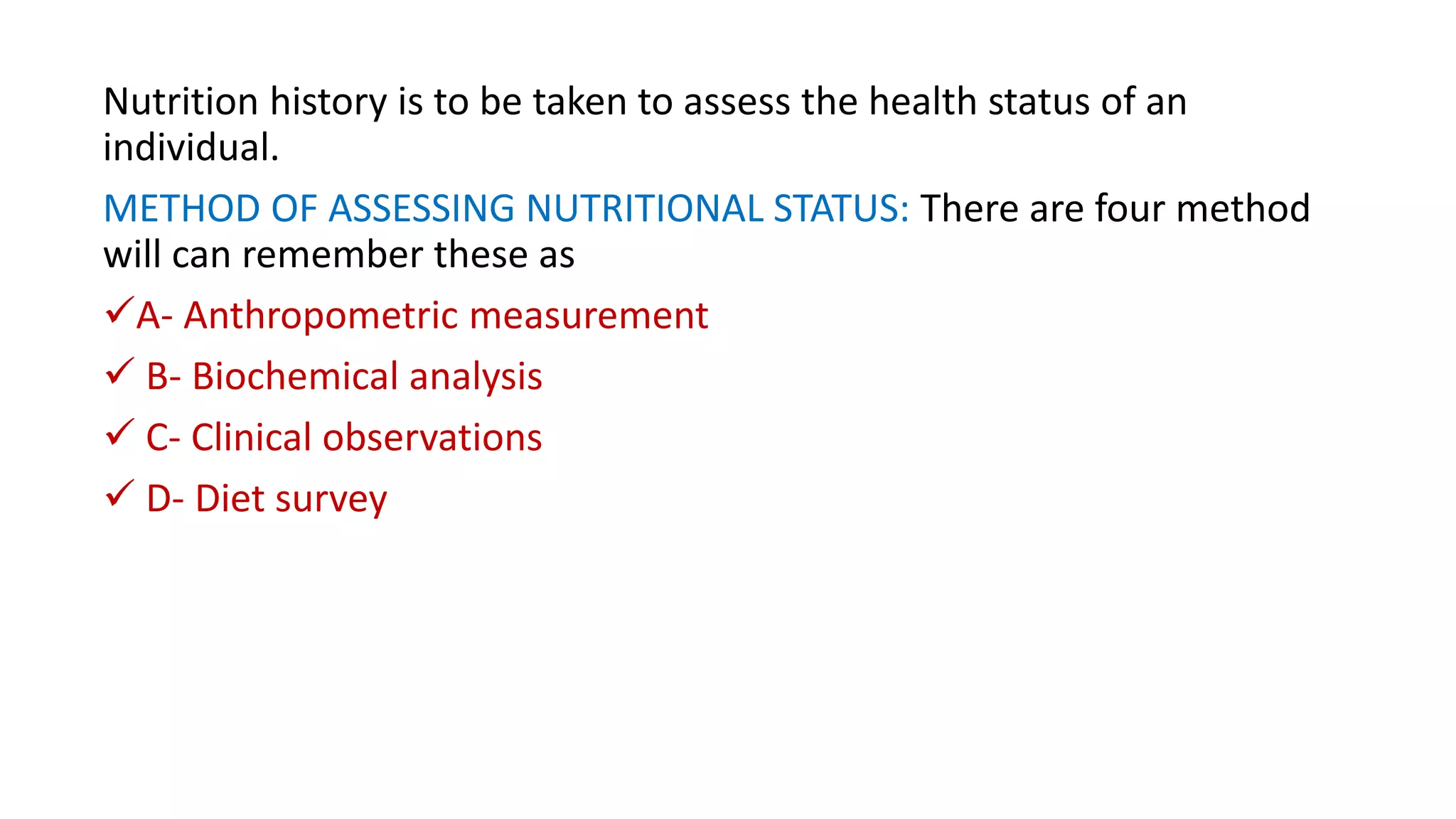
Nutrition history is to be taken to assess the health status of an
individual.
METHOD OF ASSESSING NUTRITIONAL STATUS: There are four method
will can remember these as
A- Anthropometric measurement
 B- Biochemical analysis
 C- Clinical observations
 D- Diet survey
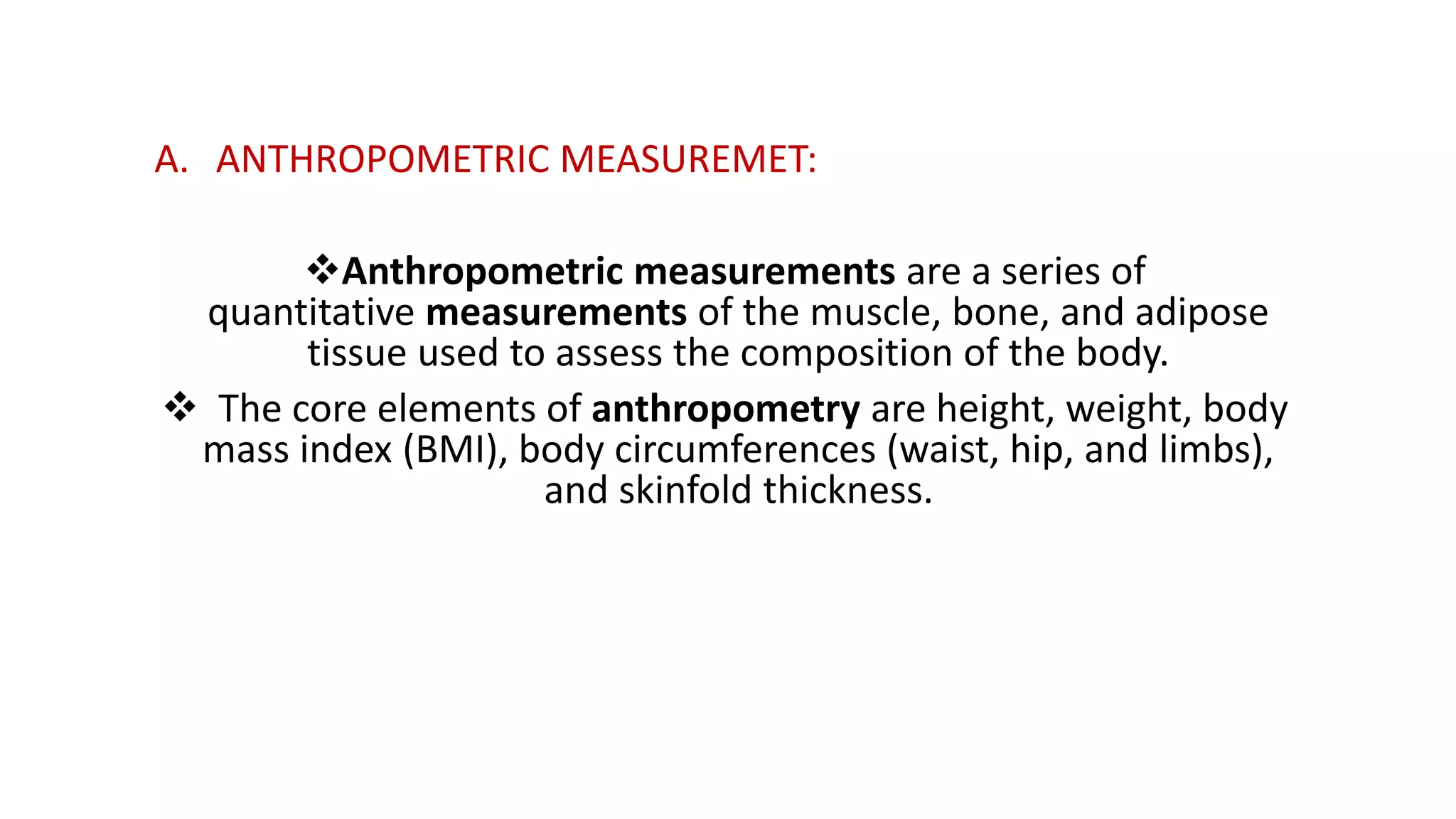
A. ANTHROPOMETRIC MEASUREMET:
Anthropometric measurements are a series of
quantitative measurements of the muscle, bone, and adipose
tissue used to assess the composition of the body.
 The core elements of anthropometry are height, weight, body
mass index (BMI), body circumferences (waist, hip, and limbs),
and skinfold thickness.
WHO - Growth standards
The World Health Organization (WHO) has developed growth standards
based on a sample of children from six countries: Brazil, Ghana, India,
Norway, Oman, and the United States of America
• Length/height-for-age
• Weight-for-age
• Head circumference velocity
• Weight-for-length/height
• Length velocity
• Head circumference for age
• Arm circumference-for-age
• Motor development milestones
• BMI-for-age
• Triceps skinfold-for-age
• Subscapular skinfold-for-age
• Motor development milestones
B. CLINICAL EXAMINATION
• Clinical methods of assessing nutritional status involve checking signs
of deficiency at specific places on the body or asking the patient
whether they have any symptoms that might suggest nutrient
deficiency from the patient. Clinical signs of nutrient deficiency
include: pallor (on the palm of the hand or the conjunctiva of the
eye), Bitot’s spots on the eyes, pitting oedema, goitre and severe
visible wasting;
goitre severe visible wasting
Bitot’s spots on the eyes
Here are some examples :
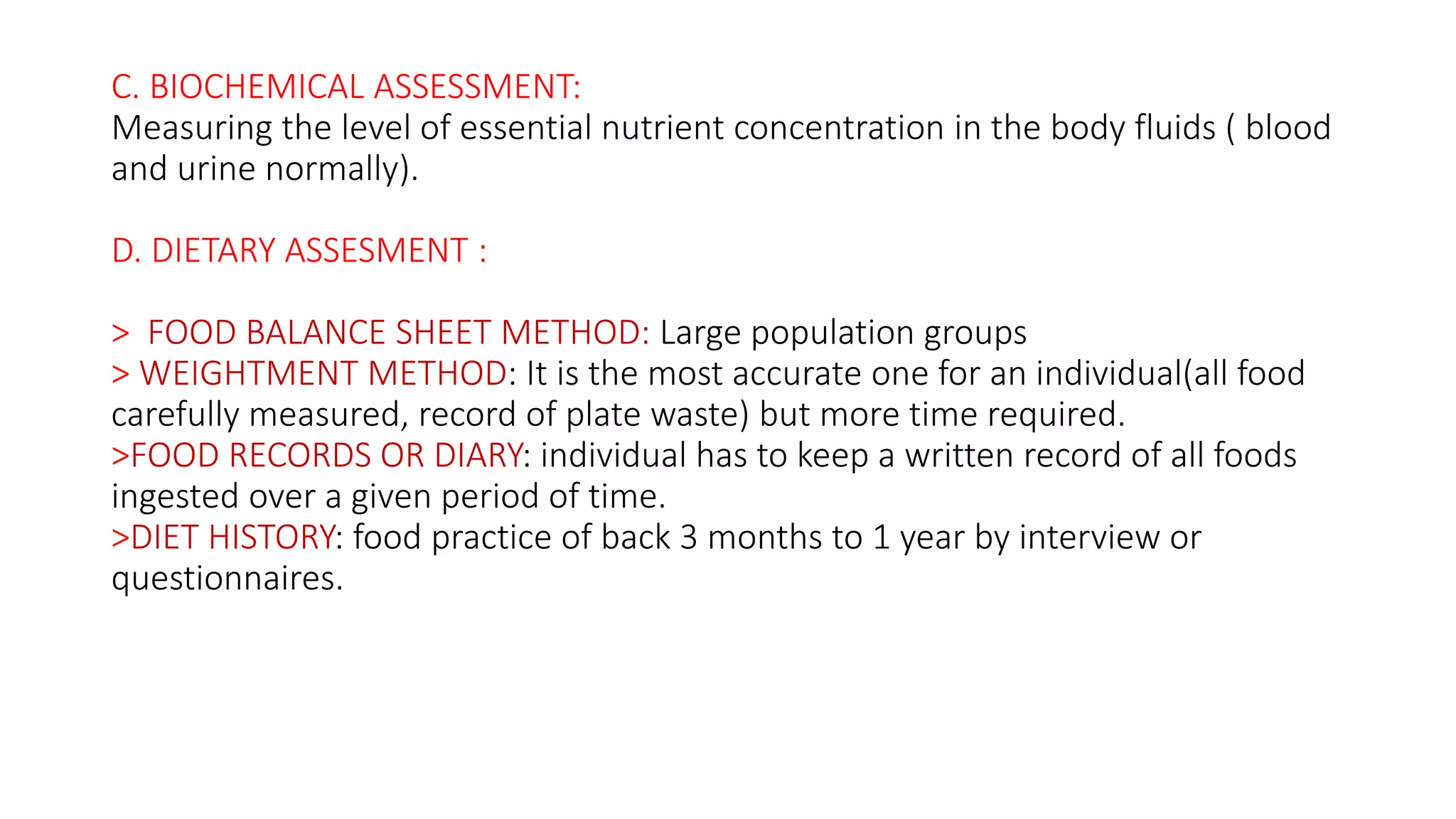
C. BIOCHEMICAL ASSESSMENT:
Measuring the level of essential nutrient concentration in the body fluids ( blood
and urine normally).
D. DIETARY ASSESMENT :
> FOOD BALANCE SHEET METHOD: Large population groups
> WEIGHTMENT METHOD: It is the most accurate one for an individual(all food
carefully measured, record of plate waste) but more time required.
>FOOD RECORDS OR DIARY: individual has to keep a written record of all foods
ingested over a given period of time.
>DIET HISTORY: food practice of back 3 months to 1 year by interview or
questionnaires.
> 24 hours recall method: Most commonly used, conducted by trained
personnel using food models and standard measuring instruments.
Subject is asked to recall as much details the food intake for the past
24 hours.
This is most widely used method of dietary assessment.
> FOOD FREQUENCY: asking the individual how often( daily, monthly ,
weekly) specific foods are eaten. Foods are grouped into categories(
based on similarity of nutritive value).
What is a balanced diet?
A balanced diet is one which provides all the
nutrients in required amounts and proper
proportions.
It can easily be achieved through a blend of the
four basic food groups.
The quantities of foods needed to meet the
nutrient requirements vary with age, gender,
physiological status and physical activity.
A balanced diet should provide around 50-60% of total calories
from carbohydrates, preferably from complex carbohydrates,
about 10-15% from proteins and 20-30% from both visible and
invisible fat.
In addition, a balanced diet should provide other non-nutrients
such as dietary fiber, antioxidants and phytochemicals.
Antioxidants are such as vitamins C and E, beta-carotene,
riboflavin and selenium, that protect the human body from free
radical damage. Other phytochemicals such as polyphenols,
flavones, etc., also afford protection against oxidant damage.
Spices like turmeric, ginger, garlic, cumin and cloves are rich in
antioxidants.
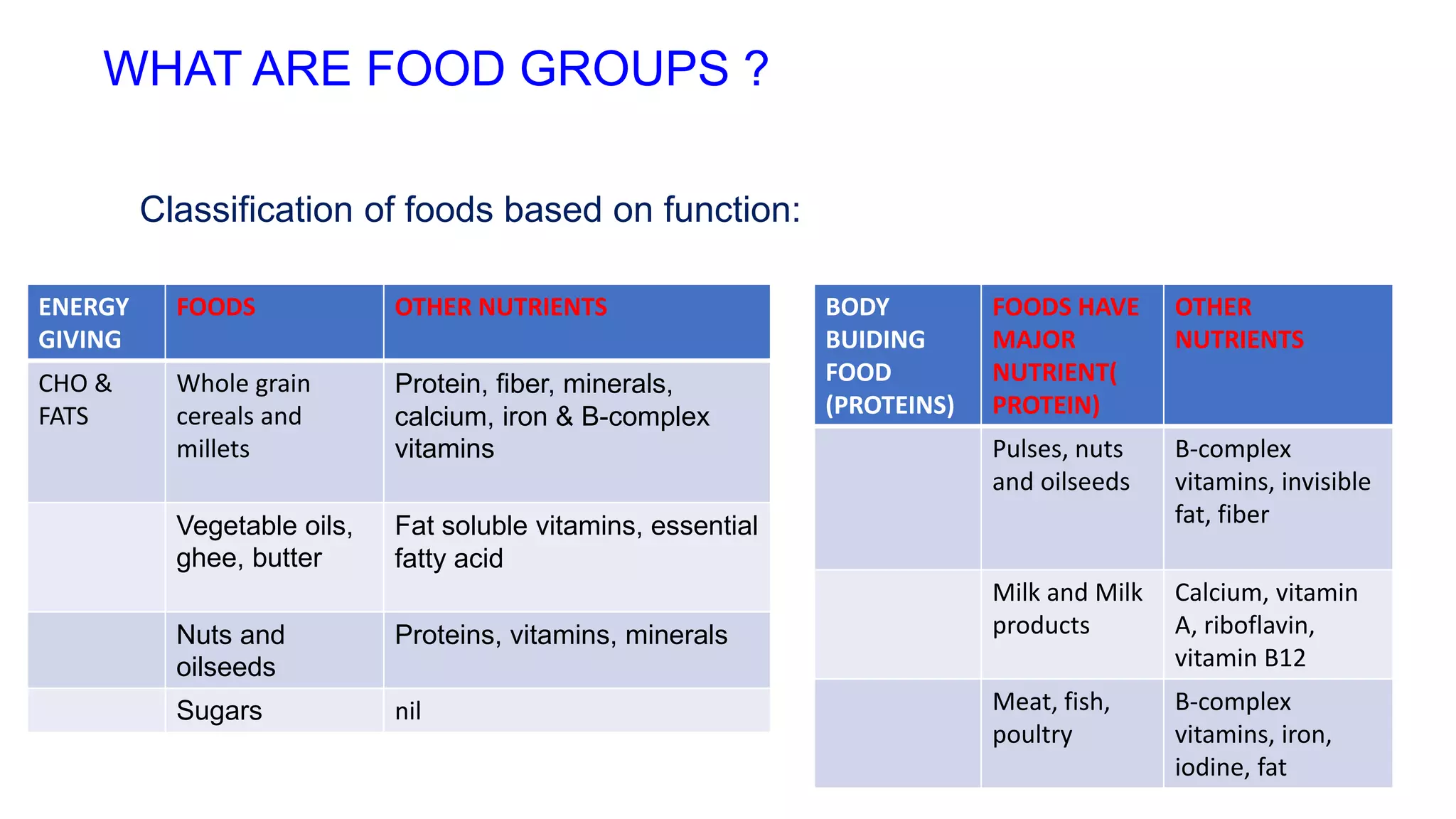
Classification of foods based on function:
ENERGY
GIVING
FOODS OTHER NUTRIENTS
CHO &
FATS
Whole grain
cereals and
millets
Protein, fiber, minerals,
calcium, iron & B-complex
vitamins
Vegetable oils,
ghee, butter
Fat soluble vitamins, essential
fatty acid
Nuts and
oilseeds
Proteins, vitamins, minerals
Sugars nil
WHAT ARE FOOD GROUPS ?
BODY
BUIDING
FOOD
(PROTEINS)
FOODS HAVE
MAJOR
NUTRIENT(
PROTEIN)
OTHER
NUTRIENTS
Pulses, nuts
and oilseeds
B-complex
vitamins, invisible
fat, fiber
Milk and Milk
products
Calcium, vitamin
A, riboflavin,
vitamin B12
Meat, fish,
poultry
B-complex
vitamins, iron,
iodine, fat
Classification of foods based on function:
Protective food( vitamins
and minerals)
FOODS OTHER NUTRIENTS
Green leafy
vegetables
Antioxidants, fiber and other
carotenoids
Other vegetables
and fruits
Fiber, sugar and antioxidants
Eggs, milk and milk
products, flesh
foods
Proteins and fats
Elderly woman: reduce
2 portion of cereals and
add 1 serving of fruit
Elderly man: reduce 3
portion of cereals and
add 1 serving of fruit
DIETARY GUIDELINES FOR HEALTHY LIFE :
1. Eat variety of foods to ensure a balanced diet.
2. Ensure provision of extra food and healthcare to pregnant and
lactating women.
3. Promote exclusive breastfeeding for six months and encourage
breastfeeding till two years or as long as one can.
4. Feed home based semi solid foods to the infant after six months.
5. Ensure adequate and appropriate diets for children and
adolescents, both in health and sickness.
6. Eat plenty of vegetables and fruits.
7. Ensure moderate use of edible oils and animal foods and very less use of ghee/ butter/
vanaspati.
8. Avoid overeating to prevent overweight and obesity.
9. Exercise regularly and be physically active to maintain ideal body weight.
10. Restrict salt intake to minimum.
11. Ensure the use of safe and clean foods.
12. Adopt right pre-cooking processes and appropriate cooking methods.
13. Drink plenty of water and take beverages in moderation.
14. Minimize the use of processed foods rich in salt, sugar and fats.
15. Include micronutrient-rich foods in the diets of elderly people to enable them to be fit and
active.
THANK YOU

NUTRITION HISTORY.pptx

  • 1.
    Topic : NUTRITIONHISTORY Class taken By: Ms Prachee Ahuja Dietician, AIIMS Bhubaneswar
  • 2.
    Nutrition history isto be taken to assess the health status of an individual. METHOD OF ASSESSING NUTRITIONAL STATUS: There are four method will can remember these as A- Anthropometric measurement  B- Biochemical analysis  C- Clinical observations  D- Diet survey
  • 3.
    A. ANTHROPOMETRIC MEASUREMET: Anthropometricmeasurements are a series of quantitative measurements of the muscle, bone, and adipose tissue used to assess the composition of the body.  The core elements of anthropometry are height, weight, body mass index (BMI), body circumferences (waist, hip, and limbs), and skinfold thickness.
  • 4.
    WHO - Growthstandards The World Health Organization (WHO) has developed growth standards based on a sample of children from six countries: Brazil, Ghana, India, Norway, Oman, and the United States of America • Length/height-for-age • Weight-for-age • Head circumference velocity • Weight-for-length/height • Length velocity • Head circumference for age • Arm circumference-for-age • Motor development milestones • BMI-for-age • Triceps skinfold-for-age • Subscapular skinfold-for-age • Motor development milestones
  • 5.
    B. CLINICAL EXAMINATION •Clinical methods of assessing nutritional status involve checking signs of deficiency at specific places on the body or asking the patient whether they have any symptoms that might suggest nutrient deficiency from the patient. Clinical signs of nutrient deficiency include: pallor (on the palm of the hand or the conjunctiva of the eye), Bitot’s spots on the eyes, pitting oedema, goitre and severe visible wasting;
  • 6.
    goitre severe visiblewasting Bitot’s spots on the eyes Here are some examples :
  • 7.
    C. BIOCHEMICAL ASSESSMENT: Measuringthe level of essential nutrient concentration in the body fluids ( blood and urine normally). D. DIETARY ASSESMENT : > FOOD BALANCE SHEET METHOD: Large population groups > WEIGHTMENT METHOD: It is the most accurate one for an individual(all food carefully measured, record of plate waste) but more time required. >FOOD RECORDS OR DIARY: individual has to keep a written record of all foods ingested over a given period of time. >DIET HISTORY: food practice of back 3 months to 1 year by interview or questionnaires.
  • 8.
    > 24 hoursrecall method: Most commonly used, conducted by trained personnel using food models and standard measuring instruments. Subject is asked to recall as much details the food intake for the past 24 hours. This is most widely used method of dietary assessment. > FOOD FREQUENCY: asking the individual how often( daily, monthly , weekly) specific foods are eaten. Foods are grouped into categories( based on similarity of nutritive value).
  • 9.
    What is abalanced diet? A balanced diet is one which provides all the nutrients in required amounts and proper proportions. It can easily be achieved through a blend of the four basic food groups. The quantities of foods needed to meet the nutrient requirements vary with age, gender, physiological status and physical activity.
  • 10.
    A balanced dietshould provide around 50-60% of total calories from carbohydrates, preferably from complex carbohydrates, about 10-15% from proteins and 20-30% from both visible and invisible fat. In addition, a balanced diet should provide other non-nutrients such as dietary fiber, antioxidants and phytochemicals. Antioxidants are such as vitamins C and E, beta-carotene, riboflavin and selenium, that protect the human body from free radical damage. Other phytochemicals such as polyphenols, flavones, etc., also afford protection against oxidant damage. Spices like turmeric, ginger, garlic, cumin and cloves are rich in antioxidants.
  • 11.
    Classification of foodsbased on function: ENERGY GIVING FOODS OTHER NUTRIENTS CHO & FATS Whole grain cereals and millets Protein, fiber, minerals, calcium, iron & B-complex vitamins Vegetable oils, ghee, butter Fat soluble vitamins, essential fatty acid Nuts and oilseeds Proteins, vitamins, minerals Sugars nil WHAT ARE FOOD GROUPS ? BODY BUIDING FOOD (PROTEINS) FOODS HAVE MAJOR NUTRIENT( PROTEIN) OTHER NUTRIENTS Pulses, nuts and oilseeds B-complex vitamins, invisible fat, fiber Milk and Milk products Calcium, vitamin A, riboflavin, vitamin B12 Meat, fish, poultry B-complex vitamins, iron, iodine, fat
  • 12.
    Classification of foodsbased on function: Protective food( vitamins and minerals) FOODS OTHER NUTRIENTS Green leafy vegetables Antioxidants, fiber and other carotenoids Other vegetables and fruits Fiber, sugar and antioxidants Eggs, milk and milk products, flesh foods Proteins and fats
  • 15.
    Elderly woman: reduce 2portion of cereals and add 1 serving of fruit Elderly man: reduce 3 portion of cereals and add 1 serving of fruit
  • 17.
    DIETARY GUIDELINES FORHEALTHY LIFE : 1. Eat variety of foods to ensure a balanced diet. 2. Ensure provision of extra food and healthcare to pregnant and lactating women. 3. Promote exclusive breastfeeding for six months and encourage breastfeeding till two years or as long as one can. 4. Feed home based semi solid foods to the infant after six months. 5. Ensure adequate and appropriate diets for children and adolescents, both in health and sickness. 6. Eat plenty of vegetables and fruits. 7. Ensure moderate use of edible oils and animal foods and very less use of ghee/ butter/ vanaspati. 8. Avoid overeating to prevent overweight and obesity. 9. Exercise regularly and be physically active to maintain ideal body weight. 10. Restrict salt intake to minimum. 11. Ensure the use of safe and clean foods. 12. Adopt right pre-cooking processes and appropriate cooking methods. 13. Drink plenty of water and take beverages in moderation. 14. Minimize the use of processed foods rich in salt, sugar and fats. 15. Include micronutrient-rich foods in the diets of elderly people to enable them to be fit and active.
  • 18.